The New York Times reports: The Obama administration has gone to court to protect the files of an influential anti-Iran advocacy group, saying they likely contain information the government does not want disclosed.
The highly unusual move by the Justice Department raises questions about the connections between the American government and the group, United Against Nuclear Iran, a hard-line voice seeking to prevent Iran from obtaining nuclear weapons. The group has a roster of prominent former government officials and a reputation for uncovering information about companies that sometimes do business with Iran, in violation of international sanctions.
The Justice Department has temporarily blocked the group from having to reveal its donor list and other internal documents in a defamation lawsuit filed by a Greek shipping magnate the group accused of doing business with Iran. Government lawyers said they had a “good faith basis to believe that certain information” would jeopardize law enforcement investigations, reveal investigative techniques or identify confidential sources if released. [Continue reading…]
Category Archives: Lands
The Palestinians’ right to self-defense
Chris Hedges writes: If Israel insists, as the Bosnian Serbs did in Sarajevo, on using the weapons of industrial warfare against a helpless civilian population then that population has an inherent right to self-defense under Article 51 of the United Nations Charter. The international community will have to either act to immediately halt Israeli attacks and lift the blockade of Gaza or acknowledge the right of the Palestinians to use weapons to defend themselves.
No nation, including any in the Muslim world, appears willing to intervene to protect the Palestinians. No world body, including the United Nations, appears willing or able to pressure Israel through sanctions to conform to the norms of international law. And the longer we in the world community fail to act, the worse the spiral of violence will become.
Israel does not have the right to drop 1,000-pound iron fragmentation bombs on Gaza. It does not have the right to pound Gaza with heavy artillery and with shells lobbed from gunboats. It does not have the right to send in mechanized ground units or to target hospitals, schools and mosques, along with Gaza’s water and electrical systems. It does not have the right to displace over 100,000 people from their homes. The entire occupation, under which Israel has nearly complete control of the sea, the air and the borders of Gaza, is illegal.
Violence, even when employed in self-defense, is a curse. It empowers the ruthless and punishes the innocent. It leaves in its aftermath horrific emotional and physical scars. But, as I learned in Sarajevo during the 1990s Bosnian War, when forces bent on your annihilation attack you relentlessly, and when no one comes to your aid, you must aid yourself. When Sarajevo was being hit with 2,000 shells a day and under heavy sniper fire in the summer of 1995 no one among the suffering Bosnians spoke to me about wanting to mount nonviolent resistance. No one among them saw the U.N.-imposed arms embargo against the Bosnian government as rational, given the rain of sniper fire and the 90-millimeter tank rounds and 155-millimeter howitzer shells that were exploding day and night in the city. The Bosnians were reduced, like the Palestinians in Gaza, to smuggling in light weapons through clandestine tunnels. Their enemies, the Serbs — like the Israelis in the current conflict — were constantly trying to blow up tunnels. The Bosnian forces in Sarajevo, with their meager weapons, desperately attempted to hold the trench lines that circled the city. And it is much the same in Gaza. It was only repeated NATO airstrikes in the fall of 1995 that prevented the Bosnian-held areas from being overrun by advancing Serbian forces. The Palestinians cannot count on a similar intervention. [Continue reading…]
Gazans want a ceasefire with an end to the siege
Sharif Abdel Kouddous reports: The destruction is total. No building has been left untouched by Israel’s bombardment in the Masryeen neighborhood in this northeast Gaza town. Mounds of rubble line the streets where buildings once stood. Dead horses and donkeys lie in the road, stiff with rigor mortis. Even colors have been erased. The entire area is covered in grey cement dust, a monochromatic wasteland. The smell of death lingers in the air as the bodies yet to be retrieved from the debris decompose in the summer heat. The sounds of shelling and airstrikes have stopped but the buzzing of the drones remains.
A 12-hour humanitarian truce agreed to by Israel and Hamas took hold on Saturday morning, allowing residents displaced from the areas hardest hit by Israel’s assault to return to their neighborhoods for the first time in days. Gaza health officials said more than 100 bodies were recovered during the lull, bringing the Palestinian death toll above 1,000, the vast majority of them civilians, including more than 200 children. Forty-three Israeli soldiers and three civilians in Israel have also been killed. On Sunday, as the conflict entered its 20th day, Israel announced that it would extend the quiet for 24 hours, but a more lasting cease-fire remains elusive. (And by Sunday’s end in Gaza, the fighting resumed.)
“We don’t just want a humanitarian truce, we want a total cease-fire that will end the siege. Truce after truce is not what we’re looking for,” Ihab al-Hussein, Hamas’s deputy information minister, told me in an interview on Saturday in Gaza City. “This is not a real truce because that would mean Israel pulling out its tanks from Gaza,” he said. “We didn’t start this war, we don’t want it. If you ask Palestinian people they say they want a cease-fire but with an agreement to end the siege.”
In the hours leading up the temporary cease-fire, the Israeli air force dropped 100 bombs, each containing a ton of explosives on Beit Hanoun, a town in northeastern Gaza close to the borders with Israel, according to Haaretz. Many of Beit Hanoun’s 30,000 residents had fled the area.
The devastation is so complete that some residents who returned during the temporary cease-fire on Saturday could not locate where their homes once stood. A man walked alone in the middle of the road surveying the wreckage. “This is a town of ghosts, not people,” he said aloud to himself.
Hamza al-Masry, a 27-year-old from al-Masryeen, sat crouched atop a pile of broken cement and twisted rebar that used to be his family home, a four-story apartment building that once housed 50 people. He came back to try and salvage something. There was nothing left.
“I couldn’t get anything out. I can’t even find clothes,” he said. “I only have the ones I am wearing.” He says he left his home with his family on Monday and sought refuge in a nearby United Nations school. The shelter was shelled on Thursday as 1,500 displaced Palestinians had gathered in the schoolyard awaiting buses to transfer them to another area.
Al-Masry said at least four shells hit the school sending hundreds fleeing into the streets in panic. Sixteen people were killed and 200 wounded in the attack. Displaced again, al-Masry is now staying at another U.N. school in Jabalia, further south. “We don’t want a cease-fire anymore,” he said. “After the destruction we have seen, all we want is resistance.” [Continue reading…]
Why Israel doesn’t want a ceasefire with Hamas
Larry Derfner writes: If Israel agrees to end the war on terms that grant major, transformative relief to Gaza, that largely lift the blockade on the Strip and allow Gazans substantial freedom of movement – which is what Ban and even Kerry are talking about – then Hamas wins the war.
And this Israeli government will not allow that, not only because of false national pride, but also because if Hamas wins freedom for Gaza, it will take over the West Bank, directly or indirectly. The Palestinian Authority will collapse – to be replaced by Hamas or the Israeli military, either scenario being a nightmare for Israel – or the Palestinian Authority will refuse to go on playing Israel’s cop and begin demanding freedom for the West Bank, too.
As Noam Sheizaf wrote, Israel could agree to a ceasefire that ended the chokehold on Gaza if it was ready to end the occupation of the Palestinian territories altogether, in the West Bank as well. But it’s not. And so the only ceasefire the Netanyahu government will agree to is one that gains Gaza nothing or, at most, finds Israel throwing it a bone, thereby teaching Hamas and the rest of the Palestinians that firing rockets at Israel – even under extreme Israeli provocation – gets them nothing but a lot more pain.
U.S. diplomats and Marines close embassy and flee Libya fighting
The Daily Beast reports: Under the watchful eye of a military drone and three F-16 warplanes flying protective cover, 158 U.S. diplomats and 80 U.S. Marines evacuated the American embassy in Tripoli, Libya, on Saturday. Although there was no specific threat targeting the U.S. personnel, fighting between rival factions in the Libyan capital is raging amid fears the North African country is headed irreversibly toward anarchy. U.S. warships were positioned off the coast and more contingents of Marines were flown to the immediate vicinity, ready to deploy if needed to protect the evacuation convoy.
The Tripoli airport has been shut down by combat between two of the country’s most powerful militias, and most of the airplanes there have been destroyed or damaged so the evacuation had to be carried out overland: a five-hour drive to neighboring Tunisia. Under orders from Washington, the convoy pulled out of Tripoli at dawn and made it to safety by mid-day. It is unclear when or if the embassy will reopen.
Libya has been flirting with civil war for months as local gangs, ideological militias, Islamists and hopelessly dysfunctional state institutions have vied topsy-turvy for control. But this week Libya’s capital was rocked by some of the worst violence since the 2011 uprising that led to the NATO-backed ouster of strongman Muammar Gaddafi’s ouster, and with no sizeable national security force of its own, the government of Prime Minister Abdullah al-Thani has been unable to halt the descent into chaos. The U.S. isn’t alone in pulling out. Amid the rising violence, the United Nations has evacuated staff and Turkey announced Friday it was shuttering its embassy. The UK urged British citizens to leave Libya. [Continue reading…]
U.S. help for Syrian rebels — too little, too late
The Washington Post reports: A U.S.-backed effort to arm the moderate Syrian opposition is finally ramping up along the Turkey-Syria border, but it may come too late to save the rebels from defeats on two fronts, by President Bashar al-Assad’s government and by the extremists seeking to carve out an Islamic state.
Spurred by concerns that the al-Qaeda-inspired radicals will continue their relentless march across Iraq and Syria, the United States and its allies have begun accelerating the supply of arms and ammunition to a small number of vetted rebel groups in northern Syria, according to diplomats and rebels who have been receiving the deliveries.
Yet even as the fresh support arrives, challenges are mounting for the embattled moderates, who have been pushed out of eastern Syria by extremists, are being encircled in Aleppo by the government and are seeing their ranks eroded by defeats, desertions and infighting.
The outlook for the revolt against Assad’s rule is now bleaker than at any time in the past three years, rebel commanders say, diminishing the chances that the opposition will be able to present any meaningful challenge to the regime or even to serve as a counterweight to Islamist radicals, as U.S. policymakers are hoping. [Continue reading…]
‘Only stones remain’: Gaza lies in ruins
Mohammed Omer reports: Umm Ahmed Abu Sahwish holds stones in her hands. They are now all that’s left of her demolished home. “My home is gone and only stones remain,” the 65-year-old says.
Hundreds of homes here have been destroyed, and unexploded Israeli missiles litter the ground at the entrance to the town, at Gaza’s northern tip near the border with Israel. The local hospital, emergency rescue equipment, and infrastructure have also incurred heavy damage from Israeli shelling.
Another woman, from a family of 20 people, cries as she tries to dig through the rubble of her house. “Lifetimes of personal and household belongings are gone, with one Israeli missile. Where can we go? We have no food, water, bedding or extra clothes,” she says.
Driving the length of this tiny stretch of land – 1.8 million Palestinians live on Gaza’s 360sq km – scenes of devastation are everywhere. The trip from the north to the south of Gaza was only possible during a 12-hour humanitarian ceasefire, agreed to by Israel and Hamas on July 26.
On Sunday, Israel resumed its military operation in Gaza, as the prime minister’s office declared: “If residents are inadvertently hit, it is Hamas which is responsible given that it has – again – violated the humanitarian truce that Israel acceded to.” [Continue reading…]
Christian-Muslim solidarity in Gaza
Christian leader in #Gaza: "If they've destroyed your mosques, make the call to prayer from our Churches." #Palestine pic.twitter.com/kO6DNXXUz6
— Sara Jo سارة (@HelloSaraJo) July 26, 2014
Churches in Gaza provide refuge for displaced Palestinian families #SupportGaza pic.twitter.com/BXeZCUamkL
— Ikhwanweb (@Ikhwanweb) July 27, 2014
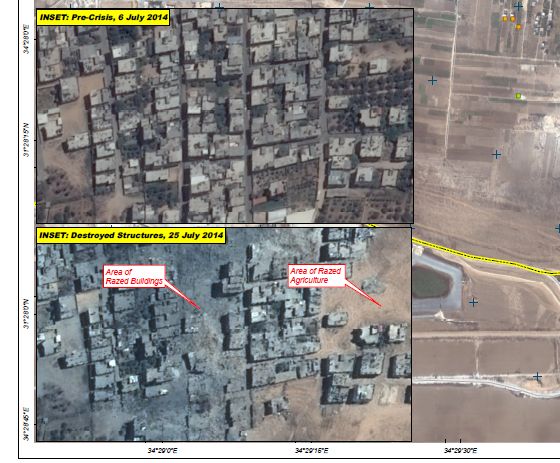
Gaza destruction revealed in UN satellite image
Channel 4 News: Unosat analysis has identified 604 destroyed structures, 236 severely damaged structures and 46 moderately damaged structured.
(Click on the image above to view full size annotated image provided by the UN.)
Destroy Hamas? Something worse would follow: Pentagon intel chief
Reuters reports: A top Pentagon intelligence official warned on Saturday that the destruction of Hamas would only lead to something more dangerous taking its place, as he offered a grim portrait of a period of enduring regional conflict.
The remarks by Lieutenant General Michael Flynn, the outgoing head of the Defense Intelligence Agency, came as Israeli ministers signaled that a comprehensive deal to end the 20-day-old conflict in the Gaza Strip appeared remote.
At least 1,050 Gazans – mostly civilians – have been killed, and 42 Israeli soldiers and three civilians in Israel have died.
Flynn disparaged Hamas for exhausting finite resources and know-how to build tunnels that have helped them inflict record casualties on Israelis. Still, he suggested that destroying Hamas was not the answer.
“If Hamas were destroyed and gone, we would probably end up with something much worse. The region would end up with something much worse,” Flynn said at the Aspen Security Forum in Colorado.
“A worse threat that would come into the sort of ecosystem there … something like ISIS,” he added, referring to the Islamic State, which last month declared an “Islamic caliphate” in territory it controls in Iraq and Syria. [Continue reading…]
Rabid Jewish nationalism now governs Israel
Lisa Goldman writes: The vast majority of Israeli Jews support the military operation, called Protective Edge, but leftist Jews and the Arab minority organized anti-war protests, primarily in liberal Tel Aviv and then in Haifa, a mixed Arab-Jewish city.
There’s nothing new in seeing a minority of Israelis protest a popular war. It is not unprecedented for that minority to be met by counter-protestors who wrap themselves in the flag and call out insults like “traitor.” But this time something new and worrying happened: Peaceful, unarmed demonstrators in Israel’s two most liberal cities were physically attacked by ultra-nationalists wielding stones and bottles. In Haifa, nationalist thugs assaulted the Arab deputy mayor, slamming the middle-aged man down on the pavement. In Tel Aviv, they chased anti-war protestors into a cafe and smashed a chair over the head of one of them, even as municipal sirens wailed to announce an incoming rocket from Gaza. The police were ineffective in stopping the violence. Later, it emerged that the ultra-nationalist attackers had organized via a Facebook group managed by a well-known rap artist – a tattooed, muscular fellow who goes by the name The Shadow.
Something has broken down in Israeli society. Friends who always said they would never leave because they were too deeply rooted in the place, its language and their families are deeply worried and even despairing over the radical rightward shift of the mainstream political discourse. Several have said they were looking for opportunities abroad because they couldn’t see themselves raising their children in a country where dissent was slowly but surely being suppressed even as the national discourse hardened rightward.
Israel has always been a flawed democracy with many festering internal divisions. Its policies toward the Arab minority reflect the unresolved tension of a conflicted identity: Should Israel aspire to be a liberal democracy or a democracy for Jews? But in the five years since Benjamin Netanyahu was elected prime minister and formed a governing coalition composed of far-right, racist and anti-democratic parties, something very fundamental has changed in Israeli society. It feels as though the majority is willing to suspend essential elements of democracy in favor of Jewish nationalism. There doesn’t seem to be a place for dissent anymore.
While slaughtering children, Israelis rescue an owl
The Times of Israel reports: The fighting in Gaza has extracted a grave human toll, but some animals have been affected as well. One was lucky enough to make it to the hospital.
About two weeks ago, a long-eared owl was injured by mortar shrapnel in Kibbutz Nirim, near the Gaza border. The owl was found by Ben Itay, a kibbutz member and veterinary student, who brought him to his home. When rocket fire from Gaza eased enough to allow Ben to bring him to the Zoological Park in Ramat Gan, also known as the Safari, vets discovered that the poor creature had lost his vision in his right eye, had a broken beak, and was suffering from shrapnel in his head.
The bird is undergoing treatment at the animal hospital, and vets hope he will be able to return to the wild.
Let’s hope the owl makes a full recovery — and let’s not forget that the Nazis were great champions of animal welfare. Unfortunately they didn’t extend the same level of concern for the welfare of countless fellow human beings.
In London 45,000 protest against Israel’s war on Gaza
The Independent reports: Tens of thousands of people amassed outside the Israeli embassy in London today to protest against Israel’s incursion into Gaza which has killed over 1000 Palestinians, including at least 192 children.
Chanting messages of solidarity to the Palestinian people, a constant flow of supporters filed through High Street Kensington underground station from early in the day.
45,000 people joined the demonstration, which later followed a route to Parliament, according to figures released by the Metropolitan Police.
The latest in a series of protests, last Saturday around 20,000 marched from outside Downing Street to the Israeli embassy.
Syria has its bloodiest week with 1,700 killed
The Huffington Post reports: As Israeli missiles lay waste to Gaza, Hamas rockets fly and innocents die in civilian planes downed in eastern Ukraine, Syria has slipped even further under the radar.
But with international attention focused elsewhere, Syria has just recorded it’s bloodiest week since the country descended into violence three years ago.
More than 1,700 people have been killed in just seven days, with fighters for the Islamic State in Iraq and the Levant (ISIS) accused of killing hundreds of government troops in a battle for a gas field, with hundreds of civilians killed as fighting intensified across the nation. The three-year-long civil war in Syria has now killed over 170,000 and displaced nearly nine million .
In the latest round of fighting, the London-based Syrian Observatory for Human Rights said that 270 government soldiers and gas field employees were killed in the clashes on July 19, many of them shot through the head execution-style. [Continue reading…]
Islamic State uses high grade captured weapons to fight Assad troops in Syria
The Telegraph reports: The extremist group Islamic State has launched a series of attacks across Syria, using military equipment seized from Iraq in its biggest concerted challenge yet to Assad regime forces.
Fighters from Islamic State have attacked two major military bases in the north-east of the country and well as regime-held areas near Aleppo.
They seized most of one base before coming under retaliatory aerial bombardment, seizing senior regime officers and in at least one case decapitating him, placing his easily recognisable head on a pole, according to pictures posted to social media.
The attacks mark a significant shift in the Syrian civil war. While the regime and Islamic State have fought in the past, both have until now preferred to focus their energies on the third major force in the civil war, the so-called “moderate rebels” comprising the Free Syrian Army and a variety of Islamist groups.
The attacks also suggest the group has for now abandoned plans to move further into Iraq or attack the capital Baghdad.
The change of tactics by Islamic State follows the gradual weakening of the western-backed rebels, who are squeezed between the jihadists and the regime. They declared war on the Islamic State in January, hoping that tackling the extremists would encourage more military backing from the West and its allies.
That backing never came, and with thousands of opposition fighters dying in the battles between competing rebel forces, the regime has advanced across key battlegrounds in the centre and north of the country, including Aleppo.
Meanwhile, in a series of lightning raids and defections, Islamic State managed to drive out competitors from most of the eastern province of Deir al-Zour, and seized major oilfields from the regime. [Continue reading…]
A nation in peril — Iraq’s struggle to hold together
Reuters reports: Iraq’s latest – and gravest – crisis erupted when mostly Sunni fighters swept through the north last month. Now the jihadist black flag flies over of most of the country’s Sunni Arab territory.
Kurdish forces, exploiting the chance to take another step towards independence, seized the city of Kirkuk and nearby oilfields, leaving the Shi’ite-led government controlling only the capital region and the mainly Shi’ite south.
The government is trying to reverse this de facto, three-way split of the country, but its reliance on Shi’ite militia and volunteers rather than the ineffectual national army has deepened sectarian mistrust without pushing the rebels back.
Across Baghdad a Sunni living in the Shi’ite area of Maalef, cut off from the rest of the city by a checkpoint where non-residents are turned back, said life there had become unbearable for those who do not belong to the majority Shi’ite community.
“The Sunnis all want separation now,” said the 37-year-old electrician, who asked not to be named for his security. “Facts on the ground tell you this will be the final result. On both sides now you have extremists who don’t want to get along”.
Kurdish politician Hoshiyar Zebari, who still staunchly advocates Iraqi unity, described the new geography. “The country is divided literally into three states: the Kurdish state; the black state (under Sunni insurgents) and Baghdad,” he said.[Continue reading…]
Father recounts witnessing his family killed by Israeli missile strike
Ayman Mohyeldin reports: Hassan Al Hallaq did what any sensible parent would do: When the latest bout of violence erupted here, he moved his family — heavily pregnant wife, Samar, and two young sons — away from their apartment on the outskirts of town and into the middle of Gaza City.
Away from the border, away from the tunnels, the rockets and the front line, Al Hallaq thought his wife and sons Kenan, 6, and four-year-old Saji would be safe.
The IT manager at a Palestinian bank had lived with his family through two previous wars and knew his neighborhood in East Gaza would be targeted by the Israelis because it is close to the border.
At Iran’s urging, Hezbollah breaks with Assad to support Hamas
As Hamas fighters battle on their home turf against the armed forces of the most militarized state on the planet, most of observers in the region who employ the term “axis of resistance” should have little trouble acknowledging that Hamas is a genuine resistance movement — except that is for Bashar al-Assad.
A few days ago Assad mocked Hamas as “amateurs who wear the mask of resistance.”
Hezbollah, whose own claim to be a resistance movement has been undermined by its willingness to help prop up Assad, has nevertheless reaffirmed its support for Hamas.
Reuters reports:
Hezbollah leader Sayyed Hassan Nasrallah pledged full support on Friday to the Palestinian group Hamas in its conflict with Israel despite a deep rift between the two militant organisations over the civil war in Syria.
“We in Hezbollah will be unstinting in all forms of support, assistance and aid that we are able to provide,” Nasrallah said.
“We feel we are true partners with this resistance, a partnership of jihad, brotherhood, hope, pain, sacrifice and fate, because their victory is all our victory, and their defeat is all our defeat,” he said.
Nasrallah delivered his speech in public in Hezbollah’s stronghold of south Beirut, a rare event for the militant Shi’ite Lebanese leader who has lived in hiding, fearing for his security, after Hezbollah’s 2006 war with Israel.
That inconclusive 34-day conflict won Hezbollah sweeping support around the Arab world for standing up to Israel’s military superiority. But its more recent military action in neighbouring Syria has eroded that regional backing.
Shi’ite Hezbollah has sent thousands of fighters into Syria to fight alongside President Bashar al-Assad’s forces, helping turn the tide against overwhelmingly Sunni Muslim rebels.
But the Hamas leadership, once based in Damascus, refused to support Assad as he confronted with force peaceful protests which broke out in 2011 and descended into an insurgency and civil war. Since then 160,000 people have been killed.
Adnan Abu Amer reports for Al-Monitor:
Hezbollah Secretary-General Hassan Nasrallah called [Hamas leader Khaled] Meshaal on July 20. This was the first official contact between Hezbollah and Hamas since April, a Hamas official informed Al-Monitor.
Hezbollah’s official website reported that, during his phone call with Meshaal, “Nasrallah praised the steadfastness of the resistance fighters in Gaza,” stressing that he “stands next to the Palestinian resistance and supports its conditions to end the battle.”
Al-Monitor contacted a Palestinian official in Lebanon who mediated Hamas’ troubled relationship with Hezbollah, who said, “It is no secret that the relationship between the officials has not been great because of the crisis in Syria. But Iran contacting Meshaal through the head of the Shura Council Ali Larijani, Foreign Minister Javad Zarif and a senior Revolutionary Guard officer on July 7 encouraged Nasrallah to call Meshaal despite the Syrian boycott of Hamas. Therefore, Nasrallah contacting Meshaal has not had positive echoes in Damascus.”