The New York Times reports: The Egyptian police arrested the spiritual leader of the Muslim Brotherhood early on Tuesday, hours after a court ordered the release of former President Hosni Mubarak.
The arrest of the Brotherhood’s spiritual leader, Mohamed Badie, appeared to represent a red line the police never crossed during Mr. Mubarak’s own crackdowns on the group. Taken together with the fact that the former president’s release for the first time seems conceivable, the developments offered a measure of how far and how quickly the tumult shaking Egypt in recent days and weeks has rolled back the changes brought by the revolution of 2011.
The order for Mr. Mubarak’s release, under a government led by former officials who worked for him, conjured the incongruous notion that he might go free even as his democratically elected successor, the Islamist Mohamed Morsi, remained in detention by the military that ousted him in early July and installed an interim government.
In a kind of counterpoint, the arrest of Mr. Badie showed the severity of the crackdown on Islamist forces that has left hundreds dead. A private television network that supports the military leadership broadcast footage of Mr. Badie, 70, in custody, with triumphal music playing against images of him clad in a white robe and sitting on a white couch with a security officer’s automatic rifle visible nearby.
His incarceration, which followed the death of a son, Ammar, in clashes on Friday, was apparently designed to further deflate the Brotherhood’s resolve to maintain its challenge to the military-backed government with street protests clamoring for Mr. Morsi’s release. [Continue reading…]
Category Archives: Lands
Kurdish militias clash with al Qaeda-linked rebel faction in northeastern Syria
The Associated Press reports: Kurdish militias battled al-Qaida-linked rebel groups in northeastern Syria on Tuesday in the latest round of heavy fighting that has helped fuel a mass exodus of civilians from the region into neighboring Iraq, activists said.
Clashes between Kurdish fighters and Islamic extremist rebel groups have sharply escalated in Syria’s northern provinces in recent months. The violence, which has left hundreds dead, holds the potential to explode into a full-blown side conflict within Syria’s broader civil war.
Tuesday’s fighting, which pitted Kurdish militiamen against rebels from the Islamic State of Iraq and the Levant, was focused in three villages near the town of Ras al-Ayn in the predominantly Kurdish Hassakeh province, according to the Britain-based Syrian Observatory for Human Rights monitoring group. There was no immediate word on casualties.
Egypt: Beyond the voice of battle
Jack Shenker writes: No matter how many times you witness it, the transformation is still a dizzying one. Kiosks that once vended chocolate and cigarettes, deployed as a gunman’s shield. Shop window shutters framing sugar-sopped cakes or risqué clothes mannequins, now the roughage of a street barricade and clouded in teargas. Rooftops normally barnacled with satellite dishes and humming AC units, today specked with sniper rifle sights. All that familiar stuff, wrenched from an old reality and pressed into use as something different. Two and a half years in, the urban shift from mundane to martial remains as abnormal as ever.
What is happening in Egypt at the moment, and what is being lost? Lives, above all else; hundreds of them — on the streets of Cairo mainly, but also beyond the capital in towns and villages beyond the gaze of the global media. It feels remarkable to have to say this when the sentiment is so obvious, but in the bitter atmosphere of recrimination and accusation that seemingly pervades all Egypt debate at present, it must be said nonetheless: The biggest tragedy of recent weeks is the death of so many, and the maiming of so many more.
Once again, Egyptians are scrawling their names on their arms in a simple effort to avoid being reduced to a number in a morgue, or worse still consigned to the ranks of the uncounted. Amid footage of besieged mosques, robocop machine-gun fire and the dreadful, desperate sight of people throwing themselves off bridges to escape a maze of bullets, it’s that little detail — the writing on the arms — that always chills me the most. Like efforts by volunteers to collect and catalogue the belongings of the dead, some of whom risked their lives to retrieve plastic bags stuffed with scraps of non-life as army bulldozers closed in, writing a name on an arm feels like the most basic affirmation of presence in the face of a state committed to inflicting absence by the bucket load: Absence of heartbeats, absence of humanity, absence of anything but a narrative in which everything is black and white and people are units to be slotted into predrawn political templates. Writing a name on an arm says, devastatingly, “No — I was here too.”
But beyond people, something else is being lost, too — just as those most invested in the old Egypt intended. For me, the most powerful expression of Egypt’s revolution has never been anything tangible, but rather that state of mind when the world seems to tip on its head and bevel with possibility, where the landscape of imagination is recast. I first encountered it on January 25 2011, as I marched alongside a group of anti-Mubarak protesters down the Corniche in central Cairo, and felt a heart-pounding distortion of the air as a line of armed Central Security Forces fanned across the road with their shields up, blocking the path ahead.
Prior to that day, I’d attended countless demonstrations consisting of a few dozen Egyptians shunted to some inconspicuous corner of the street, a tight bristle of political energy marooned in an ocean of black-clad troops. The deployment of the police across the road in front of us was a signal that the next section of this script was due to commence; we would come a stop, engage in some minor scuffling, and then be herded into a harmless protest pen so that the capital could get on with its day. But on this occasion, with reports of mass unrest spreading throughout the city, something was different. Nobody among the marchers slowed, nobody broke ranks, and instead they just kept on going, right towards those shields, chanting and glaring mutinously into the eyes of those that held them — each of whom glanced uneasily around at one another and wondered nervously how to respond. In the end, the troops simply gave way. And as we pushed past them and onto the empty street behind, several protesters broke into a run — or more accurately a skip, a dance, a hodgepodge of hops and jumps — and many began whooping and hollering and even kissing the ground.
Doubtless, more important things were happening elsewhere at that moment, beyond that little carpet of liberated asphalt. Certainly episodes of much greater drama would unfold afterwards, both later that evening, as security forces broke the occupation of Tahrir Square with volleys of tear gas, and three days on, when over 100 police stations were burnt to a cinder and Egypt’s people finally forced Mubarak’s security forces to flee into the night. But for me, that single moment in time — when those around me spontaneously decided to break through the police line and rewrite a mothballed script from the bottom up, that nanosecond where the globe spun, a street was reclaimed and everything in the old universe seemed to stagger, pitch and tumble forward into infinite opportunity — that was revolution, distilled to its purest form. It felt like a tiresome step dance had just gone freestyle as the performers rethought their collective horizons, and careened wildly into a space they had always been told was not for them. It felt like nothing could be the same again. [Continue reading…]

At the root of Egyptian rage is a deepening resource crisis
Nafeez Mosaddeq Ahmed writes: With more than 600 people killed and almost 4,000 injured from clashes between Egyptian security forces and Muslim Brotherhood protesters, the country’s democratic prospects look dismal. But while the violence is largely framed as a conflict between Islamism and secularism, the roots of the crisis run far deeper. Egypt is in fact on the brink of a protracted state-collapse process driven by intensifying resource scarcity.
Since the unilateral deposition of President Morsi, the army’s purported efforts to “restore order” are fast-tracking the country toward civil war. The declaration of a month-long state of emergency—ironically in the name of defending “democracy”—suggests we are witnessing the dawn of a new era of unprecedented violence with the potential to destabilize the entire region.
Underlying growing instability is the Egyptian state’s increasing inability to contain the devastating social impacts of interconnected energy, water and food crises over the last few decades. Those crises, already afflicting other regional states like Yemen and Syria, will unravel prevailing political orders with devastating consequences—unless urgent structural transformation to address those crises becomes a priority. The upshot is that Egypt’s meltdown represents the culmination of long-standing trends that, without a change of course, can only escalate with permanent repercussions across the Middle East and North Africa (MENA), and beyond. [Continue reading…]
Obama’s foreign policy image takes hit with Egypt upheaval
The Hill, noting that the New York Times “editorial board opined that it was ‘past time’ for Obama to reverse decades of unquestioning support for Egypt’s military,” reports:
Some experts think the damage is already done.
“People on different sides – whether it’s Arab governments or opposition groups – don’t take the U.S. seriously,” said Shadi Hamid, the director of research for the Brookings Doha Center who has lived in the region for the past four years and was in Egypt this week. “There is a widespread perception that Obama is a weak, feckless leader. That’s not just Republican talking points – it’s what people here in the region actually think and say on a regular basis.”
Hamid said there’s an “emerging consensus that Obama has gotten the Middle East wrong” because he’s convinced the United States only has limited power to shape events in the region. As a result, Hamid told The Hill, Obama missed a chance to embrace the Arab Spring by strongly opposing Bahrain’s crackdown on protesters, intervening early on in Syria’s uprising against Bashar Assad and labeling Morsi’s ouster a coup.
“It sends a very dangerous message if the U.S. is not even willing to respect its own law on matters of national security,” Hamid said. “The fact that we can’t call things what they are makes us a laughing-stock in the region. That’s why people don’t care about what Obama says and his rhetoric.”
The White House declined to comment. [Continue reading…]
U.N. says thousands of Syrians fleeing to Iraq

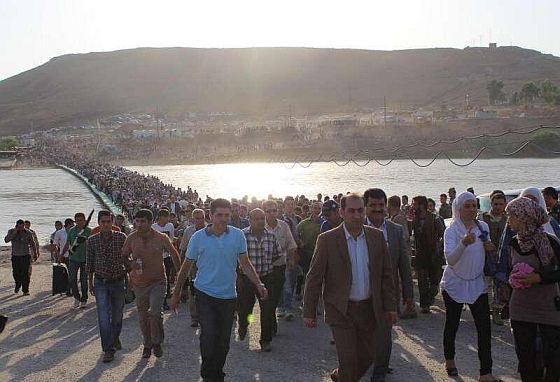
UNHCR photo shows mass exodus of Syria refugees fleeing to Iraq.
The Associated Press reports: In a mass exodus, around 30,000 Syrians have fled their homeland’s bloody civil war and crossed over into neighboring Iraq’s northern self-ruled Kurdish region over the past five days, the U.N. refugee agency said Monday.
The massive influx of people, many of whom are Syrian Kurds seeking refuge from escalating violence in northeastern Syria, has put severe strain on the resources of aid agencies as well as Iraqi Kurdistan’s regional government.
“Syrian refugees are still pouring into Iraq’s northern Kurdish region in huge numbers and most of them are women and children. The reason behind this sudden flow is still not clear,” said Youssef Mahmoud, a spokesman for the U.N. refugee agency in Iraq’s Kurdish region.
“Today, some 3,000 Syrian refugees crossed the borders and that has brought the number to around 30,000 refugees since Thursday,” he said, adding that the latest wave has brought the number of Syrian refugees in the Kurdish region to around 195,000. [Continue reading…]
The Brotherhood starts anew in Syria
Raphaël Lefèvre writes: While the Egyptian Brotherhood makes global headlines and Tunisia’s Ennahda Party struggles to remain in power, very little is publicly known about the state of Syria’s Muslim Brotherhood. In recent weeks, much has been made of the decrease in the group’s influence over the Syrian National Coalition (SNC). In contrast, not a lot has been said on the Brotherhood’s actual influence inside Syria and its strategy for the revolution. How exactly does the movement plan on dealing with recent trends in the conflict, such as the rise of Islamic extremism in opposition ranks?
A series of interviews conducted with prominent Syrian Brotherhood members and other members of the opposition in Istanbul and Beirut reveal that the group is adapting to an increasingly fragmented Syria made up of competing centers of power. But even if it seems to be gaining some traction on the ground through humanitarian assistance, political activism and armed opposition, the Syrian Brotherhood is still facing enormous external and internal challenges.
“We’ll have to deal with two major problems in the coming months and years,” one member of the Syrian Brotherhood leadership remarked bluntly. “The first is to continue to rebuild our structure and, perhaps most importantly, our image [which has been] tainted by 30 years of absence.”
In Syria, membership in the Muslim Brotherhood has been punishable by death since a law was passed to that effect in July 1980. In February 1982, a large-scale regime massacre in the city of Hama led most remaining members to flee to neighboring countries, where they are today estimated to number around 7,000–10,000. “The second problem,” argued the Brotherhood leader, “will be to deal with our own internal challenges.” The thirty-year exile of Brotherhood members has indeed stirred up tension within the group along regional and generational lines. An election to select the next leader is due next year, and it could be a turning point in the group’s future.
It was this simmering tension that led the Brotherhood leadership to agree, early on in the uprisings, on a “decentralization” policy: every regional sub-group forming the core of the Brotherhood would have to decide on the best strategy to return to Syria, rebuild a local following, and contribute to the revolutionary effort. [Continue reading…]
Egypt: Mubarak expected to be released from jail within 48 hours — updated
Reuters reports: Hosni Mubarak, the former Egyptian president overthrown in an uprising in 2011, will be released from jail in the next 48 hours after a prosecutor cleared him in a corruption case, his lawyer Fareed El-Deeb told Reuters on Monday.
He was speaking after judicial authorities ordered Mubarak released in one of the remaining corruption cases against him.
The only legal grounds for Mubarak’s continued detention rest on another corruption case which will be cleared up later this week, Deeb said.
“All we have left is a simple administrative procedure that should take no more than 48 hours. He should be freed by the end of the week,” Deeb said.
Mubarak, 85, still faces a retrial on charges of complicity in the murder of protesters during the 2011 revolt.
Egypt prosecutor orders deposed President Mursi detained for 15 days in a new case of inciting violence: state news agency #breaking
— Reuters Top News (@Reuters) August 19, 2013
Egypt’s ‘war on terrorism’ and growing xenophobia
Sarah Carr writes: It’s trite but worth remembering that an excellent barometer of political freedom is how a regime treats the media. Deposed President Mohamed Morsi attempted to shut critics up through clumsy litigation – charges of insulting him, or the judiciary and so on. It was a classic Hosni Mubarak technique but Morsi used it far more frequently. Another technique was tacitly approving or at least not doing anything when Salafi preacher Hazem Salah Abou Ismail and friends set up shop outside the Media Production City in October 6 City, in order to intimidate Lamis al-Hadidi and other vocally anti-Brotherhood presenters beyond state control.
But just like the Muslim Brotherhood failed in everything they did while in power, they failed in this, too: the cases never had the chilling effect desired and Morsi and co. were regularly ripped apart in the press, by Bassem Youssef and others. In fact the Brotherhood themselves liked to crow about their critics being left alone as an example of their political largesse. They never understood that using underhand measures to intimidate your opponents does not make you a just leader and that leaving the press alone is a positive obligation not an act of charity.
The current regime meanwhile is combining the very best of pre-2011 media repression techniques with a classic February 2011 xenophobia campaign with the force of an Interior Ministry stretching its sinewy muscles as it resurrects itself.
The xenophobia campaign began gently with allegations that Syrians and Palestinians were in the Brotherhood Rabea al-Adaweya sit-in. After Rabea al-Adaweya was broken up, the anti-West rhetoric intensified and allegations that western media support the Brotherhood widened to include not only CNN but mostly every foreign news outlet. After Friday’s clashes in Ramses Square, the propaganda machine revved up a few notches and the media filmed bearded, detained men they suggested were foreigners. Prior to this on Thursday, General Mahmoud Polo Shirt Badr from the Tamarod battalion of the Egyptian army urged Egyptian citizens to form popular committees to defend their neighborhoods against the terrorist threat. There are many well-intentioned people in popular committees but anyone who experienced the January 2011 revolution (uprising? brief glitch?) will tell you that they are also a vehicle for vigilantism and an excellent way of indirect control by the state: There was what seemed to be coordinated harassment of foreigners during certain days in 2011 from the top – state media – to the bottom – on the ground in popular committees.
We are seeing the beginnings of this again now. After the detained “foreign” men were shown on television on Friday night the next day in Ramses Square foreign journalists were physically attacked and detained. Two had to be bundled into an army APC for their own safety. Another was marched to Azbakeya Police Station and told firmly to leave Egypt. He was subsequently the victim of a citizens’ arrest on the same day. Another female journalist who works for a foreign outlet said that while in Ramses Square, a cop ordered men around her to beat her up, telling them that she is American. The Presidency on Saturday gave a presser in which Mostafa Hegazy, an advisor, repeatedly talked about Egyptians’ “bitterness” at international coverage of events. On Sunday, the Der Spiegel correspondent was detained for seven hours while at Rabea al-Adaweya and claimed that the main accusation against him was “bad reports in the Western press.” [Continue reading…]
Why are Egyptian liberals supporting the bloodshed?
Reuters reports: Mahmoud Badr, whose petition campaign helped to bring down Egypt’s Islamist president, insists the bloodshed that has followed is a necessary price for saving the nation from the Muslim Brotherhood.
And he has a message for U.S. President Barack Obama, who has expressed alarm at the violent crackdown on the Brotherhood that has led to more than 700 deaths: “Don’t lecture us on how to deal with the Brotherhood’s terrorism.”
As for aid money, he says, Obama can keep it – and “go to hell”.
Badr, like many Egyptians who consider themselves liberals, has little patience with the human rights groups who call the repression a setback for democracy.
“What Egypt is passing through now is the price, a high price, of getting rid of the Brotherhood’s fascist group before it takes over everything and ousts us all,” Badr, 28, told Reuters in a telephone interview.
Reuters now reports: Some 38 supporters of the Muslim Brotherhood died on Sunday in an incident at an Egyptian prison, security and legal sources said, giving conflicting versions of the deaths.
The Interior Ministry did not immediately confirm the death toll, but said in a statement that a number of detainees had tried to escape from a prison on the outskirts of Cairo and had taken a police officer hostage.
In subsequent clashes, the ministry said an undisclosed number of people had died from inhaling tear gas rounds. It added that the officer was freed but badly wounded.
However, offering a different explanation, a legal source told Reuters that the Brotherhood followers had suffocated in the back of a crammed police van while being taken to prison.
Egypt committing state terrorism, al-Sisi and al-Assad are same: Turkish PM; Palestinian Authority backs Egypt’s military
Hurriyet Daily News reports: Turkish Prime Minister Recep Tayyip Erdoğan has accused Egypt’s interim rulers of committing state terrorism and compared army chief Abdel Fattah al-Sisi to Syrian leader Bashar al-Assad as scores more were killed in a crackdown and hundreds were besieged in Cairo’s al-Fath Mosque by security forces.
“The Al-Fath Mosque is under siege. People’s place of worship is innocent. They have burned, destroyed our mosques in Syria and in Egypt. Either Bashar or Sisi, there is no difference between them. There is no salvation with oppression,” Erdoğan said during a defiant speech in the northwestern province of Bursa Aug. 17 where he attended the launching ceremony of an urban renovation project.
Erdoğan also slammed Egyptian officials for describing supporters of toppled President Mohamed Morsi as “terrorists.”
“People are saying ‘we ask for our vote to be honored.’ But there are those calling them terrorists. But I am saying that state terrorism is currently underway in Egypt,” Erdoğan said.
Meanwhile WAFA reports: The Palestinian leadership said Friday in a statement that harming the Egyptian security will also harm the Arab national security and its fundamental cause.
“The Palestinian leadership and people are closely following the developments in Egypt,” said the statement. “They consider any attempt to harm the Egyptian security is an attempt to harm the Arab and Islamic national security and a threat to the Palestinian cause,” it added.
“The Egyptian security is the safety valve of the Arab national security and the unruly hands that are trying to jeopardize the Egyptian state and to harm its security and the stability of the Egyptian people are serving a dubious scheme aimed at the unity of Egypt and the security and stability of all Arab countries,” added the statement.
The Palestinian leadership welcomed the position of Saudi Arabia and its king from the Egyptian crisis and called on “everyone to support Egypt and to oppose any interference in its internal affairs.”
Why the U.S. won’t cut military aid to Egypt
Juan Cole lists the top ten reasons: 1. The US doesn’t give much aid to the Egyptian people per se. Only $250 mn a year out of $1.55 bn is civilian. The aid is to cement a relationship between the Egyptian officer corps and the Pentagon.
2. The military aid, $1.3 billion a year, is mostly in-kind, a grant of weaponry . It must be spent on US weapons manufacturers. It is US arms manufacturers like Lockheed-Martin and General Dynamics (and their employees) who would suffer if it were cut off.
3. The Congress gave the Egyptian Generals a credit card to buy weapons, and they’ve run up $3 billion on it for F-16s and M1A1 tanks. If the US cancelled aid, the US government would still have to pick up that bill.
4. Even most of the civilian aid is required to be spent on US goods and materiel. It is corporate welfare for the US
5. The aid was given as a bribe to the Egyptian elite to make nice with Israel. Given the chaos in Sinai, and Egypt’s instability, Congress is more worried about that issue than at any time in 40 years.
6. The Israelis asked the US not to suspend the aid. [Continue reading…]
Israel, the world’s largest arms exporter per capita, seeks increase in U.S. military aid
While the United States exports more than tens times the volume of weapons that Israel exports, when the value of each countries arms exports are measured per capita, Israel’s amount to more than treble those from the U.S..
Aviation Week reports: In the competition to market weapons internationally, Israel ranks among the world’s top exporters.
In 2012, Israeli defense exports soared to a record of $7.47 billion, making it the world’s sixth-largest exporter of arms. The 30% increase in global arms sales—compared with 2011 levels—positions Israel’s total weapons exports behind the U.S., U.K., Russia, China and Germany and ahead of France and Italy.
“I wouldn’t speculate on our exact position,” said Shmaya Avieli, head of Israel’s defense exports agency Sibat, “but I could safely say that we’re well among the top 10 exporters.”
Meanwhile, Defense News reports: Israel is seeking a surge in future US Foreign Military Financing (FMF) grants not only to support its growing security requirements, but to offset the impact of increasingly advanced US arms sales to other counries in the volatile region.
In interviews here, US and Israeli officials said initial work toward a new 10-year military aid package, which would extend through 2027, is focusing on a full spectrum of Israeli concerns, including military modernization needs, new threats from regional instability and the erosion of Israel’s so-called qualitative military edge (QME) due to US arms sales in the Mideast.
Under the existing US $30 billion aid agreement signed in 2007, negotiators from both sides did not specifically address or attempt to calculate Israel’s QME security concerns in annual FMF funding levels prescribed by the 10-year package.
Those concerns — supported by US commitments to preserve Israel’s edge over regional adversaries — were dealt with in separate bilateral forums, with significant input by key congressional committees charged with reviewing the regional impact of proposed sales, sources here said.
“QME, which pertains to Israel’s ability to defend itself by itself against any combination of Mideast adversaries, was always implied but never explicitly linked to long-term FMF agreements or security assistance planning,” said Dov Zakheim, a former Pentagon comptroller and undersecretary of defense.
Since then, however, Washington’s decades-long, de facto commitment to Israel’s QME has been codified into US law, and bilateral working groups tasked with laying the foundation for the new accord are taking a more “holistic” view of Israeli security concerns, said Michael Oren, Israel’s ambassador to the US.
“I don’t know how big of a role, if at all, QME played in the previous round of negotiations. But the nexus between QME and FMF has become stronger,” Oren said.
Oren mentioned “very large [US] contracts to the Middle East” that “raise the question of armies having capabilities similar to our own and how we make sure we can maintain our QME.”
Nevertheless, the Israeli envoy said Israel is not raising objections to such sales.
Can the side without guns ever win?
Omar Robert Hamilton writes: I sit, for the 12th hour now, alone and struggling for what to do. For the first time since I got on a plane for Egypt on January 29, 2011, I am at a loss.
Worse days than today lie ahead of us.
We thought we could change the world. We know now that that feeling was not unique to us, that every revolutionary moment courses with the pulse of a manifest destiny. How different things feel today. I will not bury our convictions, but that feeling – youthful optimism? naiveté? idealism? foolishness? – is now truly and irrevocably dead.Omar Robert Hamilton
I mourn the dead and I despise those killing them. I mourn the dead and I despise those sending them to their deaths. I mourn the dead and I despise those that excuse their murder. How did it come to this? How did we get here? What is this place?
It is February 12, 2011. Hosni Mubarak has fallen. In the morning I will fly to America to finish a job, before moving permanently to Cairo to help build the new country. I am sitting on my mother’s balcony. We are smoking cigarettes and drinking tea to keep out the cold and talking; about all that we’ve seen and done, about all that we’re going to do. Everything, on that night, was possible. Our conversation ranges from the grandiose of the global revolution to the practical re-thinking of ministerial appointments to the minutiae of the requirements of the film school that should be established. We talked through the night. I took notes.
It is, perhaps, this memory that hurts me the most.
By the time I return from America the army had cleared two sit-ins, begun court-martialing civilians en masse and assaulting women protestors with virginity tests. The revolution now is smaller, but serious, focused and under sustained attack. The un-fallen state, the deep state, the client state; once a month, every month, it attacks. It clears Tahrir in March, April, August and December. It attacks protestors at the Israeli Embassy. It envelopes downtown Cairo in a November mist of Pennsylvanian tear gas. It rains down rocks and Molotov cocktails from the roof of the Cabinet building. It welds shut the doors of the Port Said stadium deathtrap. Every month, people die fighting it.
There were moments when we could have broken the army’s grip on the country. We should have stayed in Tahrir after Mubarak was ousted. Tahrir was in the driving seat and hadn’t yet acquired the politicians to sell it out. But we left. Everyone said they would be back the next day and then, somehow, they weren’t. People wanted to shower and to sleep in their own beds. Then spontaneous cleaning brigades of earnest patriots spread through the city and by midday everything was nice and tidy and gone.
In November 2011 and in January 2012 the streets echoed with chants demanding the end of military rule. But now it had become the self-appointed role of the politicians to translate street action into political gain. Now, the army had people to talk to. Had all the forces that were supposedly against the military – the revolutionaries, the liberals, the Brotherhood and the Salafis – ever truly united where might we have been today? Dead, possibly. But maybe not. Maybe somewhere closer to a civilian state. [Continue reading…]
Israel worried by any signs of wavering in U.S. support for Egypt’s military
Reuters reports: Israel has looked on at upheaval in Egypt largely in silence, keen to avoid disrupting strategic security cooperation with a military it sees as critical to curbing attacks by Islamist militants in neighboring Sinai, officials and analysts said.
Prime Minister Benjamin Netanyahu had aides instruct cabinet ministers to avoid public comment about Egypt, according to an official who spoke on condition of anonymity.
“Israel and the United States see the situation in Egypt very, very differently and justifiably the prime minister wouldn’t want Israeli cabinet ministers to publicly criticize American policy,” Giora Eiland, a former national security adviser, said on Channel 2 television.
In private, one senior Israeli official expressed alarm at U.S. President Barack Obama’s condemnation of the bloodshed in Egypt and cancellation of a joint military exercise with Cairo.
“Eyebrows have been raised,” the official said.
Israel worries that any sign of wavering U.S. support for Egypt’s military may embolden Islamist militants sympathetic with the Muslim Brotherhood, ousted by the Egyptian army after a year in power.
Eiland backed the crackdown by Egyptian army chief General Abdel Fattah al-Sisi on the Brotherhood this week.
“Sisi in the situation he faced, had no choice but to do what he did,” said Eiland, adding he thought Western outrage at the scale of the bloodshed was understandable. Almost 800 people have been killed so far.
Egypt: Tamarrod movement launches petition against U.S. aid and peace treaty with Israel
Al-Masry Al-Youm reports: The Tamarrod movement (Rebellion) started a petition under the name “Stop Foreign Aid” aimed at rejecting U.S. aid and scrapping the peace treaty between Egypt and Israel.
On its website, Tamarrod said that the unduly meddling of the U.S. in Egyptian internal affairs and its support of terrorist groups prompted their calls to reject the U.S. aid and call off the peace treaty with Israel, so that Egypt would be at liberty to secure its borders as necessary.
The statement further explained that the aim of this initiative is to regain Egypt’s complete sovereignty and control over its internal affairs and to put an end to years of humiliation and political-dependency.
Egypt’s military coup supported by Israel, Saudi Arabia, UAE,and AIPAC
The New York Times reports: Western governments took a wait-and-see approach even after the military committed its first mass killing, shooting more than 60 supporters of Mr. Morsi at a sit-in on July 8. Western diplomats did not engage in earnest until July 24, when General Sisi, in dark sunglasses and military regalia, delivered a fiery speech asking the public to turn out for demonstrations giving him a “mandate” to take on the Islamists. Security forces killed 80 more Morsi supporters in their second mass shooting on the day of the demonstration.
The next morning, Morsi aides and Brotherhood leaders say, their phones began ringing with American and European diplomats fearing an imminent blood bath.
The administration enlisted players on opposite sides of the contest playing out in Egypt. Diplomats from Qatar, a regional patron of the Muslim Brotherhood, agreed to influence the Islamists. The United Arab Emirates, determined opponents of the Islamists, were brought in to help reach out to the new authorities.
But while the Qataris and Emiratis talked about “reconciliation” in front of the Americans, Western diplomats here said they believed the Emiratis were privately urging the Egyptian security forces to crack down.
Abdullah bin Zayed al-Nahyan, the Emirati foreign minister, came to Washington last month and urged the Americans not to cut off aid. The emirates, along with Saudi Arabia, had swiftly supported the military takeover with a pledge of billions of dollars, undermining Western threats to cut off critical loans or aid.
The Israelis, whose military had close ties to General Sisi from his former post as head of military intelligence, were supporting the takeover as well. Western diplomats say that General Sisi and his circle appeared to be in heavy communication with Israeli colleagues, and the diplomats believed the Israelis were also undercutting the Western message by reassuring the Egyptians not to worry about American threats to cut off aid.
When Senator Rand Paul, Republican of Kentucky, proposed an amendment halting military aid to Egypt, the influential American Israel Public Affairs Committee sent a letter to senators on July 31 opposing it, saying it “could increase instability in Egypt and undermine important U.S. interests and negatively impact our Israeli ally.” Statements from influential lawmakers echoed the letter, and the Senate defeated the measure, 86 to 13, later that day. [Continue reading…]
Egypt’s rulers want to destroy Muslim Brotherhood
Reuters reports: Egypt’s prime minister has proposed disbanding the Muslim Brotherhood of ousted President Mohamed Mursi, the government said on Saturday, raising the stakes in a bloody struggle between the state and Islamists for control of the country.
Live television showed a gunman firing at soldiers and police from the minaret of a central Cairo mosque, with security forces shooting back at the building where Mursi followers had taken shelter. Reuters witnesses said Mursi supporters also exchanged gunfire with security forces inside the mosque.
The interior ministry said 173 people died in clashes across Egypt on Friday, bringing the death toll from three days of carnage to almost 800.
Among those killed was a son of Muslim Brotherhood leader Mohamed Badie, shot dead during a protest in Cairo’s huge Ramses Square where about 95 people died in an afternoon of gunfire and mayhem on Friday.
Egyptian authorities said they had rounded up more than 1,000 Islamists and surrounded Ramses Square following Friday’s “Day of Rage” called by the Brotherhood to denounce a lethal crackdown on its followers on Wednesday. [Continue reading…]