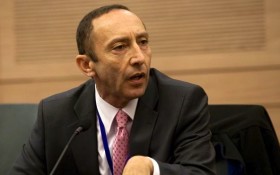
Shibley Telhami says that his polling indicates: Arabs want a combination of many things that Turkey’s model offered: a country that balances democracy and culture, but also a stable, strong, prosperous nation, and one that makes them feel proud on the world stage. Erdogan, who personally symbolized the mix of Islam and democracy in many Arab minds — at least until the recent upheavals in Turkey — was not selected by Arabs as the favorite leader until he was seen as standing up to Israel on the 2008-09 Gaza war.
Overall, the resonance of political Islam in the Arab world — and in Egypt in particular — has been exaggerated. To win the presidency last year, the Muslim Brotherhood could rely on its political machinery and the disarray of its opponents; it didn’t need to win the hearts of most Egyptians. But as Morsi learned too late, it couldn’t govern without broader public support.
However, if Morsi and the Muslim Brotherhood overestimated the Islamists’ appeal, Egypt’s transitional rulers seem ready to dismiss it too easily. Public rejection of the Brotherhood does not translate into an embrace of the generals. Gen. Abdel Fatah al-Sissi’s popularity could be fleeting: Despite the Egyptian public’s long-held admiration of the military as an institution, especially immediately after the revolution, their opinion of the generals changed within months, with only 18 percent of Egyptians polled saying they had advanced the goals of the revolution by May 2012.
It is too early to measure the impact of the bloodshed on the generals’ public support, but the coalition around them has conflicting aims and values, even if they were united against Morsi — and it is beginning to fracture, most notably with the departure of Vice President Mohamed ElBaradei.
It was easy enough to use public disenchantment with Morsi and the muscle of the military to gain power. But in an era of heightened expectations and free-flowing information, a Mubarak-style regime cannot return. It is now impossible to govern Egypt by repressing the Brotherhood and its supporters, who have become indispensable parts of an empowered citizenry.
The bloody path chosen this past week takes Egypt into the unknown. What we do know is that all Egyptians are prepared to pay a price to have their voices heard. If that can no longer happen peacefully, Egypt must brace itself for the violent radicalization that makes democracy impossible.
Category Archives: Lands
Egypt: All coups end in petty tyranny, however good the intentions
Daniel Hannan writes: When I was four years old, a mob attacked our family farm. A crowd of men lit tyres and set them against our front gates, intending to burn their way in.
My mother took me by hand to the back entrance, a footpath leading into the hills. “We’re going to play a game,” she told me. “If we have to come this way again, we must do it without making a sound.”
My father was having none of it. He had an obligation to the farm workers, he said, and he wasn’t going to be pushed off his land by hooligans bussed in from the city. He was suffering, I remember, from one of those diseases that chronically afflict white men in the tropics, and he sat in his dressing gown loading his revolver with paper-thin hands. In the end, security guards managed to disperse the crowd with shots and, for us at least, the danger passed. Others were not so lucky: there were land invasions and confiscations all over the country.
This was Peru in the early 1970s, a country reduced to chaos and penury by the military government of General Juan Velasco, whose putsch, inevitably, ended up exacerbating all the problems that had justified it in the first place.
There is no such thing as a good coup, only bad coups and worse coups. All military regimes, in time, become tawdry and self-serving. Whatever intentions the army officers begin with, they end up as petty tyrants. An elected ruler is kept in check by the knowledge that he can be fired. Take that knowledge away and, however pure his motives, he will end up arranging the affairs of state around his personal convenience.
No doubt Velasco – who inspired Venezuela’s Hugo Chávez – genuinely thought he was standing up for the downtrodden masses against the oligarchs. No doubt, from the opposite end of the spectrum in neighbouring Chile, Augusto Pinochet genuinely thought he was saving his country from Communist meltdown. In both cases, there was a smidgen of truth in their self-justification. But, over time, both men became autocrats, repressing dissent and enriching themselves at state expense.
Ah, you say, but what if the alternative is even worse? Such is the justification used by every military regime in history, going back to Bonaparte, to Cromwell, to Sulla. It is being trotted out now to justify the dictatorship in Egypt, both by Western sophists and by local liberals who, having spent the Mubarak years demanding democracy, suddenly fear it. [Continue reading…]
U.S. and allies were near a deal for peaceful end to Egypt crisis
The Washington Post reports: Two weeks before the bloody crackdown in Cairo, the Obama administration, working with European and Persian Gulf allies, believed it was close to a deal to have Islamist supporters of ousted president Mohamed Morsi disband street encampments in return for a pledge of nonviolence from Egypt’s interim authorities.
But the military-backed government rejected the deal and ordered its security forces to break up the protests, a decision that has resulted in hundreds of deaths and street clashes that continued Friday in the capital.
The agreement nearly brokered two weeks ago sought statements of restraint from both sides and an inquiry into competing claims of violence and mistreatment, said Bernardino León, the European Union’s envoy for Egypt. That was supposed to be a prelude to talks between the Muslim Brotherhood and the government.
Former Egyptian vice president Mohamed ElBaradei appeared to back the deal but could not convince Gen. Abdel Fatah al-Sissi, the head of the military, León said. ElBaradei resigned after violence erupted.
What this report neglects to make clear, is that the agreement referred to by León had already been accepted by the Muslim Brotherhood.
General Sisi, most likely with the full support of the military, was the primary obstacle to a path that would avoided this week’s massacre.
It’s also noteworthy that just a week ago, Israel’s former prime minister and defense minister, Ehud Barak, appeared on CNN, saying: “the whole world should support Sisi.” With an expression of support like that from an Israeli leader who is more closely aligned with the Obama administration than anyone in the current Israeli government, it’s hard not to wonder whether Sisi felt that any criticism he might later provoke from Washington would be of little consequence.
Defiant Hezbollah leader pledges to continue fight in Syria
Reuters reports: Hezbollah leader Sayyed Hassan Nasrallah accused radical Sunni Islamists on Friday of being behind a car bomb that killed 24 people in Beirut and vowed that the attack would redouble his group’s commitment to its military campaign in Syria.
In a fiery speech to supporters, one day after the deadliest bombing in the capital since Lebanon’s civil war ended two decades ago, Nasrallah raised the stakes by pledging to join the battle in Syria himself if needed.
Thursday’s blast in the Shi’ite militant Hezbollah’s south Beirut stronghold followed months of sectarian tension and violence in Lebanon fuelled in part by Hezbollah’s intervention against Sunni Muslim rebels in Syria’s civil war.
“It is most likely that a takfiri group was responsible for yesterday’s explosion,” Nasrallah said, referring to radical Sunni Muslim factions linked to al Qaeda, many of whom are fighting with Syrian rebels against President Bashar al-Assad.
“If you think by killing our women and children … and destroying our neighborhoods, we would retreat from the position we took (in Syria) you are wrong,” he said in a combative speech broadcast by videolink from a secret location to his supporters.
Egypt’s counter revolution
Adam Shatz writes: So this is how it ends: with the army killing more than 600 protesters, and injuring thousands of others, in the name of restoring order and defeating ‘terrorism’. The victims are Muslim Brothers and other supporters of the deposed president Mohammed Morsi, but the ultimate target of the massacres of 14 August is civilian rule. Cairo, the capital of revolutionary hope two years ago, is now its burial ground.
To each setback they have undergone since the overthrow of Mubarak, Egypt’s revolutionary forces have responded with the reassuring mantra: ‘revolution is a process.’ But so is counter-revolution, which seems to have prevailed for the foreseeable future. It won not only because the army and the feloul (remnants of the old regime) had superior resources at their disposal, but because they had a unified sense of their aims, something the leaderless revolutionaries conspicuously lacked. The revolution has been a ‘process’ in the manner of a 1960s happening, a meeting of different, often bickering forces that shared the stage only to go their own way after Mubarak’s overthrow. While accusing one another of betraying the revolution, both liberals and Islamists, at various intervals, tried to cut deals with the army, as if it might be a neutral force, as if the people and the army really were ‘one hand’, as people had once chanted in Tahrir Square. Neither had the ruthlessness, or the taste for blood, of Khomeini, who began to decapitate the Shah’s army as soon as he seized power. While the old regime reassembled its forces, Egypt’s revolutionaries mistook their belief in the revolution for the existence of a revolution. By the time Abdel Fattah al-Sisi seized power on 3 July, the revolution existed mainly in their imagination.
The triumph of the counter-revolution has been obvious for a while, but most of Egypt’s revolutionaries preferred to deny it, and some actively colluded in the process, telling themselves that they were allying themselves with the army only in order to defend the revolution. Al-Sisi was only too happy to flatter them in this self-perception, as he prepared to make his move. He, too, styles himself a defender of the revolution. [Continue reading…]
Saudi Arabia backs Egypt’s military rulers
Jared Malsin describes getting caught in Egypt’s Day of Rage: There was a crackle of gunfire. Birdshot hit the buildings overhead and the crowd of demonstrators on Cairo’s 15 May Bridge took off running from the shots. I felt a dull object hit my back. It was a brake disk from a car. Thrown by whom—it was unclear. Demonstrators shouted that police were shooting from the rooftops. I kept running.
The thousands of demonstrators that filled the bridge were supporters of deposed President Mohamed Morsi, heeding a call for a Friday of Rage, a day of nationwide demonstrations deploring a crackdown by the interim military-backed government that at least 638 people dead on Wednesday. The initial shock of Wednesday’s killing has now worn off, and given way to bitterness and anger.
Many of the protesters knew they could be marching to their deaths. “I saw two people who were shot already, and I’m not afraid,” said Haitham Eisa, 32, a quality manager at an educational company based in Germany. He’s lived in Germany for 11 years, he said, but he flew back for the January 2011 uprising that toppled dictator Hosni Mubarak. He flew back again this week to protest Wednesday’s massacre.
“I’m going because I have to protect my opinion. My opinion is democracy,” he said, jogging alongside me. “We are still fighting for democracy. Democracy should survive. Nothing else. Not military weapons.” Running past, an engineering student name Muhammad Ibrahim Younis, 21, overheard Eisa’s words and shouted, “We’re not going back even if it means death!” [Continue reading…]
The top 10 American corporations profiting from Egypt’s military
GlobalPost: The irony is thick: Obama calls on Egypt’s interim government to stop its bloody crackdown on protesters, but continues to give it $1.3 billion a year in military aid.
For decades, Egypt has been one of the largest recipients of US foreign military aid, receiving everything from F-16s to teargas grenades.
So who are the companies reaping the benefits?
The list below were the 10 biggest US Defense contracts involving direct military aid to Egypt from 2009 to 2011, according to The Institute for Southern Studies.
See the table at the bottom of the page for full details of the contracts.
1. Lockheed Martin
Amount: $259 million [Continue reading…]
A future worse than Mubarak’s reign
Shadi Hamid writes: It would be perverse if the January 2011 revolution paved the way for something worse than what it sought to replace. But that is where Egypt is headed. Under the regime of Hosni Mubarak, the Muslim Brotherhood was repressed, but the repression was never total. The Brotherhood, as the country’s largest opposition force, was allowed room to operate, to contest elections, and to have seats in parliament. Mubarak may have been a dictator, but he was no radical.
The current military government is much more ambitious, with its aim to dismantle the Brotherhood and destroy it as a political force. Unlike Mubarak, the generals have tapped into real, popular anger against the Brotherhood – after its many failures in power – and helped nurture that anger into something ugly and visceral. It’s no surprise when armies use force. That’s what armies do. But it is scary to see ordinary Egyptians, “liberal” political parties and much of the country’s media class cheering it on so enthusiastically.
Democratic transitions, even in the best of circumstances, are uneven, painful affairs. But it no longer makes much sense to say that Egypt is in such a transition. Even in the unlikely event that political violence somehow ceases, the changes ushered in by the July 3 military coup and its aftermath will be exceedingly difficult to reverse. The army’s interventionist role in politics has become entrenched. Rather than at least pretending to rise above politics, the military and other state bodies have become explicitly partisan institutions. This will only exacerbate societal conflict in a deeply polarized country. Continuous civil conflict, in turn, will be used to justify permanent war against an array of internal and foreign enemies, both real and imagined.
There is no need to be surprised. This is what military coups look like. The symbolism, of course, is especially striking. Egypt is the most populous Arab country and a bellwether for the region. There was a time when observers would say banal, hopeful things like “Egypt can show the way toward a new democratic Middle East.” But that was a different time.
America’s role in the violence in Egypt
I imagine a lot of Americans upon seeing news reports about the eruption of violence in Egypt will respond with a mixture of shock, dismay, and resignation. “This is what happens in the Middle East” — the observation that pretends to be an explanation, as though people across the region kill each other as a pastime.
And then there will be those who take note of the fact that Egypt’s security services are using Caterpillar bulldozers and Humvees — all paid for with U.S. tax dollars.
But the real enabling force behind the killing is an idea — an idea that ever since 9/11 to varying degrees most Americans have subscribed to: the idea of a war on terrorism.
Ever since that phrase was coined and popularized, it has served as currency for every dictator who wants to justify ruthless repression. And now in Egypt it serves as popular ideology as much of the population think the police and the army are now just doing their job, slaughtering members of the Muslim Brotherhood in the hundreds.
The New York Times reports: A man who sold eggs said the army had waited too long to attack the Islamists. An accountant said the police had stormed the protests with an efficiency he had not seen in years.
In the working-class neighborhood of Imbaba on Thursday, a teacher, Mohamed Abdul Hafez, said the hundreds of Islamists who died the day before mattered little to him. “It’s about the security of the country,” Mr. Hafez said.
Egypt seemed more divided than ever after a brutal day of violence here that left hundreds of people dead. Supporters of the ousted president, Mohamed Morsi, mourned those killed, vowed revenge, planned their next moves. Many other Egyptians, though, directed their ire at the protesters who had camped out in the streets for weeks. For them, what occurred made sense.
“It was necessary,” Akmal William, standing in his auto-detailing shop on Talaat Harb Street, said of the raid by soldiers and police officers. “They had to be strict.”
Witnesses described a disproportionate, ruthless attack. Condemnations came from human rights advocates, a few Egyptian political figures, and from abroad. But many Egyptians viewed things differently, focusing on what they said were continuing threats from Mr. Morsi’s supporters, who were frequently referred to as terrorists. In their view, the army was the only force standing in the Islamists’ way.
Between the parallel realities, others were torn between the claims of the security forces of violent demonstrators who threatened the country — a view parroted by the state news media — and what they heard from Islamist friends about how the battle on the streets had unfolded on Wednesday morning.
In Imbaba, a neighborhood that seems to catch all the nation’s political currents in its congested alleyways, many people regretted the bloodshed. But they asserted that the alternative was worse. The Muslim Brotherhood, Mr. Morsi’s political party, was holding back the country with endless sit-ins and protests, many said. And the longer the army waited to act, the weaker Egypt seemed to them.
That conviction only grew stronger amid reports about Islamist violence, including the storming of a government building in Giza early Thursday. Mr. William, a Coptic Christian, was preoccupied by a spate of attacks on churches and Christian homes across the country, a spasm of collective scapegoating by some of Mr. Morsi’s supporters.
“They won’t go easily,” he said, adding that churches “are still being burned.”
Some people seemed to buy the relentless propaganda of the state news media, saying they had come to realize that the Brotherhood was actually the mysterious “third party” blamed by successive Egyptian leaders for all manner of evil deeds. At least one man just seemed anxious to heap praise on the country’s leaders, irrespective of their actions, as if Egypt were still frozen in its authoritarian past.
Others had arrived at their own conclusions, and explained in detail why the government had been forced to act against Mr. Morsi and his supporters, regardless of the consequences.
“I don’t like conspiracy theories,” said Ahmed Mustafa, 37, an accountant who sat in a cafe. “I’m against violence. I gave my vote to Morsi, and he disappointed me. They did things their way, and it was a false way.”
The authorities acted responsibly on Wednesday, he said, moving during daylight, so that “everything was obvious,” rather than under the cover of darkness.
“We delegated them to fight terrorism,” he said of the military. “And the Brotherhood wanted to show themselves as victims.” [Continue reading…]
How Egypt is being made as secure as it was under Mubarak
On Thursday, Tom Rollins wrote: [T]he most worrying upshot of yesterday’s violence has been reactions in government and on the street.
At Nahda not long after the police rapidly cleared the site, local residents were cheering vans taking away the detritus of the one month-old occupation: air-conditioner fans, scrumpled-up Brotherhood banners and bags of rubbish that some person would have called their belongings at one point.
Nearby, four plainclothes soldiers sat around sipping tea and smoking cigarettes underneath an apartment block, chatting and watching state TV relay images of policemen clearing away protesters in Nahda. They were happy. On the street outside a trickle of policemen walked back with tear gas guns and rifles slung over their shoulders, joking with each other and carrying themselves like war heroes.
Most pro-Morsy protesters had already moved to Mohandiseen. When I got there, crowds were huddling for cover on Balat Ahmed Abdel Aziz. People were running between barricades and an up-turned police van was on fire in the middle of the street.
Inside the field hospital in Mostafa Mahmoud mosque, doctors were resuscitating a man, shot in the head, whose eyes had burst out of their sockets from the pressure. Five bodies were laid out on top of each other in a makeshift morgue too small to hold all the dead. You could tell when the next casualty was coming in from the tsunami of screams and cries coming down the corridor. Chest wounds, head wounds; all from live ammo. 22 dead.
I spoke to people who saw armed Brotherhood yesterday. But does that justify what happened? Did the fact Hamas had rockets justify what happened during Operation Cast Lead in 2008? Then too an organized security force pummelled retribution on hundreds of civilians for the alleged crimes of a few. People justified that too, sided with authority. Collective punishment on dubious charges.
Worse still, on Wednesday night, Interior Minister Mohamed Ibrahim thanked the police for showing “self-restraint.” He then vowed to return Egypt to the halcyon stability of the Mubarak era.
“I promise that as soon as conditions stabilize and the Egyptian street stabilizes, as soon as possible, security will be restored to this nation as if it was before January 25, and more,” he said, according to Reuters.
It’s an amazing statement. Of course Egypt could be said to have been more stable under Hosni Mubarak. Police states are good for stability. It’s the word they’ve been writing in Lucida Handwriting on the “Egypt: Good for Business” brochure handed out at US State Department events for years. But for a government supposedly acting in the name of the 25 January revolution, this takes a special dose of doublethink. Sisi and the government are getting comfortable.
And so the old regime is back, this time with a new face, new tactics. Mubarak is in prison but the security state is back on the streets with impunity.
Senior Israeli diplomat ordered to stop making offensive statements
The Guardian reports: A senior government official responsible for promoting positive images of Israel on social media networks has been ordered to stop posting offensive statements on his Facebook page.
The gagging order followed a series of trenchant comments made by Daniel Seaman, who recently took up the post of head of Israeli public diplomacy on the internet, over the past few months.Daniel Seaman
They included a response to a demand by the Palestinian chief negotiator, Saeb Erekat, for an end to new settlement expansion that read: “Is there a diplomatic way of saying ‘Go F*** yourself’?”
At the start of the Muslim holy month of Ramadan, when Muslims fast between sunrise and sunset, Seaman posted: “Does the commencement of the fast of the Ramadan means that Muslims will stop eating each other during the daytime?”
In response to a Church of Scotland report that argued that Jews do not have a divine right to the land, he wrote: “Why do they think we give a flying F*** what you have to say?”
Japanese diplomats complained about comments Seaman made on commemorations for the victims of the 1945 atomic bombs. “I am sick of the Japanese, ‘Human Rights’ and ‘Peace’ groups the world over holding their annual self-righteous commemorations for the Hiroshima and Nagasaki victims,” he wrote. “Hiroshima and Nagasaki were the consequence of Japanese aggression. You reap what you sow…”
The Rabaa war zone in Cairo — supported by U.S. military aid
Nine minutes of footage from Rabaa. A war zone. http://t.co/R7e89Bth7s
— Evan Hill (@evanchill) August 16, 2013
Samer al-Atrush reports: The further the black-clad Egyptian policemen tightened the noose on the Rabaa al-Adawiya protest camp, the more desperate became the search for a place to lay out the protesters felled by their gunfire.
Amid a swarm of hissing bullets, two protesters barged into the garden of the Rabaa al-Adawiya mosque compound in east Cairo, carrying a man whose face was masked in blood.
Others offered them directions to makeshift morgues. “Take a left.” “No, take a right.” They stumbled with their macabre burden, leaving behind smears of blood on bystanders. “Just leave him here,” one finally advised.
The morgue of the makeshift field hospital, in one of the small buildings in the mosque compound, had filled up with corpses soon after police and soldiers began their operation to clear the protest camp, after dawn on Wednesday.
Then the corpses, some with their brains shot out, encroached on the living in the nearby field clinic, in another building.
A bearded, elderly man was brought in breathing heavily, his brain partially revealed where a bullet had landed, and his eyes wide open as if in amazement.
“Say the shahada,” a man standing over him said, referring to the Muslim profession of faith. “I’m sure he already did,” another said, scrutinising the dying man’s face, who appeared unaware of his surroundings.
More and more dead kept being brought in, some with fresh blood pouring from their heads. Soon the field hospital became part morgue part clinic.
Egypt’s military rulers aim to create a state of terror
Statement from the Egyptian Revolutionary Socialists on the massacre in Cairo:
Down with military rule! Down with Al-Sisi, the leader of the counter-revolution!
The bloody dissolution of the sit-ins in Al-Nahda Square and Raba’a al-Adawiyya is nothing but a massacre—prepared in advance. It aims to liquidate the Muslim Brotherhood. But, it is also part of a plan to liquidate the Egyptian Revolution and restore the military-police state of the Mubarak regime.
The Revolutionary Socialists did not defend the regime of Mohamed Mursi and the Muslim Brotherhood for a single day. We were always in the front ranks of the opposition to that criminal, failed regime which betrayed the goals of the Egyptian Revolution. It even protected the pillars of the Mubarak regime and its security apparatus, armed forces and corrupt businessmen. We strongly participated in the revolutionary wave of 30 June.
Neither did we defend for a single day the sit-ins by the Brotherhood and their attempts to return Mursi to power.
But we have to put the events of today in their context, which is the use of the military to smash up workers’ strikes. We also see the appointment of new provincial governors—largely drawn from the ranks of the remnants of the old regime, the police and military generals. Then there are the policies of General Abdel Fatah Al-Sisi’s government. It has adopted a road-map clearly hostile to the goals and demands of the Egyptian revolution, which are freedom, dignity and social justice.
This is the context for the brutal massacre which the army and police are committing. It is a bloody dress rehearsal for the liquidation of the Egyptian Revolution. It aims to break the revolutionary will of all Egyptians who are claiming their rights, whether workers, poor, or revolutionary youth, by creating a state of terror. [Continue reading…]
Obama still reluctant to confront reality in Egypt
Romesh Ratnesar writes: President Obama’s statement this morning condemning yesterday’s blood bath in Egypt signaled that American patience with the country’s military rulers is running out. But it’s unlikely to cool the febrile atmosphere on Egypt’s streets or forestall continued crackdowns by the government against its Islamist opponents. The headline from Obama’s brief appearance was the announcement that the U.S. is canceling a joint military exercise with the Egyptian military, planned for next month. “While we want to sustain our relationship with Egypt, our traditional cooperation cannot continue as usual when civilians are being killed in the streets and rights are being rolled back,” Obama said.
Obama said the White House is considering “further steps that we may take as necessary with respect to the U.S.-Egyptian relationship.” That was a highly oblique reference to the $1.3 billion in aid the U.S. provides Egypt, much of which goes to the military. Although numerous observers have called for the U.S. to suspend that aid until the army turns power over to a legitimate civilian government, Obama didn’t go anywhere near that far. Nor did he call for the release of the imprisoned former President Mohammed Morsi, or for the prosecution of individuals involved in carrying out abuses during yesterday’s massacre, or indicate that the U.S. would seek any kind of action in the United Nations Security Council.
That’s because the administration is boxed in by its insistence in recent weeks that the military’s overthrow of the freely elected Morsi was actually a step toward restoring democracy. Obama again tried to make that case today, arguing that Morsi’s government “was not inclusive” and suggesting that after his ouster, “there remained a chance for reconciliation and an opportunity to pursue a democratic path.” But yesterday’s events make abundantly clear that democracy and military rule are irreconcilable. Sooner rather than later, President Obama will have to choose to support one or the other.
As hundreds die in Egypt’s military crackdown, Obama plays golf
The New York Times reports: The death toll from Egypt’s bloody crackdown on supporters of the deposed president, Mohamed Morsi, soared beyond 500 across the land on Thursday with more than 3,700 people injured, the Health Ministry said, in a further sign of the extent and the ferocity of Wednesday’s scorched-earth assault by security forces to raze two pro-Morsi protest camps in Cairo.
Despite the growing tally of dead, however, Muslim Brotherhood supporters of Mr. Morsi urged followers to take to the streets on Thursday, a day after the assault on the camps set off a violent backlash across Egypt and underscored the new government’s determination to crush the Islamists who dominated the free elections over the past two years.
Mohamad Fath Allah, the Health Ministry spokesman, told the official Al Ahram Web site that the toll so far stood at 525 with 3,717 injured. He said the biggest concentration of killings, numbering 202, had been in the larger of the two protest camps in Nasr City suburb, with 87 recorded in the smaller Nahda Square camp near Cairo University. A further 29 deaths were reported from the Helwan area on the outskirts of Cairo with 207 from other areas around the country. [Continue reading…]
Yet again, no Pentagon press conference today. Because there's no relevant question today about the Pentagon/Egypt relationship.
— Spencer Ackerman (@attackerman) August 15, 2013
The New York Times reports: The Obama administration on Wednesday condemned the Egyptian military’s bloody crackdown on Muslim Brotherhood protesters, but showed no signs of taking any tough steps, like suspending American aid, in response.
Secretary of State John Kerry said the violence in Cairo was “deplorable” and ran “counter to Egyptian aspirations for peace, inclusion and genuine democracy.” He said the United States strongly opposed the military’s imposition of a state of emergency, calling on all Egyptians to “take a step back.”
But Mr. Kerry announced no punitive measures, while President Obama, vacationing here on Martha’s Vineyard, had no public reaction. As his chief diplomat was speaking of a “pivotal moment for Egypt,” the president was playing golf at a private club. [Continue reading…]
Is this Egypt’s Intifada?
Michael Hirsh writes: As the Egyptian military consolidates control by murdering pro-Muslim Brotherhood protesters and declaring a state of emergency, we may be witnessing the most dangerous potential for Arab radicalization since the two Palestinian intifadas. Despite the resignation Wednesday of Mohamed ElBaradei, the vice president, in opposition to the Egyptian junta’s action, the discomfiting fact is that most of Egypt’s liberal “democrats”–along with the United States–have never looked more hypocritical. If the bloody crackdown is allowed to continue while the U.S. and West do nothing, the actions of the Egyptian military could de-legitimize democratic change in the Arab world for a generation or more.
And for Washington, a dream that began with the neoconservative push to turn Iraq into a “model democracy” after the 2003 invasion–the somewhat naïve Western hope that the Arab nations would catch up with the rest of the world–may already be dead. Worse, the loss of moderate Islamist alternatives, and the failure of democracy, could supply al-Qaida with its biggest recruiting campaign since 9/11.
The images in Egypt are excruciating to behold, both in a literal and philosophical sense. In what appeared to be more of a direct military assault than a police-style crowd-clearing exercise, Egyptian forces reportedly killed nearly 150 people, most of them supporters of ousted President Mohamed Morsi who were engaged in nothing more offensive than a series of sit-ins. Suddenly, in one awful day, the exercise of the democratic rights and ideals that are so dear to America’s self-image–and which have formed the heart of U.S. foreign policy since the end of the Cold War–were rendered all but irrelevant to many Arabs, especially because of Washington’s mild response. Apart from a few dissenters such as ElBaradei, the once-inspiring secularists who massed in Tahrir Square to oust Hosni Mubarak have now repudiated those democratic rights and values by continuing to support the bloody crackdown. And while the Obama administration issued a rote condemnation, the lack of any more dramatic response continues to fritter away what little moral authority America has left. [Continue reading…]
As commentators warn about the dangers of rising “radicalization” across the Middle East, we should never forget that in many respects this is the legacy of the war on terrorism. Which is to say, ever since the United States government elevated “terrorism” into a global threat supposedly greater than any other, authoritarian rulers have been given free license to act with relative impunity in crushing their political opponents by casting them as terrorists.
The radicalization of the Muslim Brotherhood may well be the principal objective of the Egyptian military as it pursues its current crackdown. Rather than wanting to clear the streets of protesters, it wants the protesters to become increasingly violent and as the violence escalates, the military will claim it is justified in escalating its own use of force.
The real extremism that is always at play is one that has no unique geographic, religious, or ideological locus; it is the belief that there is no alternative than a fight to destroy one’s enemy.
Egypt’s experiment with democracy
Peter Hessler writes: In Egypt, the current conflict reflects the vastly different responses that groups can have to a fledgling democracy after decades of dictatorship. For the Brotherhood, this means stubbornly following what it believes to be the correct and legitimate political path, even if it alienates others and leads to disaster; for the military, it’s a matter of implementing the worst instincts of the majority. In each case, one can recognize a seed of democratic instinct, but it’s grown in twisted ways, because the political and social environment was damaged by the regimes of the past half-century.
As for average Egyptians, the last two years have taught lessons that won’t be easily forgotten. After the coup last month, I travelled to Upper Egypt, because I was curious to see how people outside the capital interpreted these events. Upper Egypt is home to about forty per cent of the country’s population, and it played an important role in the post-revolution elections, with the Brotherhood winning vast majorities in the region. But most people I talked to last month had discarded their affection for the Brotherhood. “I was very sympathetic to them,” one man told me, in the town of El-Balyana. “I was sympathetic with Morsi until they removed him. And now I’m going to be sympathetic with whoever comes next!”
“We’re just like football fans here,” an engineer named Mohamed Latif told me, in a village called El-Araba. “When somebody scores, we cheer. But it doesn’t matter. Do you really think that anything we do here matters? Why do you want to talk to us? I voted for Morsi, and I prayed for him, but he failed. I’m against what happened. We should have kept him as an honorary figure. We could have given the power to the Army and others, but left Morsi as the President in name.”
I asked him if he believed that the coup had been a mistake. “No,” he said. “He failed. I won’t vote for them again. I don’t want democracy.” He continued, “Does China have democracy? How is its economy doing? I don’t care about democracy and freedom.”
Libya is rich but bankrupt
Fayruz Abdulhadi writes: Libya has been an especially difficult place to live over the past few weeks. With a string of high profile assassinations, a jailbreak, and a series of sometimes thwarted car bomb attacks, there is plenty for Libyans to be exasperated by. Yet amidst the lawlessness of recent weeks, nothing has frustrated the Libyan streets more than the daily power outages, sometimes running up to an excruciating 16 hours at a time.
The government has offered explanations, from overconsumption in the summer months to lack of maintenance, a legacy underinvestment in the network, and even sabotage by Qaddafi loyalists. This may be post-Revolution Libya, but given the country’s vast riches, a lack of electricity is a problem that seems especially hard to explain away.
The country boasts some of the world’s largest proven oil reserves, substantial capabilities for natural gas production, $168 billion in foreign assets and an enviable 2000 km-plus stretch of coast on the Mediterranean. For all these assets, Libya (pop. 6.4 million) also has a relatively small number of mouths to feed. In other parts of the world, the combination of small population and ample natural resources has generally proven a surefire formula for success. Why does Libya fail to follow suit?
During Qaddafi’s reign, at the very least it was clear why infrastructure and public services were lacking: the Colonel and his cronies were visibly enriching themselves on the back of oil exports, leaving little of the country’s bounty for the average Mohammed to enjoy. Now that the Qaddafi family and their business associates are gone, however, the lack of public investment is more puzzling. In a nascent democracy, it is also far less tolerable.
Truth be told, conditions for ordinary Libyans have not improved in the two years since the Revolution. The hospitals are “unfit for human beings,” in the Health Minister’s own words. The schools are decrepit. Sewage spills pungently into the once-pristine Mediterranean shoreline. Even an internet connection is a serendipitous occurrence. For Libyans and observers alike, it is not immediately obvious why Libya should be in such dire straits.
Incompetence and widespread corruption top the list of popular explanations for the country’s current condition. Both are, to some extent, true. Emerging from dictatorship, public servants are equal parts unskilled and corruptible. But the reality is that even a competent and fully transparent government would find governing today’s Libya an impossible task. The reason is simple: despite its apparent wealth, Libya is broke. [Continue reading…]