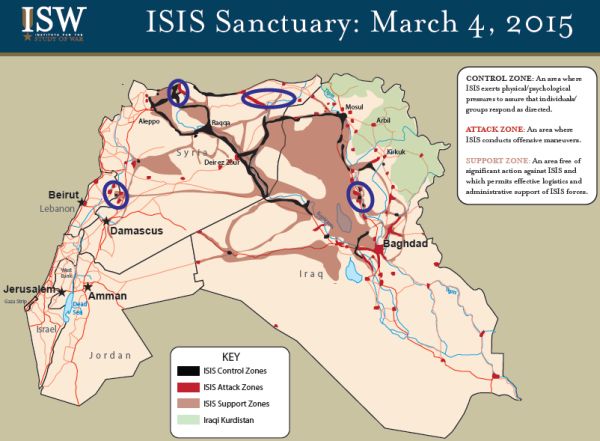
Aron Lund details the many setbacks ISIS has encountered since August 2014, but he goes on to write: The Islamic State is losing, but that does not mean that it is going to fold and disappear.
First of all, despite this long string of defeats, the Islamic State has also made progress, albeit on a lesser scale, in places like western Iraq, eastern Homs, and the Syrian desert. There is still low-hanging fruit to be picked in war-torn Syria and, for all its recent victories, the Iraqi government is staring into the barrel of economic disaster due to tumbling oil prices. Further afield, there are plenty of soft targets in Libya and Lebanon, not to mention the mouthwatering prospects that jihadis see in Jordan, Egypt and, apparently, Nigeria.
Nor should one underestimate the ability of the Islamic State to adapt to adverse circumstances. It is a flexible and lethal force and it knows what it is up against. Its top leaders have about a decade of hard-earned experience and are surely among the world’s most skilled practitioners of guerrilla war under hostile aerial supremacy. The United States was not able to decisively break Sunni jihadism in Iraq while occupying the country with 140,000 soldiers, and it will be even harder without them. And even though a number of measures have been taken to police borders, air traffic, and international bank transfers, foreign supporters in the Middle East and Europe will continue to provide the Islamic State with a hard core of fanatic volunteer fighters, suicide bombers, and financiers.
Most importantly, it must be remembered that the Islamic State is a product of the Iraqi and Syrian conflicts, not their cause. As long as the overall sectarian conflict continues, the Islamic State will continue to find willing recruits in deprived and brutalized Sunni Arab regions where becoming a holy warrior may be the only career choice available and where few community leaders see any hope of peaceful coexistence with the authoritarian rulers of Damascus and Baghdad. [Continue reading…]
Category Archives: Syria
Why the strategy in Iraq and Syria is failing
Anthony Cordesman writes: One of the ironies of a steadily more partisan Washington is that its politicians and policymakers continue to call for “strategy” without looking beyond the military dimension. One way to lose a war is to lose sight of the objective, and there seems to be an open contest between the administration and the Congress to see who can do the best job of ignoring the objective.
The key question in both Iraq and in Syria – and in what is far too often treated as a “war against ISIL” – is how do you bring any meaningful stability to either country? Military victories are at best a means to that end and can actually make things worse if they are not tied to a set of grand strategic goals.
It is important to seriously degrade the Islamic State – regardless of whether one wants to call it ISIS, ISIL, or Daesh. A violent extremist protostate not only threatens the region immediately around it, it threatens to destabilize the Islamic world and spill over into terrorist attacks outside. Even total defeat of the Islamic State, however, will scarcely end the threat of jihadist violence or put an end to the divisions inside Iraq and Syria that helped empower the Islamic State in the first place. [Continue reading…]
U.S. unclear on impact of bombing on al Qaida group in Syria
The Associated Press: The U.S. military has hit as many as 17 separate targets connected to a shadowy al-Qaida cell in Syria known as the Khorasan group, U.S. officials say, as part of a little-discussed air campaign aimed at disrupting the group’s capacity to plot attacks against Western aviation.
U.S. intelligence analysts disagree about whether the attacks have significantly diminished the group’s capabilities, according to the officials, showing how difficult it has been to develop a clear picture of what is happening on the ground in Syria.
American officials briefed on the matter agree that the air attacks have forced militants into hiding and made their use of cellphones, email or other modern communications extremely risky. The officials spoke on condition of anonymity because they were not authorized to discuss classified assessments.
There is some disagreement about how much the airstrikes have undermined the group’s ability to pose an imminent threat, U.S. officials say. Some U.S. officials say the military believes the strikes have lowered the threat, while the CIA and other intelligence agencies emphasize that the group remains as capable as ever of attacking the West.
Syria’s beleaguered opposition-in-exile is about to collapse
Global Post reports: Four years after Syria’s revolution began, its political opposition-in-exile has little to show for it.
Half-heartedly propped up by foreign governments, the Turkey-based Interim Government is going broke, and on the brink of collapse.
Khaled, a senior opposition official, is tired and depressed. We meet at a Gaziantep restaurant, in one of its three shiny malls popular for out of office meetings. It’s just down the road from the government building, which faces frequent security alerts.
He speaks frankly, seemingly relieved to get his frustrations off his chest. In his mid-30s, he’s the antithesis of the old guard that has taken the reigns of the political opposition, and is sick of pretending.
“We’re fake. We’re a lie — an illusion. We’re not a real government,” he sighs.
“Ministers think that just because someone opens a door for them that they are real… but we have zero legitimacy. We do not represent the people and don’t provide enough services.”
The illusion is convincing — the Turkey-based government has around 500 employees in addition to its teams in Syria. It produces sleek reports, holds press conferences in fancy hotels and capacity-building workshops at seaside resorts. [Continue reading…]
ISIS still on the attack, despite internal strife and heavy losses
The New York Times reports: The Islamic State is facing growing dissension among its rank-and-file fighters and struggling to govern towns and villages it has seized, but the militant Sunni group is still managing to launch attacks and expand its ideological reach outside of Iraq and Syria, senior American officials said.
In the seven months since allied warplanes in the American-led air campaign began bombing select Islamic State targets, the Sunni militancy, while marginally weaker, is holding its own, senior defense and intelligence officials said.
Pentagon officials expressed only cautious optimism on Thursday after the Islamic State lost much of the central Iraqi city of Tikrit following more than a week of fierce fighting, warning that it would be as difficult for Iraqi forces to hold the city as it was to liberate it. And even as the militants had a last stand in Tikrit, Islamic State fighters were mounting one of the fiercest assaults in months in the city of Ramadi, west of Baghdad.
But in recent months tensions have become apparent inside the Islamic State, also known as ISIS, ISIL and Daesh. The troubles stem from new military and financial pressures and from the growing pains of a largely decentralized organization trying to hold together what it views as a nascent state while integrating thousands of foreign fighters with Iraqi and Syrian militants. [Continue reading…]
The smugglers who take foreign would-be ISIS jihadis into Syria
The Guardian reports: On small dirt tracks, several minibuses and cars are waiting, each of them going to different points on the border, but all accessing Isis-controlled territory. Little by little, the minibus empties, and when it arrives in a nearby border town, which the Guardian is not naming to protect those quoted in this piece, only two passengers are left.
At the bus station, two teenage boys immediately approach, offering to take the remaining two passengers to the wire.
“Only 10 [Turkish] lira [£2.60],” offers Ahmed*, a boy in ill-fitting, mud-stained trousers, his bare feet barely filling his worn-out shoes.
Syrian smugglers such as Ali and his friend Ahmed take both goods and people across into Isis territory. They witness horror, routinely, and shrug it off.
“Just yesterday Isis beheaded three FSA [Free Syrian Army] fighters,” Ahmed says, laughing. He drops to his knees and bows his head, re-enacting the scene he says he witnessed, making a gesture imitating a sword coming down on his neck with one hand. “They chopped their heads off like this!”
Another Syrian Turkomen who had just crossed back into Turkey nods. “We saw a crucified man on the way to the border. You have no idea what we see in Syria every day now. Our lives are like a horror movie.”
Ali says he has helped to carry the luggage of countless foreigners crossing the border to reach the self-declared Islamic State. “There were French men who took their entire families with them to Syria,” he recalls. “Once I carried a bag full of dollar notes across. The guy I helped was going to give it to Isis.”
Hundreds of foreigners are believed to have used crossing points like this, though the most high-profile recent cases – the three British schoolgirls who absconded to Syria last month – are thought to have crossed farther east.
Business is thriving, the smugglers say. “We carry weapons and ammunition across as well,” says Ali. “The drivers [of the minibuses] get 500 lira per bag.”
Neither of them are Isis supporters. “No, I don’t like them. But what can I do?” asks Ahmed, grinning. “It’s a job, and I need the money.” [Continue reading…]
IRGC official: Iran indoctrinating Syria youth
NOW reports: A top Iranian Revolutionary Guards officer boasted about Tehran’s role in Syria and revealed that his country has been indoctrinating youths in the war-torn country to fight under the IRGC.
“The IRGC has begun to establish new religious groups in Syria called ‘Kashab’ among young Alawites, Sunnis, Christians and Ismailis,” Al-Arabiya on Tuesday cited Hussein Hamdani as saying.
These groups aim to carry out what Hamdani called “ideological education” for the “recruitment of teenagers in Syria to fight in militias under [the command] of the IRGC.”
The advisor to the Revolutionary Guards commander-general did not elaborate further on the youth groups, but did boast that Iran had formed 42 brigades and 138 battalions fighting for the Bashar al-Assad regime in Syria.
Hamdani added that the “establishment of the Basij in Syria was one of Iran’s most important achievements in recent years.” [Continue reading…]
Syrians describe the impact of four years of war
Faris Shihab, 35, former Free Syrian Army officer, now in Turkey, tells The Guardian: I was an officer in a huge FSA brigade in Damascus. I fought in the Mouadamiya district of west Ghouta for a year with more than 3,500 armed fighters. We were only three kilometres away from the presidential palace in July 2012. The regime was on the verge of collapse.
But when the planes struck the centre of Damascus, we had to flee to Daraya, south-west of the capital, where we hid among the groves, laboriously digging trenches, waiting for the soldiers to advance forward.
My friend Ahmed Nadeem was with me in the trench when he got a bullet in his head from a sniper. He died in my arms, aged 22 years old. For nine hours, I was in the trench with his body during airstrikes and tank shelling. I kept looking at him while he was dead: the same guy who had been sharing food with me a few minutes earlier. We had been together since first demo in Damascus. The last words he said to me were: “Please remember me as a Syrian man who died for his country.” Only after midnight, when the shelling eased, could we bury him near an olive tree.
Later, the Syrian people began to turn against the FSA. When Isis began decapitations, people started to curse those who had revolted against the regime. They thought we were the reason that these radical fighters had come to our country. But we wanted to freedom, not Isis.
Some people now think that life was better before the revolution – but these are people who did not lose a sibling, or whose car was not blown up, or whose house was not levelled. When my relatives and friends sit together or watch the news, they say: “What a pity, we were really having a great life. It is true that we did not have dignity but we had enough food.”
Now, should I keep the revolution going for the sake of the martyrs and allow more people to die from starvation under the regime’s bombing? Should I compound the number of the dead? Or conciliate with the regime in hope that one day a child among these people will lead another Syrian revolution, because our revolution is cursed by God. [Continue reading…]
Assad’s atrocities turned into an exhibition at the U.N.
Josh Rogin writes: The rise of Islamic State has distracted many from the murderous assaults by Syrian dictator Bashar al-Assad on his own citizens. Now advocates for those victims are attempting to shock world leaders into action with a novel approach: Gruesome photos of civilians tortured and murdered while in the custody of the Syrian regime are going on display Tuesday in the halls of the United Nations.
Almost a year after the Syrian defector known as Caesar escaped Syria with 55,000 photos documenting the systematic torture and murder of more 11,000 civilians, there has been little progress in holding the perpetrators accountable. Although the U.S. State Department has called Assad’s “machinery of death” the worst since the Nazis — and evidence emerged that as many as 10 European citizens were among those killed in custody — no prosecutions have moved forward.
So Caesar’s supporters will unveil a display showing atrocities committed by 24 of the regime’s security branches, which UN diplomats will see on their way to and from work each day. It comes just as a UN commission is threatening to release the names of Syrian government officials who are implicated in war crimes, a step toward their prosecution. [Continue reading…]
ISIS recruits still entering Syria from Turkey
The New York Times reports: Under pressure from its allies in the West, Turkey has made it harder for would-be jihadists to slip across the border and join the ranks of the Islamic State group at its base in northern Syria.
But it has been unable — or unwilling — to halt the flow as the group, also called ISIS or ISIL, continues to replenish forces depleted in battle.
Smugglers from border villages who have long earned a living ferrying pistachios, sugar, cigarettes and fuel across the border say they are compelled by the Islamic State to traffic in jihadists, under the threat of death or the end of their livelihoods. Sometimes they receive a late-night phone call from an ISIS commander inside Syria directing them to receive a recruit at a luxury hotel in this city to escort across the border.
“Things have become more difficult because Turkey has stricter procedures on the border,” one smuggler who gave only his first name, Mustafa, said in an interview at a cafe in Killis, a border town.
Even so, he said, he always finds a way, and sometimes the Turkish border guards in his village, who know him, look the other way.
The increased pressure means the frenetic days of 2012 are over. Foreign jihadists, with long beards and trademark fanny packs who once filled the cafes and streets in border towns, now slip quietly through Turkey, trying to attract little attention. Military supply shops, which once openly sold black headbands printed with Islamist slogans, body armor and, sometimes, weapons to foreigners on their way to Syria, have taken their business into back rooms. [Continue reading…]
Rising out of chaos: ISIS in Libya
Frederic Wehrey and Ala’ Alrababa’h write: Recent attacks in Libya by the so-called Islamic State, including the brutal slaughter of Egyptian Copts, the Corinthia Hotel attacks, car bombings in Qubbah that killed at least 45 people, and an attack on the Iranian embassy, have brought the spread of extremism in Libya to the forefront. While the Islamic State has intensified its activity in recent weeks, its spread into Libya began early in 2014 as Libyan jihadists began to return from Syria.
Jihadi groups in Libya were already deeply fragmented and localized, but the rise of the Islamic State in Iraq and Syria in 2013 and 2014 sparked new debates, eventually dividing the Libyan jihadis between supporters of the Islamic State and supporters of al-Qaeda and its regional affiliates—mainly al-Qaeda in the Islamic Maghreb (AQIM) in North Africa and the Nusra Front in Syria.
Libyans had already begun traveling to fight in Syria in 2011, joining existing jihadi factions or starting their own. In 2012, one group of Libyans in Syria declared the establishment of the Battar Brigade in a statement laden with anti-Shia sectarianism. The Battar Brigade founders also thanked “the citizens of Derna,” a city in northeastern Libya long known as a hotbed of radical Islamism, for their support for the struggle in Syria. [Continue reading…]
ISIS: Inside the army of terror
In ISIS: Inside the Army of Terror, authors Michael Weiss and Hassan Hassan set out to answer a simple question that was repeatedly being asked on cable news shows in the summer and fall of 2014: Where did ISIS come from, and how did it manage to do so much damage in so short a period of time?
As they note, while this may have seemed like a compelling question at the time, it was also strange, given that the United States has been fighting ISIS in Iraq — in the group’s various incarnations — for almost a decade.
In the book’s introduction (which follows) we learn that the path which led many young men to fight for ISIS commonly began with the desire to fight against the Assad regime.
In late 2011, Abdelaziz Kuwan approached his Syrian uncle to connect him to Riad al-Asaad, a colonel in the Syrian Air Force and one of the earliest military defectors from the dictatorship of Bashar al-Assad. Abdelaziz, a sixteen-year-old teenager from Bahrain, wanted to join the armed rebellion in Syria, but his parents forbade him from going. So he defied them.
In early 2012, he flew first to Istanbul and then, as so many other foreign fighters have done, took a thirteen-hour bus ride to the southern Turkish border town of Reyhanli. From there, he crossed into the Syrian province of Aleppo, the northern countryside that had by then completely fallen into the hands of the armed anti-Assad rebellion. Abdelaziz fought for moderate rebel factions for several weeks before deeming them too corrupt and ineffective. Then he migrated through various Islamist brigades, joining first Ahrar al-Sham and then Jabhat al-Nusra, which later revealed itself to be the al-Qaeda franchise in Syria. Having earned a reputation as a fearless and religiously devout fighter, Abdelaziz nonetheless grew disenchanted with his Islamist comrades and faced pressure from his family to return to Bahrain. He did at the end of 2012. Once home, Abdelaziz’s mother promptly confiscated his passport.
“I walk in the streets [of Bahrain] and I feel imprisoned,” Abdelaziz told the authors a year later, still pining for his days as a holy warrior. “I feel tied up. It’s like someone is always watching me. This world means nothing to me. I want to be free. I want to go back. People are giving their lives, that’s the honorable life.”
Abdelaziz’s family had moved to Bahrain from eastern Syria in the 1980s. His parents provided him with the means to lead a decent life. “His father raised him well,” one relative recalled. “He did not make him need anyone and wanted him to be of a high social status.” The relative added that Abdelaziz was “quiet,” “refined,” and “always behaved like a man.”
Abdelaziz stayed in Bahrain for three months before he managed to persuade his mother to give him back his passport. He left for Syria three days later. Once he arrived, Abdelaziz joined the Islamic State of Iraq and al-Sham (ISIS), which was then rising in prominence as one of the most disciplined and well-organized jihadist groups in Syria. Abdelaziz later said that in his last few months in Bahrain he made the decision to join ISIS after speaking with “some of the brothers” in Syria via Skype. His prior experience with other Islamist factions ideologically similar to ISIS was an advantage in joining one that was dominated by foreign fighters. Abdelaziz rose through the ranks of ISIS, first becoming a coordinator among local emirs and other rebel groups, then delivering messages and oral agreements on behalf of his leader. When ISIS seized enormous swaths of territory in both Syria and Iraq in the summer of 2014, Abdelaziz was promoted to a security official overseeing three towns near the Syrian-Iraqi border town of Albu Kamal, long a portal between the two countries for men like him.
In ISIS, Abdelaziz discovered new things about himself. He learned that he was violent, brutal, and determined. He beheaded enemies. He kept a Yazidi girl in his house as a sabiyya, or sex slave. She was his prize for his participation in battles against the Iraqi Kurdish peshmerga forces and other Kurdish militias in Sinjar, Iraq, near the Syrian border. According to ISIS’s propaganda magazine, Dabiq, one-fifth of the sex slaves taken from Sinjar was distributed to ISIS’s central leadership to do with as it so chose; the remainder was divided amongst the rank and file, like Abdelaziz, as the spoils of war.
Abdelaziz showed us a picture of his sabiyya. She was in her late teens. She “belonged” to Abdelaziz for about a month before she was handed off to other ISIS commanders.
Continue reading
Are Turkey and Saudi Arabia working together against Iran?
Fehim Taştekin writes: The relationship between Turkey and Saudi Arabia until now has been treated as almost sacrosanct and is one that is not argued about. Although Turkish and Saudi views on regional issues do not always coincide, both Ankara and Riyadh have kept their bilateral relations away from regional squabbles. Turks, in general, associate Saudi Arabia with pilgrimage (hajj) and oil prices. Aware of the tense rivalry for regional influence between Saudi Arabia and Iran, Turkey has tried to maintain good relations with both countries, and it was in Syria that Turkish and Saudi interests meshed. Although they agree that Syrian President Bashar al-Assad must go, the Turkish-Qatari axis competes with that of Saudi Arabia in Syria. Some suggest that the failure of the Syrian opposition to get its act together was because of this competition. A similar rivalry is now seen in Egypt because of the Justice and Development Party (AKP) government’s backing of the Muslim Brotherhood, and in Libya because of the AKP’s support of the Tripoli government instead of the one in Tobruk. Although Saudi Arabia is the most prominent supporter of Egyptian President Abdel Fattah al-Sisi, who toppled the Muslim Brotherhood, and of the Tobruk government in Libya, Turkey has not raised its voice against Riyadh while disparaging other countries. Now, Erdogan is adding a new controversial dimension to the unblemished Turkish relationship with Saudi Arabia.
During his visit to Saudi Arabia between Feb. 28 and March 2, Erdogan in his meeting with the new Saudi king, Salman bin Abdul-Aziz Al Saud, reached an agreement to increase Saudi-Turkish support of the Syrian opposition to levels that would enable the two countries to achieve their goals there. According to journalists accompanying Erdogan, Salman also promised to support Turkey in declaring a no-fly zone.
The two leaders, in addition to discussing Syria, Iran, Yemen, Palestine and Egypt, also reached an understanding that illustrates how Turkey is now being dragged into the much more dangerous issue of Iran. [Continue reading…]
Al-Nusra Front leader, commanders reported killed in Syria
AFP: The military chief and several top commanders of the Al-Qaeda-affiliated Al-Nusra Front have been reported killed in northwestern Syria, where the jihadist militia has been making major gains in recent months.
Syrian state media, a monitoring group and a local activist reported that Abu Hammam al-Shami had been killed but information on the circumstances of his death was contradictory.
Official Nusra sources did not announce the death of the jihadist, who is believed to have fought with Al-Qaeda in Afghanistan.
U.S. presses U.N. on Syria chlorine attacks
The New York Times reports: The United States is pushing the United Nations Security Council to condemn the use of chlorine as a chemical weapon in Syria, and impose unspecified measures against those who use it in the future.
A draft resolution written by the United States, obtained by The New York Times on Wednesday evening, does not specify who used chlorine as a weapon in Syria’s civil war, except to remind the government of Syria that it had agreed to destroy its chemical-weapons arsenal under a resolution adopted in September 2013.
The Organization for the Prohibition of Chemical Weapons, the global group that monitors compliance with a treaty banning these munitions, concluded in a report this year that chlorine had been used to make bombs, which witnesses said were dropped from helicopters.
That report also did not say who was to blame, although the Syrian military is the only faction in the conflict that has helicopters. Activists have previously collected video of aerial bomb attacks, in which yellow gas is seen being released. [Continue reading…]
ISIS-controlled territory in Iraq and Syria has not significantly diminished since June 2014
Airstrikes starting to take toll on ISIS’s money flow
McClatchy reports: The Islamic State might be the best-funded radical Islamist group, perhaps in history, but the coalition air campaign that’s targeting its oil-refining operations and military assets has begun to damage its ability to earn.
And by denying the group additional territorial expansion, the airstrikes have limited the opportunities for it to profit from capturing new infrastructure and banks, according to a recent report by a money-laundering watchdog group, as well as U.S. officials and residents of Islamic State territory.
The Islamic State, a self-styled modern caliphate that controls much of northern and western Iraq and eastern Syria, turned itself into perhaps the richest and best-equipped military non-state actor last June after seizing tremendous amounts of money and equipment from the Iraqi government as it swept through Mosul and to the western and northern outskirts of Baghdad while the Iraqi army collapsed.
The Islamic State is thought to have at least 30,000 combatants and 5 million to 6 million people under its control, leaving a huge economy to be taxed and extorted.
Thousands of armored vehicles and thousands of tons of military equipment, much of it modern weaponry supplied to Iraq by the United States, were seized in the rout last June, along with cash reserves from government banks, mostly in local currency, of at least $500 million, according to the Financial Action Task Force, an international money-laundering body that examined the group’s complex financial operations in a report released in late February.
That windfall came as the group was already making millions of dollars a day pumping and refining oil and petroleum products from previously captured oil fields, mostly in eastern Syria, where the group has wrested control of at least 50,000 barrels per day of oil and refined petroleum output, according to the task force’s report, a number widely supported by reports from the area.
Although the task force notes recent efforts by Turkish and Kurdish officials to limit the Islamic State’s ability to export these products by smuggling, not all the exporting has been stopped. Even the group’s rudimentary oil-refining ability — a process commonly targeted by coalition airstrikes — while damaged, is probably sufficient to at least support the group’s huge military operation and provide some income stream. [Continue reading…]
‘Assad-controlled’ Syria is controlled by militias
Aron Lund writes: In a recent report for Open Democracy, Dutch journalists Robert Dulmers and Teun Voeten tell of a recent trip through the parts of Syria still held by President Bashar al-Assad’s forces. Embedded with the Syrian military, they traveled by car from the capital Damascus via the reconquered city of Homs to Aleppo in the north, and back.
These cities, the country’s three largest, are at the core of Syria in every way: politically, culturally, economically, and, of course, demographically. Assad’s dominance over the Damascus-Homs-Aleppo axis, in addition to the coastal areas, Hama City, large parts of the south, and even a few small pockets in the northeast (Qamishli, Hasakah, and Deir ez-Zor), underscores that he remains the central actor of this war. He is the ruler of not exactly Syria, but of “useful Syria,” a potentially economically viable region encompassing at least two-thirds of the country’s population.
But what about the state of the regime itself? The most interesting part of Dulmers and Voeten’s account is their brief insider view of the pro-Assad forces. “In 12 days travelling some 1,200 km, except for special forces in Aleppo we hardly saw anything of the regular army,” they write, noting that most of the many checkpoints and bases along the road were manned by locally recruited militias.
The slow “militiafication” of Assad’s Syrian state has been going on since the start of the conflict in 2011, when so-called Popular Committees spawned spontaneously or were recruited by intelligence services and pro-Assad businessmen all over Syria, mirroring the mobilization of anti-government demonstrators. The opposition (and much of the international media, which at the time listened to no one else) called these militias “shabiha,” a vague term meaning approximately pro-Assad thugs, and dismissed them as a few thousand paid gangsters or members of the Alawite sect, the minority group to which Assad also belongs. But this was an underestimation of the Assad regime’s social roots. The “shabiha” phenomenon was no mere Alawite militia, but representative of a genuine popular mobilization of a significant minority of Syria’s population in favor of the regime, partly — but by no means exclusively — on a sectarian basis. [Continue reading…]