Reuters reports: Leaders of Syria’s Nusra Front are considering cutting their links with al Qaeda to form a new entity backed by some Gulf states trying to topple President Bashar al-Assad, sources said.
Sources within and close to Nusra said that Qatar, which enjoys good relations with the group, is encouraging the group to go ahead with the move, which would give Nusra a boost in funding.
The exercise could transform Nusra from a weakened militia group into a force capable of taking on Islamic State at a time when it is under pressure from bombing raids and advances by Kurdish and Iraqi military forces.
It could also boost the influence of Qatar and its allies in the campaign to oust Assad, in line with the Gulf state’s growing diplomatic ambitions in the region. [Continue reading…]
Scientific American reports: Climate change can make storms stronger, cold spells longer and water supplies drier. But can it cause war? A new study published today in Proceedings of the National Academy of Sciences says drought in Syria, exacerbated to record levels by global warming, pushed social unrest in that nation across a line into an open uprising in 2011. The conflict has since become a major civil war with international involvement.
Drying and drought in Syria from 2006 to 2011 — the worst on record there — destroyed agriculture, causing many farm families to migrate to cities. The influx added to social stresses already created by refugees pouring in from the war in Iraq, explains Richard Seager, a climate scientist at Columbia University’s Lamont-Doherty Earth Observatory who co-authored the study. The drought also pushed up food prices, aggravating poverty. “We’re not saying the drought caused the war,” Seager said. “We’re saying that added to all the other stressors, it helped kick things over the threshold into open conflict. And a drought of that severity was made much more likely by the ongoing human-driven drying of that region.”
Seager added that the entire Middle East “faces a drier, hotter climate due to climate change. This will stress water resources and agriculture, and will likely further increase risk of conflict.” Global warming is desiccating the region in two ways: higher temperatures that increase evaporation in already parched soils, and weaker winds that bring less rain from the Mediterranean Sea during the wet season (November to April). [Continue reading…]
The Washington Post: The Syrian rebel group Harakat al-Hazm, one of the White House’s most trusted militias fighting President Bashar al-Assad, collapsed Sunday, with activists posting a statement online from frontline commanders saying they are disbanding their units and folding them into brigades aligned with a larger Islamist insurgent alliance distrusted by Washington.
The statement bore Hazm’s stamp and logo, and according to the Syrian Observatory for Human Rights, a pro-opposition monitoring group, the brigade’s fighting units are disbanding. Emails and phone calls to Hazm’s political leaders were not returned.
“Given what is happening on the Syrian front, offenses by the criminal regime with its cronies against Syria as a whole, and Aleppo specifically, and in an effort to stem the bloodshed of the fighters, the Hazm movement announces its dissolution,” the statement said.
Charles Lister, an analyst with U.S, think tank Brookings, described in a tweet the implosion of the group as “absolutely remarkable.” [Continue reading…]
The New York Times reports: Mr. Emwazi was called “Jihadi John” by the foreign hostages he guarded, a number of whom he apparently beheaded in widely circulated videos. He was first identified on Thursday by The Washington Post website, and his name was confirmed by a senior British security official. The official said that the British government had identified Mr. Emwazi some time ago but had not disclosed his name for operational reasons. The identification was also confirmed in Washington by a senior United States military intelligence official.
Information is still vague about Mr. Emwazi, with Britain officially refusing to confirm that he is indeed “Jihadi John” because of what are described as continuing operations.
But Mr. Emwazi appears in 2011 court documents, obtained by the BBC, as a member of a network of extremists who funneled funds, equipment and recruits “from the United Kingdom to Somalia to undertake terrorism-related activity.”
Mr. Emwazi is alleged to be part of a group from West and North London, sometimes known as “the North London Boys,” with links to the Somalia-based terrorist group Al Shabab, organized by an individual who had returned to London in February 2007 and whose name was redacted in court documents.
Another person associated with that group was Bilal al-Berjawi, who was born in Lebanon but brought to West London as a baby. He fought in Somalia and rose through the ranks of Al Shabab and Al Qaeda in Africa before being killed in a drone strike in January 2012, according to Raffaello Pantucci, also a fellow at the Royal United Services Institute.
Mr. Berjawi traveled to Kenya in February 2009, telling his family he was heading for a safari; he and a friend were detained in Nairobi and shipped back to London, but made it to Somalia in October that year.
The neighborhood group “is a tight community and it’s very probable that they knew each other and were part of the same crew,” Mr. Pantucci said.
So it is likely that Mr. Emwazi’s own safari a few months later in May, from Britain to Germany to Tanzania, using the name of Muhammad ibn Muazzam, set off alarms with the British security services, and that he had started on the road to radicalism even before his encounter with MI5 in 2009. [Continue reading…]
A study of the origins and make-up of Islamic State characterizes the jihadist group as a ‘spectral hold-over’ of the old regime.
‘Most of its top decision-makers served either in Saddam Hussein’s military or security services. In a sense, ‘secular’ Baathism has returned to Iraq under the guise of Islamic fundamentalism.’
The authors, Syrian researcher Hassan Hassan, who hails from the town of Albu Kamal on the Iraqi border, and the American journalist Michael Weiss, write that this contradiction between secular and fundamentalist is more apparent than real.
Despite the secular origins of the Baath party, Saddam Hussein used it to preserve the dominance of Iraq’s Sunni Muslims – only 20 per cent of the population – and repress the majority Shia. In the declining years of his rule Saddam Hussein adopted an overtly religious path, in the hope of co-opting the Sunni Muslim leadership. In fact, Saddam lost control of his so-called Islamic Faith Campaign and many Baath Party members fell under the spell of the imams. [Continue reading…]
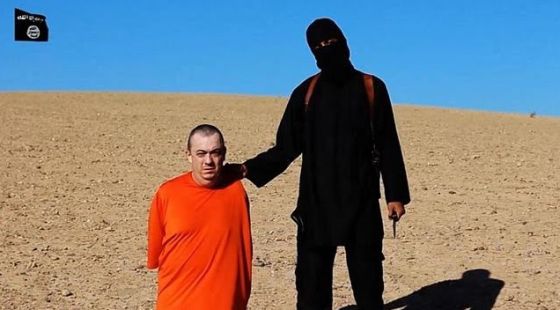
British aid worker, Alan Henning, and his executioner, alleged to be British jihadist, Mohammed Emwazi.
The Washington Post reports: The world knows him as “Jihadi John,” the masked man with a British accent who has beheaded several hostages held by the Islamic State and who taunts audiences in videos circulated widely online.
But his real name, according to friends and others familiar with his case, is Mohammed Emwazi, a Briton from a well-to-do family who grew up in West London and graduated from college with a degree in computer programming. He is believed to have traveled to Syria around 2012 and to have later joined the Islamic State, the group whose barbarity he has come to symbolize.
“I have no doubt that Mohammed is Jihadi John,” said one of Emwazi’s close friends who identified him in an interview with The Washington Post. “He was like a brother to me. . . . I am sure it is him.”
A representative of a British human rights group who had been in contact with Emwazi before he left for Syria also said he believed Emwazi was Jihadi John, a moniker given to him by some of the hostages he once held.
“There was an extremely strong resemblance,” Asim Qureshi, research director at the rights group, CAGE, said after watching one of the videos. “This is making me feel fairly certain that this is the same person.” [Continue reading…]
Qureshi, in a statement on the CAGE website, portrays Emwazi as a victim of British counter-terrorism policies:
This case should trigger thinking about British domestic and foreign policy. What risk assessments, if any, have been made about British counter-terrorism policy and the key part it plays in radicalising individuals? How have the security services been allowed to get away with abusing British citizens without redress? Why are the long-standing grievances over Western interventions in the Muslim world been ignored?
Propagandists have a habit of becoming the most devout believers in their own narrative, but I think it requires a particularly distorted mindset to portray Emwazi, given his alleged actions, as a victim.
In a press conference today, Qureshi described Emwazi as a “kind” and “gentle” young man.
In a video released today, Qureshi says: “The questions shouldn’t be about Jihadi John but they should be about what role our security services have played in alienating people in this society and turning them away from being able to find solutions to the problems they have.”
Moazzam Begg, CAGE’s director of outreach and a former detainee at Guantánamo, can also reasonably argue that he has been a victim of Britain’s counter-terrorism policy and what some see as its over-zealous security services.
Given Qureshi’s reasoning, are we to imagine that Begg or anyone else finding themselves in a similar position might be just as likely to follow in Emwazi’s footsteps and become another of ISIS’s executioners?
In fact, Begg has no illusions about ISIS: “You have no idea how dangerous these people are,” he wrote on Facebook in early 2014.
“I saw muhajireen (foreigners), locked in cages, by Allah worse, than my Guantanamo cell.
“They beat people to make them confess…just like the Arab regimes, there is no difference.
“I have been to many places, Bosnia, Afghan… but never seen this kind of fitnah [turmoil] and such dangerous extremism and readiness for takfeer [excommunication].
“Syrians on the ground have started to hate foreigners because of them.
“ISIS have even detained and killed aid workers…brothers from UK who have taken convoys [have] been looted by ISIS, guns shoved in faces of brothers who have crossed Europe to bring aid.
“And what’s the basis of detaining the non-Muslim aid worker [Alan Henning] who came in as a guest of Muslims, under their protection? They’ve probably murdered him too, just like many Muslims they’ve done that to.”
The world is full of people who for multitudes of justifiable reasons regard themselves as victims, yet this doesn’t absolve them of responsibility for their own actions.
The Guardian adds: “Jihadi John” is one of a trio of Britons who held hostage Spanish, French, Danish, British and US nationals. The hostages were captured in northern Syria, some in Idlib province, others in Aleppo and a third group in and around Raqqa province, which has since become the main Syrian stronghold of Isis.
The jihadi cell that spawned Isis was initially strong in Idlib province, having taken root there in the summer of 2012. From there it spread to Aleppo, where hostages that had been captured at that point were held in one of two locations – under the eye hospital in the centre of the city or in a factory deep in an industrial zone on its northern outskirts.
By February last year, all the hostages, including Briton John Cantlie, who is one of two remaining western hostages, were moved to Raqqa.
It was in Raqqa that the hostages first became aware of the status that Emwazi had developed among Isis. One former hostage described him as “cold, sadistic and merciless”.
Time reports: The regime of Syrian President Bashar Assad has long had a pragmatic approach to the Islamic State of Iraq and Greater Syria (ISIS), says a Syrian businessman with close ties to the government. Even from the early days the regime purchased fuel from ISIS-controlled oil facilities, and it has maintained that relationship throughout the conflict. “Honestly speaking, the regime has always had dealings with ISIS, out of necessity.”
The Sunni businessman is close to the regime but wants to remain anonymous for fear of repercussions from both ISIS supporters and the regime. He trades goods all over the country so his drivers have regular interactions with ISIS supporters and members in Raqqa, the ISIS stronghold in Syria, and in ISIS-controlled areas like Dier-ezzor.
The businessman cites Raqqa’s mobile phone service as an example of how there is commerce between the regime, Syrian businesses, and ISIS. The country’s two main mobile phone operators still work in Raqqa. “Both operators send engineers to ISIS-controlled areas to repair damages at the towers,” he says. In addition, there are regular shipments of food to Raqqa. “ISIS charges a small tax for all trucks bringing food into Raqqa [including the businessman’s trucks], and they give receipts stamped with the ISIS logo. It is all very well organized.”
The businessman has a driver who lives in an ISIS-controlled area near Dier-Ezzor. “My driver is always telling me how safe things are at home. He can leave the door to his house unlocked. ISIS requires women to veil, and there is no smoking in the streets. Men can’t wear jeans either. But there are no bribes, and they have tranquility and security. It’s not like there are killings every day in the streets like you see on TV.”
And, he notes, ISIS pays well — slightly less than the pre-war norms but a fortune in a war-torn economy: engineers for the oil and gas fields are paid $2,500 a month. Doctors get $1,500. Non-Syrians get an expatriate allowance, “a financial package that makes it worthwhile to work for ISIS,” says the businessman.
Assad does not see ISIS as his primary problem, the businessman says. “The regime fears the Free Syrian Army and the Nusra Front, not ISIS. They [the FSA and Nusra] state their goal is to remove the President. But ISIS doesn’t say that. They have never directly threatened Damascus.” As the businessman notes, the strikes on ISIS targets are minimal. [Continue reading…]
The New York Times reports: Continuing its assaults on a string of Assyrian Christian villages in northeastern Syria, the Islamic State militant group has seized scores more residents over the past two days, bringing the number of captives to as many as several hundred, Assyrian organizations inside and outside Syria said on Thursday.
The number of captives reported by different Assyrian groups has varied because, in the chaos of fighting, many families are fleeing and it has taken time to verify by name those captured.
The Syriac Military Council, a militia formed in recent years to protect Assyrian villages in the traditionally diverse area of Hasaka, in northeastern Syria, said in a statement that more than 350 civilians from 12 villages had been abducted.
George Stifo, a leader of the United States branch of the Assyrian Democratic Organization, part of the Syrian opposition, provided the names of 96 captives, which included several children. The Assyrian International News Agency, a website tracking community news, reported that 150 were missing.
The Syrian Observatory for Human Rights, an antigovernment monitoring group with a network of contacts in Syria, said on Thursday that 220 were missing. [Continue reading…]
Emile Hokayem writes: Military and diplomatic efforts in Syria are converging in Aleppo, once the country’s largest city and commercial center. Last week, U.N. Special Envoy Staffan de Mistura reported to the Security Council that Syrian President Bashar al-Assad had agreed to suspend for six weeks all aerial and artillery bombardment of the besieged city, which is divided between the regime and rebel groups.
The supposed agreement, however, does not represent much of a breakthrough, especially when compared with the diplomat’s initial ambitions of a broad “freeze” over the whole province of Aleppo, which would then be replicated in other regions later. Behind closed doors and in front of the media afterward, de Mistura sought to lower expectations, saying he had “no illusions” about the difficult task ahead. He also did not explain how a limited freeze in Aleppo could change the calculations of the various local and regional players or create new incentives for a political negotiation among the warring sides.
De Mistura’s New York briefing coincided with a large-scale regime offensive to fully encircle Aleppo from the north. Regular military units, the paramilitary auxiliaries of the National Defense Force, and Hezbollah fighters sought to press their advantage in the areas of Handarat and Malaah, north of the city, with the intention of seizing three important villages and breaking rebel groups’ siege of the Shiite towns of Zahra and Nubl. Controlling these villages and connecting roads would sever the links between the Aleppo countryside and the vitally important border with Turkey.
But the initially rapid advance of the pro-regime forces was stopped and rolled back in several areas. Bad weather grounded Assad’s helicopters and aircraft during much of the battle — overcast weather, a rebel commander quipped to me, imposed the no-fly zone that the Americans had denied the rebellion since 2011. After capturing important territory in surprise attacks over two days, Assad’s forces were surrounded by Syrian rebels who killed well over 100 soldiers and captured dozens more, making this time among the costliest days for the regime since the beginning of the armed uprising. [Continue reading…]
Al Jazeera reports: Ammar Kassir became a refugee to avoid killing fellow Syrians.
In 2012, as pro-democracy marches on the streets of Damascus were increasing, Kassir was a part of a police unit working under the direct control of President Bashar al-Assad. One afternoon, he was ordered to open fire on protesters marching for democracy.
“Assad told us we must kill these people who are making demonstrations. The protesters were shouting ‘Freedom! Freedom!’, and he said we must kill these people. I did not want to do that,” Kassir told Al Jazeera.
The safe choice would have been to follow the orders he was given. The policeman, who was 20-years old at the time, chose to resist, even though he knew refusing orders meant he would have to escape for his own safety.
Kassir became a refugee, one of three million Syrians who have fled their country in the past three years.
He left Damascus, heading north to his family’s home in Idlib. From there, he made his way alone to Turkey, crossing the border by foot.
Since the Syrian uprising began, 95 percent of the Syrians who fled their native country remained in the region, mainly in Lebanon, Jordan, and Turkey.
Kassir had other plans.
He wanted to get to Europe, to reach a safer country that would give him a chance to restart his life.
Legal pathways to Europe for Syrian refugees are rare and Kassir – like many other Syrians who sought refuge in Europe – was forced onto dangerous and expensive smuggling routes. [Continue reading…]
Der Spiegel reports: If you ask Allan Aarslev, the friendly blond police commissioner from Aarhus, about his almost globally famous program, he answers with numbers. He mentions, for example, 31, 16 and one.
In 2013, he says, 31 Muslim men from Aarhus left for Syria with the intention of joining the radical jihadists of Islamic State (IS). Five of them have since lost their lives and 10 remain in the war zone. But 16 have returned to Aarhus, either for a rest before rejoining the fight, or to remain in Denmark and, as Aarslev says, perhaps become a danger closer to home.
But the program he designed for those returning from Syria has ensured that no such danger has developed. Indeed, since the project began only a single man from Aarhus has traveled to Syria to join the war. “One single person,” says Aarslev, doing his best to sound humble. The young men who live here in Aarhus, he says, are much less radical than they were just one year ago.
Denmark can use that kind of comforting news these days. The two murders committed just over a week ago by Omar Abdel Hamid el-Hussein, a 22-year-old with Palestinian roots, have hit Denmark’s liberal society hard. And they have reignited the debate that was triggered by the attacks on Charlie Hebdo in Paris: How can a society that holds freedom of opinion to be an inalienable right prevent political-religious violence?
Copenhagen was a rather grim place to be last week with police officers armed with machine guns standing at bus stops and in front of shopping centers, helicopters buzzing low over the city and the shriek of sirens frequently piercing the air. Last Monday’s large demonstration, which saw 30,000 people gather at Gunnar Nu Hansens Plads in the heart of the city, did little to alleviate the shock — even if Prime Minister Helle Thorning-Schmidt proclaimed that all Danes had joined hands in the face of such difficult times.
Everywhere, though — in the editorial offices of newspapers like Politiken, for example, and at police headquarters in Copenhagen — people were talking about the pilot program in Aarhus. Indeed, the city’s mayor even flew to Washington recently at the invitation of President Barack Obama to talk about the Aarhus project, says Commissioner Aarslev. The city has received 150 requests from across the globe for more information and delegations are constantly visiting.
The program is almost naive in its simplicity. A significant number of the some 250 people involved work as scouts whose job it is to spot young Muslim men who have become radicalized. Once identified, they are approached by authorities in conjunction with a local Muslim cleric in the hopes of turning them away from violence. It is essentially a vast screening program for potential terrorists. And the strange thing is: It appears to be working. [Continue reading…]
The New York Times reports: Aqsa Mahmood’s family saw her as an intelligent and popular teenager who helped care for her three younger siblings and her grandparents at her home in Scotland. She listened to Coldplay, read Harry Potter novels and drank Irn Bru, a Scottish soft drink.
She aspired to be a pharmacist or a doctor, and they did not expect her to leave her home in Glasgow in November 2013 to go to Syria, where the authorities now say she is one of the most active recruiters of young British women to join the Islamic State.
The authorities are investigating possible links between Ms. Mahmood, who goes by the name Umm Layth (meaning Mother of the Lion), and the disappearance last week of three teenagers from London. They, too, are believed to have traveled to Syria to join the terrorist group also known as ISIS or ISIL.
The apparent trend of studious, seemingly driven young women leaving home to join violent jihadists has become disturbingly familiar. [Continue reading…]
Human Rights Watch: The Syrian government has carried out hundreds of new indiscriminate attacks over the past year with air-delivered munitions, including improvised weapons such as barrel bombs. The attacks have had a devastating impact on civilians, killing or injuring thousands of people.
Human Rights Watch documented the attacks in Aleppo governorate in northern Syria and in Daraa governorate in the south based on witness statements, satellite imagery analysis, and video and photographic evidence. Although the United Nations Security Council condemned the attacks in a resolution adopted a year ago, it has not responded directly to the new wave of attacks.
“For a year, the Security Council has done nothing to stop Bashar al-Assad’s murderous air bombing campaign on rebel-held areas, which has terrorized, killed, and displaced civilians,” said Nadim Houry, deputy Middle East and North Africa director. “Amid talk of a possible temporary cessation of strikes on Aleppo, the question is whether Russia and China will finally allow the UN Security Council to impose sanctions to stop barrel bombs.”
In an interview with the BBC on February 10, 2015, President Assad claimed that his forces were not using barrel bombs in spite of a wealth of evidence to the contrary. [Continue reading…]
Iranian leaders have told supporters in Iraq not to attack U.S. bases, but that detente could dissolve if the war in Syria expanded to take on Mr. Assad, U.S. officials say.
“Because we have a common enemy, a common goal, everybody is moving in the same direction,” said the senior military official. “You cross a red line in Syria, you start to infringe on what Iran sees as its long-term interest and those Shia militias could turn in the other direction.”
Military officials said their ability to control the rebels will be limited once they are on the battlefield. However, the senior official said the U.S. will have some leverage, including ammunition resupply, stipends paid to the fighters and support from airstrikes. “All those things could be put at risk if they go counter to what we have asked them to do,” the official said. [Continue reading…]
Reuters: Islamic State militants have abducted at least 150 people from Assyrian Christian villages in northeastern Syria they had raided, Christian Syrian activists said on Tuesday.
A Syrian Christian group representing several NGO’s inside and outside the country said it had verified at least 150 people missing, including women and elderly, who had been kidnapped by the militants.
“We have verified at least 150 people who have been abducted from sources on the ground,” Bassam Ishak, President of the Syriac National Council of Syria, whose family itself is from Hasaka, told Reuters from Amman.
The Wall Street Journal reports: Along the southern frontier of the European Union, a small but growing number of aspiring jihadists are blazing trails by road and ferry to Syria’s battlefields, sidestepping heightened airport security and slipping through the holes in Europe’s intelligence dragnet.
Some fighters follow meandering bus routes through several countries en route to the more loosely guarded border of Bulgaria to Turkey. Others engage in what authorities call “broken travel,” using family visits or holiday destinations as an initial leg to mask their final destination.
That was how the wife of Paris terrorist Amedy Coulibaly slipped into Syria days before her husband killed four people at a kosher grocery last month. The woman, Hayat Boumeddiene, drove from France to Spain, then flew to Turkey before joining Islamic State in Syria. She later called for others to join her, in an interview with the militant group also known as ISIS or ISIL.
Western diplomats and intelligence officials say most aspiring European fighters still try to fly directly to Turkey, which borders western Syria.
But the growing use of alternative routes magnifies a security challenge for EU policy makers: How to catch suspected militants without undermining the bloc’s commitment to free movement across a region where passport and customs checks at national borders have been effectively abolished. [Continue reading…]
Aaron Stein and Michael Stephens write: Just days after finalizing an agreement to train a new rebel force inside Turkey to attack the Islamic State, Turkish forces moved into Syria to evacuate some 40 soldiers protecting the Suleyman Shah Tomb: a small Turkish enclave on the eastern bank of the Euphrates river, 30 kilometers from the Turkish border town of Karkamis. The operation included 39 tanks, 57 armored vehicles, and an estimated 572 military personnel. The soldiers removed the body of Suleyman Shah and transported his remains to an area just opposite the Turkish town of Esmeler.
In their analysis of the operation, Stein and Stephens come to these conclusions:
It is important to put this operation into perspective: Ankara launched a limited incursion to evacuate a tomb that had come under threat. The coalition, the Kurds, and the FSA did much of the heavy lifting. Turkey, however, has proven yet again that its role in the Syrian conflict must not be overlooked. It has links to all the main actors operating in northern Syria and is able to generally get its way with most of them, albeit with the occasional disagreement.
The biggest change appears to be Ankara’s approach to ISIS. Since 2013, Turkey had treated ISIS as an irritant, rather than a major security threat, but the Suleyman Shah operation is the clearest sign to date that this approach is changing. However, it is far too early to determine whether this will result in Turkey changing its approach to the coalition’s military operations. All signs indicate that Turkey will not agree to increase its role in the coalition by opening up Incirlik Air Force base for armed strikes, or by allowing its planes to bomb ISIS directly.
Turkey’s role will remain limited to the train and equip, intelligence sharing, and border enforcement, rather than engaging ISIS from the air. In fact one must consider that now that the potential embarrassment of an ISIS takeover of the Tomb has been avoided, Turkey will take a more relaxed stance to events south of its border, and it is unlikely that another Turkish military incursion will be repeated. It is more likely that Turkey will continue with the policy it has pursued thus far: border defense at airports, increased military deployments along certain areas of the border, and the training of the new rebel brigade with US assistance. This signals one key change: Turkey is now attacking ISIS through the use of proxies, which Ankara had previously rejected, in favor of focusing on Assad.
The Guardian reports: When Isis took over Raqqa, a wave of black swept over the city. The group’s dark flags were raised where its members lived or worked, women were required to shroud themselves in black, and black paint was daubed on buildings and in public spaces.
When US air strikes started, though, activists warned families not to dry dark clothes outside or on their roofs, in case they were mistaken for Isis flags. Perhaps Isis was worried, too, as it has started repainting everything. One central square, where crucifixion and other gruesome punishments are carried out in public, has been decked out in candy colours – pink, green and white. Another is golden.
Apparently, the pressures of publicity and the mundane and expensive business of ruling a city have pushed even Isis to make some compromises.
Last summer, crimes like smoking or failing to shutter a shop during prayer time would have earned transgressors several dozen lashes, but some religious police have started to accept fines in place of punishment from those who can afford it. There are even reports that they have been forcing traders to stay open through prayers, so that they can collect more money from them – around 1,500 Syrian pounds (around £5) each time.
It is not just money that they are short of. They lack blood for fighters injured in air strikes or on the frontline. People don’t want to donate, so they compel them. Anyone with business at the Islamic court is told first to go to a certain hospital, donate a pint of blood, then return with the receipt. Only then will the case be processed. [Continue reading…]
This website or its third-party tools use cookies, which are necessary to its functioning. By closing this banner, you agree to the use of cookies.





 A study of the origins and make-up of Islamic State characterizes the jihadist group as a ‘spectral hold-over’ of the old regime.