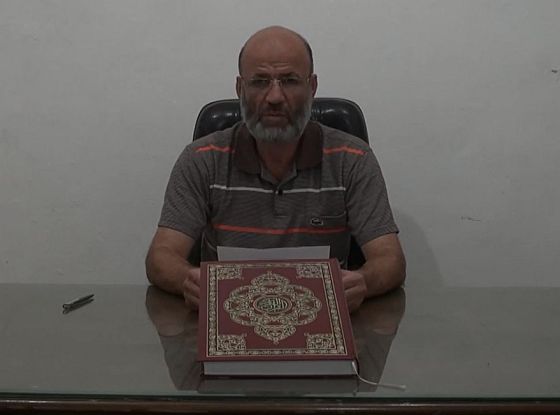
Der Spiegel reports: Once just a small group, now there are several thousand foreign jihadist fighters present in Syria today. Though some rebel leaders say their presence does pose a danger, the impact of these groups is often exaggerated by the Western media.
The role of foreign jihadists linked to al-Qaida in Syria has been the subject of intense discussion in the Western media, among think tanks and inside governments. Yet despite the attention paid to the issue, the research behind the reports published is often thin.
There’s a good reason for this, too: Very few foreign journalists are still traveling within the areas of Syria that are no longer controlled by the regime of dictator Bashar Assad. Of course, other factors also influence the reporting. Right from the start, the regime described the insurgency in its propaganda as the action of “foreign terrorists,” and it has often used the Russian media in particular as a platform for spreading false accounts of events.
In early September, for example, the regime attributed an attack by diverse rebel groups on two checkpoints held by Christian militiamen in the western Syrian city of Malloula to al-Qaida. It claimed that the group had attacked and damaged churches and that it drove Christians into the streets and forced them to convert to Islam, with the threat of decapitation if they didn’t. This horrific version of the story made its way into reporting by American and British news agencies. Indeed, few reported that the nuns at Maaloula’s Tekla monastery had denied that such attacks had even taken place. [Continue reading…]
Category Archives: Syria
Syria: ‘Not Anymore: A Story of Revolution’
In an interview with Vice magazine, filmmaker Matthew VanDyke was asked:
What do you have to say to those in the journalist community who are angered about you switching between being a journalist and being a freedom fighter when it suits you? You know, the Committee to Protect Journalists lobbying for your release [while he was held prisoner for six months by Gaddafi’s forces in Libya] under the asumption you were a freelance journalist, then you returning to fight as soon as your release had been secured.
Please don’t call me a journalist. People still do that, even though I’m not. And the journalist community isn’t irritated. There were, like, ten people who were irritated to bicker and bitch and a lot of them have their own reasons for doing it. The fact is that I’ve been balefully accused for two years now and it causes me such immense emotional distress. These people try to destroy me.
The reason they still call me a journalist is that they are looking for a one-worder that fits in a headline. My family argued with journalists not to call me a journalist when I was missing, and they still did it. When I escaped prison and found out that I was a journalist, it was news to me. I’m not unbiased, not impartial like journalists should be. I don’t report news. When I was in Syria, partly because of my actions in Libya, I had access to things that I would see in the news weeks later, but I did not report on them.
Why did you actively choose not to be a journalist?
Because I don’t cross lines—don’t mix things. I don’t think journalists should be pro-revolution; journalists should show up, report the news and not take a side. I’m so determined not to cross lines that I take financial hardship for it, I risk my life for it. I was wearing a uniform while I was making that film—sometimes with a Free Syrian Army flag on my arm—to make it clear that I’m not a journalist. The consequence of that could have been that, if I’d have been captured, I would have been tortured to death.
In Syria, FSA is a failed brand while militias increasingly gain civilian leadership
Syria Deeply reports, “In January 2012, Syria Conflict Monitor (SCM)’s five-person team began cataloguing the thousands of Free Syrian Army (FSA) videos used for recruitment purposes that were being downloaded to the Internet.”
These are the three key things revealed in SCM’s latest data:
Since the beginning of 2013, nearly one in three videos Syria-wide has invoked Islamic rhetoric as justification for the fight against the regime.
“The nationwide declines in FSA affiliation among armed groups coincides with noticeable increases in the appearance of Islamist and religious rhetoric across Syria,” SCM said.
“In addition to the aforementioned failures of any alternative galvanizing force or concept, the consistent tactical, financial and symbolic success of religiously motivated armed groups is undeniably driving a growing number of armed groups to adopt similar rhetoric and shifting the tone of the conflict. It must be reiterated that these categories are not monolithic. Groups employing Islamist rhetoric or religious symbols may differ greatly from one another. Additionally, there may be a sizable number of groups that subscribe to political-religious ideologies that do not introduce such rhetoric or symbols into their formation videos for a variety of reasons.”
Since 2012, slightly less than one-fifth of groups publishing information videos on YouTube declare affiliation with the U.S.-backed Free Syrian Army.
“Affiliating with or invoking the FSA brand in unit formation videos has significantly declined since 2012. The FSA label, with few exceptions, does not reflect real command and control or unit integration into a larger fighting group known as the FSA,” SCM said.
“Instead, the FSA label was traditionally invoked as a symbol of national solidarity with other fighting units. Based on the significant decline in FSA branding among formation videos, it is reasonable to conclude that the FSA label is no longer a symbol of unity between armed opposition groups. The FSA label in the context of formation is now likely a reminder of repeated failed attempts by figures outside of Syria to unite the armed opposition nationwide under the banner of the FSA.”
Within armed groups, there is a significant trend from military to civilian leadership.
For the first time beginning in the period of January to April 2013, a majority of videos in which declarations of leadership were made on camera were led by civilians.
“As the total number of fighting groups has increased, so too has the trend towards civilian control,” the group said. “This may reflect the insufficient number of available defected military officers to command opposition units and/or the growing aptitude of civilians to command units after two years of fighting.”
It said that civilian command of armed opposition units “carries important implications for armed group behavior … civilian command may blur the distinction between civilian and military structures on the ground, with many individuals assuming roles in local civilian governance structures in addition to armed units.”
U.S., Russia agree on Syria U.N. chemical arms measure
Reuters reports: Ending weeks of diplomatic deadlock, the United States and Russia agreed on Thursday on a U.N. Security Council draft resolution that would demand Syria give up its chemical arms, but does not threaten military force if it fails to comply.
Samantha Power, the U.S. ambassador to the United Nations, said a deal was struck with Russia “legally obligating” Syria to give up its chemical stockpile and the measure went to the full Security Council in a closed-door meeting on Thursday night.
U.S., Russian, French and British diplomats told reporters the vote could come as early as Friday evening, provided the Executive Council of the Organization for the Prohibition of Chemical Weapons in The Hague approves a plan for the destruction of Syria’s poison gas arsenal beforehand. [Continue reading…]
Most of Syria’s toxins can be destroyed more easily than officials initially thought
The Washington Post reports: U.S. and Russian officials now believe that the vast majority of Syria’s nerve agent stockpile consists of “unweaponized” liquid precursors that could be neutralized relatively quickly, lowering the risk that the toxins could be hidden away by the regime or stolen by terrorists.
A confidential assessment by the United States and Russia also concludes that Syria’s entire arsenal could be destroyed in about nine months, assuming that Syrian officials honor promises to cede control of the chemical assets to international inspectors, according to two people briefed on the analysis.
The assessment, thought to be the most authoritative to date, reflects the consensus view of Russian and U.S. analysts who compared their governments’ intelligence on Syria during meetings in Geneva this month. The Obama administration has since briefed independent experts on the key findings.
The insights into Syria’s arsenal have been bolstered further by the Damascus government’s own accounting, which lists the types of chemical agents and delivery systems it possesses, and was presented Saturday to the Organization for the Prohibition of Chemical Weapons in The Hague. U.S. officials have reviewed the Syrian inventory, which has not been publicly released, and “found it quite good,” a senior State Department official told reporters. [Continue reading…]
Assad: chemical weapons arsenal is a ‘burden’ — Syria has much more powerful weapons to defend itself against Israel
The Times of Israel reports: Syria has deterrent weapons, more advanced than anything in its chemical arsenal, that could blindside Israel in mere moments, Syrian President Bashar Assad claimed Thursday.
“Originally, we produced chemical weapons in the 1980s as a deterrent to Israel’s nuclear capabilities,” Assad said in an interview with the Hezbollah-affiliated, Lebanon-based Al-Akhbar newspaper, adding that “today, we have weapons that are far more important and sophisticated and that can blindside Israel in the blink of an eye.”
The Syrian president also charged that the West was not really concerned with stripping Syria of its weapons stockpile in order to safeguard the country’s civilians but, rather, that its goal was to tip the balance of power in the Middle East in Israel’s favor.
“They wanted to change the balance of power to protect Israel, but we turned the table on them and now the ball is in their court,” said Assad.
Referring to his regime’s chemical weapons arsenal, which, under a US-Russian agreement reached earlier this month, is due to be destroyed by mid-2014, Assad said that his stockpile, of about 1,000 tons, is a burden and will be costly and time-consuming to dispose of.
The Syrian president went on to mock President Barack Obama as “hesitant” and “weak.” He called the US administration’s handling of the threat to attack Syria — in response to the regime’s alleged chemical attack in Damascus on August 21 that killed over 1,400 people according to US officials — an “embarrassment.”
“The steps we’ve taken embarrassed the US government in the eyes of the American and European publics. Obama lost in his own home [turf]. where [he] lost the ability to maneuver internally,” Assad added. [Continue reading…]
A chemical weapons expert responds to the Al Akhbar article ‘Questions plague UN report on Syria’
Brown Moses Blog: Earlier this week an article was published by Al Akhbar, Questions Plague UN Report on Syria, making a number of claims about the UN report, including “There is not a single environmental sample in Moadamiyah that tested positive for Sarin.” and “It is scientifically improbable that survivors would test that highly for exposure to Sarin without a single trace of environmental evidence testing positive for the chemical agent.“. This is then used to claim that the 140mm artillery rockets fired at Moadamiyah were not carrying Sarin, as widely reported, and that the trajectory of these rockets, as per the UN report, which crosses over with the trajectory of other rockets fired at Eastern Ghouta over the Syrian army’s Republican Guard 104th Brigade base, is indicative of nothing, as the munitions did not contain Sarin.
One of the chemical weapon experts quoted in the article is Dan Kaszeta, who has responded to the article with a FAQ he’ll be publishing online shortly.
Q: The article claims “not a single environmental sample in Moadamiyah that tested positive for Sarin.” – What is your reaction to this?
I consider this statement to be a misleading half-truth that “cherry picks” from the UN report. It is true in respect to the fact that no actual Sarin was found in the 13 environmental samples taken from Moadamiyah. But the samples show DIMP, IMPA, and MPA, all of which are strong indicators of Sarin. The environmental samples are clear indicators that Sarin was used because of the clear presence of chemicals that are clearly decomposition products (IMPA, MPA) and impurities (DIMP), all of which persist longer in the environment than Sarin itself. [Continue reading…]
A war in which both people and ideas have become casualties
Gabriele Del Grande writes: This is my third visit to Aleppo in the last year, but the first time that I saw fear in the eyes of my Syrian activist friends accompanying me. They are not afraid of Bashar al-Assad’s regime or of bombs or of the Free Syrian Army (FSA). Rather, what scares them are the checkpoints manned by fighters from the Islamic State in Iraq and al-Sham (ISIS — also known as the Islamic State in Iraq and Syria), the main al-Qaeda force in Syria. Kidnappings and executions have been steadily increasing.
Hazim al-Azizi, a photographer at the media center in Azaz, was the latest Syrian activist to be killed by al-Qaeda. An ISIS sniper shot him on Sept. 18, when the town of Azaz, 3 kilometers (1.8 miles) from the border with Turkey, became the scene of two days of heavy fighting between the ISIS and FSA. On the same day, ISIS gunmen kidnapped Mohammed Nur Amuri, director of the Azaz media center, along with nine other activists in his office. One man, Abu Mohammad, managed to save himself.
Abu Mohammad was supposed to go to Azaz to install an aerial for a free radio network, Radio Nevroz, which was to begin broadcasting in Kurdish and Arabic to the opposition-controlled areas of northern Syria. When he heard that the ISIS was involved in fighting there, he canceled everything. In his opinion, the presence of al-Qaeda in Syria poses a serious threat to the entire civilian activist movement.
In an interview in Kilis, a Turkish town on the border with Syria, Abu Mohammad told Al-Monitor, “For us, it is extremely dangerous even just to move around. We are civilians, without any military escort when we travel. The areas in the countryside of Aleppo and Idlib have become a no-man’s-land, and the slightest suspicion is enough to get you killed by the men of ISIS.”
According to Wassim, however, the real problem is not al-Qaeda, but the ever-widening rift with the FSA. An activist living in Aleppo, Wassim explained, “When the revolution started, we used to sing ‘One, one, one. The Syrian people are one.’ Nowadays, the most popular song goes like this: ‘Alawites wait for us! We are coming to slaughter you! We will cut your throats.’ The activists abroad will tell you that it is not true, that we are a moderate people and sectarianism will not prevail. But this is true only of us civilians, not for those who fight. [Continue reading…]
Syrian rebel groups reject exiled National Coalition

The formation of a coalition of rebel groups under an “Islamic framework” that rejects the authority and legitimacy of the Western-backed and Istanbul-based National Coalition, is going to be widely seen as further evidence of the “Islamisation” of the Syrian opposition. On that basis, it will also generally be viewed as reflecting a trend towards greater extremism, but that judgement might be premature.
The group which has not officially been named yet but is being referred to by some of its members as the “Islamic Alliance” appears to have coalesced around some core principles that seem to be more strategic than ideological, namely, that it rejects the authority and legitimacy of an exiled group that has assumed the role of a kind of government-in-waiting but whose members are safely removed from the fighting; that those who are fighting “own” the revolution; and that their success will depend on solidarity.
An indication that this new coalition might not signal further radicalization of the opposition is the fact that it does not include the most radical group in Syria: the Islamic State of Iraq and al-Sham (ISIS) which is most closely affiliated with al Qaeda. Al Qaeda leader Ayman al-Zawahri recently called on Syria’s Islamist fighters to shun secularists, but this new coalition might have more to do with shunning outsiders.
By raising expectations that a U.S. intervention might decisively tip the balance of power in the rebels’ favor, only to then see President Obama sign on to a chemical weapons disarmament plan whose most likely effect will be to ensure the continuation of Bashar al-Assad’s rule, the lesson that gets repeatedly driven home to Syrians is that there is no one they can rely upon but themselves.
Aron Lund writes for Syria Comment: Abdelaziz Salame, the highest political leader of the Tawhid Brigade in Aleppo, has issued a statement online where he claims to speak for 13 different rebel factions. You can see the video or read it in Arabic here. The statement is titled “communiqué number one” – making it slightly ominous right off the bat – and what it purports to do is to gut Western strategy on Syria and put an end to the exiled opposition.
The statements has four points, some of them a little rambling. My summary:
- All military and civilian forces should unify their ranks in an “Islamic framwork” which is based on “the rule of sharia and making it the sole source of legislation”.
- The undersigned feel that they can only be represented by those who lived and sacrificed for the revolution.
- Therefore, they say, they are not represented by the exile groups. They go on to specify that this applies to the National Coalition and the planned exile government of Ahmed Touma, stressing that these groups “do not represent them” and they “do not recognize them”.
- In closing, the undersigned call on everyone to unite and avoid conflict, and so on, and so on.
The following groups are listed as signatories to the statement.
- Jabhat al-Nosra
- Islamic Ahrar al-Sham Movement
- Tawhid Brigade
- Islam Brigade
- Suqour al-Sham Brigades
- Islamic Dawn Movement
- Islamic Light Movement
- Noureddin al-Zengi Battalions
- Haqq Brigade – Homs
- Furqan Brigade – Quneitra
- Fa-staqim Kama Ummirat Gathering – Aleppo
- 19th Division
- Ansar Brigade
Who are these people?
The alleged signatories make up a major part of the northern rebel force, plus big chunks also of the Homs and Damascus rebel scene, as well as a bit of it elsewhere. Some of them are among the biggest armed groups in the country, and I’m thinking now mostly of numbers one through five. All together, they control at least a few tens of thousand fighters, and if you trust their own estimates (don’t) it must be way above 50,000 fighters.
Most of the major insurgent alliances are included. Liwa al-Tawhid, Liwa al-Islam and Suqour al-Sham are in both the Western- and Gulf-backed Supreme Military Council (SMC a.k.a. FSA) and the SILF, sort-of-moderate Islamists. Ahrar al-Sham and Haqq are in the SIF, very hardline Islamists. Jabhat al-Nosra, of course, is an al-Qaida faction. Noureddin al-Zengi are in the Asala wa-Tanmiya alliance (which is led by quietist salafis, more or less) as well as in the SMC. And so on. More groups may join, but already at this stage, it looks – on paper, at least – like the most powerful insurgent alliance in Syria.
What does this mean?
Is this a big deal? Yes, if the statement proves to accurately represent the groups mentioned and they do not immediately fall apart again, it is a very big deal. It represents the rebellion of a large part of the “mainstream FSA” against its purported political leadership, and openly aligns these factions with more hardline Islamist forces.
That means that all of these groups now formally state that they do not recognize the opposition leadership that has been molded and promoted by the USA, Turkey, France, Great Britain, other EU countries, Qatar, and – especially, as of late – Saudi Arabia.
That they also formally commit themselves to sharia as the “sole source of legislation” is not as a big a deal as it may seem. Most of these factions already were on record as saying that, and for most of the others, it’s more like a slight tweak of language. Bottom line, they were all Islamist anyway. And, of course, they can still mean different things when they talk about sharia.
Why now? According to a Tawhid Brigade spokesperson, it is because of the “conspiracies and compromises that are being forced on the Syrian people by way of the [National] Coalition”. So there.
Mohammed Alloush of the Islam Brigade (led by his relative, Mohammed Zahran Alloush), who is also a leading figure in the SILF alliance, was up late tweeting tonight. He had a laundry list of complaints against the National Coalition, including the fact that its members are all, he says, “appointed”, i.e. by foreign powers. He also opposed its planned negotiations with the regime. This may have been in reference to a (widely misinterpreted) recent statement by the Coalition president Ahmed Jerba. Alloush also referred to the recent deal between the National Coalition and the Kurdish National Council, and was upset that this will (he thinks) splinter Syria and change its name from the Syrian Arab Republic to the Syrian Republic.
Is this a one-off thing?
The fellow from the Tawhid Brigade informed me that more statements are in the making. According to him, this is not just an ad hoc formation set up to make a single point about the National Coalition. He hinted that it’s the beginning of a more structured group, but when I asked, he said it has no name yet. On the other hand, Abdulqader Saleh – Tawhid’s powerful military chief – referred to it on Twitter as al-Tahaluf al-Islami or the Islamic Alliance, but that may have been just descriptive, rather than a formal name.
Mohammed Alloush also wrote on Twitter, somewhat ambiguously, that the member groups have their own offices and political bureaus, and there’s a political program different from the National Coalition. He, too, hinted that there’s more coming: “wait for the announcement of the new army”.
Who’s missing?
These are of course not all the rebels; far from it. Dozens or hundreds of small and local groups are missing from this alliance, just like they’ve been missing from every other alliance before it. Some really big groups are also not in there, like the Farouq Battalions or the Ahfad al-Rasoul Brigades, both of them quite closely aligned with the SMC and the National Coalition.
Most notably, the Islamic State of Iraq and al-Sham – Syria’s most querulous al-Qaida faction – is absent from the list. Given the recent surge in tension between the Islamic State and other factions, that seems significant. [Continue reading…]
The crisis of Syrian refugees in Lebanon
Omar S. Dahi writes: One of the many plot lines lost in the summertime discussions of a US strike on Syria is the pace of refugee movement out of the country. As it stands, the refugee crisis is overwhelming and likely to stay that way. Another external military intervention would further accelerate the mass flight and exacerbate what is already a humanitarian emergency.
The Syrian refugee crisis became too large too quickly for any real planning of ameliorative measures to take place. At the end of September 2012, one year ago, there were less than 240,000 registered refugees in total. Today, according to UN High Commissioner for Refugees data, the number is 2 million. And that is not to speak of the millions more internally displaced persons, or IDPs, who have fled their homes but remained inside Syrian borders. Most refugees express a desire to go home, but the statistics are not on the side of return. The UNHCR defines “protracted refugee situations” as those in which refugees have lived in exile for five years or more with no serious prospect of finding a “durable solution,” meaning repatriation, integration into the host country or resettlement in a third country. By this definition, two thirds of all globally registered refugees — over 7 million people — are in “protracted” limbo. Many Syrians are likely to join them.
A number of factors make the evolving Syrian refugee crisis particularly daunting. First, the displacement comes as part of a brutal civil conflict that shows no sign of abating. Repatriation is therefore unrealistic, as is waiting until the “end of the conflict” to discuss the long-term problems of refugees. The throngs of refugees and IDPs need extensive humanitarian assistance now to meet basic needs. Second, there is now a sizable refugee population in at least five countries — Egypt, Jordan, Lebanon, Iraq and Turkey — implying the necessity of a large-scale, internationally coordinated effort at durable solutions. None of these host countries are eager to grant Syrians permanent residency; several have repeatedly vowed not to. [Continue reading…]
Journalists in Syria freelance at their own risk
The New York Observer reports: This summer, Francesca Borri, an Italian journalist, wrote an article for The Columbia Journalism Review about the perils that she faces as a freelancer in Syria. Many were stunned that Ms. Borri gets paid $70 per article, which barely covered the $50-per-night mattress on the ground in a rebel base (where Ms. Borri wrote that she got typhoid), let alone insurance.
“The editors are well aware that $70 per piece pushes you to save on everything. They know, too, that if you happen to be seriously wounded, there is a temptation to hope not to survive, because you cannot afford to be wounded,” Ms. Borri wrote. “But they buy your article anyway, even if they would never buy the Nike soccer ball handmade by a Pakistani child.”
Although $70 is on the low end, it’s not that far from major outlet rates. According to journalists we spoke to, most print publications pay in the low hundreds. TV pays more, but not by much.
It’s almost impossible to come out ahead while covering a war zone, with myriad costs including drivers, lodging, plane tickets, safety gear, insurance and so-called fixers, locals who act as translators and guides and charge upwards of $100 per day.
“You have no guarantee of selling of your story to cover the significant expenses you incurred reporting it,” said Ayman Oghana, a freelance photojournalist and reporter based in Istanbul. “Out in the field, that can drive you to stay longer or take greater risks to get something you think may sell. It also means you don’t have an editor to coordinate with on decisions or telling you, for your own safety, enough is enough, pull out and take care of yourself.”
And it isn’t just the cost of covering the war. The new model of relying on freelancers doesn’t take into account the unprecedented dangers in Syria, where journalists are very often targeted from the moment they cross the border. Veteran journalist Marie Colvin died last year during a rocket attack on Homs, after Syrian forces reportedly pledged to kill “any journalist who set foot on Syrian soil.”
According to the Committee to Protect Journalists, at least 13 local and international journalists are currently missing in Syria, a number that doesn’t include aid workers, fixers and the cases that are unreported due to the belief that, in some cases, publicizing a kidnaping makes it more difficult to negotiate release. [Continue reading…]
Mass starvation feared in Syria; ‘We have no food’
The Associated Press reports: Syrian opposition groups and international relief organizations are warning of the risk of mass starvation across the country, especially in the besieged Damascus suburbs where a gas attack killed hundreds last month.
With the world’s attention focused on the regime’s chemical weapons, activists said six people – including an 18-month girl – have died for lack of food in one of the stricken suburbs in recent weeks.
Save the Children said in an appeal Monday that more than 4 million Syrians, more than half of them children, do not have enough to eat. Food shortages have been compounded by an explosion in prices.
“The world has stood and watched as the children of Syria have been shot, shelled and traumatized by the horror of war,” said Roger Hearn, Save the Children’s regional director for the Middle East. “The conflict has already left thousands of children dead, and is now threatening their means of staying alive.”
Thousands of people are believed trapped in suburbs east and west of the capital that have been held for months by rebels fighting to topple President Bashar Assad. Regime troops are besieging the areas, and residents say food is increasingly had to find. Rebels say they are trying to break the blockade.
The suburbs were the site of the Aug. 21 attack that a U.N. report found included the use of the nerve gas sarin. They were home to more than 2 million people before the war, but it is unclear how many are there now.
In some hard-hit areas such as the western suburb of Moadamiyeh, people are running out of food and are mostly relying on lentils, olives and dried figs, according to residents and activists.
“We have no food, no milk and no medicine,” said a woman from Moadamiyeh, who identified herself by her nickname Um Lujain for fear of government reprisals. “We are surviving on one meal a day”
Um Lujain said her 18-month-old daughter has lost half her weight and spends most of her days sleeping. The woman said her daughter’s diet is based on the liquid she makes by boiling lentils.
“There has been no children formula or bread for about a year,” the woman said. She added that sometimes rebels find expired boxes of powdered milk in abandoned shops or pharmacies, and people still give it to their children for lack of food.
According to the Moadamiyeh Media Center, six people have died of starvation over the past 20 days: two women and four children ages 18 months to 7 years. It added that 15 other children are in intensive care in clinics, suffering from malnutrition.
On Monday, the opposition Syrian National Coalition accused government forces of tightening their months-long siege. “Assad’s forces are starving people to death in those areas,” the coalition claimed. “Famine looms in the horizon.”
Rana Obeid, the 18-month-old girl, was the latest to die on Monday. An amateur video showed her lying on a bed, her ribs visible and her stomach bloated. [Continue reading…]
A malnourished baby in Moadamiyyat Ash Sham, near Damascus: (Video via EA Worldview)
The Iranian general ‘running the war’ in Syria
In the New Yorker, Dexter Filkins has a 10,000 word profile of Major General Qassem Suleimani, the leader of a branch of Iran’s Revolutionary Guard called the Quds Force, thousands of whose members are now fighting in Syria. It’s worth reading the whole article, but I’ve picked out some of the most important passages below.
For Suleimani, defending Assad is a matter of pride. He is quoted as having said: “We’re not like the Americans. We don’t abandon our friends.”
Iran’s intervention in Syria escalated sharply late last year.
A turning point came in April, after rebels captured the Syrian town of Qusayr, near the Lebanese border. To retake the town, Suleimani called on Hassan Nasrallah, Hezbollah’s leader, to send in more than two thousand fighters. It wasn’t a difficult sell. Qusayr sits at the entrance to the Bekaa Valley, the main conduit for missiles and other matériel to Hezbollah; if it was closed, Hezbollah would find it difficult to survive. Suleimani and Nasrallah are old friends, having coöperated for years in Lebanon and in the many places around the world where Hezbollah operatives have performed terrorist missions at the Iranians’ behest. According to Will Fulton, an Iran expert at the American Enterprise Institute, Hezbollah fighters encircled Qusayr, cutting off the roads, then moved in. Dozens of them were killed, as were at least eight Iranian officers. On June 5th, the town fell. “The whole operation was orchestrated by Suleimani,” Maguire, who is still active in the region, said. “It was a great victory for him.”
Despite all of Suleimani’s rough work, his image among Iran’s faithful is that of an irreproachable war hero—a decorated veteran of the Iran-Iraq War, in which he became a division commander while still in his twenties.
*
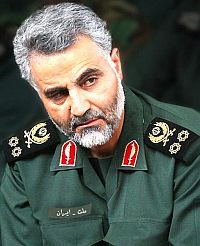
In March, 2009, on the eve of the Iranian New Year, Suleimani led a group of Iran-Iraq War veterans to the Paa-Alam Heights, a barren, rocky promontory on the Iraqi border. In 1986, Paa-Alam was the scene of one of the terrible battles over the Faw Peninsula, where tens of thousands of men died while hardly advancing a step. A video recording from the visit shows Suleimani standing on a mountaintop, recounting the battle to his old comrades. In a gentle voice, he speaks over a soundtrack of music and prayers.
“This is the Dasht-e-Abbas Road,” Suleimani says, pointing into the valley below. “This area stood between us and the enemy.” Later, Suleimani and the group stand on the banks of a creek, where he reads aloud the names of fallen Iranian soldiers, his voice trembling with emotion. During a break, he speaks with an interviewer, and describes the fighting in near-mystical terms. “The battlefield is mankind’s lost paradise—the paradise in which morality and human conduct are at their highest,” he says. “One type of paradise that men imagine is about streams, beautiful maidens, and lush landscape. But there is another kind of paradise—the battlefield.”
*
In the chaotic days after the attacks of September 11th, Ryan Crocker, then a senior State Department official, flew discreetly to Geneva to meet a group of Iranian diplomats. “I’d fly out on a Friday and then back on Sunday, so nobody in the office knew where I’d been,” Crocker told me. “We’d stay up all night in those meetings.” It seemed clear to Crocker that the Iranians were answering to Suleimani, whom they referred to as “Haji Qassem,” and that they were eager to help the United States destroy their mutual enemy, the Taliban. Although the United States and Iran broke off diplomatic relations in 1980, after American diplomats in Tehran were taken hostage, Crocker wasn’t surprised to find that Suleimani was flexible. “You don’t live through eight years of brutal war without being pretty pragmatic,” he said. Sometimes Suleimani passed messages to Crocker, but he avoided putting anything in writing. “Haji Qassem’s way too smart for that,” Crocker said. “He’s not going to leave paper trails for the Americans.”
Before the bombing began, Crocker sensed that the Iranians were growing impatient with the Bush Administration, thinking that it was taking too long to attack the Taliban. At a meeting in early October, 2001, the lead Iranian negotiator stood up and slammed a sheaf of papers on the table. “If you guys don’t stop building these fairy-tale governments in the sky, and actually start doing some shooting on the ground, none of this is ever going to happen!” he shouted. “When you’re ready to talk about serious fighting, you know where to find me.” He stomped out of the room. “It was a great moment,” Crocker said.
The coöperation between the two countries lasted through the initial phase of the war. At one point, the lead negotiator handed Crocker a map detailing the disposition of Taliban forces. “Here’s our advice: hit them here first, and then hit them over here. And here’s the logic.” Stunned, Crocker asked, “Can I take notes?” The negotiator replied, “You can keep the map.” The flow of information went both ways. On one occasion, Crocker said, he gave his counterparts the location of an Al Qaeda facilitator living in the eastern city of Mashhad. The Iranians detained him and brought him to Afghanistan’s new leaders, who, Crocker believes, turned him over to the U.S. The negotiator told Crocker, “Haji Qassem is very pleased with our coöperation.”
The good will didn’t last. In January, 2002, Crocker, who was by then the deputy chief of the American Embassy in Kabul, was awakened one night by aides, who told him that President George W. Bush, in his State of the Union Address, had named Iran as part of an “Axis of Evil.” Like many senior diplomats, Crocker was caught off guard. He saw the negotiator the next day at the U.N. compound in Kabul, and he was furious. “You completely damaged me,” Crocker recalled him saying. “Suleimani is in a tearing rage. He feels compromised.” The negotiator told Crocker that, at great political risk, Suleimani had been contemplating a complete reëvaluation of the United States, saying, “Maybe it’s time to rethink our relationship with the Americans.” The Axis of Evil speech brought the meetings to an end. Reformers inside the government, who had advocated a rapprochement with the United States, were put on the defensive. Recalling that time, Crocker shook his head. “We were just that close,” he said. “One word in one speech changed history.”
*
Last December, when Assad’s regime appeared close to collapse, American officials spotted Syrian technicians preparing bombs carrying the nerve agent sarin to be loaded onto aircraft. All indications were that they were plotting an enormous chemical attack. Frantic, the Americans called leaders in Russia, who called their counterparts in Tehran. According to the American defense official, Suleimani appeared to be instrumental in persuading Assad to refrain from using the weapons.
Suleimani’s sentiments about the ethics of chemical weapons are unknown. During the Iran-Iraq War, thousands of Iranian soldiers suffered from chemical attacks, and the survivors still speak publicly of the trauma. But some American officials believe that his efforts to restrain Assad had a more pragmatic inspiration: the fear of provoking American military intervention. “Both the Russians and the Iranians have said to Assad, ‘We can’t support you in the court of world opinion if you use this stuff,’ ” a former senior American military official said.
The regime is believed to have used chemical weapons at least fourteen times since last year. Yet even after the enormous sarin attack on August 21st, which killed fourteen hundred civilians, Suleimani’s support for Syria has been unbending. To save Assad, Suleimani has called on every asset he built since taking over the Quds Force: Hezbollah fighters, Shiite militiamen from around the Arab world, and all the money and matériel he could squeeze out of his own besieged government. In Baghdad, a young Iraqi Shiite who called himself Abu Hassan told me that he was recruited to fight by a group of Iraqi men. He took a bus to the Iranian city of Mashhad, where he and three dozen other Iraqis received two weeks of instruction from Iranian trainers. The men travelled to the Shiite shrine of Sayyidah Zaynab, near Damascus, where they spent three months fighting for the Assad government, along with soldiers from Hezbollah and snipers from Iran. “We lost a lot of people,” Abu Hassan told me.
Suleimani’s greatest achievement may be persuading his proxies in the Iraqi government to allow Iran to use its airspace to fly men and munitions to Damascus. General James Mattis, who until March was the commander of all American military forces in the Middle East, told me that without this aid the Assad regime would have collapsed months ago. The flights are overseen by the Iraqi transportation minister, Hadi al-Amri, who is an old ally of Suleimani’s—the former head of the Badr Brigade, and a soldier on the Iranian side in the Iran-Iraq War. In an interview in Baghdad, Amri denied that the Iranians were using Iraqi airspace to send weapons. But he made clear his affection for his former commander. “I love Qassem Suleimani!” he said, pounding the table. “He is my dearest friend.”
So far, Maliki has resisted pressure to supply Assad overland through Iraq. But he hasn’t stopped the flights; the prospect of a radical Sunni regime in Syria overcame his reservations about becoming involved in a civil war. “Maliki dislikes the Iranians, and he loathes Assad, but he hates Al Nusra,” Crocker told me. “He doesn’t want an Al Qaeda government in Damascus.”
This kind of starkly sectarian atmosphere may be Suleimani’s most lasting impact on the Middle East. To save his Iranian empire in Syria and Lebanon, he has helped fuel a Sunni-Shiite conflict that threatens to engulf the region for years to come—a war that he appears happy to wage. “He has every reason to believe that Iran is the rising power in the region,” Mattis told me. “We’ve never dealt him a body blow.”
In June, a new, moderate President, Hassan Rouhani, was elected in Iran, promising to end the sanctions, which have exhausted the country and demolished its middle class. Hopes have risen in the West that Khamenei might allow Rouhani to strike a deal. Although Rouhani is a moderate only by Iranian standards—he is a Shiite cleric and a longtime adherent of the revolution—his new administration has made a series of good-will gestures, including the release of eleven political prisoners and an exchange of letters with President Obama. Rouhani is in New York this week to speak at the United Nations and, possibly, to meet with Obama. The talks will surely center on the potential for Iran to restrain its nuclear program, in exchange for relaxed sanctions.
Many in the West are hoping that Iran will also help find an end to the grinding war in Syria. Assad’s deputy prime minister recently offered the possibility of a cease-fire, saying, “Let nobody have any fear that the regime in its present form will continue.” But he did not say that Assad would step down, which the rebels have said is a necessary condition of negotiations. There have been hints from powerful Iranians that Assad isn’t worth holding on to. In a recent speech, the former President Hashemi Rafsanjani said, “The people have been the target of chemical attacks by their own government.” (After a leaked recording of the speech caused a stir in Iran, Rafsanjani denied the remarks.) But a less sympathetic regime in Syria would split the Axis of Resistance, and radically complicate Iran’s partnership with Hezbollah. In any case, the Iranian regime may be too fragmented to come to a consensus. “Anytime you see a statement coming out of the government, just remember there’s a rat’s nest of people fighting underneath the surface,” Kevan Harris, a sociologist at Princeton who has studied Iran extensively, told me. As Rouhani tries to engage the West, he will have to contend with the hard-liners, including Suleimani and his comrades, who for more than a decade have defined their foreign policy as a covert war on the U.S. and Israel. “They don’t trust the other side,” Harris said. “They feel that any concession they make will be seen by the West as a sign of weakness.”
For Suleimani, giving up Assad would mean abandoning the project of expansion that has occupied him for fifteen years. In a recent speech before the Assembly of Experts—the clerics who choose the Supreme Leader—he spoke about Syria in fiercely determined language. “We do not pay attention to the propaganda of the enemy, because Syria is the front line of the resistance and this reality is undeniable,’’ he said. “We have a duty to defend Muslims because they are under pressure and oppression.” Suleimani was fighting the same war, against the same foes, that he’d been fighting his entire life; for him, it seemed, the compromises of statecraft could not compare with the paradise of the battlefield. “We will support Syria to the end,” he said.
Yahya Ababneh, source of Mint Press chemical weapons ‘report’ appears to be a fraud
Yahya Ababneh, source of a report which alleged that Saudi Prince Bandar bin Sultan was responsible for the chemical weapons attack outside Damascus on August 21, now appears to be a fraud operating under multiple names using a fake work history and comes from Russia.
Brian Whitaker writes: According to Ababneh’s profile on LinkedIn, the professional networking website, he has carried out journalistic assignments “in Jordan, Syria, Lebanon, Saudi Arabia, Russia, and Libya for clients such as al-Jazeera, al-Quds al-Arabi, Amman Net, and other publications”.
So far, though, no evidence has emerged to support this claim and internet searches in English and Arabic for articles that carry his byline have drawn a blank.
To add to this mystery, Ababneh’s profile was deleted from LinkedIn yesterday, though a cached copy can be found here.
One thing that doesn’t show up in the cache is the endorsements given to Ababneh by other LinkedIn users. On the deleted page, he had received endorsements for his skills from two people – Ghazal Omid of the Iran Future organisation and Sufian Ababneh, a legal adviser at the Jordanian embassy in London. Among other things, Sufian Ababneh had endorsed him for his skills as an actor.
@snarwani @Brown_Moses #Syria Mint Press journalist Yahya Ababneh claims to work for Al Jazeera. But Al Jaz web has no record of him.
— Anita McNaught (@anitamcnaught) September 21, 2013
And seems to have a Russian VKontakte page that says he was born in St. Petersburg http://t.co/AQkNczvYJ0 @daoudkuttab
— Laura Rozen (@lrozen) September 22, 2013
Syria’s refugees: the catastrophe
Hugh Eakin and Alisa Roth write: In early June 2011, some three months into the uprising against the regime of Syrian leader Bashar al-Assad, Syrian government forces began preparing for a large-scale assault on Jisr al-Shughour, a rebellious border town sixty-five miles southwest of Aleppo. The events that led to this operation are a matter of some dispute. Residents of the town said that Assad’s security forces shot and killed an unarmed man during a protest after Friday prayers. At his funeral the next day, thousands of mourners marched to a post office where security forces were gathered.
According to eyewitnesses, government snipers on top of the building began shooting at the crowd, while more troops arrived to back them up. But numerous accounts also describe soldiers defecting and joining with the mourners, a number of whom had brought guns, to attack the regime forces; Syrian state media later claimed that 120 soldiers had been massacred by “armed gangs.”
What is certain is that an exceptionally violent confrontation took place. As the regime sent reinforcements to retake control, most of the town’s 44,000 inhabitants and many from the surrounding area fled. “They were burning houses and fields and killing animals. They started shooting. And killed two families,” a woman who called herself Lajia told us when, reporting for a public radio story, we met her in a tiny Turkish village two weeks later. With her six children, then aged six to seventeen, she had escaped from her farm near Jisr al-Shughour across the border to Turkey, where she was staying with relatives. “Villages were increasingly empty from around forty kilometers away,” a United Nations official reported after a fact-finding mission later that month. “Jisr al-Shughour itself was almost deserted.” Like Lajia and her family, much of the population had crossed into Turkey’s Hatay province—the first refugees in a conflict that has since produced more than two million of them.
In more than one way, what happened in Jisr al-Shughour is unusually revealing about the course of Syria’s civil war: it was the first well-documented case of protesters arming themselves and fighting back against Syrian troops. It was also one of the first occasions that large numbers of Syrians were forced to flee to a neighboring country. At the time, the Turkish government had not yet endorsed the Syrian opposition; it had spent the previous decade building economic and political ties with the Assad regime and still hoped for a negotiated solution to the uprising. But Turkey is a Sunni country whose current leadership has Islamist sympathies. Jisr al-Shughour was a Sunni town with a history of Islamist activism and violent repression by Syria’s ruling Baath regime, which is dominated by the Alawite sect. The refugees who left for Turkey soon became the first links in a crucial supply chain for the rebel cause. In July 2011, a few weeks after we met Lajia and other Syrians in the border region of Hatay province, a group of military defectors among them announced the founding of the Free Syrian Army (FSA), dedicated to the armed overthrow of Assad. [Continue reading…]
How to destroy Syria’s chemical arsenal
BBC News reports: Syria has been given until the middle of 2014 to destroy its chemical weapons stockpile.
But in a country torn apart by civil war, the disposal process is likely to be fraught with difficulties. So how will it work?
Different techniques are used for destroying chemical munitions and chemical agents, but most methods involve either:
- Incineration at very high temperatures to destroy the toxicity of the chemicals, or
- Neutralisation of the chemicals by the addition of water and a product like caustic soda.
Destroying chemical weapons, armed with explosives, carries extra risks. One solution is the use of mobile destruction units, which can be moved into place relatively quickly and therefore avoid the dangers of transporting live weapons through a warzone.
Some of these mobile units destroy chemical agents by surrounding them with explosives and placing them in an armour-plated chamber, known as a “bang box”. The explosion destroys the munition and the chemical agent.
The US military has developed a mobile unit, called the Explosive Destruction System (EDS), which uses chemicals to neutralise the toxic agent. It has been used to destroy more than 1,700 items in the US since 2001 and can handle up to six weapons at a time. [Continue reading…]
Syria meets first test of accord on chemical weapons
The New York Times reports: A senior Obama administration official said Friday that the United States was encouraged by the initial inventory that the Syrian government had submitted of its chemical weapons arsenal.
“We were pleasantly surprised by the completeness of their declaration,” said the official, who declined to be identified because he was not authorized to speak publicly on the matter.
“It was better than expected,” he added.
The Organization for the Prohibition of Chemical Weapons, the watchdog group known as the O.P.C.W. that oversees the international agreement banning poison gas, said on Friday that Syria had provided “an initial declaration” of its chemical weapons program.
The submission met the first deadline for Syrian compliance that was set down by the framework agreement that the United States and Russia concluded in Geneva last weekend.
American, British, Chinese, French and Russian diplomats are debating the terms of a United Nations Security Council resolution that would enforce the agreement. Secretary of State John Kerry said on Thursday that it was essential for the Council to adopt the resolution next week.
“It started coming in yesterday,” Michael Luhan, a spokesman for the O.P.C.W., said of the Syrian declaration. Mr. Luhan, who spoke in a telephone interview from The Hague, said that the organization’s technical experts were studying the declaration but would not give additional details.
The declaration’s completeness is an early test of President Bashar al-Assad’s commitment to relinquish Syria’s chemical weapons arsenal.
The United States and Russia agreed in Geneva that Syria has about 1,000 tons of precursor chemicals and chemical agents, including sulfur mustard and sarin gas.
The fact that Russia, which has been one of the principal supporters of the Assad government, reached a consensus with the United States on the size of the arsenal after receiving an intelligence briefing by American experts suggested that the Syrian government would eventually declare a similar figure. [Continue reading…]
Israel’s spies inside Damascus
The Israeli journalist, Ronen Bergman, who covers military and intelligence affairs for Yedioth Ahronoth, provides an Israeli-sourced history of Israel’s decades long surveillance and sabotage of Syria’s WMD programs.
In the mid-1990s, Syria succeeded in the manufacture of the most toxic chemical agent, VX. This agent is so hazardous that it consists of two separate substances that are kept apart inside a missile warhead and combine only when the warhead hits the ground, creating an extremely lethal neurotoxic agent. Unlike other chemical warfare elements, VX does not disperse in a short time. The know-how for the manufacture of this weapon was supplied by Russian President Boris Yeltsin’s advisor on chemical weapons disarmament, Gen. Anatoly Kuntsevich.
Under the guise of a routine working visit to Syria, and as part of the good military relations that had remained between Syria and Russia (with the Russians still maintaining intelligence bases in the Golan Heights and in northern Syria), Kuntsevich began forming personal links with the heads of the Syrian regime. He received huge amounts of money from them, and in turn, he supplied them with the know-how and some of the equipment, which he acquired in Europe, for the manufacture of VX weapons.
In 1998, the Mossad learned details of some of these transactions. Israeli Prime Minister Ehud Barak tried to warn the heads of the government in Moscow about the general’s doings in meetings he held with them in 1999, but to no avail. It seemed as though Yeltsin could not, or would not, intervene. When the Israelis saw that their pressure was not working, Mossad agents in Europe were assigned to pose as independent researchers working on the background for a documentary film on gas warfare. They repeatedly contacted high-ranking officials in the Kremlin and the Russian army and said that according to their information, Kuntsevich was selling chemical warfare agents to Syria. The goal was to scare Moscow into believing that the information was about to be made public. Unfortunately, this didn’t work either, and apart from a stern warning, nothing was done to curb the general.
On April 3, 2002, Kuntsevich died mysteriously while on a flight from Damascus to Moscow. Also mysterious is the inscription on his headstone in Moscow, which states his death date as March 29. Syrian intelligence is convinced that the Mossad was behind his demise. Israeli officials have not commented on such allegations.
Historically, Israel has devoted many resources to keeping a watch on the Scientific Studies and Research Center, the main Syrian agency in charge of the effort to produce chemical and biological weapons. The SSRC was identified by U.S. intelligence as the front organization for the Syrian defense establishment, and the U.S. Treasury Department consequently imposed financial sanctions.
With over 10,000 personnel, the SSRC is responsible for operating the main facilities in Syria where chemical weapons are manufactured and stored, according to Israeli military intelligence estimates. The main site is at al-Safir, in northern Syria, where the chemical weapons are assembled and stored and some of the Scud missiles and launchers are kept.
Al-Safir was one of the prime targets for the possible American attack proposed in late August. Now that such an attack has been called off, it will be a site of enormous interest to international weapons inspectors. Al-Safir is an enormous facility, covering dozens of square kilometers and comprising several sections, surrounded by patrol roads and high double fences.
On July 25, 2007, at al-Safir, a horrendous breakdown occurred in the production line of VX warhead components, a line that was constructed by the Syrians and North Koreans. One of the pipes feeding substances to the assembly line burst, and within seconds the entire line became a blazing inferno. The blast was so powerful that doors were blown off the building and the noxious gases escaped and spread across the entire al-Safir facility. The initial explosion killed 15 Syrians and, according to reports reaching the Mossad, 10 Iranian engineers at the site. An unknown number of people were seriously wounded, and some 200 are believed to have been affected. The rescue and first-aid forces permanently stationed at al-Safir were unable to handle all the casualties, and the authorities had to call in outside firefighting and rescue services, violating their goal of maintaining maximum secrecy at the site.
Investigations carried out after the incident by a special team appointed by the Syrian president reached the unequivocal conclusion that this was an intentional act of sabotage, though to this day footprints leading to the perpetrators have not been traced. A senior Israeli cabinet minister speaking with me under terms of not identifying him would not refer directly to the al-Safir explosion, but would only say with a wink and a nod that it was “a marvelous mishap.” [Continue reading…]

In March, 2009, on the eve of the Iranian New Year, Suleimani led a group of Iran-Iraq War veterans to the Paa-Alam Heights, a barren, rocky promontory on the Iraqi border. In 1986, Paa-Alam was the scene of one of the terrible battles over the Faw Peninsula, where tens of thousands of men died while hardly advancing a step. A video recording from the visit shows Suleimani standing on a mountaintop, recounting the battle to his old comrades. In a gentle voice, he speaks over a soundtrack of music and prayers.