Category Archives: Syria

Syria and how the U.S. antiwar movement forgot the spirit of internationalism

Danny Postel writes: The American peace movement has been celebrating what it sees as its victory on Syria. “The U.S. is not bombing Syria, as we certainly would have been if not for a huge mobilization of anti-war pressure on the president and especially on Congress,” writes Phyllis Bennis of the Institute for Policy Studies (IPS). This represents “an extraordinary, unforeseen victory for the global anti-war movement,” she goes on, one that “we should be savoring.” Robert Naiman of the organization Just Foreign Policy vaunts “How We Stopped the U.S. Bombing of Syria”.

This turn of events is “something extraordinary – even historic,” writes my good friend Stephen Kinzer, coming from a different but overlapping perspective. “Never in modern history have Americans been so doubtful about the wisdom of bombing, invading or occupying another country,” writes the author of the classic Overthrow: America’s Century of Regime Change from Hawaii to Iraq. “This is an exciting moment,” he rhapsodizes, “the start of a new, more realistic approach to foreign policy.”

The tireless progressive journalist David Sirota, whom I admire a lot, extols “How the Antiwar Majority Stopped Obama.” The opposition of “angry Americans” to the administration’s push for a military strike, he contends, proved “absolutely critical” and is “why there now seems to be a possibility of avoiding yet another war in the Middle East.”

I completely understand this jubilance. And yet it leaves me feeling uneasy.

Let me be clear: I too was against the Obama administration’s proposed military strike on Syria. I thought it strange that after two and a half years of doing essentially nothing about the deepening crisis in Syria, the White House suddenly decided to act with such a sense of urgency that it was unwilling to wait for the United Nations inspection team to complete its job. As if the world should just trust American claims about weapons of mass destruction. That went really well last time.

I also thought chemical weapons were exactly the wrong issue. To paraphrase Shadi Hamid of the Brookings Doha Center, why draw a “red line” at the use of chemical weapons but not at 100,000 dead? Or at two and a half years of crimes against humanity? The vast majority of the civilians killed since the Syrian uprising began in March of 2011 have died by means of conventional, not chemical weapons.

I agreed wholeheartedly with the International Crisis Group that the Obama administration’s case for action was based on “reasons largely divorced from the interests of the Syrian people,” who “have suffered from far deadlier mass atrocities during the course of the conflict without this prompting much collective action in their defence.”

Hinging its case on chemical weapons turned out to be a huge strategic mistake as well. Russia cleverly short-circuited the Obama administration, taking advantage of the thinness of its case. So Syria’s chemical weapons stockpiles will be removed from the equation – then what? The Assad killing machine, which was overwhelmingly nonchemical to begin with, can continue unfettered on its rampage. Chemical weapons issue – solved. The killing fields of Syria – no end in sight.

Given this horrific picture, it’s hard for me to share the peace movement’s triumphalism. Yes, a US military attack was thwarted – good. But is that where the story ends? [Continue reading…]


Facebooktwittermail

Assad is looking stronger than ever

Paul Wood writes: Everyone in rebel-held areas will tell you that the Islamists, of whichever stripe, are making gains because of the ‘secular’ FSA’s corruption and opportunism. That and the fact that most of the money and guns are going to the Islamists, sent by Qatar and Saudi Arabia. ‘Ali’ had been a flight attendant with Emirates before the war, living in Dubai and going to bars to pick up girls. Now he was in a Nusra Front brigade, he told me, but only because he thought they were really taking the battle to the regime. The emir of his group had banned smoking in line with Islamist doctrine. Ali would sneak outside for a crafty cigarette. He wasn’t an Islamist, he said, he just wanted Assad gone.

The bits of the FSA that continue to oppose Nusra and the Islamic State blame the West for their loss of power. ‘The Syrian people will welcome any support if the West continues to abandon us,’ the FSA’s commander for southern Syria, Abu Fadi, told me in Jordan. Abu Fadi said that, contrary to reports in the US newspapers, he had received almost no American help. None of his men had been trained in the camps that supposedly exist in Jordan. No weapons had been handed over. ‘We have had some new boots and jackets,’ he said with a snort. ‘That’s all.’

Isis and their satellites are still far from a majority but they have influence beyond their numbers. Public beheadings are now common in northern Syria. The BBC obtained pictures of one, the executioner dressed in black waving a severed head before a jubilant crowd.

Amid what the guidebooks call the ‘stylish and opulent’ surroundings of the Albergo hotel in Beirut, a western diplomat was briefing journalists. The room was all Persian rugs and wing-backed chairs. Waiters hovered. The official was his government’s main conduit to the Syrian rebels. I asked him what percentage of the rebels western countries could support: what percentage were not jihadis, not committing human rights abuses, looting or kidnapping — and were militarily effective?

There was a silence. Finally, he said: ‘Thirty per cent.’ It was a devastating admission. Then he paused and said he had been considering only the first three criteria. Adding in military effectiveness, you would have to say the West could support only 10 per cent.

Western diplomats are now scrambling to ensure that 10 per cent has at least the appearance of running the show. [Continue reading…]

Facebooktwittermail

CIA ramps up rebel training program designed to prolong war in Syria

The Washington Post reports: The CIA is expanding a clandestine effort to train opposition fighters in Syria amid concern that moderate, U.S.-backed militias are rapidly losing ground in the country’s civil war, U.S. officials said.

But the CIA program is so minuscule that it is expected to produce only a few hundred trained fighters each month even after it is enlarged, a level that officials said will do little to bolster rebel forces that are being eclipsed by radical Islamists in the fight against the government of Syrian President Bashar al-Assad.

The CIA’s mission, officials said, has been defined by the White House’s desire to seek a political settlement, a scenario that relies on an eventual stalemate among the warring factions rather than a clear victor. As a result, officials said, limits on the agency’s authorities enable it to provide enough support to help ensure that politically moderate, U.S.-supported militias don’t lose but not enough for them to win.

The officials, who spoke on the condition of anonymity to discuss intelligence matters, said the agency has sent additional paramilitary teams to secret bases in Jordan in recent weeks in a push to double the number of rebel fighters getting CIA instruction and weapons before being sent back to Syria.

The agency has trained fewer than 1,000 rebel fighters this year, current and former U.S. officials said. By contrast, U.S. intelligence analysts estimate that more than 20,000 have been trained to fight for government-backed militias by Assad’s ally Iran and the Hezbollah militant network it sponsors. [Continue reading…]

Facebooktwittermail

Syria’s jihad tourists

Der Spiegel reports: Foreign Islamists coming into Syria have been gathering in the relatively quiet north. But many of them are finding transit towns — with good food, video games and smoking — preferable to the front. When they do end up fighting, it’s often with each other.

Atmeh looks like the set for a movie about al-Qaida. New arrivals pulling suitcases on wheels search for their emirs, Africans and Asians can be seen on the village streets, and long-haired men dressed in traditional Afghan clothing walk around wielding AK-47s. There are patrons at the local kebab stand whose northern English dialect is peppered with Arabic words and phrases. “Subhan’Allah, bro, I asked for ketchup,” says one man. The many languages heard on the street include Russian, Azerbaijani and Arabic spoken with a guttural Saudi Arabian accent.

The once-sleepy smugglers’ nest on the Turkish border has become a mecca for jihad tourists from around the world. A year ago, SPIEGEL reporters in Atmeh met with one of the first foreign fighters in Syria, a young Iraqi who said that he had come to overthrow the dictatorship. Meanwhile, more than 1,000 jihadists are staying in and around Atmeh, making it the densest accumulation of jihadists in all of Syria. Ironically, while war rages in the rest of the country, the foreign jihadists have made one of Syria’s quietest spots into their base. Or perhaps they have chosen Atmeh precisely because it is so quiet. Once they arrive, many are reluctant to leave.

The Turkish mobile phone network provides strong reception, and the shops carry Afghan pakol wool hats, al-Qaida caps and knee-length black shirts made of the same coarse material used in the Pakistani tribal regions. New restaurants have popped up, and a company called International Contacts books flights and exchanges Saudi riyals, British pounds, euros and US dollars into the local currency. The pharmacy sells miswak, a teeth-cleaning stick from Pakistan with which the Prophet Muhammed supposedly brushed his teeth. The package label promises that the use of miswak increases the effectiveness of subsequent prayers by a factor of 70.

A third Internet café opened in mid-June to accommodate the many jihadists wanting to communicate with their relatives and friends at home via phone, email or chat programs. This prompted the owner of the first café to hang al-Qaida flags above his computers as a sign of loyalty to his customers. The move has improved business despite the growing competition. The heavily armed customers use Skype to tell their friends at home about what a paradise Atmeh is. The rents are cheap, they say, the weather and food are good, they can walk around with their weapons and, with a little luck, they can even find wives. In the evenings, the sound of several jihadists playing Counter-Strike spills into the streets in a cacophony of video game warfare. In Atmeh, the holy war is a costume spectacle, and everyone can feel as if he were part of it — without suffering any harm. [Continue reading…]

Facebooktwittermail

Syrian refugees destabilizing Lebanon

Der Spiegel reports: The war in Syria and its wave of refugees is destabilizing and overwhelming Lebanon. Now there are fears the hundreds of thousands of newcomers will never want to leave, and the sectarian conflict will worsen.

General Ibrahim Bachir saw it coming. He has been warning the government for over two years now: Stop wasting time and start building refugee camps to deal with the influx of Syrian refugees, he told them.

But the deeply divided and ineffective government authorities in Lebanon did nothing, he says — and now it’s too late: “We have all these problems,” the general says, “criminals, prostitutes and beggars everywhere — across the entire country!”

Bachir, 60, heads the High Relief Commission, the state agency charged with helping the masses of refugees fleeing the conflict in neighboring Syria. “But how is such a small country supposed to accommodate so many refugees?” he asks. “One in four people here is now a Syrian refugee.” [Continue reading…]

Facebooktwittermail

Syria beyond the binaries

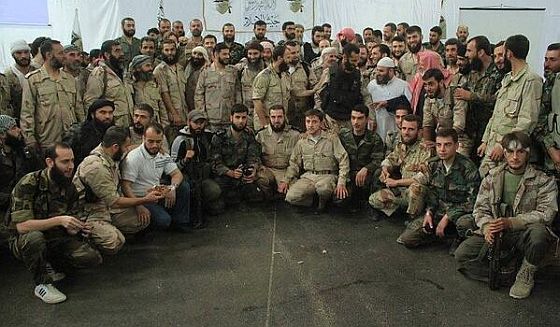
Jaish al-Islam commanders from  50 insurgent groups who merged on Sunday.

Jaish al-Islam commanders from 50 insurgent groups who merged on Sunday.

I suspect that for quite a few observers there’s something vaguely comforting about the spectacle of the rise of extremism in Syria. Why comforting? Because it reinforces the idea that however bad the Assad regime might be, the alternative seems destined to be worse. On that basis one can take comfort in the belief that the best course of action for those outside Syria is no action at all.

Indeed, the Assad regime itself seems willing to cater to those who want to balance both humanitarian and non-interventionist concerns through facilitating a symbolic intervention by destroying Syria’s chemical weapons arsenal. If the Syrian government is sufficiently cooperative in this undertaking it will no doubt earn qualified praise for doing so.

Which brings me to a headline in yesterday’s Washington Post: “Foreign extremists dominate Syria fight“. As if carried away by the sentiment in those words, the security analyst Matthew Aid then reposted the article on Tumblr with an even more sensational headline: “Most Fighting in Syria Being Done by AQ-Linked Militants, Not Free Syrian Army“.

The problem is, neither headline actually reflected the details of the report. No doubt Liz Sly, reporting from Beirut, wanted to convey some sense of Syria being taken over by foreign jihadists, yet the second sentence in her report acknowledges: “The number of Syrians battling to overthrow the regime led by President Bashar al-Assad outstrips by a large margin the thousands of Arabs and other non-Syrian Muslims who have streamed into Syria over the past two years to join in the fight.”

Further in to the report she says that conservative estimates put the number of foreign fighters at between 6,000 to 10,000 — though she fails to put that in context by referring to the estimated size of the fighting opposition: 100,000.

Supposedly, what is happening in Syria can only be comprehended in binary terms: Syrian vs foreign; moderate vs extremist; secular vs Islamist; Sunni vs Allawite. But the overarching effect of the imposition of these simplistic labels is to reinforce the sentiment that Syria is bad news and the less we hear about it the better.

On the other hand, for those who retain an interest in being provided with a more nuanced picture of what’s happening on the ground, there are commentators like Hassan Hassan who are capable of explaining some of the complexity in an ever-changing landscape while underlining the fact that whatever fissures do indeed exist inside the opposition, this remains a fight to topple the Assad regime.

Hassan notes that in the liberated areas of Syria, Salafi-leaning fighters are now dominant and among these the newly formed Jaish al-Islam (“the Army of Islam”) composed of at least 50 groups operating mainly around Damascus, has now displaced the FSA as the strongest rebel force.

The emerging trend, far from that of Syria being taken over by foreign fighters, may actually be going in the opposite direction:

Significant grassroots hostility is building in liberated Syrian areas against foreign-funded extremists and al Qaeda affiliates. These tensions do not always develop into sustained clashes — for almost all rebel groups, toppling the regime is the priority, not fighting extremist forces, which have proved indispensable in the battlefield.

According to an activist based in the northern city of Raqqa, when clashes erupted between the al Qaeda-affiliated ISIS and Ahfad al-Rasoul in August, local residents threw their support behind one or the other side — but the strongest condemnation was for the infighting itself. “When they see the regime’s warplanes shelling the city without a single shot in their direction, they get angry at the fighters who could do something,” the activist explained.

The size of extremist groups is not an accurate indicator of the support for their ideology within Syrian society. Fighting groups are also not ideologically homogenous, as many fighters join groups for their effectiveness on the battlefield and disciple — not their religious beliefs. Ahrar al-Sham members in Daraa, for example, can be remarkably different in terms of religiosity from members in more conservative northern areas such as Idlib or the Aleppo countryside.

The situation inside the country is more fluid and nuanced than many groups’ hard-line slogans would suggest. Moderates can be members of hard-line groups and vice versa. Some groups, such as Suqour al-Sham, include both secular members and Islamist veterans of the insurgency against the U.S. occupation of Iraq. For example, a former judge at Aleppo’s cassation court, a secular Syrian who does not pray, nevertheless supports an Islamic identity to the state.

For this reason, many moderate fighters are more concerned with the foreign networks and leaders than the rank-and-file members of hard-line groups. “We are not too worried about Jabhat al-Nusra,” said one FSA-affiliated officer in the eastern governorate of Deir Ezzor who said he worked in intelligence operations. “Once the fighting ends, we’ll bring them back. We know them. They’re our brothers, cousins, and neighbors — they’re the sons of our tribes. Our true struggle will be against [ISIS] and the Nusra leaders.”

Facebooktwittermail

More than 115,000 killed in Syrian conflict – monitoring group

Reuters reports: More than 115,000 people have been killed in Syria’s two-and-a-half-year-old civil war, including tens of thousands of soldiers, rebels and civilians, the Syrian Observatory for Human Rights said on Tuesday.

The figure suggested that around 5,000 people had died in September alone and that the bloodshed has not been slowed by an international deal for the elimination of Syria’s chemical weapons after an August 21 sarin gas attack in the Damascus area.

The British-based Observatory, which monitors violence through a network of activists, medical and military sources around Syria, said about 47,000 soldiers and militia fighters loyal to President Bashar al-Assad had been killed.

Rebel fighters, including army defectors, accounted for around 23,000 of the dead, the Observatory said.

More than 41,000 civilians have been killed, including 6,000 children and 4,000 women. The toll includes 3,000 unidentified people, according to the Observatory which says it documents deaths by obtaining film and photographs of bodies and seeking to confirm identities through family, medics and activists.

Facebooktwittermail

Syria: Fuel-air bombs strike school

Human Rights Watch: A Syrian government airstrike using fuel-air explosive bombs hit outside a secondary school in the opposition-held city of Raqqa on September 29, 2013, killing at least 14 civilians. At least 12 of those killed were students attending their first day of classes.

A Raqqa resident who went to the school immediately after the attack told Human Rights Watch that he saw 14 bodies, including some without limbs. A doctor from National Hospital in Raqqa said he saw 12 dead bodies, most of them students, and the hospital treated 25 wounded.

The blast wounds and flash burns visible on victims in videos and photographs, coupled with the body positions and few shrapnel wounds, indicates the use of fuel-air explosives (FAE), also known as “vacuum bombs,” Human Rights Watch said. More powerful than conventional high-explosive munitions of comparable size, fuel-air explosivesinflict extensive damage over a wide area, and are therefore prone to indiscriminate impact in populated areas.

“While the world tries to bring Syria’s chemical weapons under control, government forces are killing civilians with other extremely powerful weapons,” said Priyanka Motaparthy, Middle East child rights researcher at Human Rights Watch. “Even students on their first day of school are not safe.” [Continue reading…]

Facebooktwittermail

Syrian militant Islamists denounce SNC and form ‘Islamic Alliance’

Charles Lister writes: In a video issued late on September 24, the chief political leader of Liwa al-Tawhid, Abdulaziz Salameh, speaking on behalf of 12 other Islamist militant groups in Syria, condemned the “unrepresentative” Western-backed Syrian National Coalition (SNC) and called explicitly for “an Islamic framework based on sharia [Islamic law].”

The video was issued along with a scanned statement, personally signed by the senior leadership of all 13 groups, encorporating existing members of the SNC, members of the hardline Salafist coalition the Syrian Islamic Front, and also Jabhat al-Nusra. As such, a new “Islamic Coalition” was formed.

All 13 groups – specifically, Jabhat al-Nusra, Harakat Ahrar al-Sham al-Islamiyya, Liwa al-Tawhid, Liwa al-Islam, Suqor al-Sham, Liwa al-Haq, Harakat Fajr al-Sham al-Islamiyya, Harakat al-Nour al-Islamiyya, Kataib Nour al-Din al-Zinki, Liwa al-Furqan, Liwa al-Ansar, Tajamu Fastaqm Kamr Umrat and Forqat al-Tisaa Ashr – represent Syria’s most sizeable and powerful insurgent groups. The inclusion of the core of the SNC force – incorporating Liwa al-Tawhid, Liwa al-Islam and Suqor al-Sham – effectively depletes the SNC’s armed wing, the Syrian Military Council (SMC). As all four groups were also members of the SNC-linked Syrian Islamic Liberation Front coalition, with Suqor al-Sham leader Sheikh Ahmed Abu Issa its leader, it is likely that that moderate Islamist coalition has ceased to exist as a single organisational structure.

The announcement is potentially extremely significant for the long-term nature of the Syrian opposition. The SNC has long been accused of retaining minimal on-the-ground control of insurgent groups technically under its command, and this public renunciation of its leadership and its political foundations will likely prove extremely damaging for its long-term role inside Syria. The group’s 13 signatories currently play the lead roles in insurgent theatres across Syria, particularly throughout the north, in Homs, Damascus and as far south as al-Quneitra governorate.

While the significant Aleppo-based Asifat al-Shamal did not sign into the alliance, it issued a written statement expressing support for its objectives. Meanwhile, moderate forces Alwia Ahfad al-Rasoul and Jabhat al-Asala wa Tanmia will likely remain the SMC’s most significant multi-governorate-level actors, although the latter notably without one of its key constituent groups, Kataib Nour al-Din al-Zinki. [Continue reading…]

Facebooktwittermail

Ret. Gen. Boykin promotes End Times view of war in Syria

Mother Jones: Lt. Gen. Jerry Boykin, a top executive at the influential Family Research Council, has joined the chorus of religious conservatives touting the Syrian conflict as a prelude to Armageddon. On Wednesday, Boykin appeared on Prophetic Perspectives on Current Events, a talk show hosted by dominionist preacher Rick Joyner (see the video above). The pair discussed a passage in Isaiah 17, which predicts Damascus will be reduced to “a ruinous heap.”

“One of the scriptures that has never been fulfilled and has to be fulfilled before this age can end is that Damascus will be destroyed, never inhabited again,” Joyner explained. “What in the world could cause a city to be destroyed and never inhabited again?” Boykin didn’t hesitate. “One of the ways Damascus could be destroyed, never to be re-occupied, would be through a chemical attack,” he replied. ” So let’s just take a scenario: The Free Syrian Army takes Damascus and Bashar al-Assad is in a desperate mode now…. What would be his final act? Well it may very well be to unload all his chemical weapons on the population center there in Damascus. Destroy the city and destroy it in a way that he just kills maybe millions of people. But the byproduct is that he has residue there that could make Damascus uninhabitable and for a very long time.”

This is not the first time Boykin has embraced the notion that war in the Middle East will lay waste to the Syrian capital—and pave the way for Jesus’s return. He recently wrote an endorsement for Damascus Countdown, a fictionalized account of the looming biblical conflict by best-selling author Joel Rosenberg. And he has spoken at several of Ronseberg’s annual Epicenter Conferences, which explore the Middle East’s role in biblical prophesy.

Facebooktwittermail

Syrian opposition groups stop pretending

Rania Abouzeid writes: The pretense that the so-called Syrian opposition-in-exile speaks for those inside the country, never firm to begin with, was further exposed late on Tuesday, in a two-minute video statement called “Communiqué No. 1,” which was issued by eleven armed rebel groups that are influential in northern Syria. Their message was simple: the Western-backed hotel revolutionaries jetting from capital to capital, claiming leadership in the political National Coalition and an interim government-to-be, don’t speak for them—and they won’t listen to them. The new coalition, which has yet to announce its name, also said it wants Islamic Sharia law to be the basis of any future government, and that the various opposition parties should unite within “an Islamic framework.”

There has long been a disconnect between those fighting and bleeding inside Syria and the political and diplomatic machinations of those in exile. What is new here is that at least three of the eleven groups—Liwa al-Tawhid, Liwa al-Islam, and Suqour al-Sham—are aligned with the military wing of the National Coalition, the Supreme Military Council, which is supported by the West and is what passes for the leadership of the loose franchise outfit known as the Free Syrian Army (F.S.A.). Now they have publicly thrown in their lot with Jabhat al-Nusra, which also signed on to the statement and is connected to Al Qaeda.

This public alliance of affiliates of the F.S.A. and of Al Qaeda, however, is more of a shift on paper than a marked change in how things work on the ground. There has long been operational coördination on a local level—for a particular battle or in a certain geographic area. All that has really happened at this stage is that a fig leaf has dropped.

The fighting men within Syria have long despised their political and military leaders-in-exile. It’s common to hear them say, “We are in the khanadik”—trenches—“and they are in the fanadik,” hotels. In late August, four of the leaders of the F.S.A.’s five fronts said that the National Coalition—their own political counterparts—had no legitimacy. They threatened to resign from the Supreme Military Council because of, among other things, “the lying promises of those states who claim to be friends of Syria,” who have not provided assistance “worthy of the sacrifices of the Syrian people.”

The disunity goes deeper. Colonel Abdul-Jabbar Agaydee, the top F.S.A. commander in the northern city of Aleppo and a man who doesn’t spend his time in hotel lobbies, has lambasted the Supreme Military Council, of which he himself is a member, saying it is “completely disconnected from reality.” [Continue reading…]

Facebooktwittermail

Chemical weapons ‘saved’ the Assad regime

Reuters reports: Bashar al-Assad, who only a month ago faced the likelihood of U.S. missile strikes that could have tipped the balance of Syria’s war against him, has won a reprieve.

His supporters, political sources in Damascus say, are jubilant, convinced the threat of regime change has lifted and that the Assads can face down opponents they consider weak – U.S. President Barack Obama and France’s President Francois Hollande among them – just as they saw off their predecessors.

“I think they feel that they can live this out and wait for leaders like Hollande and Obama to leave office, just as they did with Jacques Chirac and George W. Bush,” said one well-placed source in Damascus, speaking on condition of anonymity.

“I think Assad feels that the chemical weapons actually saved his regime, rather than brought it down.”

The mood shift is a consequence of the world’s confused response to a sarin gas attack on rebel suburbs of Damascus last month, the sources say. Russian President Vladimir Putin, Assad’s ally in the 30 months-old conflict, conjured up a diplomatic process to confront the atrocity. [Continue reading…]

Facebooktwittermail

Syria: Victims of chemical weapons attacks running out of food

Fred Abrahams writes: One month after an attack with Sarin gas killed hundreds of people on the outskirts of Damascus, people in the affected areas are facing a humanitarian crisis, Syrian activists are warning.

The Syrian government, whose forces in all likelihood launched the chemical attack of August 21, is blocking the delivery of food and medical supplies.

As world leaders debate how to secure chemical weapons in Syria, they should demand that aid reaches the victims of chemical attacks, and others in need.

In the Western Ghouta town of Moadamiya, one of two areas where chemical weapons struck, an aid worker said the government has blocked food, milk and medicine for three months.

“We are prisoners in our city and homes,” the aid worker told Human Rights Watch by phone. He said residents were boiling tree leaves for soup with salt and olives. Starvation had claimed four children and two adults.

A report by the Syrian Violations Documentation Center (VDC) says conditions in Moadamiya have reached “catastrophic levels.”

An aid worker in Eastern Ghouta, also hit with chemical weapons, told Human Rights Watch the area is besieged and, “witnessing a shortage of every kind of food you can think of.” The painkiller paracetamol has jumped ten times in price, he said.

“The biggest fear we are all facing now is winter season,” the aid worker said. “I don’t know how we will survive the winter.” [Continue reading…]

Facebooktwittermail

U.N. investigates more alleged chemical attacks in Syria

The New York Times reports: As the pace of efforts to scrutinize Syria’s chemical weapons stockpiles quickens, United Nations inspectors said on Friday that they were investigating reports that the weapons were used seven times in Syria, including three after an attack on Aug. 21 on the outskirts of Damascus, the Syrian capital, that set off an international crisis.

The disclosure, which came in a statement from the United Nations in Damascus that was quoted in news reports, came as the Organization for the Prohibition of Chemical Weapons, the group in The Hague that oversees the international treaty banning them, planned a meeting late Friday to approve a separate schedule for inspections of chemical weapons storage and production sites. Syria applied to join the treaty this month.

A joint proposal by the United States and Russia to be put before the organization’s executive council on Friday calls for the completion of inspections and the destruction of “production and mixing/filling equipment” by November, according to a text on the organization’s Web site.

An official at the Organization for the Prohibition of Chemical Weapons said that, if the meeting of the 41-nation Executive Council approves the plan to deploy inspectors in Syria at its meeting later on Friday, a first team of experts could leave for Syria on Monday and plan to arrive there on Tuesday.

The official, who declined to discuss the composition of the team, spoke on the condition of anonymity because the plan had not yet been approved.

In a breakthrough accord on Thursday, the five permanent members of the United Nations Security Council, which include the United States and Russia, the Syrian government’s most powerful ally, agreed on a resolution that would require Syria to give up its chemical weapons, although there would be no automatic penalties if the Syrians failed to comply. More than 100,000 people have died in Syria’s civil war, now in its third year. [Continue reading…]

Facebooktwittermail

In Syria, NGOs make up for lack of investigative journalism

The New York Times reports: What to believe? That’s a key question in the diplomatic duel over Syria, as Russia continues to dispute evidence in a United Nations inspectors’ report that points to the Syrian government’s complicity in the Aug. 21 chemical attack on the Damascus suburb of Ghouta.

The Russians, who insist the attack was a “provocation” by Syrian rebels, dismiss the findings of the U.N. experts as “biased.” Instead they cite the report of a Lebanese-born nun who, from a hotel room in Geneva, did her own analysis of videos of the scene at Ghouta and declared them fake.

So goes another chapter in a continuing information war that has made reporting on the bloody, multisided conflict in Syria such a nightmare for journalists, and such a difficult story for their readers.

Not only has Syria become ever more dangerous for reporters — 16 foreign and 60 Syrian journalists are currently detained, kidnapped or missing in Syria, according to Reporters Without Borders — but fewer newspapers around the world have the budgets to send correspondents abroad, let alone to war zones.

Finding out the truth, and figuring out whom to believe, has become even more treacherous in a world awash in YouTube videos, tweets and rumors spread by the Internet. Sorting out the facts from the fake adds new burdens and risks to the business of gathering news.

Into this breach have stepped various human rights and other nongovernmental organizations now filling the gaps left by the these shifts and twists of the media world.

Six days before the publication of the U.N. report, Human Rights Watch released its own investigation of the Aug. 21 attack that also found evidence “strongly” suggesting that the government of President Bashar al-Assad was responsible.

Not for the first time, this kind of independent report made front-page news in the world’s newspapers, which, for the most part, were unable to confirm the facts on the ground with their own reporting.

“The NGOs are doing more and more of the investigative work that journalists don’t do — either because the media they work for is understaffed, underfunded or uninterested,” said Alfred de Montesquiou, a prize-winning war reporter for the French weekly magazine Paris Match. Reached on assignment in the Central African Republic, he cited both Human Rights Watch and Amnesty International for their work in Syria, breaking or confirming major stories, and identifying key players.

It’s a role that these organizations are ready to assume, even as they defend their main purpose, which is to be advocates for victims not only of war but of injustice, abuse or discrimination around the world.

“We do feel that as journalism has ebbed, we have a responsibility to flow,” said Carroll Bogert, deputy executive director for external relations at Human Rights Watch headquarters in New York.

Human Rights Watch works in 90 countries with a staff of about 400 people based in 60 locations, many of them, not surprisingly, ex-journalists. Its budget, all privately raised, has shot up to a current $70 million from about $13 million in 1998 — when Ms. Bogert, a former foreign correspondent for Newsweek, joined.

With these resources, Human Rights Watch continues to turn out the kind of in-depth reports, each one exhaustively vetted by lawyers, editors and experts, that are increasingly hard to find in newspapers.

But there’s a difference.

“We don’t just stop at the water’s edge of journalism,” Ms. Bogert said. “We investigate, we expose and we push for change. We are advocates.”

That last role sets human rights researchers apart from journalists but not, Ms. Bogert insisted, at the expense of their credibility.

“We don’t go into the field with a narrative,” she said. “We go with open notebooks, and open minds.”

Some nongovernmental agencies have already evolved into journalistic-type multimedia, multiplatform operations, with videos, Twitter accounts, maps, graphs, satellite imagery and staff experts in areas from health to weapons. The New York Times credited forensic work by Human Rights Watch analysts in a pivotal story that traced the trajectory of rockets used in the Aug. 21 attack.

In Syria, where it has a long history chronicling complaints of human rights abuses by the government of Mr. Assad, Human Rights Watch has the same security concerns as journalists. That means it does much its work from afar, sifting through testimony, checking back with trusted sources and authenticating videos, many of which end up being discarded.

“The reason we have impact is that we have a trusted brand,” Ms. Bogert said. “What we publish has to meet rigorous standards.”

The news release used to be the classic way for NGOs to get out their message, but that, too, is changing. Human Rights Watch, for instance, has opened space on its Web site for “dispatches” written by its researchers, offering brief and quick reactions to news events. For instance, a critical response to the Op-Ed article in The New York Times this month by President Vladimir V. Putin of Russia was posted on the Web site within nine hours, getting 40,000 hits. This past week, a detailed rebuttal of Russia’s position on the Ghouta attack, written by Ms. Bogert, ran in the Moscow newspaper Vedomosti.

“Is it journalism?” Ms. Bogert asked. “I don’t know, but it is information that people need, and that people are using.”

Ms. Bogert insisted that Human Rights Watch had no intention of taking the place of foreign correspondents who remain their essential partners. “We are not dancing on the grave of journalism,” she said, “but it is a fact that there are fewer traditional journalists working for established papers. That’s not good for us, that’s not good for them, but we are among those information providers who are filling the gap.”

Facebooktwittermail

Saudi Arabia and the Syrian Muslim Brotherhood

Raphaël Lefèvre writes: The openly difficult relationship between Saudi Arabia and Muslim Brotherhood chapters across the region has become a salient feature of Middle East politics since the advent of the “Arab Spring.” This mutual mistrust has increased in the wake of the Kingdom’s recent support for the military takeover in Cairo and the generals’ subsequent repression of the Brotherhood there. But how is the Islamist organization affected by this dynamic in Syria, where the Muslim Brothers and the Saudis both battle against Bashar al-Assad?

The question has become ever more relevant since Saudi Arabia’s takeover of the “Syrian file” from the hands of the Qataris last May.[1] Yet the answer is steeped in ambiguities. On the one hand, the relationship between Riyadh and the Syrian Brotherhood suffers from political contradictions and a lack of genuine trust. On the other hand, the two actors know each other well and have a common short and medium-term interest: to see the Iran and Hezbollah-backed Syrian regime replaced by a new political system dominated by Sunnis. But the moving sands of Egypt might soon reach Syria too, and the consequences for the local Brotherhood branch there may one day be significant.

To understand the relationship between the Syrian Brotherhood and Saudi Arabia, often described by Syrian Brothers themselves as “complex,”[2] one first needs to look a few decades back. For it was after the Syrian Brotherhood’s rebellion in the late 1970s that both actors really started to know each other. Fleeing harsh repression in the early 1980s, tens of thousands of Muslim Brothers escaped Syria and took refuge in Jordan, Iraq, and, to a lesser extent, Turkey and Saudi Arabia. It is estimated that the number of Brothers residing in the Kingdom today is in the low thousands.

This relatively sizeable presence initially posed challenges to Saudi rulers, who considered the Brotherhood’s goal of politicizing Islam a threat to the apolitical nature of their deeply conservative Wahhabi society. “The Saudi government believes that the implementation of the Brotherhood’s political project—calling for elections and the formation of parties—would mean the end of its own model, which depends on the control of a ruler who has all powers,” argued a leader of the Syrian Brotherhood who has family in the Gulf. The Kingdom therefore regulated the Syrian Brothers’ presence in Saudi Arabia by allowing them to carry out political activities in private but forbidding any politicization of Saudi society, with the promise of an uncompromising and harsh response as a deterrent. “We would be very cautious not to cross these lines,” recounted another Brother who was raised in Saudi Arabia. “There would be Syrian Brotherhood gatherings in houses or mosques but, to be discreet, we would only go and leave by a group of two or three individuals. We wouldn’t mix with members of other Brotherhood chapters, and we would almost never disclose our political affiliation in the presence of Saudi citizens.”

Thus, despite a sometimes heavy intelligence surveillance, the Kingdom nonetheless allowed the Syrian Brotherhood to operate underground. Saudi Arabia even became the place of residence for two leaders of the organization: Hassan al-Houeidi from Deir Ezzor, who lived in Medina, and Abdel Fatah Abu Ghuddah, a distinguished Islamic scholar from Aleppo who was based in Riyadh. This 30-year presence of an important share of the Syrian Brotherhood in the Kingdom helps explain why, short-term mutual interests aside, the Saudi rulers have for a long time tolerated the group more than its Egyptian counterpart. [Continue reading…]

Facebooktwittermail