The Guardian reports: The UN has confirmed that the worst chemical weapons attack in 25 years took place in eastern Damascus last month, involving specially designed rockets that spread sarin nerve agent over rebel-held suburbs of the Syrian capital.
The report did not assign blame for the attack but the US, Britain and France said the details on the sarin, the rockets used and their trajectories all proved that Bashar al-Assad’s regime was responsible.
However, Russia argued that the western powers had “jumped to conclusions” and said claims of rebel use against their own supporters to provoke foreign intervention “should not be shrugged off”.
There was also sharp disagreement about what kind of UN resolution was needed to implement the agreement struck by the US and Russia on Saturday in Geneva on dismantling the Assad regime’s chemical weapons programme.
The differences – on whether an initial resolution should include the threat of punitive measures for Syrian non-compliance – were a reminder that the Geneva agreement could still unravel before it is put into force.
Presenting the report, the UN secretary general, Ban Ki-moon, said: “This is the most significant confirmed use of chemical weapons against civilians since Saddam Hussein used them in Halabja in 1988. The international community has pledged to prevent any such horror from recurring, yet it has happened again.”
However, Ban did not say who was responsible for the attack, noting that was not in the mandate of the UN investigation.
“It is for others to pursue this matter further to determine responsibility. We will all have our own thoughts on this,” the secretary general said.
Presenting their arguments afterwards, western diplomats said the head of the UN investigation team, Åke Sellström, a Swedish scientist, had observed that the quality of the sarin used in the attack on western and eastern Ghouta suburbs on 21 August was higher than that used in the 1995 terror attack on the Tokyo underground or Saddam Hussein’s attack on the Kurdish town of Halabja.
Sellström also said the rockets used were professionally made. His report said they were fired from the north-west, and western officials said the details of the trajectories confirmed that they came from an area held by government troops.
“All of that confirms in our view there is no remaining doubt that it was the regime that used the chemical weapons. It confirms that the regime was responsible,” Mark Lyall Grant, the British envoy to the UN, said.
His American counterpart, Samantha Power, singled out evidence in the UN report on the calibre of rocket used, saying that in “thousands of videos” from the Syrian conflict there was no indication that the rebels had such weapons. Nor was there any evidence that the rebels possessed sarin, she added. [Continue reading…]
Category Archives: Syria
Who was responsible for the August 21st attack?
Brown Moses Blog: In light of today’s report from the UN confirming the use of sarin in the August 21st attacks in Damascus, I thought I’d take a look at the open source evidence of who is responsible. I’ll be looking at evidence that’s freely available for anyone to examine, rather than what German spy boats may or may not of heard, or intelligence reports that tell us they have evidence, but don’t actually show the evidence. As always, evidence does not automatically equal proof, so it’s up to you to decide if this information proves one side or the other was responsible.
Two munitions have been linked to the attack, the M14 140mm artillery rocket, and a munition I’ve previously referred to as the UMLACA (Unidentified Munition Linked to Alleged Chemical Attacks).
The UN inspectors have now confirmed both munitions carried a chemical payload, so the question is, who used them? In the 18 months I’ve been studying the arms and munitions in the conflict I have never seen either type of munition used by the opposition. The opposition has rocket artillery, for example the 107mm Type-63 multiple rocket launcher and the Croatian 128mm RAK-12, but I’ve never seen any sign of the 140mm systems (such as the BM-14) that would be used to launch the M14 artillery rocket. [Continue reading…]
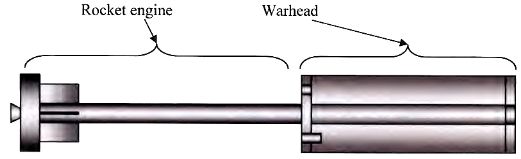
Diagram of suspected chemical weapon shown in UN report:

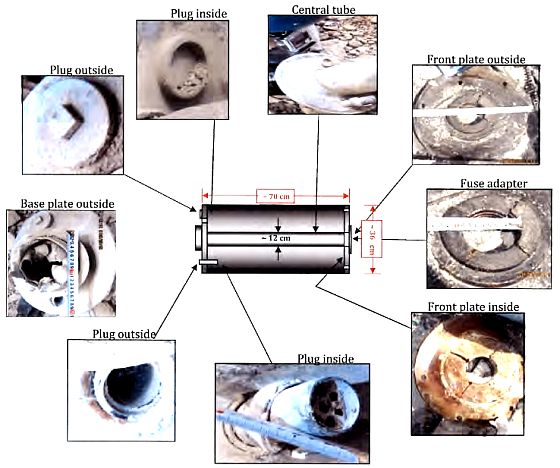
Photographs of the warhead components shown in the UN report:

RUSI analysis of chemical weapons used in Syria:
How the U.S. went from, Assad must go, to, he can stay
The New York Times reports: Both sides in Syria’s civil war see the deal to dismantle President Bashar al-Assad’s chemical weapons stockpiles as a major turning point. It left rebels deflated and government supporters jubilant. And both sides say it means the United States knows Mr. Assad is not going anywhere anytime soon.
The agreement between the United States and Russia, Mr. Assad’s most powerful backer, ended weeks of tension over the possibility of an imminent American military strike. Plans for such a strike have been put aside while the diplomatic process surrounding the agreement plays out, engaging Mr. Assad’s government and infusing it with new confidence that could have immediate impact.
Rebels who had hoped to capitalize on a military strike to regain momentum in the fighting are now bracing for the opposite, expecting Mr. Assad to press the battle more aggressively with conventional weapons, which they bitterly note have killed scores of times as many civilians as chemical weapons have.
Rebels and analysts critical of Mr. Assad’s government say he has a well-established pattern of agreeing to diplomatic initiatives to buy time, only to go on escalating the fighting.
For example, when Mr. Assad accepted Arab League monitors in the country in late 2011 and early 2012, he also intensified his crackdown on opponents, and shortly afterward he began the large-scale bombardments of rebel-held areas, like the Baba Amr neighborhood of Homs, that have since become daily occurrences.
Kamel Wazne, a Lebanese analyst who has close contacts with senior members of Hezbollah, the Lebanese militia that has sent fighters to aid Mr. Assad’s forces, said Sunday that the deal allowed the side of the Syrian government to exhale.
“Whether the Americans like it or not,” he said, “when you negotiate the deal with the Russians as representatives of Bashar al-Assad, you acknowledged his existence and his continuation in power.”
Though American officials keep saying that their threat of military force remains, Mr. Wazne added, the Syrian government is now reassured that there will be no strikes anytime soon, and that “at least for today, life is normal in Damascus.” [Continue reading…]
U.N. report confirms rockets loaded with sarin in Aug. 21 attack
The New York Times reports: Rockets armed with the banned chemical nerve agent sarin were used in a mass killing near Damascus on Aug. 21, United Nations chemical weapons inspectors reported Monday in the first official confirmation by nonpartisan scientific experts that such munitions had been deployed in the Syria conflict.
Although the widely awaited report did not ascribe blame for the attack, it concluded that “chemical weapons have been used in the ongoing conflict between the parties in the Syrian Arab Republic, also against civilians, including children, on a relatively large scale.”
The inspectors, who visited the Damascus suburbs that suffered the attack and left the country with large amounts of evidence on Aug. 31, said that “In particular, the environmental, chemical and medical samples we have collected provide clear and convincing evidence that surface-to-surface rockets containing the nerve agent sarin were used.”
Secretary General Ban Ki-moon, who ordered the report, received it on Sunday and presented it to the 15-member Security Council on Monday in a closed-door session.
The 38-page report said the facts supporting that conclusion included “impacted and exploded surface-to-surface rockets, capable to carry a chemical payload, were found to contain sarin.” The facts also included sarin-contaminated areas at the sites, more than 50 interviews given by survivors and health care workers, clear signs of exposure in patients and survivors, and blood and urine samples by those patients and survivors that were “found positive for sarin and sarin signatures.” [Continue reading…]
Who is fighting for what in Syria?
The Daily Telegraph reports: Opposition forces battling Bashar al-Assad’s regime in Syria now number around 100,000 fighters, but after more than two years of fighting they are fragmented into as many as 1,000 bands.
The new study by IHS Jane’s, a defence consultancy, estimates there are around 10,000 jihadists – who would include foreign fighters – fighting for powerful factions linked to al-Qaeda..
Another 30,000 to 35,000 are hardline Islamists who share much of the outlook of the jihadists, but are focused purely on the Syrian war rather than a wider international struggle.
There are also at least a further 30,000 moderates belonging to groups that have an Islamic character, meaning only a small minority of the rebels are linked to secular or purely nationalist groups.
The stark assessment, to be published later this week, accords with the view of Western diplomats estimate that less than one third of the opposition forces are “palatable” to Britain, while American envoys put the figure even lower. [Continue reading…]
In a recent report for Foreign Policy, Charles Lister wrote about the confusion that arises in most Western media analysis and political discourse by the continuing insistence on a simplistic division of rebels into two camps: moderates and extremists. He wrote:
I have spoken with members of all groups mentioned in this article and as shocking as it may sound to some, the large majority of them seem, outwardly, to have what they perceive to be Syria’s best interests at the forefront of their minds, at least for now. However, the tactics and rhetoric employed by many are clearly unpalatable by most Western standards.
While it is incontrovertibly the case that jihadists (or "extremists") represent a minority of the total insurgent force, true genuine "moderates" — by Western standards of supporting the establishment of a non-religious, liberal state preferably founded on democratic principals — also do not represent a majority. The largest portion of insurgent fighters in Syria is in fact represented by "Islamists," some less socially and politically conservative than others. Crucially, this does not preclude them from being potentially valuable leaders of a future Syria or even as future friends of the West, but it is important that this crucial element of the opposition is included within the minds of today’s policymakers.
Domenico Quirico, an Italian war correspondent who was just released after being held hostage by rebels for the last five months, spoke bitterly about his experience and described Syria as “a country of evil”. But, BBC News reports:
Paradoxically, he said, “the only ones who treated us with humanity were those closest to al-Qaeda”, because they had an attitude towards prisoners – a code of conduct – that other captors lacked.
It’s ironic that the Bush-Cheney view of the world ended up being swallowed whole by so many opponents of Bush and Cheney. Progressives and Tea Party kooks seem to be of one mind in their reactions to anyone who gets labelled “extremist”.
The fact is, the opposition in Syria, is not fundamentally different from any other opposition movement. Opposition movements build their solidarity around the thing they are opposing. For instance, opponents of the war in Iraq covered the political spectrum, from far left to far right, liberal, conservative, and libertarian.
Why should a movement to topple a dictatorial regime be any different?
U.N. Syria war crimes team checking 14 alleged chemical attacks
Reuters reports: U.N. war crimes investigators know of 14 potential chemical attacks in Syria since they began monitoring Syrian human rights abuses in September 2011, the team’s chairman said on Monday.
“We are investigating 14 alleged cases of chemical weapons or chemical agent use. But we have not established the responsibility or the nature of the materials that were used,” Paulo Pinheiro, chairman of the U.N. Commission of Inquiry on Syria told a news conference.
“We don’t have to share where, or when, or what moment. We don’t have to elaborate more on that.”
Iranians dial up presence in Syria
The Wall Street Journal reports: At a base near Tehran, Iranian forces are training Shiite militiamen from across the Arab world to do battle in Syria—showing the widening role of Iran’s elite Revolutionary Guard Corps in Syria’s bloody war.
The busloads of Shiite militiamen from Iraq, Syria and other Arab states have been arriving at the Iranian base in recent weeks, under cover of darkness, for instruction in urban warfare and the teachings of Iran’s clerics, according to Iranian military figures and residents in the area. The fighters’ mission: Fortify the Syrian regime of President Bashar al-Assad against Sunni rebels, the U.S. and Israel.
Iran’s widening role in Syria has helped Mr. Assad climb back from near-defeat in less than a year. The role of Iran’s training camp for Shiite fighters hasn’t previously been disclosed.
The fighters “are told that the war in Syria is akin to [an] epic battle for Shiite Islam, and if they die they will be martyrs of the highest rank,” says an Iranian military officer briefed on the training camp, which is 15 miles outside Tehran and called Amir Al-Momenin, or Commander of the Faithful.
The training of thousands of fighters is an outgrowth of Iran’s decision last year to immerse itself in the Syrian civil war on behalf of its struggling ally, the Assad regime, in an effort to shift the balance of power in the Middle East. Syria’s bloodshed is shaping into more than a civil war: It is now a proxy war among regional powers jockeying for influence in the wake of the Arab Spring revolutions. [Continue reading…]
A Syrian’s cry for help
Yassin al-Haj Saleh writes: The story is simple. Here in Syria, there is a regime that has been killing its subjects with impunity for the last 30 months. The notion that there is a mysterious civil war that is inextricably linked to the nature of the Middle East and its complicated sectarian divisions is far from the truth.
The primary perpetrator of violence is the government of Bashar al-Assad, which controls public resources, the media, the army and the intelligence services. The civilians who rose up against that regime, first peacefully and then through armed resistance, constitute a broad spectrum of Syrian society.
When a government murders its own citizens and they resist, this can hardly be called a civil war. It is a barbaric campaign of the first degree.
During the revolution’s first year, Syrians demanded international protection. First we asked for no-flight zones or humanitarian corridors, and later for weapons and military aid for the Free Syrian Army, but to no avail.
Not a month went by without some American or NATO official expressing little appetite for intervention. Realizing that this attitude was not about to change, the regime escalated the violence. It attacked the rebels with everything it had: first with rifles, then with tanks, helicopters, jet fighters, missiles and toxic gases.
Meanwhile, Western powers masked their diplomatic inertia with empty rhetoric about a “political solution.” Yet they have failed to coax the regime — which has not once indicated that it is ready to abandon its “military solution” — to the negotiating table.
Inaction has been catastrophic. While the world has dithered, Syrians have experienced unprecedented violence. Around 5,000 Syrians were killed in 2011. About the same number are now being killed each month. [Continue reading…]
The U.S.-Russian deal on Syria: A victory for Assad
Shadi Hamid writes: A deal with Russia on chemical weapons may be a “win” for President Obama but only in the narrowest sense. He managed to avoid a war he desperately did not want. But with the near-obsessive focus on chemical-weapons use, the core issues have been pushed to the side. These were always more or less the same — a regime bent on killing and terrorizing its own people and a brutal civil war spilling over into the rest of the region, fanning sectarian strife and destabilizing Syria’s neighbors.
For his part, Syrian President Bashar al-Assad is effectively being rewarded for the use of chemical weapons, rather than “punished” as originally planned. He has managed to remove the threat of U.S. military action while giving very little up in return. Obscured in the debate of the past few weeks is that chemical weapons were never central to the Syrian regime’s military strategy. It doesn’t need to use chemical weapons. In other words, even if the regime does comply with inspections (which could drag on for months if not years), it will have little import for the broader civil war, which Assad remains intent on winning.
If anything, Assad finds himself in a stronger position. Now, he can get away with nearly anything — as long as he sticks to using good old conventional weapons, which, unlike the chemical kind, are responsible for the vast majority of the more than 100,000 deaths so far in the civil war. Let’s say Assad intensifies the bombardment of villages and cities using aircraft and artillery. What if there are more summary executions, more indiscriminate slaughter? What we have already seen is terrible, of course, but it is not the worst Assad can do with conventional weapons.
Assad and his Russian backers played on Obama’s most evident weakness, exploiting his desire to find a way — any way — out of military action. There was a threat of military force, but it was a weak and not entirely credible one, and this has only been further confirmed by the events of the last few weeks. Assad is still in power, prosecuting his war. Before the “deal,” Assad had to at least worry about the possibility of military intervention and modulate his daily kill rate accordingly.
For this reason, the focus on chemical weapon use was, as some have put it, “obscene.” It concerned itself not with the killing itself but with the method. [Continue reading…]
Assad’s forces on attack after U.S.-Russia arms deal
Reuters reports: Syrian warplanes and artillery bombarded rebel suburbs of the capital on Sunday after the United States agreed to call off military action in a deal with Russia to remove President Bashar al-Assad’s chemical weapons.
President Barack Obama said he may still launch U.S. strikes if Damascus fails to follow a nine-month U.N. disarmament plan drawn up by Washington and Assad’s ally Moscow. But a reluctance among U.S. voters and Western allies to engage in a new Middle East war, and Russian opposition, has put any attacks on hold.
Syrian rebels, calling the international focus on poison gas a sideshow, dismissed talk the arms pact might herald peace talks and said Assad had stepped up an offensive with ordinary weaponry now that the threat of U.S. air strikes had receded.
Syrian official declares ‘victory,’ thanks Russia
CNN reports: A Syrian minister declared “victory” for his country on Sunday, thanking Russia for orchestrating a chemical weapons deal to avert U.S. military action, Russia’s state-run news agency RIA Novosti reported.
“We welcome these agreements. On the one hand, they will help Syrians come out of the crisis, and on the other hand, they prevented the war against Syria by having removed a pretext for those who wanted to unleash it,” National Reconciliation Minister Ali Haidar was quoted as saying.
He called the deal an achievement of Russian diplomacy, and “a victory for Syria won thanks to our Russian friends,” RIA Novosti reported.
Obama has exchanged letters with Iranian president Rouhani
ABC News reports: Obama confirmed publicly for the first time on “This Week” that he has exchanged letters with new Iranian president Hassan Rouhani, who has vowed to act forcefully to prevent any Western military intervention in Syria, using “all efforts to prevent it.”
Obama said he believes his threat to use U.S. military force in Syria, and subsequent pause to pursue diplomacy, sends a signal to the Iranian regime in the ongoing dispute over its contested nuclear program.
“What they should draw from this lesson is that there is the potential of resolving these issues diplomatically,” Obama said.
“I think this new president is not going to suddenly make it easy,” he added. “But you know, my view is that if you have both a credible threat of force, combined with a rigorous diplomatic effort, that, in fact … you can strike a deal.”
Framework for Elimination of Syrian Chemical Weapons
U.S. State Department: Taking into account the decision of the Syrian Arab Republic to accede to the Chemical Weapons Convention and the commitment of the Syrian authorities to provisionally apply the Convention prior to its entry into force, the United States and the Russian Federation express their joint determination to ensure the destruction of the Syrian chemical weapons program (CW) in the soonest and safest manner.
For this purpose, the United States and the Russian Federation have committed to prepare and submit in the next few days to the Executive Council of the OPCW a draft decision setting down special procedures for expeditious destruction of the Syrian chemical weapons program and stringent verification thereof. The principles on which this decision should be based, in the view of both sides, are set forth in Annex A. The United States and the Russian Federation believe that these extraordinary procedures are necessitated by the prior use of these weapons in Syria and the volatility of the Syrian civil war.
The United States and the Russian Federation commit to work together towards prompt adoption of a UN Security Council resolution that reinforces the decision of the OPCW Executive Council. This resolution will also contain steps to ensure its verification and effective implementation and will request that the UN Secretary-General, in consultation with the OPCW, submit recommendations to the UN Security Council on an expedited basis regarding the UN’s role in eliminating the Syrian chemical weapons program. [Continue reading…]
Qaeda tells Syria fighters to shun secularists in sign of deeper rebel rift
Reuters reports: Al Qaeda leader Ayman al-Zawahri has told the Islamist militants who are some of Syria’s toughest opposition forces to avoid alliances with other rebel fighters backed by Gulf Arab states and the West.
His comment reflects a deepening rift between groups of the Western- and Arab-backed Free Syrian Army (FSA) and guerrillas sympathetic to Zawahri’s ultra hardline network, which seeks to wage a transnational armed campaign against the West.
Division among rebel fighters, as well as the influence of hardline Islamists, is one reason Western powers have hesitated to intervene in Syria’s two-and-a-half-year-old conflict, in which more than 100,000 people have been killed.
In an audio speech released a day after the 12th anniversary of the 9/11 strikes, Zawahri said the United States would try to push opposition fighters to link up with “secular parties that are allied to the West”, the SITE monitoring service said. [Continue reading…]
Syria deal brings renewed attention to Israel’s chemical weapons program
The Wall Street Journal reports: The joint U.S. Russian push to dismantle Syria’s chemical weapons is starting to have ripple effects, focusing attention on the suspected arsenal of Israel.
By forcing Syria to admit to its stockpiles of the weapons of mass destruction and take tentative steps toward their elimination, Washington and Moscow could coax Syria’s neighbors into eventually following suit, said Western and Arab diplomats.
But a frequent complaint among Arab countries in the region—that Israel has an undeclared but presumed nuclear-weapons program—has already resurfaced.
Syria’s government has hinted that it could raise Israel’s suspected arsenal of nuclear and other weapons as an international issue and potentially a precondition for Damascus moving ahead on the destruction of what the U.S. estimates is at least 1,000 tons of chemical agents.
Russian President Vladimir Putin has publicly stated that Syria’s program was only necessary as a defense against Israel’s vastly superior firepower.
“It’s well known that Syria has a certain arsenal of chemical weapons and the Syrians always viewed that as an alternative [response] to Israel’s nuclear weapons,” he said Tuesday.
This position could place the Obama administration in a diplomatic corner. The U.S. has held to a decades-old policy of neither publicly acknowledging nor denying Israel’s capabilities, which are believed to include nuclear warheads.
It also could undermine the White House’s efforts to counter weapons proliferation and contain Iran’s nuclear program. The U.S. has repeatedly stated that American efforts to reduce its own weapons stockpiles, and those of its allies, diminished the needs of other countries to seek atomic bombs.
“The main danger of WMD is the Israel nuclear arsenal,” Syria’s ambassador to the U.N., Bashar Ja’afari, told reporters on Thursday. [Continue reading…]
In a lengthy report for Foreign Policy, Matthew Aid this week revealed the contents of a 1983 CIA intelligence estimate on Israel’s chemical weapons program. The estimate has not been declassified but was unearthed at the Ronald Reagan Presidential Library in California where it was found having been stapled to an innocuous unclassified report.
According to the 1983 intelligence estimate, "Israel, finding itself surrounded by frontline Arab states with budding CW [chemical weapons] capabilities, became increasingly conscious of its vulnerability to chemical attack. Its sensitivities were galvanized by the capture of large quantities of Soviet CW-related equipment during both the 1967 Arab-Israeli and the 1973 Yom Kippur wars. As a result, Israel undertook a program of chemical warfare preparations in both offensive and protective areas."
Israeli concerns about Egypt and other Arab states possessing chemical weapons were legitimate. Documents discovered at the National Archives confirm that the Egyptian military had possessed a large stockpile of mustard gas since the early 1960s and had demonstrated that it was not afraid to use these weapons. A declassified May 23, 1967 intelligence assessment found at the National Archives reveals that Egyptian forces first began using mustard gas bombs against Saudi-backed royalist rebel forces in what was then known as North Yemen as early as 1963. According to a January 15, 1968 CIA report, U.S. intelligence learned in early 1967 that Egyptian Soviet-made Tu-16 bombers had dropped bombs filled with nerve agents on rebel positions in Yemen, marking the first time that nerve agents had ever been used in combat. And according to a May 20, 1967 top secret White House memorandum found at the National Archives, the Israelis sent Washington an intelligence report stating that Israeli intelligence had observed "canisters of [poison] gas" with Egyptian troops stationed along the Israeli border in the Sinai Peninsula.
The 1983 CIA estimate reveals that U.S. intelligence first became aware of Israeli chemical weapons-testing activities in the early 1970s, when intelligence sources reported the existence of chemical weapons test grids, which are specially instrumented testing grounds used to measure the range and effectiveness of different chemical agents, particularly nerve agents, in simulated situations and in varying climatic conditions. It is almost certain that these testing grids were located in the arid and sparsely populated Negev Desert, in southern Israel.
But the CIA assessment suggests that the Israelis accelerated their research and development work on chemical weapons following the end of the 1973 Yom Kippur War. According to the report, U.S. intelligence detected "possible tests" of Israeli chemical weapons in January 1976, which, again, almost certainly took place somewhere in the Negev Desert. A former U.S. Air Force intelligence officer whom I interviewed recalled that at about this time, the National Security Agency captured communications showing that Israeli air force fighter-bombers operating from Hatzerim Air Base outside the city of Beersheba in southern Israel had been detected conducting simulated low-level chemical weapons delivery missions at a bombing range in the Negev Desert.
The U.S. intelligence community was paying an extraordinary amount of attention to Israel in the 1970s, according to a retired CIA analyst I spoke with who studied the region at the time. The possible January 1976 Israeli chemical weapons test occurred a little more than two years after the end of the 1973 war, an event that had shocked the Israeli political and military establishment because it demonstrated for the first time that the Arab armies were now capable of going toe-to-toe on the battlefield with the Israeli military.
To complicate things further, in January 1976 the long-simmering civil war in Lebanon was beginning to heat up. And the CIA was increasingly concerned about the growing volume of evidence, much of it coming from human intelligence sources inside Israel, indicating that the Israeli nuclear weapons stockpile was growing both in size and raw megatonnage. At the same time that all this was happening, the Israeli "chemical weapons" test mentioned in CIA document occurred. It increased the already-heightened level of concern within the U.S. intelligence community about what the Israelis were up to.
In March 1976, two months after the Israeli test in question, a number of newspapers in the U.S. published stories which quoted CIA officials to the effect that Israel possessed a number of nuclear weapons. The leak was based on an authorized off-the-record briefing of newspaper reporters by a senior CIA official in Washington, who intimated to the reporters that Israel was also involved in other activities involving weapons of mass destruction, but refused to say anything further on the subject. The CIA official was likely referring to the agency’s belief that the Israelis may have conducted a chemical weapons test in January 1976. According to a declassified State Department cable, Israeli foreign minister Yigal Allon called in the U.S. ambassador to Israel and registered a strong protest about the story, reiterating the official Israeli government position that Israel did not possess nuclear weapons. After the protest, all further public mention of Israeli WMD activities ceased and the whole subject was quickly and quietly forgotten.
Deal reached to destroy chemical weapons in Syria
The New York Times reports: The United States and Russia reached a sweeping agreement on Saturday that called for Syria’s arsenal of chemical weapons to be removed or destroyed by the middle of 2014 and indefinitely stalled the prospect of American airstrikes.
However, the joint announcement, on the third day of intensive talks in Geneva, also set the stage for one of the most challenging undertakings in the history of arms control.
“This situation has no precedent,” said Amy E. Smithson, an expert on chemical weapons at the James Martin Center for Nonproliferation Studies. “They are cramming what would probably be five or six years’ worth of work into a period of several months, and they are undertaking this in an extremely difficult security environment due to the ongoing civil war.”
Although the agreement for the first time explicitly includes the United Nations Security Council in determining possible international action in Syria, Russia has maintained its opposition to any military action.
But George Little, the Pentagon press secretary, emphasized that the possibility of unilateral American military force was still on the table. “We haven’t made any changes to our force posture to this point,” Mr. Little said. “The credible threat of military force has been key to driving diplomatic progress, and it’s important that the Assad regime lives up to its obligations under the framework agreement.”
In Syria, the state news agency, SANA, voiced cautious approval of the Russian and American deal, calling it “a starting point.” But there was no immediate explicit statement about the government’s willingness to implement it as detailed on Saturday.
In any case, the deal represented at least a temporary reprieve for Mr. Assad’s government — a reality that was bitterly seized on by the fractured Syrian rebel forces, most of which have pleaded for American airstrikes. General Salim Idris, the head of the Western-backed rebels’ nominal military command, the Supreme Military Council, denounced the initiative.
“All of this initiative does not interest us. Russia is a partner with the regime in killing the Syrian people,” he told reporters in Istanbul. “ A crime against humanity has been committed, and there is not any mention of accountability.” [Continue reading…]
President’s brother key to Syria regime survival
The Associated Press reports: He is rarely photographed or even quoted in Syria’s media. Wrapped in that blanket of secrecy, President Bashar Assad’s younger brother has been vital to the family’s survival in power.
Maher Assad commands the elite troops that protect the Syrian capital from rebels on its outskirts and is widely believed to have helped orchestrate the regime’s fierce campaign to put down the uprising, now well into its third year. He has also gained a reputation for brutality among opposition activists.
His role underlines the family core of the Assad regime, though he is a stark contrast to his brothers. His eldest brother, Basil, was the family prince, publicly groomed by their father, Hafez, to succeed him as president — until Basil died in a 1994 car crash. That vaulted Bashar, then an eye doctor in London with no military or political experience, into the role of heir, rising to the presidency after his father’s death in 2000. The two brothers — the “martyr” and the president — often appear together in posters.
The 45-year-old Maher Assad, however, has resolutely stayed out of the limelight. Friends, military colleagues and even his enemies describe him as a strict military man to the core. [Continue reading…]
U.S., Russia agree to deal on Syria chemical weapons
Reuters reports: The United States and Russia have agreed on a proposal to eliminate Syria’s chemical weapons arsenal, Secretary of State John Kerry said on Saturday after nearly three days of talks with Russian Foreign Minister Sergei Lavrov.
Kerry said that, under the pact, Syria must submit a “comprehensive listing” of its chemical weapons stockpiles within one week.
Kerry, at a press conference with Lavrov, said that under the agreement, U.N. weapons inspectors must be on the ground in Syria no later than November. The goal, he said, is the complete destruction of Syria’s chemical weapons by the middle of 2014.
Kerry and Lavrov said that if Syria does not comply with the agreement, which must be finalized by the Organization for the Prevention of Chemical Weapons, it would face consequences under Chapter 7 of the U.N. Charter, the part that covers sanctions and military action.
Kerry said there was no agreement on what those measures would be. U.S. President Barack Obama, he said, reserves the right to use military force in Syria.
“There’s no diminution of options,” he said.
Lavrov said of the agreement, “There (is) nothing said about the use of force and not about any automatic sanctions.”