Category Archives: Syria

How does Bashar al-Assad view Syria?

David W. Lesch, author of Syria: The Fall of the House of Assad, writes: I got to know Assad fairly well over the years. I do not see him as either an eccentric or as a bloodthirsty killer, along the lines of Muammar al-Qaddafi or Saddam Hussein. People I know who have met all three readily agree with this assessment. There are those, however, who differ, viewing Bashar as a corrupt tyrant from the very beginning. Many of these people have never even been to Syria. Many of them have agendas that have been — or still are — assisted by this characterization. And almost none of them have ever met Assad or any other top Syrian official. They often base their position on the evidence of continued repression and repeatedly delayed reform. This is understandable. If they said that the Syrian system had been corrupt and repressive from the beginning of Assad’s rule, then I would wholeheartedly agree.

If they said that he was bound eventually to succumb to this system, even if he was altruistic in the beginning, then they would be correct. But Bashar was different from the typical Middle Eastern dictator, and this led many people, including me, to hope for the best — and maybe even indulge in a little wishful thinking. That Bashar was perceived by most who met him as a relatively ordinary person, and that this ordinary person then sanctioned a brutal crackdown on the uprising in what seems to have been a very matter-of-fact manner says something about human behavior and about how even normal people can become corrupted under the pressure of power and delusion.

Somewhere along the road, Assad lost his way. He either convinced himself, or was convinced by sycophants, that his well-being was synonymous with the well-being of the country, and that his brutal response to the protests was a necessary response. A self-reinforcing alternate reality was orchestrated and constructed around him, and there was no way of testing it against what was real.

A friend of mine, Ayman Abd al-Nour, is a prominent voice on things Syrian. He went to college with Bashar in Syria and got to know him well as a friend. Ayman was forced into exile several years ago because of his criticisms of the regime that appeared on his blog, All4Syria. “After he became president, when people showered him with compliments and inflated his ego, he became totally different — as if he was chosen by God to run Syria,” he told me. “He believed he was a prophet and started to build his own world.”

While the rest of the world thinks Assad has been delusional since his March 30 speech, it is my contention that he and his inner circle really believe — more than most people can imagine — that they have indeed been battling foreign conspiracies from the very beginning. The Syrian leadership simply has a different conceptual paradigm that frames the nature of internal and external threat to the country. From the Western point of view, it appears extremely paranoid; from the perspective of Damascus, it is based on historical circumstances. And the violence Assad has unleashed has helped to create a context in Syria whereby external forces are, in fact, involving themselves in the uprising — it has, to some extent, become a self-fulfilling prophecy.

The Syrian government’s crackdown is a push-button, convulsive reaction to domestic threat. It is not that Bashar does not control the security forces — this is simply the way Syria has worked under the Assads. Syrian leaders reached into their pockets and pulled out what worked for them in the past, in this case what they found was much closer to Hama in 1982 than to anything else. The regimes of Hafez and Bashar al-Assad have always refused to make concessions from a perceived position of weakness — they will only do so from a perceived position of strength. Cracking down hard on demonstrators while offering political reforms are two sides of the same coin.

Thus, there was never much U.S. President Barack Obama’s administration could do to change Bashar’s response to the revolt. The United States tried to squeeze blood from a stone: It pushed for dramatic political reform from a system that simply is not built for it.

Assad’s removal perhaps will just be a matter of time — although it may take longer than many want. Unfortunately, it is unlikely to be a pretty sight. [Continue reading…]


Facebooktwittermail

Among the Alawites

Nir Rosen has witnessed the Syrian revolution from more vantage points and for longer on the ground than probably any other Western reporter. His latest report, appearing in the London Review of Books, is worth reading in full.

Here’s an excerpt: Alawites aren’t wrong to feel that for all the fury of its repression, the state is at a loss to know how to protect them. It is this feeling, above all, that has led to the growth of the increasingly powerful independent loyalist militias who act with impunity and often embarrass the regime. The militias have been responsible for several massacres in Homs and Hama, but Bashar is in no position to bear down on his most diehard supporters. An engineer in Homs, an Alawite who had joined the opposition, told me that the first time he saw loyalist gangs in action was in March 2011. ‘It was random and nobody organised them,’ he said. ‘They only had clubs. But by July they were organised. Now they work on their own account … The most dangerous thing in a civil war is the people who live off it and depend on it financially. I saw this in Lebanon. In Homs it’s open civil war.’

In the days of Hafez al-Assad the term shabiha, which means ‘ghosts’, referred only to organised criminals and smugglers who co-operated with the security forces. Some were part of the Assad clan – Bashar’s brother famously crushed and jailed elements of the Assad shabiha who got out of control – but by no means all were Alawites. When the uprising started, however, the word shabiha quickly came to refer to the loyalist militias, and in due course to any government loyalists. Soon many loyalists could be heard at pro-regime rallies directing chants at the opposition: ‘We are the shabiha! Screw your freedom! Shabiha for ever!’ There are thousands of shabiha, or popular committee members, in the Alawite neighbourhoods of Homs, a security officer told me. They are not paid for their militia activities, he said, but they continue to draw their government salaries even though they no longer go to work. They answer to local mayors. ‘They can arrest somebody from Khaldiyeh or Bayada,’ he said, naming two Sunni neighbourhoods, ‘and hand him over to security forces. They co-ordinate with security.’

The opposition engineer in Homs was more blunt: ‘A shabih is somebody who loves Bashar more than Bashar. A shabih is a culture not a person. He feels he is above the law, he is the law … For now the state can control them but I don’t know if they can control them in the future. The state is using them now. The state did it.’ [Continue reading…]

Facebooktwittermail

Iran shipping arms, personnel to Syria via Iraq

Reuters reports: Iran has been using civilian aircraft to fly military personnel and large quantities of weapons across Iraqi airspace to Syria to aid President Bashar al-Assad in his attempt to crush an 18-month uprising against his government, according to a Western intelligence report seen by Reuters.

Earlier this month, U.S. officials said they were questioning Iraq about Iranian flights in Iraqi airspace suspected of ferrying arms to Assad, a staunch Iranian ally. On Wednesday, U.S. Senator John Kerry threatened to review U.S. aid to Baghdad if it does not halt such overflights.

Iraq says it does not allow the passage of any weapons through its airspace. But the intelligence report obtained by Reuters says Iranian weapons have been flowing into Syria via Iraq in large quantities. Such transfers, the report says, are organized by the Islamic Revolutionary Guard Corps.

“This is part of a revised Iranian modus operandi that U.S. officials have only recently addressed publicly, following previous statements to the contrary,” said the report, a copy of which was provided by a U.N. diplomatic source.

“It also flies in the face of declarations by Iraqi officials,” it said. “Planes are flying from Iran to Syria via Iraq on an almost daily basis, carrying IRGC (Iranian Revolutionary Guard Corps) personnel and tens of tons of weapons to arm the Syrian security forces and militias fighting against the rebels.”

It added that Iran was also “continuing to assist the regime in Damascus by sending trucks overland via Iraq” to Syria.

Although the specific charges about Iraq allowing Iran to transfer arms to Damascus are not new, the intelligence report alleges that the extent of such shipments is far greater than has been publicly acknowledged, and much more systematic, thanks to an agreement between senior Iraqi and Iranian officials.

Facebooktwittermail

The agony of Syria

I posted an excerpt of the following article when it first appeared in the New York Review of Books but at that time the whole article could only be read by subscribers. It’s now publicly viewable and essential reading.

Max Rodenbeck writes: Postcolonial governments have often seemed condemned to repeat the sins of the imperialists they replaced, a sad irony that has been especially pronounced in the Middle East. The British in 1920, for instance, pioneered the use of poison gas against civilians in order to subdue a tribal revolt in Iraq. The last known deployment of chemical weapons for mass murder was again in Iraq, in 1988, when Saddam Hussein gassed his fellow citizens during the notorious Anfal campaign against the Kurds.

Syria, too, has experienced sinister symmetries. Soon after France grabbed the territory as a share of its spoils from World War I, an insurrection among the proud Druze of the Houran region in the south quickly spread elsewhere. The colonial government countered this challenge with a mix of sweet propaganda and extreme violence. Depicting their foes as sectarian fanatics, the French posed as patrons of progress and as the noble guarantors of peace between Syria’s diverse sects. Yet they also worked hard to sharpen the schism they warned of. Arming and empowering favored groups, they brutalized others with summary executions, the burning of crops, and the razing of villages.

The counterinsurgency culminated with a brazen demonstration of destructive power that effectively terrorized Syria’s propertied class into submission. In October 1925 French artillery and aircraft bombarded Damascus for two days, leaving 1,500 dead and much of the Syrian capital in ruins; the large, incongruously grid-patterned section of the Old City known simply as al-Hariqa—The Fire—today serves as a memorial to that conflagration. In May 1945, French forces again shelled Damascus indiscriminately, killing more than six hundred people in what proved a vain attempt to reassert control following the end of World War II.

The regime built under the Assad clan, whose godfather, Hafez Assad, Syria’s then minister of defense, seized power in 1970 and held it for three decades until his son Bashar’s succession, has followed these unfortunate examples. Like France’s colonial governors the Assads have posed as defenders of a modern secular state. They have called their opponents sectarian extremists, even as their favoritism toward some parts of Syria’s complex ethnic and religious mosaic—particularly their own minority Alawite sect—and punishment of others, such as the 10 percent Kurdish minority, have enflamed communal resentment. The striking viciousness and scale of state repression, enforced by seventeen competing intelligence agencies whose upper ranks are dominated by Alawites, have been excused as a necessary bulwark against threats to national unity. [Continue reading…]

Facebooktwittermail

Syria’s secular and Islamist rebels: Who are the Saudis and the Qataris arming?

Time reports: Vast swaths of northern Syria, especially in the province of Idlib, have slipped out of the hands of President Bashar Assad, if not quite out of his reach. The area is now a de facto liberated zone, though the daily attacks by Damascus’ air force and the shelling from the handful of checkpoints and bases regime forces have fallen back to are reminders that the rebel hold on the territory remains fluid and fragile.

What is remarkable is that this substantial strip of “free” Syria has been patched together in the past 18 months by military defectors, students, tradesmen, farmers and pharmacists who have not only withstood the Syrian army’s withering fire but in some instances repelled it using a hodgepodge of limited, light weaponry. The feat is even more amazing when one considers the disarray among the outside powers supplying arms to the loosely allied band of rebels.

As TIME reports here, disorder and distrust plague two of the rebels’ international patrons: Saudi Arabia and Qatar. The two Gulf powerhouses are no longer on the same page when it comes to determining who among the plethora of mushrooming Syrian rebel groups should be armed. The rift surfaced in August, with the alleged Saudi and Qatari representatives in charge of funneling free weaponry to the rebels clearly backing different factions among the groups — including various shades of secular and Islamist militias — under the broad umbrella that is the Free Syrian Army (FSA).

The middlemen of the two countries operate out of Turkey, the regional military power. Ankara has been quite public with its denunciation of Assad even as it denies any involvement in shuffling weapons across the border to Syrian rebels. It claims its territory is not being used to do so. And yet, as TIME reported in June, a secretive group operates something like a command center in Istanbul, directing the distribution of vital military supplies believed to be provided by Saudi Arabia and Qatar and transported with the help of Turkish intelligence to the Syrian border and then to the rebels. Further reporting has revealed more details of the operation, the politics and favoritism that undermine the task of creating a unified rebel force out of the wide array of groups trying to topple the Assad regime. [Continue reading…]

Facebooktwittermail

Syria tested chemical weapons systems, witnesses say

Der Spiegel reports: The Syrian army is believed to have tested missile systems for poison gas shells at the end of August, statements from various witnesses indicate.

The tests took place near a chemical weapons research center at Safira [ten miles] east of Aleppo, witnesses told SPIEGEL. A total of five or six empty shells devised for delivering chemical agents were fired by tanks and aircraft, at a site called Diraiham in the desert near the village of Khanasir.

Iranian officers believed to be members of the Revolutionary Guards were flown in by helicopter for the testing, according to the statements.

The Safira research center is regarded as Syria’s largest testing site for chemical weapons. It is officially referred to as a “scientific research center.”

Scientists from Iran and North Korea are said to work in the expansive, fenced-off complex. According to Western intelligence agencies, they produce chemical agents such as sarin, tabun and mustard gas and test them on animals. [Continue reading…]

Facebooktwittermail

Towns in rebel-controlled Syria experiment with open democracy

Borzou Daragahi reports: The leaders of the council governing Souran, a town in rebel-controlled Syria, decide to hold an impromptu meeting right on the footpath along its main street, a gesture of open government that would impress Canada or Sweden.

They draw together some plastic chairs and a table, pour tea and, as pedestrians listen in, explain the workings of the government they have set up to replace the Baath Party and the security officials who ran the region with an iron fist under President Bashar al-Assad’s rule.

“This is a new thing for us,” says Faez Hamsho, a businessman and one of 11 members of the town’s governing council. “But when Bashar’s men fled, we had to solve the day-to-day problems of the area.”

A commotion suddenly erupts. Word trickles in that a missile fired by one of Assad’s fighter jets has struck a nearby village. There are numerous injuries. Drivers on motorcycles and cars full of children and loaded with suitcases zoom past, fleeing in fear of further bombs. Aircraft can be heard circling overhead. A minor panic erupts.

The experiment in open democracy is adjourned and the men rush indoors.

As a ferocious war pits Syrian rebels against Assad’s regime, a self-rule experiment has begun to take root in the parts of the country under the control of the opposition. Much of the country’s north is under rebel control. The regime still controls Damascus, but parts of the capital city remain contested. Elsewhere there are rebel enclaves.

Under the shadow of Assad’s fighter jets, shelling and helicopters, the self-described revolutionaries manage local affairs such as refuse collection or food distribution, house the many displaced by war, mete out justice and resolve potentially cataclysmic disputes between clans before they get out of hand.

Syrians have little democratic experience. They lived for decades under the tight-fisted, centralized rule of Assad and his father, Hafez. But many of those now leading their communities took part in the peaceful protests last year, a time of intense political education and dialogue infused with the democratic spirit that ignited revolutions in Tunisia and Egypt. [Continue reading…]

Facebooktwittermail

Syria massacres seem to show slow, steady killing strategy

The Los Angeles Times reports: As he hid from soldiers in a field next to his neighborhood, a young man watched as a cat wandered down a street. Suddenly, it was shot dead. That’s when Zuhair noticed the sniper on a nearby roof.

But a father and son walking along the street didn’t see the gunman, Zuhair said. The sniper lowered his head and peered through his scope.

He shot the boy first. As the man tried to grab his son, who looked to be about 10, he was shot as well.

The two are among a reported 700 victims of snipers, shelling and summary executions, most of them men, since forces loyal to President Bashar Assad stormed the Damascus suburb of Dariya in late August, one in a growing list of Syrian towns and villages that briefly enter the world’s spotlight, only to be replaced by another one when a new mass killing is committed.

Unlike a massacre by government forces three decades earlier in the city of Hama, which left more than 20,000 dead in just three weeks and still haunts the country, the reported atrocities have been spread over months of bloodshed in Syria. That has led some to call the government campaign a kind of slow-motion Hama.

Late last year, as the government siege of the city of Homs was underway, activists began tweeting: “Homs 2011 = Hama 1982, but slowly, slowly.” As the conflict becomes more bloody on both sides, the same can be said for the entire country.

“They killed them in one sweep [in Hama]; with us, it’s in stages,” said Um Hussam, a mother of five who runs a small convenience shop in an old neighborhood of Dariya. “We expected they would kill and terrorize people, but not to this … level of barbarity.”

After videos of children’s bodies emerged after a massacre of 108 people in the town of Houla in May, there was brief international outcry, and several Western countries expelled their Syrian ambassadors and diplomats. Less than two weeks later in the town of Qubair, 78 were killed and United Nation monitors were fired upon when they first tried to visit the village.

On Thursday, activists said 36 civilians had been executed in Yalda, a Damascus suburb.

Like the Hama massacre before, these mass killings are an effort not only to crush dissent but also to ensure that future generations don’t think of revolting, said Muhammad Shihadeh, an activist in Dariya. He also sees a sinister motive in the relatively smaller toll in each mass killing.

“It was a smart tactic on the part of the regime so there wouldn’t be a shock from the international community,” Shihadeh said. “But we’re seeing that the world has a very expansive red line.”

The opposition estimates at least 27,000 have been killed, and the numbers are rising.

Facebooktwittermail

Syria’s Libyan revolutionary

The Libya Herald reports: Over the past few months, growing reports have emerged from Syria of a group of Libyans engaged in the conflict to overthrow the regime of longtime dictator Bashar Al-Assad.

Having lived through the horrors of last year’s revolution in Libya, these young men have travelled to Syria to fight for a second time, out of a sense of solidarity with a country many feel has been abandoned to its fate by the outside world.

Perhaps the most famous of these repeat revolutionaries is Mahdi Al-Harati, commander of the Liwa Al-Ummah, a 6,000 strong body composed overwhelmingly of Syrians but led by a Libyan.

A softly spoken man raised in Ireland, Harati led the Revolutionaries of Tripoli brigade during last year’s uprising in Libya, and his was the first group of fighters to enter the capital from Zawiya, on 21 August 2011. Muammar Qaddafi’s last redoubt, his fortress compound Bab Al-Azizia, fell two days later.

Harati subsequently served as deputy head of the Tripoli Military Council, before stepping down in November and heading to Syria to witness the plight of the people there first-hand.

What he saw there resolved him to use his fighting experience to help Syria’s often-ramshackle revolutionaries to organise themselves into a more effective fighting force.

Earlier this year, he formed the Ummah brigade for that purpose. Here he speaks to the Libya Herald about his experiences and what it means to be a Libyan in a Syrian revolution.

“When I first arrived in Syria, what I saw was a group of people in a terrible condition. I was touched with the response I received and realised these men wanted all the help they could get.

“They welcomed me and requested me to help them”, Harati says. “I accepted and initially started to work on the lines of relief goods.”

What Harati soon realised, however, was that the level of fighting and the loss of life was such that the situation was much more difficult than even what he had faced in Libya.

“The situation was very grim and there was no comparison between the two countries. I realised the fight was tough as the people were being killed in large numbers every day and the Syrians would require all the help possible to succeed.”

After realising the nature of the war Harati knew that it would take help from the broader Muslim community (the Ummah) to topple the Assad regime, and so it was that the Ummah brigade was formed.

“War required a serious contribution from the Ummah and they didn’t disappoint, praise be to God. People contacted me from all over the world to help the Syrian cause,” he said.

“There are now more than 6,000 fighters in the Liwa Al-Umma. We have strictly kept 90 per cent of the members Syrians.”

The remaining ten per cent, Harati says, are drawn from other Muslim countries, including Libya. Many of the Libyans fought with Harati in the Tripoli Revolutionary Brigade and are amongst Harati’s closest confidants, including his brother-in-law Housam Najjair.

“The Syrians were very willing to fight but didn’t have the expertise to do so effectively. So I decided to put my experience from Libya to good use and trained the locals. But the response from around the world was amazing. People were coming from different countries to help their brothers and sisters in Syria. They realised that Syria is the gateway to Quds [Jerusalem] and the Ummah must contribute to help liberate and protect it.

“Turkey was full of people who wanted to fight. At one point I had to stop them from coming to Syria as I lacked the resources to manage that many fighters.” [Continue reading…]

Facebooktwittermail

Syria: end opposition use of torture, executions

UpdateThe Guardian interview’s HRW’s researcher Ole Solvang:

Human Rights Watch: Armed opposition groups have subjected detainees to ill-treatment and torture and committed extrajudicial or summary executions in Aleppo, Latakia, and Idlib, Human Rights Watch said today following a visit to Aleppo governorate. Torture and extrajudicial or summary executions of detainees in the context of an armed conflict are war crimes, and may constitute crimes against humanity if they are widespread and systematic.

Opposition leaders told Human Rights Watch that they will respect human rights and that they have taken measures to curb the abuses, but Human Rights Watch expressed serious concern about statements by some opposition leaders indicating that they tolerate, or even condone, extrajudicial and summary executions. When confronted with evidence of extrajudicial executions, three opposition leaders told Human Rights Watch that those who killed deserved to be killed, and that only the worst criminals were being executed.

“Declarations by opposition groups that they want to respect human rights are important, but the real test is how opposition forces behave,” said Nadim Houry, deputy Middle East director at Human Rights Watch. “Those assisting the Syrian opposition have a particular responsibility to condemn abuses.”

Military and civilian Syrian opposition leaders should immediately take all possible measures to end the use of torture and executions by opposition groups, including condemning and prohibiting such practices, Human Rights Watch said. They should investigate the abuses, hold those responsible to account in accordance with international human rights law, and invite recognized international detention monitors to visit all detention facilities under their control. Initiatives to have armed opposition groups adopt and enforce codes of conduct that promote respect for human rights and international humanitarian law should be encouraged.

Human Rights Watch presented its research findings and detailed recommendations in meetings with opposition leaders in northern Aleppo in August and in a letter sent to several opposition leaders on August 21, 2012. In a written response, the Military Council for the Aleppo Governorate said that, in light of the findings, it had reiterated its commitment to humanitarian law and human rights to Free Syrian Army (FSA) groups, that it was in the process of establishing special committees to review detention conditions and practices, and that it would hold responsible those who act “contrary to the guidelines.”

Countries financing or supplying arms to opposition groups should send a strong signal to the opposition that they expect it to comply strictly with international human rights and humanitarian law, Human Rights Watch said.

Human Rights Watch documented more than a dozen extrajudicial and summary executions by opposition forces. Two FSA fighters from the Ansar Mohammed battalion in Latakia told Human Rights Watch, for example, that four people had been executed after the battalion stormed a police station in Haffa in June 2012, two immediately and the others after a trial.

Six of 12 detainees interviewed by Human Rights Watch in two opposition-run detention facilities said that FSA fighters and officials in charge of detention facilities had tortured and mistreated them, in particular by beating them on the soles of their feet. Abuse appeared to be more prevalent during the initial stages of detention, before the detainees were transferred to civilian opposition authorities.

Because of inconsistencies in their accounts and visible injuries consistent with torture, Human Rights Watch has reason to believe that FSA fighters and prison authorities had also tortured or mistreated at least some of the six detainees who denied during their interviews that they had been abused.

“Sameer,” whom the FSA arrested in the beginning of August, told Human Rights Watch.

The FSA fighters who caught me first brought me to their base. I spent a night there, together with one other prisoner. They beat me a lot, with a wooden stick, on the soles of my feet. It lasted for about two hours. First, I refused to confess, but then I had to. Once I confessed, they stopped beating me.

Human Rights Watch has also reviewed more than 25 videos on YouTube in which people reportedly in the custody of armed opposition groups show signs of physical abuse. Human Rights Watch cannot independently confirm the authenticity of these videos.

The head of the Aleppo Governorate Revolutionary Council told Human Rights Watch that the authorities do not execute or torture detainees, but that beating detainees on the soles of the feet was “permissible” because it did not cause injuries. When Human Rights Watch explained that beating on the soles of the feet constitutes torture and is unlawful according to international law, he said that he would provide new instructions to FSA fighters and those in charge of detention facilities that such beating was not permitted.

“Time and again Syria’s opposition has told us that it is fighting against the government because of its abhorrent human rights violations,” Houry said. “Now is the time for the opposition to show that they really mean what they say.”

Local opposition authorities told Human Rights Watch that they have appointed judicial councils that review accusations against detainees and issue sentences. In some towns, these judicial councils relied exclusively on Sharia law. In other towns, the judicial councils relied on Sharia law for civil matters, but still relied on Syrian criminal law for criminal matters.

Descriptions of the trials by detainees and members of the judicial councils indicate that the trials did not meet international due process standards, including the right to legal representation and the opportunity to prepare one’s defense and challenge all the evidence and witnesses against them.

All armed forces involved in the hostilities, including non-state armed groups, are required to abide by international humanitarian law. The FSA, at least in the areas where Human Rights Watch has conducted its research, appears to be capable of ensuring respect for international humanitarian law by its forces given its level of organization and control. A number of countries are providing armed opposition groups in Syria with financial and military support. Interviews with Syrian opposition activists as well as media reports indicate that Saudi Arabia, Qatar, and Turkey are actively assisting a number of armed groups. The United States, the United Kingdom, and France, have also pledged non-lethal aid to opposition groups. Human Rights Watch urged countries assisting opposition groups to condemn publicly the human rights and humanitarian law abuses by those groups.

Human Rights Watch has repeatedly documented and condemned widespread violations by Syrian government security forces and officials, including extrajudicial executions and other unlawful killings of civilians, enforced disappearances, use of torture, and arbitrary detentions. Human Rights Watch has concluded that government forces have committed crimes against humanity.

The United Nations Security Council should refer the situation in Syria to the International Criminal Court (ICC), which would have jurisdiction to investigate violations by both government and opposition forces, Human Rights Watch said. Russia and China should support such a referral.

“An ICC referral would give the ICC jurisdiction to investigate crimes committed by both the government and the opposition,” Houry said. “This is one measure that all Security Council members, including Russia, should find it easy to agree on if they are truly concerned about the violations committed in Syria.” [Continue reading…]

Facebooktwittermail

Blasphemy

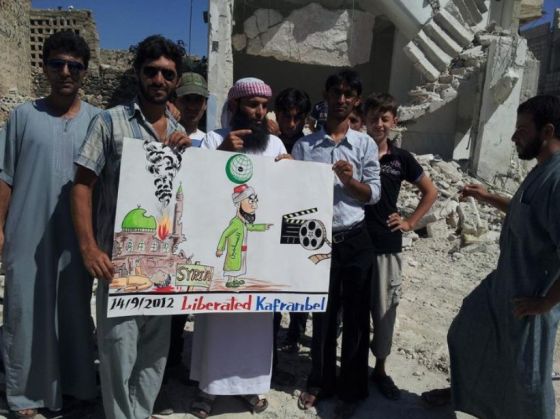
To residents in Kafranbel it's clear that protests across the region against a provocative film are simply a massive distraction directing attention away from the devastation inside Syria.

Robin Yassin-Kassab writes: This video is not suitable for children nor for those of a nervous disposition. I include myself in the latter category. At first I couldn’t watch it, then I made myself do so in order to hear the words. Before the usual “Freedom? You want freedom?” the torturee is forced to declare that Bashaar al-Asad is his ‘lord’ (the Arabic word ‘rabb’, which means God). The violent (but very small) protests which have swept the Muslim world in response to a ridiculous low-budget smear of the Prophet Muhammad are in part the expression of a deeply humiliated people who remember Western support of Zionism and Muslim dictatorships, Western invasions of Iraq and Afghanistan, and so on. They are in part the result of the failure of Arab and Muslim dictatorships to build functioning education systems, and a symptom of a profound and generalised despair that requires wounded symbols through which to manifest itself. Most importantly, they are signals of an opportunistic power play by the extreme right-wing Salafist minority. It’s a case of extreme right-wing Islamophobes, Zionists, Coptic extremists and American Republicans on the one hand and extreme right-wing Islamists on the other, feeding off each other. The furore has made the ridiculous anti-Islam film a Youtube hit. Nobody would have heard of it had Egyptian Islamists not publicised it, and had the American ambassador to Libya, apparently a friend of the Arabs who was critical of US policy on Palestine, not been murdered. As with all the episodes in the ‘culture wars’, it’s an enormous diversion from the really serious issues. The torture video here was first pointed out by the Syrian activist Wissam Tarif. He asked a simple question. Where are the furious demonstrations against this blasphemy? Why have no Syrian embassies been burnt following the repeated bombing of mosques and churches, the murder, rape, torture and humiliation of tens of thousands of Syrian Muslims? [Continue reading…]

Facebooktwittermail

How Robert Fisk became a fair and balanced reporter

Thirty years after Robert Fisk drew the attention of the world to the Sabra and Chatila massacre — a massacre in which the victims had initially been dubbed ‘terrorists’ — it’s ironic that he would have chosen to become a mouthpiece of the Syrian government in its effort to cover up the Daraya massacre where as many as 500 people were slaughtered.

At Open Democracy Yassin Al Haj Saleh and Rime Allaf write: The international media has not always been kind to Syria’s revolutionary people. For months on end, many of the latter turned themselves into instant citizen-journalists to document their uprising and the violent repression of the Syrian regime, loading clips and photos taken from their mobile-phones to various social networks; still, the established media, insinuating that only it could really be trusted, covered these events with an ever-present disclaimer that these images could not be independently verified. Since the Damascus regime was refusing to allow more than a trickle of foreign media personnel into the country, chaperoned by the infamous minders, what the Syrians themselves were reporting was deemed unreliable.

Nevertheless, an increasing number of brave journalists dared to sneak into Syria at great personal risk, reporting the same events which activists had attempted to spread to the world. For the most part, experienced journalists were perfectly capable of distinguishing between straight propaganda from a regime fighting for its survival and real information from a variety of other sources. Overwhelmingly, ensuing reports about Syria gave a voice to “the other side” or at least quoted opposing points of view, if only for balance. In some cases, journalists found no room to cater for the regime’s claims, especially when reporting from civilian areas under relentless attack by Bashar al-Assad’s forces.

It was from the wretched Homs district of Baba Amr, under siege and shelling for an entire month, that the late Marie Colvin, amongst others, testified on the eve of her death under the regime’s shells about the “sickening situation” and the “merciless disregard for the civilians who simply cannot escape.” Like her, most of those who managed to get into Syria have testified about the regime’s repression of a popular uprising, even after the latter evolved to include an armed rebellion.

Robert Fisk, a seasoned war correspondent who has covered the region for decades, surprisingly broke a mould, gradually allowing himself to become a part, and not simply a witness, of the Syrian regime’s propaganda campaign.

On 30 October 2011, Fisk – who works for the Independent newspaper, and whose reports are widely republished – was a guest of Syrian state television for an extended interview during which his legendary directness seemed subdued, as he meekly advised his host that he feared the Syrian authorities were running out of time to turn the situation around. In an article entirely dedicated to Bouthaina Shaban, one of Assad’s advisors, he quoted some of her extraordinary tales without adding one of his trademark comments: thus, he didn’t challenge the claim that a Christian baker in Homs was accused (supposedly by the extremists the regime says are leading the uprising) of mixing whisky in the bread.

Over the last few months, Fisk’s pieces on Syria have consisted more of commentary than of reporting, with a growing emphasis on the conspiracy scenario as he reminds readers that the governments criticising the Assad regime were themselves hardly examples of freedom or democracy. This is indeed true in many cases, but is not directly relevant to the Syrian people’s uprising, which moreover he increasingly reports in the sectarian terminology he had previously criticised when covering the invasion and occupation of Iraq.

But even copious editorialising of this nature could not have heralded Fisk’s shocking decision to embed with the Syrian regime’s armed forces, when he had previously stated (on 22 January 2003) that “war reporters should not cosy up to the military”. In Syria, Fisk embedded first in Aleppo with the commander of operations in the embattled city, and then in Damascus and its suburbs under attack by the regime. In particular, his piece on Daraya’s gruesome massacre has shocked many Syrians. [Continue reading…]

Facebooktwittermail

For Syrians, frustration over outrage about film, not Assad’s horrors

Ahed Al Hendi says, as the media turn their attention to senseless violence elsewhere, the struggling, besieged people of Syria wonder: Where’s the demonstrators’ anger about what’s happening to us?

“Dear Arabs, if you had dared to protest against Bashar in the same way of your protest against the American embassies, Bashar would not have been able to kill 200 Syrians a day.”

So read a banner in Syria satirizing the absurd and exaggerated outrage against the Web trailer for Innocence of Muslims. Another read: “We have an Assad-esque movie that offends the messenger [Muhammad] and the god of the messenger. It’s been playing for 18 months.”

Many Syrians on Twitter, Facebook, and other social-media sites have expressed outrage about the production of this Web film. But their anger is largely directed at the Arab world’s reaction. Bashar al-Assad’s forces are slaughtering people on a daily basis not in a movie, but in real life, while the media and protesters elsewhere have shifted attention to what many Syrians call “a silly movie.”

“What happened affected us Syrians negatively,” Yassin Al Haj Saleh, a prominent Syrian writer and dissident based in Damascus, tells me over Google Chat. “First, media attention was focused on this story. Second, the movie and the violent reaction served the regime and its supporters by giving them an excuse—that a regime that looks modernist from the outside and depends on a criminal intelligence apparatus would be the best for the Middle East.”

Al Haj Saleh, who was one of 11 people recently awarded the Prince Claus Award for his work, did not rule out the possibility that the acts of violence were backed by remnants of ousted regimes or opportunistic populist movements.

Many Syrian activists share Saleh’s view of the movie. They fear that Western governments will use the turmoil as a pretext not to support Syrian opponents of the Assad regime. [Continue reading…]

Facebooktwittermail

Some Syrian activists angry about Arab outrage over Muhammad video

The Los Angeles Times reports: Some Syrian anti-government activists expressed frustration Wednesday that a controversial video belittling the prophet Muhammad is generating more outrage among Arabs than the rising death toll within Syria.

Comments on social media sites by some opposition activists said the protests over the video in Cairo and Benghazi, Libya, where four Americans were killed, epitomize a focus on symbolic and religious issues versus a relative indifference over the desperate plight of Syrian civilians.

“The only thing that seems to mobilize the Arab street is a movie, a cartoon or an insult, but not the pool of blood in Syria,” wrote one Syrian activist on Twitter.

Since anti-government protests broke out in March 2011, at least 17,000 people, mostly civilians, have been killed by the security forces of President Bashar Assad and rebel forces, according to United Nations figures.

“One thing is clear,” tweeted Shakeeb Jabri, a Syrian activist. “Syrians are quite pissed off at those who protested the Mohammad movie and not Assad’s shelling of mosques.”

Facebooktwittermail