The Washington Post reports: Furious over Russia’s bombardment of Aleppo, European leaders warned the Kremlin on Thursday that it could face consequences if it maintains its offensive against the besieged rebel-held part of the Syrian city, although they fell short of the unity required to impose new sanctions.
The sharp rhetoric was a substantial departure for European leaders, who have long been focused on when they can dial back existing sanctions on Russia, not ramp them up. Instead, Russian actions in recent weeks have upended the conversation. From the Russian-backed pummeling of Aleppo to the shipment of nuclear-capable missiles to Kaliningrad, the recent steps have galvanized Western anger and plunged relations to fresh depths. The warnings came as leaders gathered in Brussels for a summit in part to discuss relations with Russia.
Europe’s toughened stance marks a partial victory for Washington, which has struggled to maintain European unity on sanctions and has long taken a harder position on Russia than its partners across the Atlantic. The stand also reflects the toll of Russia’s actions in Syria, where it has partnered with the regime of President Bashar al-Assad in a punishing campaign that has made little distinction between combatant and civilian. [Continue reading…]
Category Archives: Syria
The idea that the U.S. can ‘do no harm’ depends on the fiction that it can be ‘neutral’ in foreign conflicts
Shadi Hamid writes: The eight years of the Obama presidency have offered us a natural experiment of sorts. Not all U.S. presidents are similar on foreign policy, and not all (or any) U.S. presidents are quite like Barack Obama. After two terms of George W. Bush’s aggressive militarism, we have had the opportunity to watch whether attitudes toward the U.S. — and U.S. military force — would change, if circumstances changed. President Obama shared at least some of the assumptions of both the hard Left and foreign-policy realists, that the use of direct U.S. military force abroad, even with the best of intentions, often does more harm then good. Better, then, to “do no harm.”
This has been Barack Obama’s position on the Syrian Civil War, the key foreign-policy debate of our time. The president’s discomfort with military action against the Syrian regime seems deep and instinctual and oblivious to changing facts on the ground. When the debate over intervention began, around 5,000 Syrians had been killed. Now it’s close to 500,000. Yet, Obama’s basic orientation toward the Syrian dictator Bashar al-Assad has remained unchanged. This suggests that Obama, like many others who oppose U.S. intervention against Assad, is doing so on “principled” or, to put it differently, ideological grounds.
Despite President Obama’s very conscious desire to limit America’s role in the Middle East and to minimize the extent to which U.S. military assets are deployed in the region, there is little evidence that the views of the hard Left and other critics of American power have changed as a result. (Yes, the U.S. military is arguably involved in more countries now than when the Obama administration took office, but — compared to Iraq and Afghanistan before him — Obama’s footprint has been decidedly limited, with a reliance on drone strikes and special-operations forces.) As for those who actually live in the Middle East, a less militaristic America has done little to temper anti-Americanism. In the three countries — Egypt, Jordan, and Lebanon — for which Pew has survey data for both Bush’s last year and either 2014 or 2015, favorability toward the U.S. is significantly worse under Obama today than it was in 2008. Why exactly is up for debate, but we can at the very least say that a drastic drawdown of U.S. military personnel — precisely the policy pushed for by Democrats in the wake of Iraq’s failure — does not seem to have bought America much goodwill.
Despite the fact that Assad and Russia are responsible for indiscriminate attacks on civilians and civilian infrastructure, including hospitals, many leftists have viewed even the mere mention of the U.S. doing anything in response as “warmongering.” We have had the unfortunate situation of someone as (formerly) well-respected as Jeffrey Sachs arguing that the U.S. should provide “air cover and logistical support” to Bashar al-Assad. We have had Wikileaks’ attacks on the White Helmets, who have risked — and, for at least 140, lost — their lives in the worst conditions to save Syrian lives from the rubble of Syrian and Russian bombardment. Of course, it is not an absurd position to be skeptical of any proposed American escalation against Assad, and many reasonable people across the political spectrum have made that case. But it is something else entirely to apply such skepticism selectively to the U.S. and not to others, especially when the others in question deliberately target civilians as a matter of policy. It can be a slippery slope. While no one would accuse Obama of liking Putin, coordinating with and enabling Russia in Syria is effectively U.S. policy. As the New York Times columnist Roger Cohen noted in February, well before the current disaster in Aleppo: “The troubling thing is that the Putin policy on Syria has become hard to distinguish from the Obama policy.”
The Left has always had a utopian bent, believing that life, not just for Americans, but for millions abroad, can be made better through human agency (rather than, say, simply hoping that the market will self-correct). The problem, though, is that the better, more just world that so many hope for is simply impossible without the use of American military force. At first blush, such a claim might seem self-evidently absurd. Haven’t we all seen what happened in Iraq? The 2003 Iraq invasion was one of the worst strategic blunders in the history of U.S. foreign policy. Yet, it’s not clear what exactly this has to do with the Syrian conflict, which is almost the inverse of the Iraq war. In Iraq, civil war happened after the U.S. invasion. In Syria, civil war broke out in the absence of U.S. intervention. [Continue reading…]
Russian air defense raises stakes of U.S. confrontation in Syria
The Washington Post reports: Russia’s completion this month of an integrated air defense system in Syria has made an Obama administration decision to strike Syrian government installations from the air even less likely than it has been for years, and has created a substantial obstacle to the Syrian safe zones both Hillary Clinton and Donald Trump have advocated.
Deployment of mobile and interchangeable S-400 and S-300 missile batteries, along with other short-range systems, now gives Russia the ability to shoot down planes and cruise missiles over at least 250 miles in all directions from western Syria, covering virtually all of that country as well as significant portions of Turkey, Israel, Jordan and the eastern Mediterranean.
By placing the missiles as a threat “against military action” by other countries in Syria, Russia has raised “the stakes of confrontation,” Secretary of State John F. Kerry said Sunday.
While there is some disagreement among military experts as to the capability of the Russian systems, particularly the newly deployed S-300, “the reality is, we’re very concerned anytime those are emplaced,” a U.S. Defense official said. Neither its touted ability to counter U.S. stealth technology, or to target low-flying aircraft, has ever been tested by the United States.
“It’s not like we’ve had any shoot at an F-35,” the official said of the next-generation U.S. fighter jet. “We’re not sure if any of our aircraft can defeat the S-300.” [Continue reading…]
Syria talks conclude with agreement to carry on talking
The Washington Post reports: Talks in Switzerland on stemming the bloodshed in Syria resulted in no breakthrough Saturday, but the discussions did yield a decision to keep seeking ways to achieve a truce and resume negotiations.
Secretary of State John F. Kerry, who called the meeting with Russian Foreign Minister Sergei Lavrov and diplomats from seven Middle Eastern countries, characterized the gathering that lasted more than four hours as a brainstorming session that brought some new ideas to the table. However, he declined to specify what those ideas were.
No date was set for another meeting of the foreign ministers who took part, but their staffs are expected to continue talking together about possible approaches. [Continue reading…]
ISIS suffers major symbolic defeat with loss of Dabiq
Christian Science Monitor reports: The Islamic State has been dealt a major symbolic blow in the battle for its existence.
Turkish-backed rebels, reportedly supported by United States special forces, seized the Syrian town of Dabiq Sunday, said the Syrian Observatory for Human Rights. According to Islamic prophecies central to the Islamic State’s radical message, Dabiq is the site of an end-of-days battle that ushers in the apocalypse.
Now, having lost control of the town, the Islamic State must scramble to change a narrative that has been a core part of its appeal.
In the short term, the Islamic State can put a positive spin on losing the town of 3,500, which has little strategic value otherwise. Simply by bringing forces and foreign armies to Dabiq, the Islamic State can claim an ideological victory.
“No matter how the battle goes, the fact that they are fighting there is a justification that their entire reason for existence is correct and is fulfilling the words of the prophet,” says Malcolm Nance, terrorism expert and author of two books on the Islamic State. “In the near-term, they can spin this to boost the morale in Raqqa and Mosul and to boost recruitment.”
But longer-term, the group will struggle to reconcile the loss of Dabiq with nearly a decade-old narrative dating back to the group’s origins as Al Qaeda in Iraq.
“No matter how they try to spin it, the optics of a defeat in Dabiq are bad for ISIS,” says Mathew Lester, analyst at the Soufan Group, a New York-based strategic security firm. [Continue reading…]
The strange sympathy of the Far Left for Putin
Gershom Gorenberg writes: Jeremy Corbyn, the grim, controversial, and recently re-elected leader of Britain’s Labour Party, rejects the idea of protesting outside Russia’s embassy in London against that country’s brutal bombing of Syria. “The focus on Russian atrocities or Syrian army atrocities,” said a Corbyn aide this week, distracts attention from “very large scale civilian casualties as a result of the U.S.-led coalition bombing.”
In case this is a bit obtuse, let’s go over to Britain’s Stop the War coalition, which Corbyn chaired before he was elected Labour leader. In a radio interview, current vice-chairman Chris Nineham said that protesting Russian atrocities would increase “hysteria and jingoism.” The way to end the Syria conflict, he said, was to “oppose the West.”
In another words, when we say we’re against war, we don’t mean Vladimir Putin’s war. We mean war waged by Western imperialists.
To fill in some dots: The idea of protesting outside Russian embassies, not just in London but around the world, reportedly came from Labour MP Ann Clwyd. It’s true that Foreign Secretary Boris Johnson endorsed the proposal. But ignoring Russian war crimes because Johnson opposes them is a bit like ignoring Donald Trump’s misogyny because some Republicans also object to it.
As for the equation of Russian and coalition actions, The Guardian did a fact-check with the monitoring group Airwars. The civilian death rate from Russian attacks, said the group’s director, “probably outpaces the coalition by a rate of eight to one.” The coalition tries to limit civilian deaths; the Russians deliberately target civilians, he said.
Predictably, lots of people in the riven Labour Party are outraged by Corbyn’s stance. It’s only the latest instance of Corbyn’s fossilized and one-dimensional anti-imperialism being an embarrassment for the left. In the United States, Putin’s most prominent fan is the embarrassment of the right.
Still, Corbyn has his American counterparts — starting with Green Party candidate Jill Stein. Until a few days ago, Stein had a statement on her website saying that the United States should end any military role in Syria, impose an arms embargo, and work “with Syria, Russia, and Iran to restore all of Syria to control by the government.” The “anti-war” candidate’s stance, in other words, was to let the war crimes continue until the Assad regime and its patrons massacre their way to victory. [Continue reading…]
If they really wanted to Stop the War in Syria, they’d target Russia
Jonathan Freedland writes: Pity the luckless children of Aleppo. If only the bombs raining down on them, killing their parents, maiming their friends, destroying their hospitals – if only those bombs were British or, better still, American.
Then the streets of London would be jammed with protestors demanding an end to their agony. Trafalgar Square would ring loud with speeches from Tariq Ali, Ken Loach and Monsignor Bruce Kent. Whitehall would be a sea of placards, insisting that war crimes were being committed and that these crimes were Not in Our Name. Grosvenor Square would be packed with noisy protestors outside the US embassy, urging that Barack Obama be put on trial in The Hague. The protestors would wear Theresa May masks and paint their hands red. And they would be doing it all because, they’d say, they could not bear to see another child killed in Aleppo.
But that is not the good fortune of the luckless children of that benighted city. Their fate is to be terrorised by the wrong kind of bombs, the ones dropped by Bashar al-Assad and Vladimir Putin. As such, they do not qualify for the activist sympathy of the movement that calls itself the Stop the War Coalition. Indeed, it’s deputy chair, Chris Nineham, told the Today programme that his organisation would not be organising or joining any protests outside the Russian embassy because that would merely fuel the “hysteria and the jingoism” currently being whipped up against Moscow. Stop the War would instead, explained Nineham in a moment of refreshing candour, be devoting its energies to its prime goal – “opposing the west”. [Continue reading…]
Berlin, 1945; Grozny, 2000; Aleppo, 2016
Michael Kimmelman writes: The destruction is so complete that it obliterates even a sense of time. At a glance, the video could show Berlin in 1945 or Grozny, 2000. Mass death erases all distinctions.
The place is Aleppo, Syria, the al-Mashhad district, or what remains of it after recent attacks by Syrian government forces and their Russian allies. Toppled rooftop satellite dishes, choked by plaster dust, resemble wilted flowers. Figures move through the pulverized rubble but are hard to make out.
“Would you really feel any pity if one of those dots stopped moving forever?” Harry Lime asked on the Ferris wheel in “The Third Man,” the classic noir film set in postwar Vienna. This is drone footage, after all, shot from the same detached, superior perspective of the bombers who committed this atrocity in the name of fighting non-jihadist rebels. The video was made to document the devastation and bear witness, but it inevitably reduces people on the streets to Lime’s dots. [Continue reading…]
Aleppo must be ‘cleaned,’ declares Assad, amid outcry over bloody siege
The Guardian reports: Syria’s president, Bashar al-Assad, has spoken of “cleaning” the besieged city of Aleppo, where a quarter of a million people are caught under heavy bombardment by his government’s forces, and using it as a “springboard” for winning the country’s war.
With Britain leading international outcry over the regime’s campaign against rebels in Aleppo and Russia’s backing for it, Assad declared that victory in the strategic city would allow the Syrian army to liberate other areas of the country from “terrorists”.
Speaking to Russia’s Komsomolskaya Pravda, Assad said Aleppo was effectively no longer Syria’s industrial capital but taking back the city would provide important political and strategic gains for his regime.
“It’s going to be the springboard, as a big city, to move to other areas, to liberate other areas from the terrorists. This is the importance of Aleppo now,” Assad said.
“You have to keep cleaning this area and to push the terrorists to Turkey to go back to where they come from, or to kill them. There’s no other option. But Aleppo is going to be a very important springboard to do this move.” [Continue reading…]
Ground down by savagery — the agony of Aleppo
Martin Chulov reports: In the distance, Aleppo briefly emerged from the smoke and dust of war, a low grey skyline on a brown summer plain. A heat haze shimmered over the road ahead, shrouding first an abandoned army barracks, then ransacked, smouldering factories, an empty crossroads, and finally, the city itself.
Even then, days after the eastern half of the city had been seized by armed Syrians opposed to the rule of Bashar al-Assad, many of Aleppo’s people had fled. Shops were shuttered. Twisted tanks and toppled buses blocked intersections and the few residents on its empty streets scurried past with their heads down.
These were the first days of August 2012, a momentous time in a civil war that had just seen half of Syria’s second city – and industrial heart – fall to an insurrection hatched by the working-class men of its hinterland. It was my first visit to the city, after several earlier trips to nearby towns where the rebel push for northern Syria had been gathering steam. It paved the way for the Guardian’s subsequent reporting on a conflict with no apparent end.
In more than 10 journeys to Aleppo, from that first visit in 2012 until my last in December 2014, I have chronicled the decline of one of the world’s oldest continually inhabited cities as it has been ground down by savagery. Modern warfare has done what uprising and invasion have failed to do throughout the ages, transforming half the city into a shell of its prewar self, and imperilling an ancient core that has weathered centuries of conflict and even a devastating earthquake.
Along the way, those who remained and fought for its destiny offered windows into a war that has ramifications far beyond the borders of Syria. Long a crossroads of trade and transport, and a hub of empire, Aleppo is again central to the fate of the region, even under the assault of Russian bombers, which have made much of the east uninhabitable over the past year.
The rebel-held east was the focus of all my visits; west Aleppo has remained off-limits, functioning with little disruption and firmly under the control of the Syrian regime, which refuses visa requests. [Continue reading…]
U.S. mulls over Syria policy — further military intervention is unlikely
The Guardian reports: The Obama administration is conducting a final review of its Syria policy as it enters its last hundred days, but the rethink is not expected to lead to any radical changes or significant military interventions that could bring US and Russian forces into head-on confrontation.
The secretary of state, John Kerry, will travel to Lausanne in Switzerland on Saturday to meet the Russian foreign minister, Sergey Lavrov, and their counterparts from the Middle East. Turkey, Saudi Arabia and Qatar are expected to attend. Iran’s participation is in doubt, possibly as a result of the dire state of its relations with Saudi Arabia.
Kerry will brief the UK, French and German governments in London on Sunday, on his way back from Switzerland.
The ministers go into the Lausanne meeting with low expectations, diplomats said. The best of the likely outcomes would be a humanitarian pause in the bombing of eastern Aleppo for two or three days to allow some basic humanitarian supplies to reach the embattled rebel-held districts, home to 275,000 people. [Continue reading…]
If we don’t act now, all future wars may be as horrific as Aleppo
Paul Mason writes: To single day of fighting in June 1859, among the vineyards and villages near Lake Garda, left 40,000 Italian, French and Austrian soldiers dead or wounded. The Battle of Solferino might have been remembered simply for its carnage, but for the presence of Henry Dunant. Dunant, a Swiss traveller, spent days tending the wounded and wrote a memoir that led to the founding of the Red Cross and to the first Geneva convention, signed by Europe’s great powers in 1864.
Solferino inspired the principle that hospitals and army medical personnel are not a legitimate target in war. Today, with the bombing of hospitals by the Russians in Syria, the Saudis in Yemen and the Americans in Afghanistan, those who provide medical aid in war believe that principle is in ruins.
So far this year, according to Médecins Sans Frontières (MSF), 21 of their supported medical facilities in Yemen and Syria have been attacked. Last year an MSF hospital in Kunduz, Afghanistan was destroyed by a US attack, in which those fleeing the building were reportedly gunned down from the air, and 42 patients and staff died.
A UN resolution in May urged combatants to refrain from bombing medical facilities. MSF says that the resolution “has made no difference on the ground”. Four out of the five permanent members of the UN security council, it says, are actively involved in coalitions whose troops have attacked hospitals.
To understand the renewed popularity of killing sick people in hospital beds, it’s not enough to point – as MSF does – to the new techniques of war, such as drones and special forces. Something has been eroded about our perception of humanitarian principles. [Continue reading…]
The West’s decline is of its own making
Judy Dempsey writes: A park close to the European Parliament in Brussels has been given a face-lift, if that is the right term. Apart from being spruced up, the area now contains new sculptures in the form of twelve ostriches. And yes, the ostriches have their heads stuck in the sand. If Europe as well as the United States weren’t suffering such a malaise as they are today, the symbolism of these birds wouldn’t matter.
But three recent events only confirm how the West continues to duck fundamental issues in ways that will leave it weaker and increasingly unable to project itself politically, socially, and economically.
The first event was the decision by the United States to cut off talks with Russia on trying to end the war in Syria. John Kerry, the U.S. secretary of state, who was in Brussels on October 4, tried to defend his country’s role in Syria. In a speech hosted by the German Marshall Fund of the United States, he decried Russia’s support for the regime of Syrian President Bashar al-Assad, Moscow’s relentless bombing of civilian targets, and the way Syrian government forces were using barrel bombs and chlorine gas against their opponents.
What Kerry omitted, hardly surprisingly, was how the United States in particular had crossed its own so-called redlines when it came to Syria. U.S. President Barack Obama’s decision not to intervene, despite saying in August 2012 that any use of chemical weapons would be a redline the United States would not tolerate, gave Russia and other players a free hand to play out their cynical geostrategic interests in that wretched country. [Continue reading…]
Vladimir Putin just won an international peace prize
Max Bearak writes: The past few weeks have been rough for Russian President Vladimir Putin’s international image.
Putin has been blamed for airstrikes in Syria that have killed hundreds of civilians, including children, dooming a cease-fire his government helped foster but may have never intended to abide by. A Dutch investigation said the antiaircraft missiles that downed Malaysia Airlines Flight 17 in July 2014, killing all 298 people aboard, came from Russia. And the Obama administration accused his government of a hacking campaign to interfere with this year’s U.S. presidential election.
But Friday, the day the Nobel Peace Prize was awarded, brought him some welcome news: Venezuelan President Nicolás Maduro bestowed on Putin the Hugo Chávez Prize for Peace and Sovereignty of the Peoples. Putin can put it on his mantel beside China’s Confucius Peace Prize, which he won in 2011.
Maduro, whose South American nation has been reeling amid a massive economic crisis, announced the prize during the unveiling of a statue (designed by a Russian artist) of his deceased predecessor, Chávez, in the latter’s home town of Sabaneta.
Referencing Putin, Maduro said the prize should be given to “a leader that I believe is the most outstanding there is in the world today, a fighter for peace, for balance, and a builder of a pluripolar, multicentric world.” [Continue reading…]
Josh Rogin writes: There is clear and abundant evidence the Assad regime and the Russian government are committing crimes that include, but are not limited to, deliberate attacks on civilians, collective punishment, starvation as a tool of war, torture, murder, inhumane treatment of prisoners and the use of chemical weapons on the battlefield.
Nevertheless, no near-term accountability seems likely. Last month, U.N. Secretary General Ban Ki-moon called on the U.N. Security Council to refer the situation in Syria to the International Criminal Court, a step dozens of countries have endorsed. But Russia would surely veto such a move and, since neither Syria nor Russia has ratified the ICC’s founding Rome Statute, the court’s power is limited without Security Council action.
The U.N. Commission of Inquiry on Syria fecklessly refuses to assign blame for atrocities — such as, for example, when a U.N. aid convoy was attacked last month, which the United States attributed to Russia and which was yet another violation of international humanitarian law. Congress has a sanctions bill that would punish the Syrian government, Russia and Iran for war crimes and crimes against humanity, but the White House opposes that legislation.
Justice for the innocent victims in Syria will likely take years, if not decades, to be realized. But there is both precedent and a legal path forward for such prosecutions.
Russian soldiers bear criminal responsibility not only for participating in the war crimes but also for aiding and abetting the Syrian regime, said Cherif Bassiouni, who led the U.N. investigations into crimes in Yugoslavia, Bahrain and Libya and helped create the ICC. And, he said, due to what’s known in international law as the doctrine of command responsibility, senior Russian military and political figures could also be prosecuted for the actions of their subordinates.
“The criminal responsibility applies to all of those in the chain of command who know of the commission of these crimes, all the way up to Putin,” said Bassiouni. “The law is not only applicable to he who gives an order, but he who knows it’s a war crime and does nothing to stop it.”
Under the Geneva Conventions, any state can assert what’s known as universal jurisdiction and bring prosecutions against Syrian and Russia leaders for war crimes.
“Every country if it wanted to could assert its jurisdiction if it could grab the person,” said Bassiouni. “Every Russian officer involved should know they are exposed to it.” [Continue reading…]
The Guardian reports: Russia should be investigated for war crimes in the Syrian city of Aleppo and risks becoming a pariah nation, Boris Johnson has said, taking the unusual step of calling for demonstrations by anti-war protesters outside the Russian embassy in London.
The British foreign secretary said “the mills of justice grind slowly, but they grind small” as he predicted those responsible for war crimes in Syria would eventually face charges before the international criminal court.
Johnson’s remarks underline the degree to which relations between Russia and the west have deteriorated to levels not seen since the end of the cold war. [Continue reading…]

Putin in Syria: Chechnya all over again
Oliver Bullough writes: Putin’s admirers often compare him to a chess player as a way of stressing his strategic nous (Barack Obama merely plays checkers). But that is to overstate his abilities. Any moderately capable politician could do what he does given a complicit media and control of all three branches of government. Where he does resemble a chess player, however, is in his insistence on linking unconnected issues: Ukraine, Syria, a joint U.S.-Russian program to dispose of radioactive material — all are pieces on his board, to be sacrificed for the ultimate good of the player, namely himself.
If Mr. Putin’s bombs allow his proxies to capture the square on the board labeled Syria, his Western admirers will hail him as a genius. But that victory would be as much a result of his weaknesses as his strengths. Seeing the world as a chess game means he believes the board is filled with pawns rather than people, with agency and ideas of their own.
In the fall of 2013, Mr. Putin thought he had convinced the Ukrainian government to reject a trade deal with the European Union and join a Russian project instead. He then promised it a $15 billion loan. But ordinary Ukrainians wouldn’t go along with the plan — they refused to be pawns — and their revolution ousted Mr. Putin’s allies in Kiev, turning his tactical victory into a strategic defeat.
In the years after Mr. Putin started his Chechen war in 1999, he had Chechnya’s leaders killed and imposed peace via a local strongman. The savagery necessary to maintain order has since driven out at least one-third of the prewar Chechen population, with most of them seeking asylum in Europe. The exodus continues today. Chechnya still requires vast annual subsidies from Moscow, and its peace remains just one assassination away from chaos.
Bombing Aleppo into submission and imposing Mr. Assad on the rubble via fake elections would allow Mr. Putin and RT to present the Syria problem as solved and give the Kremlin’s Western proxies an opportunity to praise their grandmaster’s cunning. But you cannot bomb someone into loving you. For as long as Putin fails to realize that ordinary people’s desires are ultimately more important than his own, any system he creates will remain as fragile as the one he built in Chechnya. [Continue reading…]
West must confront Russia over Aleppo, British MPs to be told
The Guardian reports: Western air forces must be willing to confront Russian military jets over the skies of Syria to enforce a no-fly zone and protect the citizens of eastern Aleppo from a bombardment akin to the attack on Guernica during the Spanish civil war, UK MPs will be told by a former cabinet minister in an emergency three-hour Commons debate on Tuesday.
The intervention by Andrew Mitchell, the former international development secretary, and the granting of the debate itself, will force the UK’s Foreign Office to set out how it intends to respond after Russia’s veto of a UN resolution calling for a ceasefire in eastern Aleppo. The west has been criticised for lacking any leverage over Russia in Syria.
Britain has criticised Russia but set out no clear plan on how to respond to the growing threat posed by Moscow not just in the Middle East, but across eastern Europe. Mitchell argues the whole post-cold war international diplomatic architecture is being torn down by Russian actions. [Continue reading…]
Warming relations between Russia and Turkey as Putin and Erdogan revive pipeline deal
The New York Times reports: Amid increasingly tense relations with the United States over Syria, President Vladimir V. Putin of Russia took advantage of a routine meeting in Istanbul on Monday to advance the Kremlin’s reconciliation with Turkey, including an agreement to revive a suspended natural-gas pipeline project.
The new pipeline, known as the Turkish Stream, would run under the Black Sea to Turkey and then the Greek border, allowing Russian gas to reach Western markets without using Russia’s existing export pipelines through Eastern Europe.
The pipeline would make it much easier for Russia to cut off gas supplies to neighboring countries like Ukraine without disrupting sales to countries farther west like Italy or Austria. Russia has been trying for years to establish such an export route.
Mr. Putin’s appearance at an international energy conference was his first visit to Turkey since a crisis in relations between the countries after Turkey’s downing of a Russian fighter jet along the border with Syria in November 2015, in which a Russian pilot was killed. President Recep Tayyip Erdogan of Turkey, nominally an ally of the United States in Syria, patched things up with a letter of apology and a trip to St. Petersburg in August.
The two have sought to use their warming relationship both at home and abroad to indicate that they are not politically isolated and remain central players in any Syria solution. They sat next to each other in the front row of the World Energy Congress in Istanbul, laughing together, and later met for bilateral talks. [Continue reading…]
Everything Donald Trump says about Syria is crazy, wrong, or both

Michael Weiss writes: Well, now I prefer the guy who didn’t know what Aleppo is.
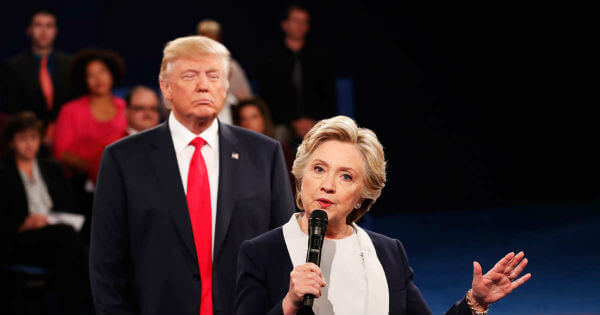
In the second presidential debate, during which Hillary Clinton looked as if she could profit from her own no-fly zone against her menacingly hovering opponent, Donald Trump made a series of assertions about the five-year-old humanitarian catastrophe in Syria that no one with access to Google, much less classified intelligence, ever ought to make. That he managed to do this while both deferring to a theocratic—excuse me, Islamic terrorist—regime he claims to reprehend and also humiliating his own running-mate in the process was a masterstroke of Trumpist illogic and megalomania.
By way of reaffirming his faith in a better working relationship with the Kremlin (whose hacking of the Democratic National Committee he again doubted), Trump stated that “Assad is killing ISIS. Russia is killing ISIS. And Iran is killing ISIS.” He sees this as proof of absent American leadership, and is quite comfortable being on their side in a civilizational struggle, even though he hates the fact that Iran is richer and only able to war against the Sunni extremists thanks to Obama’s nuclear deal.
In point of fact, none of the parties Trump rattled off has demonstrated much of a keenness or willingness to fight ISIS in Syria, as a bevy of U.S. officials and independent monitors have repeatedly pointed out. [Continue reading…]