Category Archives: Syria

ANALYSIS: Détente with Syria

The Syrians are back

The report of UN prosecutor Serge Brammertz on the Harriri assassination came out last week. Not only did it fail to name any Syrian suspects (contrary to original reports in 2005) but also praised Syria’s cooperation in the UN probe. Simultaneously, the US Department of State did not veto a United Nations technological grant to Syria, to be used for sophisticated surveillance by the Customs Department, knowing that the equipment will be coming from Cisco Systems. Cisco received a special export license from the US Department of Commerce to ship routers, switches, and high-tech equipment to Syria.

The US has been accusing Syria of supporting the insurgency in Iraq, destabilizing Lebanon, and honeymooning with Iran. Why the sudden change?

In fact, the thaw has been under way for some time. It started with a Syrian-US meeting at a regional conference on Iraq back in March 2006. The Americans reasoned that in order to achieve stability in Iraq, they had to deal with either Syria or Iran.

Dealing with both was too difficult for the Bush White House, and continuing to sideline both was equally destructive. It was easier to talk to Syria than Iran, the Americans reasoned, since Syria was reasonable and did not have a history of anti-Americanism. This new perception led to a groundbreaking encounter between Foreign Minister Moualem and his US counterpart Condoleezza Rice. [complete article]

Facebooktwittermail

EDITORIAL: Diplomacy on the ascent

A “different dynamic” in American diplomacy

If war follows the failure of diplomacy, it’s natural that the failure of war should lead to the resurrection of diplomacy. George Bush might not clearly grasp this, but there are strong indications that it is obvious to many of his closest advisers. The latest evidence comes from Lebanon.

genmichelsuleiman.jpgFor the last week, Lebanon has been without a president but now, after a standoff that has lasted months, the political factions (always simplistically described in the Western media as being pro-Western or pro-Syrian) appear to have agreed on a compromise. Washington didn’t make it happen but it could have stood in the way. Instead, the administration is now willing to accept that Lebanon’s next president, Syria’s preferred candidate, will be General Michel Suleiman.

Some commentators predicted this outcome months ago. Back on August 15, a blogger calling himself, “Outlaw Josey Wales,” wrote, “The powers-that-be have decided General Michel Suleiman/Sleiman will be the next president of Lebanon.” Today, the Wall Street Journal (via Syria Comment) reports:

In recent days [pro-Western] March 14 politicians, with Washington’s consent, agreed to a compromise candidate for the presidency. Gen. Michel Suleiman, commander of the Lebanese Armed Forces, worked closely with Damascus during its military occupation of Lebanon and is already receiving support from some of Syria’s Lebanese political allies.

March 14 leaders say the general’s selection, while not their first choice, could help stabilize Lebanon, because of his leadership of a Lebanese military increasingly viewed as a unifying force in their country.

“Michel Suleiman is well-known to the Hezbollah and the Syrians,” said Walid Jumblatt, a key leader of March 14. “If the Syrians don’t want Suleiman, it means they don’t want stability in Lebanon.”

The concession on the Lebanese president comes amid a broader push by the U.S. and its allies to re-engage Damascus in other ways. American and Israeli strategists view this initiative as aimed at breaking Syria’s alliance with Iran, Hezbollah and the Palestinian militant group Hamas, which have all increased their influence across the Middle East in recent years. It is also aimed at gaining greater support from Syria in cutting off militants infiltrating into Iraq.

The administration wants to characterize the Lebanese presidential choice as a concession by its allies:

A high-ranking US official was quoted by the Kuwait News Agency (KUNA) as saying that Washington has no objections to agreements among the Lebanese on the election of army commander General Michel Suleiman for president. “The US did not strike any deal with Syria regarding Lebanon at the Annapolis conference,” the official, who spoke on condition of anonymity told KUNA. “We understand the concerns of the Lebanese on this issue,” he added. “The US is separating Lebanon from the other pending problems in the region.” The US official said that Lebanon is not up for negotiation, especially not with Syria. “We only refer to Lebanese-Syrian relations when we are calling on Damascus to stop meddling in Lebanon’s internal affairs,” he said.

Mark those words carefully: If the US did not strike any deal with Syria regarding Lebanon at the Annapolis conference it was because the deal had been struck in advance. This is what the New York Times reports:

Syria, the most important outside influence over Lebanese politics, had hesitated until the last minute over whether to attend the conference.

Immediately after the talks, Syrian allies in Lebanon endorsed the first major political breakthrough. Analysts say the talks could thaw strained relations between Syria and the United States.

“The Syrians did not want to go to Annapolis, and without them the conference would have been a failure and would have weakened the Arabs,” said Talal Atrissi, a political analyst and sociologist at Lebanese University. “The Syrians traded their participation, which did not cost them anything, with a deal on the Lebanese presidency.”

Another breakthrough then came after the conference when on Thursday, Christian leader Michel Aoun, a retired general and a former army chief who was seeking the presidency himself and is backed by Syria, indicated that he is “open” to Suleiman becoming president. Lebanese commentator, Michael Young, that day had written, “Aoun will swallow poison before saying yes to Suleiman.” I guess the poison was less bitter than Young imagined.

So why should observers in the United States be surprised by the latest turn of events in the generally mystifying process of Lebanese politics? Here’s why. This is what the astute Syrian political analyst and journalist Sami Moubayed has to say:

…if the Syrians are able to get their way, they would opt for Michel Suleiman, the current army commander. Washington DC is not too enthusiastic about him because he is politically independent; too independent for Washington’s taste. He is committed to combating Israel, supporting Hizbullah, and friendship with Syria. His one slogan has been “Israel is the enemy”, something that greatly pleases Damascus but is frowned upon by 14 March. If elected, he would certainly work for a greater role for Hizbullah in the government, and might even turn a blind eye to their activities in south Lebanon, as did Elias Hrawi in the early 1990s, and Lahoud in 1998-2006. Also to the displeasure of 14 March was a recent remark by the army commander, “Fatah Al-Islam is linked to Al-Qaeda not Syria.”

Washington has plenty of reasons not to like Suleiman. The fact that they have now given their consent to his becoming Lebanon’s next president makes it quite transparent: the realpolitik faction inside the administration is not simply ready to do business with Syria — business is already underway.

Facebooktwittermail

NEWS & ANALYSIS: Confronting Iran

War is peace, sanctions are diplomacy

The White House is pressing ahead with its stated goal of persuading the UN Security Council to pass far-reaching sanctions to punish Iran for refusing to suspend its nuclear research program. Sanctions are what President George W. Bush is referring to when he pledges to nervous US allies that he intends to “continue to work together to solve this problem diplomatically.” The non-diplomatic solution in this framing of the “problem,” presumably, would be airstrikes on nuclear facilities in the Islamic Republic.

With its portrayal of UN and unilateral US sanctions as part of a diplomatic effort, the Bush administration has successfully confused much media coverage of the Iranian-Western confrontation over Iran’s enrichment of uranium. Sanctions are punitive measures, not serious diplomacy, and the Bush administration has never undertaken a sustained diplomatic initiative aimed either at inducing Iran to cease enriching uranium or at soothing broader US-Iranian tensions. Meanwhile, the Bush administration’s persistent refusal to take military options “off the table,” combined with its intensified rhetoric against Iran, has made sanctions palatable to allies, as well as to some of the most dovish members of Congress and the American public — but without addressing the political disputes that keep the US and Iran on a collision course. Congress, by and large, has merely greased the skids. [complete article]

U.S. electronic surveillance monitored Israeli attack on Syria

The U.S. provided Israel with information about Syrian air defenses before Israel attacked a suspected nuclear site in Syria, Aviation Week & Space Technology is reporting in its Nov. 26 edition.

The U.S. was monitoring the electronic emissions coming from Syria during Israel’s Sept. 6 attack, and while there was no active American engagement in the operation, there was advice provided, according to military and aerospace industry officials.

The first event in the raid involved Israel’s strike aircraft flying into Syria without alerting Syrian air defenses. The ultimate target was a suspected nuclear reactor being developed at Dayr az-Zawr. But the main attack was preceded by an engagement with a single Syrian radar site at Tall al-Abuad near the Turkish border.

The radar site was struck with a combination of electronic attack and precision bombs to allow the Israeli force to enter and exit Syrian airspace unobserved. Subsequently all of Syria’s air-defense radar system went off the air for a period of time that encompassed the raid, U.S. intelligence analysts told Aviation Week. [complete article]

Editor’s Comment — This report presents further evidence that, as Gareth Porter suggested earlier this week, “a more plausible explanation for the strike [than its being aimed at destroying a purported Syrian nuclear facility, is] that it was a calculated effort by Israel and the United States to convince Iran that its nuclear facilities could be attacked as well.”

A plan to attack Iran swiftly and from above

Massive, devastating air strikes, a full dose of “shock and awe” with hundreds of bunker-busting bombs slicing through concrete at more than a dozen nuclear sites across Iran is no longer just the idle musing of military planners and uber-hawks.

Although air strikes don’t seem imminent as the U.S.-Iranian drama unfolds, planning for a bombing campaign and preparing for the geopolitical blowback has preoccupied military and political councils for months.

No one is predicting a full-blown ground war with Iran. The likeliest scenario, a blistering air war that could last as little as one night or as long as two weeks, would be designed to avoid the quagmire of invasion and regime change that now characterizes Iraq. But skepticism remains about whether any amount of bombing can substantially delay Iran’s entry into the nuclear-weapons club. [complete article]

Iran warns of domino effect of nuclear attack

Iran warned today that an attack on its nuclear facilities would trigger a “domino” effect across the Middle East as deeply divided world powers met to review Teheran’s co-operation with United Nations resolutions.

Mohamed ElBaradei, the head of the UN’s International Atomic Energy Agency (IAEA) has endorsed Iranian promises that access to suspected nuclear facilities will increase in the months ahead. At a meeting of the body’s 35-country board of governors in Vienna today, battle lines were drawn both over Mr ElBaradei’s faith in an Iranian blueprint and the text of the IAEA’s latest report which said Iran had cleared up several key questions about its past research.

America and Britain are pushing for the UN to quickly impose a third round of sanctions on Iran to reinforce the drive to close the Islamic Republic’s secret programme of atomic research, which appears to be slowly yielding the capability to make a nuclear weapon.

China and Russia, which have not yet swung behind new sanctions, appear poised to back Mr ElBaradei’s calls for negotiators to be given more time. [complete article]

Iran’s Ahmadinejad slammed for accusing rivals

Iranian President Mahmoud Ahmadinejad is facing increasing criticism for his virulent personal attacks on rivals and acting as both “plaintiff and judge” in legal cases, media reported on Thursday.

He has drastically upped the stakes ahead of March parliamentary elections by accusing opponents of being “traitors” for not supporting the government’s confrontational stance in the nuclear crisis.

“The general climate of the country has been overwhelmed by propaganda against individuals,” complained an angry editorial in the hardline Jomhouri Eslami newspaper, close to Iran’s clerical establishment. [complete article]

Facebooktwittermail

ANALYSIS & EDITOR’S COMMENT: Deep in the (well-populated, well-connected, fertile) desert

Tourist trips to the Box-on-the-Euphrates

Is the Box-on-the-Euphrates in a remote place?

Details like that might seem insignificant, but they are not. Often, it seems to me, intelligence judgments are supported by informal bits of “color” or what you might call the gouge — circumstantial details that aren’t part of any official briefing, but appear in loose talk to bolster a judgment. Recall the “viewing stand” that North Korea never built, but nonetheless contributed to a false alarm about North Korean nuclear testing in Spring 2005.

One detail in the Box-on-the-Euphrates story that seems to lend credence to the “nuclear reactor” hypothesis is that the site is remote, and therefore suspicious. Here is how Martha Raddatz at ABC put it:

The official said the suspected nuclear facility was approximately 100 miles from the Iraqi border, deep in the desert along the Euphrates River. It was a place, the official said, “where no one would ever go unless you had a reason to go there.”

But the claim the the location is remote is, itself, an exaggeration. [complete article]

Editor’s Comment — As I pointed out a week ago, the fact that the Box on the Euphrates is not in a remote location is evident simply from studying Google Earth images. It’s very easy to zero in on the site’s location because the Euphrates river valley comprises two broad ribbons of rich agricultural land in the middle of which an arid interlude — no more than a few miles long — divides the river valley. This is the spot that, from a narrow-angle view, looks like the middle of nowhere.
middle of nowhere
Syria is not the American mid-West — in other words, agriculture is not highly mechanized and thus requires plenty of labor. Close to the “isolated” location that the media has only depicted in close aerial shots, there are lots of towns and villages. A surfaced road and a railway track run either side of the “nuclear” site. By no definition of the expression, can this be called “the middle of nowhere” — unless, that is, it’s an expression being used by those parochial observers who regard Syria itself as the middle of nowhere.

Facebooktwittermail

NEWS & EDITOR’S COMMENT: Ho hum… first use of nukes since 1945?

Al-Jazeera: Strike on Syria was made by U.S. Air Force with tactical nukes

The September 6 raid over Syria was in fact carried out by the US Air Force, Al-Jazeera’s Web site reported in Arabic Friday, quoting unnamed Israeli and Arab sources as saying that two strategic US jets armed with tactical nuclear weapons executed the attack on a nuclear site under construction.

The sources were quoted as saying that Israeli F-15 and F-16 jets only provided cover for the US fighter-bombers, which carried one tactical nuclear weapon apiece. The site was hit by one bomb and totally destroyed. The use of nukes might account for the fact that the suspected plant was effectively erased from the earth, with few if any traces remaining, according to satellite photos. [complete article]

New satellite surveillance system was key Israeli tool in Syria raid

In addition to the military objective of destroying the target, the raid on Syria also had important international and domestic political overtones, notes one Israeli official. The goal was to send a strategic signal to the region about Israel’s willingness to act. Moreover, for the IAF, the mission was an important step. The armed forces are grappling with lessons learned from last year’s Lebanon war and a potential budget shift to the ground forces. As a result, the air arm wanted to signal its continued importance to national defense. [complete article]

Editor’s Comment — Former CIA officer Philip Giraldi, recently asserted that the Box-on-the-Euphrates story bears all the marks of a “classic disinformation” campaign. I beg to differ. I think the script here comes straight out of The Onion. How else can we account for such a wildly meandering narrative that spans every quarter from historic event — the first offensive use of nuclear weapons since “Fat Man” obliterated Nagasaki on August 9, 1945 — to the prosaic — a theatrical piece of budgetary infighting as the Israeli Air Force competes against the Israeli Army for a larger slice of the IDF sheqel pie — to the absurd — a Syrian super secret, so secret it couldn’t be revealed to Syria’s own military?

What next? It was Osama bin Laden’s hide out and he got killed in the attack?

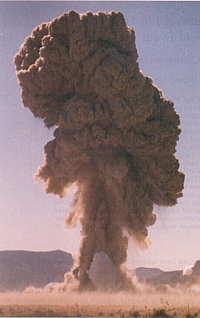
And just in case anyone wants to think seriously about the idea that a tactical nuclear weapon was used to destroy the Box on the Euphrates (or “tall building shaped like a square” to use the IAEA’s more technically precise nomenclature), this is what an explosion equivalent to a low-yield (5kt) nuclear explosion looks like:
misersgold.jpg
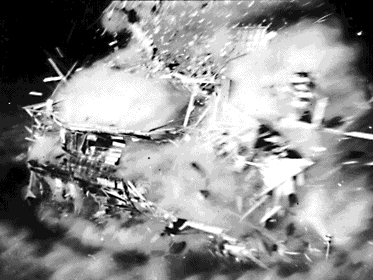
This is what happens to a house located 1,100 meters away a somewhat larger (16kt) explosion:
blast8.gif
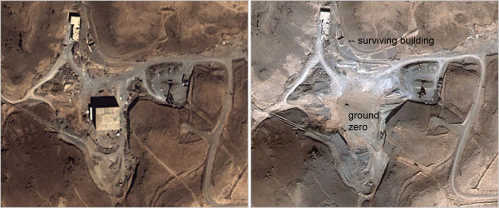
And this is a picture of the Syrian site after the attack:
noboxontheeuphrates.jpg
Note, a small building just 300 meters directly up from “ground zero” was still standing after the attack. That’s a clue — there was no nuclear shockwave that ripped through this gully.

Facebooktwittermail

NEWS: Syria’s “tall building shaped like a square”

Syria nuclear probe may be inconclusive

The IAEA has been studying before-and-after commercial aerial photos of the site and has asked Syria for explanations. But Syria has not replied and the pictures alone are unlikely to yield conclusions, the diplomat told Reuters.

“IAEA experts are looking back at the evolution of this facility. But with these pictures alone they feel they may be unable to draw conclusions,” the diplomat, familiar with IAEA affairs but not authorised to speak on the record, told Reuters.

“If the IAEA got credible indications from anyone of nuclear procurement or activity, that would be different. But imagery of a tall building shaped like a square, that’s not enough (to tell whether or not the site may have been a nuclear site).” [complete article]

Facebooktwittermail

EDITORIAL: The box on the Euphrates

The box on the Euphrates

Writing in The American Conservative, former CIA officer Philip Giraldi sees in the Syrian-nuclear-reactor story the hallmarks of a disinformation campaign:

In the intelligence community, a disinformation operation is a calculated attempt to convince an audience that falsehoods about an adversary are true, either to discredit him or, in an extreme case, to justify military action. When such a campaign is properly conducted, information is leaked to numerous outlets over a period of time, creating the impression of a media consensus that the story is true, as each new report validates earlier ones.
[…]
The [news] pieces [on the target of the Israeli air attack in Syria] have a common thread: they rely entirely on information provided by Israeli sources without independent corroboration. And the ongoing play they are getting in the international media, without much critical commentary and without direct attribution to Israel, mark them as classic disinformation.

As nuclear proliferation expert Jeffery Lewis notes, the latest revelation — that the “box-on-the-Euphrates” is at least four years old, its existence having already been noted by the intelligence community (IC) — provides a compelling explanation why national security adviser Stephen J. Hadley has kept such a tight lid on the dissemination of the “new” intelligence: “we’d already looked at the building and Hadley knew what the IC would say.”

In the absence of further hard evidence, the ensuing commentary and analysis, most of which is extremely sketchy, has nevertheless become conventional wisdom in part because a few usually reliable sources have given the narrative a veneer of credibility:

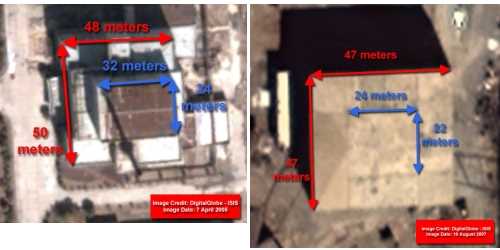
    — Respected former IAEA inspector, David Albright, has lent support to the idea that the box resembles the North Korean Yongbyon reactor based on not a lot more than the fact that the two buildings share the same diameter footprint. But whereas Yongbyon comprises a larger box with smaller boxes stacked on top of it, the image of the Syrian cube has been helpfully marked up with locations for imaginary boxes. “There also appears to be a faint square on top of the Syrian building’s roof. It is unclear whether something would be built there, but its dimensions, 24 meters by 22 meters, are consistent with the subsequent construction of an upper roof.” Four years after this faint square was first photographed, it remained a faint square [PDF].

boxes.jpg

    Global Security‘s John Pike refers to the site as being located in “the middle of nowhere” — everyone has now seen images of the barren location — yet one only needs to spend a few minutes on Google Earth to discover that the Box on the Euphrates lies right in the middle of Syria’s agricultural heartland with sizable communities either direction from this supposedly isolated location.

middle of nowhere

    This makes it all the more strange that nothing in the images appear to indicate the existence of a secure perimeter to this facilitiy — something that can easily be discerned if one looks at similar resolution images of, for instance, Israel’s nuclear facility at Dimona. However laid-back the Syrians might be, I’d wager that come the day that there was anything of high value at this site, there would be some serious security to keep out unwelcome intruders.
    — Washington’s high priest of gossip, Chris Nelson, after originally being convinced that the facility was related to Scud missile assembly, has now been won over to the nuclear reactor theory. The “evidence” that shifted his opinion? The fact that US-North Korea negotiator Chris Hill, in his recent Congressional testimony, did not refuted the theory. The absence of a denial is the same as an affirmation? Not according to my understanding of logic.

So what do we really know at this point?

A large cube-shaped building next to the Euphrates was visible from space in 2003. Given its size it must have taken a while to construct. The primary structure looked pretty much the same from above in August 2007. New images reveal that it’s not there now, the site has been leveled and it is reasonable to assume that the site clearing occured after, and very likely as a result of, an Israeli air force attack on September 6, 2007.

Do we have hard evidence that Syria was engaged in constructing a nuclear reactor? Not yet. Are any journalists hunting down that hard evidence? Probably not — why go to the trouble when you can kick back and get paid for schmoozing with John Bolton.

Meanwhile, IAEA director Mohamed ElBaradei is pissed off about the “bomb first and then ask questions later” approach. “I think it undermines the system and it doesn’t lead to any solution to any suspicion, because we are the eyes and ears of the international community. It’s only the agencies and inspectors who can go and verify the information.” He notes that in all the years that John Bolton and his cohorts have been making accusations about a Syrian nuclear program, “we have not received information about any nuclear-related activities, clandestine nuclear-related activities in Syria.”

Perhaps then we can infer that the real target of the Israeli strike was not a nuclear facility: it was the IAEA inspections processa troublesome log that the neocons are eager to clear off the road leading to Tehran.

Facebooktwittermail

NEWS & EDITOR’S COMMENT: Syria levels the rubble

Satellite photos show cleansing of Syrian site

New commercial satellite photos show that a Syrian site believed to have been attacked by Israel last month no longer bears any obvious traces of what some analysts said appeared to have been a partly built nuclear reactor.

Two photos, taken Wednesday from space by rival companies, show the site near the Euphrates River to have been wiped clean since August, when imagery showed a tall square building there measuring about 150 feet on a side.

The Syrians reported an attack by Israel in early September; the Israelis have not confirmed that. Senior Syrian officials continue to deny that a nuclear reactor was under construction, insisting that Israel hit a largely empty military warehouse. [complete article]

Editor’s Comment — Who destroyed the evidence? We have been given to understand that the square building at the Syrian site was blown up by Israeli bombs. If anyone was concerned about demonstrating what the building was for, perhaps it should have been left in tact. Independent IAEA investigators could have determined what was there. Israel’s rumored accusations might have been substantiated — or not.

Instead, now all we have are satellite images revealing something and its absence, along with purported intelligence photos taken on the ground somewhere yet no means to establish the authenticity of that evidence — evidence which thus far has not been made publicly available.

The Syrian site has now been cleared, or “cleansed,” as Pravda-style the Times reports. So what? Syria does not have an open democratic government — but that’s not news, is it?

Facebooktwittermail

NEWS, OPINION & EDITOR’S COMMENT: The secret that can’t be told

The right confronts Rice over North Korea policy

A fight has erupted between conservatives on national security and Secretary of State Condoleezza Rice over the Bush administration’s pursuit of diplomacy with North Korea in the face of intelligence that North Korea might have helped Syria begin construction on a nuclear reactor.

The debate moved to Capitol Hill on Wednesday, when Ms. Rice had a tense private meeting with Representative Ileana Ros-Lehtinen of Florida, the senior Republican on the House Foreign Affairs Committee. Just days earlier, Ms. Ros-Lehtinen was the co-author of an opinion article questioning the White House approach, which offers incentives to North Korea to dismantle its nuclear program.

That article also criticized the Bush administration for what it called the “veil of secrecy” surrounding intelligence that led to an Israeli airstrike in Syria last month on the suspected reactor site, and for the fact that only a handful of lawmakers have been briefed on the subject. [complete article]

What happened in Syria?

We are concerned that, although the Bush administration refuses to discuss the Israeli airstrike with the American people or with the majority of Congress, it has not hesitated to give information on background to the press to shape this story to its liking. New York Times writer David Sanger authored and coauthored articles on Oct. 14 and 15 that appeared to reflect extensive input from senior policy makers. Washington Post writer Glenn Kessler coauthored an article on Sept. 21 that also cited inside information from the administration. We believe this is unacceptable. [complete article]

Editor’s Comment — And where exactly in the contract of employment for journalists at the New York Times and the Washington Post does it say that reporters are meant to help the White House shape a story to its liking? Is that under the “business as usual” clause?

Hoekstra and Ros-Lehtinen do of course have their own ax to grind here, but if two Republican members of the secret circle say that the secret should be let out, what are we waiting for? And while these members of Congress are pressing the White House, why not the Israeli government too? It was an Israeli air strike after all.

And then there’re a few more details about the evidence. Why is the building next to the Euphrates being referred to as a “pumping station” rather than as “a building that might be a pumping station”? The photo in the Times doesn’t appear to show evidence of pipelines running between the purported pumping station and the building purported to house a future reactor. Moreover, no one spells out the necessity of having a water pumping station nearby what is claimed to be a gas-cooled reactor. But then again, all of these are questions that should be addressed by the IAEA and not half-assed journalists, unaccountable government officials, uninformed politicians, and blogging dilettantes.

Facebooktwittermail

NEWS & EDITOR’S COMMENT: Pinpointing what?

Photographs said to show Israeli target inside Syria

Independent experts have pinpointed what they believe to be the Euphrates River site in Syria that was bombed by Israel last month, and satellite imagery of the area shows buildings under construction roughly similar in design to a North Korean reactor capable of producing nuclear material for one bomb a year, the experts say.

Photographs of the site taken before the secret Sept. 6 airstrike depict an isolated compound that includes a tall, boxy structure similar to the type of building used to house a gas-graphite reactor. They also show what could have been a pumping station used to supply cooling water for a reactor, say experts David Albright and Paul Brannan of the Institute for Science and International Security (ISIS).

U.S. and international experts and officials familiar with the site, who were shown the photographs yesterday, said there was a strong and credible possibility that they depict the remote compound that was attacked. Israeli officials and the White House declined to comment. [complete article]

Editor’s Comment — There is now a “strong and credible possibility” that satellite photographs reveal the target of Israel’s strike on Syria. Which is to say, the photographs reveal where Israel hit — not what Israel hit.

It’s thus curious that with mantra-like repetition we keep on being told that the site in Syria resembled a “North Korea-style reactor.” No such thing exists. There is no North Korean style of nuclear reactor. All the North Koreans did was make use of the declassified design of the Magnox reactor first used in the UK at Calder Hall — it’s a design that has been publicly available for 50 years! It involves the use of unrefined uranium, there is no containment dome; gas — not water — is the coolant. The facility is housed in non-descript industrial buildings which means it’s almost impossible for satellite imagery to provide hard evidence that such buildings would have been designed to contain a reactor. Such evidence would have to be gathered by IAEA inspectors on the ground and since Syria — unlike Israel — is a signatory of the Non-Proliferation Treaty, Syria would presumably be legally required to provide inspectors access to the site. Rather than push for the evidence to be exposed, Israel preferred to destroy it.

Israel, we are being led to assume, has a greater interest in disregarding international law than in demonstrating to its allies and the rest of the world that Syria might have been engaged in developing a clandestine weapons program. Given that Israel clearly has complete contempt for world opinion, why should the world not with equal contempt dismiss Israel’s fears?

Facebooktwittermail

NEWS: The damning photos we don’t get to see

The case for Israel’s strike on Syria

…as ABC News reported in July, the Israelis made the decision to take the facility out themselves, though the U.S. urged them not to. The Bush administration, with Secretary of State Condoleezza Rice and Defense Secretary Robert Gates leading the way, said the Israelis and the U.S. should “confront not attack.”

The official said the facility had been there at least eight months before the strike, but because of the lack of fissionable material, the United States hesitated on the attack because it couldn’t be absolutely proved that it was a nuclear site.

But the official told ABC News, “It was unmistakable what it was going to be. There is no doubt in my mind.” [complete article]

Editor’s Comment — Hmmm… “A senior U.S. official” has no doubt in his mind — sounds like Cheney or someone who spends too much time in his company. And of course there’s no reason why we would need to see the compelling photographic evidence when we can see such excellent computer graphics.

Facebooktwittermail

NEWS: Syria shuts main exit from war for Iraqis

Syria shuts main exit from war for Iraqis

Long the only welcoming country in the region for Iraqi refugees, Syria has closed its borders to all but a small group of Iraqis and imposed new visa rules that will legally require the 1.5 million Iraqis currently in Syria to return to Iraq.

The change quietly went into effect on Oct. 1. Syrian officials have often threatened to stem the flow of refugees over the past eight months, but until now have backed down after pleas from the United Nations High Commissioner for Refugees.

For more than a year, 2,000 to 4,000 Iraqis have fled into Syria every day, according to United Nations officials. On the last four days that the border remained open, the officials said, 25,000 Iraqis crossed into Syria.

“The door is now closed to Iraqis in every direction,” said Sybella Wilkes, a spokeswoman here for the United Nations refugee agency. [complete article]

Facebooktwittermail

NEWS: The Syrian nuclear mirage

U.N. nuclear agency examines Syria images

U.N. experts have begun analyzing satellite imagery of the Syrian site struck last month by Israeli warplanes, looking for any signs it was a secret nuclear facility, diplomats said Friday.

It was unclear where the material was obtained or what exactly it showed. One of the diplomats, who is linked to the International Atomic Energy Agency, said the experts were studying commercial images, contrary to earlier suggestions they came from U.S. intelligence.

Separately, a senior diplomat familiar with the issue indicated the experts were looking at several possible locations for the Israeli strike. Two other diplomats said initial examination of the material found no evidence the target was a nuclear installation, but emphasized it was too early to draw definitive conclusions. [complete article]

Syrians disassembling ruins at site bombed by Israel, officials say

While expressing concern over the prospect that Syria may have decided to launch a nuclear program in secret, some weapons experts question why neither Israel nor the United States made any effort before the secret attack — or in the six weeks since — to offer evidence to the International Atomic Energy Agency, a move that would trigger an inspection of Syria by the nuclear watchdog.

“The reason we have an IAEA and a safeguard system is that, if there is evidence of wrongdoing, it can be presented by a neutral body to the international community so that a collective response can be pursued,” said Daryl Kimball, executive director of the Arms Control Association. “It seems to me highly risky and premature for another country to bomb such a facility.” [complete article]

US intelligence does not show Syrian nuclear weapons program, officials say

One US intelligence source familiar with the events expressed concern about recent news reports describing Syria as having a functioning nuclear weapons program and cautioned against attributing those reports to the US intelligence community.

“The allegations that North Korea was helping to build a nuclear reactor have not been substantiated by US intelligence,” said this intelligence official, adding, “ but that hasn’t stopped Dick Cheney and his minions at the NSC, Elliot Abrams and Steve Hadley, from leaking the information [to the press], which appears to be misleading in the extreme.” [complete article]

See also, Syrian “copy” of Yongbyon? (Arms Control Wonk) and Syrian’s comment on bomb target mistranslated: U.N. (Reuters).

Facebooktwittermail

ANALYSIS: A former CIA officer’s speculations on the Israeli attack on Syria

On the mysterious Israeli air attack on Syria

Having dealt with Arabs for more than fifty years now, often in situations very similar to this one, I have no trouble understanding why the Syrian reaction to the Israeli bombing attack last month has been carefully muted. Asad cannot afford a military confrontation with Israel at this time. His air force and army could be effectively wiped out by the IDF in a few hours. And he has no desire to broadcast the fact that his air defense forces (some of which, I am told, consist of very expensive new ground-to-air rocketry purchased from Russia but not yet operational) were impotent to respond in the face of such a deep and brazen Israeli penetration of the Syrian motherland. It would be plainly foolhardy for the Syrians to attempt confrontation with the IDF when their military establishment is in such a parlous state as it is today. I therefore find it perfectly understandable that Asad has chosen not to fly off the handle over this incident, and why his Arab neighbors and supposed brothers in arms have likewise decided that the better part of valor is to pretend they haven’t noticed. [complete article]

Facebooktwittermail

ANALYSIS: The sparks of a conflagration

Ticking clocks and ‘accidental’ war

Whilst Washington looks at the Iranian prospects through the prism of a binary, to bomb or to acquiesce decision, facing President Bush over the remainder of his presidency, the actors in the region see the conflict as imminent and arriving in a roundabout way, through the backdoor – either via escalation of Western and Israeli tension with Syria; or from events in Lebanon, or a combination of both interacting with each other. All these key actors are convinced that conflict, should it occur, will convulse the entire region. They see the Wursmer ‘engineered’ war that ultimately will extend to Iran, as almost upon them; and they wonder at the silence from Europe and from informed observers in the US. Is it, they speculate, that everyone is so focused on Iraq, and so convinced that Iraq will be the arena in which the decision on Iran will be shaped, that they have forgotten to attend to the backdoor that David Wurmser (until last month Dick Cheney’s Middle East adviser) already has a foot around? [complete article]

Facebooktwittermail

ANALYSIS & EDITOR’S COMMENT: Cheney takes a sabbatical

Pre-emptive caution: the case of Syria

It was President Bush who, a year after the Sept. 11 terrorist attacks, rewrote America’s national security strategy to warn any nation that might be thinking of trying to develop atomic weapons that it could find itself the target of a pre-emptive military strike.

But that was the fall of 2002, when the world looked very different from how it does in the fall of 2007. Now, the case of Syria, which Israeli and American analysts suspect was trying to build a nuclear reactor, has become a prime example of what can happen when Mr. Bush’s first-term instincts run headlong into second-term realities.

Five years later, dealing with nations that may have nuclear weapons ambitions — but are also staying within the letter of the Nuclear Nonproliferation Treaty — looks a lot more complicated than it once did. [complete article]

Editor’s Comment — If it depends on journalists like David Sanger, he’s probably right in predicting that, “It may be months or years before all the mysteries surrounding the attack on Syria become clear.” Meanwhile, Sanger seems happy to keep on drinking the White House Kool-Aid. Should we be concerned about the chances for a U.S. attack on Iranian nuclear facilities? Far from it, Sanger reports, since those ubiquitous senior officials he’s been hanging out with assure him that the administration is far too prudent. “Iran, they say, has too many ways to strike back at American interests — in Iraq, in the oil markets and throughout the Middle East.” Does the vice president know that? In Sanger’s analysis, Cheney in conspicuously absent. The administration is now being controlled by pragmatic realists, while the president is focused on his diplomatic achievements.

Getting a deal with North Korea to disgorge its own nuclear fuel and weapons may require looking past whatever North Korea might have sold to another country. And it may mean engaging the Syrians, even before they answer the question of what, exactly, they were building in the desert.

Who could have predicted such a sunny turn of events? The only question now is, how can the Israelis be persuaded to sign up with the diplomatic program. What Sanger implies is that a White House, sobered by experience, may offer Israel wise council but that there’s not much chance they’ll listen.

And as for those readers who still have nagging questions about what happened on September 6, the latest word from Israel is that it is “plausible” and “logical” that a nuclear reactor under construction was hit. The IAEA has put in a request for information.

Facebooktwittermail

OPINION & EDITOR’S COMMENT: The phoenix of preventive war arises from Syrian ashes

Preemption, Israeli style

Last month, one of the more mysterious episodes in the history of the Arab-Israel conflict began to leak slowly into the news. Although the facts are still unconfirmed, what seems to have happened has major implications not only for the region but even more for the laws of war and preemption that President Bush has been trying to redefine ever since his 2002 national security strategy paper.

First, Syrian spokesmen complained that Israeli planes had violated their country’s airspace on Sept. 6 — and had been driven off, or so they said. Within a few days came stories — mostly from anonymous sources — that the planes had fired into Syria; these were followed by still other stories that a target had in fact been hit. But what was it?

After further journalistic digging, the most plausible accounts said that the Syrian targets were related to nuclear weapons activity and may even have been manned by North Koreans. Later reports suggest some dispute within the U.S. government about how far Syria had progressed in achieving its nuclear ambitions, but these same reports confirm that this is what Israel was targeting.

The obscurity of this episode results in part from uncharacteristically tight lips in Jerusalem and Damascus. But that is not the whole of the reason. There has also been a deafening silence from the international community and especially from the other states of the region. This highly unusual reaction is one of the oddest parts of the whole episode and, in some ways, the most meaningful. [complete article]

Editor’s Comment — The neoconservatives and their Iraqi allies famously predicted that American soldiers would be greeted in Baghdad with sweets and flowers. As if to outdo themselves in making wild predictions, with Iran now the target, the suggestion being floated by Joshua Muravchik and other neocons is that alarming predictions about the consequences of a US/Israeli attack on Iran are being vastly overstated. The lesson from Syria, so we are supposed to believe, is that a strike on Iran’s nuclear facilities will be greeted by deafening silence.

Eager to boost her stock in the Israel lobby and implying to neocons that there is such a thing as life-after-Cheney, Hillary Clinton was unequivocal in expressing her support for the Israeli attack:

“We don’t have as much information as we wish we did. But what we think we know is that with North Korean help, both financial and technical and material, the Syrians apparently were putting together, and perhaps over some period of years, a nuclear facility, and the Israelis took it out. I strongly support that.”

Clinton’s Iran vote: the fallout

Senators Joe Biden and Chris Dodd voted against it. Senator Barack Obama said he would have voted against it if he had voted. Former Senator John Edwards implied he would have voted against it if he could vote.

And Senator Hillary Rodham Clinton? She voted in favor of the measure in question, which asked the Bush administration to declare Iran’s 125,000-member Revolutionary Guard Corps a foreign terrorist organization. Such a move — more hawkish than even most of the Bush administration has been willing to venture so far — would intensify America’s continuing confrontation with Iran, many foreign policy experts say.
[…]
Think of it as Iran declaring that the United States military is a terrorist organization because it carries out President Bush’s orders. Such a move, say some Iran experts — including some advisers to the Clinton campaign who declined to publicly criticize their possible boss — runs the risk of further alienating the Iranian population, because many Iranians are tied to the Revolutionary Guard or its many offshoots and enterprises in some way.

“What Senator Clinton and the other legislators who voted for this bill don’t seem to realize is that the Revolutionary Guards are not Al Qaeda,” said Karim Sadjapour, an Iran expert at the Carnegie Endowment for International Peace. “They’re not a group of voluntary jihadists signing up to fight the United States. Many are conscripts taken from the regular army.” [complete article]

Facebooktwittermail

NEWS & EDITOR’S COMMENT: “Nuclear project” – story still under construction

Analysts find Israel struck a nuclear project inside Syria

Israel’s air attack on Syria last month was directed against a site that Israeli and American intelligence analysts judged was a partly constructed nuclear reactor, apparently modeled on one North Korea has used to create its stockpile of nuclear weapons fuel, according to American and foreign officials with access to the intelligence reports.

The description of the target addresses one of the central mysteries surrounding the Sept. 6 attack, and suggests that Israel carried out the raid to demonstrate its determination to snuff out even a nascent nuclear project in a neighboring state. The Bush administration was divided at the time about the wisdom of Israel’s strike, American officials said, and some senior policy makers still regard the attack as premature.
[…]
The officials did not say that the administration had ultimately opposed the Israeli strike, but that Secretary of State Condoleezza Rice and Defense Secretary Robert M. Gates were particularly concerned about the ramifications of a pre-emptive strike in the absence of an urgent threat.

“There wasn’t a lot of debate about the evidence,” said one American official familiar with the intense discussions over the summer between Washington and the government of Prime Minister Ehud Olmert of Israel. “There was a lot of debate about how to respond to it.”
[…]
The partly constructed Syrian reactor was detected earlier this year by satellite photographs, according to American officials. They suggested that the facility had been brought to American attention by the Israelis, but would not discuss why American spy agencies seemed to have missed the early phases of construction.

North Korea has long provided assistance to Syria on a ballistic missile program, but any assistance toward the construction of the reactor would have been the first clear evidence of ties between the two countries on a nuclear program. North Korea has successfully used its five-megawatt reactor at the Yongbyon nuclear complex to reprocess nuclear fuel into bomb-grade material, a model that some American and Israeli officials believe Syria may have been trying to replicate.
[…]
While Bush administration officials have made clear in recent weeks that the target of the Israeli raid was linked to North Korea in some way, Mr. Bush has not repeated his warning since the attack. In fact, the administration has said very little about the country’s suspected role in the Syria case, apparently for fear of upending negotiations now under way in which North Korea has pledged to begin disabling its nuclear facilities.

While the partly constructed Syrian reactor appears to be based on North Korea’s design, the American and foreign officials would not say whether they believed the North Koreans sold or gave the plans to the Syrians, or whether the North’s own experts were there at the time of the attack. It is possible, some officials said, that the transfer of the technology occurred several years ago. [complete article]

Editor’s Comment — In spite of the fact that hard evidence has yet to be produced, let’s for now take it as given that Syria was building some type of nuclear facility and that it was destroyed by an Israeli air attack. Although the Times notes, as has been repeated so often, that “information about the raid has been wrapped in extraordinary secrecy,” the question — why the secrecy? — remains all important.

Suppose Israel was reluctant to be perceived as having acted without US support and it waited until it got the green light from Washington — except, when the green light came, it came from the Vice President’s office. Now that would be one incredibly compelling reason for secrecy from all quarters! That’s something neither Cheney, nor Bush, nor Olmert could afford to reveal.

Of course I speculate, but while this story remains so murky, speculation will be rife.

Facebooktwittermail