Category Archives: Syria

Syrian Alawites distance themselves from Assad

BBC News reports: In a deeply unusual move, leaders of President Bashar al-Assad’s Alawite sect in Syria have released a document, obtained by the BBC, that distances themselves from his regime and outlines what kind of future they wish for the country after five years of civil war.

The community and religious leaders say they hope to “shine a light” on the Alawites after a long period of secrecy, at what they call “an important moment” in their history.

In the eight-page document, termed a “declaration of identity reform”, the Alawites say they represent a third model “of and within Islam”.

Those behind the text say Alawites are not members of a branch of Shia Islam – as they have been described in the past by Shia clerics – and that they are committed to “the fight against sectarian strife”.

They also make clear that they adhere to “the values of equality, liberty and citizenship”, and call for secularism to be the future of Syria, and a system of governance in which Islam, Christianity and all other religions are equal. [Continue reading…]

Facebooktwittermail

A CIA grunt’s tale of the fog of secret war

The New York Times reports: In Douglas Laux’s final days as a C.I.A. officer, the futility of his mission prompted him to quote George Orwell to his boss.

Mr. Laux had spent months in 2012 working with various Middle Eastern nations that were trying to ship arms to Syria to help disparate rebel groups there. But it had become clear to him that the C.I.A had little ability to control the squabbling and backstabbing among the Saudis, Qataris and other Arabs.

He told a senior C.I.A. officer he felt like Winston Smith, the character in “1984” known for his fatalism, because he was carrying out his work without comprehending the politics and competing agendas thwarting progress in aiding the rebellion. “I understand the how,” Mr. Laux said, paraphrasing one of Smith’s famous lines. “I do not understand the why.”

It is a sentiment that might sum up much of Mr. Laux’s career at the C.I.A., an organization he served for eight years as an undercover case officer and soldier in the agency’s shadowy conflicts overseas. His career at the agency began with a tour at a remote firebase in southern Afghanistan and ended with a spot on the agency’s Syria Task Force — a life in war zones that is emblematic of the lives of a large cadre of American spies who joined the C.I.A. after the Sept. 11 terrorist attacks. He left the agency three years ago, but is speaking publicly about his experiences there for the first time in conjunction with the release of a memoir. [Continue reading…]

Facebooktwittermail

Turkey is no ‘safe haven’ for refugees – it shoots them at the border

Patrick Kingsley writes: It was beyond sad to read in the Times this week that Turkish border guards have allegedly shot dead Syrians trying to reach safety in Turkey. Sixteen refugees, including three children, have been killed trying to escape the battlegrounds of northern Syria in the past four months, according to the Syrian Observatory for Human Rights, a frequently cited watchdog.

It is shocking to think of people fleeing the combined atrocities of Islamic State and Bashar al-Assad being gunned down just as they make their bid for safety. But what is perhaps most shocking of all is that we observers are still shocked by this.

The shooting of Syrians on the border is not a new phenomenon. Refugees and rights groups have reported shootings of migrants on the Turkish-Syrian border since at least 2013. These abuses are well-documented, and the reports widely circulated. So why, in the months following a shady European deal that forces Turkey to shoulder the biggest burden of the refugee crisis, are we still so appalled when Turkey continues to use deadly violence to stop that burden getting any bigger? [Continue reading…]

Facebooktwittermail

Amid clashes, Greece presses on with plan to deport refugees

The New York Times reports: Violent clashes erupted in Greek refugee camps among panicked migrants as Greece and the European Union pressed ahead on Friday with their intention to expel them from Europe and deport thousands back to Turkey, despite strong objections from rights groups and United Nations relief officials who say the plan is illegal and inhumane.

Hundreds of migrants broke out of an overcrowded detention center on the Greek island of Chios and began walking to the port to protest a European Union deal that went into effect in March, authorizing Greece to return them to Turkey if their applications for asylum in Europe were not accepted. The deportations officially begin on Monday.

Video clips in the Greek media showed migrants streaming away from the camp unhindered by the police, hours after a brawl broke out at the camp’s registration center. Several refugees were taken to a hospital after the riot police used stun grenades, and a help center run by Doctors Without Borders was destroyed, forcing the aid group to abandon its work. More than 1,500 migrants were being held at the center, designed for 1,200. Three people were also reported stabbed during a migrant riot on the island of Samos, where another detention facility operates. [Continue reading…]

Facebooktwittermail

After Palmyra, where next for Assad?

Aron Lund writes: Forces loyal to Syrian President Bashar al-Assad on March 27 retook the desert city of Palmyra, which had been lost to the self-proclaimed Islamic State in May 2015. Its loss came at a difficult time for Assad, whose exhausted and overstretched army was losing territory on several fronts while the decaying economy in government-controlled areas was threatening to undo his regime from within. Given Palmyra’s location at the center of valuable gas fields and position as a nexus of major transportation routes in Syria’s eastern deserts, its loss compounded Assad’s problems. The government found itself with an expanded eastern frontline, with the Islamic State burrowing into the Qalamoun mountains, north of Damascus, and the Badiya region, where central Syria’s fertile plains around Homs and Hama fade into the desert.

A reversal of fortunes began on September 30, 2015, when Russian President Vladimir Putin ordered his country’s air force into action in Syria. Since the end of 2015, Assad has significantly improved his position in western Syria — where he is fighting other rebel and jihadi forces — and made limited advances against the Islamic State near Aleppo. The current push — which came after a truce with mainstream rebel factions — began on February 27 and marked the first major push east. Shortly after that Putin announced a somewhat disingenuous withdrawal from Syria on March 14.

Not only has Assad’s advance into Palmyra redrawn Syria’s military battlefield, but it also looks likely to accelerate the shift of its politics. [Continue reading…]

Facebooktwittermail

As long as there is no real democracy in the Middle East, ISIS will continue to mutate

David Hearst writes: The betting is that neither the pro-Assad coalition nor the Saudi-backed one will prevail in Syria. The likeliest outcome of a ceasefire is a Syria permanently fragmented into sectarian statelets in the way Iraq was after the US invasion.

This could be regarded as the least worst option for foreign powers meddling in Syria. Jordan, the Emirates and Egypt will have stopped this dangerous thing called regime change. Saudi will have stopped Iran and Hezbollah. Russia will have its naval base and retain a foothold in the Middle East. Assad will survive in a shrunken sectarian state. The Kurds will have their enclave in the north. America will walk away once more from the region.

There is just one loser in all this – Syria itself. Five million Syrians will become permanent exiles. Justice, self-determination, liberation from autocracy will be kicked into the long grass.

The history of the region has lessons for foreign powers. It proves that fragmentation only leads to further chaos. The region needs reconciliation, common projects and stability as never before. That will not come from creating sectarian enclaves backed by foreign powers.

The Islamic State is a distraction from the real struggle of the region, which is liberation from dictatorship and the birth of real democratic movements. IS is not a justification for the strong men. It is a product of their resistance to change. History did not start in 2011 and it won’t stop now. The revolutions of 2011 were empowered by decades of misrule. There is a reason why millions of Arab rose – peacefully at first – against their rulers and that reason still exists today.

As long as there is no real democratic solution in the Middle East, the Islamic State group will continue to mutate like a pathogen that has become antibiotic-resistant in the body politic of the Middle East. Each time it changes shape, it will become more virulent. [Continue reading…]

Facebooktwittermail

Retaking Palmyra should not be seen as a victory

H A Hellyer writes: It is a peculiar thing when bittersweet outcomes are cast as victories. But this is Syria. Last week, the forces of Syrian president Bashar Al Assad, who have killed more Syrian civilians than any other force in history, retook the ancient city of Palmyra from the brutes of ISIL. Celebration should be in order – but this is Syria.

From the beginning of the Syrian uprising, the Syrian president has been trying hard to cast the battle as one between him on the one side, and the radical Islamist camp on the other. He appears to be gambling that the rest of the world will come to the conclusion that while they may not like him all that much, they like the likes of ISIL and Jabhat Al Nusra even less – and, as such, they’ll leave him be.

Mr Al assad isn’t foolish in this regard. Certainly, for a large proportion of the international community, his wager is paying off. Many western journalists, who used to be noted for their anti-imperialist and contrarian tendencies in western capitals, are now describing Mr Al Assad as somehow “defending civilisation”.

Officials in Washington, Brussels and Paris are murmuring about how much they do not trust Mr Al Assad, but how, perhaps, he’s what Syria needs, at least for now. And so the pact is being drawn – as it was meant to be. [Continue reading…]

Facebooktwittermail

Frenchman plotting ‘imminent’ attack is charged with terrorism

The New York Times reports: A suspected Islamic State operative who was arrested last week had amassed a trove of guns and bomb-making equipment, including the type of explosive used in terrorist attacks in Paris and Brussels, the French authorities announced on Wednesday, reinforcing fears that militants are planning additional assaults on Europe.

The suspect, Reda Kriket, a 34-year-old Frenchman, was arrested on Thursday afternoon in Boulogne-Billancourt, a western suburb of Paris. That evening, the authorities raided a fourth-floor apartment Mr. Kriket had rented under a fake name in Argenteuil, a northwestern suburb that was once a popular weekend getaway and a subject for Impressionist painters.

Inside the apartment, the authorities found “an arsenal of weapons and explosives of an unprecedented size,” which led them to believe Mr. Kriket had been planning an “imminent attack,” the Paris prosecutor, François Molins, said at a news conference on Wednesday evening, describing for the first time the scope of the plot.

The arsenal included explosive materials — among them TATP, which was used in suicide bombs that were set off in Paris on Nov. 13 and in Brussels on March 22 — along with Kalashnikov assault rifles, a submachine gun, pistols, ammunition, four boxes containing thousands of small steel balls, stolen French passports, brand-new cellphones, a tear-gas canister and two computers with instructions to make explosives.

A judge who focuses on terrorism cases charged Mr. Kriket on Wednesday with terrorist conspiracy, possession of weapons and explosives, and falsification of documents, among other offenses, Mr. Molins said.

Mr. Kriket had an extensive criminal record, with multiple convictions for robbery, possession of stolen goods and acts of violence, Mr. Molins added. [Continue reading…]

Facebooktwittermail

U.S. and Russia reach ‘agreement’ that some day Assad will leave Syria

Middle East Eye reports: The US and Russia have reached an understanding that Syrian President Bashar Assad will leave to another country as part of the future peace process, according to the Lebanese Al-Hayat newspaper.

A diplomatic source on the Security Council told al-Hayat in reports published on Thursday that US Secretary of State John Kerry had “informed concerned Arab countries that the US and Russia have reached an agreement on the future of the political process in Syria, including the transfer of President Bashar al-Assad to another country.”

The source said the US-Russian agreement was “clear” in diplomatic back channels, though he said that “the timing and context of that in the political process remains unclear to everyone at the moment”. [Continue reading…]

Facebooktwittermail

Assad, buoyed by a win over ISIS, dismisses opposition’s demands

The Washington Post reports: Fresh from a major victory over Islamic State militants, Syrian President Bashar al-Assad on Wednesday expressed support for peace talks next month in Geneva but still firmly rejected the opposition’s key demands.

In an interview with Russian media, the embattled leader discussed his vision for eventual reconstruction from a devastating civil war and his desire to let Moscow, a key ally, maintain an indefinite military presence in Syria.

Assad’s comments come just days after his forces drove Islamic State extremists out of Palmyra. Seizing the archaeologically rich city was a big success for his government and its foreign military backers, most notably Russia, which bombed the militants in the desert city.

In his remarks, Assad appeared buoyed by that battlefield win, strongly dismissing as “illogical and unconstitutional” the idea of forming a transitional government to end a civil war that has killed more than 250,000 people, displaced millions and fueled the rise of the Islamic State. [Continue reading…]

Facebooktwittermail

I’m from Palmyra, and I can tell you after what I’ve seen that the Assad regime is no better than Isis

Mohamed Alkhateb writes: I was born and raised in Palmyra. I went to university in Homs, but when noises started to be made about a revolutionary movement, I knew I had to return to my home city.

At the beginning of the Revolution, my friends and I established what we called the “Palmyra Coordination” – essentially a group to coordinate and lead peaceful demonstrations calling for freedom. But the situation quickly spiralled out of control. Security forces within the city were unable to control the escalating revolution or withstand the flood of demonstrations. Tens of protesters were killed during their efforts.

After months of protests, the Assad regime sent a huge deployment of about 50 tanks and 3000 soldiers to take control of the city. After Palmyra was stormed by the SAA [Syrian Arab Army], some friends and I knew we had to flee.

After six days, however, we were captured by a group of around 30 SAA soldiers in the surrounding countryside and detained.

Needless to say, we were badly treated by these soldiers. They slapped us and beat us, and then marched us to a security branch in Palmyra to begin our interrogation. Worse was to come. [Continue reading…]

Facebooktwittermail

How Russian special forces are shaping the fight in Syria

The Washington Post reports: The troops that recently recaptured Palmyra, Syria, from the Islamic State included Syrian, Iranian and Hezbollah forces. And on Monday, Russian officials said there was another group that contributed to the victory: Russia’s elite special forces, also known as Spetsnaz.

Russian troops are nothing new to the Syrian ground war. Since their arrival in September, the Russians have used naval infantry to secure a key port in Tartus and the perimeter of an airfield in Latakia. But Russian special forces operating on the front — aside from a small number of artillery and tank units — have remained mostly out of the public eye.

With the seizure of Palmyra, though, that is no longer the case. Russian officials announced Monday that Palmyra was “liberated with participation of Spetsnaz and military advisers.” The Islamic State took Palmyra in May and shortly after partially destroyed a number of the city’s historic sites.

Russian special forces have come to the forefront of Russia’s Syria narrative because the battle for Palmyra plays directly into the anti-Islamic State rhetoric that Russia used as a pretense to initially intervene, said Chris Kozak, a research analyst at the Institute of the Study of War.

Involvement of Russian special forces in Palmyra “looks great,” Kozak said. “Whereas their involvement against opposition groups in Aleppo or Latakia doesn’t fit the narrative.”

It is unclear exactly when Russian special forces began operating in Syria, though prior to Russia’s intervention there, Russian troops had long helped advise and train Syrian forces. According to Michael Kofman, an analyst at CNA who focuses on Russian military operations, Russia currently operates several special forces units in Syria, Zaslon, KSO and detachments of reconnaissance teams. [Continue reading…]

Facebooktwittermail

In Iraq 21 generals lead 5,000 U.S. troops — about what a colonel usually commands

Nancy Youssef reports: In the war against the self-proclaimed Islamic State, the U.S. military is notably short on soldiers, but apparently not on generals.

There are at least 12 U.S. generals in Iraq, a stunningly high number for a war that, if you believe the White House talking points, doesn’t involve American troops in combat. And that number is, if anything, a conservative estimate, not taking into account the flag officers running the U.S. air war, the admirals helping wage the war from the sea, or their superiors back at the Pentagon.

At U.S. headquarters inside Baghdad’s fortified Green Zone, even majors and colonels frequently find themselves saluting superiors at a pace that outranks the Pentagon and certainly any normal military installation. With about 5,000 troops deployed to Iraq and Syria ISIS war, that means there’s a general for every 416 troops, give or take. To compare, there are some captains in the U.S. Army in charge of that many people.

Moreover, many of those generals come with staffs and bureaucracy that some argue slows decision-making against an agile terror group.

The Obama administration has frequently argued that the U.S. maintains a so-called light footprint in Iraq to reassure the American public that its military is not back in Iraq. Indeed, at times, the United States has not acknowledged where it has deployed troops until one of them died.

But if the U.S. footprint is so small, why does the war demand so many generals? [Continue reading…]

In an editorial, the New York Times says: With the military campaign against the Islamic State making some progress, American officials have begun to sharpen plans to expel the terrorist organization from two major cities it still controls.

Recapturing Raqqa, in northern Syria, and Mosul, in northern Iraq, from the Islamic State is critical. But President Obama has not made the case for expanding America’s role in the fighting, nor has he given a forthright assessment of the resources that would be required.

Since Mr. Obama authorized the first airstrikes in Iraq and Syria in 2014 to curb the rise of the Islamic State, administration officials have been vague and at times disingenuous about the evolution of a military campaign that has escalated sharply. [Continue reading…]

Facebooktwittermail

Activating the sleepers: ISIS adopts a new strategy in Europe

Christoph Reuter reports: They chose the perfect moment. Just as Europe was letting out a sigh of relief, having captured one of the Paris terrorists after months of pursuit, the bombers detonated their explosives. The signal sent by the arrest was that Islamic State (IS) is defeatable. But the Brussels attack tells us that isn’t the case. Just when you think you’ve beaten us, we’ll strike you right in the heart.

Investigators and intelligence agencies both agree that preparations for the attacks in Brussels must have begun long ago. The Belgian bombs thus heralded a new approach for Islamic State in Europe — one that does not bode well for those trying to prevent acts of terrorism — because the threat is no longer limited to individuals known to the police or already on wanted lists, but also comes from those in the shadows in the second or third rank. Even jihadists who have not yet been identified by officials are now capable of striking.

This approach reflects the one used in IS’ main battle grounds of Syria and Iraq. For some time there, unsuspected aggressors, who have been discreetly trained, have infiltrated targeted circles and built up long-term sleeper cells. Or men from regions neighboring a target are recruited to wait and attack at the right moment.

This is a modus operandi that has been employed by terrorists against prominent and often well-defended opponents multiple times — it’s how Abu Khalid al Suri, the Syrian emissary for al-Qaida boss Aiman al-Zawahiri, was betrayed by one of his own employees and killed in early 2014 by IS despite all possible protective measures being taken at his top secret hideout.

A rebel commander who had fled after Islamic State had taken over Raqqa was abducted by his own driver in Turkey, who was working under the orders of IS. And the founder of the secret activist network Raqqa Is Being Slaughtered Silently was massacred in his apartment in the Turkish city of Sanliurfa by an IS agent who had infiltrated the opponents months before, posing as a supporter.

The people behind this terror are proving to be surprisingly farsighted, patient planners and not rash actors — and this applies in both Europe and Syria. This is the new and long underestimated side of IS. [Continue reading…]

Facebooktwittermail

The end of the Arab affair

Bassel Salloukh writes: What kind of a Syria will emerge from the wreckage of – so far – more than five years of fighting? This is the question international, regional, and local actors are pondering as ‘proximity talks’ between Syrian government envoys and representatives of the internationally-designated opposition commenced in Geneva in March 2016 under UN auspices.

What political system can restore a semblance of territorial integrity to a country devastated by all kinds of overlapping international, regional, and local wars and crisscrossed by transnational and local salafi-jihadi groups, where sectarian and ethnic identities, never the sole markers of political identity, have been securitised and are now assumed primordial and the main source of political identity and community?

How will communities that have witnessed political mobilisation in the name of the sect or the ethnic group, as well as sectarian and ethnic massacres, accept to live together again under the same flag or inside the same borders?

The inescapable question then is whether postwar Syria will retain its centralised unitary political structure, will be divided along ethno-federal lines, or a middle ground will be devised between these binary choices that may help restore peace to Syria without altering its political geography forever or denying its peoples their justifiable democratic aspirations. [Continue reading…]

Facebooktwittermail

During Russia’s ‘withdrawal,’ it has been shipping more into Syria than it has been removing

Reuters reports: When Vladimir Putin announced the withdrawal of most of Russia’s military contingent from Syria there was an expectation that the Yauza, a Russian naval icebreaker and one of the mission’s main supply vessels, would return home to its Arctic Ocean port.

Instead, three days after Putin’s March 14 declaration, the Yauza, part of the “Syrian Express”, the nickname given to the ships that have kept Russian forces supplied, left the Russian Black Sea port of Novorossiysk for Tartous, Russia’s naval facility in Syria.

Whatever it was carrying was heavy; it sat so low in the water that its load line was barely visible.

Its movements and those of other Russian ships in the two weeks since Putin’s announcement of a partial withdrawal suggest Moscow has in fact shipped more equipment and supplies to Syria than it has brought back in the same period, a Reuters analysis shows.

It is not known what the ships were carrying or how much equipment has been flown out in giant cargo planes accompanying returning war planes.

But the movements – while only a partial snapshot – suggest Russia is working intensively to maintain its military infrastructure in Syria and to supply the Syrian army so that it can scale up again swiftly if need be. [Continue reading…]

Facebooktwittermail

Why it’s wrong to say that the Arab uprisings failed

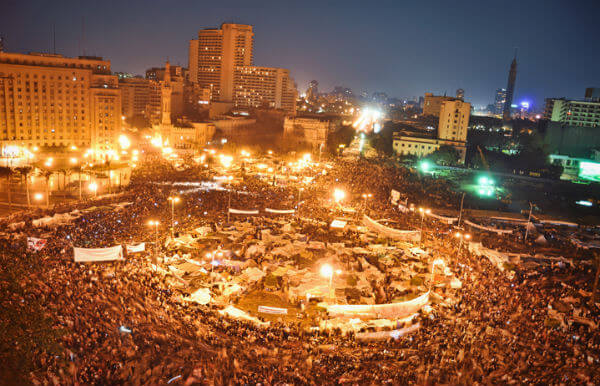
Tahrir_Square

Marc Lynch writes: Conventional wisdom holds that the Arab uprisings that began in Tunisia in December 2010 failed. It’s hard to argue with such a harsh verdict. Most Arab regimes managed to survive their popular challenges through some combination of cooptation, coercion and modest reform. Egypt’s transition ended in an even harsher military regime. Yemen and Libya collapsed into state failure and regionalized wars, while Syria degenerated into a horrific war.

But simply dismissing the uprisings as a failure does not capture how fully they have transformed every dimension of the region’s politics. Today’s authoritarians are more repressive because they are less stable, more frightened and ever more incapable of sustaining their domination. With oil prices collapsing and popular discontent again spiking, it is obvious that the generational challenge of the Arab uprising is continuing to unfold. “Success or failure” is not a helpful way to understand these ongoing societal and political processes.

Instead of binary outcomes, political scientists have begun to more closely examine the new political forms and patterns, which the uprisings generated. A few months ago, the Project on Middle East Political Science convened a virtual symposium with 30 political scientists examining how the turmoil of the past five years have affected Arab politics. Those essays, many of them originally published on the Monkey Cage, are now available for open access download as an issue of POMEPS Studies. Those essays offer an ambivalent, nuanced perspective on what has and has not changed in the region since 2011 – and point to the many challenges to come.

The new politics shaped by the Arab uprising can be tracked along multiple levels of analysis, including regional international relations, regimes, states, and ideas. [Continue reading…]

Facebooktwittermail

How ISIS built the machinery of terror under Europe’s gaze

shadow8

The New York Times reports: The day he left Syria with instructions to carry out a terrorist attack in France, Reda Hame, a 29-year-old computer technician from Paris, had been a member of the Islamic State for just over a week.

His French passport and his background in information technology made him an ideal recruit for a rapidly expanding group within ISIS that was dedicated to terrorizing Europe. Over just a few days, he was rushed to a park, shown how to fire an assault rifle, handed a grenade and told to hurl it at a human silhouette. His accelerated course included how to use an encryption program called TrueCrypt, the first step in a process intended to mask communications with his ISIS handler back in Syria.

The handler, code-named Dad, drove Mr. Hame to the Turkish border and sent him off with advice to pick an easy target, shoot as many civilians as possible and hold hostages until the security forces made a martyr of him.

“Be brave,” Dad said, embracing him.

Mr. Hame was sent out by a body inside the Islamic State that was obsessed with striking Europe for at least two years before the deadly assaults in Paris last November and in Brussels this month. In that time, the group dispatched a string of operatives trained in Syria, aiming to carry out small attacks meant to test and stretch Europe’s security apparatus even as the most deadly assaults were in the works, according to court proceedings, interrogation transcripts and records of European wiretaps obtained by The New York Times. [Continue reading…]

Facebooktwittermail