Category Archives: Syria

Russian airstrikes allow ISIS to advance

The Guardian reports: Bunkered down in his base just north of Hama, Captain Mustafa of the Free Syria Army (FSA) is getting used to the Russian airstrikes. And he is growing just as accustomed to the assurances of his American backers: “We can have most of the weapons we want,” he says. “But nothing to shoot down the planes.”

More than a week since the Russian strikes began targeting them, and days after the US announced an end to its efforts to train forces to fight Isis, the original anti-Assad rebels of Syria’s north-west remain entrenched, though battered, in the towns and villages of their heartland.

Nearby, Syrian forces, which had barely moved for the past year, are trying to advance from the south, said Mustafa, the military spokesman of an FSA unit, Tajamul Ala’Azza. Further away in the north-east, Isis has made its strongest gains in many months, advancing across the top of Aleppo, while a mix of opposition groups clash nearby with Russian jets and artillery.

“The Russians have given them a boost, which is what they wanted to do by attacking the Syrian people,” said Mustafa. “The biggest disaster for them would be to acknowledge that a real opposition remains defiant and strong.

“Well, we say to the Russian bear that we will chase you to your grave. You don’t know what you’ve got yourself into.”

Among the rebel groups, of northern and western Syria, a reckoning has been taking place ever since Moscow ramped up its efforts to defend Bashar al-Assad’s regime earlier this month. The opposition has been gaming whether its allies would follow suit, giving them the firepower it had long withheld to combat the threat from the skies.

So far the answer is no. “It’s the same as it’s always been,” said Mustafa. “Our supply lines are still open, but we still can’t get any anti-aircraft missiles. The Americans have never changed their position on that.” he sighed. “That’s politics.”

Rebels in the vicinity of the regime strongholds of Tartous and Latakia, and the nearby Alawite hinterland, have been hit especially hard in the Russian offensive which was touted as a campaign against Isis, but which the US, Nato, and rebel groups claim has almost exclusively targeted non-jihadi opposition groups.

Other rebel groups in Idlib province have also been pounded and fear that Russia’s strategy is to destroy the opposition, leaving only the regime army and Isis standing. The Russian offensive west of Aleppo has stymied an opposition squeeze on the city. Meanwhile, Isis’s moves since Thursday have seen the terror group gain more ground than it had in many months. [Continue reading…]


Facebooktwittermail

How pro-Kremlin tweeps are framing the Syrian debate

RFE/RL reports: Support among Russians for military intervention in Syria has more than doubled, to 31 percent in early October from 14 percent in September, according to independent pollster Levada Center.

The increase comes with coverage of air strikes filling Russian state airwaves, press, and the Internet, and social-media salvoes fired from both sides of the debate.

On social networks like Twitter, expressions of support for Moscow’s air raids appear to fit into three distinct categories: perceived cultural and historical affinities between Syria and Russia; purported Western helplessness in the face of the continuing Syrian crisis; and the conflation of any armed forces opposing Syrian President Bashar al-Assad’s regime under the “terrorist” banner. [Continue reading…]

Facebooktwittermail

Russia doubles number of daily airstrikes in Syria as rebels intensify their attacks

The New York Times reports: Russian warplanes are carrying out more airstrikes in support of Syrian government ground troops as rebels are firing more American antitank weapons, deepening the impression that a proxy war between the United States and Russia is joining the list of interlocking conflicts in Syria.

Russia doubled the number of its airstrikes over the weekend to more than 60 a day, Russian state news media said, helping government troops take two villages on Monday.

Videos posted online by pro-Russian outlets, from an area above the village of Tal Skayk, in Hama Province, showed Syrian troops and allied militias watching as heavy barrages sent smoke towering from clusters of houses, while a narrator enthusiastically described progress in fighting “terrorists.”

At the same time, the handful of insurgent groups that received covert assistance from the United States have intensified their use of TOW antitank guided missiles, posting more than two dozen videos in the past few days of the missiles weaving over open fields before hitting their targets. [Continue reading…]

The Washington Post reports: It is unclear whether the TOWs will be able to change the course of the war, as did the Stinger antiaircraft missiles introduced in the 1980s by the CIA in Afghanistan, where they were used by the mujahideen to shoot down Russian helicopters and paralyze the Soviet army.

Now that the Russians have introduced more intensive and heavier airstrikes and, for the first time, combat helicopters have been seen in videos strafing villages in the Hama area, the TOW missiles may only be able to slow, but not block, government advances.

The rebels have appealed for the delivery of Stinger missiles or their equivalents to counter the new threat from the air, but U.S. officials say that is unlikely. The Obama administration has repeatedly vetoed past requests from the rebels, as well as their Turkish and Saudi allies, for the delivery of antiaircraft missiles, out of concerns that they could fall into extremist hands.

But the TOW missile program is already in progress, and all the indications are that it will continue. Saudi Arabia, the chief supplier, has pledged a “military” response to the Russian incursion, and rebel commanders say they have been assured more will arrive imminently.

Under the terms of the program, the missiles are delivered in limited quantities, and the rebel groups must return the used canisters to secure more, to avoid stockpiling or resale.

The supplies of the missiles, manufactured by Raytheon, are sourced mainly from stocks owned by the Saudi government, which purchased 13,795 of them in 2013, for expected delivery this year, according to Defense Department documents informing Congress of the sale. Because end-user agreements require that the buyer inform the United States of their ultimate destination, U.S. approval is implicit, said [Oubai ] Shahbandar, a former Pentagon adviser. [Continue reading…]

Facebooktwittermail

Ankara bombs: Turkey is being torn apart by bad leaders and bad neighbours

By Alpaslan Ozerdem, Coventry University

It had already been a deadly summer of political instability in Turkey. And now this. Another bloody massacre – this time at the hand of twin bomb attacks on a peace rally in Ankara, which have killed at least 97 people.

It is the worst terror attack in Turkey’s history, and the culmination of a dreadful wave of violence. In just a few months, hundreds of civilians, Turkish security personnel and PKK members have been killed. Barely a single day passes in Turkey nowadays without some incident of lethal political violence.

Freedom from fear is the very basic principle of human security, which should be protected by any state that wants a true sense of legitimacy over its population and territory. In Turkey, that freedom is under enormous pressure from all sorts of internal and external forces.

Continue reading

Facebooktwittermail

ISIS suicide bombers suspected in the Ankara attack

The Daily Beast reports: The so-called Islamic State has emerged as the main suspect behind the deadliest bomb attack in Turkish history, which killed almost 100 people in the capital Ankara on Saturday. Analysts say the incident shows that the conflict in neighboring Syria is destabilizing Turkey, a crucial U.S. ally and NATO member in the Middle East.

There has been no official statement by police or the government blaming ISIS jihadists for the twin suicide attack on a peace rally in Ankara. But the official Anadolu news agency quoted police sources as saying the bombs used in Ankara— packs of TNT fortified with metal balls for increased destructive effect— were similar to the one a suspected ISIS suicide bomber used in an attack in the town of Suruc on July 20 that killed more than 30 people.

Several Turkish newspapers also reported that one of the two suicide bombers, Yunus Emre Alagoz, 25, was the brother of Suruc bomber Seyh Abdurrahman Alagoz. The other Ankara bomber was a woman, news reports said. The Alagoz brothers allegedly traveled to Syria last year to join ISIS and received bomb-making training before returning to Turkey. [Continue reading…]

Facebooktwittermail

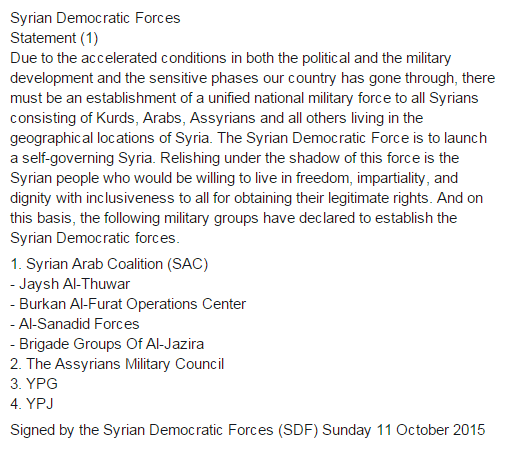
New Syrian alliance unites Kurds, Arabs, and Assyrians

Reuters reports: A Kurdish militia that has been fighting Islamic State in Syria with help from U.S.-led air strikes has joined forces with Arab groups in an alliance announced on Monday that may be a prelude to an attack on the jihadists’ base of operations in Raqqa.

The alliance calling itself the Democratic Forces of Syria includes the Kurdish YPG militia and Syrian Arab groups, some of which fought alongside it in a campaign that drove Islamic State from wide areas of northern Syria earlier this year.

The Arab groups in the new alliance are operating under the name “The Syrian Arab Coalition” – a grouping which U.S. officials have said would receive support under a new U.S. strategy aimed at fighting Islamic State in Syria.

A U.S. military official has told Reuters that the Syrian Arab Coalition would push down towards Raqqa, Islamic State’s de facto capital, while staying east of the Euphrates river. [Continue reading…]

A statement issued yesterday by the Syrian Democratic Forces says:

sdfstatement

Facebooktwittermail

Syria: New Russian-made cluster munition reported

Human Rights Watch: An advanced type of Russian cluster munition was used in an airstrike southwest of Aleppo on October 4, 2015, Human Rights Watch said today. The use of the weapon near the village of Kafr Halab raises grave concerns that Russia is either using cluster munitions in Syria or providing the Syrian air force with new types of cluster munitions to use.

New photographs and videos also suggest renewed use of air-dropped cluster munitions as well as ground-fired Russian-made cluster munition rockets as part of the joint Russian-Syrian offensive in northern Syria.

“It’s disturbing that yet another type of cluster munition is being used in Syria given the harm they cause to civilians for years to come,” said Nadim Houry, deputy Middle East director at Human Rights Watch. “Neither Russia nor Syria should use cluster munitions, and both should join the international ban without delay.” [Continue reading…]

Last month, Human Rights Watch researcher, Ole Solvang, wrote about Saudi Arabia’s use of cluster bombs in Yemen: Cluster munitions were used in Yemen in past wars and now Saudi Arabia and members of its coalition are dropping bombs and launching rockets with this indiscriminate weapon on populated areas.

The U.S. is providing logistical and intelligence support for the coalition, and if it is providing targeting assistance for cluster munition strikes, it could be complicit in resulting laws-of-war violations. What’s more, the evidence we found of cluster rocket use just a few weeks ago showed that they were manufactured by U.S. companies. U.S. officials have expressed concern at the use of cluster munitions by Syria, South Sudan, Ukraine, and Sudan yet when it comes to the use of cluster munitions by the coalition in Yemen, the U.S. has been silent. [Continue reading…]

Facebooktwittermail

Shiites in Iraq hail ‘Sheikh Putin’

The New York Times reports: One of the most popular Facebook posts in Iraq’s Shiite heartland is a Photoshopped image of President Vladimir V. Putin of Russia dressed in the robe of a southern tribal sheikh.

It was the American-led invasion in 2003 that toppled Saddam Hussein and empowered Iraq’s long-repressed Shiite majority. The United States also took the lead more than a year ago to assemble a coalition to conduct airstrikes in Syria and Iraq against the Sunni militants of the Islamic State.

But with the struggle against the Islamic State largely stalemated, it is the naked display of Russian military power in neighboring Syria, as well as the leadership of “Sheikh Putin,” that is being applauded by residents of this Shiite power center. Russian planes continued to hit targets in Syria on Sunday, the Russian Defense Ministry said.

“What the people in the street care about is how to get Daesh out of Iraq,” Ibrahim Bahr al-Ulum, a member of Iraq’s Parliament, said, using an Arabic name for the Islamic State, also known as ISIS or ISIL. “Now they feel Russia is more serious than the United States.” [Continue reading…]

Facebooktwittermail

Ankara bombings came as Kurdish forces prepare to advance on ISIS stronghold

Following yesterday’s bombing in Ankara, Bloomberg reports: No one immediately claimed responsibility for the deadliest terrorist attacks in Turkey’s recent history, though suspicion quickly turned to Islamic State. The blasts on Saturday targeted a march called to urge an end to violence between the government and Kurdish militants. In the wake of the attack, Kurdish fighters declared a unilateral cease-fire, which they said they would honor as long as they are not attacked.

The carnage in Ankara, the Turkish capital, came as U.S.-allied Kurdish forces affiliated with the militant Kurdistan Workers’ Party, or PKK, were preparing to advance toward Islamic State’s self-declared capital of Raqqa in Syria, according to Nihat Ali Ozcan, who studies the Kurdish conflict at the Economic Policy Research Foundation in Ankara.

“Daesh struck at the PKK in Ankara before a Kurdish offensive on Raqqa,” Ozcan said by phone, using the Arabic acronym for Islamic State. “Turkey has become the battleground in a growing war between the PKK and Daesh.” [Continue reading…]

Simon Tisdall notes: Many in Turkey accuse Erdoğan of deliberately fuelling a reviving conflict with militant Kurdish groups, including the outlawed PKK, ‎in order to scare voters into supporting his law-and-order, security-first platform in the coming elections. If he succeeds, it is argued, he will seize more powers for the presidency and promote himself as a sort of modern-day Sublime Porte. Thus, it is suggested, the last thing Erdoğan really wants at this juncture is a Kurdish peace. [Continue reading…]

Reuters reports: Government officials made clear that despite alarm over the attack on a rally of pro-Kurdish activists and civic groups, there would be no postponement of November polls Erdogan hopes can restore an overall majority for the AK Party he founded.

Thousands of people gathered near the scene of the attack at Ankara’s main railway station, many accusing Erdogan of stirring nationalist sentiment by his pursuit of a military campaign against Kurdish militants, a charge Ankara vehemently rejects.

“Murderer Erdogan”, “murderer police”, the crowd chanted in Sihhiye square, as riot police backed by water cannon vehicles blocked a main highway leading to the district where parliament and government buildings are located.

The pro-Kurdish Peoples’ Democratic Party (HDP), a major presence at Saturday’s march and holding seats in parliament, said police attacked its leaders and members as they tried to leave carnations at the scene. Some were hurt in the melee, it said in a statement. [Continue reading…]

Facebooktwittermail

Obama’s legacy is tarnished as Putin fills the vacuum in Syria

Muhammad Idrees Ahmad writes: “Beware that, when fighting monsters, you yourself do not become a monster,” warned Nietzsche. “For when you gaze long into the abyss, the abyss gazes also into you.”

Russian tanks rolling into Hama, its air force bombing Idlib, its missiles flying from the Caspian, its fighter jets violating Turkish airspace – all of it backed by the familiar language of the “war on terror” – is the abyss staring back at an America that, in search of monsters to destroy, has helped legitimise monstrous deeds.

Vladimir Putin can face little resistance if he bombs an ambulance in Idlib when a US gunship incinerates a hospital in Kunduz. Bashar Al Assad can get away with murder because he has conveniently pronounced his opponents “terrorists”.

As long as the US carries the dead weight of the war on terror, it will have neither the agility to respond to crises nor the moral authority to restrain its wayward – or inadvertent – allies. When Mr Putin volunteered his forces to join a war on terror in Syria, Mr Obama had little choice but to assent. Russia, unlike the US, however has targeted mainly anti-Assad forces, some of them said to be US-backed. But Washington’s feeble complaints ring hollow when the US has itself set the precedent in targeting anti-ISIL groups.[Continue reading…]

Facebooktwittermail

ISIS seizes ground from Aleppo rebels under cover of Russian airstrikes

The Guardian reports: Islamic State militants have scored their most significant advances in the province of Aleppo, the closest they have come to Syria’s former commercial capital in two years, as it becomes increasingly clear that they are taking advantage of Russian airstrikes against the rest of the opposition to march into new territory.

As Russian planes continued to pound rebel forces in western Aleppo and other frontlines in the country, many of the opposition fighters who ousted Isis from the province at great cost last year found themselves pinned down and unable to halt the terror group’s largely unopposed advance towards the city at the end of last week.

“Russian planes are striking the Free Syrian Army and laying the groundwork for Daesh [Isis] control of strategic areas in Aleppo,” said a source from Tajammu al-Izzah, a moderate opposition group backed by western and Gulf states which has been hit by Russian airstrikes. “The truth is that Russia is backing Isis.” [Continue reading…]

The Associated Press adds: CIA-backed rebels in Syria, who had begun to put serious pressure on President Bashar Assad’s forces, are now under Russian bombardment with little prospect of rescue by their American patrons, U.S. officials say.

Over the past week, Russia has directed parts of its air campaign against U.S.-funded groups and other moderate opposition in a concerted effort to weaken them, the officials say. The Obama administration has few options to defend those it had secretly armed and trained. [Continue reading…]

Facebooktwittermail

Islamism, the Arab Spring, and the failure of America’s do-nothing policy in the Middle East

Shadi Hamid writes: In the years leading up to the Arab Spring, Islamist parties developed something of an obsession with the role of Western powers in supporting democracy in the Arab world — or, more likely, not supporting it. Islamists were fighting on two fronts: not just repressive regimes, but their international backers as well. The ghosts of Algeria lingered. In January 1992, Algeria’s largest Islamist party, the Islamic Salvation Front (FIS), found itself on the brink of an historic election victory — prompting fears that the military was preparing to move against the Islamists. In the tense days that followed, FIS leader Abdelkader Hachani addressed a crowd of supporters. “Victory is more dangerous than defeat,” he warned, urging them to exercise restraint to avoid giving the army a pretext for intervention. But it was too late. The staunchly secular military aborted the elections, launching a massive crackdown and plunging Algeria into a civil war that would claim more than 100,000 lives.

That authoritarian regimes and activist militaries could count on American and European acquiescence (or even support) — as they did in 1992 — made Arab regimes seem more durable than they actually were, and the task of unseating them more daunting. During the first and forgotten Arab Spring of 2004-5, Algeria repeatedly came up in my interviews with Muslim Brotherhood leaders in Egypt and Jordan. Perhaps over-learning the lessons of the past, Islamist parties across the region, despite their growing popularity, were careful and cautious. They made a habit of losing elections. In fact, they lost them on purpose. This ambivalence and even aversion to power prevented Islamists from playing the role that opposition parties are generally expected to play. It was better to wait, and so they did.

It’s been almost five years since the start of the Arab Spring, but one conversation still stands out to me, despite (or perhaps because of) everything that’s happened since. Just two months before the uprisings began, Egypt was experiencing what, at the time, seemed like an especially hopeless period. I was in the country for November elections that proved to be the most fraudulent in Egyptian history. After winning an unprecedented 88 seats in parliament in 2005, the Muslim Brotherhood wasn’t permitted by Hosni Mubarak’s regime to claim even one seat. But this movement, the mother of all Islamist movements, accepted its fate in stride. “The regimes won’t let us take power,” Hamdi Hassan, the head of the Brotherhood’s parliamentary bloc, told me during that doomed election campaign. What was the solution, then? I asked him. “The solution is in the ‘Brotherhood approach.’ We focus on the individual, then the family, then society.”

“In the lifespan of mankind, 80 years isn’t long,” he reasoned, referring to the time that had passed since the Brotherhood’s founding. “It’s like eight seconds.” [Continue reading…]

Facebooktwittermail

How the old left still struggles to face new realities in the Middle East

In an interview, Dr H.A. Hellyer says: Many of our assumptions have been challenged in the past 5 years, since the revolutionary uprisings took place in the Arab world. I can still remember a world where academics wrote about the ‘resistance axis’ in the region, and the likes of Hizbollah and Bashar al-Assad’s Damascus were a part of that, described as ‘counter-weights’ to the machinations of right-wing neoconservatism and imperialism. The frames are wholly different now, on both of those points, due to the Syrian revolutionary uprising – and that leads to an important question for the Arab anti-imperialist left, as well as the old left in the West. Is this what left-wing politics is about, where we sacrifice the Syrian revolutionary uprising on the altar of some kind of imagined ‘resistance’ – while another type of foreign interference, be it from Tehran, Moscow, or Hizbollah, is critical in propping up a regime that has overseen the killing of tens of thousands of Syrian civilians? That’s a question that ought to be asked. In so doing, I hope the answer is not for the left to decide that they ought to become akin to the right-wing, whether in the West or the Arab world, and lose their time-honoured commitments to social justice as leftists. But rather, that the left ought to become more nuanced, and really take seriously the autonomy of people as a motivating factor, even when it is politically inconvenient. [Continue reading…]

Last year, Germano Monti, a freelance journalist and pro-Palestinian activist, wrote that neo-Nazis, Stalinists, Catholic fundamentalists and pacifists have found common ground in a diffuse brand of anti-imperialism: Fear of Islam is playing an increasingly significant role in the politics of the right wing. In the run-up to this year’s European elections, the leaders of various European extreme right-wing groups have met on a number of occasions – in Spain last November, for example, and in Rome in February 2014. Jens Pühse of the German NPD attended the Spanish meeting, as did members of the Syrian National Socialist Party (SSNP).

The SSNP is a close ally of Assad’s ruling Baath party and has two members in the Syrian cabinet: the deputy prime minister and another minister. The party deploys its own units to fight side-by-side with the regime and the Lebanese Hezbollah militias against the Syrian rebels. The ideology of the SSNP, which was founded in 1932 in Beirut, as well as its symbolism are obviously modelled on that of German National Socialism: a raised right arm is used as a salute, and the emblem emblazoned on the flag closely resembles a swastika. The SSNP’s Italian representative is the aforementioned Ouday Ramadan, who is in charge of organising support for the Assad regime in Italy.

The rapprochement between neo-Nazis, Catholic fundamentalists, Stalinists and pacifists under the banner of anti-imperialism is a crucial factor in the lack of solidarity with the Syrian people, particularly in left-wing circles. This small “red-brown army” is extraordinarily active on the Internet, with websites and blogs that initially seem to be left wing. Over the past three years, this army has managed to paralyse the Italian solidarity and peace movement for Syria by relentlessly invoking the spectre of a supposed NATO attack on Syria and a Zionist-Salafist plot against the Assad clan’s “secular, anti-imperialist and socialist” regime. [Continue reading…]

Facebooktwittermail

Assad tries to force the West to choose between regime and ISIS

The Wall Street Journal reports: Syrian President Bashar al-Assad and his inner circle are engaged in a high-stakes gamble for the future of their fractured nation, betting Russian attacks on rebel positions will shift momentum in the conflict and shore up support from their core constituency.

Russia’s intervention is lending credence to what is widely believed to be Mr. Assad’s ultimate aim: Leave only one opponent in the multisided war—Islamic State—and force the West to choose between the extremist group and his regime.

Jubilant Assad loyalists have boasted that Moscow’s expanded involvement has foiled more than four years of efforts by the West and its allies to dislodge the strongman by backing Syria’s more-moderate armed opposition. The U.S. and its Western allies have said Russian airstrikes are primarily targeting these rebels, and not Islamic State.

“The heroic and extraordinary move by our friends in the Russian Federation will create a new history and geography for the region,” Faisal al-Mekdad, Syria’s deputy foreign minister, said on state television late Wednesday. “This is a transitional period, not for us, but for those in the enemy camp. It is they who will make the shift,” he added, referring to the U.S. and its Arab allies. [Continue reading…]

The Washington Post reports: Islamic State militants advanced against rival insurgents in wide swaths of Aleppo province Friday, activists and local media said, as Russia ramped up its campaign to recapture rebel-held territory for the Syrian government.

In a surprise advance — marking some of the Islamic State’s biggest gains in recent months — jihadists routed Syrian rebels from at least five villages and threatened the outskirts of Aleppo city, Syria’s second-largest city, activists said. [Continue reading…]

Facebooktwittermail

Iranian general killed in Syria by ISIS

The Wall Street Journal reports: A top Iranian military commander who played a crucial role in Tehran’s efforts to defend the Syrian regime was killed in the outskirts of the northern Syrian city of Aleppo, Iran’s state media said Friday.

Brig. Gen. Hossein Hamedani died at the hands of “Daesh terrorists” on Thursday while conducting advisory duties, Iranian state media said, quoting a statement by the Islamic Revolutionary Guard Corps, or IRGC.

Although the statement used the Arab acronym for the extremist group Islamic State to describe those responsible for Gen. Hamedani’s death, the circumstances of his demise weren’t disclosed. The Iranian government, like the Syrian regime, tends to use “Daesh” and “terrorists” as catchall terms for all opponents of President Bashar al-Assad.
Gen. Hamedani, a longtime commander in the elite military unit of the IRGC, is believed to have directly overseen the organization of pro-Assad forces into groups such as the Popular Committees, which were later folded into the so-called National Defense Force.

These local militias are now estimated to number anywhere between 150,000 and 190,000 people. They are mainly members of Mr. Assad’s Shiite Muslim-linked Alawite sect, while some belong to Syria’s own small Shiite community. The majority of those fighting Mr. Assad are Sunni.

Before he was dispatched to Syria to provide know-how and training to the Assad regime, Gen. Hamedani was a commander in the IRGC’s elite military unit that led crackdowns on Iranian protesters in 2009. [Continue reading…]

Facebooktwittermail

White House hopes to de-escalate the conflict while Assad remains in power

Josh Rogin & Eli Lake write: “The White House somehow thinks we can de-escalate the conflict while keeping Assad in power,” one senior administration official told us.

That view, being pushed by top White House National Security staffers, including senior coordinator for the Middle East Rob Malley, is not new. But it has received fresh emphasis given Russian intervention.

If Assad is staying and there’s no political process in sight, this argument goes, the U.S. might as well focus on alleviating the suffering of the Syrian people and mitigate the growing refugee crisis.

Local ceasefires have been struck sporadically throughout the war, mostly in areas under siege by the Assad regime. The United Nations special envoy for Syria, Staffan de Mistura, has been pushing this idea for over a year.

“The current policy of the United States and its partners, to increase pressure on Assad so that he ‘comes to the table’ and negotiates his own departure, must be rethought,” Malley’s predecessor at the National Security Council, Philip Gordon, wrote at Politico as Russia was amassing its forces in Syria.

The NSC view is opposed by top officials in other parts of the government, especially Secretary of State John Kerry and U.S. Ambassador to the UN Samantha Power. They are trying to persuade Obama that the only way to solve Syria is to increase the pressure on Assad in the hopes he will enter negotiations.

Yet Kerry and Power now find themselves without any hope that Putin might bring the Syrian regime to the table. Kerry, though always skeptical of Russia, has been the point man on engaging the Russian government through several conversations with Foreign Minister Sergei Lavrov. But it’s now clear the Russians were leading the Obama administration down the primrose path.

“In Syria, much as it did in Ukraine, Russia has hidden its true intentions, using the ruse of joining the fight against ISIL to provide cover for Russia’s military intervention to prop up the Assad regime,” Senate Armed Services Committee ranking Democrat Jack Reed said Thursday. “Russia’s actions, however, increasingly expose their true objectives.”

The de-escalation and delay-Assad’s-departure approach pushed by Malley and Gordon “has always been on the table. It is fully operative now,” former State Department official Frederic Hof wrote in response to Gordon’s Politico article. The problem, he said, is that it won’t work because “neither the regime, nor Tehran, nor Moscow have demonstrated any interest in it.” [Continue reading…]

Facebooktwittermail

Russians in Syria due to success of U.S. policy, claims Obama official

The Daily Beast reports: The Russian airstrikes on Syria are a sign that U.S. policy is working, a senior State Department official told shocked Syrian-American advocates in a private meeting on Monday.

The “Russians wouldn’t have to help Assad if we didn’t weaken him,” U.S. special envoy for Syria Michael Ratney said, according to multiple participants in the meeting and contemporaneous notes. Russian intervention, he went on to say, is a sign of success for American policy on Syria. [Continue reading…]

Facebooktwittermail

Gulf Arabs ‘stepping up’ arms supplies to Syrian rebels

BBC News reports: Saudi Arabia is responding to the recent Russian air strikes on Syrian rebels by stepping up its supplies of lethal weaponry to three different rebel groups, a Saudi government official has told the BBC.

The well-placed official, who asked not to be named, said supplies of modern, high-powered weaponry including guided anti-tank weapons would be increased to the Arab- and western-backed rebel groups fighting the forces of Syria’s President Bashar al-Assad and his Russian, Iranian and Lebanese allies.

He said those groups being supplied did not include either Islamic State (IS) or al-Nusra Front, both of which are proscribed terrorist organisations. Instead, he said the weapons would go to three rebel alliances – Jaish al-Fatah (Army of Conquest), the Free Syrian Army (FSA) and the Southern Front.[Continue reading…]

Facebooktwittermail