Category Archives: Turkey

EU woos Turkey for refugee help, ignoring rights crackdown

The New York Times reports: The contrast was jarring: Just days after the police broke into the offices of an opposition newspaper using tear gas and water cannons, Turkey’s prime minister was greeted in Brussels with offers of billions in aid, visa-free travel for Turks in Europe and renewed prospects for joining the European Union.

The juxtaposition highlighted the conundrum Europe faces as it seeks solutions to its worst refugee crisis since World War II. To win Turkey’s desperately needed assistance in stemming the flow of migrants to the Continent, European officials seem prepared to ignore what critics say is President Recep Tayyip Erdogan’s steady march toward authoritarianism.

It is a moment of European weakness that the Turkish leadership seems keen to capitalize on. As Prime Minister Ahmet Davutoglu arrived in Brussels this week, he upped the ante, asking for more financial aid than was previously negotiated and demanding visa-free travel by June, while offering to take back some migrants who had crossed into Europe. [Continue reading…]

Facebooktwittermail

Takeover of opposition newspaper is a death warrant for free speech in Turkey

By Ahmet Erdi Öztürk, University of Ljubljana

On Friday March 4, a Turkish court ruled that the country’s biggest daily newspaper, Zaman, would be run by appointed trustees – ostensibly because of its so called “terrorist” activities, but more likely because the publication was linked to US-based Muslim preacher Fethullah Gülen, an opponent of the government.

Shortly after the court’s decision, police stormed the paper’s Istanbul headquarters in a dramatic midnight raid, firing tear gas and water cannon at the hundreds-strong crowd that formed outside.

The new administrative members dismissed the editor, executive editor and other senior staff, transforming the newspaper’s editorial line, in less than 48 hours, from a rigorous opposition voice into a propaganda mouthpiece for the president, Recep Tayyip Erdoğan.

Full disclosure: I have written oped pieces for Zaman for the past two years or so – at a rate of about two or three per month. Never at any time was there any attempt to dictate my angle or censor my work, even when – as I did several times – I wrote articles that were critical of Gulen or his movement. Now I feel that the doors of this newspaper are closed – not only for me but also for most of the other academic writers who had used the paper as a vehicle for their opinions.

This episode has not come as a huge surprise to anyone who has been following Turkey’s political scene. While Erdoğan and his AKP party enjoyed close relations with Gulen and his Hizmet educational and religious movement when the party first emerged – and observers believe that Hizmet used his enormous popularity to help Erdogan secure his first term as prime minister in 2002 – things have gone bad between them since 2013.

Continue reading

Facebooktwittermail

Turkey cracks down on foreign fighters

The Washington Post reports: The plea for help came from Sweden: Two young Muslim males had left Stockholm for Syria and would soon be terrorists-in-training unless authorities in Turkey could intercept them.

Turkish security caught the men arriving at an airport in Istanbul with one-way tickets and camouflage gear, officials said. The two were sent back to Sweden and the trouble averted — until eight days later, when the same duo turned up at a Turkish seaport, this time arriving by ferry from the Greek island of Kos.

The back-to-back deportations of those would-be militants last year were in some ways a sign of substantial progress in the cooperation between Western governments and Turkey in sharing intelligence and stemming the flow of foreign fighters to Syria.

But the sequence and hundreds of similar cases have also fueled rising levels of frustration in Turkey, which has been accused of enabling the migration of fighters into Syria even while being called upon to block militants on behalf of other governments unwilling or unable to do the job themselves. [Continue reading…]

Facebooktwittermail

Refugee crisis magnified by European divisions

refugees1

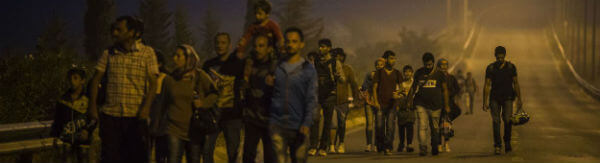
Der Spiegel reports: A rickety gate of galvanized wire is all that separates desperation from hope. The gate is part of the fence erected in the farming village of Idomeni on the border between Greece and Macedonia. At this moment, some 12,000 people are waiting for it to be opened.

It’s the gateway to Europe and the gateway to Germany.

A woman in boots and a blue uniform stands guard in front of the gate. Her name is Foteini Gagaridou and she is an official with the Greek border police — and she looks exhausted. All it would take for her to open the border would be to pull a thin metal pin out of the latch, but she’s not allowed to.

If it were up to her, she says, she would let every single one of these people pass through, just as they were able to do just a few weeks earlier — across the border to Macedonia and on through Serbia, Croatia and Slovenia to Austria, where they could continue their journey to Germany on what is known as the Balkan Route. It’s the same path chosen by hundreds of thousands of refugees last year, but the Balkan Route is now closed. It ends at Gagaridou’s wire gate.

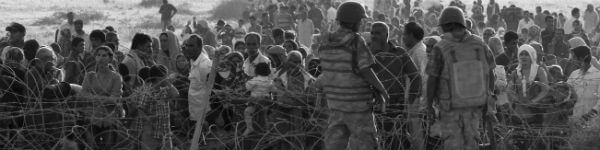
This is where Fortress Europe begins, secured with razor wire and defended with tear gas. Desperate scenes played out here on Monday, reminiscent of those witnessed in Hungary back in September. A group of young men used a steel beam as a battering ram to break down the gate. Rocks flew through the air as the gate flew off its hinges, prompting the volleying of tear gas cartridges and stun grenades from the Macedonian side. Men could be seen running and children screaming. One woman lay on the ground with her daughter, crying.

This frontier has become Europe’s new southern border, with Greece serving as Europe’s waiting room — and the possible setting for a humanitarian disaster. Around 32,000 migrants are currently stranded in the country, a number that the Greek Interior Ministry says could quickly swell to 70,000. The aid organization Doctors Without Borders is even expecting 200,000 refugees. Greece’s reception camps are already full, and the highly indebted country is stretched well beyond its capacity.

The decision as to whether and how many refugees will be able to cross the border isn’t one for border guard Gagaridou to make. Rather, it will be taken by the Macedonian government. Macedonia, for its part, is pointing fingers at countries further to the north, noting it is they who have tightened their borders, especially Austria, which created a chain reaction of border closures last week. The countries apparently felt they could wait no longer for the broader European solution German Chancellor Angela Merkel has promised will result from a special EU summit scheduled for March 7.

Merkel wants to see Turkey stem the flow of refugees and put a stop to the exodus to Europe. European leaders agreed on Feb. 18 that this plan remains the “priority.” But Austria and the Balkan states nevertheless moved ahead and closed their borders.

Idomeni has become a symbol of the current political chaos in Europe and the crumbling of a joint European refugee policy. The town is emblematic of the new Europe of fences. It is here that German Chancellor Angela Merkel’s open border policies have met their end. Under Austria’s leadership, the Balkan Route has been closed in the precise move Berlin had hoped to avoid.

Merkel has begun warning of the EU’s disintegration “into small states” that will be unable to compete in a globalized world, as well as of the possibility that border controls might soon be reintroduced all across Europe.

Were Europe in agreement, it would be unproblematic to accommodate 2-3 million refugees, given the Continent’s population of a half billion people. From such a perspective, the current spat actually seems somewhat ridiculous. But in the run up to next week’s EU summit, Europe is gripped by strife. Europe’s greatest achievement, the opening of its borders through the Schengen agreement, is at stake, and the increasingly toxic atmosphere between countries has reached alarming dimensions. [Continue reading…]

Facebooktwittermail

Turkey: Zaman newspaper taken over as government steamrolls press freedom

Amnesty: Today’s government takeover of Zaman newspaper is the latest deeply troubling episode in the Turkish authorities’ ongoing onslaught on dissenting media, Amnesty International said today.

“By lashing out and seeking to rein in critical voices, President Erdogan’s government is steamrolling over human rights,” said Andrew Gardner, Amnesty International’s Turkey expert.

“A free and independent media, together with the rule of law and independent judiciary, are the cornerstones of internationally guaranteed freedoms which are the right of everyone in Turkey.”

Just last week, the TV channel IMCTV was taken off air, silencing the only national news channel reporting a counter view of the situation in south-eastern Turkey, where round-the-clock curfews were imposed as armed clashes devastated entire towns. [Continue reading…]

Facebooktwittermail

Drought in eastern Mediterranean Levant region worst in 900 years, study finds

shadow16

American Geophysical Union: A new study finds that the recent drought that began in 1998 in the eastern Mediterranean Levant region, which comprises Cyprus, Israel, Jordan, Lebanon, Palestine, Syria, and Turkey, is likely the worst drought of the past nine centuries.

Scientists reconstructed the Mediterranean’s drought history by studying tree rings as part of an effort to understand the region’s climate and what shifts water to or from the area. Thin rings indicate dry years while thick rings show years when water was plentiful.

In addition to identifying the driest years, the science team discovered patterns in the geographic distribution of droughts that provides a “fingerprint” for identifying the underlying causes. Together, these data show the range of natural variation in Mediterranean drought occurrence, which will allow scientists to differentiate droughts made worse by human-induced global warming. The research is part of NASA’s ongoing work to improve the computer models that simulate climate now and in the future.

“The magnitude and significance of human climate change requires us to really understand the full range of natural climate variability,” said Ben Cook, lead author and climate scientist at NASA’s Goddard Institute for Space Studies and the Lamont Doherty Earth Observatory at Columbia University in New York City. [Continue reading…]

Facebooktwittermail

Who owns the Syrian revolution?

kobane

Naila Bozo writes: I recognized the importance of Syria in my life through my separation from it. The hours before going to the airport made me feel weak. The departure from Syria was a small but recurring trauma. I was not merely putting kilometers between Syria and myself; I felt I had travelled for centuries, travelled through galaxies as soon as I landed in Europe. Only a few hours after leaving the country, Syria felt like nothing but a hazy memory.

I do not know if I can put a claim to Syria as my home but that sunbaked, dusty country with the coincidental palm trees scattered by the roads, with the empty red bags of potato chips blowing in the gutter and the sound of Umm Kulthum owns me. I can still conjure the warmth of the yellow taxis’ leather seats under my fingers.

The claim to a home has grown more complex with the war in Syria. On one hand, there is a wish to be united with all Syrians against the dictatorial regime of Bashar al-Assad but on the other hand, one cannot ignore the Syrian armed and political opposition’s dubious alliance with Turkey, a state that has violated Kurdish rights for decades and recently intensified its crackdown upon Kurdish civilians and fighters. Today, the mutual mistrust between Syrian rebels and Kurdish fighters has intensified due to the former being a loose coalition that includes several formations within the so-called moderate Free Syrian Army that have varying degrees of affiliations with groups like Islamist rebel group Ahrar al-Sham and al-Qaeda’s branch in Syria, Jabhat al-Nusra while the latter is being accused of carrying out an expansionist agenda facilitated by U.S. and Russian airstrikes. [Continue reading…]

Facebooktwittermail

Turkey: Families return to shattered Kurdish town of Cizre – ‘a second Kobane’

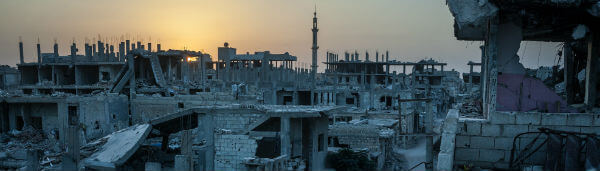
IBT reports: Residents have returned to Cizre to find their homes destroyed by shelling. Authorities partially lifted a 24-hour curfew that had been imposed to facilitate security operations against Kurdish militants. A first wave of arrivals reached the town at the break of dawn, their vehicles loaded with personal belongings and, in many cases, children. In the battle-scarred Sur neighbourhood, homes have enormous holes blasted into their walls, ceilings have collapsed, windows are shattered and doors are hanging on their hinges.

The level of damage in some neighbourhoods evoked the early days of military conflict in neighbouring Syria with buildings gutted by shelling and shrapnel. “Those who did this are not humans,” said Cizre resident Serif Ozem. “What took place here is a second Kobani in a country that is supposed to be a democracy.” Kobani is a predominantly Kurdish town in northern Syria that suffered a brutal siege at the hands of the Islamic State (Isis) group. [Continue reading…]

Facebooktwittermail

If the Kurds go broke, it’s lights out for Obama’s war on ISIS

John Hannah writes: Here’s a worrying bit of news: America’s best ally in the war against the Islamic State, Iraq’s Kurdistan Regional Government (KRG), is nearly broke. That’s a major problem, especially as the U.S.-led coalition gears up for its most difficult battle yet: the effort to liberate Mosul, the heart of the Islamic State’s power in Iraq. With the Kurds slated to play an essential role in that potentially decisive military campaign, now is the time for their capabilities to be reaching their zenith. Instead, they’re under growing threat of catastrophic collapse.

A near-perfect storm of crises has been draining KRG finances. First, there’s the burden of the war. For over 18 months, Kurdish forces have been pushing IS back across a 600-mile front. There’s also the KRG’s chronic dispute with the central government in Baghdad that has denied the region its share of Iraq’s national budget for the better part of two years. That’s billions upon billions of dollars in foregone revenue.

Further exacerbating the situation has been a massive influx of refugees and displaced persons, an estimated 1.8 million men, women, and children, fleeing the Islamic State’s hordes for the relative safety of Kurdistan. That tidal wave of humanity has increased the region’s population by an astounding 30 percent, straining its infrastructure and social services to the breaking point (just think about that: in the United States, that’s the equivalent of trying to take in over 90 million people overnight). Finally, like oil producers everywhere, what earnings the KRG receives from its own energy exports have been decimated by the collapse in world prices.

This can’t end well. The warning signs are everywhere. Up to 70 percent of Kurdistan’s workforce is on the KRG’s payroll. Most have not been paid for months. When back wages finally come through, it’s often at a fraction of what’s owed. Going forward, officials have dangled the threat of draconian salary cuts. Labor strikes are breaking out, involving teachers, medical workers, and even elements of the police. Political tensions are escalating. The broader economy is grinding to a halt. Construction of schools, hospitals, roads, and other critical infrastructure, is stalled. Tourism has dried up. Property values have plummeted. Consumer spending is collapsing.

Even more worrisome is the impact on Kurdistan’s oil sector, overwhelmingly the KRG’s primary source of revenue. The small international firms responsible for most of the region’s exports have received only sporadic payments. Absent these funds, the companies largely lack the necessary cash flow to invest in further developing existing fields. And without sufficient capital expenditures, production at these fields could actually begin to decline. New exploration, meanwhile, is at a virtual standstill, with the region’s rig count down by more than 90 percent, reaching levels not seen since the first production contracts were signed more than a decade ago. [Continue reading…]

Foreign Policy reports: Iraqi Kurds’ dreams of energy-financed political independence are taking a beating — and not just because of low oil prices.

Since the middle of February, Iraqi Kurdistan’s tenuous export link to the outside world has been totally shut down. As recently as January, the Kurds were exporting 600,000 barrels a day in exchange for desperately needed revenue. But the mysterious closure of the pipeline that connects Kurdish refineries to the Turkish coast has brought that number to essentially zero.

Kurdish officials say they don’t know for sure why the pipeline has been shut down; theories range from a terrorist bombing to simple sabotage to a precautionary shutdown by Turkish authorities carrying out big military operations in the area.

What’s crystal clear is that a region dependent on oil export revenues — one that was already struggling mightily to make ends meet during its costly war against the Islamic State — now has its back to the wall. The Kurdish region earned about $630 million a month from direct oil sales in 2015, which still fell short of the $850 million or so it needed every month to pay its soldiers and civil servants, as well as foreign oil companies for the crude they’ve pumped. The two-week pipeline closure has now cost Erbil an additional $200 million — and the Kurdish losses will continue to grow until it comes back online. [Continue reading…]

Facebooktwittermail

Turkey cracks down on insults to President Erdogan

The New York Times reports: Since August 2014, 1,845 criminal cases have been opened against Turks for insulting their president, Recep Tayyip Erdogan, a crime that carries a penalty of up to four years in prison. Among the offenders are journalists, authors, politicians, a famous soccer star, even schoolchildren.

That number quantified a growing trend of cracking down on dissent, and was revealed this week by the country’s justice minister, Bekir Bozdag, in response to a question in Parliament.

“I don’t think you could read this without blushing,” Mr. Bozdag said late Tuesday, defending the myriad alleged insults subject to judicial scrutiny. “It is not an expression of opinion, it is all swears and insults.”

“Nobody should have the freedom to swear,” he added.

The crush of insult crimes that have inundated Turkey’s justice system reflect the president’s authoritarian leadership style, critics say, and his determination to not let any insult, perceived or otherwise, go unanswered. [Continue reading…]

Facebooktwittermail

Turkey’s lack of confidence in Arab countries

Semih Idiz writes: Speaking a few days after Saudi Arabia’s Foreign Minister Adel al-Jubeir put to rest speculation that Turkey and his country were preparing for a ground operation in Syria, [Turkey’s Prime Minister Ahmet] Davutoglu made several remarks that are bound to go down badly in Moscow and Tehran, suggesting that Ankara is betting on a defeat of the Syrian regime and its principal allies Russia and Iran, much like the defeat of the Soviet Union in Afghanistan. He also said Turkey would not actively intervene in Syria because it was not confident of support from Arab countries, citing the condemnation by the Arab League of the deployment of Turkish troops in Bashiqa near Mosul on Dec. 3.

Davutoglu’s remarks revealed that the Arab League’s reaction to the Bashiqa deployment, the complaint lodged at the UN Security Council by the Iraqi government and the lack of support from Arab countries for this deployment still rankle in Ankara.

Jubeir told Agence France-Presse on Feb. 18 that any special forces sent by Saudi Arabia to Syria would only fight the Islamic State, underlining that they would not get involved in unilateral operations against the Syrian regime unless an international coalition was established for this purpose. Jubeir’s remark deflated growing expectations in some quarters of the Islamist and pro-government Turkish media that Turkey and Saudi Arabia, with their own “coalition of the willing,” were preparing to intervene in Syria. [Continue reading…]

Facebooktwittermail

Brexit has the potential to destroy the EU

Wolfgang Münchau writes: There is now a real possibility that the EU system for border and immigration controls will break down in about 10 days. On March 7, EU leaders will hold a summit in Brussels with Ahmet Davutoglu, the Turkish prime minister.

The idea is to persuade Ankara to do what Greece failed to do: protect the EU’s south-eastern border and halt the flow of immigrants. There is a lot of behind-the-scenes diplomacy going on between Germany and Turkey. The mood in Berlin, however, is not good.

The action taken by Austria, Hungary and other countries to protect their national borders has shut the western Balkan route along which migrants had made their way to Germany.

Refugees now find themselves trapped in Greece. Some may leave for Italy by boat. When those who survive the journey arrive there, I would expect Slovenia, Switzerland and France to close their borders. At that point, we should no longer assume that the European Council of heads of government is a functioning political body.

A refugee crisis that spins out of control could tilt the vote in the British referendum. There is no way the EU will be able to deal with two simultaneous shocks of such size. Coming at a time like this, Brexit has the potential to destroy the EU.

I do not expect such a doomsday scenario, but it is not implausible either. The EU is about to face one of the most difficult moments in its history. Member states have lost the will to find joint solutions for problems that they could solve at the level of the EU but not on their own. The EU’s population of more than 500m can easily absorb 1m refugees a year. No member state can do this alone, even Germany. [Continue reading…]

Facebooktwittermail

Kurdish ‘democratic confederalism’ or counter-revolution in Syria?

Robin Yassin-Kassab writes: The first fact is this: the Kurds have suffered a terrible historical injustice. The Arabs were rightly enraged when Britain and France carved bilad al-Sham (the Levant) into mini-states, then gave one of them to Zionism.

But the post-Ottoman dispensation allowed the Kurds no state at all – and this in an age when the Middle East was ill with nationalist fever. Everywhere the Kurds became minorities in hyper-nationalist states.

Over the years an estimated 40,000 people have been killed in Turkish-Kurdish fighting, most of them Kurds.

In the late 1980s, Saddam Hussein’s genocidal Anfal campaign murdered somewhere between 50,000 and 200,000 Iraqi Kurds.

In Syria, where Kurds formed about 10 percent of the population – or around two million people – it was illegal to teach in the Kurdish language.

Approximately 300,000 Kurds (by 2011) were denied citizenship by the state, and were therefore excluded from education and health care, barred from owning land or setting up businesses.

While oppressing Kurds at home, President Hafez al-Assad (Bashar’s father) cultivated good relations with Kurdish groups abroad. This fitted into his regional strategy of backing spoilers and irritants as pawns against his rivals. [Continue reading…]

Facebooktwittermail

Refugees are becoming Russia’s weapon of choice in Syria

refugee5

Simon Tisdall writes: Excerpts from a report by Turkey’s security services, published on Tuesday in Hurriyet newspaper, highlighted Turkish suspicions that Russia was purposefully attempting to “weaponise” the refugee crisis.

The report warned: “Regime forces and allies are trying to create a new refugee wave by moving towards Azaz [in northern Syria] … There are 10 refugee camps between this town and Turkey’s town of Kilis, approximately along an eight-kilometre line. The residents of these camps will likely flee and seek shelter in Turkey while these camps would be taken by the PYD or Assad forces.”

Security officials told the paper that Russia was employing tactics previously used in the first Chechen war in the north Caucasus in the 1990s, known as the “Grozny model”. This involved forcibly emptying urban residential areas through a campaign of attrition against the local population. Once this was achieved, heavy weapons were deployed to eradicate opposing forces, entailing widespread destruction of homes and infrastructure.

Given Assad’s previous documented use of barrel bombs, chemical weapons, airstrikes and heavy artillery against civilian areas, Russia’s alleged tactics hardly seem new. What appears to be different is the deliberate creation of tactical refugee emergencies to influence outside actors who must deal with the fallout.

Speaking at the weekend, US senator John McCain, a fierce critic of the Obama administration’s policy of non-intervention and a noted hawk, said Russia’s strategy was “to exacerbate the refugee crisis and use it as a weapon to divide the transatlantic alliance and undermine the European project”.

European politicians attending the weekend Munich security conference, prior to Monday’s attacks, echoed McCain’s concerns saying shops, schools and hospitals were being targeted in an attempt to force the local population to capitulate and increase the flow of refugees towards Turkey and Europe. [Continue reading…]

Facebooktwittermail

European states deeply divided on refugee crisis before key summit

The Guardian reports: Europe’s deep divide over immigration is to be laid bare at an EU summit in Brussels on Thursday, with German chancellor Angela Merkel struggling to salvage her open-door policy while a growing number of countries move to seal borders to newcomers along the Balkan routes.

A debate on the migration crisis over dinner on Thursday evening will do little to resolve the differences, senior EU officials predict. Donald Tusk, the president of the European council, has avoided putting any new decisions on the agenda in an attempt to avoid fresh arguments.

The leaders of four anti-immigration eastern European countries met in Prague on Monday and demanded alternative EU policies by next month. Their plan amounts to exporting Hungary’s zero-immigration razor-wire model to the Balkans, sealing Macedonia’s border with northern Greece, and bottling up the vast numbers of refugees in Greece unless they are deported back to Turkey. [Continue reading…]

Facebooktwittermail

Kurds carve out new reality in northern Syria

The Guardian reports: Amid the chaos in northern Syria in recent months, several themes have emerged.

The first is that Islamic State has been spared from intensified Russian airstrikes and advances by pro-regime forces. The second, and potentially more important development, is that one of the war’s least visible players – the Kurds – have done more than anyone else to carve out a new reality.

As Lebanese Hezbollah, militias from Iraq, and Syrian troops – all led by Iran – have inched their way around the top of Aleppo, the Kurdish YPG, supported by Russian air cover, has been making strident moves towards areas they have avoided throughout the conflict.

Over the weekend, the YPG moved towards two Syrian towns between the Turkish border and the almost besieged Aleppo, after earlier seizing an airbase that had been held by the opposition. Throughout the war, the YPG had been viewed warily by the opposition, and given a wide berth by the regime.

Now, though, its moves have sharply expanded a footprint in the north, alarming rebels who have been distracted by other foes, and Turkey, which had vowed never to let the Kurds dominate its border with Syria.

The Kurds are ascendant, and the Turks are enraged. Ankara sees YPG militants, who are affiliated with the Kurdistan Workers’ party (PKK), as vying to own areas they have never before controlled, to establish a foothold from Irfin in Syria’s north-west to the Iraqi border, a frontier dominated for decades by Arabs.

Helping the YPG do that are the same Russian jets that are steadily destroying Turkish-supported rebel groups, whose three-year push to oust Bashar al-Assad increasingly looks lost. [Continue reading…]

Facebooktwittermail

Russia uses world war threat to dictate Syria policy, says Turkish PM

Hurriyet Daily News reports: Russia is deliberately using the threat of a possible world war in order to dictate its policy in Syria, according to Turkish Prime Minister Ahmet Davutoğlu.

“Russia is consciously engaging in a perception operation to suggest ‘there could be a world war.’ By keeping this on the agenda, Russia continues to bother the world and dictate its policy,” Davutoğlu said Feb. 15 en route to Kyiv for a one-day visit.

“We should not be tricked with this perception operation,” he added.

Davutoğlu was referring to Russian Prime Minister Dmitry Medvedev’s words in Germany’s Handelsblatt newspaper on Feb. 11 that “world war” was possible if international powers failed to negotiate an end to the conflict in Syria. [Continue reading…]

Facebooktwittermail

Turkey to hold back on Syria ground offensive

The New Arab reports: Turkey has said it will only commit forces to a ground operations in Syria if its allies – including the US – back the offensive with troops.

A senior Turkish official told reporters that Ankara has asked its partners to intervene in Syria’s war, but his country will not take any action alone.

“We want a ground operation with our international allies,” the official told reporters in Istanbul on Tuesday.

“There is not going to be a unilateral military operation from Turkey to Syria… [but] without a ground operation it is impossible to stop the fighting in Syria. We are asking the coalition partners that there should be a ground operation.”

It comes as speculation mounts about possible Turkish intervention in Syria’s war to prevent Kurdish forces estabishing a mini-state on its borders and protect Syrian rebel forces from losing further ground. [Continue reading…]

Facebooktwittermail