Category Archives: Turkey

On trip to Turkey, Pope Francis calls for dialogue in battling ISIS

The New York Times reports: In his first visit as pope to a predominantly Muslim country, Pope Francis said in Turkey on Friday that interreligious dialogue, more than just military action, was required to combat Islamic State militants who are attacking Christians and other religious minorities along the country’s southern border.

“To this end, it is essential that all citizens — Muslim, Jewish and Christian — both in the provision and practice of the law, enjoy the same rights and respect the same duties,” the pope said in a televised speech from President Recep Tayyip Erdogan’s presidential palace in Ankara. “They will then find it easier to see each other as brothers and sisters who are traveling the same path, seeking always to reject misunderstandings while promoting cooperation and concord.”

The pope emphasized the need to focus on commonalities of faith and the value of learning from religious differences to repair relations between Christians and Muslims. [Continue reading…]

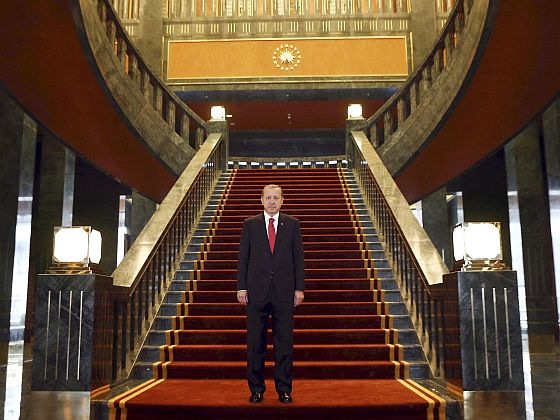
The Guardian reports: Francis will also walk straight into another controversy when he visits the Turkish president Recep Tayyip Erdoğan’s new palace built on once-protected farm and and forest in Ankara. He will the first foreign dignitary to be hosted at the lavish, 1,000-room complex.

The palace, which dwarfs the White House and other European government palaces, cost of £394m. It has drawn the ire of opposition parties, environmentalists, human rights activists and architects who say it is too extravagant, has damaged the environment and was built despite a court injunction against it.

Erdoğan brazenly dismissed the court ruling. “Let them knock it down if they have the power,” he said.

Facebooktwittermail

The president who ate Turkey

Erdogan-palace

Steven Cook writes: Without fail every year, starting around November 10, my #Turkey Twitter feed is jammed with not just the latest news from Ankara and Istanbul, but also Auntie Jean’s turkey recipe and suggestions about how to deep fry the bird without blowing up your house. And every year, on behalf of Turks and Turkey scholars the world over, I plaintively ask the tweeting masses to change #Turkey to #Turkiye, the actual Turkish name for the country that borders Greece, Bulgaria, Iran, Iraq and Syria—alas, with no success.

This year, however, basting and brining be damned, I am not going to make my annual plea. In an odd sort of way, #Turkey and #Turkiye have come together for me. That’s because after a mere 90 days as president, Recep Tayyip Erdogan has become the man who has eaten Turkey — the country. He is president and de facto prime minister, making him Turkey’s first “Primesident” — sort of like the political version of Turducken. Yet Erdogan’s powers run even further and deeper. He is also, effectively, the country’s foreign minister and chief judge, a prosecutor and big city mayor, university rector and father figure. There is nothing that better represents how Erdogan has gorged on Turkey than the president’s own newly unveiled Ak Saray, or White Palace, with its $350-$650 million price tag, 1,000 rooms and more than 2 million square feet. [Continue reading…]

Facebooktwittermail

It’s impossible to laugh off the appalling sexism of the Turkish president

Alev Scott writes: On Monday, Turkey’s president, Recep Tayyip Erdoğan, made headlines by announcing at a summit on women and justice in Istanbul that women are not equal to men “because it goes against the laws of nature”.

Understandably this caused some outrage around the world but in Turkey it was outflanked by weary cynicism. We’ve heard it all before, you see, most recently in July when the deputy prime minister told Turkish women not to laugh in public. “Don’t rise to the bait, ladies,” said one (female) journalist on Twitter. Another Middle East observer called the story a “waste of news space”.

Here’s why it isn’t: Erdoğan is neither a lone madman in a padded cell, nor a Victorian uncle caught in a time warp. He’s the president of a country of 75 million people where only 28% of women are in legal employment, an estimated 40% of women suffer domestic violence at least once in their lives, and where millions of girls are forced into under-age marriage every year (incidentally, Erdoğan’s predecessor, Abdullah Gül, married his wife when she was 15). Exact figures on domestic abuse and rape are hard to come by because it is socially frowned upon to complain about husbands, and police often tell women and girls who have been threatened with murder by their partners to go home and “talk it over”. [Continue reading…]

Facebooktwittermail

The embargo against Rojava

TATORT Kurdistan: Although Rojava (in northern Syria) is a mosaic of languages and cultures, regional and international powers have isolated it both economically and politically—indeed, it is now entirely on its own. To the north, Turkey has walled the region off. To the east, South Kurdistan has lined its veritable ditch with military checkpoints. To the south, the radical Islamist combat units of ISIS and the Al Nusra Front have cut the region off from the rest of Syria.

This embargo is having severe consequences for the people of Rojava.

Taken by itself, Rojava is economically quite a wealthy place. It produces 60 percent of Syria’s wheat and oil, and it raises cotton for the Syrian market. Vis-à-vis Syria it had the status of a colony, in the sense of being a source of raw materials. Rojava doesn’t have processing industries. Thus it grows and harvests grains, but it doesn’t mill them. It doesn’t refine oil but shipped it at great expense to central Syria. That, at least, was the starting situation for Rojava.

The water supply for agriculture comes partly from deep wells, but after the jihadis took over the power stations in Raqqa, those pumps — and hence farming — were threatened. But Rojavans began to use diesel generators to produce power. First they had to develop the technology to generate diesel at all. Rojava’s first winter was very hard–snow fell for the first time in several years, and there was no heating oil. But today many small generators pollute the cities. Only a few of the large ones are available, and no more can be imported because of the embargo.

Turkey and South Kurdistan (the Kurdish region of Iraq) work closely together to maintain the embargo against Rojava. They recognize that Rojavans are attempting, through a grassroots organization, to go beyond capitalist modernity and Western intervention. If the Rojava project should turn out to function, the political and social consequences will ripple throughout the Middle East. That would interfere with the strategy of the NATO states, so they support the embargo. [Continue reading…]

Facebooktwittermail

Biden in Turkey, warns about corrosive effect of concentration of powers

The Guardian reports: US vice-president Joe Biden on Saturday warned that a concentration of powers under a head of state was “corrosive” as he visited Turkey – which has been accused of increasing authoritarian tendencies.

Biden made the remarks before meeting Recep Tayyip Erdogan, who in August became the Turkish president after more than a decade as prime minister. Critics have accused Erdogan of seeking to centralise powers in a powerful presidency, which until he took office was largely a ceremonial role.

At a joint news conference held after a four-hour talks session, Biden said he and Erdogan had discussed a transition of power in Syria, away from President Bashar al-Assad. [Continue reading…]

McClatchy adds: Biden’s visit here also brought forth the first signs of policy convergence. Midway through the discussion here, the Turkish government disclosed that it is willing to train and equip Iraqi government forces, a dramatic shift to support Iraq’s new leadership of Prime Minister Haider Abadi after years of tensions with his predecessor, Nouri al Maliki. Turkey also disclosed it is training Peshmerga militias under control of the Kurdistan Regional Government (KRG).

This all seemed to have come about as part of the preparations for the Biden talks. Davutoglu pledged to train and assist national guard units that Abadi is setting up to fight the Islamic State, the Turkish official said. “We are always ready to give any kind of contribution” to the Iraqi authorities, added the official, who disclosed the policy changes on condition he not be identified by name.

Before returning to meet with Biden, Davutgoglu visited Irbil, the capital of the largely autonomous Kurdish region, and a camp where Turkey has already begun training Peshmerga forces, the official said. Just a few years ago, Turkey and the KRG were frequently at loggerheads over the KRG’s willingness to host armed Turkish separatists who were at war with the Turkish state.

Biden’s visit to Istanbul was his first since the blow-up last month that followed his public criticism of Turkey for “contributing to the rise” of the Islamic State. Erdogan said if Biden didn’t apologize for his remarks, he will be “history to me.” [Continue reading…]

Facebooktwittermail

Iraq, Turkey vow to work together against ISIS

The Associated Press reports: Iraq’s prime minister said on Thursday that his country and neighboring Turkey have agreed on closer security and intelligence cooperation in the face of the threat posed by the Islamic State group.

“We have a key agreement to exchange information and have full security cooperation,” Prime Minister Haider al-Abadi told a news conference after talks with his visiting Turkish counterpart, Ahmet Davutoglu. “The Turkish prime minister also wants us to have military cooperation in the face of terrorism and Daesh and we welcome that,” said al-Abadi, using the Arabic acronym for the Islamic State group.

Davutoglu confirmed the two sides’ agreement on closer security cooperation.

“I can say that Daesh threatens both Iraq and Turkey, but we will cooperate and do everything we can to stand up to terrorism,” he said. “There is a new page in relations between Turkey and Iraq and that is why I hope that there will be close cooperation between our security and intelligence agencies to defeat terrorism.”

The Turkish prime minister also rejected charges that his country facilitated the transit of militants through its territory to Syria. [Continue reading…]

Facebooktwittermail

The roots of Turkish mistrust

Mustafa Akyol writes: A poll by the Pew Research Center in October highlighted a trend in Turkish society with foreign policy implications: Turks hold deeply unfavorable views of other nations. The most disliked nation proved to be Israel, with only 2% of Turks expressing any sympathy for the Jewish state. The United States also turned out to be highly unpopular, with only 19% of polled Turks expressing sympathy. Similarly unpopular were the European Union, China, Brazil and Russia.

One could suspect that Turks’ views of other nations are based on a distaste for all non-Muslims, as Turkey is a predominantly Muslim nation. However, Iran and Saudi Arabia — fellow Muslim nations — proved to be unpopular in the same poll, too. “In fact,” the Pew researchers concluded, “it is hard to find any country or organization the Turkish people really like, except, of course, Turkey itself.”

Yet, one could doubt this conclusion as well, because other polls have shown that the opinions of Turks of one another are not terribly positive either. Different surveys about levels of global “interpersonal trust” have repeatedly shown Turkey is one of the most extreme examples of a distrustful society. In a 2008 poll by World Values Survey, for example, Turkey was at the bottom of a list of 60 different countries rated according to interpersonal trust. Only 4.9% of Turks agreed with the statement, “Most people can be trusted,” equaling the answers from Rwandans, who suffered a genocide 14 years prior to the poll. (In contrast, the highest levels of trust turned out to be in Norway and Sweden, where around 70% of citizens agree with the same statement.) [Continue reading…]

Facebooktwittermail

Oil politics and the battle for Kobane

By Mika Minio-Paluello, Open Democracy, November 7, 2014

Kobane was supposed to fall. As ISIS assaulted the town, Turkish troops besieged it from the north, preventing reinforcements and arresting hundreds fleeing. US jets bombed ISIS forces elsewhere, driving them towards Rojava: the largely Kurdish region in northern Syria self-administered by the movement for a democratic society (Tev-Dem), headed politically by the PYD, and defended by the YPG and YPJ. A month into the battle, Kerry admitted that defending Kobane was still not a US strategic priority, despite growing pressure for an airdrop.

But Kobane didn’t fall. Unlike the Iraqi Army with its tanks and Humvees, the lightly-armed YPG and YPJ guerillas held firm. Kurdish activist Dilar Dirik argues that, “The people of Kobane were massively outgunned. But their will to fight kept them going. They are fighting for a fundamentally different future.”

Why was the US happy to see ISIS crush Rojava? The heavy violence in Syria is heavily influenced by oil-driven geopolitics. This goes well beyond the smuggling of crudely refined fuel from ISIS-controlled Deir Ezzor into Turkey. For decades, energy colonialism has enabled the repression of democratic movements.

Energy colonialism

Large oil fields and potential export routes contributed to Kurdistan – spread between Iraq, Iran, Turkey and Syria – being subjected to intense violence. For over a century, foreign policy decisions made in Washington, London and Paris aimed to control oil reserves in the region and preserve corporate profits. Borders were drawn, autocrats were supported and weapons poured in. Kurdish movements were used opportunistically and encouraged to revolt – only to be abandoned and slaughtered once short-term goals were achieved.

The 2003 war on Iraq and 1990s sanctions followed a much older pattern: where democratic forces and organised labour grew, British and US governments, corporations and local elites crushed them. When oil workers in Iraq occupied a pipeline pumping station in 1948, the company surrounded them with machine guns and armoured cars, starving them out. The next year, the Syrian parliament refused to ratify construction of the Trans-Arabian pipeline. The oil companies had the CIA organise a coup and the new military government immediately completed the agreement.

Today’s pipeline routes are the product of wars and political struggles, expensive infrastructure, mass displacement, and intensive corporate lobbying. Kurdish communities were seen as a threat, and subjected to cultural assimilation, forced emigration and brutal crackdowns. The enormous twin Kirkuk-Ceyhan pipelines from Iraq to the Mediterranean snakes its way through the Kurdish mountains, carrying 1.6 million barrels of oil every day. Its construction brought thousands of Turkish troops along its the route and into nearby villages.

Oil reserves in both Syria and Turkey – while not enormous – are heavily concentrated in Kurdish areas. 60% of Syrian oil is in and around Rojava, while 99% of crude extracted in Turkey comes from the south-east. Shell recently started fracking for shale gas around Diyarbakir. More reasons why Turkish and Syrian governments opposed any Kurdish autonomy.

The conservative-nationalist Kurdish Regional Government in Iraq managed to leverage its oil resources to attain significant autonomy, largely by making itself an ally to western energy interests and neoliberal power. In contrast, the Kurdish movements in Turkey and Syria are aiming for greater social liberation.

Who can decolonise energy?

Kurdish autonomy in Turkey or Syria could threaten western oil interests, especially with the Öcalan-inspired PKK and PYD sister parties both espousing “democratic, ecological, gender-liberated society”. The PYD is the driving force in Rojava, where popular assemblies have seen a “flourishing of a democratic culture that promotes popular participation, social emancipation, gender equality, ecological sensitivity, local self-organization, and ethnic and religious pluralism.”

Rojava’s deliberative politics has created a vision of an ecological society not subjugated to neoliberalism. Its political economy is characterised by community-based production and large-scale cooperatives. The Assad regime’s property was turned over to worker-managed co-operatives. A free Rojava is less open to exploitation for foreign interests, like Gulfsands, the London sanctions-dodging oil company that drilled for crude in Rojava.

The PKK and PYD are the most organised and democratic political forces in the region, and have the best chance to begin democratising and decolonising energy. Energy democracy in the Middle East would be transformative globally. Western elites use the control of oil overseas to weaken democratic forces at home, fearmongering about “energy security” and undermining the power of energy workers.

We need Rojava

This is one more reason why the US and Turkey are relaxed about ISIS and the YPG battling it out. No elite power wants a progressive and democratic revolution that could begin to transform our energy future. Neither the US or Russia, Turkey or Iran, the Israelis or Saudi Arabia.

By delaying meaningful airstrikes on ISIS positions around Kobane, the US ensured that the PYD became dependent on western support. The YPG needs heavy weapons – airdrops have begun and there is potential for more. The US excels at using “aid” to alter movement politics and enforce subservience. Guns come with strings attached and American military advisers to pull them. But the PYD/PKK have deep ideological roots and hopefully won’t roll over.

Whichever way the battle for Kobane ends, the longer struggle for Rojava will continue. We all need Rojava, as an inspirational model to draw on, and as an ally in dismantling energy colonialism that keeps us all weak. Rojava needs us, and we need Rojava.

This article was originally published in the independent online magazine www.opendemocracy.net

Facebooktwittermail

‘ISIS commanders told us to fear nothing at all because there was full cooperation with the Turks’

Newsweek reports: A former member of ISIS has revealed the extent to which the cooperation of the Turkish military and border forces allows the terrorist group, who now control large parts of Iraq and Syria, to travel through Turkish territory to reinforce fighters battling Kurdish forces.

A reluctant former communications technician working for Islamic State, going by the pseudonym ‘Sherko Omer’, who managed to escape the group, told Newsweek that he travelled in a convoy of trucks as part of an ISIS unit from their stronghold in Raqqa, across Turkish border, through Turkey and then back across the border to attack Syrian Kurds in the city of Serekaniye in northern Syria in February, in order to bypass their defences.

“ISIS commanders told us to fear nothing at all because there was full cooperation with the Turks,” said Omer of crossing the border into Turkey, “and they reassured us that nothing will happen, especially when that is how they regularly travel from Raqqa and Aleppo to the Kurdish areas further northeast of Syria because it was impossible to travel through Syria as YPG controlled most parts of the Kurdish region.”

Until last month, NATO member Turkey had blocked Kurdish fighters from crossing the border into Syria to aid their Syrian counterparts in defending the border town of Kobane. Speaking to Newsweek, Kurds in Kobane said that people attempting to carry supplies across the border were often shot at.

National Army of Syrian Kurdistan (YPG) spokesman Polat Can went even further, saying that Turkish forces were actively aiding ISIS. “There is more than enough evidence with us now proving that the Turkish army gives ISIS terrorists weapons, ammunitions and allows them to cross the Turkish official border crossings in order for ISIS terrorists to initiate inhumane attacks against the Kurdish people in Rojava [north-eastern Syria].”

Omer explained that during his time with ISIS, Turkey had been seen as an ally against the Kurds. “ISIS saw the Turkish army as its ally especially when it came to attacking the Kurds in Syria. The Kurds were the common enemy for both ISIS and Turkey. Also, ISIS had to be a Turkish ally because only through Turkey they were able to deploy ISIS fighters to northern parts of the Kurdish cities and towns in Syria.”

“ISIS and Turkey cooperate together on the ground on the basis that they have a common enemy to destroy, the Kurds,” he added. [Continue reading…]

Facebooktwittermail

‘It was never my intention to join ISIS’: Interview with a former member

A former ISIS member going by the pseudonym Sherko Omer came from a privileged family in the Kurdistan region of Iraq. He went to Syria to fight in the uprising against Bashar Al-Assad and ended up joining ISIS.

I witnessed horrible crimes committed by ISIS. I was so stressed in Al-Raqqa that I thought of suicide on several occasions. I wanted to escape but there was no way out. Only when I was deployed to the Kurdish region did the opportunity come to leave and I immediately surrendered to the YPG [National Army of Syrian Kurdistan] forces as they attacked our ISIS camp in the Kurdish city of Serekaniye.

I was held for several months and finally released after all sorts of investigations proved that I had no part in any crimes. I had been assigned to work in as a communication technician but my two friends became ISIS fighters. They were deployed to A’zaz – and both have been confirmed as dead.

While with ISIS, I noticed that the field captains and commanders spoke fluent Turkish. I rarely heard them speak in Arabic. ISIS commanders in Raqqa openly talked about the best foreign jihadists crossing into Syria from Turkey. Once, I heard that some ISIS foreign jihadists had been stopped by the Turkish border guards and police, but such were the ISIS connections that they were soon freed and safely on their way to Syria.

The last time I talked to one of my friends on the telephone, he had had enough of the whole organisation and he too had witnessed ISIS killing innocent people. He said he was scared to make an escape because he had witnessed ISIS publically beheading its own members who had tried to run. [Continue reading…]

Facebooktwittermail

Turkish soldiers kill activist Kader Ortakaya at Kobane border

Firat News Agency reports: It came out that the woman killed in the attack by Turkish troops at Suruç-Kobanê border today is 28-year-old Kader Ortakaya, an activist from the Collective Freedom Platform and post-graduate at Marmara University.

Kader Ortakaya has lost her life after being shot on the head as Turkish troops fired real bullets and intense tear gas on artists affiliated to the Initiative for Free Art who formed a human chain at Suruç-Kobanê border today.

Soldiers also fired tear gas and real bullets on the people at the Kobanê side of the border.

The young woman’s body has been taken to the hospital in Kobanê and will reportedly be transferred to the Forensic Medicine Institution in Urfa via the Mürşitpınar border crossing.

Kader Ortakaya was from Siverek district of Urfa and doing master degree at Marmara University in Istanbul after graduating from the department of sociology. Ortakaya was joining the resistance vigil in the villages of Mehser and Miseynter for around 25 days. She had also taken part in the works of women’s academy in Amed, Gezi protests of last year, as a person known to be sensitive towards social events.

Facebooktwittermail

U.S. backs Kurds on arms for Kobane, exposing more cracks in Turkey ties

Rudaw reports: In a clear sign of further cracks in US-Turkish ties, the US Department of State said Monday it backs Erbil’s move to send more arms to Kobane, the same day the Turkish president railed against too much international attention to the besieged Syrian-Kurdish town.

A group of 150 Peshmerga fighters from the Kurdistan Region are fighting alongside Syrian-Kurdish defenders who have resisted an overrun by the Islamic State, the jihadi group most commonly known as ISIS or ISIL.

“We support what they’re (Kurds) – their help in fighting back against ISIL in Kobane, yes,” said the US State Department Spokesperson Jen Psaki, responding to a reporter’s question about whether the US supports the Kurdistan Regional Government’s (KRG) decision to resupply Kurdish fighters in Kobane.

Major general Karzan Shaqlawai of the Peshmerga Ministry told Rudaw that a new resupply convoy of arms was on its way to Kobane with weapons for the Peshmerga and Syrian People’s Protection Units (YPG). They said the convoy was going through Turkey.

Ajansa Nûçeyan a Firatê reports: YPG Commander Mahmud Berxwedan said after the peshmerga forces crossed into Kobanê they have acted like a single army, rather than in coordination. He added: “The peshmerga are endeavouring to carry out what is asked of them in a self-sacrificing way.” Mahmud Berxwedan said the peshmerga had carried out effective strikes against the ISIS gangs with the heavy weaponry they had brought with them.

Mahmud Berxwedan said that since the end of October the initiative had passed to the YPG forces and answered questions from the ANF regarding the arrival of the peshmerga, the situation of civilians and the latest state of the conflict. [Continue reading…]

Facebooktwittermail

This is how ISIS smuggles oil

Mike Giglio reports from Besaslan: This town on the Turkish-Syrian border is covered in trash. Residents refuse to let any outsiders — even garbagemen — inside. What makes Besaslan more guarded than the other grim towns lining what has become one of the world’s most dangerous borders sits at the end of a winding dirt road: oil.

The oil brings Omar to town weekly, huddling with grease-covered men to negotiate the purchase of faded, 17-gallon drums. A Syrian in his thirties, Omar was once a proud rebel in his country’s civil war. Now he’s a merchant in the trade that bankrolls the extremists who hijacked it: the Islamic State of Iraq and Syria, or ISIS. The militants can make more than $1 million a day selling oil from fields captured in eastern Syria. But the way this shadowy trade works on the ground remains largely unknown. [Continue reading…]

Facebooktwittermail

Kobanê resists ISIS — but Turkey still can’t get the Kurdish question right

By Cengiz Gunes, The Open University

The biggest new development in the ongoing conflict between the Kurds and Islamic State has been the growing co-operation between the Kurdish movements in Iraq and Syria – a phase change that forces to upend the whole question of Kurdish politics.

The link-up between Kurdish movements across borders has been a major security coup. It first paved the way for a US airdrop of weapons, ammunition and medical supplies on October 20, resources which were sent to defend the town of Kobanê, which has been under siege from IS for seven weeks. We’ve also seen the deployment of Iraqi-Kurdish Peshmerga fighters, armed with heavy weapons such as artillery and anti-tank missiles.

These events have run contrary to many analysts’ initial expectation that Kobanê’s fall to IS was a foregone conclusion – and the exemplary resistance of Kurdish forces has drawn the support of both the international coalition and the Peshmerga forces.

But winning the support of the international coalition is a major development for the Kurds’ entire political cause, not just for their fight against IS.

Previously, the US authorities rejected the idea of working with the Kurds in Syria at all, on the grounds that the main Kurdish political party in Syria – Democratic Union Party (PYD) – has links to the Kurdistan Workers’ Party (PKK), which is on the US’s list of terrorist organisations.

But the Kurds’ response was astute and effective – and has forced the US’s hand. The Syrian Kurdish political parties met in Duhok, in the Kurdistan Region of Iraq, to establish a joint administration for Syria’s Kurdish-controlled areas. The Kurds of Syria and Iraq knew that closer co-operation could make them an important force in the international fight against IS – which in turn is likely to increase their clout in regional politics in general.

But even with this new-found solidarity, any effort to properly integrate the Kurds into the existing regional power equation will have to clear significant hurdles.

Continue reading

Facebooktwittermail

The Kurds’ lonely fight against ISIS

Der Spiegel reports: The headquarters of one the world’s mightiest terrorist organization is located in the mountains northeast of Erbil, Iraq. Or is it the nerve center of one of the Western world’s most crucial allies? It all depends on how one chooses to look at the Kurdistan Workers’ Party (PKK).

All visits to the site in northern Iraq’s Qandil Mountains must first be authorized by PKK leaders, and the process is not immediate. But after days of waiting, our phone finally rings. “Get ready, we’re sending our driver,” the voice at the other end of the line says. He picks us up in the morning and silently drives us up the winding roads into the mountains. At one point, we pass the burned out remains of a car destroyed by Turkish bombs three years ago, killing the family inside. The wreckage has been left as a kind of memorial. The driver points to it and breaks his silence. “Erdogan has gone nuts,” he says.

Just behind the Kurdish autonomous government’s final checkpoint, the car rounds a bend in the road and suddenly Abdullah Öcalan’s iconic moustache appears, part of a giant mural made of colored stones on the opposite hillside. The machine-gun toting guards wear the same mustache. “Do you have a permit, colleagues?” they ask.

Officially, we’re in the Kurdish autonomous region in northern Iraq. Really, though, it is a PKK state. A region of 50 square kilometers (19 square miles) of rugged, mountainous territory, it provides a home for PKK leadership in addition to training camps for fighters. It also has its own police force and courts. The surrounding hillsides are idyllic with their pomegranate trees, flocks of sheep and small stone huts. But they are also dotted with Humvees, captured by the PKK from the Islamic State terrorist militia, which had stolen them from the Iraqi army.

It is here in the Qandil Mountains that PKK leaders coordinate their fight against Islamic State jihadists in the Syrian town of Kobani and in the Iraqi metropolis of Kirkuk in addition to the ongoing battle in the Sinjar Mountains. Turkey, some fear, could soon be added to the list. [Continue reading…]

Facebooktwittermail

Peshmerga forces delayed in Turkey en route to fight ISIS in Kobane

The Guardian reports: Dozens of Iraqi Kurdish peshmerga fighters have been held up in Turkey en route to the Syrian border town of Kobani, where they will join the fight against Islamic State (Isis) militants.

The peshmerga command have not commented on the delay, but Turkish media cited an attack by Isis on Free Syrian Army (FSA) fighters crossing into Kobani through the Mürsitpinar border gate as a reason for the delay. According to the newspaper Milliyet, three FSA members were wounded by Isis snipers on Wednesday. They are being treated at a Turkish hospital.

Facebooktwittermail

Kobane gets reinforcements in fight against ISIS

Masoud Barzani, President of the Kurdistan Region of Iraq, explains why they have only sent a small peshmerga force to Kobane:

Facebooktwittermail

Turkish military blocks locals from joining Peshmerga mission to Kobane

Rudaw reports: The Turkish military is holding Kurdish Peshmerga soldiers seven kilometers from the Turkish border to Syria, delaying their mission in the besieged city of Kobane, Peshmerga officials told Rudaw.

A Peshmerga commander says his troops are in the town of Pirsus, guarded by Turkish military to prevent enthusiastic locals from joining the Iraqi Kurdish unit. The Iraqi Kurdish troops will provide artillery support to the Syrian Kurdish militia defending the city.

He declined to provide further details about the location and timing of their passage to Kobane, but confirmed that the Islamic State had intensified attacks in expectation of their arrival and the US-led coalition planned targeted airstrikes to facilitate a safe crossing.

They will be the first foreign soldiers to be dispatched to the Syrian Kurdish border town, which has been under siege by ISIS for more than 40 days. Local Kurdish fighters have held out with backing from US-led airstrikes.

This comes a day after the Free Syrian Army (FSA) said 200 its fighters had entered Kobane at the request of the People’s Protection Units (YPG), the Syrian-Kurdish force that has been defending the city against an ISIS takeover. [Continue reading…]

Facebooktwittermail