Today’s Zaman reports: President Recep Tayyip Erdoğan greeted Azerbaijani President Ilham Aliyev on Thursday in a historic welcome ceremony involving 16 soldiers wearing ceremonial clothes and the “Resurrection Anthem,” a theme song of a TV serial featuring the establishment of the Ottoman Empire.
As Erdoğan walked to greet Aliyev, the presidency’s band played “Resurrection Anthem,” the theme song of the show “Diriliş-Ertuğrul” (Resurrection-Ertuğrul), which is about the establishment of the Ottoman Empire. The song is a slightly altered version of “Dombra,” a Turkish nationalist song that was used by Erdoğan in his campaign for the March 30, 2014, local elections.
Army soldiers stood on one side of the president while 16 soldiers dressed up in ceremonial clothes representing each of the 16 states established by Turkic people throughout history were standing on his other side. [Continue reading…]
Category Archives: Turkey
Erdogan is losing touch with reality
President #Erdogan received the President of the #Palestinian National Authority Mahmoud Abbas with formal ceremony pic.twitter.com/XRppM3bpHB
— Turkey PM Press&Info (@ByegmENG) January 12, 2015
Mahmoud Abbas usually looks miserable but this time he looks genuinely perplexed — as though he just got transported through a time-warp and landed on another planet.
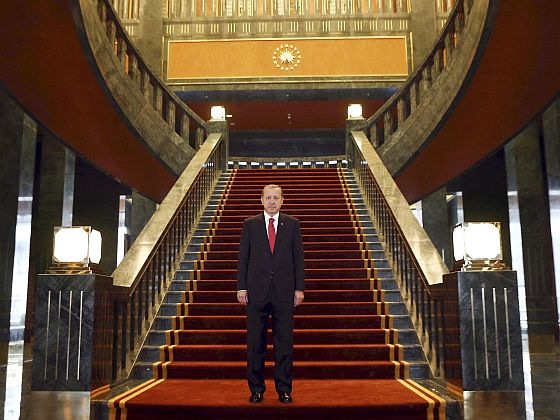
Kadri Gursel writes: In Turkish culture, the “gate” image is known to symbolize power and dominance. In President Recep Tayyip Erdogan’s “New Turkey,” it is being reinforced with the image of “stairs,” symbolizing the ascent to “prosperity and power.” In this context, Turkey’s newest and most famous staircase is in Erdogan’s pompous new 1,150-room palace. Made of fancy gray marble, the 25-step stairway leads from the palace’s ground floor ceremonial entrance up to the official presidential quarters.
The international audience had a first glimpse of the palace’s staircase on Oct. 31 when The New York Times published a picture of Erdogan posing alone in front of it. On Jan. 12, the same staircase made the headlines again as 16 men, clad in ancient eastern warrior costumes and holding replica swords, maces and spears, lined up on both sides of the staircase, eight on each side. Some were bedecked in chain mail and helmets, sporting fake mustaches and beards.
Climbing down between the warriors in the glimmer of their armor — some golden, others chromate — Erdogan walked to the ceremonial door to greet his guest, Palestinian President Mahmoud Abbas. The pair saluted the Presidential Guard of Honor before walking to the bottom of the staircase, where they posed for a picture, shaking hands. The scene looked surreal with the costumed men — believed to represent Turkic-Mongolian and Ottoman warriors — standing proudly upright in the background. [Continue reading…]
Today’s Zaman reports: Soldiers in the presidential palace wearing different ceremonial clothes of various Turkic tribes — photos of which garnered laughter in Turkey and around the world when they were released on Monday — will remain permanent, the Turkish media said, citing presidential sources.
The sources said it was still not clear how the soldiers will be displayed, but the Presidency will continue to have the same dressed-up soldiers at future ceremonies while hosting foreign state dignitaries.
The Independent reports: The Turkish president has accused the West of “playing games” with Muslims in the wake of the Paris attacks and urged its governments to crack down on Islamophobia.
Recep Tayyip Erdoğan chided the French security services for not preventing the attack on the offices of French satirical newspaper Charlie Hebdo and said that Muslims would suffer as a result of the murders.
“French citizens carry out such a massacre, and Muslims pay the price. That’s very meaningful … Doesn’t their intelligence organisation track those who leave prison?” he said.
He cited an increase in attacks on mosques after the incidents as indicative of double standards in France and other countries.
“The West’s hypocrisy is obvious. As Muslims, we’ve never taken part in terrorist massacres. Behind these lie racism, hate speech and Islamophobia,” Erdoğan said.
When Erdogan says that “as Muslims, we’ve never taken part in terrorist massacres,” he’s reiterating the conspiracy theory widely promoted in the Middle East over the last decade that terrorism is instigated by non-Muslims — it’s usually Mossad or the CIA — and this is all part of a Western/Zionist effort to suppress Muslims and vilify Islam.
During this period, American and Israeli wars in which hundreds of thousands of Muslims have died, have helped reinforce the narrative.
But we’re now living in the age of ISIS and those who want to keep on peddling the line that Muslims are only victims and never perpetrators of gruesome brutality, are either being disingenuous or they’re delusional.

Turkish court rules to block web pages featuring Charlie Hebdo cover
Today’s Zaman: The Diyarbakır 2nd Criminal Court of Peace blocked access to the web pages of some online news portals for republishing the cover of the magazine’s new issue, which portrays the Prophet Muhammad.
A lawyer from the Diyarbakır Bar Association, Ercan Ezgin, filed a petition on Tuesday with the Diyarbakır 2nd Criminal Court of Peace, requesting a media ban to be issued against the websites that republished the new Charlie Hebdo cover. Considering the petition of the lawyer, the court decided to block access to the web pages.
Turkish spy agency planning false-flag terror acts in crowded areas, whistleblower claims
13. Terror acts are planned to take place in malls and AKP buildings so it could increase rancor and violence against the Gülen movement.
— Fuat Avni Eng (@FuatAvniEng) January 10, 2015
Before getting to today’s report in the Turkish daily, Today’s Zaman, why should a prediction of a false-flag terror attack be viewed as credible if this is coming from a Twitter user whose real identity remains unknown? Here’s why:
Foreign Policy reported on December 16: Fuat Avni — who has 670,000 followers on his Turkish-language account and nearly 23,000 on a related English-language account — is believed by some observers to be an insider in the administration of President Recep Tayyip Erdogan. He has captivated the country with his mostly reliable predictions of events, including two rounds of mass arrests of police officers involved in an anti-government wiretapping probe.
Today’s Zaman now reports: A Turkish whistleblower, who has a credible record of predicting police operations and government policies, has made a shocking claim, arguing that the Turkish spy agency is planning false-flag operations to blow up crowded areas to frame the Gülen movement as a terrorist organization.
Fuat Avni said early on Saturday that the President Recep Tayyip Erdoğan initially planned to use Dec. 14 raids against the media to announce the Gülen movement as a terrorist organization, but he had to resort to other ways as the previous plan failed. The whistleblower said Erdoğan approved of the false-flag operations.
“After the fiasco,” Avni tweeted, “Erdoğan tasked the spy agency [National Intelligence Organization] MİT with labeling the Gülen movement as a terrorist organization.” He claimed that Erdoğan has difficult time after France shootings for his support for the Islamic State of Iraq and Levant (ISIL) and al-Qaeda. “To get out of this difficult period and turn the tide in his favor, Erdoğan is making new evil plans,” Avni tweeted.
Erdogan tackles growing threat from cartoonists

A protester who held up this image, published in The International New York Times, has been questioned by the police.
The New York Times reports: In the cartoon, an image of Recep Tayyip Erdogan stands watch while two thieves empty a safe full of cash. “No need to rush,” one of the thieves says with a grin. “We have a holographic watchman,” he adds.
The message in the cartoon, published in February in Cumhuriyet, an opposition newspaper, was unmistakable, coming as members of the Turkish leader’s inner circle were targeted in a corruption investigation.
Mr. Erdogan was not amused. The offending cartoonist, Musa Kart, who had a history of drawing cartoons critical of Mr. Erdogan, was taken to court on charges of insulting the prime minister (now the president), violating the privacy of an investigation and committing libel. Mr. Kart was acquitted in October, leaving him free, for the moment — Mr. Erdogan’s lawyer has appealed the decision — to keep challenging authority with his caricatures of Turkey’s rich and powerful.
“This repetitive cycle of legal actions affects all cartoonists, writers, intellectuals in this country,” Mr. Kart said. “We will continue to work and express what we think for the good of our future generations.”
But the episode points to an increasingly difficult environment for editorial cartoonists, who have long been a staple of Turkey’s political culture, as Mr. Erdogan has shown less tolerance for criticism and dissent. Critics of Mr. Erdogan and his government have found themselves embroiled in criminal lawsuits while dozens have lost their jobs — victims, critics say, of government efforts to intimidate dissidents. [Continue reading…]
Hamas leader Mashaal endorses Turkish leaders in surprise speech
Hurriyet Daily News reports: Khaled Mashaal, the head of Hamas’ political bureau, has made a surprise appearance at an event of Turkey’s ruling party, endorsing the Turkish leaders and voicing his hope to “liberate Palestine and Jerusalem” together with them in the future.
“A strong Turkey means a strong Palestine … Inshallah, God is with us and with you on the road to victory,” Mashaal said in his address to the Justice and Development Party’s (AKP) annual congress in the Konya province on Dec. 27.
Turkish Prime Minister Ahmet Davutoğlu, whose hometown is Konya, personally presented Mashaal to the audience. “Konya, the city of heroes! You give birth to your leaders,” Mashaal said, congratulating the Turkish people “for having Davutoğlu and President Recep Tayyip Erdoğan.”
Mashaal’s brief speech was interrupted by slogans including “God is great” and “Down with Israel” several times by AKP supporters in the sports hall who waved Turkish and Palestinian flags. [Continue reading…]
Court releases schoolboy arrested for ‘insulting’ Erdogan
AFP reports: A Turkish court on Friday freed a 16-year-old high school pupil arrested for “insulting” President Recep Tayyip Erdogan, amid accusations his detention was the latest sign of a lurch to authoritarianism under the strongman leader.
The boy, Mehmet Emin Altunses, was released following a complaint by his lawyer, but he still faces trial in the future, the official Anatolia news agency reported.
Altunses was met by his parents as he left the main courthouse building in the city and immediately fell into the arms of his mother, Turkish television pictures showed.
But the teen defiantly declared his political activism would continue, saying he was not a terrorist but a “soldier” of modern Turkey’s secular founder Mustafa Kemal Ataturk.
“There is no question of taking a step back from our path, we will continue along this road,” he said.
Altunses had delivered a speech on Wednesday in the central Turkish city of Konya, a bastion of the ruling Islamic-rooted Justice and Development Party (AKP), where he accused Erdogan and the ruling party of corruption. [Continue reading…]
Erdogan calls birth control ‘treason’ and says role of women is to be mothers
AFP reports: Turkish President Recep Tayyip Erdogan described efforts to promote birth control as “treason”, saying contraception risked causing a whole generation to “dry up”, reports said Monday.
Erdogan made the comments on Sunday, directly addressing the bride and groom at the Istanbul wedding ceremony of the son of businessman Mustafa Kefeli, who is one of his close allies.
He told the newly-weds that using birth control was a betrayal of Turkey’s ambition to make itself a flourishing nation with an expanding young population.
“One or two (children) is not enough. To make our nation stronger, we need a more dynamic and younger population. We need this to take Turkey above the level of modern civilisations,” Erdogan said.
“In this country, they (opponents) have been engaged in the treason of birth control for years and sought to dry up our generation,” Erdogan said. [Continue reading…]
Turkey’s emerging police state
Sinem Adar writes: When Recep Tayyip Erdogan was elected president this summer, the future of the Turkey seemed one of anxieties and unknowns. Since then, the political scene has been overwhelmed by growing despotic state power that functions through intense securitisation of state-society relations, on one hand, and an increasingly salient public discourse of morality that takes religion as its primary reference, on the other. The Justice and Development Party (AKP) government was shaken, one year ago by a corruption scandal. As of today, there has been no prosecution process over corruption allegations.
This massive corruption scandal was the peak point of the struggle between once-allies Erdogan and his cronies, on one hand, and the Islamic scholar Fethullah Gulen, whose name is associated with the leadership of the Hizmet movement. What followed was an extended crackdown on dissent, which is still going on.
The AKP government immediately responded to the corruption allegations by relocating and firing officers within the police force involved with the case. In addition, the public prosecutors working on the corruption lawsuits were relocated as well. [Continue reading…]
Mystery Twitter leaker of raids has Turkey guessing
AFP reports: He has access to top secret information, has been able to stay one step ahead of the authorities and is nearly always right.
Who is Fuat Avni, the mystery Turkish Twitter user who once again correctly predicted Sunday’s raids against critics of President Recep Tayyip Erdogan days before they took place?
The controversial swoop on media allied to exiled US-based cleric Fethullah Gulen — who Erdogan blamed for orchestrating a corruption probe to unseat him — was just the latest in over half a dozen such raids since the summer.
On each and every occasion, the raids have been correctly predicted by Fuat Avni before they took place, allowing the suspects to brace themselves for their arrest.
But no one has a firm idea of who Fuat Avni is and from where he obtains his information, leaving Turkey abuzz with rumours over the user’s real identity. [Continue reading…]
Is Erdogan on the path to dictatorship?

Jenny White writes: Something substantially different is shaping up in today’s Turkey. Given the many variables in play, no one can be sure what the country will look like in 10 years. The recent autocratic turn of the pious former prime minister and now president, Recep Tayyip Erdoğan, cannot be explained simply as a form of Islamic radicalization. After more than a decade of economic growth and social reform under the Justice and Development Party (AKP), Muslim and Turkish identities have been transformed to such an extent that it is nearly impossible to assign people to one end or the other of a secular-Islamist divide, particularly that half of the population that is under 30. Many young people have heterogeneous identities, composed of seemingly contradictory positions and affiliations. Turkey is now split along more complex lines, pitting Sunni against Sunni, Sunni against Alevi (a heterodox Shia sect that makes up more than 10 percent of the population), and both pious and secular nationalists against Kurds. It could be argued that a lust for power and profit on the part of one man and his inner circle, rather than a wider cohort, has driven recent events as much as religion. This is no novelty in the world of dictators, which may well be the direction Turkey is taking.
Part of the answer to what is happening in the present lies in the past, in Kemalist practices (the legacy of Mustafa Kemal Atatürk, who founded the modern Turkish state in 1923) that still powerfully shape social and political life today. Erdoğan, threatened by recent street protests and the actions of a rival Islamic movement, has returned to the fearmongering and aggressive political paternalism that were ingrained in the Turkish psyche for much of the twentieth century, making them powerful tools for social manipulation. Kemalism has been largely dethroned, but the levers of power it developed remain in place. In the absence of Kemalist symbolism, AKP rule has taken on an Ottoman and Sunni Muslim veneer.
What is fundamentally different, though, is that Erdoğan has begun, for the first time, to dismantle the democratic structures that, creaky and biased though they were, provided a balance of power among institutions. Under Erdoğan, these institutions, from universities and the media to police, prosecutors, and judges, have been forced to answer not to a party, but essentially to one man who has taken control of most mechanisms of rule. This is a new and worrisome development, out of step with the AKP’s (and Erdoğan’s) accomplishments over the previous decade. Those who claim to have seen this coming could have done so only by closing their eyes to what the party accomplished — and what these newest developments put at risk. [Continue reading…]
Spying effort drives ISIS to shut down cellphone service in Mosul
McClatchy reports: A covert campaign of spying by residents and Iraqi intelligence agents hunting for top leaders of the Islamic State has forced the group to suspend cellphone service in areas it controls – a move Kurdish and Iraqi officials say will do little to stop the program but will further infuriate people living under the extremists’ rule.
Iraqi officials read as a sign of success the Islamic State’s announcement last week that it had suspended cellphone service indefinitely in Mosul, the city in northern Iraq it’s controlled since June, and parts of Anbar province for fear local residents were phoning in tips that were used by U.S. and Iraqi commanders to select airstrike targets.
The U.S. military hasn’t said which of its hundreds of airstrikes since August were aimed at suspected Islamic State leaders, limiting its descriptions to generalities – an Islamic State vehicle, a fighting position or a fighting unit. But Iraqi officials confirmed that an aggressive intelligence collection program is in place to help pinpoint Islamic State leaders and military positions.
“Certainly this is an important element,” said Kurdish Foreign Minister Falah Mustafa, who agreed to speak about the intelligence collection only in general. “It helps a great deal when you know the details of what your enemy is doing in terms of their strength, their presence, their weapons, their situation, their internal situation, their supply lines, so all that is very important.” [Continue reading…]
Meanwhile, Hürriyet Daily News reports: The Turkish Armed Forces (TSK) has confirmed that 150 Kurdish Iraqi fighters combatting Islamist jihadists in Kobane will be replaced with a new group that will also use Turkish soil to travel to the northern Syrian town.
Although precise details are not yet known, a group of around 110 fighters is expected to enter Kobane, passing through Turkey as the first group did, Turkish military sources told daily Hürriyet on Dec. 1.
U.S., Turkey narrow differences on ISIS fight while ISIS suffers heavy losses in Kobane
The Wall Street Journal reports: U.S. and Turkish officials have narrowed their differences over a joint military mission in Syria that would give the U.S. and its coalition partners permission to use Turkish air bases to launch strike operations against Islamic State targets across northern Syria, according to officials in both countries.
As part of the deal, U.S. and Turkish officials are discussing the creation of a protected zone along a portion of the Syrian border that would be off-limits to Assad regime aircraft and would provide sanctuary to Western-backed opposition forces and refugees.
U.S. and coalition aircraft would use Incirlik and other Turkish air bases to patrol the zone, ensuring that rebels crossing the border from Turkey don’t come under attack there, officials said. [Continue reading…]
Middle East Eye reports: Islamic State group militants battling for control of the Syrian town of Kobane suffered some of their heaviest losses yet in 24 hours of clashes and US-led air strikes, monitors said Sunday.
At least 50 militants were killed in the embattled border town in suicide bombings, clashes with Kobane’s Kurdish defenders and air strikes, the Syrian Observatory for Human Rights said.
Open source analysis on yesterday’s ISIS attack on Kobane
Aaron Stein writes: Yesterday, the Islamic State detonated four suicide car bombs in the embattled town of Kobane. One VBIED detonated just inside the Mursitpinar border gate. After the explosion, clashes broke out between the YPG and the Islamic state in the area. The YPG has since claimed that the VBIED entered from Turkey. Ankara, in turn, has denied this.
I have done a brief open source analysis of the videos and imagery and have come to a few tentative conclusions. My analysis is far from definitive, but I think it deserves consideration. [Continue reading…]
Pope and patriarch condemn Middle East persecution of Christians
The Guardian reports: The pope has concluded a three-day trip to Turkey by attending a religious service in Istanbul led by the ecumenical Patriarch Bartholomew I, the pre-eminent spiritual leader of 300 million Orthodox Christians worldwide.
Afterwards, both men condemned the violent persecution of many Christian communities in the Middle East, and called for peace in Ukraine.
In a joint declaration signed by Pope Francis and Bartholomew after the divine liturgy to commemorate the Feast of Saint Andrew the Apostle, the leaders expressed concern for the increasingly volatile situation in both Syria and Iraq, and urged the international community not to turn away from their responsibility to those being oppressed and driven from their homes. [Continue reading…]
Kurdish deal with Turkey within reach but legal guarantees key, says PKK leader
Reuters reports: A settlement to end a three-decade insurgency by Kurdish militants in Turkey could be reached within months if the government puts in place legal guarantees for Kurdish rights, a jailed militant leader was quoted as saying on Sunday.
The siege by Islamic State militants of the Syrian Kurdish town of Kobani on the Turkish border has risked derailing Turkey’s fragile peace process with its own Kurds, who have accused Ankara of failing to protect their ethnic kin.
Around 40 people were killed when thousands of Kurds took to the streets in October, mostly in Turkey’s predominantly Kurdish southeast, to demonstrate against what they saw as Ankara’s refusal to intervene in Kobani.
Abdullah Ocalan, leader of the Kurdistan Workers Party (PKK) militant group, nonetheless said agreement could be found within 4 to 5 months if Turkey showed it was serious, according to the pro-Kurdish HDP party, which visited him on his island prison. [Continue reading…]
ISIS attacks Kobane from Turkey
The Associated Press reports: The Islamic State group launched an attack Saturday on the Syrian border town of Kobani from Turkey, a Kurdish official and activists said, although Turkey denied that the fighters had used its territory for the raid.
The assault began when a suicide bomber driving an armored vehicle detonated his explosives on the border crossing between Kobani and Turkey, said the Britain-based Syrian Observatory for Human Rights and Nawaf Khalil, a spokesman for Syria’s powerful Kurdish Democratic Union Party.
The Islamic State group “used to attack the town from three sides,” Khalil said. “Today, they are attacking from four sides.” [Continue reading…]
Turkey shells Kobane injuring Kurdish civilians and fighters
Rudaw reports: Turkish bombardment of Kobane on Saturday has wounded a number of civilians and fighters inside the Kurdish city, the city administrator said.
“Under the pretense of stopping an ISIS attack on Turkey the Turkish army bombarded the center of Kobane with tanks and artillery,” Anwar Muslim, co-chair of the Kobane canton told Rudaw. “A number of civilians and fighters have been wounded.”
Muslim said that heavy fighting is going on between the Islamic State (ISIS) militants and the Peoples Protection Units (YPG) and the Peshmerga forces in several parts of the city.
“The YPG and Peshmerga have countered all the attacks, the fighting is still going on and we have a number of wounded,” said Muslim.
He added that the Kurdish forces still control most of the city, but “the ISIS has mined the few parts of the city that are under their control.” [Continue reading…]