Today’s Zaman reports: The terrorist Islamic State in Iraq and the Levant (ISIL) seemingly set free 46 Turkish hostages in exchange for the release by Turkey of some key figures of the radical Islamist organization.
“A couple of figures who are very, very important for ISIL were traded in the swap [for the hostages],” Abdülkadir Selvi, a columnist in the pro-government Yeni Şafak daily, said on Monday.
Selvi, who is a journalist particularly close to Erdoğan and the government, affirmed in his column that he reached such a conclusion after looking into what happened behind the scenes.
ISIL, which calls itself the “Islamic State,” captured 49 people, three of whom were reportedly Iraqis, from the Turkish Consulate General in Mosul when it seized the northern Iraqi city in June.
President Recep Tayyip Erdoğan did not deny, at a press meeting he held before leaving for the US on Sunday, that a swap might have been made to set free the Turkish hostages. [Continue reading…]
Category Archives: Turkey
100,000 refugees cross into Turkey fleeing ISIS attacks in Syria
The Associated Press reports: The 19-year-old Kurdish militant, who has been fighting the Islamic State group in Syria, brought his family across the border into Turkey to safety Sunday. But in the tranquility of a Turkish tea garden just miles from the frontier, Dalil Boras vowed to head back after nightfall to continue the fight.
Pulling a wad of Syrian bills from his pocket, the young fighter – who has already lost a 17-year-old brother to the Islamic militants’ brutal advance – said that if the Turkish border guards tried to stop him, the money would persuade them.
Boras and his relatives are among some 100,000 Syrians, mostly Kurds, who have flooded into Turkey since Thursday, escaping an Islamic State offensive that has pushed the conflict nearly within eyeshot of the Turkish border.
On Sunday, heavy clashes broke out between the Islamic State militants and Kurdish fighters only miles from the Syrian border town of Kobani, where members of the al-Qaida breakaway group were bombarding villagers with tanks, artillery and multiple rocket launchers, said Nasser Haj Mansour, a defense official in Syria’s Kurdish region.
“They are even targeting civilians who are fleeing,” Haj Mansour told The Associated Press.
At a border crossing where Turkish authorities were processing the refugees, Osman Abbas said he and 20 relatives were fleeing a village near Kobani when Islamic State fighters shot one of his sons. The 35-year-old had tried to return to their home to recover valuables while the rest of the family fled.
“They took our village, they took our house, they killed my son,” Abbas said. “I saw it with my own eyes.”
As refugees flooded in, Turkey closed the border crossing at Kucuk Kendirciler to Turkish Kurds in a move aimed at preventing them from joining the fight in Syria. A day earlier, hundreds of Kurdish fighters had poured into Syria through the small Turkish village, according to the Britain-based Syrian Observatory for Human Rights. [Continue reading…]
Yesterday, AP reported: Some 600 PKK fighters also crossed from Iraq into Syria, heading toward Kobani, said a military official in Iraq’s northern Kurdish region. That official also spoke on condition his name not be used because he wasn’t authorized to speak to journalists. The PKK have a base in the Qandil mountains in the Kurdish region of Iraq.
Turkey somehow secures release of 49 hostages held by ISIS
Not a shot fired, no ransom paid, no prisoners exchanged, but somehow Turkish intelligence (MİT) agents managed to escort 49 captives out of Syria and back to Turkey earlier today.
So far, the only clue on how Turkey managed to pull off this operation comes from Hurriyet Daily News reporting this: “there are indications of a kind of false flag, or deception operation by MİT. In answering such a question one ranking official said MİT ‘has tried every possible method and left no stone unturned’ to get the hostages alive.”
But the same report also describes ways in which the operation was coordinated with ISIS:
It was ISIL’s condition to give the hostages to Turkey at the border with Syria, “Because of their own security concerns due to their heavy clashes with Kurdish forces. They did not want to make the handover through the Kurdish region,” a security source told HDN.
The report also says: “One official source said ISIL might have ‘not wanted to get into a clash with Turkey’.”
As has widely been reported, a reluctance to put the lives of these hostages in jeopardy was one of Turkey’s main reasons for declining to join the U.S.-led coalition against ISIS — all the more reason to assume that ISIS must have believed that its interests would in some other way be served by releasing the hostages.
The PKK has called on Kurds in Turkey to join their comrades in Kobane, northern Syria, where they are fighting alone against ISIS. Perhaps Turkey threatened ISIS that if it did not free the hostages, Turkey would do nothing to prevent the flow of Kurdish recruits into Syria.
In spite of the suggestion that ISIS was deceived in some way, I’m inclined to believe that the group had reason to expect that it had more to gain by releasing its Turkish hostages than it could by holding on to them.
Slemani Times, an independent English language news publication, covering the Kurdistan Region, Iraq, and the Middle East, in an unsourced tweet offers this explanation for how Turkey successfully negotiated the release of the hostages:
#Turkey has released over 180 #ISIS detainees and transported them by military trucks to the Turkish-Syrian border close to #Kobane. #ISIL
— Slemani Times (@SlemaniTimes) September 20, 2014
About 60,000 Syrian Kurds flee to Turkey as ISIS advances
Reuters reports: About 60,000 Syrian Kurds have crossed into Turkey in the past 24 hours, a deputy prime minister said on Saturday, fleeing an advance by Islamic State militants who have seized dozens of villages close to the border and are advancing on a Syrian town.
Turkey opened a stretch of the frontier on Friday after Kurdish civilians fled their homes, fearing an imminent attack on the border town of Ayn al-Arab, which is also known as Kobani. Islamic State is now within 15 km (9 miles) of the town, a Kurdish commander on the ground said.
Islamic State’s advances in northern Syria have prompted calls for help by the region’s Kurds who fear a massacre in Kobani. The town sits in a strategic position on the border and has prevented the radical Sunni Muslim militants from consolidating their gains across northern Syria.
Lokman Isa, a 34-year-old farmer, said he had fled with his family and about 30 other families after heavily-armed Islamic State militants entered his village of Celebi. He said the Kurdish forces battling them had only light weapons. [Continue reading…]
The PKK’s strategy for fighting ISIS
Jamil Bayek, the head of the PKK Leadership Committee, says in an interview appearing in As-Safir and translated by Al-Monitor: We have a clear strategy, the most important thing in it is that we do not view IS as an organization, but as a group of mercenaries and murderers who pose a threat to the region’s peoples, cultures and religions, even a threat to all humanity. Since the PKK is a humanitarian movement and in light of this brutal onslaught against the peoples of the region in general and [against] the will of our people in western Kurdistan in particular, we are determined to break the will of those mercenaries. Our directives are clear in this regard: we will attack IS wherever it is found, with all our capabilities. We will not allow it to advance and achieve its goals. And we will be ready to lead a joint struggle alongside all those who resist IS and who have a clear position toward it, in order to defeat these mercenaries, liquidate them, and obliterate them from existence.
As-Safir: What is your position regarding the international coalition led by the United States against the Islamic State?
Bayek: Humanity should be aware what IS is and how it arose. This group did not fall from the sky and did not appear accidentally or suddenly. Many analyses indicate that Middle Eastern and international powers used IS to achieve their interests. At the moment, we see that the US does not want IS to achieve progress that allows it to become a great Middle Eastern power, especially since it has reached a dangerous point.
There are objective and good American attempts to confront this danger. But the problem, in our view, is not limited to IS, as there is a structure upon which these mercenaries stand, launch from, and protect themselves with. Therefore, we see that there is a need to get rid of this structure by establishing a shared democracy and freedom among the peoples of the Middle East on the basis of fraternity and equality as a substitute for the authority of the nation-state. We believe that the basis of the solution starts from here. Regarding the US measures to address IS, they are good steps without a doubt. They may produce certain results at a certain time. As long as IS constitutes a threat, military measures remain necessary. But achieving the desired results requires a radical solution. It involves, as I said earlier, “democratizing” the Middle East and achieving freedom for its all peoples. [Continue reading…]
How oil is smuggled from Syria into Turkey
Fehim Taştekin reports: From Ezmerin [a village in Syria], about 500 illegal oil pipelines, small-diameter plastic pipes normally used for irrigation, extend to the Turkish side of the Asi River. On the Turkish side, they are buried under agricultural fields to reach the village. Just like the village’s underground water distribution lines, oil pipelines crisscross under streets to reach the back yards of private houses. Diesel fuel pumped from a tanker on the Syrian side fills the private tanks. Simple “pump” and “stop” commands are given over cellular phones.
Consumers come to the houses of sellers and buy the diesel for 1.25 Turkish lira per liter ($0.56). This is how the system worked for a long time.
The state began to intervene only after the international media started to question whether Turkey was supporting IS and whether IS oil was being sold in Turkey. At the end of March, soldiers that had until then been watching the goings on from a hilltop about 100 meters from the river began digging up the pipes from the fields and cutting the ones that lay visible in the streets. Checkpoints were established to prevent the diesel from leaving Hacipasa. But the smugglers always found ways to bypass the gendarmerie, the latest being shipping the fuel in barrels. [Continue reading…]
Turkey considers buffer zone along its Iraq, Syria border
Daily Sabah reports: Turkey’s military is studying the prospect of establishing a buffer zone along its border with Syria and Iraq amid the escalating threat posed by the Islamic State of Iraq and al-Sham (ISIS), President Recep Tayyip Erdoğan was quoted as saying yesterday. The government will evaluate the plans and decide whether such a move is necessary, Turkish television stations quoted Erdoğan as telling reporters on his plane as he returned from an official visit to Qatar.
A presidency official confirmed that Erdoğan had made such remarks but did not specify where along the border the zone might be established and gave no further details. “The general staff is carrying out inspections on whether a buffer zone could be viable, but there is nothing concrete yet,” an official said on the condition of anonymity. Turkey, a NATO member and Washington’s key ally in the region, has been reluctant to take part in combat operations against ISIS, or allow the U.S.-led coalition to use its airbases for strikes against the extremists because the group is holding 49 Turkish nationals hostage, including diplomats and children. [Continue reading…]
ISIS draws a steady stream of recruits from Turkey
The New York Times reports: Hacibayram, a ramshackle neighborhood in the heart of Ankara’s tourist district, has morphed into an ISIS recruitment hub over the past year. Locals say up to 100 residents have gone to fight for the group in Syria.
“It began when a stranger with a long, coarse beard started showing up in the neighborhood,” recalled Arif Akbas, the neighborhood’s elected headman of 30 years, who oversees local affairs. “The next thing we knew, all the drug addicts started going to the mosque.”
One of the first men to join ISIS from the neighborhood was Ozguzhan Gozlemcioglu, known to his ISIS counterparts as Muhammad Salef. In three years, he has risen to the status of a regional commander in Raqqa, and locals say he frequently travels in and out of Ankara, each time making sure to take back new recruits with him.
Mehmet Arabaci, a Hacibayram resident who assists with distributing government aid to the poor, said younger members of the local community found online pictures of Mr. Gozlemcioglu with weapons on the field and immediately took interest. Children have started to spend more time online since the municipality knocked down the only school in the area last year as part of an aggressive urban renewal project.
“There are now seven mosques in the vicinity, but not one school,” Mr. Arabaci said. “The lives of children here are so vacant that they find any excuse to be sucked into action.”
Playing in the rubble of a demolished building on a recent hot day here, two young boys staged a fight with toy guns.
When a young Syrian girl walked past them, they pounced on her, knocking her to the floor and pushing their toy rifles against her head. “I’m going to kill you, whore,” one of the boys shouted before launching into sound effects that imitated a machine gun.
The other boy quickly lost interest and walked away. “Toys are so boring,” he said. “I have real guns upstairs.”
The boy’s father, who owns a nearby market, said he fully supported ISIS’s vision for Islamic governance and hoped to send the boy and his other sons to Raqqa when they are older.
“The diluted form of Islam practiced in Turkey is an insult to the religion,” he said giving only his initials, T.C., to protect his identity. “In the Islamic State you lead a life of discipline as dictated by God, and then you are rewarded. Children there have parks and swimming pools. Here, my children play in the dirt.” [Continue reading…]
Turkey insists root causes of ISIS must be eliminated
Hürriyet Daily News reports: The international conference to be held under French leadership in Paris on Sept. 15 is unlikely to change Turkey’s position vis a vis the international military campaign against the Islamic State of Iraq and the Levant (ISIL), according to a Turkish official.
Foreign Minister Mevlüt Çavuşoğlu, who will represent Turkey at the conference, will underline the need for “absolute elimination of ISIL’s root causes,” citing the formation of an inclusive government in Iraq and the toppling of the Bashar al-Assad regime in Syria as necessary priorities to achieve this end.
In the event that participants in the Paris conference agree on an action plan outlining the division of labor among the coalition countries, including which country will carry out airstrikes or whose country’s airbases and military facilities will be used, Çavuşoğlu will not make any commitment on behalf of Turkey, according to the Turkish official speaking to the Hürriyet Daily News. [Continue reading…]
Turkey refuses U.S. permission for combat missions against ISIS
AFP reports: Turkey will refuse to allow a U.S.-led coalition to attack jihadists in neighboring Iraq and Syria from its air bases, nor will it take part in combat operations against militants, a government official told Agence France Presse Thursday.
“Turkey will not be involved in any armed operation but will entirely concentrate on humanitarian operations,” the official said on condition of anonymity.
The decision echoes the country’s refusal to allow the U.S. to station 60,000 troops in Turkey in 2003 to invade Iraq from the north, which triggered a crisis between the two allies.
Ankara then also refused Washington permission to use its air bases to attack Saddam Hussein’s regime.
Turkey has come under fire by some critics for indirectly encouraging the formation of the Islamic State because of its support of Islamist opponents of Syrian President Bashar Al-Assad, and its loose control of its borders.
But Ankara vehemently denies its strategy has backfired. [Continue reading…]
Is the PKK becoming a new Middle East power?

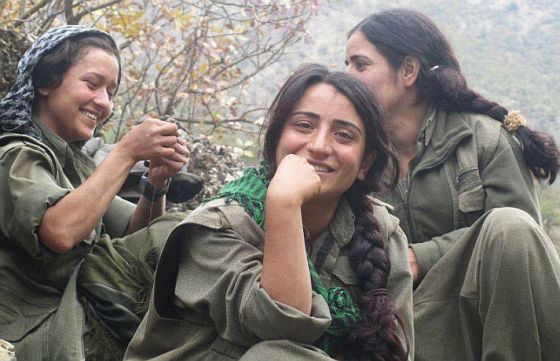
30% of the PKK’s fighters are women.
The Turkish columnist, Kadri Gursel, writes: [T]he PYD [the Democratic Union Party, the PKK’s Syrian branch] has been able to hold on to these three regions [Ras al-Ain, Kobani and Afrin, in northern Syria] and resist the jihadists for more than two years. Hence, long before IS’ capture of Mosul, the PKK already deserved to be recognized as the Middle East’s only fighting force to defy and resist IS for the struggle it has waged in Rojava [Syrian Kurdistan].
The Kurdish forces in Syria have surprised the world not only with their resolve against the jihadists but also with their female fighters. Against a barbarian mindset that enslaves and sells women as concubines, the PYD has displayed a secular mindset embracing gender equality, which has enormously contributed to its international image.
In Iraq, on the other hand, the PKK has put aside disagreements with the Kurdistan Democratic Party (KDP) to form a national military alliance against the jihadist threat to Iraqi Kurdistan.
That the Western public is already discussing the prospect of the PKK’s removal from the lists of terrorist organizations is a clear indication of how much the PKK’s struggle against the jihadists has contributed to its international standing.
Lauren Bohn reports: Standing in a parched field far from any roads in Turkey’s southeastern mountains, a teary-eyed Sokrun Gunduz clutched photographs of her two absent sons.
Mazlum, 15, is in a Turkish prison under suspicion of collaborating with the Kurdistan Workers Party (PKK), a group branded a terrorist organization by Turkey, the European Union and the United States.
Agit, 22, is in northern Iraq battling the jihadist Islamic State in Iraq and Syria (ISIS) with the same group. The young man is one of thousands of PKK soldiers who have joined the war against ISIS in Kurdish areas of Syria and Iraq, and who have become vital to the international community’s battle against the powerful Islamist insurgency.
“The Kurdish fight has spread,” the 43-year-old grocer said at a recent rally marking the anniversary of the PKK’s armed struggle against Turkey. The group has battled the Turkish state for cultural and political rights and Kurdish self-rule for 30 years in a conflict that has claimed more than 30,000 lives.
“We must protect our Kurdish brothers and sisters,” she said amid a crowd of thousands of PKK fighters and supporters celebrating the 30th anniversary of the group’s struggle. “In doing so, we will finally get our own Kurdish state.”
Many of Turkey’s Kurds – a disenfranchised minority that makes up a fifth of the country’s population – feel revitalized by the PKK’s role in Syria and Iraq, and hope their successes on the battlefield will produce political victories such as greater autonomy, more rights and perhaps even an independent state.
“In a way, we have to thank the Islamic State. They’ve united us, reviving the great Kurdish cause,” said Seyid Narin, a municipal mayor in Diyarbakir, long the center of the Kurdish resistance and separatist movement in southeast Turkey. Ten months ago he lost a son who was fighting in Syria — a second one is now in northern Iraq with the PKK.
“Our struggle is reborn,” he said.
This struggle poses a potential threat to Turkey’s ruling Justice and Development Party (AK Party) which has spearheaded efforts to restart peace talks with the terror group and now tolerates its military role in Turkey.
“Both the (ruling party) and PKK know that ISIS must be stopped … if anything, this fight will bring the AK party and Kurds closer together,” said Bedirhan Akyol, a Kurdish Justice and Development official in Diyarbakir. “The PKK is becoming stronger through this fight, but that won’t have a bad effect on peace talks.”
But Akyol’s positive spin belies a deep unease in Turkey about the PKK’s role fighting ISIS in Syria and its place in society at large. That the long reviled organization has been cast as the hero in the war against homicidal Islamist fighters has prompted alarm and anger in some circles.
The ruling party and the PKK are essentially creating laws that would result in the break- up of Turkey, said Oktay Vural, a leading Turkish opposition politician.
“The terrorists failed to divide Turkey for 30 years, but the country is now being brought to the brink of partition in the name of [Recep Tayyip] Erdogan’s political future,” he wrote in an editorial, referring to the country’s powerful prime minister and president elect.
Even some who do not consider talks with the PKK treasonous, like Vural does, worry that Turkey already has enough on its plate with the regional threat posed by ISIS and a teeming Syrian refugee population, before dealing with the legitimization of a group long branded as terrorists. [Continue reading…]

Should U.S. remove the PKK from its terrorist list?
Brutal rise of ISIS turns old enemies into new friends
The Wall Street Journal reports: In the brutal calculation of Middle East politics, the baseline for friendship has always been simple: The enemy of my enemy is my friend.
By that standard, the Islamic State extremist group is creating friendships aplenty. An odd set of bedfellows or potential bedfellows, transcending geographical, ideological and alliance bounds, is emerging from the ranks of those threatened by what many see as the most dangerous militant movement in a generation.
Shiite Muslim Iran and Sunni Muslim Saudi Arabia, for instance, have been bitter foes since at least 1979, when the Iranian revolutionary government of Ayatollah Ruhollah Khomeini hoped to inspire similar revolutions in the Sunni world. But both countries now fear Islamic State’s armed radical Islamist movement, which seeks to usurp their own claimed leadership of the Muslim world.
That led Iran and Saudi Arabia to independently back the same candidate to lead Iraq, in a push for a new government that might unite Sunnis and Shiites to battle Islamic State. This week, Iranian and Saudi diplomats held a rare meeting to consult.
Turkey has long distrusted and worked against ethnic Kurds, especially a violent splinter group known as the PKK that operates out of the mountainous environs of northern Iraq. But the Turks looked the other way when Syrian Kurdish militias affiliated with the PKK played a starring role in the rescue from Islamic State fighters of thousands of Yazidis stranded on a mountainside.
Russia and the U.S. are at loggerheads in Ukraine and elsewhere, including the Middle East. But they agree that the sort of violent Islam practiced by Islamic State, which now controls large swaths of Iraq and Syria, endangers the global order in which both countries compete for influence.
Islamic State even has had a falling out with al Qaeda, the group that spawned it. Al Qaeda’s official Syrian branch, known as the Nusra Front, is outflanked and mocked by Islamic State. So Nusra has joined the fight against Islamic State, clashing violently on the battlefields of Syria.
These countries and movements may be at odds over nearly everything else, but nothing focuses the mind like a mortal threat, say some analysts and former top security officials. Given not only Islamic State’s savagery but its potential to overthrow regimes and spill over borders, they all seem to agree on only one thing: It needs to be stopped.
Lacking a coalition of the willing, the Obama administration should muster up a sort of alliance of the unwilling, these analysts argue. Whether that is possible, and whether the U.S. has the guile and clout to unite such disparate forces—either formally, or more likely in a combination of overt, covert and arm’s-length arrangements—is an open question.
“It has to be patched together, somewhat ad hoc, with maybe some sort of informal and even clandestine agreements on who does what,” says Zbigniew Brzezinski, a former U.S. national-security adviser.
In a region where states such as Iraq and Syria are literally fragmenting, Mr. Brzezinski urges an approach focused on the handful of what he categorizes as truly “viable” states — Turkey, Iran, Egypt, Israel and Saudi Arabia — to confront Islamic State, which also is known by the acronyms ISIS and ISIL. [Continue reading…]
U.S. mobilizes allies to widen assault on ISIS
The New York Times reports: The United States has begun to mobilize a broad coalition of allies behind potential American military action in Syria and is moving toward expanded airstrikes in northern Iraq, administration officials said on Tuesday.
President Obama, the officials said, was broadening his campaign against the Sunni militants of the Islamic State in Iraq and Syria and nearing a decision to authorize airstrikes and airdrops of food and water around the northern Iraqi town of Amerli, home to members of Iraq’s Turkmen minority. The town of 12,000 has been under siege for more than two months by the militants.
“Rooting out a cancer like ISIL won’t be easy, and it won’t be quick,” Mr. Obama said in a speech on Tuesday to the American Legion in Charlotte, N.C., using an alternative name for ISIS. He said that the United States was building a coalition to “take the fight to these barbaric terrorists,” and that the militants would be “no match” for a united international community.
Administration officials characterized the dangers facing the Turkmen, who are Shiite Muslims considered infidels by ISIS, as similar to the threat faced by thousands of Yazidis, who were driven to Mount Sinjar in Iraq after attacks by the militants. The United Nations special representative for Iraq, Nickolay Mladenov, said in a statement three days ago that the situation in Amerli “demands immediate action to prevent the possible massacre of its citizens.”
As Mr. Obama considered new strikes, the White House began its diplomatic campaign to enlist allies and neighbors in the region to increase their support for Syria’s moderate opposition and, in some cases, to provide support for possible American military operations. The countries likely to be enlisted include Australia, Britain, Jordan, Qatar, Saudi Arabia, Turkey and the United Arab Emirates, officials said. [Continue reading…]
ISIS advances towards the borders of Turkey as West considers options
The Guardian reports: Islamic State extremists are pushing to secure the border between Turkey and north-western Syria as the main gateway for recruits to join the caliphate they have imposed across much of eastern Syria and western Iraq.
Large numbers of jihadists from Islamic State (formerly Isis) are moving this weekend towards the Turkish border area, about 60 miles north of Aleppo, in columns of armoured trucks that they looted from abandoned Iraqi military bases. The area is now one of the most active front lines in the group’s attempt to redraw the borders of the Levant, a campaign that will have huge ramifications for Turkey.
Residents and Syrian opposition militants in the town of Marea, close to the Turkish border, on Saturday said that Isis had advanced to within sight of the town and had sent envoys to negotiate access.
Turkey Syria“They could storm in like the Mongols, if they wanted to,” said a fighter from Syrian rebel group Islamic Front. “But they’re trying to be nice. We have dealt with them before. There is no reconciling with them. We will have to fight.”
The Syrian opposition fought a bitter and costly war with Isis in the same area in January, ousting them from ground they had used as a rallying point for foreign fighters and for a successful push into Iraq. The six-week battle cost the lives of more than 2,500 opposition fighters and allowed the Syrian regime, together with its proxies, to slowly encircle Aleppo from the north-west, a move which is likely to prove decisive in the Syrian civil war.
Since that battle, the flow of foreign fighters from across the Turkish border to Isis has slowed. Isis now wants to reverse that, making it easier for anyone who wants to join them to cross a 130-mile strip of the frontier that has been used by the vast majority of foreign fighters, including British and European jihadists. [Continue reading…]
ISIS allegedly tipped off to U.S. operation to free Foley from Antakya
Today’s Zaman: A secret planned United States military operation in Syria this summer to save US journalist James Foley before he was beheaded by the terrorist Islamic State of Iraq and the Levant (ISIL) was ultimately unsuccessful because ISIL was tipped off about the plan when its members saw Americans asking about the hostages in the province of Antakya, in Turkey.
A Syrian source close to ISIL, which is also knows as the “Islamic State,” told Reuters that the ISIL militants learned about the operation after Americans were desperately looking for their hostages or any information about the. The source, who spoke to Reuters on the condition of anonymity, said: “They [Americans] met people in Antakya and asked questions. Afterwards, the operation became expected. The state [ISIL] anticipated the operation and took precautions. They expected it and that is why they probably changed the location of the hostages.” [Continue reading…]
U.S. airstrikes helped, but Kurds from Syria turned tide against #ISIS
McClatchy reports: Victory, they say, has many fathers, and as Kurdish peshmerga militia pushed Islamic State forces from a string of towns near Irbil Sunday and Monday, it was easy to cite two: accurate airstrikes by U.S. aircraft that eliminated artillery positions and convoys and timely deliveries of light arms and ammunition from the CIA.
But a third may have been just as important, though less publicized: the addition of hundreds of fighters from a Turkish group designated by the U.S. government as a terrorist organization.
Visits to front-line positions Monday made it clear that an influx of fighters with links to the Kurdish Workers Party, known by its Kurdish initials PKK, had played a major role in driving the Islamic State from key areas within a 30-minute drive of Irbil, the capital of Iraq’s Kurdistan Regional Government. It was Irbil’s possible fall last week that ended weeks of Obama administration inaction on Iraq.
“The PKK took Mahmour,” a peshmerga fighter at a checkpoint outside Mahmour acknowledged, shaking his head in admiration. Then, using the Arabic acronym for the Islamic State, he offered an explanation: “They’re very experienced from fighting Daash in Syria and are true guerrilla fighters from their time in Turkey. They have more experience and training than we do.”
There was plenty of gratitude for the U.S. intervention, which since Friday has included at least seven announced airstrikes on Islamic State targets near Irbil.
“The strikes came at the last second but, thank God, they came,” said one Kurdish defense official at Kalak, where the peshmerga has set up a defense line that, compared with last week’s ragged look, had developed a formidable array of machine guns mounted on pickup trucks with ample supplies of light ammunition. [Continue reading…]
The jihadi gift shop in Istanbul
Joseph Dana visited the only known clothing store, located in the suburb of Bagcilar in Istanbul, which specializes in selling ISIS-branded merchandize: The idea of ISIS T-shirts shouldn’t actually be that surprising. For a terrorist organization hell-bent on creating a state based on a puritanical and bigoted form of Islam, ISIS has an incredibly savvy marketing and branding campaign. The group uses social media platforms, especially Twitter, to mold a specific media narrative and recruit funds, as well as fighters, from across the globe. Clothing targeting young men has come to be a central component of the group’s branding. By most accounts, the production and design inspiration of ISIS clothing stems from East Asia.
The Indonesian company Zirah Moslem has emerged as the world’s leading seller of ISIS merchandise. T-shirts are generally priced under $15 and, until recently, could be found on its Facebook page. Before Facebook removed the page for violating its terms of service, Zirah Moslem had more than 9,000 likes. The company still sells clothing on its website and likely acts as a wholesaler to smaller operations around the world, like Istanbul’s Islami Giyim. While it might be easy to buy ISIS T-shirts and other articles of clothing online, to date Islami Giyim is the only brick-and-mortar establishment to receive any press.
The popularity of ISIS clothing — most notably T-shirts emblazoned with the group’s initials flanked by AK-47s — demonstrates the next phase of ISIS’s international branding campaign. Islami Giyim’s Facebook page already has 6,400 likes and prominently displays a variety of ISIS-related clothing items. Without revealing exact sales figures, the store’s owner said that business was good. So good, in fact, that he plans to open more locations throughout Istanbul in the coming months. [Continue reading…]