Category Archives: Turkey

Turkish warships will escort aid vessels to Gaza

Today’s Zaman reports:

Turkey said on Thursday it would escort aid ships to Gaza and would not allow a repetition of last year’s Israeli raid that killed nine Turks, setting the stage for a potential naval confrontation with its former ally.

Raising the stakes in Turkey’s row with Israel over its refusal to apologise for the killings, Prime Minister Recep Tayyip Erdoğan told Al Jazeera television that Turkey had taken steps to stop Israel from unilaterally exploiting natural resources in the Mediterranean.

“Turkish warships, in the first place, are authorised to protect our ships that carry humanitarian aid to Gaza,” Erdoğan said in the interview, broadcast by Al Jazeera with an Arabic translation.

“From now on, we will not let these ships to be attacked by Israel, as what happened with the Freedom Flotilla,” Erdoğan said.

Referring to Erdoğan’s comments, Israeli Foreign Ministry spokesman Yigal Palmor said: “This is a statement well-worth not commenting on.”

Relations between Turkey and Israel, two close US allies in the region, have soured since Israeli forces boarded the Gaza-bound Mavi Marmara aid ship in May 2010.

Facebooktwittermail

Turkish president warns European leaders over their role in extremism

Today’s Zaman reports:

Turkish President Abdullah Gül has called on European leaders to stick to values such as democracy, the rule of law and respect for human rights, which originated from the continent of Europe, as he warned that populist tendencies among European leaders towards migration triggered the radicalization of immigrant societies.

Delivering a speech at the third Global Policy Forum held in the central Russian city of Yaroslavl, Gül said the values of democracy, the rule of law and respect for human rights, although having originated in Europe, had a global impact.

“The Arab Spring that began with the demand of the people for democratic transformation is the latest manifestation of this impact. One expects a decline in discriminatory treatment as the world experiences these developments and the emergence of a common cultural understanding for mankind, but we unfortunately continue to witness the strengthening of extremist views that consider differences as a reason for conflict in various parts of the world,” Gül said at the forum, to which he had been invited as guest of honor. The forum was held under the auspices of Russian President Dmitry Medvedev. This year’s forum, titled “The Modern State in the Age of Social Diversity,” focused on issues democracies face in the present-day social diversity such as the correlation of economic efficiency and social equality, the balance between innovation and tradition, maintaining global security and personal freedoms.

“The existence of these movements on the European continent, which presented the world with the notions of democracy and the modern state, is food for thought. Racism, Islamophobia and xenophobia that fester contemporaneously with the economic crisis affecting Europe give rise to serious concern. Parties that point at migrants as the source of problems such as security, crime, poverty and other social difficulties gain more votes.

“The reaction by governments and main political parties that introduce stricter measures on migration in order to counter this fear by the people is also worrying. Rising intolerance and discrimination becomes a trigger for radicalization,” Gül said.

The July 22 terrorist attacks in which a right-wing extremist killed 77 people and rocked the foundations of Norway’s democratic society, which places high value on openness and civil rights, was one example used by Gül to better explain his point.

Facebooktwittermail

Turkey crisis: unconditional U.S. backing has helped Israel to isolate itself

Tony Karon writes:

Israel’s fallout with long-time ally Turkey is no isolated spat that will be repaired any time soon; it’s a dramatic illustration that no amount of U.S. backing can prevent the growing international isolation resulting from Israel’s handling of the Palestinian issue. Indeed, the unconditional nature of Washington’s backing may, in fact, have become dysfunctional to Israel’s diplomatic standing: A U.S. domestic political climate in which challenging Israel on anything is about as wise as threatening to cut medicare payments leaves Washington unable to restrain the most right-wing government in Israeli history from its most self-destructive urges, while economic changes and the radical policies adopted by the United States in the decade since 9/11 have left Washington’s influence in the Middle East at its weakest since World War II.

The trigger for Turkey expelling Israel’s ambassador, cutting defense ties and vowing to wage a diplomatic campaign against the blockade of Gaza and in support of the Palestinian move for recognition of statehood at the United Nations was the Netanyahu government’s refusal to apologize for the killing of nine Turkish citizens and a Turkish American in last year’s raid on the Gaza flotilla. The Obama Administration had tried to broker a rapprochement involving some form of Israeli apology, which Prime Minister Benjamin Netanyahu had reportedly been inclined to accept but his ultranationalist foreign minister and key coalition partner (as well as rival) Avidgor Lieberman refused to countenance it.

The breakdown, however, is about a lot more than an apology: The flotilla itself, after all, had sailed in direct challenge to the Gaza blockade, with the support of the Turkish government — an expression of the fact that Ankara was no longer willing to follow its NATO allies, under U.S. leadership, in turning a blind eye to the plight of the beleaguered Palestinians. Israeli leaders and their most enthusiastic boosters in Washington like to paint this as a sign that Turkey had “gone over” to the region’s Iranian-led “resistance” camp, but despite the ruling AK Party’s roots in moderate political Islam and its insistence on a political solution to the nuclear standoff with Iran, Turkey is in fact a regional rival for influence with Tehran. Ankara’s stance on the Palestinians, like its refusal to support or enable the Bush Administration’s invasion of Iraq and its stance on the Iran nuclear issue or its break with the Syrian regime of President Bashar al-Assad, is based on its own reading of what’s good for the region — which is quite different from Washington’s — and on Turkish public opinion. And, as if to underscore the fact that its break with Israel doesn’t threaten its commitment to NATO, Turkey announced last week that it had agreed to host radar installations for a NATO missile defense system targeting Iran.

Turkey’s actions also reflect a growing international impatience with and loss of faith in Washington’s handling of the Israeli-Palestinian conflict. Israel is worried, with good reason, that Egypt — whose foreign policy has been made more responsive to public opinion by the overthrow of the Israel-friendly U.S.-backed President Hosni Mubarak last February — may follow the Turkish example.

Meanwhile, the Associated Press reports:

Rising tensions with some of its closest and most important allies have left Israel increasingly isolated ahead of a momentous vote on Palestinian independence at the United Nations.

Troubles with Turkey, Egypt and even the U.S. are adding to Israel’s headaches ahead of the vote, which is shaping up to be a global expression of discontent against the government of Prime Minister Benjamin Netanyahu.

The Palestinians plan to ask the United Nations this month to recognize their independence in the West Bank, Gaza Strip and east Jerusalem – areas captured by Israel in the 1967 Mideast war – probably by embracing them as a “nonmember observer state.” The measure is expected to pass overwhelmingly in the U.N. General Assembly.

The assembly’s decisions are not legally binding, so the vote will be largely symbolic. But the Palestinians hope the measure will increase the already considerable pressure on Israel to withdraw from occupied territories, and add leverage should peace talks resume. The Palestinians refuse to negotiate while Israel continues to expand Jewish settlements in the West Bank and east Jerusalem.

Ghassan Khatib, a spokesman for the Palestinian government in the West Bank, said Israeli isolation is playing right into Palestinian hands. “We are seeing that result in increased support for us in the United Nations,” he said.

On Wednesday, China announced it would support the Palestinian bid. And a French Mideast envoy, Valerie Hoffenberg, said she had been fired after publicly arguing against the Palestinian initiative. France has not publicly said how it will vote, but her comments signaled that the government favors the Palestinians.

Facebooktwittermail

As ties with Turkey collapse, Israeli politicians, media and intelligence push for more conflict

Max Blumenthal writes:

The “Periphery Doctrine” has been a cornerstone of Israel’s strategic approach to the Middle East since the state’s foundation. Devised by David Ben Gurion and Eliahu Sassoon, an Israeli Middle East expert who became Israel’s first diplomatic representative in Turkey, the doctrine was based on maintaining alliances with non-Arab states and ethnic minorities in the region as a counterweight to pan-Arabism. Though three countries — Iran, Ethiopia, and Turkey — became key regional allies of Israel, Ben Gurion was keenly aware that the relationships were temporary, and could not substitute for peace with Israel’s Arab neighbors (something Ben Gurion ironically tried to manufacture through his “activist” foreign policy of unilateral military strikes and disproportionate force). From Turkey’s perspective, the relationship with Israel was never a proper strategic alliance, but rather a means of establishing leverage against nationalistic Arab governments.

This week’s events delivered the death knell to the terminally ill Periphery Doctrine. Following the Palmer/Uribe report’s factually flawed claims about the legality of Israel’s siege on the Gaza Strip and Israeli Prime Minister Benjamin Netanyahu’s refusal to apologize for Israel’s execution-style massacre of 9 activists on the deck of the Mavi Marmara — “We need not apologize!” the Prime Minister boomed three times during a recent press conference — the Turkish government significantly downgraded its relations with Israel. Turkey not only expelled Israel’s ambassador from Ankara, it suspended all military relations between the two states. Turkish Prime Minister Recep Tayyip Erdogan has suggested further sanctions will follow, exposing Netanyahu’s bravado as empty and self-destructive.

Though Netanyahu claimed today in a speech that “we sincerely want improved relations” with Turkey, he reiterated his refusal to apologize. The optics of the speech, which featured Netanyahu addressing a crowd of naval officers and hailing the bravery of the commandos who stormed the Mavi Marmara, were calculated to project an image of defiance. Meanwhile, elements in the Israeli political arena, security establishment and media are cultivating public opinion for an open conflict with Turkey, and with no apparent shortage of enthusiasm.

Facebooktwittermail

Can Israel adapt to democracy?

While Israel’s ability to develop internally as a democracy is shackled by the undemocratic nature of Zionism, it’s hardly surprising that the growth of democracy outside Israel — notably in Turkey and Egypt — presents a conundrum for the Jewish state: how can harmonious relations be maintained with historically friendly governments without also attempting to cultivate friendly relations with the people that those governments represent?

Democracy is a simple idea: people matter. And if Israel doesn’t get this, it doesn’t get democracy.

İhsan Dağı writes:

Public opinion has had an increasing impact on Turkey’s foreign policy-making in recent years. Democratization and a growing participation in civil society, due to economic development and the EU accession process, have empowered public opinion to assert itself on the matter of foreign affairs, which was not the case a decade ago. Thus Turkey’s relationship with Israel was questioned whenever Israel engaged in violent policies in the region, like the war in Lebanon and the attacks on Gaza. Public reaction to Israeli aggression in the region is bound to be taken into consideration by a government that is accountable to its people.

Especially after the killing of eight Turks and one Turkish-American aboard the Mavi Marmara by Israeli soldiers, public opinion is ever more important. It will be very difficult to win the people over to a rapprochement with Israel, without at least an official apology and compensation.

It is therefore a mistake to assume that the Erdoğan government is the source of the problem, and to claim that Turkish-Israeli relations would return to normal under a non-AK Party government. To refute this I will say two things: First, the AK Party government is only responding to the public mood and demands. Second, the AK Party is very unlikely to disappear from the political scene in Turkey. That is to say that both the current public mood and the AK Party’s rule appear as though they will be around for a while. So instead of sitting and waiting in vain for them to disappear, Israel and its friends should try to not lose Turkey’s support permanently.

My advice to the Israeli government is that it should get used to living and working with the AK Party government, and to try to understand the “new Turkey” because even in a future post-AK Party period things will never be the same as in days past.

Facebooktwittermail

Ankara and Tel Aviv, collision course or path to progress?

Haaretz reports:

Turkey on Monday informed Israel’s top diplomat in Ankara that nearly all senior Israeli embassy personnel must leave the country by Wednesday.

Ella Ofek, the deputy to the Israeli ambassador to Turkey and the person currently in charge of the Israeli embassy in Ankara, was summoned to the Turkish Foreign Ministry on Monday. Ofek was informed that all Israeli diplomats ranked above the level of second secretary, including the IDF military attaché, must depart Turkey by Wednesday.

The only Israeli diplomats permitted to remain include embassy spokesman Nizar Amir and personnel who provide consular services.

Facebooktwittermail

Turkish FM says flotilla issue not just between Israel and Turkey

Today’s Zaman reports:

Firmly opposing the portrayal of the recent escalation of the crisis between Turkey and Israel solely as a bilateral affair which must be resolved between the two countries, Turkey’s Foreign Minister Ahmet Davutoğlu has warned that when dealing with Israel’s lethal 2010 raid on a Gaza-bound aid flotilla, in which nine pro-Palestinian activists were killed, the international community should not ignore the fact that Israel’s repeated breaches of international law and ethics lie at the core of the issue.

Davutoğlu made these remarks when he was called upon to answer various questions concerning a new set of Turkish measures against Israel from his European counterparts at an informal meeting of the European Union. The meeting on Saturday gathered together 27 ministers from EU member countries, as well as their counterparts from Iceland, Turkey, Croatia, Montenegro and Macedonia, all nations aspiring to join the bloc, in the Baltic Sea resort of Sopot, Poland.Davutoğlu was the last minister to take the stage, where he answered questions apparently prompted by his announcement Friday in Ankara that Turkey has downgraded its diplomatic ties with Israel to the level of second secretary, and giving the Israeli ambassador and other high-level diplomats until Wednesday to leave the country.

In other measures against Israel, Turkey suspended military agreements, promised to back legal suits brought against Israel by the families of the raid victims, and vowed to take steps to ensure that freedom to navigate is maintained in the eastern Mediterranean.

Speaking with Today’s Zaman late on Saturday en route from Sopot to Turkey, Davutoğlu said he first explained to the assembled ministers how the situation in the eastern Mediterranean has been prone to escalating tensions due, to the unresolved Cyprus conflict and the ongoing crisis in Syria. “I brought up the issue of the overall dynamics in the eastern Mediterranean. I noted that everyone should be careful, and told them about the Israel issue. Everyone came up to me and asked if there is anything they can do about it. They agree that Turkey is right, and they advise us to ease up the tension. I told them that it is an issue in its own right for us, with or without the Arab Spring or the Middle East conflict. When the incident happened a year ago, there was no Arab Spring. It is about principles for us. Our people were murdered by an army outside of combat conditions,” Davutoğlu told Today’s Zaman.

“I told them that this is what upset us: Among those detained on that ship there were people from most of the countries sitting around this table. We brought them from Tel Aviv to İstanbul and sent them back to their countries. When our people returned, the issue was suddenly dubbed an Israeli conflict. If they had stayed there, it would have been your issue too. This is not a particular issue between us and Israel; it is an issue between Israel and international law and ethics and the international community. So if you want to help, go tell Israel to apologize and pay compensation. If you just do that, that would be best help,” the minister added. The foreign minister was referring to the fact that the Mavi Marmara, aboard which eight Turks and one Turkish-American were killed during the May 31, 2010 raid, was part of a flotilla which included about 600 activists from 32 different countries, including Australia, Belgium, Canada, Greece, France, Sweden and the US.

Facebooktwittermail

Israelis visiting Turkey shocked when treated like Turks visiting Israel

Ynet reports:

About 40 Israeli passengers on board a Turkish Airlines flight from Tel Aviv to Istanbul were held for several hours by local police on Monday after their passports had been taken away from them. The passengers said that the Turkish police officers were disrespectful, claiming that such an incident was unprecedented.

“I think that the police officers didn’t even know what they were looking for,” one of the passengers told Ynet. “They apparently got an order to detain us, one by one. Everyone was in shock; we didn’t know what they were going to do to us. Obviously this was done intentionally in order to create an unpleasant feeling.”

“They asked us why we came here, opened our bags, checked how much money we have and what we have on our laptops,” he added.

As shocked as these Israelis might have been, Barak Ravid reports that the treatment of Turkish citizens visiting Israel is actually much worse.

[Israeli] Foreign Ministry officials told Haaretz on Monday that over the past year, there were dozens of complaints on the part of Turkish citizens who claimed they were humiliated by Israeli security personnel at Ben-Gurion airport.

The officials also said that almost every Turkish citizen who arrives at Ben-Gurion airport undergoes a routine procedure of extensive, humiliating examinations that also include undressing to one’s underwear.

“Turkish citizens are always separated from the rest of the passengers at the airport,” said a Foreign Ministry official.

“When their luggage is thoroughly examined and they undergo extensive questioning they understand it comes from security needs, but when they get to the strip search part it breaks them and they are humiliated. Many Turkish businesspeople and tourists have complained about this in the past. This humiliation ceremony of Turkish citizens is a routine matter.”

Facebooktwittermail

‘Israel’s bullying in eastern Med is over’

Hürriyet Daily News reports:

The eastern Mediterranean will no longer be a place where Israeli naval forces can freely exercise their “bullying” practices against civilian vessels, a Turkish official said Friday.

The official said this would be the outcome of Foreign Minister Ahmet Davutoğlu’s statement earlier in the day that “Turkey would take every precaution it deems necessary for the safety of maritime navigation in the eastern Mediterranean.”

Davutoğlu’s statement about providing maritime safety in the eastern Mediterranean grabbed the most attention among the various sanctions against Israel the foreign minister announced Friday. He did not further elaborate, however, on what he meant by taking “every precaution.”

The Turkish foreign minister’s statement will likely spark a new faceoff between Turkey and Israel, the region’s strongest armies, in the eastern Mediterranean. A potential confrontation between the two countries’ navies would have serious negative consequences for regional stability.

Turkish diplomats told the Hürriyet Daily News that the Turkish Navy will be more visible in the eastern Mediterranean through regular patrolling in international waters. “A more aggressive strategy will be pursued. Israel will no longer be able to exercise its bullying practices freely,” one said.

Facebooktwittermail

Turkey to challenge Gaza blockade at International Court of Justice

The Guardian reports:

Turkey is to challenge Israel’s blockade on Gaza at the International Court of Justice, amid a worsening diplomatic crisis between the once close allies.

The announcement by Turkish foreign minister Ahmet Davutoglu appears to rebuff UN secretary general Ban Ki-moon’s attempt to defuse the row over Israel’s armed assault on a Gaza-bound aid flotilla in which nine people were killed.

Turkey dramatically downgraded its relations with Israel, cutting military ties with its former ally and expelling the country’s ambassador over his government’s refusal to apologise for the killings of eight Turkish citizens and a Turkish American last May.

Ban said today that the two countries should accept the recommendations of a UN report that examined the incident. The report found Israel had used “excessive and unreasonable” force to stop the flotilla approaching Gaza, but that it was justified in maintaining a naval blockade on the Palestinian enclave.

But Davutoglu later dismissed the report, stating it had not been endorsed by the UN and was therefore not binding.

“What is binding is the International Court of Justice,” he told Turkey’s state-run TRT television. “This is what we are saying: let the International Court of Justice decide.

“We are starting the necessary legal procedures this coming week.”

Facebooktwittermail

Turkey expels Israeli diplomats, suspends military ties after UN report

Today’s Zaman reports:

In the face of a leaked United Nations panel report on the Mavi Marmara incident, which includes accusations both against Israel and Turkey, Turkey on Friday announced that it is further reducing diplomatic relations and cutting military ties with Israel over the country’s refusal to apologize for last year’s deadly raid on a Gaza-bound flotilla.

The decision effectively expels Israeli diplomats in Turkey.

“The time has come for Israel to pay for its stance that sees it above international laws and disregards human conscience,” Foreign Minister Ahmet Davutoğlu said at a press conference in Ankara. “The first and foremost result is that Israel is going to be devoid of Turkey’s friendship.”

Davutoğlu said the UN report “displayed the violence committed by the Israeli soldiers,” but also criticized it for describing Israel’s naval blockade as a legitimate security measure and in line with international law.

He stated that Turkey is downgrading its diplomatic representation in Israel from charge d’affaires to the level of second secretary, suspending all military agreements with Israel, and that Turkey will, as the country with the longest coastal line in the eastern Mediterranean, take necessary measures pertaining to freedom of navigation, lend full support to the victims of the flotilla incident in their legal efforts to seek their rights and will seek a review of the Israeli blockade of Gaza by the International Court of Justice (ICC) as Turkey does not recognize the blockade.

Haaretz reports:

Speaking to reporters in Istanbul later Friday, [Turkish President Abduallah] Gul said that Israel apparently “did not understand how determined Turkey was to show it has not forgotten the events of the past,” adding that Turkey “would always defend our citizens’ rights,” saying that the “steps announced today were just the first phase.”

“In accordance with Israel’s stance, it is possible that more steps may come in the future,” the Turkish president added, saying of the UN’s Gaza flotilla report that “as far as we’re concerned that reports doesn’t exist.”

Gul also said that Turkey had considered to sanction Israel for its refusal to apologize sooner, but instead waited since it wanted to “give some of our good-willed allies the opportunity to end the crisis.”

The Jerusalem Post reports on how at least one member of Israel’s Knesset has become so incensed by Turkey’s response to the killing of its own citizens, that he imagines the Obama administration might be willing to include Turkey in the “axis of evil”! Dream on Danny!

Following a Turkish ultimatum warning Israel to apologize for the raid of the Mavi Marmara or face snactions, Likud MK Danny Danon on Thursday sent a letter to US Secretary of State Hillary Clinton calling on Washington to declare Turkey a “terror-supporting state.”

“Turkey has gotten closer to Iran and constitutes a direct continuation of the axis of evil. The government in Washington must answer the Turkish problem before it is too late,” Danon wrote.

Danon called for economic and diplomatic sanctions against Turkey until Ankara changes its ways and abandons the way of terror.

“The Turks have crossed the line. They supported the flotilla, they support terror and they dare to ask Israel to apologize to them,” Danon stated in response to the ultimatum.

Danon’s views are not shared by all members of the Knesset. Haaretz reports:

In response to the Turkish announcement, two of the Knesset’s leading Israeli Arab voices later Friday voiced support of the decision to expel the Israeli envoy to Ankara, with United Arab List-Ta’al chairman Ahmed Tibi saying that “these days, whoever kills pays,” adding that “eventually, Israeli arrogance will lead to an apology by the most extreme and arrogant of Israel’s governments.”

“In Turkey, the blood of those killed can be heard screaming from the soil and from the sea,” Tibi added.

Balad MK, and flotilla participant, MK Hanin Zuabi called the Turkish decision a “strong and dramatic move, but it is the “right response to a continued disregard of human life, of the pride of the nations of the regions, and of the sovereignty of neighboring states.”

“Turkey will not be the last country to put an end to Israeli arrogance and aggressiveness,” Zuabi added. The Israeli Arab MK also tied the recent wave of Israeli social protest with the Turkish move, saying that “just as Israelis are beginning to seriously consider a new social order, they must also consider a new diplomatic order in which Israel will pay a heavy price for its policy of oppression, occupation, and belligerence.”

Facebooktwittermail

Turkish FM: No more delays for UN report on Israel

Today’s Zaman reports:

Ankara has refused to comply with Israel’s request seeking a delay of the UN report on the Mavi Marmara flotilla raid for another six months, reportedly designed to cut Israeli Prime Minister Benjamin Netanyahu some slack until he gets more political backing at home in Israel.

“It is not remotely possible for us to agree to a six-month delay,” said Turkish Foreign Minister Ahmet Davutoğlu from Sarajevo, where he was visiting as part of his tour of the Balkans during Eid al-Fitr. “For us the deadline [for the formal apology from Israeli officials] is the day the UN report gets released, or we resort to Plan B,” said the minister without further elaborating on what might constitute the premises of the alternative “B” route.

The UN-led Palmer Report, initially expected to be released in February 2011, has already seen multiple delays that Turkish officials blame on Israeli leaders who have taken one step forward and two steps back on the issue of an apology and compensation demanded by Turkey in the aftermath of the Mavi Marmara raid that brought about a diplomatic crisis between the two countries.

Although not conclusively determined, the UN report is expected to be released by UN Secretary-General Ban Ki-moon some time in early September and shed light on the investigation carried out concerning the deadly flotilla raid that is the reason of the year-long impasse between the old allies in the region.

Facebooktwittermail

Syrian opposition decides to take up arms against Assad regime

Deutsche Presse-Agentur reports:

The leader of the Revolutionary Council of the Syrian Coordination Committees, Mohammad Rahhal, said in remarks published Sunday that the council took the decision to arm the Syrian revolution.

Since mid-March pro-democracy protests have engulfed most of Syria calling for political and economic reforms as well as for the ousting of Syrian president Bashar Assad.

“We made our decision to arm the revolution which will turn violent very soon because what we are being subjected to today is a global conspiracy that can only be faced by an armed uprising,” he told the London-based As-Sharq al-Awsat newspaper. Circumstances no longer allow dealing peacefully with the regime’s “crimes,” he added. “We will use whatever arms and rocks … We will respond to the people’s calls to arm the revolution,” he said.

“Confronting this monster (the Syrian regime) now requires arms, especially after it has become clear to everyone that the world only supports the Syrian uprising through speeches,” he added. Rahal lashed out some Arab regimes and described them as “cowards.”

Haaretz reports:

Turkish President Abdullah Gul said he has lost confidence in Syria, and that the situation has reached a point where changes would be too little too late, Turkish state-run news agency Anatolian reported on Sunday.

Commenting on the situation in Turkey’s neighbor, Gul told Anatolian in an interview: “We are really very sad. Incidents are said to be ‘finished’ and then another 17 people are dead.”

He continued, asking, “how many will it be today? Clearly we have reached a point where anything would be too little too late. We have lost our confidence.”

Earlier this month Gul, who like other Turkish leaders has piled pressure on Syria to end a violent crackdown on protests, appealed to Syrian President Bashar Assad not to leave reforms until it was too late.

Hürriyet Daily News reports:

Turkey would side with the Syrian people if it has to make a choice between the neighboring country’s government and its citizens, Foreign Minister Ahmet Davutoğlu said late Thursday.

“We would choose the people, because what is permanent for us is the brotherhood of the Syrian and Turkish people. Our side is certain. We are with the Syrian people and we will continue to be,” Davutoğlu said in an interview with the private news channel NTV.

Davutoğlu earlier this month traveled to Damascus to convey a “last warning” to Syrian leader Bashar al-Assad to end the bloodshed. The neglect of this advice by the Syrian regime and its continued military operations against the Syrian people during the holy month of Ramadan have caused deep frustration and anger in Ankara, whose ties with Damascus had flourished in recent years. Turkey has repeatedly called on al-Assad to initiate reforms but has stopped short of calling for his departure.

“There is a vicious cycle, we want Syria to immediately break this cycle,” Davutoğlu told NTV, adding that Turkey was ready for any scenario.

Though he ruled out a foreign military intervention, the minister said Turkey “cannot accept human-rights violations either. Our ‘zero problems with neighbors’ policy does not mean we’ll turn our back to such violations.”

When asked what message he conveyed to al-Assad in Damascus, Davutoğlu said: “[I said] we stood by you against possible interventions by other countries. But now if we have to make a choice between you and [your] people in this current problem of yours, we’ll side with the people. Because what is lasting and what will endure until eternity is the brotherhood of the people of Turkey and Syria.”

Tom Rogan writes:

External pressure is building on President Bashar al-Assad. Along with the EU and US, key regional actors including Jordan, Saudi Arabia and Turkey have taken steps to distance themselves from the faltering Syrian regime. Further, as Meir Javedanfar argues on this site, the Iranian clerical leadership will only support Assad to the degree that this support serves their on-going Islamic revolution.

These states are calibrating their policies towards Syria with an eye on Assad’s potential fall from power and the consequences likely to follow. Hezbollah’s approach under leader Hassan Nasrallah is no different. As David Hirst notes, Nasrallah has made Hezbollah “the most influential political player in Lebanon and probably the most proficient guerrilla organisation in the world”. Nasrallah does not risk jeopardising these successes lightly.

Clearly, because of the major forms of support that Assad provides, Hezbollah has a vested interest in his political survival. This Syrian support includes the provision of material supplies and a relatively safe haven for Hezbollah leaders. Syria also acts as a reliable ally through which supplies of money and weapons can transit from Iran to Lebanon. And, as Randa Slim explains, Assad’s regime provides a legitimating and supportive Arab state to balance Iran. This complements Hezbollah’s intended appearance as a cross-sectarian liberation force, a force struggling not just for Shia Islam but for the subjugated “oppressed” in general.

However, as important as Assad’s support is to Hezbollah, the survival of his regime does not take precedence over Hezbollah’s objectives: the defeat of Israel, the marginalisation of American influence and the creation of a regional arc of Shia theocracies.

Accordingly, Hezbollah’s support for Assad is predicated on its perception of his political survival as both realistically possible and compatible with Hezbollah’s objectives. Hezbollah thus must consider the impact of its stance regarding Assad in the context of political environments in Syria, Lebanon and beyond.

Facebooktwittermail

How Israelis (and many others) shirk moral responsibility for their actions

It’s a clever maneuver and it’s used again and again.

They are attacking me not because of what I did. They are attacking me because of who I am.

Not only does this put the self-declared victim in an invulnerable position — no one can change or should need defend their simple identity — but this also deflects criticism by insinuating that it springs from bigotry or blind hatred.

A few months after the Israeli Defense Forces had slaughtered hundreds of Palestinian civilians — men, women and children — in Gaza in 2009, Israel’s ambassador to Turkey, Gaby Levy, spoke to the US ambassador to Turkey, James Jeffrey, and expressed his concern about deteriorating Israeli-Turkish relations.

Levy’s explanation, with which Jeffrey concurred, was that Turkish Prime Minister Recep Tayyip Erdoğan hates Israel. “He’s a fundamentalist. He hates us religiously,” Levy claimed.

Jeffrey commented: “Our discussions with contacts both inside and outside of the Turkish government on Turkey’s deteriorating relations with Israel tend to confirm Levy’s thesis that Erdogan simply hates Israel.”

In other words, Erdoğan’s attitude towards Israel had nothing to do with his reaction to Israel’s barbaric treatment of Palestinians. It was the product of simple hatred — the implication thus being that there would be nothing that poor little Israel could do in order to make amends.

Erdoğan has been in office since 2003. In early 2006, Israel’s Ministry of Foreign Affairs described relations with Turkey as “perfect.” In 2007, Israel’s President Shimon Peres was honored by being invited to address the Turkish parliament — it was the first time an Israeli president had addressed the parliament of a Muslim-majority country.

In 2008, right up until Israel launched the war on Gaza, Turkey was helping mediate indirect peace talks between Israel and Syria.

Turkey mediated five rounds of talks between Israeli and Syrian officials. Toward the end of Olmert’s term the two sides were on the verge of resuming direct negotiations.

At the last meeting between Olmert and Prime Minister Recep Tayyip Erdoğan, the Turkish leader called Syrian President Bashar al-Assad and relayed messages to and from Olmert. But after Operation Cast Lead began in December 2008 and the freeze in negotiations with Syria, Erdoğan said Olmert had stabbed him in the back.

In 2010, while Israel was refusing to allow Turkey to serve as a mediator with Syria, former Israeli prime minister, Ehud Omert said during a conference at Tel Aviv University:

We can reach an understanding with the Syrians which would change the map in the Middle East. A decision on this issue must be made. It’s too easy being angry at Erdogan, but it would be wise to reconcile with him. He is a fair mediator. We need negotiations with Turkish mediation.

Now we learn from Wikileaks that during this period in which Turkey, under Erdogan’s leadership, had made unprecedented efforts to serve as a peace-broker between Israel and its neighbors, key Israeli and American diplomats were in collusion with each other, reinforcing their shared and counter-productive view of Turkey’s prime minister.

Levy and Jeffrey were not looking at a real obstacle to diplomacy. They were revealing their own incompetence as diplomats by playing the game: it’s not what we do; it’s who we are.

This is the cable:

C O N F I D E N T I A L ANKARA 001549

SIPDIS

DEPARTMENT FOR EUR/SE

E.O. 12958: DECL: 10/26/2019
TAGS: PREL PGOV TU IS
SUBJECT: ISRAELI AMBASSADOR TRACES HIS PROBLEMS TO ERDOGAN

REF: ANKARA 1532

Classified By: AMB James F. Jeffrey, for reasons 1.4(b,d)

¶1. (C) During an October 26 call on the Ambassador, Israeli Ambassador Gabby Levy registered concern over the recent deterioration in his country’s bilateral relations with Turkey and the conviction that the relationship’s decline is attributable exclusively to Prime Minister Erdogan. Levy said Foreign Minister Davutoglu had relayed a message to him through the visiting Czech foreign minister that “things will get better.” He had also fielded messages from senior civil servants, xxxxx urging him to weather quietly Erdogan’s harsh public criticisms of Israel. The latter claimed Erdogan’s repeated angry references to the humanitarian situation in Gaza are for “domestic political consumption” only.

¶2. (C) Levy dismissed political calculation as a motivator for Erdogan’s hostility, arguing the prime minister’s party had not gained a single point in the polls from his bashing of Israel. Instead, Levy attributed Erdogan’s harshness to deep-seated emotion: “He’s a fundamentalist. He hates us religiously” and his hatred is spreading. Levy cited a perceived anti-Israeli shift in Turkish foreign policy, including the GoT’s recent elevation of its relations with Syria and its quest for observer status in the Arab League.

¶3. (C) Comment: Our discussions with contacts both inside and outside of the Turkish government on Turkey’s deteriorating relations with Israel tend to confirm Levy’s thesis that Erdogan simply hates Israel. xxxxx discusses contributing reasons for Erdogan’s tilt on Iran/Middle East isues, but antipathy towards Israel is a factor.

JEFFREY

Facebooktwittermail

Syrian navy pounds the port city of Latakia

Anthony Shadid reports:

In yet another escalation of its crackdown on dissent, the Syrian government unleashed navy vessels, tanks and a mix of soldiers, security forces and paramilitary fighters against the port city of Latakia on Sunday, killing at least 25 people, including three children, activists and residents said.

The attacks in Latakia marked the third weekend in a row that the government has defied international condemnations in its campaign to stanch a remarkably resilient uprising, which began in March. The attacks have stoked fresh outrage, in part because they have come during the Muslim holy month of Ramadan, traditionally a time of piety and festivity when observant Muslims fast from dawn to dusk.

For much of the summer, President Bashar al-Assad’s government seemed to lose momentum in the face of protests that brought out hundreds of thousands of demonstrators in Syria’s fourth and fifth-largest cities, Hama and Deir al-Zour. But this month, the government retook firm control first of Hama, then Deir al-Zour last weekend. Late on Saturday, it turned its attention to Latakia, which, like Syria as a whole, has a Sunni Muslim majority and an Alawite minority, the Muslim sect that is disproportionately represented in the country’s leadership.

The attacks grew in ferocity on Sunday, and activists and residents said for the first time that gunfire was coming from navy vessels anchored off the coast. As in Hama, activists said security forces fired anti-aircraft weapons at civilian buildings. In addition, the activists said, land-line telephones and Internet connections were cut off to some neighborhoods of Latakia, a city of 650,000 that serves as Syria’s main port.

Tony Karon argues that Syria’s fate may come to rest less in the hands of its own people than be determined by its most influential neighbor: Turkey.

The government of Prime Minister Recep Tayyip Erdogan is arguably more responsive to domestic public opinion than any in Turkey’s history, and just as Turks were outraged at images of Israel pulverizing Gaza in early 2009, so have they been outraged at the spectacle at the Sunni civilian population across the border being shot and shelled for having the temerity to challenge the Assad regime, whose sectarianizing of the conflict also turns the predominantly Sunni Turkish public against Damascus. Then again, Turkey’s Alevi sect, that accounts for about 20% of the countries Muslims, has a close affinity with Syria’s ruling Allawites. Turkey’s interests are arguably less sectarian, in nature, than anti-sectarian.

Then, there’s the fact that some 10,000 Syrian refugees from Assad’s crackdown have already flooded into Turkey, and more would surely follow if the Syrian military allowed them to flee. That prompted Prime Minister Recep Tayyip Erdogan to deem Syria a domestic issue, rather than simply a foreign policy challenge for Turkey.

But while Turkey insists that the Syrian protests are a popular movement that require engagement and reforms by the regime, Iran embraces Assad’s narrative that the protests are a product of Western or Israeli (or Saudi, although that’s rarely said) scheming. Iran has reportedly delivered $5 billion in emergency aid to shore up the Assad regime (and by some accounts has pressed its allies in Iraq to do the same). Rumours that Syria’s military is being coached by the Iranians, however, seem farfetched — or part of a propaganda effort to paint Iran as the fount of all evil. Syria has plenty of experience deploying military force against its own citizenry, and its direct military assaults on opposition strongholds make Iran’s 2009 post-election crackdown look kid-gloved by comparison.

AFP reports:

Spain sent a special envoy to Damascus last month to convince President Bashar al-Assad to accept a plan to end months of violence in the country, a Spanish news report said on Monday. The government was also “ready to offer asylum to Assad and his family in Spain,” the country’s leading daily El Pais said.

The violence in Syria has killed around 2,200 people since March, including some 400 members of the security forces, according to rights activists. Syrian authorities have blamed the bloodshed on armed gangs and Islamist militants.

Spanish Prime Minister Jose Luis Rodriguez Zapatero sent Bernardino Leon, who was at the time one of his senior aides, to Damascus in July “to propose a transition plan for a peaceful solution to the revolution,” El Pais said, quoting sources close to Leon.

The mission was so secret that Leon travelled alone using an ordinary passport rather than a diplomatic one. He never set foot in any public building in Damascus, instead meeting with Syrian officials at their homes.

Jillian C York describes the electronic army that has been mobilized to defend Assad:

While the battles between the opposition and the Syrian regime are waged on the ground, a different battle is emerging online.

In the midst of a virtual blackout on the city of Hama, citizen videos – often shaky and unverifiable – document the brutality of the Syrian military’s crackdown on the city, ongoing since July 31 – the day before the start of Ramadan – while online campaigns, hosted on Facebook and Twitter, aim to draw attention to events on the ground. The narrative: Syrians are suffering and want the world to take notice.

At the same time, and often on the same networks, a different story can be seen, as Syrians in favour of the Assad regime stake out online ground in attempt to shift the narrative in their favour. And though there are individuals who post supportive sentiments about Assad, the overwhelming majority of pro-regime content online appears well-coordinated; the work of organised groups coming together to support the beleaguered president.

Tunisia’s Ben Ali promised a more open internet just one day before he was ousted. In Egypt, Mubarak sought a different strategy, shutting down the majority of the internet for a week in the hopes of disabling activist networks. Syria has taken a different approach to the internet altogether, first unblocking popular social networking sites, then throwing support to pro-regime hackers in the hopes of countering opposition forces online.

Facebooktwittermail

Turkey doesn’t rule out international intervention in Syria

Hurriyet Daily News reports:

Turkey isn’t ruling out international intervention in Syria if the Bashar al-Assad regime doesn’t stop using violence against its own people, a Turkish official speaking on condition of anonymity told the Hürriyet Daily News on Friday.

The source also said that a letter from Turkish President Abdullah Gül to Assad delivered by Turkish Foreign Minister Ahmet Davutoğlu on Tuesday was considered by Ankara as an “ultimatum” to Damascus that, if violence by Syrian troops continued, Assad would no longer be able to rely on Turkey’s friendship.

“Up until eight months ago, we were trying to convince our Western allies to give some more time for Assad to implement reforms. We were as friendly as to convene joint Cabinet meetings and lift visas,” the source told the Daily News. “But if a regime is not listening to the advice of its friend and neighbor and continues opening fire on its own people, that regime can no longer be Turkey’s friend.”

Facebooktwittermail

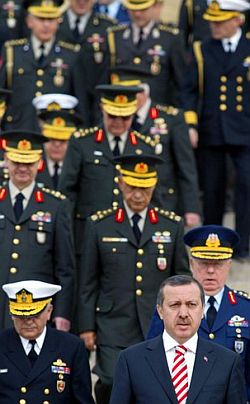
‘The days of Turkey’s military calling the shots are over’

Anthony Shadid reports:

Fifty years ago, when a populist prime minister tangled with the Turkish military, he ended up on the gallows, the mandate of three election victories little consolation. This time around, the rivalry climaxed with most of Turkey’s military command resigning simultaneously, its leader complaining of powerlessness and bad press.

As Turks grappled Saturday with the shock of the resignations — and an extraordinary moment in modern Turkey’s history — officials scrambled to project a facade of business as usual, even as their critics warned of a creeping authoritarianism engineered by Prime Minister Recep Tayyip Erdogan, who has governed since 2003.

But in broader ways, the resignations on Friday delivered Mr. Erdogan a perch to reshape a military bound by civilian control, pursue a foreign policy emboldened by the decisive victory of his conservative and populist party in elections in June and pursue constitutional changes that could transform politics here.

The struggle that has posed the most serious danger to Mr. Erdogan — a powerful military willing to act above the law — in many ways appears to have come to an end.

“The days of Turkey’s military calling the shots are over,” said Cengiz Candar, a prominent columnist. “There’s a new equation in the politics of the country, and anyone depending on the military to score points on a political issue has to forget about it.”

Facebooktwittermail