Bloomberg: In the days after the Sandy Hook Elementary School massacre on Dec. 14, executives with a half-dozen major U.S. gun manufacturers contacted the National Rifle Association. The firearm industry representatives didn’t call the NRA, which they support with millions of dollars each year, to issue directives. On the contrary, they sought guidance on how to handle the public-relations crisis, according to people familiar with the situation who agreed to interviews on the condition they remain anonymous.
While the Obama administration had reacted meekly to mass shootings in Tucson and Aurora, Colo., Sandy Hook would be different. Twenty first-graders were dead. The president, a gun control supporter who previously had avoided the radioactive issue, wiped away tears when talking on television about the “beautiful little kids.” As a nation, the normally stoic president added, “We have been through this too many times.” In crass political terms, he was newly reelected and had less to lose in confronting pro-gun forces. The NRA’s leadership faced a choice: Go to the mattresses as usual, or acknowledge the special horror of Sandy Hook and offer an olive branch.
That decision rested with Wayne LaPierre, the NRA’s chief executive since 1991. One of Washington’s most durable and enigmatic power brokers, LaPierre arrived at the organization in 1978 with a master’s in political science from Boston College. The bookish Roanoke (Va.) native didn’t know much about firearms. Colleagues joked that duck hunting with Wayne was more dangerous for the hunters than the ducks. Nevertheless, driven by an ambition impressive even by Washington standards, he rose swiftly, a mild-mannered presence in private who developed an Elmer Gantry-like persona for speeches and interviews.
In the immediate wake of Sandy Hook, the NRA reassured nervous gun company reps that they could stand down, according to people familiar with the situation. LaPierre would handle it.
One week after the massacre, he delivered a nationally televised tirade tinged with his trademark cultural resentment and paranoia. “Is the press and the political class here in Washington, D.C., so consumed by fear and hatred of the NRA and American gun owners,” he said, “that you’re willing to accept the world where real resistance to evil monsters is [an] unarmed school principal left to surrender her life, her life, to shield those children in her care?”
As intended, LaPierre’s performance received massive media attention. It also upset many—including some gun makers. “The funerals were still going on in Newtown,” says Joseph Bartozzi. “Parents were burying their children.” A senior vice president at O.F. Mossberg & Sons, a shotgun and rifle manufacturer in North Haven, Conn., Bartozzi belongs to the NRA and applauds its stalwart defense of Second Amendment rights. But this time, LaPierre’s diatribe struck him as ill-timed and graceless.
The companies that make and market firearms might prefer a softer tone, but they rarely complain publicly about NRA fear mongering because it’s been so good for business. Corporate donations to the NRA, which together with its affiliates has annual revenue of $250 million, have risen during the past decade, a period when the organization has taken increasingly absolutist positions. Still, it’s not the industry that muscles the NRA.
“NRA leadership worries about two things above all else: perpetuating controversy to stimulate fundraising from individual members and protecting its right flank from the real crazies,” says Richard Feldman, author of a feisty 2007 memoir, Ricochet: Confessions of a Gun Lobbyist. Feldman has worked in various capacities for both the NRA and the industry. “The idea that the NRA follows orders from the gun companies is a joke,” he says. “If anything, it’s the other way around.”
NRA spokesman Andrew Arulanandam declined to comment for this article, as did LaPierre and other top officials at the lobby group’s Fairfax (Va.) headquarters. New York Mayor Michael Bloomberg, a gun control advocate, founded Bloomberg LP, which owns this magazine.
Gun companies defer to the NRA for two main reasons: First, there’s intimidation. The lobby group has incited potentially ruinous consumer boycotts against firearm makers that fail to follow the NRA line with sufficient zeal. Second, regardless of some executives’ concerns about civil discourse, gun companies benefit financially from the NRA’s hype. Alarms about imminent gun confiscation—an NRA staple, despite its implausibility—reliably send firearm owners back to retail counters. Sales are booming. Mossberg is running three shifts a day. “Demand,” Bartozzi says, “is very strong.” [Continue reading…]
Category Archives: United States
America’s barbarous roots
Daniel K. Richter writes: Colonial history, I’ve often told my students, isn’t pretty. The well-scrubbed Williamsburg, Virginia, that tourists see today would have been unrecognizable to Thomas Jefferson, much less to the enslaved laborers who made up most of its population in the eighteenth century. And almost anywhere in British North America during that century was a paradise compared to what had existed a hundred years earlier. Today’s images of the seventeenth century — up the road from Williamsburg at Historic Jamestowne or down the road from Harvard at Plimouth Plantation — aren’t so well scrubbed. But neither site can begin to recreate the stench, the terror, the misery that haunted every place and everybody in that bloody era. Living-history museums dare not drive away those they hope to educate by revealing too much of the bitter truth. And so Web surfers are cheerily invited to “Dine at Plimouth Plantation.” In the accompanying photograph, a jolly Jacobean couple stands behind a modern man hoisting a huge roast turkey leg, while a multiracial tableful of guests lift their glasses and entice visitors to join them. What, one wonders, might the starving band of seventeenth-century religious zealots — who had watched half their compatriots perish during their first horrible winter on Cape Cod — have made of this cheerful picture?
The eminent Harvard historian Bernard Bailyn, Ph.D. ’53, LL.D. ’99, has a pretty good idea. “Death was everywhere,” he says in his aptly named new book, The Barbarous Years: The Peopling of British North America: The Conflict of Civilizations, 1600–1675. “America, for these hopeful utopians, had become a graveyard.” No one is better qualified to survey the carnage at Plymouth than Bailyn, now Adams University Professor emeritus, who began teaching at Harvard in 1953, published the first of his more than 20 books in 1955, and has earned the Pulitzer Prize for history twice. The heaping dishes he would serve to latter-day Plymouth diners are not pretty to look at — indeed they often purposefully turn the stomach — but they provide some necessary doses of past reality that only someone of his vast learning and experience could prepare.
The Barbarous Years resumes a series that Bailyn began in 1986, with the publication of a brief overview called The Peopling of British North America: An Introduction, and a massive tome entitled Voyagers to the West: A Passage in the Peopling of America on the Eve of the Revolution. The opening pages of the shorter volume conjure “a satellite circling the globe from the early medieval period to the advent of industrialism.” Its camera, Bailyn says, would reveal that “the transforming phenomenon was…the massive transfer to the Western Hemisphere of people from Africa, from the European mainland, and especially from the Anglo-Celtic fringes of the British Isles.” Voyagers to the West is a high-resolution snapshot, developed from intense analysis of every recorded departure from the British Isles for North America between late 1773 and early 1776. Packed with numbers, tables, graphs, and maps, it traces broad patterns. But Voyagers is also full of personal stories revealing the motives, experiences, and emotions of those who made new homes in North America.
As Bailyn admits, for the seventeenth century “the data do not exist” for this kind of comprehensive analysis. The Barbarous Years must therefore be far more impressionistic than its predecessor, although it does the best it can with the fragmentary passenger lists, port records, and other materials available. Colorful characters — familiar and often unfamiliar — leap from its deeply researched pages. Groups of chapters organized by region — Virginia and Maryland, New Netherland and New Sweden, Plymouth and Massachusetts Bay — survey what is known about the varied backgrounds, controversies, and personalities in the founding years of European colonization in each place.
The three regions, each treated mostly in isolation from the others, differed in geography, environment, and economy, but “of one characteristic of the immigrant population there can be no doubt. They were a mixed multitude.” Chesapeake colonists spanned a vast range of social statuses, and they came from all over the British Isles. New England Puritans mostly sprang from middling social strata but brought with them multiple local traditions of farming and government. And once they escaped their common enemies in England, they discovered huge theological disagreements among themselves. Meanwhile, New Netherland and short-lived New Sweden — the substrate on which, after two military conquests, the later English colonies of New York, New Jersey, Pennsylvania, and Delaware would be built — “left behind, on the shores of North America, one of the strangest assemblages of people that region would ever know,” a “farrago” of Finns, Jews, Walloons, and motley others.
Presiding over this assemblage were Dutch rulers like Willem Kieft and Petrus Stuyvesant, “the chronicle of whose administrations read at times like Tacitus’s annals of imperial Rome.” Dominant figures in New England and the Chesapeake were no less remarkable, and their populaces no more governable. Chaos and violence were the orders of the day, not just among the colonists themselves but especially in their relations with indigenous people. Beginning with its title, The Barbarous Years highlights the brutality that Europeans and Indians inflicted on each other.
Still, for all the book’s learned strengths, its discussions of Native Americans are disappointing, even for a study focused on European migrants rather than Indian affairs. Many of the problems involve unfortunate choices of language, beginning with the decades-old decision to call the series The Peopling of British North America. [Continue reading…]
The gun industry’s deadly addiction
Tim Dickinson writes: For gunmakers, the political fight over assault rifles and high-capacity pistols is about more than just profits – it’s about the militarization of the marketplace and represents a desperate bid by gunmakers to prop up a decaying business. The once-dependable market for traditional hunting guns has fallen off a cliff. To adapt, the firearms industry has embraced a business strategy that requires it to place the weapons of war favored by deranged killers like Adam Lanza and Jared Loughner into the homes and holsters of as many Americans as possible. “They’re not selling your dad’s hunting rifle or shotgun,” says Josh Sugarmann, executive director of the Violence Policy Center, a top industry watchdog. “They’re selling military-bred weaponry.”
As recently as 2008, shotguns, rifles and other traditional hunting weapons made up half of all new civilian gun sales in America, according to SEC documents – a brisk billion-dollar business. Today, hunting guns account for less than a quarter of the market, and the hunting industry is forecasting a 24 percent drop in revenue by 2025. Gunmakers are on the wrong side of the same demographic curves that haunt the modern Republican Party. Its customer base is too old, too white, too male and too Southern. According to Gallup, 61 percent of white males in the South own guns today. Nationwide, just 18 percent of Latinos do. “The white males are aging and dying off,” says Sugarmann. Flooding the market with battle-ready guns, he says, “is an effort to find one new, shiny thing to sell them.”
For the moment, that strategy is paying handsome dividends. Handgun sales have jumped 70 percent since 2008, racking up an estimated $1.5 billion in sales last year. Powerful pistols – sold under brands like Beretta, Glock and Ruger – have replaced traditional hunting guns as the industry’s cash cow. Revenue from assault rifles is growing at an even faster clip – having doubled in the past five years, to $489 million. Gaudy profit margins have become the norm: Top gunmakers enjoy gross profits of 30 percent or more. Ammunition manufacturers, too, boast of being fat and happy. And it’s no wonder: AR-15 enthusiasts brag they can fire up to 400 rounds in 60 seconds. Paying roughly 50 cents a bullet, such shooters are blowing through $200 worth of ammo in a hot minute.
Much of the industry’s recent success is linked to politics – in particular, to the gun-buying public’s anxiety about the first black man in the White House. The phenomenon is reflected in Smith & Wesson’s SEC filings, which trumpeted “strong consumer demand for our firearm products following a new administration taking office in Washington, D.C., in 2009.” Sen. Mark Pryor of Arkansas has joked that Barack Obama is “his own stimulus plan for the gun industry.” [Continue reading…]
Selling a new generation on guns

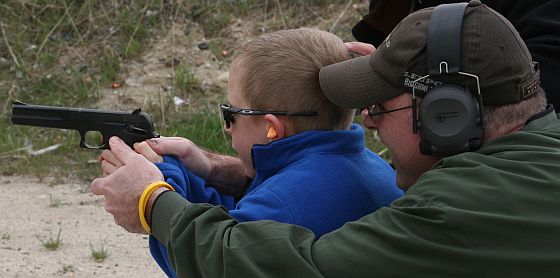
The New York Times reports: Threatened by long-term declining participation in shooting sports, the firearms industry has poured millions of dollars into a broad campaign to ensure its future by getting guns into the hands of more, and younger, children.
The industry’s strategies include giving firearms, ammunition and cash to youth groups; weakening state restrictions on hunting by young children; marketing an affordable military-style rifle for “junior shooters” and sponsoring semiautomatic-handgun competitions for youths; and developing a target-shooting video game that promotes brand-name weapons, with links to the Web sites of their makers.
The pages of Junior Shooters, an industry-supported magazine that seeks to get children involved in the recreational use of firearms, once featured a smiling 15-year-old girl clutching a semiautomatic rifle. At the end of an accompanying article that extolled target shooting with a Bushmaster AR-15 — an advertisement elsewhere in the magazine directed readers to a coupon for buying one — the author encouraged youngsters to share the article with a parent.
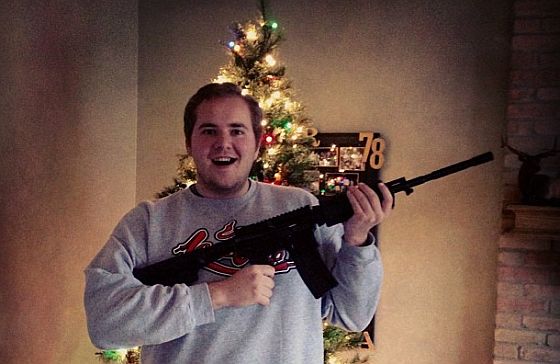
“Who knows?” it said. “Maybe you’ll find a Bushmaster AR-15 under your tree some frosty Christmas morning!” [Continue reading…]

Sweeping new gun laws proposed by influential liberal think tank
The Washington Post reports: With President Obama readying an overhaul of the nation’s gun laws, a liberal think tank with singular influence throughout his administration is pushing for a sweeping agenda of strict new restrictions on and federal oversight of gun and ammunition sales.
The Center for American Progress is recommending 13 new gun policies to the White House — some of them executive actions that would not require the approval of Congress — in what amounts to the progressive community’s wish list.
CAP’s proposals — which include requiring universal background checks, banning military-grade assault weapons and high-capacity ammunition magazines, and modernizing data systems to track gun sales and enforce existing laws — are all but certain to face stiff opposition from the National Rifle Association and its many allies in Congress.
Obama — as well as Vice President Biden, who is leading the administration’s gun violence task force — has voiced support for many of these measures. Yet it is unclear which policies he ultimately will propose to Congress. Biden is planning to present his group’s recommendations to Obama on Tuesday.
CAP’s recommendations, presented Friday to White House officials and detailed in an 11-page report obtained by The Washington Post, establish a benchmark for what many in Obama’s liberal base are urging him to do after last month’s massacre at an elementary school in Newtown, Conn.
How the NRA wants to turn the U.S. into Colombia
Elisabeth Rosenthal writes: In the wake of the tragic shooting deaths at Sandy Hook Elementary School in Newtown, Conn., last month, the National Rifle Association proposed that the best way to protect schoolchildren was to place a guard — a “good guy with a gun” — in every school, part of a so-called National School Shield Emergency Response Program.
Indeed, the N.R.A.’s solution to the expansion of gun violence in America has been generally to advocate for the more widespread deployment and carrying of guns.
I recently visited some Latin American countries that mesh with the N.R.A.’s vision of the promised land, where guards with guns grace every office lobby, storefront, A.T.M., restaurant and gas station. It has not made those countries safer or saner.
Despite the ubiquitous presence of “good guys” with guns, countries like Guatemala, Honduras, El Salvador, Colombia and Venezuela have some of the highest homicide rates in the world.
“A society that is relying on guys with guns to stop violence is a sign of a society where institutions have broken down,” said Rebecca Peters, former director of the International Action Network on Small Arms. “It’s shocking to hear anyone in the United States considering a solution that would make it seem more like Colombia.”
As guns proliferate, legally and illegally, innocent people often seem more terrorized than protected.
In Guatemala, riding a public bus is a risky business. More than 500 bus drivers have been killed in robberies since 2007, leading InSight Crime, which tracks organized crime in the Americas, to call it “the most dangerous profession on the planet.” And when bullets start flying, everyone is vulnerable: in 2010 the onboard tally included 155 drivers, 54 bus assistants, 71 passengers and 14 presumed criminals. Some were killed by the robbers’ bullets and some by gun-carrying passengers.
Scientific studies have consistently found that places with more guns have more violent deaths, both homicides and suicides. Women and children are more likely to die if there’s a gun in the house. The more guns in an area, the higher the local suicide rates. “Generally, if you live in a civilized society, more guns mean more death,” said David Hemenway, director of the Harvard Injury Control Research Center. “There is no evidence that having more guns reduces crime. None at all.” [Continue reading…]
Let’s repeal the Second Amendment
Kurt Eichenwald writes: As news of the massacre at Sandy Hook Elementary played out around the country, the mantra from the gun-rights folks was fairly consistent: now is not the time to discuss how the government should deal with controls on firearms. It’s politicizing tragedy to talk about it, they whine.
O.K., I’ll agree. Let’s not talk about policy when it comes to Sandy Hook.
Instead, let’s consider the San Ysidro McDonald’s massacre in 1984. Following the shooting of 40 people at that time, gunnies also said it was too soon to discuss new firearms laws; it would politicize the shooting at a moment that should only be about remembrance, you see. So let’s do it now—28 years is long enough to wait.
Or we can talk about the 21 people shot at the post office in Edmond, Oklahoma, two years later. Or the 35 at Cleveland Elementary School in Stockton, California, in 1989. Or the 20 that same year at Standard Gravure. Or the 50 at Luby’s Cafeteria in Killeen, Texas, in 1991. Or the 14 at Lindhurst High School in Olivehurst, California, the year after that. Or the 25 on the Long Island Railroad in 1993. Or the 15 at Westside Middle School in Jonesboro, Arkansas. Or the 29 at Thurston High School.
Or Columbine. Or Virginia Tech. Or Tucson. Or Aurora. Or Clackamas Town Center, just three days before Sandy Hook.
Or any of the senseless mass murders that have left behind piles of the maimed and murdered—the elderly, students, children, shoppers, worshippers, moviegoers, diners, workers, and even a member of Congress. One young woman—Jessica Ghawi—missed a gun rampage while shopping at a mall by a matter of minutes, only to be killed weeks later at the Aurora movie-theater massacre. Almost 1,000 innocent Americans have been shot in the last 30 years in these bloodbaths. And at each instance, the National Rifle Association and company try to shame us with this “not the time” argument so that we can’t discuss adopting laws to protect ourselves; eventually, the horror recedes, we move on with our lives, and we walk out into the world never knowing whether our heads will be the next to explode after being struck by a madman’s bullet.
Enough. We talk now. And my position is going to be direct: America needs to repeal the Second Amendment. [Continue reading…]
New guns for a new year: American anthropology and gun violence
Jason Antrosio writes: Lynyrd Skynyrd had gun violence figured out in 1975:
Hand guns are made for killin’
Ain’t no good for nothin’ else
And if you like your whiskey
You might even shoot yourself
So why don’t we dump ’em people
To the bottom of the sea
Before some fool come around here
Wanna shoot either you or me
–Lynyrd Skynyrd, Saturday Night SpecialIf they can make gun control palatable for that audience, why can’t we do it now?
As of 19 December 2012, even David Brooks and Gail Collins were in rare agreement that we were headed for some sensible gun regulations, Brooks speculating that the NRA would “get out in front of this by making some immediate concessions on gun rights, and they should promote a practical agenda on mental health and gun access” (The Newtown Aftermath). There seemed to be consensus clamor for strengthening gun laws. But as Frank Rich wisely put it, “let’s see what happens when the circus folds its tent and we are back in the bitter winds of January, redirecting our attention to the Inauguration and the Super Bowl” (America’s Other Original Sin).
We do not need to wait that long. Although many people, even Republicans, thought the NRA stance was unhelpful, disgusting, disastrous, and a thirty-round magazine of crazy, plenty of support remains for NRA-type arguments, especially in districts controlled by House Republicans. This was something I already noted before the NRA announcement, that not a single sitting House Republican had announced any change in position. The rhetoric from many places, including my own Republican representatives, had hardly budged (see Semi-Automatic Anthropology). Truthfully, for most of these representatives there is hardly any political gain from supporting even the mildest gun control regulations, and substantial backlash risk for not holding the line. [Continue reading…]
Bearing witness to gun violence in America

A lot of gun owners indulge in childish fantasies about the ways in which weapons protect life. That’s hardly surprising when as an icon in American culture a gun’s power is invested in the finger on the trigger, not the kinetic force of metal ripping apart flesh. Thus when witnessing gun violence on the screen, we are much more often intended to identify with the shooter than the person being shot.
Doctors in emergency rooms, however, have no illusions about what guns do. David H. Newman, director of clinical research in the department of emergency medicine at Mount Sinai School of Medicine and an Army veteran, describes their effects:
Here is just some of what I have seen over the years. In Baghdad, I saw a 5-year-old girl who was shot in the head while in her car seat. Her father, who knew she was dying before I said it, wept in my arms, as bits of her body clung to his shirt.
Much of the gun violence I have seen, though, I have seen on home soil, here in the United States. There was a 9-year-old girl, shot in the chest by an assault rifle during a “drive-by” gang shooting, in a botched retaliation for a shooting earlier that day. She was baffled, and in pain, with a gaping hole under her collarbone.
I have also seen an 8-year-old who found a shotgun in the closet while playing with a friend. The two boys pointed the weapon at each other a number of times before the gun accidentally discharged. The 8-year-old arrived in my emergency department with most of his face blown off. Miraculously, he survived.
Another child I will never forget was a 13-year-old who was shot twice in the abdomen by an older boy who mistook him for one of a group that had bullied and berated him a week earlier. Slick with sweat and barely conscious, he groaned and turned to look at me. Soon after, he died in the operating room. His mother arrived minutes later, wide-eyed and breathless.
I do not know exactly what measures should be taken to reduce gun violence like this. But I know that most homicides and suicides in America are carried out with guns. Research suggests that homes with a gun are two to three times more likely to experience a firearm death than homes without guns, and that members of the household are 18 times more likely to be the victim than intruders.
I know that in 2009, the most recent year for which data is available, nearly 400 American children (age 14 and under) were killed with a firearm and nearly 1,000 were injured. That means that this week we can expect 26 more children to be injured or killed with a firearm.
Who pays for the right to bear arms?
David Cole writes: In the days following the Newtown massacre the nation’s newspapers were filled with heart-wrenching pictures of the innocent victims. The slaughter was unimaginably shocking. But the broader tragedy of gun violence is felt mostly not in leafy suburbs, but in America’s inner cities.
The right to bear arms typically invokes the romantic image of a cowboy toting a rifle on the plains. In modern-day America, though, the more realistic picture is that of a young black man gunned down in his prime in a dark alley. When we celebrate gun rights, we all too often ignore their disproportionate racial burdens. Any effort to address gun violence must focus on the inner city.
Last year Chicago had some 500 homicides, 87 percent of them gun-related. In the city’s public schools, 319 students were shot in the 2011-12 school year, 24 of them fatally. African-Americans are 33 percent of the Chicago population, but about 70 percent of the murder victims.
The same is true in other cities. In 2011, 80 percent of the 324 people killed in Philadelphia were killed by guns, and three-quarters of the victims were black.
Racial disparities in gun violence far outstrip those in almost any other area of life. Black unemployment is double that for whites, as is black infant mortality. But young black men die of gun homicide at a rate eight times that of young white men. Could it be that the laxity of the nation’s gun laws is tolerated because its deadly costs are borne by the segregated black and Latino populations of North Philadelphia and Chicago’s South Side?
And is it any coincidence that the NRA is a club dominated by white men?
Video: Have U.S. police forces become too militarised?
Gun nuts petition to have Piers Morgan deported for using First Amendment
The Associated Press reports: Tens of thousands of people have signed a petition calling for British CNN host Piers Morgan to be deported from the U.S. over his gun control views.
Morgan has taken an aggressive stand for tighter U.S. gun laws in the wake of the Newtown, Connecticut, school shooting. Last week, he called a gun advocate appearing on his “Piers Morgan Tonight” show an “unbelievably stupid man.”
Now, gun rights activists are fighting back. A petition created Dec. 21 on the White House e-petition website by a user in Texas accuses Morgan of engaging in a “hostile attack against the U.S. Constitution” by targeting the Second Amendment. It demands he be deported immediately for “exploiting his position as a national network television host to stage attacks against the rights of American citizens.”
American idolatry — misplaced faith in a piece of paper
Before I came to America in 1988, I’d experienced a lot of cultural diversity. Having grown up in England, traveled through much of Europe, lived in India and France, briefly witnessed the revolution in Iran, explored pre-war Afghanistan, lived in mud huts and slept in caves, I didn’t think I was susceptible to culture shock — until I came here.
This is the paradox the United States presents to so many non-Americans: no other country is so well-known to people from afar, yet upon being confronted with the reality, one discovers that what looks familiar turns out to be foreign.
No other country seems quite as obsessed with a self-defined vision of its uniqueness — an exceptionalism held onto by a population that is largely unfamiliar with other countries. In this glorified isolation the rest of the world is barely visible. At times, America seems less like a country and more like a religion.
From Britain, Jonathan Freedland writes:
We watch their movies, we eat their fast food. Their culture has become global culture. So it always comes as a shock to realise how different Americans are from everyone else. The massacre in Newtown horrified even those who thought themselves inured to horror – I know many who could hardly bear to look at those smiling family photographs of the children – but for non-Americans the subsequent discussion has also been shocking to watch.
To outsiders, the point seems so blindingly obvious: more guns equal more death. In Britain, where gun laws are strict, the annual number of gun-related murders stood, at last count, at 41. In the US the equivalent figure is just short of 10,000.
Whether it’s Britain, Japan or Australia, the evidence is the same: strict gun control means fewer people die. American unwillingness to face this basic arithmetic – preferring to blame the mental health system or videogames or the “feminisation” of the classroom, as one conservative pundit did, or the absence of religious prayer in schools – the explanation of former Republican presidential candidate Mike Huckabee – rather than the most obvious culprit for all this gun violence, namely easy access to military-grade assault weapons, can drive outsiders to distraction. Witness Piers Morgan’s bad-tempered hosting of a CNN debate on guns this week, haranguing his guests for failing to admit what to him was obvious – a performance that few of his American colleagues would match.
What exactly is America’s problem? Why does it stand so far apart, notching up more gun homicides than the rest of the world’s wealthy countries put together? People like to point the finger at the mighty National Rifle Association, which, to be sure, is a well-funded, effective lobby, especially in battleground congressional districts where NRA members can make the difference between victory and defeat. But big tobacco used to be a mighty lobby too; yet when the evidence linked smoking to lung cancer, they were steadily beaten back. Judging by its abysmal performance at a bizarre press conference today, the NRA could ultimately be defeated.
If you really want to know why the US can’t kick its gun habit, take a trip to the National Archives in Washington, DC. You don’t even have to look at the exhibits. Just study the queue. What you’ll see are ordinary Americans lining up, in hushed reverence, to gaze at an original copy of the United States constitution, guarded and under heavily armoured glass. It is no exaggeration to say that for many Americans this is a religious experience. [Continue reading…]
When the U.S. became a police state
Naomi Wolf writes: People often ask me, in terms of my argument about “ten steps” that mark the descent to a police state or closed society, at what stage we are. I am sorry to say that with the importation of what will be tens of thousands of drones, by both US military and by commercial interests, into US airspace, with a specific mandate to engage in surveillance and with the capacity for weaponization – which is due to begin in earnest at the start of the new year – it means that the police state is now officially here.
In February of this year, Congress passed the FAA Reauthorization Act, with its provision to deploy fleets of drones domestically. Jennifer Lynch, an attorney at the Electronic Frontier Foundation, notes that this followed a major lobbying effort, “a huge push by […] the defense sector” to promote the use of drones in American skies: 30,000 of them are expected to be in use by 2020, some as small as hummingbirds – meaning that you won’t necessarily see them, tracking your meeting with your fellow-activists, with your accountant or your congressman, or filming your cruising the bars or your assignation with your lover, as its video-gathering whirs.
Others will be as big as passenger planes. Business-friendly media stress their planned abundant use by corporations: police in Seattle have already deployed them.
An unclassified US air force document reported by CBS (pdf) news expands on this unprecedented and unconstitutional step – one that formally brings the military into the role of controlling domestic populations on US soil, which is the bright line that separates a democracy from a military oligarchy. (The US constitution allows for the deployment of National Guard units by governors, who are answerable to the people; but this system is intended, as is posse comitatus, to prevent the military from taking action aimed at US citizens domestically.)
The air force document explains that the air force will be overseeing the deployment of its own military surveillance drones within the borders of the US; that it may keep video and other data it collects with these drones for 90 days without a warrant – and will then, retroactively, determine if the material can be retained – which does away for good with the fourth amendment in these cases. While the drones are not supposed to specifically “conduct non-consensual surveillance on on specifically identified US persons”, according to the document, the wording allows for domestic military surveillance of non-“specifically identified” people (that is, a group of activists or protesters) and it comes with the important caveat, also seemingly wholly unconstitutional, that it may not target individuals “unless expressly approved by the secretary of Defense”.
In other words, the Pentagon can now send a domestic drone to hover outside your apartment window, collecting footage of you and your family, if the secretary of Defense approves it. [Continue reading…]
Compassion, not anger, is the best response to the Newtown massacre
Izzeldin Abuelaish writes: Like countless other people, I was shocked and mesmerised by the murders at Sandy Hook school. So many innocent souls and committed teachers who risked their lives to protect their six- and seven-year-old pupils. Twenty children shot again and again, an act so sickening that even the chief medical examiner for Connecticut said he had been in his job for a third of a century but that this massacre of innocents was the worst he had ever seen.
Millions of people shared the devastating sadness. For me, there was something else, a shadow I couldn’t turn away from. For the events brought back the deaths by bombs of my own three precious daughters and niece during the attack on Gaza in 2008. Gaza couldn’t be more different from America’s quiet, affluent Newtown. Yet for me, there was a horrendous connection in the violent killing of children. In the murdered child Grace I saw my daughter Aya; in the valiant teacher Victoria, who died protecting her students, I saw my own daughter Bessan, a mother to her sisters. I saw them; I was seized by the images to such an extent that I stopped driving on a green light. “What’s wrong, Dad,” asked my son Abdullah.
“Your sisters are with me,” I answered without a pause to reflect on what I had said.
I, unfortunately, don’t have to guess what the parents of these murdered innocents are going through: the shock, the disbelief, the mourning and the memories that will remain for ever.
And like many of the parents and the community and many of the people of the US, I felt angry: why did these innocents have to die? But then I am led beyond grief and anger, to resolve: this must not happen again. We must do something.
What, we should ask ourselves, would these parents want us to do? Put more guns into households and schools, arm every six-year-old innocent with a weapon whose only purpose is to kill or injure?
That is the path of fear, and the absurd notion that more guns will result in less violence. The path of fear leads to anger, hatred, violence and depression. As a physician I can say it leads to mental and physical illness. It helps neither the parents nor any surviving children in the family.
There is another path, one of human connection and compassion. [Continue reading…]
Enough with the ‘good guys’ and ‘bad guys’ — it’s time to stop talking and thinking like five-year olds
Adam Serwer writes: At the National Rifle Association’s first press conference since the Newtown massacre that killed 27 people, most of them elementary school children, the gun lobby’s CEO Wayne LaPierre said the solution is more guns.
“There exists in this country a callous, corrupt and corrupting shadow industry that sells, and sows, violence against its own people,” said LaPierre. He was talking about the entertainment industry, not groups such as the NRA that lobby for laws that allow people to get away with murder. Rolling out a list of 1990s-era conservative cultural shibboleths, LaPierre blamed a coarsening culture, and violence in movies, video games, and music for mass shootings — that is, everything but the deadly weapons the killers have used to slaughter people.
LaPierre’s “solution” is for Americans to arm themselves, and for the government to place armed guards at every public school in the country: “I call on Congress today to act immediately, to appropriate whatever is necessary to put armed police officers in every school — and to do it now, to make sure that blanket of safety is in place when our children return to school in January.” LaPierre did not note that Columbine High School had an armed guard when two students went on a murderous shooting rampage there in 1999, and that Virginia Tech had an armed police force with its own SWAT team equivalent when one of its students killed 33 people in 2007.
The head of the nation’s most powerful gun rights organization laid out a vision of a paramilitary America, where citizens are protected by armed guards until they are old enough to walk around with their own firearms on the off-chance they might need to pump a few rounds into a fellow citizen. “The only thing that stops a bad guy with a gun is a good guy with a gun,” said LaPierre.
Even if we don’t make a cognitive leap that few American leaders are willing to make — dispense with the cartoon imagery of a world populated by good guys and bad guys — the question, using LaPierre’s own terms, is: how to stop bad guys from getting guns?
As for LaPierre’s indictment of the American culture of violence, fed by movies and video games, this is a challenge not without merit. Even if effective regulations for gun control were put in place, one can still reasonably ask what kind of influence the media’s portrayals of violence have on the minds of young Americans who enter the military.
The blood shed in American schools is a small fraction of the blood shed overseas and whereas when it happens on this soil we are told that it was a bad guy who had his finger on the trigger, if it happens abroad the supposition is almost always that the bad guys got killed.
Sooner or later we will have to dispense with the good guy/bad guy narrative, and ask why killing people got so easy.
Forced treatment isn’t the answer
In America, whether it comes to tackling crime, or the most severe mental illness, there’s a popular sentiment that says the best solution is to “lock ’em up and throw away the keys.” That’s part of the reason this country has a higher incarceration rate than any other. A knee-jerk response to the Newtown massacre is likely to be a push to reduce legal obstacles to involuntary treatment.
Christian Science Monitor reports: Sandy Hook shooter Adam Lanza may have been motivated by anger at his mother because of plans to have him committed for treatment, Fox News reported Thursday, citing comments from the son of an area church pastor and an unnamed neighborhood source. Fox also cited an unnamed senior law enforcement official saying anger at plans for “his future mental-health treatment” were being investigated as a possible motive.
While the Fox reports are still uncorroborated, other media reports paint a general picture that suggests Ms. Lanza was growing increasingly concerned about the mental health of her son.
These reports are bringing to light a debate over where to set the bar when it comes to forcing an individual into treatment – and whether those caring for people with mental-health issues have enough resources available to head off potential crises before they happen.
On one hand, warning signs are often apparent, so making it easier to commit someone for involuntary treatment could save lives.
The young adult men who end up being violent often “have others in their lives … who are trying desperately to get help before something bad happens. They can see it coming down the pike,” says Liza Gold, a clinical professor of psychiatry at Georgetown University School of Medicine. But caregivers “have run up against these commitment laws that are so restrictive – that come down so far on the side of civil liberties and privacy – that it is almost impossible to contain, hospitalize, treat someone with a chronic and escalating mental illness.”
On the other hand, forced treatment can also be emotionally wrenching for the patient and cause lingering anger, mental-health experts say.
“People who are forcibly treated so often feel traumatized by it,” says Robert Whitaker, author of “Anatomy of an Epidemic: Magic Bullets, Psychiatric Drugs, and the Astonishing Rise of Mental Illness in America.” “Women in particular will sometimes talk about it almost like a quasi-rape, because sometimes they are held down and injected,” he says.
“That’s Crazy,” is a documentary that shows forced treatment from the perspective of someone who has been stripped of the right to make choices concerning his own health:
That’s Crazy Trailer from Ian Mangiardi on Vimeo.
Americans preparing for the end of America
Max Blumenthal writes: Many of those I interviewed at the gun shows were common hunters, sportsmen, and expert target shooters. One man told me he hunted deer with a bow and throwing knives, a family tradition he learned from his grandfather. For them, guns were a part of daily life, enabling their interaction with the rugged western environment in which they were raised.
But then there were others seeking out military-grade sniper rifles designed specifically to kill humans with deadly accuracy from hundreds of meters away. Though the exemption covers all “private sales”, not limited to gun shows, the so-called “gun show loophole” means that two in every five guns are acquired without a federally-mandated criminal background check.
Inside the Reno casino, I sidled up to a group of gray-haired men gathered around an exhibition table where a dealer from Nemesis Arms was touting the features of the Mini Windrunner .308 caliber sniper rifle. (Adam Lanza’s weapon of choice was a .223 caliber Bushmaster assault rifle.) According to Defense Review, a leading online newsletter covering the small arms industry, the gun was a “nasty little piece of manpackable/backpackable ballistic business!” With the sleek, 3ft-long rifle in his hand, the dealer explained:
“The bipod will articulate to the side. You can shoot off of walls, car or truck doors, building tops, cliffs – at any angle, all the way to barricade position.”
In less than a minute, the dealer effortlessly disassembled the gun and packed it away discreetly in a black backpack, explaining:
“The reason that we don’t do this in a molly pack is that it looks military. If it’s military, then people will assume that you’re military. So what we do with this is we keep it as benign as possible so it looks like just any other backpack that anybody would have … so anybody with any garb, any dress, can go anywhere with it.”
Why would a common civilian need a sniper rifle capable of shooting off of building tops and car doors? And why would they require stealthy methods of concealment, so they could pass through American cities without detection? Companies like Nemesis Arms never explained the logic behind such disturbing sales pitches. But clearly, they were falling on fertile soil.