Category Archives: United States

The daily trauma that the BP Deepwater Horizon oil spill left behind

There are lots of problems with the term post-traumatic stress disorder — not merely that because of its common association with war, its prevalence among people unaffected by war tends to get overlooked.

The term itself is misleading in that it suggests an inability to recover from a traumatic event, whereas in reality, for individuals experiencing PTSD, the trauma is ongoing. It is much more of a present-traumatic stress disorder than post-traumatic.

Dahr Jamail reports: Most people believe only those who have experienced war can know post-traumatic stress disorder (PTSD). But those living in the impact zone of BP’s 2010 oil spill disaster in the Gulf of Mexico know differently.

John Gooding, a fisherman and resident of the coastal city of Pass Christian, Mississippi, began having health problems shortly after the disaster began. He became sicker with each passing month, and moved inland in an effort to escape continuing exposure to the chemicals after being diagnosed with toxic encephalitis.

He experiences seizures regularly, and two of his dogs even died of seizures from what he believes was chemical exposure.

“I’ve been married 25 years, and my wife and I’ve never had problems. But recently we’ve started having problems, mostly because of finances and my health,” Gooding told Al Jazeera.

“I can no longer work because of my physical sickness from the chemicals. My wife is struggling with depression, and is going through grief counselling due to having to deal with my ongoing health issues. Our savings is gone. Our retirement is gone. This has been a living hell and continues to be a nightmare.”

Gooding’s story is not uncommon among countless Gulf residents living in areas affected by the BP disaster.

“People are becoming more and more hopeless and feeling helpless,” Dr Arwen Podesta, a psychiatrist at Tulane University in New Orleans, told Al Jazeera back in August 2010. “They are feeling frantic and overwhelmed. There is already more PTSD and more problems with domestic violence, threats of suicide and alcohol and drugs.”

BP’s attempts to minimise the amount of compensation it pays to those affected is not helping to improve what now are chronic psychological, community, and personal impacts along the Gulf coast. [Continue reading…]

Facebooktwittermail

How did a form of torture become policy in America’s prison system?

Andrew Gumbel writes: In 1831, Alexis de Tocqueville visited the Eastern State Penitentiary in Philadelphia to observe first-hand the effects of a peculiar — and, at the time, entirely novel — form of incarceration. The Quakers, who had opened the prison two years earlier, believed that long-term solitary confinement was an ideal form of religious penitence (whence the term penitentiary) and would hasten prisoners’ rehabilitation and reintegration into society. They saw it not as extreme punishment but as a progressive idea, far preferable to the giant holding pens typical of the age, where mutilations and violence among prisoners were common, and spiritual betterment all but unthinkable.

Tocqueville was favorably impressed. “Can there be a combination more powerful for reformation,” he wrote, “than that of a prison which hands over the prisoner to all the trials of solitude, leads him through reflection to remorse, through religion to hope, and makes him industrious by the burden of idleness?”

Ten years later, Dickens paid his own visit to Eastern State, and came away with a rather different opinion. Solitary confinement, he found, inflicted unimaginable torment on the minds of those subjected to it. Far from leading prisoners to enlightenment, it ruined their concentration and haunted them with hideous visions. They fell into deep despair, losing track of time and of themselves. “I hold this slow and daily tampering with the mysteries of the brain, to be immeasurably worse than any torture of the body,” he wrote in his American Notes for General Circulation:

[B]ecause its ghastly signs and tokens are not so palpable to the eye and sense of touch as scars upon the flesh; because its wounds are not upon the surface, and it extorts few cries that human ears can hear […] It wears the mind into a morbid state, which renders it unfit for the rough contact and busy action of the world.

Dickens was not alone. Harry Hawser, who wrote poems about his experience at Eastern State around the same time, hauntingly described the effects of being plunged into a “living tomb.” By the end of the 19th century, the Supreme Court noted that solitary confinement had caused many prisoners to fall “into a semi-fatuous condition,” and others still to kill themselves or to become violently insane. By World War I, the practice was largely abandoned.

Still, the idea never entirely went away, and in our bewildering world of chronically overcrowded, gang-infested prisons, it has returned with a vengeance. The new generation of high-security supermax prisons, whose spreading popularity over the past 40 years has coincided with an explosion in prisoner numbers, is premised on the notion that dangerous inmates — the “worst of the worst,” in official parlance — need to be kept separate from the general prison population, and from each other. [Continue reading…]

Facebooktwittermail

New York City’s secret police

Jim Dwyer writes: It may not have occurred to people that New York City needed to deploy an undercover detective to spy on Occupy Sandy, a relief operation run by activists that delivered food and supplies to parts of the city ruined by the hurricane. But Detective Wojciech Braszczok, who embedded with the Occupy Wall Street forces under the nom de activist Albert, was putting posts on Twitter last November about the Sandy operation, which, by the way, received consistently high grades from people for its nimble, effective work.

The city now has a sturdy legion of undercover officers who have taken up residence in many surprising regions of civic life. Much of this began in early 2003, when a federal judge lifted many restraints on spying by the Police Department. The city had been failed by the federal intelligence services, and thousands died on Sept. 11. Police Commissioner Raymond W. Kelly and Mayor Michael R. Bloomberg created an independent intelligence capacity.

So before and during the Iraq War, the organization of antiwar rallies was regarded as a fit matter for police surveillance; so were the monthly Critical Mass bicycle rallies, as well as groups protesting at the Republican National Convention in 2004, and a range of Islamic facilities, from mosques to college student clubs. Undercover New York police officers showed up at activists’ meetings all over the country, carrying guitars and knapsacks. Handlers left money for them in the wheel wells of cars. Field reports were stamped “NYPD Secret.” Anyone who left a scrap of paper on the desk at the Intelligence Division’s headquarters in Chelsea was apt to get his or her knuckles rapped by the commander, a former Central Intelligence Agency man who brought that agency’s custom of fastidiousness to the mess of the city.

The unrestrained surveillance in New York public life is the physical embodiment of what has been taking place online over the last decade under operations of the National Security Agency revealed by Edward J. Snowden. To borrow the title of a 1918 novel about nosy Irish villagers, we have become The Valley of the Squinting Windows.

But it was all O.K. because the mayor and the police commissioner said so, though from the outside, no one could really say what they were up to. [Continue reading…]

Facebooktwittermail

The Obama administration and the press: Leak investigations and surveillance in post-9/11 America

In a report for the Committee to Protect Journalists, Leonard Downie Jr., former editor of the Washington Post, writes: In the Obama administration’s Washington, government officials are increasingly afraid to talk to the press. Those suspected of discussing with reporters anything that the government has classified as secret are subject to investigation, including lie-detector tests and scrutiny of their telephone and e-mail records. An “Insider Threat Program” being implemented in every government department requires all federal employees to help prevent unauthorized disclosures of information by monitoring the behavior of their colleagues.

Six government employees, plus two contractors including Edward Snowden, have been subjects of felony criminal prosecutions since 2009 under the 1917 Espionage Act, accused of leaking classified information to the press — compared with a total of three such prosecutions in all previous U.S. administrations. Still more criminal investigations into leaks are under way. Reporters’ phone logs and e-mails were secretly subpoenaed and seized by the Justice Department in two of the investigations, and a Fox News reporter was accused in an affidavit for one of those subpoenas of being “an aider, abettor and/or conspirator” of an indicted leak defendant, exposing him to possible prosecution for doing his job as a journalist. In another leak case, a New York Times reporter has been ordered to testify against a defendant or go to jail.

Compounding the concerns of journalists and the government officials they contact, news stories based on classified documents obtained from Snowden have revealed extensive surveillance of Americans’ telephone and e-mail traffic by the National Security Agency. Numerous Washington-based journalists told me that officials are reluctant to discuss even unclassified information with them because they fear that leak investigations and government surveillance make it more difficult for reporters to protect them as sources. “I worry now about calling somebody because the contact can be found out through a check of phone records or e-mails,” said veteran national security journalist R. Jeffrey Smith of the Center for Public Integrity, an influential nonprofit government accountability news organization in Washington. “It leaves a digital trail that makes it easier for the government to monitor those contacts,” he said.

“I think we have a real problem,” said New York Times national security reporter Scott Shane. “Most people are deterred by those leaks prosecutions. They’re scared to death. There’s a gray zone between classified and unclassified information, and most sources were in that gray zone. Sources are now afraid to enter that gray zone. It’s having a deterrent effect. If we consider aggressive press coverage of government activities being at the core of American democracy, this tips the balance heavily in favor of the government.”

At the same time, the journalists told me, designated administration spokesmen are often unresponsive or hostile to press inquiries, even when reporters have been sent to them by officials who won’t talk on their own. Despite President Barack Obama’s repeated promise that his administration would be the most open and transparent in American history, reporters and government transparency advocates said they are disappointed by its performance in improving access to the information they need.

“This is the most closed, control freak administration I’ve ever covered,” said David E. Sanger, veteran chief Washington correspondent of The New York Times.

The Obama administration has notably used social media, videos, and its own sophisticated websites to provide the public with administration-generated information about its activities, along with considerable government data useful for consumers and businesses. However, with some exceptions, such as putting the White House visitors’ logs on the whitehouse.gov website and selected declassified documents on the new U.S. Intelligence Community website, it discloses too little of the information most needed by the press and public to hold the administration accountable for its policies and actions. “Government should be transparent,” Obama stated on the White House website, as he has repeatedly in presidential directives. “Transparency promotes accountability and provides information for citizens about what their government is doing.”

But his administration’s actions have too often contradicted Obama’s stated intentions. “Instead,” New York Times public editor Margaret Sullivan wrote earlier this year, “it’s turning out to be the administration of unprecedented secrecy and unprecedented attacks on a free press.”

“President Obama had said that default should be disclosure,” Times reporter Shane told me. “The culture they’ve created is not one that favors disclosure.” [Continue reading…]

Facebooktwittermail

Are Americans dumb? No, it’s the inequality, stupid

Sadhbh Walshe asks: Are Americans dumb? This is a question that has been debated by philosophers, begrudging foreigners and late night TV talk show hosts for decades. Anyone who has ever watched the Tonight Show’s “Jaywalking” segment in which host Jay Leno stops random passersby and asks them rudimentary questions like “What is Julius Caesar famous for?” (Answer: “Um, is it the salad?”) might already have made their minds up on this issue. But for those of you who prefer to reserve judgement until definitive proof is on hand, then I’m afraid I have some depressing news. America does indeed have a problem in the smarts department and it appears to be getting worse, not better.

On Tuesday, the Organization for Economic Co-operation and Development (OECD) released the results of a two-year study in which thousands of adults in 23 countries were tested for their skills in literacy, basic math and technology. The US fared badly in all three fields, ranking somewhere in the middle for literacy but way down at the bottom for technology and math.

This shouldn’t be all that surprising as there is a well documented pattern of American school kids failing to keep up with their tiger cub counterparts in other countries. But these results are the first concrete proof that this skill gap is extending well beyond school and into adulthood. The question is, do the study’s results imply, as the New York Post so delicately put it, that “US adults are dumber than your average human“? Hardly, but it does suggest that many Americans may not be putting the smarts they have to good use, or, more likely, that they are not getting the opportunity to do so. Put another way: it’s inequality, stupid. [Continue reading…]

Facebooktwittermail

A mysterious fire transformed North America’s greatest city in 1170

Cahokia

Annalee Newitz writes: One thousand years ago, in the place where St. Louis, Missouri now stands, there was once a great civilization whose city center was ringed with enormous earthen pyramids, vast farmlands, and wealthy suburbs. For hundreds of years it was the biggest city in North America. Then a mysterious fire changed everything.

The city that once existed in St. Louis’ current footprint is known today as Cahokia, and its creators are commonly called the Mound Builders because of the 120 or so enormous mounds they left behind. Shaped much like the stone pyramids of the Maya civilization to the south, these mounds rose up hundreds of feet, and were often built on top of tombs. At their summits were ceremonial buildings made from wood and thatch. Unfortunately, many of these magnificent creations were destroyed in the nineteenth century when St. Louis was built. Below, you can see one of the only remaining pyramids, known as Monk’s Mound.

The first evidence of a settlement in the Cahokia area is from the year 600 CE, at a time when the Maya civilization would have been at its peak. But it wasn’t until after the largest cities of the Maya began to fall in the 1000s that Cahokia came into its own. It’s estimated that the city center held as many as 15,000 people (making it comparable in size to European cities of the same era), and reached the height of its productivity between roughly 1000-1300 CE. [Continue reading…]

Facebooktwittermail

Dwindling faith in the American dream

Gary Younge writes: The final chapter of America’s Promise, a high-school textbook on American history, ends with a rallying cry to national mythology. “The history of the United States is one of challenges faced, problems resolved, and crises overcome,” it states. “Throughout their history Americans have remained an optimistic people, carrying this optimism into the new century. The full promise of America has yet to be realised. This is the real promise of America; the ability to dream of a better world to come.”

Such are the assumptions beamed from the torch of Lady Liberty, coursing through the veins of the nation’s political culture and imbibed with mothers’ milk. Their nation, many will tell you, is not just a land mass but an ideal – a shining city on the hill beckoning a bright new tomorrow and a dazzling dawn for all those who want it badly enough. Such devout optimism, even (and at times particularly) in the midst of adversity makes America, in equal parts, both exciting and delusional. According to Gallup, since 1977 people have consistently believed their financial situation will improve next year even when previous years have consistently been worse.

But when President Barack Obama was planning his run for a second term his pollsters noticed a profound shift in the national mood. The optimism was largely gone – and with it both the excitement and the delusion. The time-honoured rhetorical appeals to a life of relentless progress, upward mobility and personal reinvention didn’t work the way they used to.

“The language around the American dream wasn’t carrying the same resonance,” Joel Benenson, one of Obama’s key pollsters, told the Washington Post. “Some of the symbols of achieving the American dream were becoming burdens – owning that house with the big mortgage was expensive, owning two cars and more debts; having your kid go to college. The cost and burden of taking out those loans was making a lot of Americans ambivalent. They weren’t sure a college education was worth it.”

This wasn’t just about the recession – though of course that didn’t help – but a far more protracted, profound and painful descent in expectations and aspirations that has been taking place for several decades. For underpinning that faith in a better tomorrow was an understanding that inequality in wealth would be tolerated so long as it was coupled with a guarantee of equality of opportunity. In recent years they have seen both heading in the wrong direction – the gap between rich and poor has grown even as possibilities for economic and social advancement have stalled. [Continue reading…]

Facebooktwittermail

Time for Americans to stop defending their right to kill each other

Rosa Brooks writes: Here we go again. With 12 dead bodies at Washington’s Navy Yard, not including that of the shooter, Americans are back to the usual handwringing: Why, oh why can’t we stem the tide of gun violence?

People, this is not rocket science. (Yes, I’m mad).

For a start, we have too many guns sloshing around. A recent Council on Foreign Relations (CFR) backgrounder notes that “The United States, with less than 5 percent of the world’s population, has about 35-50 percent of the world’s civilian-owned guns.” Reading the news, you might imagine that Syria, Iraq, Afghanistan, the Democratic Republic of the Congo, or some other conflict-ravaged nation would be leading the most guns-per-capita race, but nope: That’s us. We’re number one.

Yes, you say, but guns don’t kill people, people do. Well, bless your shrunken little NRA heart, that’s true! Last I checked, guns just lying around all by themselves don’t spontaneously start shooting at elementary-school children or random passersby. With rare exceptions (“I dropped it on the floor and it just went off…”), it takes a finger on the trigger to get them going.

But while guns don’t kill people on their own, they sure make it easier for people to kill people. This, incidentally, is why our troops carry guns, instead of slingshots or brass knuckles: If you need to be able to kill quickly and surely, guns will do the trick. [Continue reading…]

Facebooktwittermail

Decline of the empire

In State of the Union: Nation Essays 1958-2005, Gore Vidal writes: On September 16, 1985, when the Commerce Department announced that the United States had become a debtor nation, the American Empire died. The empire was seventy-one years old and had been in ill health since 1968. Like most modern empires, ours rested not so much on military prowess as on economic power.

After the French Revolution, the world money power shifted from Paris to London. For three generations, the British maintained an old-fashioned colonial empire, as well as a modern empire based on London’s primacy in the money markets. Then, in 1914, New York replaced London as the world’s financial capital. Before 1914, the United States had been a developing country, dependent on outside investment. But with the shift of the money power from Old World to New, what had been a debtor nation became a creditor nation and central motor to the world’s economy. All in all, the English were well pleased to have us take their place. They were too few in number for so big a task. As early as the turn of the century, they were eager for us not only to help them out financially but to continue, in their behalf, the destiny of the Anglo-Saxon race: to bear with courage the white man’s burden, as Rudyard Kipling not so tactfully put it. Were we not—English and Americans—all Anglo-Saxons, united by common blood, laws, language? Well, not, we were not. But our differences were not so apparent then. In any case, we took on the job. We would supervise and civilize the lesser breeds. We would make money.

By the end of World War II, we were the most powerful and least damaged of the great nations. We also had most of the money. America’s hegemony lasted exactly five years. Then the cold and hot wars began. Our masters would have us believe that all our problems are the fault of the Evil Empire of the East, with its Satanic and atheistic religion, ever ready to destroy us in the night. This nonsense began at a time when we had atomic weapons and the Russians did not. They had lost 20 million of their people in the war, and 8 million of them before the war, thanks to their neoconservative Mongolian political system. Most important, there was never any chance, then or now, of the money power (all that matters) shifting from New York to Moscow. What was—and is—the reason for the big scare? Well, World War II made prosperous the United States, which had been undergoing a depression for a dozen years; and made very rich those magnates and their managers who govern the republic, with many a wink, in the people’s name. In order to maintain a general prosperity (and enormous wealth for the few) they decided that we would become the world’s policeman, perennial shield against the Mongol hordes. We shall have an arms race, said one of the high priests, John Foster Dulles, and we shall win it because the Russians will go broke first. We were then put on a permanent wartime economy, which is why a third or so of the government’s revenues is constantly being siphoned off to pay for what is euphemistically called defense. [Continue reading…]

Facebooktwittermail

The political roots of American obesity

E. Douglas Kihn writes: Remember when Reagan was elected in 1980? He came in just at the beginning of the recession of 1981, when thousands of Americans suddenly found their incomes slashed or eliminated. His administration soon took on the unions, with the aim of breaking them. The first famous victim was PATCO – the Professional Air Traffic Controllers Organization.

On August 3, 1981, the union declared a strike, seeking better working conditions, better pay and a 32-hour workweek. On August 5, following the PATCO workers’ refusal to return to work, Reagan fired the 11,345 striking air traffic controllers who had ignored the order and banned them from federal service for life. PATCO was decertified from its right to represent workers by the Federal Labor Relations Authority on October 22, 1981.

From that time onwards, American unions have taken a savage beating to the point where only 7 percent of private enterprises are unionized today, and public service union employees – teachers, nurses, office workers, firefighters – are fighting everywhere to keep their jobs and unions.

It was during Reagan’s first term that the phrase bean counter came into prominent usage. These were the efficiency experts whose job it was to increase profits for the major corporations, mainly by introducing speedups, job consolidations, forced overtime, the hiring of part-time workers – along with artful and ruthless union-busting.

This was also the beginning of the “War on Iran,” the “War on Drugs,” the war against the people of Nicaragua and El Salvador (all of them Marxists doubtless bent on rampaging through the streets of US cities) and a dangerous escalation of threats against the Soviet Union/Evil Empire.

As social fear and insecurity rise, mental health declines.

Apparently, so does physical health. According to a new study from Rice University and the University Colorado at Boulder in Social Science Quarterly, despite modest gains in lifespan over the past century, the United States still trails many of the world’s countries when it comes to life expectancy, and its poorest citizens live approximately five years less than more affluent people. The United States, which spends far more money on medical care than other advanced industrialized countries, has the sickest residents in every category of unwellness.

The result of all of this hysteria and whip-cracking on the backs of the American workforce is that we feel harried and harassed, with little reward to show for it. Mental health has been worsening for a long time in the United States, and this mental decline has been the culprit behind so many – probably the majority – of physical health problems as well. One of them, as we shall see later, is obesity.

Chinese medicine can help to make sense of most mental and physical problems in the United States and organize them into three main categories: those of chronic tension, excessive interior heat and excess weight. Together, they form a super-syndrome some would call the American Syndrome, since it seems to be a universal phenomenon. [Continue reading…]

Facebooktwittermail

The danger of believing you belong anywhere but here

Patricia Park writes: As a non-white American, I’m often asked where I’m from and whether I’ve been “back home”. And people don’t mean New York City, where I was born and raised. They look at me, and my ethnic face, and they mean South Korea.

That was how I used to answer, too. Even though I had never lived in South Korea until I was almost 30. Even though my parents were born in what is now North Korea, fled to the South as wartime refugees, then took the slow boat to Argentina, before becoming naturalized Americans. Despite the fact that I recited the pledge of allegiance at school each morning, despite my blue US passport, I never self-identified as American while growing up; it had never occurred to me that I was.

What I describe is hardly a new phenomenon: scores of fellow ethnic “others” have long felt similarly un-American growing up in the US, facing subtle rhetorical reminders of our out-group status. It’s well-trodden territory, treated in My Big Fat Greek Wedding, The Joy Luck Club, and the works of Chang-Rae Lee. As “hyphenated Americans,” our identities are qualified – our Americanness is made subordinate, and secondary, to all the ethnic matter that precedes it. We are constantly told to look to that other home, our “real” home, as the place where we truly belong.

But what we have failed to address is the reverse phenomenon: what exactly awaits us when we “return” to the quote-unquote motherland. As a society we carry romantic notions of stepping off the plane – or boat – and being met with open arms, perpetuated by the likes of Olive Garden commercials (“When you’re here, you’re family!”) and even Jersey Shore, where Snooki et al set off for Italy to search for their roots under every pizza box and carafe of Chianti. Conan O’Brien famously parodied this romanticized attachment to the “old country” when he traveled to Ireland and pressed his giant orange head into the bosom of each and every startled passerby, claiming kinship. [Continue reading…]

Facebooktwittermail

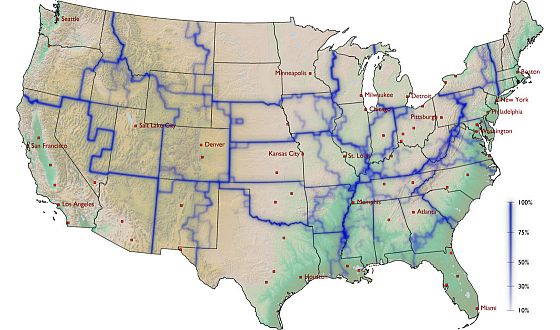
A ‘whom do you hang with?’ map of America

Robert Krulwich writes: Look at the center of this map, at the little red dot that marks Kansas City. Technically, Kansas City is at the edge of Missouri, but here on this map it’s in the upper middle section of a bigger space with strong blue borders. We don’t have a name for this bigger space yet, but soon we will.

I would call it, for the moment, “The Part Of America Kansas City Hangs With” because that’s what this map is saying. It’s a new, intriguing way to see our country. This one was built by tracking dollar bill circulation. There’ve been similar maps built from phone call data. The idea here is to show America not as 50 states, but as regions where people do stuff together. In other words, a “Whom Do You Hang With?” map.

Here’s the notion. A few years ago, Dirk Brockmann, a theoretical physicist from Germany, was visiting his American friend Dennis, and they got talking about population mobility. Dirk knew Americans move around a lot, but he wondered how to capture where they go, who they talk to. His friend said, “Have you ever heard of Where’s George? Dirk hadn’t.

It’s a website that tracks the movement of dollar bills. Thousands of people participate. All you do is take a bill out of your wallet, type the denomination, serial number, the date and your zip code onto the Where’s George? site, and then, with a pen or a stamp, deface the bill with the words “WheresGeorge.com.” After which (and this is key), you spend it. So now your bill is moving from business to business, person to person, and if and when another Where’s George volunteer discovers it, she or he will note where, note when and spend it again. Since dollar bills pass between people, Dennis suggested why not us the “Where’s George?” data to get a sense of where people go, and, just as interesting, where they don’t go?

That’s what Dirk did. After checking 1,033,095 reports (describing the movement of 464,670 bills), he came up with this map. [Continue reading…]

Facebooktwittermail

U.S. ranks near bottom of UNICEF report on child well-being

Salon: The United States ranked in the bottom four of a United Nations report on child well-being. Among 29 countries, America landed second from the bottom in child poverty and held a similarly dismal position when it came to “child life satisfaction.”

Keeping the U.S. company at the bottom of the report, which gauged material well-being, overall health, access to housing and education, were Lithuania, Latvia and Romania, three of the poorest countries in the survey.

UNICEF said in a statement on the survey that child poverty in countries like the U.S. “is not inevitable but is policy-susceptible” and that there isn’t necessarily a strong relationship between per capita GDP and overall child well-being, explaining: “The Czech Republic is ranked higher than Austria, Slovenia higher than Canada, and Portugal higher than the United States.”

Facebooktwittermail

America’s gun junkies

Most Americans don’t own a gun, so if gun ownership is fundamental to the American way of life, does that mean most people living in America aren’t real Americans?

Probably not. Why? Because the people who feel the greatest need to buy guns are people who already own guns. And since guns tend to be extremely durable items — most are designed well enough to outlive their owners — the need to buy guns, seems very much like the need to buy heroin. No one needs it until they start using it, but once they start using, it becomes increasingly difficult to get enough.

James Werrell writes: You’d think, reading news reports about people rushing out to buy assault rifles and stock up on ammo, that gun ownership is on the rise. But according to at least one survey, just the opposite is true.

If the survey is accurate – and the National Rifle Association is skeptical – it offers a fascinating contrast between reality and perception. Instead of a citizen militia busily stockpiling firearms, we may be a nation in which a large majority of people don’t have a single gun in the house.

According to data from the General Social Survey, a public opinion survey conducted every two years by a research center at the University of Chicago, the household gun ownership rate has fallen from an average of 50 percent in the 1970s to 49 percent in the 1980s, 43 percent in the 1990s and 35 percent in the 2000s. Consider that, only about a third of U.S. households have guns.

And, equally surprisingly, the decline has occurred across the board. The rate has dropped in big cities and small towns, suburbs and rural areas, and in all regions of the country – including the gun-loving South and West.

Gun ownership is down among households with children and those without children. It’s down among rich and poor. It’s down among churchgoers and non-worshippers alike.

Those who doubt the validity of the survey point to anecdotal evidence of increased gun sales, a rise in the number of background checks and long waits for gun-safety classes. But the researchers who conducted the survey have an answer for that: The people buying guns are the people who already have guns.

That category could include everyone from collectors to survivalists. Apparently, though, most Americans aren’t interested in assembling an arsenal in their homes. [Continue reading…]

Facebooktwittermail