Category Archives: News

Erdogan warns Muslims against using birth control

Middle East Eye reports: Turkish President Tayyip Erdogan said on Monday that Muslim families should refrain from birth control and have more children.

Erdogan said it was the responsibility of mothers to ensure the continued growth of Turkey’s population, which has expanded at a rate of around 1.3 percent in the last few years.

“I will say it clearly … We need to increase the number of our descendants,” he said in a speech in Istanbul.

“People talk about birth control, about family planning. No Muslim family can understand and accept that!

“As God and as the great prophet said, we will go this way. And in this respect the first duty belongs to mothers.”

Erdogan and his wife Emine have two sons and two daughters. Earlier this month, the president attended the high-profile marriage of his younger daughter Sumeyye to defence industrialist Selcuk Bayraktar.

His elder daughter Esra, who is married to the up-and-coming Energy Minister Berat Albayrak, has three children.

The Platform to Stop Violence Against Women, which campaigns to stop the killings of hundreds of woman every year, condemned Erdogan’s comments as violating the rights of women.

“You [Erdogan] cannot usurp our right to contraception, nor our other rights with your declarations that come out of the Middle Ages,” the group said in a statement on Twitter. [Continue reading…]

Facebooktwittermail

Syrian opposition negotiator quits peace talks

The Wall Street Journal reports: The chief Syrian opposition negotiator in Geneva resigned, citing both the international community’s failure to make concrete progress toward ending the country’s conflict and continuing hostilities by the regime.

Mohammad Alloush’s departure could be a particularly troubling development for the fractured opposition, which has faced difficulties nominating consensus leaders wielding both political clout with the international community and influence among rebels on the ground.

The High Negotiations Committee, the opposition’s representative body in Geneva, will meet in Riyadh in 10 days to form a delegation for coming peace talks and select his successor, a spokeswoman said.

The resignation is the latest hitch in the continuing peace negotiations, as President Bashar al-Assad’s regime, the opposition and their respective allies appear no closer to finding a mediated solution to the five-year conflict.

The latest cease-fire attempt, brokered by the U.S. and Russia, broke down weeks after it began in February.

“The last three rounds of negotiations in Geneva under U.N. auspices have been unsuccessful because of the unwillingness of the regime to compromise and its continuation in the bombing and aggression against the Syrian people,” Mr. Alloush said Sunday night in the letter to the HNC. “Also, the international community [has been unable] to implement its decisions especially with regard to the humanitarian angle from breaking the siege, allowing aid into besieged areas, the release of detainees and a commitment to cessation of hostilities.” [Continue reading…]

Facebooktwittermail

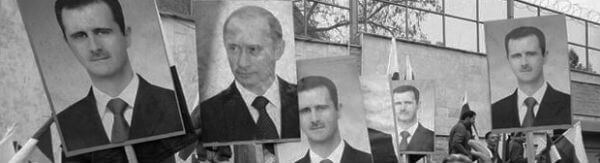
Russia’s draft constitution: End of Syria’s Baath era?

Assad-4

Al Jazeera reports: Last Tuesday, Lebanese daily newspaper, Al-Akhbar, reported that Russia had finished drafting a constitution for Syria that would remove many of the Syrian president’s powers and set up a more decentralised government, both possible concessions to rebel groups fighting the regime of President Bashar al-Assad.

According to the Al-Akhbar report, the new constitution, done with the blessing of the United States, would be put to referendum before the end of the year. This would put the countries on pace to meet their self-imposed deadline to draft a Syrian constitution by August 2016.

The Syrian presidency quickly dismissed the report, describing it as “untrue”.

“No draft constitution has been shown to the Syrian Arab Republic. Everything which has been said in the media about this subject is totally untrue,” a statement on the Syrian Presidency’s official Facebook page said.

Barely six weeks after their military intervention began, Russian officials put forth an eight-point plan called: “Approach to the Settlement of the Syrian Crisis” that provided the basic contours of Russia’s vision for ending the conflict.

This vision was rather narrow, however, as the first five points dealt specifically with the fight against the Islamic State group (ISIL, also known as ISIS), and the remaining three carried vague commitments to a political process carried out under international auspices.

For most observers, the plan represented little more than the fulfilment of the regime’s wish-list and carried with it no substantive political concessions. [Continue reading…]

Facebooktwittermail

Eric Holder says Edward Snowden performed a ‘public service’

CNN reports: Former U.S. Attorney General Eric Holder says Edward Snowden performed a “public service” by triggering a debate over surveillance techniques, but still must pay a penalty for illegally leaking a trove of classified intelligence documents.

“We can certainly argue about the way in which Snowden did what he did, but I think that he actually performed a public service by raising the debate that we engaged in and by the changes that we made,” Holder told David Axelrod on “The Axe Files,” a podcast produced by CNN and the University of Chicago Institute of Politics.

“Now I would say that doing what he did — and the way he did it — was inappropriate and illegal,” Holder added. [Continue reading…]

Facebooktwittermail

Drowned baby picture captures week of tragedy in Mediterranean

Reuters reports: A photograph of a drowned migrant baby in the arms of a German rescuer was distributed on Monday by a humanitarian organization aiming to persuade European authorities to ensure safe passage to migrants, after hundreds are feared to have drowned in the Mediterranean last week.

The baby, who appears to be no more than a year old, was pulled from the sea on Friday after the capsizing of a wooden boat. Forty-five bodies arrived in the southern Italian port of Reggio Calabria on Sunday aboard an Italian navy ship, which picked up 135 survivors from the same incident.

German humanitarian organization Sea-Watch, operating a rescue boat in the sea between Libya and Italy, distributed the picture taken by a media production company on board and which showed a rescuer cradling the child like a sleeping baby.

In an email, the rescuer, who gave his name as Martin but did not want his family name published, said he had spotted the baby in the water “like a doll, arms outstretched”.

“I took hold of the forearm of the baby and pulled the light body protectively into my arms at once, as if it were still alive … It held out its arms with tiny fingers into the air, the sun shone into its bright, friendly but motionless eyes.”

The rescuer, a father of three and by profession a music therapist, added: “I began to sing to comfort myself and to give some kind of expression to this incomprehensible, heart-rending moment. Just six hours ago this child was alive.” [Continue reading…]

Facebooktwittermail

Three days, 700 deaths on Mediterranean as refugee crisis flares

The New York Times reports: The migrant ships kept sinking. First came a battered, blue-decked vessel that flipped over on Wednesday as terrified migrants plunged into the Mediterranean Sea. The next day, a flimsy craft capsized with hundreds of people aboard. And on Friday, still another boat sank into the deceptively placid waters of the Mediterranean.

Three days and three sunken ships are again confronting Europe with the horrors of its refugee crisis, as desperate people trying to reach the Continent keep dying at sea. At least 700 people from the three boats are believed to have drowned, the United Nations refugee agency announced on Sunday, in one of the deadliest weeks in the Mediterranean in recent memory.

The latest drownings — which would push the death toll for the year to more than 2,000 people — are a reminder of the cruel paradox of the Mediterranean calendar: As summer approaches with blue skies, warm weather and tranquil waters prized by tourists, human trafficking along the North African coastline traditionally kicks into a higher gear.

Taking advantage of calm conditions, smugglers in Libya send out more and more migrants toward Italy, often on unseaworthy vessels. Drowning deaths are inevitable, even as Italian Coast Guard and Navy ships race to answer distress calls. Last year, more than 3,700 migrants died in the Mediterranean, a figure that could be surpassed this year. [Continue reading…]

Facebooktwittermail

Fears ISIS will use 50,000 trapped civilians as human shields as Iraqi forces storm Fallujah in dawn offensive

The Telegraph reports: The Iraqi army entered Islamic State-held Fallujah in a major dawn offensive on Monday as it made its “final push” to recapture the city from jihadists.

Troops pincered Isil from three directions and managed to push into urban areas for the first time since the operation began a week ago.

With the help of an Iran-backed Shia militia and air support from the US-led coalition, the army said it had gained control of 80 per cent of the towns and villages around Fallujah and was now focused on retaking the city itself.

Some 1,500 Isil fighters holed up in the centre, which has been under their control for more than two years, were putting up fierce resistance with suicide bombings and rocket attacks. [Continue reading…]

Facebooktwittermail

Iran-led push to retake Falluja from ISIS worries U.S.

The New York Times reports: American commandos are on the front lines in Syria in a new push toward the Islamic State’s de facto capital in Raqqa, but in Iraq it is an entirely different story: Iran, not the United States, has become the face of an operation to retake the jihadist stronghold of Falluja from the militant group.

On the outskirts of Falluja, tens of thousands of Iraqi soldiers, police officers and Shiite militiamen backed by Iran are preparing for an assault on the Sunni city, raising fears of a sectarian blood bath. Iran has placed advisers, including its top spymaster, Qassim Suleimani, on the ground to assist in the operation.

The battle over Falluja has evolved into yet another example of how United States and Iranian interests seemingly converge and clash at the same time in Iraq. Both want to defeat the Islamic State, also known as ISIS or ISIL. But the United States has long believed that Iran’s role, which relies on militias accused of sectarian abuses, can make matters worse by angering Sunnis and making them more sympathetic to the militants. [Continue reading…]

Facebooktwittermail

The last remaining Pentagon-trained rebel group in Syria is now in jeopardy

The Washington Post reports: Throughout the fiasco of the Pentagon’s $500 million effort to train and equip a force of Syrian rebels to take on the Islamic State, one small group endured.

The New Syrian Army completed the U.S. training course in Jordan, infiltrated into Syria and then, in March, without fanfare or publicity, seized a pinprick of territory from the militants at the remote Tanaf border crossing with Iraq in the far southeast corner of the Syrian province of Homs.

There they have remained, holding their ground without deserting, defecting or getting kidnapped, unlike many of the other similarly trained rebels whose mishaps prompted the temporary suspension of the program last year.

Even this modest success is now in jeopardy, however, following an Islamic State suicide attack this month. An armored vehicle barreled into the rebels’ base shortly before dawn on May 7, killing a number of them, said Lt. Col. Mohammed Tallaa, a Syrian officer who defected and is the group’s commander. [Continue reading…]

Facebooktwittermail

All European scientific articles to be freely accessible by 2020

The Netherlands EU Presidency 2016: All scientific articles in Europe must be freely accessible as of 2020. EU member states want to achieve optimal reuse of research data. They are also looking into a European visa for foreign start-up founders.

And, according to the new Innovation Principle, new European legislation must take account of its impact on innovation. These are the main outcomes of the meeting of the Competitiveness Council in Brussels on 27 May.

Under the presidency of Netherlands State Secretary for Education, Culture and Science Sander Dekker, the EU ministers responsible for research and innovation decided unanimously to take these significant steps. Mr Dekker is pleased that these ambitions have been translated into clear agreements to maximise the impact of research. ‘Research and innovation generate economic growth and more jobs and provide solutions to societal challenges,’ the state secretary said. ‘And that means a stronger Europe. To achieve that, Europe must be as attractive as possible for researchers and start-ups to locate here and for companies to invest. That calls for knowledge to be freely shared. The time for talking about open access is now past. With these agreements, we are going to achieve it in practice.’

Open access means that scientific publications on the results of research supported by public and public-private funds must be freely accessible to everyone. [Continue reading…]

Facebooktwittermail

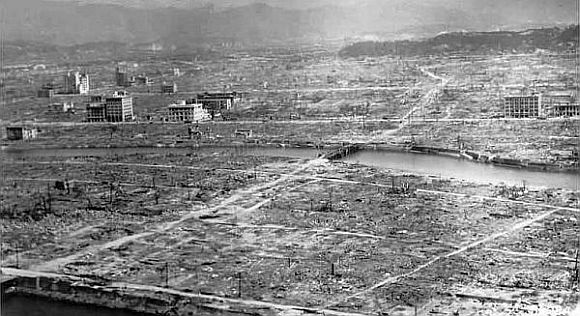
Hope and hype of Hiroshima can’t conceal Obama’s dismal record on nuclear disarmament

Hiroshima: the original Ground Zero

Setsuko Thurlow, who as a 13-year-old girl survived the atomic bombing of Hiroshima, writes: In [President Obama’s] famous speech in Prague, in 2009, he said, “As the only nuclear power to have used a nuclear weapon, the United States has a moral responsibility to act. We cannot succeed in this endeavor alone, but we can lead it, we can start it.”

Why then has the U.S. government, under the Obama administration, pledged $1 trillion over the next 30 years to modernize its nuclear arsenal? Exactly where is the moral responsibility and leadership in that?

Regarding disarmament, Obama stated, “Our efforts to contain these dangers are centered on a global nonproliferation regime, but as more people and nations break the rules, we could reach the point where the center cannot hold.” Why then are the U.S. and other nuclear weapon states actively boycotting the latest international nuclear negotiations? [Continue reading…]

Tim Wright writes: Under the Obama presidency, contrary to perceptions, the pace of nuclear warhead dismantlement has slowed, not hastened. Indeed, the two presidents Bush and Bill Clinton each made greater gains in downsizing the colossal US nuclear stockpile amassed during the cold war.

But more alarming than this failure to destroy old nuclear weapons has been the Obama administration’s aggressive pursuit of new, “smaller” ones, for which the threshold of use would be lower, according to former military commanders.

At great expense, the president has bolstered all three components of the nation’s “nuclear triad”: the strategic bombers, intercontinental ballistic missiles and submarine-launched missiles. This was the price paid for securing Republican support in 2010 for the ratification of a modest bilateral arms reduction treaty with Russia.

Obama’s much-publicised “nuclear security summits” largely ignored the greatest source of nuclear insecurity in the world today: 15,000 nuclear weapons, including 1,800 on hair-trigger alert. Instead, they focused on measures to keep “vulnerable nuclear material” out of terrorists’ hands – a vital endeavour, certainly, but for all the fanfare the results were small.

Now the United States is stridently resisting diplomatic moves by two-thirds of the world’s nations to declare nuclear weapons illegal. It boycotted UN talks in Geneva this month aimed at setting the stage for negotiations on a prohibition treaty. But it cannot veto this initiative, just as it could not veto the processes that led to bans on landmines in 1997 and cluster munitions in 2008.

While a prohibition on nuclear weapons will not result in disarmament overnight, it will powerfully challenge the notion that these weapons are acceptable for some nations. It will place them on the same legal footing as both other types of weapons of mass destruction – namely, chemical and biological weapons. [Continue reading…]

Facebooktwittermail

Israel/Palestine in the coming realignment of American politics

Following Bernie Sanders’ selection of Cornel West, Keith Ellison, James Zogby, Deborah Parker, and Bill McKibben to sit on the 15-member Democratic Party platform-writing committee, Corey Robin writes: However insignificant, power-wise, Sanders’s choices may be — his people will constitute about a third of the total committee — they are highly significant in terms of the discussion in this country around Israel/Palestine, as Haaretz rightly pointed out.

Because so much of Israel/Palestine politics in this country depends upon keeping certain voices and arguments out of the mainstream, the very fact that Sanders has chosen Cornel West — who in addition to self-identifying as a socialist, is also a long-standing critic of Israel and firm supporter of the boycott, divestment, and sanctions movement (BDS) — as well as Zogby and even Ellison, as his representative on the platform committee, is a big deal.

West, Zogby, and Ellison are now the voices of not only Sanders but also of the not-insignificant sector of Sanders voters within the Democratic Party.

Israel/Palestine has always been a curious issue in American politics: on the one hand, it’s one tiny piece of the world; on the other hand, it plays an outsized role in US foreign policy and political culture, for all sides of the debate.

That Sanders has chosen to make that one issue a kind of line in the sand of his particular brand of politics — when so many of us had thought he’d simply the ignore the issue altogether — suggests to me that it will play a large role in the coming realignment of American politics. [Continue reading…]

Facebooktwittermail

ISIS advance traps 165,000 Syrians at closed Turkish border

Gerry Simpson, at Human Rights Watch, writes: There are two walls on the Turkey-Syria border.

One is manned by Turkish border guards enforcing Turkey’s 15 month-old border closure who, according to witnesses, have at times shot at and assaulted Syrian asylum seekers as they try to reach safety in Turkey – abuses strongly denied by the Turkish government.

The other is a wall of silence by the rest of the world, including the United Nations, which has chosen to turn a blind eye to Turkey’s breach of international law which prohibits forcing people back to places, including by rejecting them at the border, where their lives or freedom would be threatened.

Both walls are trapping 165,000 displaced Syrians now scattered in overcrowded informal settlements and fields just south of Turkey’s Öncupınar/Bab al-Salameh border crossing and in and around the nearby Syrian town of Azaz. [Continue reading…]

Facebooktwittermail

U.S. military special forces pictured aiding Kurdish fighters in Syria

The Guardian reports: Elite US military forces have been photographed for the first time in Syria as they join largely Kurdish forces on an advance toward, Raqqa, the Islamic State terror group’s capital.

A photographer with Agence France-Presse captured US special operations forces with Kurdish forces known as the YPG, part of the US-mentored Syrian Democratic Forces, in a rural village less than 40 miles from Raqqa. Some US troops wear the insignia of the YPG in an apparent show of support.

Peter Cook, the Pentagon press secretary, resisted commenting on the photographs and would only describe the US special operations forces’ mission in generic terms.

“Our special operations forces in the past have, yes, worn insignias and other identifying marks with their partner forces,” Cook told reporters on Thursday. [Continue reading…]

BBC News reports: Turkey has hit out at the US over images said to show US special forces in Syria wearing insignia of Kurdish militia, during joint operations against so-called Islamic State (IS).

Turkish Foreign Minister Mevlut Cavusoglu called the US “two-faced” and said the practice was “unacceptable”.

The images appear to show a US special forces soldier wearing the patch of the YPJ – a Kurdish militia group.

A Pentagon spokesman said troops often blended in with partners for safety. [Continue reading…]

Facebooktwittermail

As Iraqi offensive unfolds, civilians trapped in Fallujah face multiple threats

The Washington Post reports: Civilians trapped in the Iraqi city of Fallujah face mounting threats as humanitarian conditions worsen and Iraqi forces­ press their offensive to oust the Islamic State, local and foreign officials said Thursday.

About 50,000 civilians are believed to remain in the city, which has been under Islamic State control since January 2014, living under the militants’ harsh and capricious rule. Conditions for residents have grown dire in recent months as a siege by government-aligned forces has aggravated shortages of food and medicine.

Now, officials from Fallujah fear that the ongoing operation designed to break the militants’ grip on the city will further endanger civilians. In recent days, a combined force of Iraqi army troops, police, Shiite militiamen and Sunni tribal fighters has made progress in clearing militants from areas around Fallujah, in preparation for a push into the city in western Anbar province. [Continue reading…]

Becky Bakr Abdulla, from the Norwegian Refugee Council, describes the impact on civilians: The first thing that struck me was the silence. On Tuesday, as I entered Al Iraq, a displacement camp in Amiriyat Al-Fallujah and the nearest to the besieged city of Fallujah, no one was outside their tents. As fighting raged just 30km away between armed opposition groups and the Iraqi military, it was strangely quiet.

The camp shelters some of the few families who have managed to escape the fighting in the city that has been under armed opposition groups control for the last two years. On Monday, as the Iraqi military began an offensive in the city, the atmosphere in our office in Baghdad became particularly tense, as the already dire humanitarian situation became critical. Staff shared the latest scraps of news. Some became particularly anxious about their friends and family among the estimated 50,000 civilians still trapped in the city.

The families I met were in a state of shock and spoke about the ordeal of their escape. They were among the 21 families in Al Iraq camp, out of approximately 114 who we believe have escaped the city so far. One woman, whose family was told by armed opposition groups that they would be shot if they tried to flee, waited until night-time to make a move. They removed their shoes and sandals so they were not heard as they started running. [Continue reading…]

Facebooktwittermail

U.S. reports first case of bacteria resistant to antibiotic of last resort

The Washington Post reports: For the first time, researchers have found a person in the United States carrying bacteria resistant to antibiotics of last resort, an alarming development that the top U.S. public health official says could mean “the end of the road” for antibiotics.

The antibiotic-resistant strain was found last month in the urine of a 49-year-old Pennsylvania woman. Defense Department researchers determined that she carried a strain of E. coli resistant to the antibiotic colistin, according to a study published Thursday in Antimicrobial Agents and Chemotherapy, a publication of the American Society for Microbiology. The authors wrote that the discovery “heralds the emergence of a truly pan-drug resistant bacteria.”

Colistin is the antibiotic of last resort for particularly dangerous types of superbugs, including a family of bacteria known as CRE, which health officials have dubbed “nightmare bacteria.” In some instances, these superbugs kill up to 50 percent of patients who become infected. The Centers for Disease Control and Prevention has called CRE among the country’s most urgent public health threats.

Health officials said the case in Pennsylvania, by itself, is not cause for panic. The strain found in the woman is still treatable with other antibiotics. But researchers worry that its colistin-resistance gene, known as mcr-1, could spread to other bacteria that can already evade other antibiotics. [Continue reading…]

The Guardian reports: Nearly one-third of Americans prescribed antibiotics during doctor’s office visits probably should not have received the drugs, were not given a long enough course or did not get the right dose, according to new research.

The new study into how doctors prescribe antibiotics to Americans in outpatient settings comes as rates of antibiotic resistant bacterial infections are on the rise. Up to 23,000 Americans die and 2 million more become sick due to antibiotic resistant bacteria each year, according to the Centers for Disease Control and Prevention (CDC), and scientists have found rates of such infections on the rise.

“This study shows that there certainly is a lot more work to be done,” said Dr Katherine E Fleming-Dutra, a CDC researcher and lead author on the study. “It is so critical to preserve antibiotics for the future, to make sure they work.”

The study of 184,032 visits, titled Prevalence of Antibiotic Prescriptions Among US Ambulatory Care Visits, 2010-2011 and published in the Journal of the American Medical Association, comes as a White House panel of experts convened to work on the issue push doctors to halve the prescribing of antibiotics in such settings by 2020. [Continue reading…]

Facebooktwittermail

Donald Trump would allow Keystone XL pipeline and end Paris climate deal

The Guardian reports: Donald Trump pledged to cancel the Paris climate agreement, endorsed drilling off the Atlantic coast and said he would allow the Keystone XL pipeline to be built in return for “a big piece of the profits” for the American people.

At an oil and natural gas conference in North Dakota on Thursday, just minutes after he had celebrated hitting the 1,237 delegate mark needed to formally clinch the party’s nomination, Trump gave a speech on energy policy that was largely shaped by advice from Kevin Cramer, a US representative from the state.

In a press conference before the event, Trump praised the advice of oil tycoon Harold Hamm. Hamm and Cramer then introduced him onstage.

Michael Brune, executive director of the Sierra Club environmentalist group, was taken aback by Trump’s address.

“I have never heard more contradiction in one hour than I heard in the speech,” he told the Guardian. [Continue reading…]

Facebooktwittermail