The Washington Post reports: Until a week ago, it seemed the Israeli-Palestinian peace process was a flat-liner.
President Obama thought so. In March, he said he wouldn’t seek to jump-start talks — the two sides were too far apart; it was not in the cards.
Now Israeli-Palestinian peace initiatives are popping up all over.
On Friday, the French will host a meeting of about 25 foreign ministers, including Secretary of State John F. Kerry, to seek international consensus on a way to move talks forward.
State Department spokesman John Kirby said Kerry was going to Paris to learn and listen — not to lead.
“It’s about being there, being part of the discussion, exploring ideas and options that might get us closer to a two-state solution,” Kirby said.
But Kerry’s presence in Paris worries Israelis who fear that the international community is going to press them to end the 49-year military occupation of the West Bank and the partial trade and travel blockage of Gaza, and to stop ongoing construction of Jewish settlements on land the Palestinians want for a future state.
The Israelis also have their eyes on the calendar. They are concerned that the Obama administration will, before leaving office, enshrine a two-state solution in a speech or a U.N. resolution, in effect laying out the final status ahead of negotiations.
Kerry spent nine months trying to bring the two sides together in 2014. The talks ended in recriminations about who was to blame for their failure.
Across the political spectrum in Ramallah and Jerusalem, nobody holds out much hope for the French effort.
French diplomats shrug and say in briefings with journalists, “We have to do something.”
In Israel, there is a feeling that something is happening.
Just this week, the once-moribund Arab Peace Initiative is back in the game after years on the sidelines.
Proposed by Saudi Arabia in 2002, the deal offers the idea that the Arab states will normalize relations with Israel after Israel withdraws from the occupied territories — including East Jerusalem — and begins the process of allowing for a Palestinian state.
Former Israeli governments have been hostile or lukewarm to the Arab proposal.
Former prime minister Ariel Sharon called the Arab Peace Initiative a “nonstarter” when it was proposed.
This week, Prime Minister Benjamin Netanyahu called the Arab peace offer intriguing. But Netanyahu also suggested that the Arab states recognize Israel first as Israel makes moves toward giving the Palestinians a state.
That will be a tough sell in the Arab League.
Into this mix comes former British prime minister Tony Blair, who has been shuttling between Egypt, the Arab Gulf states and the Israelis, trying to broker a way to get the sides talking.
Also intriguing, Egyptian President Abdel Fatah al-Sissi said in a recent speech that he thinks the time is ripe to revisit a deal between Israel and the Palestinians.
The French seem ready to press ahead with what they see as a solution to the conflict — including what borders should look like for a Palestinian state and whether Palestinians should have a capital in Jerusalem.
The French also may try to set deadlines for future talks. If their efforts fail, French diplomats have warned that they may unilaterally recognize a Palestinian state. [Continue reading…]
Category Archives: News
Universe is expanding up to 9% faster than we thought, say scientists

The Guardian reports: The universe is expanding faster than anyone had previously measured or calculated from theory. This is a discovery that could test part of Albert Einstein’s theory of relativity, a pillar of cosmology that has withstood challenges for a century.
Nasa and the European Space Agency jointly announced the universe is expanding 5% to 9% faster than predicted, a finding they reached after using the Hubble space telescope to measure the distance to stars in 19 galaxies beyond theMilky Way.
The rate of expansion did not match predictions based on measurements of radiation left over from the Big Bang that gave rise to the known universe 13.8bn years ago.
Physicist and lead author Adam Riess said: “You start at two ends, and you expect to meet in the middle if all of your drawings are right and your measurements are right.
“But now the ends are not quite meeting in the middle and we want to know why.” [Continue reading…]
Why Trump University got chased out of Texas
USA Today reports: The Texas Attorney General’s Office opened a deceptive trade practices investigation of Trump University in 2010 and chased the business out of the state, saying the promises made to students were “virtually impossible to achieve,” according to documents unearthed by a Democratic super PAC.
Assistant Attorney General Rick Berlin wrote to Donald Trump’s lawyers in June 2010 that Trump University seminars – for which students paid thousands of dollars – were targeted at real estate novices and promised “to teach these novices everything they need to know to be a successful residential real estate broker — in 3 days.”
But in Texas, “to become licensed as a real estate broker you must have 900 hours of classroom instruction and 2 years selling experience,” Berlin said, in the memo the Democratic super PAC American Bridge 21st Century uncovered through a public records request and provided to USA TODAY. The information given to students by Trump University “is essentially unusable,” and students “will be unable to recoup their investment in the course, much less make a profit, as promised by Trump U,” Berlin wrote. [Continue reading…]
Aid delivered in Syria may be too little, too late
The Washington Post reports: The government siege of a Damascus suburb was broken Wednesday with delivery of medical supplies and a small amount of baby food, after Syria agreed to allow an international aid convoy to enter the area for the first time since 2012.
Arrival of United Nations and Red Cross vehicles in the rebel-held, government-surrounded city of Darayya came just hours into a June 1 deadline, after which the United States and Russia had pledged to organize airdrops for food and medicine to reach starving civilians.
Although U.S. officials said they would continue to prepare for international food delivery by air, in case the access ends, the convoys to Darayya, and to the similarly besieged city of Moadamiya, appear to have averted the latest potential escalation in Syria’s years-long civil war.
But they accomplished little to change a situation in which maintaining the status quo now seems the most optimistic outcome in the near term, and perhaps for the remainder of Barack Obama’s presidency.
What seemed the chance of a political solution in Syria barely three months ago now appears an ever fainter possibility. At the same time, those within the administration who have long advocated a more robust U.S. commitment to the Syrian opposition have largely given up. [Continue reading…]
What happens after ISIS?
The Daily Beast reports: Troops fighting ISIS appeared to on the verge of another victory over the self-proclaimed Islamic State Wednesday, as they moved into a city that has served as the main thoroughfare for ISIS foreign fighters and weapons. But the potential seizure of the Syrian city of Manbij by U.S.-backed forces is only likely to set off a new battle for control — this time pitting Arabs against Kurds.
The battle Wednesday reflected a growing problem for the U.S. and its push to train local fighters, even as those forces take territory from ISIS. Who exactly will govern those towns now? Will it be the Kurds who have led the fight against ISIS? Or will it be what some in the Pentagon have privately called the “token Arabs” trained by the U.S. to accompany them?
Two defense officials told The Daily Beast Wednesday they don’t know. They believe the Arabs would be in charge. But even these officials admit that asking the 5,000-or-so newly-trained Arab fighters to control three or more formerly ISIS-controlled areas — and at the same time move into the ISIS capital of Raqqa — would be difficult.
On the other hand, some worry that a Kurdish controlled Manbij could be ethnically cleansed, creating the kind of Sunni disenfranchisement that led to the rise of ISIS. The fall of Manbij into Kurdish hands, however, would give the Kurds a contiguous region in northern Syria. Moreover, a Kurdish controlled Manbij could draw the ire of U.S.-allied Turkey, which rejects a Kurdish controlled region on its border.
The question “what happens after ISIS?” looms increasingly over the U.S.-led effort. Indeed, defense officials said how the governance question is answered in Manbij could foreshadow the strategy for Raqqa, ISIS’s capital. Local U.S.-backed forces, accompanied by U.S. forces, have moved within 18 miles of the city in the last week. Over the Memorial Day weekend, one U.S. service member was injured while supporting the local fighters. [Continue reading…]
Militias in Libya advance on ISIS stronghold of Surt with separate agendas
The New York Times reports: Fighters aligned with Libya’s United Nations-backed unity government are advancing along the Mediterranean coast toward the Islamic State stronghold of Surt, signaling the first major assault on territory that, since last year, has become the terrorist group’s largest base outside of Iraq and Syria.
Two separate militia forces have fought their way toward the city in recent days, attacking from both the east and the west, in apparently uncoordinated attacks that have reduced the length of Libyan coastline controlled by the Islamic State to 100 miles from about 150 miles. On Wednesday, one of the militias claimed to have seized control of Surt’s power plant, 20 miles west of the city.
Those victories occurred in sparsely populated areas, and it was unclear whether the militias had either the strength or the will to push into Surt, which is thought to be heavily fortified and also harbor several thousand foreign fighters. But the advance did signal a new setback for the Islamic State, also known as ISIS or ISIL, at a time when it is already under concerted attack in Falluja, Iraq, and in parts of Syria.
Analysts and diplomats warn that while the offensive addresses the West’s biggest concern in Libya, it also risks destabilizing the fragile peace effort by fostering violent competition between rival groups.
“Only a year ago, these two groups were battling for control of the so-called oil crescent, and lobbying rockets and shells at one another,” said Frederic Wehrey, a Libya specialist at the Carnegie Endowment for International Peace, who visited that country recently. “Now they are converging on a common enemy, but the great fear is what comes next.” [Continue reading…]
It wasn’t a ‘glitch’: State Department deliberately cut embarrassing questions from press briefing video
The Washington Post reports: The State Department acknowledged Wednesday that someone in its public affairs bureau made a “deliberate” request that several minutes of tape be cut from the video of a 2013 press briefing in which a reporter asked if the administration had lied about secret talks with Iran.
The embarrassing admission by State Department spokesman John Kirby came three weeks after another spokesperson insisted that a “glitch” had caused the gap, discovered only last month by the reporter whose questioning had mysteriously disappeared.
“This wasn’t a technical glitch, this was a deliberate step to excise the video,” Kirby told reporters.
Kirby said he had not been able to learn who ordered the deletion, which appeared as a jarring, undisguised white flash on the archived video posted on the State Department’s website and in its YouTube video.
“The recipient of the call doesn’t remember anything other than the caller, the individual who called this technician, was passing on a request from someone else within the public affairs bureau,” Kirby said, explaining the faulty memory by adding, “This happened three years ago.”
The curious gap in an old video of a public briefing is not of the same ilk as the famous 18 1/2- minute gap in audio tapes of President Nixon’s Oval Office conversations during the Watergate coverup. The official written transcript of the State Department briefing always carried the full exchange.
But it is likely to further fuel controversy over the administration’s nuclear deal with Iran, coming amid allegations that the White House duped the press and misled Congress and foreign policy scholars about the Iran nuclear deal that was implemented in January. [Continue reading…]
Scientists have found yet another part of Antarctica that may be in trouble

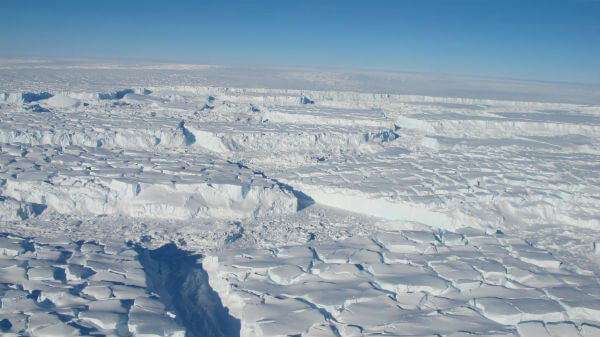
The Washington Post reports: The forces affecting the ice in West Antarctica are an area of urgent focus for climate scientists who are all too aware of the ice sheet’s huge potential contributions to global sea-level rise. A great deal of this attention has centered on a specific region bordering the Amundsen Sea, south of the Antarctic Peninsula, where research has suggested that a set of rapidly retreating glaciers — including the famous Thwaites and Pine Island glaciers — may be increasingly vulnerable to collapse.
But research is increasingly suggesting that the region is not the only area deserving of concern. Just last month, a new study suggested that the Totten Glacier in East Antarctica, which has typically been considered much less of a threat than West Antarctica, is also thinning quickly and has retreated inland by close to two miles in some areas. Overall, the glacier has the potential to raise sea levels by about 13 feet should it collapse.
And now, a new study just published in the journal Geophysical Research Letters has identified a new area of concern. The new research focuses on the Bellingshausen Sea region, an area just above the Amundsen Sea on the west side of the Antarctic Peninsula. Using four decades’ worth of satellite data, researchers have found that ice in this region has also experienced significant retreat, particularly since 1990, and could be a bigger threat than expected. [Continue reading…]
Renewable energy surges to record levels around the world
BBC News reports: New solar, wind and hydropower sources were added in 2015 at the fastest rate the world has yet seen, a study says.
Investments in renewables during the year were more than double the amount spent on new coal and gas-fired power plants, the Renewables Global Status Report found.
For the first time, emerging economies spent more than the rich on renewable power and fuels.
Over 8 million people are now working in renewable energy worldwide.
For a number of years, the global spend on renewables has been increasing and 2015 saw that arrive at a new peak according to the report. [Continue reading…]
Fear of ‘catastrophe unfolding’ amid fighting in Falluja
The New York Times reports: Along the battle line north of Falluja, small units of Shiite fighters are raining mortar shells and rockets down on the city and its Islamic State occupiers. Militia graffiti is scrawled in red paint along a network of low walls cratered by bullets and bombs, and a wailing ambulance siren signals another load of wounded bound for treatment away from the front.
The battle for Falluja has become entrenched outside the city itself. Iraqi forces surrounding the area have been bogged down by a fierce Islamic State counterattack. A few civilians managed to escape the city as the fighting closed in, but the status of tens of thousands still trapped there is an urgent question.
Some parts of the extended battlefield are lush with date palm trees and almost bucolic, familiar to anyone who watched television images of American Marines fighting over the same territory more than a decade ago. But mostly, the land is brown and parched, scarred by the fighting. A charred tank, split in two, sits at an intersection, and smoke is always rising in the distance, from an airstrike, a mortar or a car bomb.
The landscape has also been gutted by an elaborate network of tunnels — some of which have been hit in recent days by American airstrikes — that the Islamic State was able to construct while it held the area for more than two years. [Continue reading…]
Dozens killed in bombing of national hospital in Idlib
The Guardian reports: At least two dozen people including several children have been killed in northern Syria in the latest apparent attack by forces loyal to the Bashar al-Assad regime on medical facilities in opposition-held areas, UN officials and activists have said.
The bombing of the national hospital and its surroundings in Idlib city, a provincial capital wrested from regime control last year, was the latest incident in a systematic aerial campaign against medical personnel and facilities that has gone unpunished despite its intensification over the last year and a half.
“There is no use to all of this. The bombing of hospitals will continue and cannot be stopped – that much is clear,” said Zedoun al-Zoabi, head of the Union of Syrian Medical Relief Organisations, which operates a number of hospitals in northern Syria. “We have lost hope, and all we can do is build hospitals underground because there is no international decision to prevent the bombing of hospitals.” [Continue reading…]
Syrian troops looting ancient city Palmyra, says archaeologist
AFP reports: Syrian regime troops are looting the ancient city of Palmyra like the Islamic State jihadis who controlled it until March, according to a leading archaeologist.
Hermann Parzinger, president of the Prussian Cultural Heritage Foundation, said off-duty soldiers were conducting illegal excavations and had looted at the Unesco world heritage site. [Continue reading…]
Almost all of Israel’s 32 women in parliament have been sexually harassed or assaulted
The Washington Post reports: Out of 32 female members of Israel’s parliament, called the Knesset, 28 say they have been sexually harassed or assaulted, and at least two say those experiences occurred in the Knesset itself, according to a new survey by an Israeli television channel.
The survey comes two weeks after 17 French members of parliament signed a column denouncing widespread sexual harassment and impunity in their workplace. In December, the Israeli interior minister and vice premier, Silvan Shalom, resigned after almost a dozen women, including one of his former employees, came forward with allegations of sexual harassment or assault.
The survey gave the lawmakers a chance to speak publicly about the perils of being a woman in Israeli politics.
“Even today, the fact that I’m a single woman in the Knesset puts me in unpleasant situations,” said Merav Ben Ari, a Knesset member from the centrist Kulanu political party. “Sometimes people make comments. … I don’t want to elaborate, but there was a situation recently in the Knesset, and I took care of it.” [Continue reading…]
The new president of the Philippines says many slain journalists deserved it
The Washington Post reports: Many slain journalists in the Philippines had been corrupt and had “done something” to warrant being killed, the country’s president-elect said.
“Just because you’re a journalist you are not exempted from assassination if you’re a son of a bitch,” Rodrigo Duterte said Tuesday, Agence France-Presse reported.
The brash, tough-talking former mayor, who will be sworn in as president on June 30, was responding to a question about how he would handle the killing of journalists.
He has previously attracted international outrage for his comments, including remarks about the rape and killing of an Australian missionary in 1989. Human Rights Watch has deemed him the “Death Squad Mayor.”
The Philippines ranks as the second-deadliest country for journalists, according to the Committee to Protect Journalists. At least 75 journalists there have been killed since 1992. [Continue reading…]
Germany considers easing of Russia sanctions
Der Spiegel reports: With the Wednesday evening sun shining in his face, German Economics Minister Sigmar Gabriel is standing at the entrance to the HanseMesse convention center in the northern German city of Rostock. He’s surrounded by cardboard sandwich boards displaying the center’s motto: “Where the world comes together.” Today, the sentence is half true at best: The world isn’t coming together in Rostock, rather German and Russian business leaders are converging here. It is the second “Russia Day” and Gabriel is the keynote speaker.
The focus of the gathering is on business, but when Russia is involved, politics are never far away. Even Gabriel’s appearance sends a political message, as is his demonstratively friendly treatment of Russia’s industry minister — not to mention the first sentence he speaks into the microphone: “Isolation is not at all helpful.”
Later in his speech, Gabriel expands on that sentiment, saying isolation is not a tenable policy and that only continued dialogue is helpful. He says that Russia has recently shown that it can be a reliable partner and mentions the nuclear deal with Iran as an example. He says that Russia and the world are dependent on each other — and that the time has come for a step-by-step easing of sanctions.
Gabriel voiced a similar message prior to the most recent extension of the sanctions against Russia. Nothing came of it then, but things could be different this time.
As expected, G-7 leaders reiterated their hardline approach to Moscow in the Japan summit’s closing statement. Chancellor Angela Merkel complained last Thursday that there still isn’t a stable cease-fire in Ukraine and the law pertaining to local elections in eastern Ukraine, as called for by the Minsk Protocol, still hasn’t been passed. That, she said, is why “it is not to be expected” that the West will change its approach to Russia.
What Merkel didn’t say, though, is that behind the scenes, her government has long since developed concrete plans for a step-by-step easing of the sanctions against Russia and that the process could begin as early as this year. [Continue reading…]
Facebook, Twitter, YouTube, Microsoft back EU hate speech rules

Reuters reports: Facebook, Twitter, Google’s YouTube and Microsoft on Tuesday agreed to an EU code of conduct to tackle online hate speech within 24 hours in Europe.
EU governments have been trying in recent months to get social platforms to crack down on rising online racism following the refugee crisis and terror attacks, with some even threatening action against the companies.
As part of the pledge agreed with the European Commission, the web giants will review the majority of valid requests for removal of illegal hate speech in less than 24 hours and remove or disable access to the content if necessary.
They will also strengthen their cooperation with civil society organisations who help flag hateful content when it goes online and promote “counter-narratives” to hate speech.
“The recent terror attacks have reminded us of the urgent need to address illegal online hate speech. Social media is unfortunately one of the tools that terrorist groups use to radicalise young people,” EU Justice Commissioner Vera Jourova said.
Germany got Google, Facebook and Twitter to agree to delete hate speech from their websites within 24 hours last year and even launched an investigation into the European head of Facebook over its alleged failure to remove racist hate speech. [Continue reading…]
U.S. struggles with goal of admitting 10,000 Syrians

The New York Times reports: President Obama invited a Syrian refugee to this year’s State of the Union address, and he has spoken passionately about embracing refugees as a core American value.
But nearly eight months into an effort to resettle 10,000 Syrian refugees in the United States, Mr. Obama’s administration has admitted just over 2,500. And as his administration prepares for a new round of deportations of Central Americans, including many women and children pleading for humanitarian protection, the president is facing intense criticism from allies in Congress and advocacy groups about his administration’s treatment of migrants.
They say Mr. Obama’s lofty message about the need to welcome those who come to the United States seeking protection has not been matched by action. And they warn that the president, who will host a summit meeting on refugees in September during the United Nations General Assembly session, risks undercutting his influence on the issue at a time when American leadership is needed to counteract a backlash against refugees. [Continue reading…]
Elite U.S. soldiers and Kurdish troops moving on ISIS near Mosul
Florian Neuhof reports: The operation is the largest by the Kurds in Iraq since they took Sinjar from the Islamic State last November. Intent on driving ISIS out of nine villages facing them at the Khazir front, the Kurdistan Regional Government (KRG) threw 4,700 men into the offensive, according to Arif Tayfor, the sector commander at Khazir.
By Monday afternoon, seven of those nine villages had been taken.
The Kurds, without question, benefitted from some hands-on U.S. support. A few miles from Mufti, on the road leading directly to Mosul, I came across a U.S. special operations commando shoveling empty machine-gun cartridge cases out of the turret of an armored car.
These camera-shy elite soldiers usually refrain from engaging the enemy directly, instead gathering intelligence and directing air strikes. But at Khazir, U.S. ammunition clearly was expended.
It is not the first time American special operations forces have tangled with ISIS on the Kurdish front lines in Iraq. Early in May, U.S. Navy Seal Charlie Keating was killed when a group of Seals helped contain an ISIS attack on Telskuf, an abandoned Christian town near Mosul.
The Khazir operation’s immediate aim is to relieve the pressure on the nearby frontline town of Gwer and push ISIS further away from Erbil, the capital of the autonomous Kurdish region that is barely an hour’s car ride away.
The long-term goal is to carve out a greater Kurdistan from the crumbling caliphate and a disintegrating Iraq. The villages at Khazir are part of the disputed territories, areas claimed by both the KRG and the central government in Baghdad. [Continue reading…]