Category Archives: News

GOP leaders: ‘People don’t care’ about Trump’s woman problem

The Guardian reports: After a week of make-up meetings with Donald Trump, Republican party leaders have arrived at a new strategy to accommodate their presumptive presidential nominee: ignore his problematic attitude to women, his tax issues and his fluctuating positions on trade, immigration, foreign relations and a host of other topics, and instead embrace the will of Republican voters.

The switch was illuminated on Sunday, a day after the New York Times published a lengthy investigation into Trump’s alleged mistreatment and objectification of women in his personal life.

Reince Priebus, chair of the Republican National Committee, told Fox News Sunday that if voters have shown they are prepared to ride over issues surrounding the nominee’s behavior, so should the party.

“We’ve been working on this primary for over a year,” he said. “People don’t care. The question is, who is going to bring an earthquake to Washington DC?”

Trump, Priebus added, “represents something much different from the analysis of traditional candidates. Donald Trump is going to have to answer the question, but we’re in a year where nothing applies.

“It’s down to the bigger question: Who is going to blow up the system? That’s what this election is coming down to.” [Continue reading…]

Facebooktwittermail

Al Qaeda leaders turns to Syria, with a plan to challenge ISIS

The New York Times reports: Al Qaeda’s top leadership in Pakistan, badly weakened after a decade of C.I.A. drone strikes, has decided that the terror group’s future lies in Syria and has secretly dispatched more than a dozen of its most seasoned veterans there, according to senior American and European intelligence and counterterrorism officials.

The movement of the senior Qaeda jihadists reflects Syria’s growing importance to the terrorist organization and most likely foreshadows an escalation of the group’s bloody rivalry with the Islamic State, Western officials say.

The operatives have been told to start the process of creating an alternate headquarters in Syria and lay the groundwork for possibly establishing an emirate through Al Qaeda’s Syrian affiliate, the Nusra Front, to compete with the Islamic State, from which Nusra broke in 2013. This would be a significant shift for Al Qaeda and its affiliate, which have resisted creating an emirate, or formal sovereign state, until they deem conditions on the ground are ready. Such an entity could also pose a heightened terrorist threat to the United States and Europe.

Qaeda operatives have moved in and out of Syria for years. Ayman al-Zawahri, the group’s supreme leader in Pakistan, dispatched senior jihadists to bolster the Nusra Front in 2013. A year later, Mr. Zawahri sent to Syria a shadowy Qaeda cell called Khorasan that American officials say has been plotting attacks against the West.

But establishing a more enduring presence in Syria would present the group with an invaluable opportunity, Western analysts said. A Syria-based Qaeda state would not only be within closer striking distance of Europe but also benefit from the recruiting and logistical support of fighters from Iraq, Turkey, Jordan and Lebanon. [Continue reading…]

Facebooktwittermail

Al-Qaeda affiliates are threatening West Africa’s most peaceful cities

The Washington Post reports: In a city where nightclubs and mosques coexist peacefully, Islamist violence long felt like a foreign problem — something residents watched on news clips from the Middle East or other parts of ­Africa.

“We just didn’t worry very much about it,” said Abdullaye Diene, the deputy imam of the country’s largest mosque. “Here you can spend your nights drinking at the disco and then shake the hand of the imam.”

But Senegal and its neighbors are facing a new threat from extremists moving far from their traditional strongholds in northwest Africa. Since November, militant groups have killed dozens of people in assaults on hotels, cafes and a beachside resort in West Africa, passing through porous borders with impunity.

The attacks have occurred in countries that had been rebounding from political turbulence, such as Ivory Coast and Burkina Faso. Now fears of such bloodshed are growing in this pro-Western democracy, which serves as a ­regional hub for international ­organizations. [Continue reading…]

Facebooktwittermail

ISIS, growing stronger in Libya, sets its sights on fragile neighbor Tunisia

The Washington Post reports: The families arrived at the cemetery in the night carrying the bullet-riddled corpses of their sons and brothers, residents recalled. One by one, the bodies were placed in unmarked graves, outcasts even in death.

The dead men had been fighters for the Islamic State. All Tunisians, they had crossed into Libya to join the terrorist group’s affiliate there. In March, they returned with other radicalized Tunisians in an attempt to seize Ben Guerdane, a smuggling hub 20 miles from the border. Dozens of the militants were killed in fierce clashes with security forces, including at least 10 who were raised here in the southeastern corner of the country.

Only eight were buried in the cemetery.

“Some families refused to take the bodies,” said Samir Naqi, a senior police official.

That Ben Guerdane, long known as an incubator for jihadists, was not captured was a victory for Tunisia. But the attack and its aftermath revealed the North African nation’s fragility as it struggles to contain the toxic fallout from the Arab Spring uprisings five years ago, and represented an escalation in the Islamic State’s ambitions.

Tunisians form the largest contingent of foreign fighters in Syria and Iraq. But with U.S. and Russian airstrikes hammering them there, and travel bans and stricter border controls in place, more Tunisians are joining the Islamic State in Libya. Increasingly, Libya’s conflict is spilling into Tunisia, the only country to emerge as a functioning democracy after the revolutions. [Continue reading…]

The Guardian reports: Leading foreign ministers from Europe and the Middle East are to meet in Vienna on Monday under the joint chairmanship of the US and Italy to discuss how to bolster support for the UN-backed Libyan government in the face of deepening splits in the country over political legitimacy, oil resources and Islamic State.

Elaborate plans to send thousands of Italian-led troops to the area are either on hold, or have been abandoned. But the west is still desperate to find ways to strengthen the political authority of the Tripoli-based government since it will help create a single military Libyan force able both to defeat Isis and tighten the control of refugees leaving the lawless coastland for Italy.

Special forces from the US, UK, France and Italy are operating in various parts of Libya, sometimes backing different military forces and hindering efforts to reunite Libyan politics behind the UN government of Fayez al-Sarraj. [Continue reading…]

Facebooktwittermail

ISIS cancels fighters’ holidays as it prepares to defend Raqqa

The Telegraph reports: Isil has cancelled holidays for militants in its Syrian stronghold of Raqqa as it maximises available manpower ahead of a feared international assault on the city.

Over the past two weeks, the group has accelerated its drive to defend Raqqa, sources inside the area told The Telegraph, digging trenches alongside checkpoints and strengthening a network of underground bunkers.

“Isil cancelled holidays, increased the number of shifts, and asked all members to be present – even the administrators,” said a source in regular contact with civilians inside the city.

Although the extremist group is far from defeat, it is under pressure across several battlefronts, losing strongholds including the Iraqi city of Ramadi in December and the ancient town of Palmyra in March. As Kurdish and Syrian rebel forces prepare to edge towards Raqqa, the city is frequently the target of airstrikes by the US-led coalition, as well as the Syrian air force and Russian warplanes that began an air campaign in the country in late September.

In an attempt to block the view of circling drones, the militants have started hanging sheets across shop-fronts and homes. They are also believed to have moved several key headquarters underground. [Continue reading…]

Facebooktwittermail

Afghan president inching closer to peace deal which could later serve as a blueprint for a deal with the Taliban

The Washington Post reports: President Ashraf Ghani is inching closer to a peace deal with the leader of a militant group that, though largely inactive now, was a powerful force during Afghanistan’s civil war in the 1990s.

But a spokesman for the president said Sunday that Ghani has held off on finalizing the 25-point peace plan with warlord Gulbuddin Hekmatyar’s Hezb-i-Islami group because of “minor differences.”

Dawa Khan Menapal, the spokesman, said: “This is a process. There are some minor differences. It may take one day, maybe weeks or even longer.” The talks began in 2014.

Hekmatyar has been a thorn in the government’s side since the fall of the Taliban in 2001. But his group has been only marginally active in recent years. Its last major attack occurred in 2013, when a suicide bombing killed 15 people, including six U.S. soldiers.

Still, Ghani has been pursuing a peace plan with Hekmatyar, one that political analysts say would serve as a potential blueprint for a far more complicated deal with Taliban insurgents. [Continue reading…]

Facebooktwittermail

Israel tells France it’s not interested in multilateral peace talks

The Washington Post reports: French officials said Sunday that they will continue to press ahead with plans to host a multilateral Middle East peace conference later this year, despite hearing, in blunt language, that Israel doesn’t really like the idea.

French Foreign Minister Jean-Marc Ayrault met with Prime Minister Benjamin Netanyahu on Sunday to promote what diplomats are calling the “French Initiative,” a still evolving and admittedly vague diplomatic project that seeks to bring global attention to the Israeli-Palestinian conflict and find consensus among the international community on how to move forward with a two-state solution.

The French are planning to host about 30 foreign ministers — from Europe and the Middle East as well as Russia, China and India — at a preparatory meeting at the end of this month, which could lead to a peace conference later this year.

Neither Israel nor the Palestinians, who support the French Initiative, will attend the May meeting in Paris.

U.S. Secretary of State John F. Kerry has not said whether he would be there.

Israeli officials have been pressing Washington to pour cold water on the French effort, which seeks to fill the vacuum left behind by the Obama administration, which declared that it would not be making any major move to bring Israel and the Palestinians back to the negotiating table. [Continue reading…]

Facebooktwittermail

Kurdish militants reportedly shoot down Turkish security forces helicopter

The Washington Post reports: They were used to stalk Russian helicopters in Afghanistan, and the United States has worked hard to keep them out of chaotic Syria. But now Kurdish guerrillas battling Turkey’s security forces may now have shoulder-fired missiles — an acquisition analysts say will seriously challenge Turkish air power and potentially intensify fighting in the region.

On Saturday, media affiliated with the Kurdistan Workers’ Party (PKK), a leftist militant group battling the Turkish state, posted a video purporting to show a fighter downing a Cobra attack helicopter with a man-portable air-defense system — or MANPADS — in the mountains of southeastern Turkey on Friday morning. Arms observers said this is the first time they have seen PKK fighters successfully using MANPADS in their four-decade fight against the Turks.

About four minutes into the video, the fighter, clad in camouflage fatigues, crouches on a verdant hillside with the weapons system on his shoulder. When the launcher locks on its target — a helicopter whirring noisily on the horizon — the fighter stands to fire. The heat-seeking missile swoops through the air and strikes the Cobra’s tail, sending the aircraft spinning and eventually crashing into the mountainside. [Continue reading…]

Facebooktwittermail

Turkish military’s influence rises again

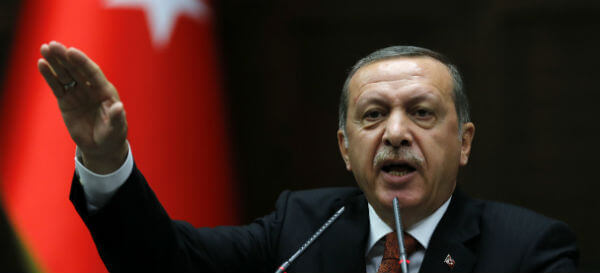
erdogan

The Wall Street Journal reports: After 13 years of being methodically marginalized during Recep Tayyip Erdogan’s tenure atop Turkish politics, the army is regaining its clout as the president sidelines his political rivals.

Turkey’s military, which has forced four civilian governments from power since 1960, is re-emerging as a pivotal actor alongside Mr. Erdogan, who has long viewed the army as a potentially dangerous adversary.

Mr. Erdogan’s moves to sideline political opponents — he forced out his handpicked prime minister this month amid a power struggle — has cleared the way for Turkey’s generals to play a greater role in shaping Mr. Erdogan’s attempts to extend his global influence.

Turkish generals are tempering Mr. Erdogan’s push to send troops into Syria, managing a controversial military campaign against Kurdish insurgents, and protecting Turkey’s relations with Western allies who view the president with suspicion. By steering clear of politics, they re-emerged as a central player in national security decisions.

“The Turkish military is the only agent that wants to put on the brakes and create checks-and-balances against Erdogan,” said Metin Gurcan, a former Turkish military officer who now works as an Istanbul-based security analyst.

It is in Syria where the military is most clearly acting as a check on the president. When Mr. Erdogan last year debated sending Turkish forces into Syria to set up a safe zone for those fleeing the fighting, military leaders expressed strong reservations, former Turkish officials and allies of Mr. Erdogan said. That, they said, helped put the idea on hold.

The debate returned last week when Mr. Erdogan threatened to send Turkish troops into Syria to end weeks of Islamic State rocket attacks on a Turkish border town.

Sending large numbers of combat troops into Syria is still a hard sell for the military, allies of Mr. Erdogan and U.S. officials said. If Turkey were to act without the support of the U.S. and its other North Atlantic Treaty Organization allies, the military fears its soldiers could be bombed by Russian jets and would face international condemnation.

“This is a very realistic headquarters. They know what Turkey’s armed forces are capable of. They’re not adventurous,” said Can Kasapoglu, a defense analyst with the Center for Economic and Foreign Policy Studies, a Turkish think tank.

The Turkish military and Mr. Erdogan’s press office both declined to discuss their relationship.

The restoration of the Turkish army’s influence has resurrected concerns all the way up to the presidential palace that generals might try to topple Mr. Erdogan, a polarizing figure whose extensive crackdown on domestic dissent has triggered alarm in Western capitals, according to people familiar with the matter. [Continue reading…]

Facebooktwittermail

Activists claim: Ben Rhodes told us he’s ‘not proud of our Syria policy’

The Daily Beast reports: Senior White House official Ben Rhodes told Syrian-American activists at a gathering on Wednesday that he was “not proud” of the Obama administration’s Syria policy, according to three people who participated in the interchange.

But Rhodes waved off any suggestion that the United States should be responsible for a conflict that has left millions displaced and hundreds of thousands dead, those attendees said.

“We aren’t proud of our Syria policy — but we don’t have any good options… nothing we could have done would have made things better,” Rhodes said, according to three individuals present: Ibrahim Al-Assil, a fellow at the Middle East Institute; Kenan Rahmani, a policy adviser with the Coalition for a Democratic Syria, and a third individual, who requested to stay anonymous.
Ned Price, a spokesman for the National Security Council disputed the activists’ characterization of the conversation. Rhodes “in no way indicted or distanced himself from our Syria policy,” Price said.

The three activists, as well as a fourth activist, the Syrian American Council’s Omar Hossino, were present for various parts of the conversation with Rhodes. Hossino told The Daily Beast that he began to weep as he told Rhodes about the cost in human life that had taken place as a result of the war, and excused himself from the conversation.

“We’re not the ones killing Syrians. [President Bashar al-]Assad is the one killing people,” Rhodes said, according to three of the individuals present.

It was, as one advocate said, a poor explanation. “It would be as if the Bush administration argued that ‘a hurricane destroyed New Orleans, so it’s not our responsibility,’” Al-Assil told The Daily Beast. [Continue reading…]

Facebooktwittermail

Hezbollah avoids blaming Israel for death of top commander in Syria

The Washington Post reports: In a surprise announcement Saturday, Lebanon’s Hezbollah militia blamed the recent killing of a militant described as its top commander in Syria on extremist Sunni insurgents. Many expected the powerful Shiite group to point a finger at its traditional nemesis, Israel.

Hezbollah revealed a day earlier that Mustafa Badreddine, one of its most senior figures, died in a mysterious blast in Damascus, the Syrian capital. Before leading thousands of militants in Syria, Badreddine, 55, is suspected of having roles in the assassination of a Lebanese prime minister in 2005, and other bombings that date to the attack on the U.S. Marine barracks in Beirut in 1983.

Analysts said Friday that ­Badreddine’s killing appeared to bear the hallmarks of an airstrike by Israel, which has targeted a number of the Lebanese militants in Syria in recent years. But in a statement, Hezbollah blamed it on “artillery bombardment carried out by takfiri groups in the area.”

Hezbollah uses “takfiri,” an ­Arabic word, to describe its extremist Sunni Muslim enemies, including al-Qaeda and the Islamic State.

Hezbollah didn’t specify which group killed Badreddine or when he died.

But the Syrian Observatory for Human Rights, a Britain-based monitoring group, said there has been no shelling for more than a week in the area where Hezbollah said Badreddine was killed, Reuters reported.

If Hezbollah had blamed Israel for his death, the group would have come under pressure to launch a tough retaliation that, in turn, would risk triggering war. Israel and Hezbollah fought a brief but devastating war in 2006. [Continue reading…]

Facebooktwittermail

Kurdish tensions undermine the war against ISIS

Hassan Hassan writes: Amnesty International has in seven months issued two major reports highlighting allegations of war crimes by rebel and Kurdish forces in northern Syria. The two reports are related to a secondary conflict brewing between Arabs and Kurds from Hasakah to Qamashli to Aleppo, which could easily spin out of control and add to the many conflicts that already plague the country.

The United States has an unintentional hand in this new conflict, and de-escalation hinges largely on whether Washington is willing to review its strategy in northern Syria, which sometimes privileges the appearance of success in the battle against ISIL over sustainable policies.

On Friday, Amnesty published a damning new report accusing rebel factions in Aleppo, organised under the Army of Conquest, of committing acts that may amount to war crimes. The rights group said it gathered strong evidence of indiscriminate attacks that killed at least 83 civilians, including 30 children, in the Kurdish-dominated Sheikh Maqsoud between February and April.

On October 13 last year, Amnesty issued a report, Forced Displacement and Demolitions in Northern Syria, accusing the Kurdish political party PYD, the Democratic Union Party, of carrying out a wave of forced displacement and home demolitions that it also said may amount to war crimes. The shelling of civilians by rebel forces cannot be justified, and perpetrators must be punished and restrained by their regional backers. The attacks on Sheikh Maqsoud were encouraged by some supporters of the opposition living abroad, after the PYD’s military wing, the YPG, attacked the rebels in February. Worse, such calls continue to be heard and more indiscriminate attacks can be expected. [Continue reading…]

Facebooktwittermail

Belgium to begin air strikes against ISIS in Syria

AFP reports: Belgium will extend its F-16 air strikes against Islamic State jihadists in Iraq into Syria, the government said Friday, as it grapples with the aftermath of deadly IS-claimed bomb attacks in Brussels in March.

“In accordance with UN Resolution 2249, the engagement will be limited to those areas of Syria under the control of IS and other terrorist groups,” a spokesman for Prime Minister Charles Michel told AFP after a cabinet meeting.

“The objective will be to destroy these groups’ refuges,” the spokesman said, adding that the strikes would begin on July 1.

Belgium launched its first attacks against IS in Iraq in late 2014 as part of the US-led coalition, but decided against strikes in Syria amid public fears over getting dragged into a wider conflict. [Continue reading…]

Facebooktwittermail

What happened to billions in U.S. military aid to Egypt?

Julian Pecquet writes: The Egyptian government is hindering Washington’s ability to track billions of dollars worth of anti-aircraft missiles and other US weapons, the US government watchdog said in a blistering report just as Congress gets ready to renew the annual $1.3 billion request.

The United States provided $6.5 billion in military assistance to Cairo between 2011 and 2015 with the understanding that it would be closely monitored and it would serve American interests. Instead, the Government Accountability Office (GAO) asserts that the Obama administration has often failed to meet those requirements due to resistance from their Egyptian counterparts, lack of guidance from Washington and insufficient staffing at the US Embassy in Cairo.

The State Department and the Defense Department (DOD) have established programs “to provide reasonable assurance that military equipment transferred or exported to foreign governments is used for its legitimate intended purposes and does not come into the possession of individuals or groups who pose a threat to the United States or its allies,” the GAO said in its May 12 report. “However, gaps in the implementation of these end-use monitoring programs — in part due to limited cooperation from the Egyptian government — hampers DOD’s and State’s ability to provide such assurances.” [Continue reading…]

Facebooktwittermail

How Russia allowed homegrown radicals to go and fight in Syria with ISIS

Reuters reports: Four years ago, Saadu Sharapudinov was a wanted man in Russia. A member of an outlawed Islamist group, he was hiding in the forests of the North Caucasus, dodging patrols by paramilitary police and plotting a holy war against Moscow.

Then his fortunes took a dramatic turn. Sharapudinov, 38, told Reuters that in December 2012 Russian intelligence officers presented him with an unexpected offer. If he agreed to leave Russia, the authorities would not arrest him. In fact, they would facilitate his departure.

“I was in hiding, I was part of an illegal armed group, I was armed,” said Sharapudinov during an interview in a country outside Russia. Yet he says the authorities cut him a deal. “They said: ‘We want you to leave.’”

Sharapudinov agreed to go. A few months later, he was given a new passport in a new name, and a one-way plane ticket to Istanbul. Shortly after arriving in Turkey, he crossed into Syria and joined an Islamist group that would later pledge allegiance to radical Sunni group Islamic State.

Reuters has identified five other Russian radicals who, relatives and local officials say, also left Russia with direct or indirect help from the authorities and ended up in Syria. The departures followed a pattern, said Sharapudinov, relatives of the Islamists and former and acting officials: Moscow wanted to eradicate the risk of domestic terror attacks, so intelligence and police officials turned a blind eye to Islamic militants leaving the country. Some sources say officials even encouraged militants to leave. [Continue reading…]

Facebooktwittermail

Struggling to fight ISIS in a fractured Libya

Frederic Wehrey writes from Sabratha, Libya: Ahmed “Amu” Dabbashi, the 28-year-old leader of a militia in this seaside town near the Tunisian border, proudly unfurls a black Islamic State flag, seized during late-February raids on safe houses of ISIS, as the group is also known. He shows me a captured arsenal, too: truck-borne explosives, detonators, crates of ammo, crew-served machine guns, and identification cards of foreign fighters.

Days earlier, American warplanes had bombed an Islamic State training site at a nearby house. Then, Amu tells me, “we decided to cleanse our town.” In the raids that followed, fighters for the so-called caliphate struck back, assaulting a police station and cutting the throats of several officers. Scores of youths perished in gunbattles.

Elsewhere across Libya, disparate factions are trying to hold the line against ISIS, often tenuously. The terrorist group is most entrenched in the central city of Sirte. Refugees fleeting Sirte tell me that ISIS extorts businesses and stops traffic to conduct executions.

In late March, a new presidential council — formed under the auspices of a U.N.-brokered unity agreement — arrived with great fanfare in the capital of Tripoli. Washington and its allies had hoped this would provide a foundation for a military campaign against ISIS. But after an initial burst of public enthusiasm, the council is struggling to exert its authority.

The fight against Islamic State faces daunting challenges. First, there still is no unified military structure through which the U.S. and Western allies can channel assistance. A powerful eastern faction allied with Gen. Khalifa Haftar remains hostile to the unity agreement and has tried to sell oil independently from Tripoli. Other militias, even if nominally supporting the new government, remain beholden to towns, tribes and power brokers.

Thus, Western special forces must work with militia surrogates in any operations against Islamic State. But this is risky: Assisting these armed groups could rekindle old rivalries and further reduce the incentives for national reconciliation.

Militias have figured out that signing up for the campaign against Islamic State is the best way to get legitimacy and attention. Whether or not they intend to use outside support solely against ISIS is another story. Many still regard their local rivals as the pressing concern. In some cases, the West may find them unsavory partners: traffickers, hard-line Salafists, tribal supremacists, military officers with authoritarian and anti-Islamist leanings.

This is evident in Sabratha, where Amu’s extended family has had longtime links with smugglers and jihadists. In the capital of Tripoli, a Salafist militia leader lets me tour his prison’s rehabilitation center, where Islamic State suspects are thrown in with drug addicts for undefined stretches with no due process. In a trip to Benghazi last fall, I saw how neighborhood militias carried out what amounts to personal and tribal vendettas, all under the cover of combating Islamic State. [Continue reading…]

Facebooktwittermail

U.S. establishes Libyan outposts with eye toward offensive against ISIS

The Washington Post reports: American Special Operations troops have been stationed at two outposts in eastern and western Libya since late 2015, tasked with lining up local partners in advance of a possible offensive against the Islamic State, U.S. officials said.

Two teams totaling fewer than 25 troops are operating from around the cities of Misurata and Benghazi to identify potential ­allies among local armed factions and gather intelligence on threats, according to the officials, who spoke on the condition of anonymity to discuss a sensitive mission overseas.

The insertion of a tiny group of U.S. personnel into a country rife with militant threats reflects the Obama administration’s worries about the Islamic State’s powerful Libyan branch and the widespread expectations of an expanded campaign against it. For months, the Pentagon has been developing plans for potential action against the group, which has at least several thousand fighters in the coastal city of Sirte and other areas. And the U.S. personnel, whose ongoing presence had not been previously reported, is a sign of the acceleration toward another military campaign in Libya.

The mission is also an illustration of President Obama’s reliance on elite units to advance counterterrorism goals in low-visibility operations. [Continue reading…]

Facebooktwittermail

No, Donald Trump has not softened his stance on banning Muslims

The Washington Post reports: As headlines popped up this week declaring that Donald Trump had softened his position on banning most foreign Muslims from entering the United States, some Republicans celebrated the news.

“Glad he’s walking it back,” Sen. Jeff Flake (R-Ariz.) tweeted on Thursday.

Except that Trump has not actually walked anything back. The presumptive Republican nominee still wants to ban nearly all members of the world’s fastest-growing religion from entering the United States in an effort to prevent terrorist attacks. [Continue reading…]

Facebooktwittermail