The Guardian reports: Leaked documents show how Facebook, now the biggest news distributor on the planet, relies on old-fashioned news values on top of its algorithms to determine what the hottest stories will be for the 1 billion people who visit the social network every day.
The documents, given to the Guardian, come amid growing concerns over how Facebook decides what is news for its users. This week the company was accused of an editorial bias against conservative news organizations, prompting calls for a congressional inquiry from the US Senate commerce committee chair, John Thune.
The boilerplate about its news operations provided to customers by the company suggests that much of its news gathering is determined by machines: “The topics you see are based on a number of factors including engagement, timeliness, Pages you’ve liked and your location,” says a page devoted to the question “How does Facebook determine what topics are trending?”
But the documents show that the company relies heavily on the intervention of a small editorial team to determine what makes its “trending module” headlines – the list of news topics that shows up on the side of the browser window on Facebook’s desktop version. The company backed away from a pure-algorithm approach in 2014 after criticism that it had not included enough coverage of unrest in Ferguson, Missouri, in users’ feeds. [Continue reading…]
Category Archives: News
War crimes in Aleppo and Daraya
Amnesty reports: Armed groups surrounding the predominantly Kurdish Sheikh Maqsoud district of Aleppo city have repeatedly carried out indiscriminate attacks – possibly including with chemical weapons – that have struck civilian homes, markets and mosques, killing and injuring civilians, and have displayed a shameful disregard for human life, said Amnesty International today.
Two of the armed groups conducting attacks on Sheikh Maqsoud – Ahrar al Sham and Army of Islam – have sent representatives to the UN-brokered negotiations on Syria in Geneva, while the others have approved delegates to represent them at the talks.
There are around 30,000 civilians living in Sheikh Maqsoud, a district controlled by the Kurdish People’s Protection Unit (YPG) forces, and the area has come under sustained attack from opposition armed groups who control areas to the north, east and west of the district.
Among the weapons used by the armed groups are unguided projectiles which cannot be accurately aimed at specific targets, including home-made “Hamim” rockets and projectiles fitted with gas canisters known as “hell cannons”.
Amnesty has obtained the names of at least 83 civilians, including 30 children, who were killed by attacks in Sheikh Maqsoud between February and April. More than 700 civilians were also injured, according to the local field hospital. Video evidence seen by Amnesty shows artillery shelling, and rocket and mortar attacks carried out by the Fatah Halab (Aleppo Conquest) coalition of armed groups in the area, targeting YPG forces. [Continue reading…]
Vice News reports: Omar’s daughter is two months old, but he still hasn’t met her. He lives in Daraya, a rebel-controlled suburb of Damascus that’s besieged by the Syrian regime. His wife and child live just a few kilometers to the west, in the neighboring rebel suburb of Moadamiya. The Syrian army cut the road between the two enclaves in January shortly before his daughter was born.
On Thursday, Omar eagerly awaited the arrival of an international aid convoy that was scheduled to bring medicine and baby formula into Daraya. The Syrian government agreed to the delivery, and it was organized by the United Nations, the International Committee of the Red Cross (ICRC), and the Syrian Arab Red Crescent.
It would have been the first convoy to reach Daraya since it was first besieged in 2012 — but the trucks didn’t make it to the town.
According to the ICRC, it was turned away at the last checkpoint outside of Daraya. Just minutes after the convoy was sent back, the Local Council of Daraya — a committee that operates as the local government — reported that the Syrian army had shelled a group of civilians who’d gathered to receive the aid. A father and son were killed and five other civilians were injured, the council said.
The Syrian Observatory for Human Rights, a British-based monitoring group, said Syrian troops loyal to President Bashar al-Assad’s regime had fired into the town.
After the shelling, Omar rushed to a nearby field hospital where the wounded were being treated.
“The people are now filled with frustration and anger,” he told VICE News via messaging app. “To be honest, at this point we no longer trust the international community or the UN.”
Though it’s just a 20-minute drive from the center of Damascus, Daraya is one of the most isolated places in Syria: it’s been under siege for over four years, and it’s one of the few areas where no aid convoys have ever been permitted to enter. According to residents interviewed by VICE News, people survive on meager meals of lentil and rice soup that are often fortified with weeds or grass. The water supply was cut off two years ago. [Continue reading…]
Mustafa Badreddine, Hezbollah military commander, is killed in Syria
The New York Times reports: Mustafa Amine Badreddine, Hezbollah’s top military commander, who was directing its operations in Syria and was accused in a string of deadly attacks stretching across decades, has been killed in Damascus, Hezbollah officials confirmed on Friday.
Mr. Badreddine, 55, had been overseeing Hezbollah’s forces in Syria, which have been decisive in keeping President Bashar al-Assad in power through five years of war with various rebel and militant Islamist groups seeking to topple him.
Mr. Assad is a close ally of Hezbollah’s patron, Iran, which has long provided a conduit to supply Hezbollah with weapons to battle Israel. Now, Hezbollah is the most powerful of several Iran-backed Shiite paramilitary groups that, along with Iranian forces, are playing an ever more prominent role on the battlefield in Syria.
It remained unclear who was behind Mr. Badreddine’s death: Israel, or one of the insurgent groups Hezbollah has been fighting.
Hezbollah, which confirmed the death on Al Manar, its television network, said that Mr. Badreddine died in a “huge blast” near the Damascus airport, in which several of the group’s fighters were wounded. “The investigation will find out the nature of the blast as well as its reasons, and whether it was a result of an airstrike or rocket attack,” it said.
The timing of the attack was not provided. A Beirut-based television network, Al Mayadeen, which is also close to Hezbollah, initially reported that Mr. Badreddine had been killed in an Israeli airstrike, but it later removed that report. [Continue reading…]
The Guardian reports: Born in the southern Beirut suburb of Ghobeiry on 6 April 1961, Badreddine had a pronounced limp, believed to have been sustained while he fought alongside pro-Palestinian and pan-Arabist militias during the Israeli invasion of Lebanon in 1982.
His nom de guerre was Sayyed Zul Fikar: Sayyed indicating a claimed descent from the prophet Muhammad; Zul Fikar being the name of the legendary forked sword of Imam Ali, the prophet’s cousin and one of the most revered figures in Shia Islam.
Badreddine was arrested and sentenced to death in Kuwait in 1983 over his suspected involvement in a string of coordinated bombings in the tiny Gulf emirate that also targeted the US and French embassies. They were believed to be retribution for Kuwait and the west’s support for Iraq in its war with Iran.
The sentence, which had to be formally approved by the emir, was never carried out, perhaps as a consequence of a series of attacks and plane hijackings demanding the release of the Kuwait attackers, and which allegedly involved Mughniyeh. It was also never carried out because when the Iraqi dictator Saddam Hussein invaded Kuwait in August 1990, he threw open the doors of the country’s prisons, allowing Badreddine to escape.
This is where the trail disappears. It only emerges again in 2011, when UN prosecutors investigating a 2005 Beirut bombing that killed Lebanon’s prime minister, Rafik Hariri, indicted Badreddine. They alleged he was the coordinator of a sophisticated network that tracked and ultimately assassinated the popular billionaire. [Continue reading…]
Beijing is setting the stage for war in the South China Sea

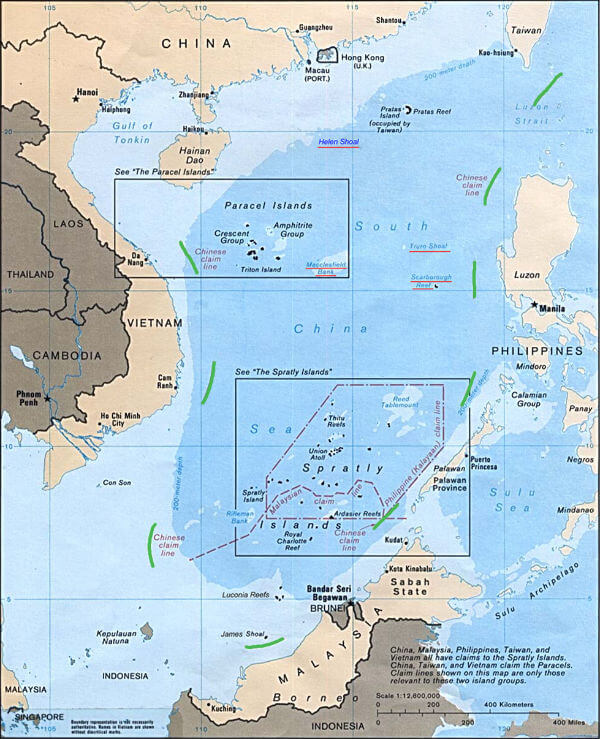
Steve Mollman writes: All any nation needs to go to war is a good provocation, and China is no exception. With its sweeping territorial claims, island-building, militarization, patriotic fervor, and prickly rhetoric, Beijing is setting itself up to be repeatedly provoked in the South China Sea. It might even be counting on it.
Consider the nation’s manmade, militarized island at Fiery Cross Reef in the Spratly archipelago. Though it didn’t even exist a few years ago, and for decades ships from other nations could routinely sail by it without disturbance, now Beijing feels provoked if anyone goes near it — and sends out warnings or makes aggressive gestures in response.
This week the USS William P. Lawrence, a guided missile destroyer from the US Navy, conducted a “freedom of navigation” operation near the island. It deliberately sailed within 12 nautical miles of Fiery Cross Reef. If the US recognized the reef as China’s territory to begin with — which it does not — that would be considered entering China’s territory.
The problem is China has claimed, outrageously, that nearly the entire sea is its own territory. Considering the fact that some $5 trillion in ship-borne trade passes through the strategic waterway every year, that’s a problem not just for the US, but any number of countries participating in the global economy. The US Navy’s operation was a reminder to China that the sea is open waters, despite any impromptu islands that might have been constructed of late.
China bases its sea claim on a “nine-dash line” that it drew on a map after World War 2. Never mind that the line conflicts with international norms and overlapping claims by nearby nations, including the Philippines, Vietnam, and Malaysia, nations whose coasts are much closer to the disputed sea than China’s. [Continue reading…]
Bill and Melinda Gates Foundation divests entire holding in BP
The Guardian reports: The Bill and Melinda Gates Foundation has sold off its entire holding in oil giant BP, in a move welcomed by fossil fuel divestment campaigners.
Bill Gates has called the selling off of coal, oil and gas stocks a “false solution” to climate change, but the known investments of his foundation in major fossil fuel companies has fallen by 85% since 2014.
The foundation, which has spent many billions of dollars improving global health, sold its $187m stake in BP between September and December 2015, according to recent regulatory filings to the US Securities and Exchange Commission (SEC).
It had previously dumped its entire $824m holding in ExxonMobil. BP posted a record $6.5bn annual loss in February while ExxonMobil is under investigation about whether it lied in the past to investors about the threat of climate change.
The Guardian’s Keep it in the Ground campaign has called on the Gates foundation to divest its $40bn endowment from fossil fuels. [Continue reading…]
Saudia Arabia and Iran: The Cold War of Islam
Der Spiegel reports: No previous US president had been made to suffer such an indignity when visiting America’s supposedly closest ally in the Arab world: When Barack Obama touched down at the airport in Riyadh in mid-April, King Salman opted to remain in his palace. The most powerful man in the world was received by the governor of Riyadh instead. There was no pomp or ceremonial reception and state-controlled television declined to broadcast the arrival. Obama seemed slightly at a loss on the tarmac before trying to cover up the affront with a broad smile.
The message was clear: Saudi Arabia feels as though it has been left in the lurch by America and is not afraid to show that it isn’t happy.
The story of the failed reception is more than just an anecdote from the international diplomatic stage. It serves to illustrate the massive geo-political shift and the growing conflict that has gripped the entire Middle East. It has become the Cold War of our era, pitting Saudi Arabia against Iran, the two rivals that are striving for supremacy in the region. And it is not entirely clear which side the US is on.
The Middle East as we have long known it is changing dramatically. And no matter where one looks, Tehran and Riyadh are standing behind at least one of the parties involved in the conflict. The kingdom of Saudi Arabia, host and protector of the holy sites in Mecca and Medina, sees itself as the home of Sunni Islam, to which the majority of the world’s Muslims belong. The Islamic Republic of Iran, a Shiite theocracy, claims leadership of the Shiites, which make up roughly 13 percent of Muslims worldwide. For both regimes, religion is an important tool of power.
Today’s bloodiest civil war, the conflict in Syria, is entering its sixth year and has thus far cost the lives of more than 250,000 people — and the cease-fire that has been in place for the last two months doesn’t look as though it will last much longer. In Syria, and also in the conflicts in Iraq and in Yemen, the fighting fronts run primarily along confessional lines: Sunnis against Shiites. A fragile peace holds in Lebanon and Bahrain, but it is one that could be shattered at any time by confessional unrest.
All of these proxy wars and confessional conflicts have unleashed a wave of migration among those who have been displaced: more than 6 million people from Syria and Iraq along with almost 3 million from Yemen. And out of the rubble of the Middle East, hydra-headed monster has risen that seeks to terrorize Brussels, Paris, Istanbul and the rest of the world: Islamic State. In an irony of history, the Sunni terror militia sees both Iran and Saudi Arabia as its enemies.
At its essence, the escalation in the Middle East also has to do with America and its changing role in the world. After decades of enmity with Iran, US President Barack Obama wanted to restart a dialogue with the country and he negotiated a nuclear treaty with Tehran. The hope is that the deal will limit Iran’s ability to pursue a nuclear weapon while making it possible for the country to do business with the West in return.
At the same time, though, the US would prefer to withdraw from this complicated, crisis-plagued region of the world. Current developments are also a product of this trend.
Iran, meanwhile, following decades of isolation, would like to revert to its former position of regional importance. The more Middle Eastern countries there are under the control of Shiites, the stronger Iran feels — and the more hard-pressed Saudi Arabia feels, a country whose rulers once rose to power by way of a pact with Sunni fundamentalists, the Wahhabis.
This new Cold War affects the entire world, making it vital to search out its causes and to scrutinize what is pushing Saudi Arabia and Iran to continue on the path of escalation. A team of SPIEGEL reporters went to both countries to investigate and spoke with politicians, religious leaders, activists, intellectuals and normal people on the streets. [Continue reading…]

Bernie Sanders could still win the Democratic nomination — no, seriously
Seth Abramson writes: Last night on CNN, while discussing Bernie Sanders’ landslide victory over Hillary Clinton in West Virginia — which followed a 5-point Sanders win in Indiana last week — Michael Smerconish said that “Democratic super-delegates might have to rethink” their support of Hillary Clinton given how dramatically better Sanders fares in head-to-head match-ups against Donald Trump.
After Clinton’s Indiana loss, John King had told CNN viewers that “if Sanders were to win nine out of ten of the remaining contests, there’s no doubt that some of the super-delegates would panic. There’s no doubt some of them would switch to Sanders. What he has to do is win the bulk of the remaining contests. Would that send jitters, if not panic, through the Democratic Party? Yes. Yes it would.”
So what gives? Isn’t this thing over?
Almost, but not quite.
What Smerconish (and Wolf Blitzer) were discussing last night, and John King was discussing last week, is a very simple theory — call it “run-the-table” — which is easy enough to understand if you simply know the history of Democratic super-delegates and what’s happened in the 2016 Democratic primary since Super Tuesday.
So here it is — both a brief history of the “super-delegate” and an explanation of the “run-the-table” scenario that increasingly is making it into the mainstream media. [Continue reading…]
Why many of Iran’s ‘moderates’ say they prefer Trump to Clinton
Jeremy Shapiro and Ellie Geranmayeh write: Much of the world seems fairly put off by Donald Trump. Europeans are annoyed that he has threatened to withdraw from NATO. The Japanese and South Koreans seem upset about his intention to withdraw US troops from their shores. Mexicans dislike him so much they are selling Donald Trump piñatas like hotcakes. Even the Chinese seem worried about his idea to slap them with a 45 percent tariff and his support for a nuclear-armed Japan.
So does anyone outside of America like Trump? Many people point to Russian President Vladimir Putin. He and Trump have expressed admiration for each other’s leadership qualities. But beyond Putin, there is (unsurprisingly) little foreign support for Trump’s trademark blend of American nationalism and xenophobia.
Recent conversations, however, have led us to suspect that there might be another country of potential Trump supporters out there: Iran. [Continue reading…]
Trump’s empty administration

Politico reports: Top Republican political leaders aren’t the only ones shunning their party’s presidential nominee — a vast number of highly skilled managers and policy experts, veterans of recent GOP administrations who would normally be expected to fill key positions for a new White House, are also vowing to sit out a Donald Trump presidency.
And while the failure of the two Presidents Bush or House Speaker Paul Ryan to endorse the presumptive nominee carries political consequences, the absence of policy veterans in a new administration would have a substantive effect on the running of government.
POLITICO interviewed nearly five dozen Republicans over the past two weeks — people with experience working in government and who understand how Congress can enact, or shred, a new president’s agenda — and heard the same sentiment expressed repeatedly. If Trump doesn’t change his tune or extend much longer olive branches, many of these government veterans say they intend to cede highly coveted administration posts to less-experienced competitors.
“I would never serve in a Trump administration,” said James Capretta, a former Office of Management and Budget official under George W. Bush. “The person at the top is unfit for the presidency. He’s made that very clear with his behavior.” [Continue reading…]
Behind the carnage in Iraq: ISIS intends to divide and conquer
The Daily Beast reports: Baghdad suffered its deadliest day in months during a series of attacks Wednesday. The carnage not only shocked the capital, but also raised questions about whether Iraqi security forces are capable of reclaiming Mosul, Iraq’s second-largest city, which has been occupied for almost two years by the self-proclaimed Islamic State.
One obvious question is how Iraqi security forces can retake and secure Mosul if they cannot protect Baghdad from three suicide bombings in a matter of hours. But the picture is more complicated, and indeed, more problematic even than that.
The bombings targeted Shia neighborhoods in what appears to be part of the continuing ISIS effort to provoke a frenzy of ethnic cleansing similar to that of a decade ago. As one U.S. official immersed in the anti-ISIS war puts it, “Sunnis see ISIS as their protection — their wall against Shia revenge.”
The estimates of those killed Wednesday are as high as 150, with hundreds more injured. Among those reportedly killed were several women at a hair salon struck by a truck bomb as they prepared for their wedding day. [Continue reading…]
Lack of plan for ISIS detainees raises human rights concerns
The New York Times reports: The Islamic State calls them “inghimasi” — zealous foot soldiers who intend to fight to their deaths. And as the American-backed coalition has reclaimed territory from the group in Iraq and Syria, that fervor has kept prisoners from being much of a problem: The shooting only stops when almost every Islamic State fighter has been killed.
But that could change as the coalition moves toward the Islamic State’s largest urban strongholds — Mosul, Iraq, and Raqqa, Syria — raising a potential problem for the United States. If the coalition is successful and thousands of ordinary members of a collapsing Islamic State have nowhere left to retreat, will they start to surrender in greater numbers? And if so, who will be responsible for imprisoning them?
After the experiences of the past decade in the wars in Afghanistan and Iraq, the Obama administration is determined not to revive large-scale detention operations. But it is far from clear whether allies on the ground — especially rebels in Syria — are prepared to hold large numbers of prisoners, raising the prospect of an ugly aftermath to any victory.
“If they’re not killed but detained, we are concerned about the standards of care, who would do it and how it would be done,” Peter Maurer, the president of the International Committee of the Red Cross, said in an interview. [Continue reading…]
The FBI is keeping 80,000 secret files on the Saudis and 9/11
The Daily Beast reports: The Obama administration may soon release 28 classified pages from a congressional investigation that allegedly links Saudis in the United States to the 9/11 attackers. A former Republican member of the 9/11 Commission alleged Thursday that there was “clear evidence” of support for the hijackers from Saudi officials.
But in Florida, a federal judge is weighing whether to declassify portions of some 80,000 classified pages that could reveal far more about the hijackers’ Saudis connections and their activities in the weeks preceding the worst attack on U.S. soil.
The still-secret files speak to one of the strangest and most enduring mysteries of the 9/11 attacks. Why did the Saudi occupants of a posh house in gated community in Sarasota, Florida, suddenly vanish in the two weeks prior to the attacks? And had they been in touch with the leader of the operation, Mohamed Atta, and two of his co-conspirators?
No way, the FBI says, even though the bureau’s own agents did initially suspect the family was linked to some of the hijackers. On further scrutiny, those connections proved unfounded, officials now say.
But a team of lawyers and investigative journalists has found what they say is hard evidence pointing in the other direction. Atta did visit the family before he led 18 men to their deaths and murdered 3,000 people, they say, and phone records connect the house to members of the 9/11 conspiracy. [Continue reading…]
Bob Graham: Release the uncensored truth about 9/11
Former senator Bob Graham writes: Nearly 15 years after the horrific events of 9/11, President Obama must decide whether to release 28 pages of information withheld as classified from the publicly released report of the congressional inquiry into the terrorist attacks that killed thousands of Americans.
On April 10, the CBS program “60 Minutes” aired a story about the missing 28 pages. I was one of several former public officials — including former House Intelligence Committee chairman and CIA director Porter Goss (R-Fla.) ; Medal of Honor recipient and former senator Bob Kerrey (D-Neb.); former Navy secretary John Lehman; and former ambassador and representative Tim Roemer (D-Ind.) — who called on the White House to declassify and release the documents.
Two days after that broadcast, I received a call from a White House staff member who told me that the president would make a decision about the 28 pages no later than June. While that official made no promises as to what Obama would do, I viewed the news as a step in the right direction. [Continue reading…]
U.S. activates Romanian missile defense site, angering Russia
Reuters reports: The United States switched on an $800 million missile shield in Romania on Thursday that it sees as vital to defend itself and Europe from so-called rogue states but the Kremlin says is aimed at blunting its own nuclear arsenal.
To the music of military bands at the remote Deveselu air base, senior U.S. and NATO officials declared operational the ballistic missile defense site, which is capable of shooting down rockets from countries such as Iran that Washington says could one day reach major European cities.
“As long as Iran continues to develop and deploy ballistic missiles, the United States will work with its allies to defend NATO,” said U.S. Deputy Defence Secretary Robert Work, standing in front of the shield’s massive gray concrete housing that was adorned with a U.S. flag.
Despite Washington’s plans to continue to develop the capabilities of its system, Work said the shield would not be used against any future Russian missile threat. “There are no plans at all to do that,” he told a news conference.
Before the ceremony, Frank Rose, deputy U.S. assistant secretary of state for arms control, warned that Iran’s ballistic missiles can hit parts of Europe, including Romania. [Continue reading…]
WHO report: Europe trails U.S. in cutting air pollution

The New York Times reports: European countries, which rely heavily on diesel-fueled vehicles, remain far behind the United States in their efforts to reduce harmful air pollution, according to a report to be issued Thursday by the World Health Organization.
The report, which compiled air quality readings from 3,000 cities in 103 countries, found that more than 80 percent of people in those cities were exposed to pollution exceeding the limits set by W.H.O. guidelines, above which air quality is considered to be unhealthy. And in poorer countries, 98 percent of cities with more than 100,000 inhabitants were out of compliance with the health organization’s guidelines.
Lower levels of pollution were far more prevalent in North America and higher-income European countries than in most other places, especially countries like India, Pakistan and China.
But in Europe, a higher percentage of cities exceeded the limits set by the W.H.O. than in North America.
That disparity was greatest in wealthier countries; more than 60 percent of European cities failed to meet the guidelines, compared with less than 20 percent in North America. [Continue reading…]
Michael Ratner, lawyer who won rights for Guantánamo prisoners, dies at 72
The New York Times reports: Michael Ratner, a fearless civil liberties lawyer who successfully challenged the United States government’s detention of terrorism suspects at Guantánamo Bay without judicial review, died on Wednesday in Manhattan. He was 72.
The cause was complications of cancer, said his brother, Bruce, a developer and an owner of the Brooklyn Nets.
As head of the Center for Constitutional Rights, Michael Ratner oversaw litigation that, in effect, voided New York City’s wholesale stop-and-frisk policing tactic. The center also accused the federal government of complicity in the kidnapping and torture of terrorism suspects and argued against the constitutionality of warrantless surveillance by the National Security Agency, the waging of war in Iraq without the consent of Congress, the encouragement of right-wing rebels in Nicaragua and the torture at the Abu Ghraib prison during the Iraq war.
“Under his leadership, the center grew from a small but scrappy civil rights organization into one of the leading human rights organizations in the world,” David Cole, a former colleague at the center and a professor at Georgetown Law School, said in an interview this week. “He sued some of the most powerful people in the world on behalf of some of the least powerful.” [Continue reading…]
World’s carbon dioxide concentration teetering on the point of no return

The Guardian reports: The world is hurtling towards an era when global concentrations of carbon dioxide never again dip below the 400 parts per million (ppm) milestone, as two important measuring stations sit on the point of no return.
The news comes as one important atmospheric measuring station at Cape Grim in Australia is poised on the verge of 400ppm for the first time. Sitting in a region with stable CO2 concentrations, once that happens, it will never get a reading below 400ppm.
Meanwhile another station in the northern hemisphere may have gone above the 400ppm line for the last time, never to dip below it again.
“We’re going into very new territory,” James Butler, director of the global monitoring division at the US National Oceanographic and Atmospheric Administration, told the Guardian.
When enough CO2 is pumped into the atmosphere from burning fossil fuels, the seasonal cycles that drive the concentrations up and down throughout the year will eventually stop dipping the concentration below the 400ppm mark. The 400ppm figure is just symbolic, but it’s psychologically powerful, says Butler.
The first 400ppm milestone was reached in 2013 when a station on the Hawaiian volcano of Mauna Loa first registered a monthly average of 400ppm. But the northern hemisphere has a large seasonal cycle, where it increases in summer but decreases in winter. So each year since it has dipped back below 400ppm.
Then, combining all the global readings, the global monthly average was found to pass 400ppm in March 2015.
In the southern hemisphere, the seasonal cycle is less pronounced and atmospheric levels of CO2 hardly drop, usually just slowing in the southern hemisphere summer months. This week scientists revealed to Fairfax Media that Cape Grim had a reading of 399.9ppm on 6 May. Within weeks it would pop above 400ppm and never return.
“We wouldn’t have expected to reach the 400ppm mark so early,” said David Etheridge, an atmospheric scientist from the CSIRO, which runs the Cape Grim station. “With El Nino, the ocean essentially caps off it’s ability to take up heat so the concentrations are growing fast as warmer land areas release carbon. So we would have otherwise expected it to happen later in the year.
“No matter what the world’s emissions are now, we can decrease growth but we can’t decrease the concentration. [Continue reading…]
Russia’s new missile means the nuclear arms race is back on

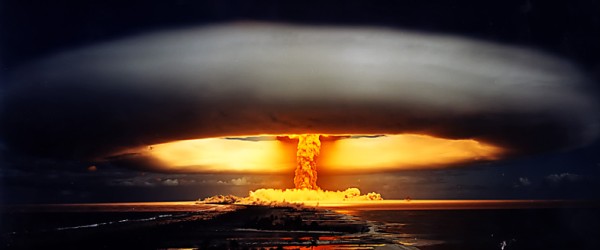
David Axe reports: Russia has a new nuclear missile — one that Zvezda, a Russian government-owned T.V. network, claimed can wipe out an area “the size of Texas or France.”
Actually, no, a single SS-30 rocket with a standard payload of 12 independent warheads, most certainly could not destroy Texas or France. Not immediately. And not by itself.
Each of the SS-30’s multiple independently targetable reentry vehicle warheads, or MIRVs, could devastate a single city. But Texas alone has no fewer than 35 cities of 100,000 people or more.
Which is not to say the instantaneous destruction of a dozen cities and the deaths of millions of people in a single U.S. state wouldn’t mean the end of the world as we know it.
Nobody nukes just Texas. And if Russia is disintegrating Texan cities, that means Russia is also blasting cities all over the United States and allied countries — while America and its allies nuke Russia right back.
Moscow’s arsenal of roughly 7,000 atomic weapons — 1,800 of which are on high alert — and America’s own, slighly smaller arsenal — again, only 1,800 of which are ready to fire at any given time — plus the approximately 1,000 warheads that the rest of the world’s nuclear powers possess are, together, more than adequate to kill every human being on Earth as well as most other forms of life.
One new Russian rocket doesn’t significantly alter that terrible calculus.
But that doesn’t mean you shouldn’t be alarmed. The SS-30 is only the latest manifestation of a worrying trend. After decades of steady disarmament, the United States and Russia are pouring tens of billions of dollars into building new and more capable nuclear weaponry that experts agree neither country needs, nor can afford.
The SS-30 by itself is just slightly more destructive than older Russian missiles. It’s what the new weapon represents that’s frightening. The post-Cold War nuclear holiday is over. And apocalyptic weaponry such as Russia’s new SS-30 are back at work making the world a very, very scary place. [Continue reading…]