Category Archives: News

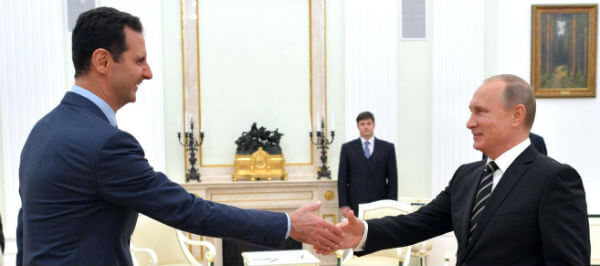
The secret pact between Russia and Syria that gives Moscow carte blanche

assad-putin

The Washington Post reports: When you are a major nuclear power and you want to make a secretive deployment to a faraway ally, what is the first thing you do? Draw up the terms, apparently, and sign a contract.

That’s what the Kremlin did with Syria in August, according to an unusual document posted this week on a Russian government website that details the terms of its aerial support for Syrian President Bashar al-Assad.

Among other revelations in the seven-page contract dated Aug. 26, 2015, the Kremlin has made an open-ended time commitment to its military deployment in Syria, and either side can terminate it with a year’s notice.

Russian military personnel and shipments can pass in and out of Syria at will and aren’t subject to controls by Syrian authorities, the document says. Syrians can’t enter Russian bases without Russia’s permission. And Russia disclaims any responsibility for damage caused by its activities inside Syria. Since Russia’s bombing campaign started at the end of September, Assad’s forces have been able to recapture some territory from rebels, and much of the humanitarian aid to the country has come to a halt. A war that already looked intractable now seems more so. [Continue reading…]

Jadaliyya has an English translation of the contract.

Facebooktwittermail

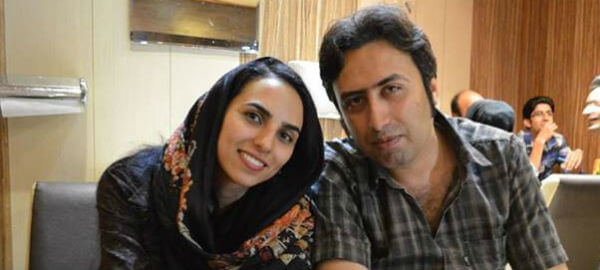
Two Iranian poets, facing lashings and prison, escape country

Fatemeh-Ekhtesari-Mehdi-Mousavi

The Associated Press reports: Two Iranian poets who face lashings and prison sentences have fled Iran, one of the writers said Monday, a rare escape for local artists and activists ensnared in an ongoing crackdown on expression in the country.

Fatemeh Ekhtesari and Mehdi Mousavi’s freedom came as world powers lifted sanctions on Iran over its contested nuclear program and as the country separately freed four Iranian-Americans in exchange for seven Iranians held in the U.S.

The poets’ escape is a reminder that despite the growing detente with the West, hard-liners still exert control over much of life in the Islamic Republic.

Ekhtesari told The Associated Press on Monday that both she and Mousavi escaped from Iran in recent days and made it to another country. She declined to elaborate out of continuing concerns about their safety.

Ekhtesari faced an 11½-year prison sentence, while Mousavi faced nine years on charges ranging from propaganda against the state to “insulting sanctities.” Each was sentenced to 99 lashings. They likely were targeted because their work is known abroad. Both are self-described “postmodern Ghazal” poets who seek to revive the traditional Persian love sonnet by applying it to contemporary political and social issues. [Continue reading…]

Facebooktwittermail

Why are we looking on helplessly as markets crash all over the world?

Will Hutton writes: There has always been a tension at the heart of capitalism. Although it is the best wealth-creating mechanism we’ve made, it can’t be left to its own devices. Its self-regulating properties, contrary to the efforts of generations of economists trying to prove otherwise, are weak.

It needs embedded countervailing power – effective trade unions, law and public action – to keep it honest and sustain the demand off which it feeds. Above all, it needs an ordered international framework of law, finance and trade in which it can do deals and business. It certainly can’t invent one itself. The mayhem in the financial markets over the last fortnight is the result of confronting this tension. The oil price collapse should be good news. It makes everything cheaper. It puts purchasing power in the hands of business and consumers elsewhere in the world who have a greater propensity to spend than most oil-producing countries. A low oil price historically presages economic good times. Instead, the markets are panicking.

They are panicking because what is driving the lower oil price is global disorder, which capitalism is powerless to correct. Indeed, it is capitalism running amok that is one of the reasons for the disorder. Profits as a share of national income in Britain and the US touch all-time highs; wages touch an all-time low as the power of organised labour diminishes and the gig economy of short-term contracts takes hold. The excesses of the rich, digging underground basements to house swimming pools, cinemas and lavish gyms, sit alongside the travails of the new middle-class poor. These are no longer able to secure themselves decent pensions and their gig-economy children defer starting families because of the financial pressures. [Continue reading…]

Facebooktwittermail

U.S. investigating Moscow’s divide and rule strategy in Europe

The Telegraph reports: American intelligence agencies are to conduct a major investigation into how the Kremlin is infiltrating political parties in Europe, it can be revealed.

James Clapper, the US Director of National Intelligence, has been instructed by the US Congress to conduct a major review into Russian clandestine funding of European parties over the last decade.

The review reflects mounting concerns in Washington over Moscow’s determination to exploit European disunity in order to undermine Nato, block US missile defence programmes and revoke the punitive economic sanctions regime imposed after the annexation of Crimea.

The US move came as senior British government officials told The Telegraph of growing fears that “a new cold war” was now unfolding in Europe, with Russian meddling taking on a breadth, range and depth far greater than previously thought.

“It really is a new Cold War out there,” the source said, “Right across the EU we are seeing alarming evidence of Russian efforts to unpick the fabric of European unity on a whole range of vital strategic issues.”

A dossier of “Russian influence activity” seen by The Sunday Telegraph identified Russian influence operations running in France, the Netherlands, Hungary as well as Austria and the Czech Republic, which has been identified by Russian agents as an entry-point into the Schengen free movement zone.

The US intelligence review will examine whether Russian security services are funding parties and charities with the intent of “undermining political cohesion”, fostering agitation against the Nato missile defence programme and undermining attempts to find alternatives to Russian energy.

Officials declined to say which parties could come into the probe but it is thought likely to include far-right groups including Jobbik in Hungary, Golden Dawn in Greece, the Northern League in Italy and France’s Front National which received a 9m euro (£6.9m) loan from a Russian bank in 2014. [Continue reading…]

Facebooktwittermail

ISIS in Gaza

Sarah Helm writes: In a house in Rafah, at the southern edge of Gaza, I met Sheikh Omar Hams, fifty-one years old, a slender figure dressed in a simple white robe and seated on a mattress on the floor. Hams is director of the Ibn Baz Islamic Institute, based in Rafah, where it also runs a bakery and charity outlets. His mission, he says, is to spread the word of the Prophet Muhammad and to give bread and other aid to the homeless and the poor.

Hams is a Salafist sheikh. “A Salaf means an original ancestor—one of those who lived close to the Prophet and observed his actions intimately, followed his ways and his words literally,” he explains. The sheikh teaches his students how to return to those ways, and they in turn spread the word. Unlike many Salafis, who abhor any rational argument about the literal meaning of the Koran, Hams is open to at least some debate. And though sometimes willing to support violent jihad, he accepts that violence is often not justified, preferring instead to secure a return to original Islam through the use of prayer, study, and preaching.

Pulling his legs underneath him, the sheikh prepares for questions on how the Prophet might have viewed the methods of Daesh (ISIS) — also Salafists — and on the battle to contain its influence across the world, most particularly here in Gaza.

Since 2007 Hamas has been the de facto government of Gaza, albeit under Israeli rule — a rule implemented nowadays by means of a military and naval blockade by air, land, and sea, which is described by the United Nations Secretary General, Ban Ki Moon, as “a collective penalty against the people of Gaza.” Hamas is itself an Islamist resistance movement, with a resistance “army” called al-Qassam, but Hamas members are seen as infidels by ISIS since they place the nationalist battle for a Palestinian state before the campaign for a caliphate. Hamas’s willingness to negotiate with Israel and to agree to a cease-fire last summer was seen by ISIS as the latest demonstration of its collaboration. ISIS supporters inside Gaza have shown their opposition and tried to break the cease-fire by firing rockets into Israel, thereby angering Hamas and risking heavy Israeli retaliation. [Continue reading…]

Facebooktwittermail

Genocide in Diyala: Iraqi officials warn of sectarian cleansing

The New Arab reports: Iraqi officials have raised the alarm of a “genocide” against Sunni Muslims in the eastern province of Diyala, where Shia militia groups wield huge influence.

The warnings come after the Islamic state group [IS] carried out twin bombings at a cafe frequented by government-allied militiamen in the Diyala town of Miqdadiyah on Monday, killing at least 24 people and wounding 52.

Angry mobs responded to the Miqdadiyah bombings by blowing up several Sunni mosques, completely destroying two of them, killing an imam, and burning Sunni-owned houses and shops. [Continue reading…]

Facebooktwittermail

The Burkina Faso attack shows how al-Qaeda is exploiting weak governments in West Africa

Omar Mohammed reports: The attacks in Burkina Faso that left 28 people dead and 55 injured point to an increasing security challenge in West Africa, where, analysts say, militant groups affiliated to Al-Qaeda and Islamic State are taking advantage of fragile and weak states to hit western targets.

This is the second time in a couple of months that militants launched an assaulted directed at an establishment popular with foreigners. In neighboring Mali last November, in a similar fashion to what happened at the Splendid Hotel in Ouagadougou, gunmen stormed the Radisson Hotel in Bamako and took 170 people hostage and ultimately killing 21 people many of whom westerners.

In both of these cases, the militant group Al-Qaeda in the Islamic Maghreb (AQIM) claimed responsibility.

AQIM, which traces its roots to the Algerian civil conflict in the 1990s and became an al-Qaeda affiliate in mid-2000s, has increasingly focused their strategies on targets located in countries that are either weak or unstable. In west Africa, it has targeted Algeria, Niger, Mali killing people and carrying out kidnappings for ransom, all done with the objective of ridding the region of what they perceive to be the corrupting influence of the West. [Continue reading…]

Facebooktwittermail

This is where 90 percent of global warming is going

The Washington Post reports: Scientists have known for some time that when global warming occurs, the oceans will be the site of the most profound response.

The reason is simply that they are able to retain vastly more heat than the atmosphere. “Ninety, perhaps 95 percent of the accumulated heat is in the oceans,” said Peter Gleckler, an oceanographer at the Lawrence Livermore National Laboratory. The physical reason is that water has a far greater heat “capacity” than air, requiring more energy to raise its temperature — something that is apparent to anyone who has ever tried to boil it on a stove.

Gleckler is the lead author of a new study in the journal Nature Climate Change finding that, in the past two decades, ocean heat content has been rising rapidly and that, much more than before, heat is also mixing into the deeper layers of the ocean, rather than remaining near the surface. [Continue reading…]

Facebooktwittermail

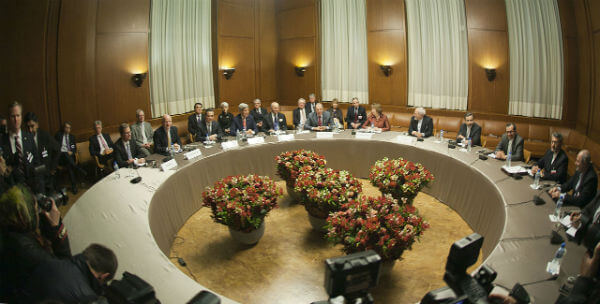
Was the Iran deal worth it?

iran-deal

Last July, after the Joint Comprehensive Plan of Action agreement on Iran’s nuclear program had been reached in Vienna, Shadi Hamid wrote: It was clear from the start of the uprising [in Syria] that Obama did, in fact, have a clear objective – minimizing U.S. involvement as much as possible. But there are other places, such as Iraq, where the Obama administration was pulled back in despite (or, more likely, because of) its best efforts. The unwillingness to rethink Syria strategy in any serious way has been reinforced by the momentum of the Iran negotiations. Why rock the boat and potentially provoke a major international incident, when progress was being made on Iran’s nuclear program? Why even take the chance with so much at stake? “Linkage,” moreover, was been built in to the policy process. As the journalist Josh Rogin noted: “All Syria proposals at State must go through the office of the undersecretary for political affairs, Wendy Sherman, who is also the administration’s lead negotiator over a nuclear deal with Iran.”

On the specifics of a deal, I tend to think, like many, that the U.S. made too many concessions, without getting enough in return. According to the New York Times, in the final days of talks, a television anchor on a hardline Iranian channel said: “The fact is, Obama needs this deal much more than we do.” She went on: “The American president needs a victory, and only a deal with Iran can give him that. They have retreated on several issues and compromised on their own red lines.” Whether or not this perception is fair, it’s a perception nonetheless, and perceptions drive behavior.

Others have noted that Iran, due to its deteriorating economy, needed a deal more than the U.S. did. This is almost certainly true. But while Iran may have needed it more, the U.S. wanted it more – or, at the very least, seemed like it did. Some of this, to be fair, was outside the U.S.’s control. The perception had already solidified throughout the region, drawing on 6 years of observing the Obama administration’s handling of various crises, most notably the backing down from stated “red lines” in Syria. Allies, such as Egypt, and enemies, such as Syria, have grown confident that we’ll blink first in a staring contest, in part because we usually do. This was why I was skeptical that any final deal could ever be the best possible deal. The administration has had tendency to misuse and/or underestimate its leverage in some of our most important bilateral relationships. As the negotiations wrapped to a close, there was no obvious way to address this. It was too late. We couldn’t change how Iran viewed the Obama administration.

There was a related asymmetry during the negotiations. As Pollack writes, “I don’t think that Iran values a nuclear deal as much as it does its positions in these various countries.” With us, it was the reverse: we cared less about Iran’s positions in various countries and more about its nuclear program. This, too, was built in to the talks.

Some are troubled that most people had strong opinions about the deal before reading the actual text of the agreement. One certainly hopes that legislators will eventually read at least some of it. But the specifics of the deal aren’t, ultimately, as important as the broader issues and implications, and those aren’t anywhere to be found in the text. Here, I tend to agree with my colleague Jeremy Shapiro who argued in April that that the devil wasn’t in the details. The details “really don’t matter.” He goes on: “At heart, this is a fight over what to do about Iran’s challenge to U.S. leadership in the Middle East and the threat that Iranian geopolitical ambitions pose to U.S. allies.”

In other words, your position on the Iran deal is likely to depend on how you view the Middle East and America’s role in it more broadly. If you see the Syrian civil war as a, or even the, core regional conflict, then you’re probably worried about the $100 billion in potential sanctions relief. Iran, even we assume it chooses butter over guns as American officials hope and uses, say, only 3 percent of that total, will have $3 billion more to prop up the Syrian regime and other regional allies and proxies. It also depends on your starting assumptions about the nature of the Iranian regime. Are Iranian leaders “rational,” and do you think it matters whether “moderates,” such as President Rouhani and Foreign Minister Zarif, are empowered over their “hardline” counterparts?

For me, at least one other issue comes into play, and it’s a factor which has pushed me to be more supportive of the Iran deal than I expected to be. It’s striking how little discussion there has been about what Iranians think and want. As small-d democrats, Americans should always at least take into account public opinion in other countries. Presumably, Iranians know their country better than American politicians do. According to opinion polls, a majority of Iranians favor a deal. We all saw the pictures of ordinary Iranians celebrating the framework agreement in April. This time around, the regime has been more careful, closing off public spaces, with hardliners warning of the dangers of Iran Deal-induced “happiness.” Importantly, as Nader Hashemi notes, “some of the most vociferous defenders of a nuclear deal with the West are Iranian civil society and human rights activists.” It makes little sense for us to say that an Iran deal will make progress on human rights less likely, when Iran’s own human rights activists seem to think the opposite. In a survey of 22 leading human rights activists, support for ongoing negotiations was “unanimous,” while over half believed that a deal would lead to a significant improvement in human rights in Iran. Of course, they could be wrong, but we shouldn’t bet on that.

To be sure, the link between a deal and the empowerment of Iranian reformers, as intuitive as it might seem, is far from guaranteed. As many have noted, conservatives may be just as likely to gain from a deal for any number of reasons. What seems inescapable, however, is that the failure of negotiations would have been a major, perhaps even decisive loss for Iran’s reformist trend. President Hassan Rouhani, who buoyed expectations with his come-from-behind election victory two years ago, has been losing popularity and goodwill. On human rights, he pledged to expand personal freedoms and broaden space for civil society. As for the economy, it can sputter along, as it has, but without sanctions relief, Rouhani’s hands are tied. His raison d’etre, then, depends on a successful deal. Without one, we would have likely had more of the same: conservatives in control and dominating the country’s politics. Now at the least there is a glimmer of possibility, even if the road toward substantive reforms remains a difficult one.

Taking these various, and very different, factors into account, the deal is, on balance, a mixed bag. I don’t think an Iran nuclear deal deserved the near-obsessive focus it received from this administration. Too much was subsumed and compromised due to the desire for a deal, an administration priority which took precedence over nearly everything else. Now that a deal has been concluded, U.S. officials may have more room to maneuver. Of course, the implementation of a deal will still require constant attention, to say nothing of the domestic fight which is still to come. But perhaps, at some point, the U.S. will be able to act and think beyond Iran’s nuclear program and re-focus attention on the broader issues and conflicts in which Iran plays a major role. The U.S. will now come under pressure to “compensate” (or overcompensate depending on your perspective). It will need to reassure skeptical Gulf allies that it will do more to counter Iran’s regional designs. I agree with Ken Pollack that the best place to do this is probably in Syria. As he writes: “In the aftermath of an Iranian nuclear deal, finally executing the Administration’s proclaimed strategy for Syria, may be the best and only way to regain control over the dangerous confrontation escalating between Iran and America’s Arab allies.”

Now that President Obama’s legacy, however controversial, is secure (both on domestic and foreign policy), he can afford to do the very things he wasn’t willing to do when Iran negotiations were the overwhelming focus. That doesn’t mean he will do them, but that’s where, I hope, the debate over a post-Iran deal Middle East can now turn.

Even after the deal was signed, Obama may have felt his hands remained tied on at least two counts: it remained to be seen whether Iran would follow through in implementing the requirements for sanctions to be lifted, and as we have now just learned, secret negotiations were still under way to secure the release of five Americans imprisoned in Iran. They have now been released and sanctions have been lifted.

One thing that no one was anticipating last July was the impact of Russia’s unforeseen intervention in Syria.

Iran’s president today tweeted:


But stock markets across the Middle East just saw “£27bn wiped off their value” in anticipation of the new wave of Iranian oil flowing into an already flooded market.

Al Jazeera reports:

With the sanctions now removed, Iran is ready to increase its crude oil exports by 500,000 barrels a day, Deputy Oil Minister Amir Hossein Zamaninia was quoted as saying by the Shana news agency on Sunday.

Iran’s return to an already glutted oil market is one of the factors contributing to a global rout in oil prices, which fell below $30 a barrel last week for the first time in 12 years. Iran is the world’s fourth largest oil producer.

The administration sold the Iran deal by claiming that no deal would make another major war inevitable. The ongoing war in Syria was left out of the equation.

The question now is whether that war is any closer to ending or whether, on the contrary, its conclusion is even further away.

I’m inclined to believe that Shadi Hamid’s assessment last July — that Obama’s objective has always been to minimize U.S. involvement in Syria as much as possible — is just as accurate today as it was then.

If Obama is preoccupied with his legacy, he should be asking himself whether his presidency will be remembered more for what he accomplished through negotiations with Iran or more for what he failed to do as the rest of the region unraveled.

Facebooktwittermail

Mini-republics: A Syrian village seeks to survive amid carnage

Christoph Reuter reports: The St. Lucie cherry trees were in bloom when the calamity began. It was not unexpected. Indeed, the men of Korin and surrounding villages had done their part to bring it about. Since winter, after two years of an almost static front line, they quickly overran several of the Syrian army’s last outposts in the Idlib Province. And soon after regime troops fled the eponymously named provincial capital at the end of March, the bombs arrived. It is a pattern that has often been seen in Syria: Soon after rebels take an army base, an airport or a city, the air force arrives to pound them from above.

For weeks, regime helicopters circled at an altitude beyond the range of rebel weapons and repeatedly dropped half-ton barrel bombs on Korin. On at least one occasion, a cylinder full of chlorine gas outfitted with detonators was dropped on the village, which is located some 40 kilometers (25 miles) south of the Turkish border. Sukhoi jets appeared between the clouds and fired rockets at those buildings that were still intact. Thirty-one people died — a number smaller than it might have been because the residents of Korin, accustomed as they are to fleeing violence, had retreated to the olive groves that surround the village when the first bombs started to fall. For a while, they lived in tiny shacks among the trees — shelters that had been built in more peaceful times.

The air strikes began to wane around the time when the olive trees bloomed. The jets were needed elsewhere; additional villages were in need of punishment. And in Korin, the villagers returned from the olive groves. Soon, around three-quarters of the erstwhile population of 11,000 were again living in the town, collecting stones and organizing cement and tarps to repair their homes. If the war weren’t still going on, one could almost have called it a peaceful summer.

It was the calm between the storms — a fragile calm, not unlike that of a tiny boat on the high seas. After all, Korin and the entire region surrounding it, with hundreds of towns and villages, have been living for almost four years in a state of anarchy.

It is almost as though someone had devised a wicked experiment to see what happens when everything that serves public order is suddenly removed. When police, courts and indeed the entire state simply disappears without a new one replacing it. And when the old state reappears periodically to spread death and destruction. It is a situation reminiscent of End Times science fiction tales in which marauding hordes find themselves in a constant battle for fuel, water and women. But what is it really like? [Continue reading…]

Facebooktwittermail

Iran sanctions: Middle East stock crash wipes £27bn off markets as Tehran enters oil war

oil-industry

The Telegraph reports: Stock markets across the Middle East saw more than £27bn wiped off their value as the lifting of economic sanctions against Iran threatened to unleash a fresh wave of oil onto global markets that are already drowning in excess supply.

All seven stock markets in the Gulf states tumbled as panic gripped traders. London shares are now braced for a second wave of crisis to hit when they open on Monday morning after contagion from China sent the FTSE 100 to its worst start in history last week.

Dubai’s DFM General Index closed down 4.65pc to 2,684.9, while Saudi Arabia’s Tadawul All Share Index, the largest Arab market, collapsed by 7pc intraday, before recovering to end down 5.44pc at 5,520.41, its lowest level in almost five years. [Continue reading…]

Facebooktwittermail

International sanctions against Iran lifted

The Washington Post reports: Iran reentered the global economy Saturday as years of crippling international sanctions ended in exchange for the verified disabling of much of its nuclear infrastructure.

For Iran, implementation of the landmark deal it finalized with six world powers last summer means immediate access to more than $50 billion in long-frozen assets and freedom to sell its oil and purchase goods in the international marketplace. Tehran has hailed the deal as vindication of its power and influence in the world.

“Today marks the start of a safer world,” said Secretary of State John F. Kerry. “We understand this marker alone will not wipe away all the concerns the world has rightly expressed about Iran’s policies in the region. But we also know there isn’t a challenge in the entire region that wouldn’t become much more complicated, much worse, if Iran had a nuclear weapon.” [Continue reading…]

Facebooktwittermail

Prisoner swap: Obama’s secret second channel to Iran

Robin Wright writes: urteen months ago, President Obama authorized a top-secret, second diplomatic channel with Tehran to negotiate freedom for Americans who had disappeared or been imprisoned in Iran. It was a high-risk diplomatic gamble. The initiative grew out of nuclear negotiations, launched in the fall of 2013, between Iran and the world’s six major powers. On the margins of every session, Wendy Sherman, the top American negotiator, pressed her Iranian counterparts about the American cases. The Iranians countered with demands for the release of their citizens imprisoned in the United States for sanctions-busting crimes. More than a year of informal discussions between Sherman and her counterpart, Majid Takht Ravanchi, the Iranian Foreign Ministry official in charge of American and European affairs, led to an agreement, in late 2014, that the issue should be handled separately — but officially — through a second channel. After debate within the Administration, Obama approved the initiative. But it was so tightly held that most of the American team engaged in tortuous negotiations on Iran’s nuclear program were not told about it.

What heightened the risk was the fact that the new Iranian team was headed by a senior intelligence official, a sharp departure from the traditional but still tentative diplomatic channels with the Iranian Foreign Ministry developed in the nuclear talks. The involvement of Iranian intelligence made prospects far more unpredictable — and potentially controversial. Brett McGurk, a senior State Department official, headed the small American team, which also included officials from the Department of Justice, the F.B.I., and the intelligence community. The meetings — facilitated by the Swiss government and often held in Geneva — repeatedly hit snags, complications, legal hurdles, and last-minute demands. The swap — officially referred to as a “humanitarian gesture” — came close to fruition three times over more than a year of secret meetings, only to collapse again and again, an Iranian official said. [Continue reading…]

Facebooktwittermail

Old myths perpetuate poor analysis of Saudi Arabia

Hassan Hassan writes: Economic sanctions on Iran have been lifted. The removal of sanctions, which will release billions of dollars worth of frozen assets and bring Iran in from the cold, comes exactly two weeks after a diplomatic spat with Saudi Arabia brought the region to boiling point.

Both of these events could have profound international implications for Saudi Arabia. After the diplomatic row, the kingdom came under fierce media attack and was generally portrayed as an irresponsible regional player that deliberately provoked Iran by executing the Saudi religious cleric Nimr Al Nimr. Such depictions do not bode well for the kingdom as it prepares for the entry of a regional rival into the international arena.

Broadly speaking, much of the punditry about Saudi Arabia and the Gulf states at large tends to rely on old facts and myths – mostly dating back to the 1990s.

Perpetuating old stereotypes about Saudi Arabia’s foreign policy ignores the progress –and indeed the drastic changes – that have taken place over the past decade. More importantly, they also reduce Iran’s role in the neighbourhood to a geopolitical rivalry with its neighbours, rather than casting this role in its true light, as an aggressive sectarian agenda that claimed the lives of thousands of people and perpetuated conflict and civil strife.

To better understand Iran’s behaviour, consider the policies of the two countries since the eruption of the Arab uprisings five years ago. [Continue reading…]

Facebooktwittermail

American victim of Cologne sex attacks recounts how she was rescued by Syrian refugees

At the core of Christianity is the commandment to “love your neighbor as you love yourself,” so you’d think that in a country with so many loudly professing Christians, there really wouldn’t be any debate about whether America should welcome refugees.

Indeed, when it came to clarifying who should be described as a neighbor, Jesus chose to illustrate this teaching through a parable that cast a Samaritan — considered by most Jews at that time as an enemy — as the exemplar of the principle of universal love.

The teaching doesn’t go: love your neighbors after they’ve been vetted by the FBI, so long as you’re sure they’re Christian, and so long as you own a gun to protect yourself.

After the mass sex attacks in Cologne helped fuel a new round of anti-refugee hysteria, a Good Samaritan story has emerged in which a 27-year-old American woman recounts how she was saved that night by the intervention of strangers — a group of men who turned out to be Syrian refugees.

The New York Times reports: Caught up in a melee of drunken revelers outside the Cologne train station on New Year’s Eve, Caitlin Duncan, a neuroscience student from Seattle, was terrified. She had somehow gotten separated from her German boyfriend, who had both their cellphones and her wallet. Ms. Duncan, 27, said that she was quickly surrounded and groped by several young men: One snatched her hat from her head, another tried to kiss her face and neck.

Like many of the hundreds of women who later said they had been assaulted in the crowd, Ms. Duncan sought help from the police, but said the officers were too busy trying to clear the square. But unlike other victims, whose complaints of attacks by foreigners of North African and Arab descent have ignited new debate about Germany’s ability to absorb migrants, Ms. Duncan said she was rescued by a group of Syrian asylum seekers.

Amid the swirl of criminal chaos, it seems, there were also acts of chivalry.

As the crowd swelled and grew more unruly, Ms. Duncan said, a stranger came up and asked if she needed help. Both of them spoke broken German, so the stranger summoned a friend who spoke English. He was Hesham Ahmad Mohammad, from Aleppo, Syria, who had met up in Cologne for the holiday with six or seven other Syrian refugees scattered around Germany.

The men offered Ms. Duncan money for a taxi to her boyfriend’s parents’ home: “the only address I knew,” she said. They would happily have called her boyfriend, Sebastian Samer, but Ms. Duncan had relied on speed-dial and could not remember the number. “I know there’s a lot of 7s,” she thought, “but that’s not helping me right now.”

She persuaded the men to form a kind of cordon around her so they could move through the crowd. She described her boyfriend to them, and they eventually found him inside the station. She cried. “I was just so relieved,” she recalled later.

Mr. Ahmad Mohammad, a former primary-school teacher, said he had left Aleppo, a scene of tremendous fighting in the Syrian civil war, in 2014 for Turkey, and had arrived in Germany via the Balkans and Austria in September. He said he had left his wife and two sons in a village near the Syrian-Turkish border and was living in a small town near Cologne with two other Syrians, studying German as he awaited asylum.

He said in a telephone interview on Friday that he and his friends had also felt unsafe on New Year’s, and blamed “bad boys” who were “drinking, and I think taking marijuana or something. They lost their minds.” Now, they worry that Germans and other Europeans are drawing conclusions that will make it harder for new arrivals. [Continue reading…]

Facebooktwittermail

Ramadi — another city destroyed in an effort to save it from ISIS

The Associated Press reports: So complete was the destruction of Ramadi that a local reporter who had visited the city many times hardly recognized it.

“Honestly, this is the main street,” Amaj Hamid, a member of Iraq’s elite counterterrorism forces, told the TV crew as they entered from the southwest.

He swerved to avoid the aftermath of months of fighting: rubble, overturned cars and piles of twisted metal. Airstrikes and homemade bombs laid by the Islamic State group had shredded the poured-concrete walls and ceilings of the houses and shops along the road.

Ramadi, once home to about 500,000 people, now largely lies in ruins. A U.N. report released Saturday used satellite imagery to assess the devastation, concluding that more than 3,000 buildings had been damaged and nearly 1,500 destroyed in the city 70 miles (115 kilometers) west of Baghdad.

All told, more than 60 percent of Anbar’s provincial capital has been destroyed by constant air bombardment and the scorched-earth practices of IS fighters in retreat, according to local estimates. [Continue reading…]

Facebooktwittermail

Burkina Faso attack demonstrates al Qaeda revival in Africa

CNN reports: Al Qaeda in the Islamic Maghreb, often seen as a fractured and undisciplined group, apparently has carried out its second major terror attack in two months — claiming more than 20 lives in the assault on a luxury hotel and two other targets in Ouagadougou, the capital of Burkina Faso.

The gun attack on the Splendid Hotel bears many similarities to that on the Radisson Blu hotel in Bamako, Mali, on November 20 in which 22 people were killed.

Both targets were popular with Westerners and international (especially U.N). officials; they were “soft,” rather than military installations or police stations. The attackers (two in Bamako, possibly four in Ouagadougou) were armed with automatic weapons, their aim to kill and then take as many hostages as possible.

And both operations apparently were carried out by an AQIM group called Al Mourabitoun.

The group’s statement after the latest attack claimed the Splendid Hotel was “frequented by staff of the nations of global disbelief;” the attack was “to punish the cross-worshippers for their crimes against our people in Central Africa, Mali, and other lands of the Muslims.” [Continue reading…]

Facebooktwittermail

Mokhtar Belmokhtar, ‘The Uncatchable’ desert jihadist

AFP reports: Wily one-eyed Mokhtar Belmokhtar, whose jihadists have claimed the attack on a hotel in Burkina Faso, shot to global notoriety with a spectacular assault on an Algerian gas field in 2013, but had long been known as “The Uncatchable”.

Washington has offered a $5 million (4.7 million euros) bounty for the 43-year-old, born and bred in the Algerian desert, and of all the jihadist leaders in the Sahel region straddling the southern Sahara, it is Belmokhtar who is most wanted.

He was behind the 2013 attack on the In Amenas natural gas complex in the remote south of his homeland, in which 39 hostages and 29 Islamists were killed.

And his Al-Murabitoun group, an Al-Qaeda affiliate, also claimed responsibility for the jihadist siege at the Radisson Blu hotel in Mali’s capital Bamako that left 20 dead in November, including 14 foreigners. [Continue reading…]

Facebooktwittermail