Al Jazeera reports: When a giant Royal Dutch Shell rig arrived last Thursday at the Port of Seattle, it was an unwelcome sight for a number of city officials and environmentalists. The 300-foot tall Polar Pioneer is one of two drilling rigs that Shell plans to use to explore for oil off the coast of Alaska this summer.
Earlier this month, the city declared that the port, where Shell has rented space to store its fleet, would need a new permit to house the rigs. The oil giant responded defiantly, hauling the mammoth platform into port without city approval. On late Monday, Seattle issued a notice of violation to the port, Shell and Foss Maritime, the company leasing the space to Shell.
The notice arrived amid several days of protests over the rig. Earlier on Monday, Seattle city councilor Kshama Sawant, a socialist and former Occupy activist, joined a few hundred demonstrators who blocked the gates of the terminal where the rig is moored. “The eyes of the world are on Seattle this week,” said Margo Polley, a city transportation worker who participated in the protest on her day off. “Hopefully we can build this movement, make it huge and stand up to these fossil fuel giants.” [Continue reading…]
Category Archives: News
ISIS controls 50% of Syria after seizing historic city of Palmyra
The Guardian reports: Islamic State now holds sway over half of Syria’s landmass after its seizure of Palmyra, where it has begun massacring a rebellious tribe and faces no opposition to its entry and sacking of the historic city’s ancient ruins.
“There are no forces to stop them [entering the ruins],” Rami Abdul Rahman, director of the Syrian Observatory for Human Rights monitoring group, said. “But the important thing also is they now control 50% of Syria.”
Isis seized Palmyra on Wednesday night after a week-long siege that led to the collapse of forces loyal to Bashar al-Assad. The militants are drawing closer to his strongholds of Homs and Damascus and severing supply lines to Deir Ezzor in the east, which faces an overpowering Isis crackdown.
Local activists said Isis had imposed a curfew and was sweeping the city for remnants of Assad’s forces. Isis has also massacred members of the Shaitat tribe, which fought alongside the Assad regime in Palmyra and had railed against Isis in Deir Ezzor – a rebellion in which the militant group killed 800 members of the tribe.
Control of Palmyra leaves Isis with unopposed access to the city’s magnificent ruins, amid fears that they will destroy significant chunks of Syria’s heritage as they did in Iraq.
But more significantly, Isis controls vast swaths of Syria, from Palmyra to Raqqa and Deir Ezzor in the country’s west, a tract that the Syrian Observatory for Human Rights estimates to be 95,000 sq km, or more than half Syria’s landmass. With its seizure of the Arak and al-Hail gas fields near Palmyra, it also controls much of the country’s electricity supply – those two fields power much of the Syrian regime’s strongholds in the west. [Continue reading…]
The Daily Beast adds: According to Khaled Omran, a member of the Palmyra’s anti-Assad Coordinating Committee, the regime tried to reinforce its collapsing front lines Wednesday with detainees from the notorious Tadmour Prison. Most, however, ran away from the ISIS onslaught rather than stay and fight for their jailers. “I saw about 10 busloads of prisoners being driven to the front,” Omran said Wednesday evening via Skype. “Maybe 1,000 men.” They added to the regime’s “thousands” of soldiers and forcibly conscripted tribal militias who were used, in Omran’s words, as “cannon fodder.”
Assad’s military were stationed throughout the city and its outlying districts, which are home to several security installations, including an important airbase that Iran’s Revolutionary Guards Corps has used in the past to deliver resupplies to its overstretched and attrited ally, and the Syrian air force has used to wage sorties on mostly civilian and non-ISIS targets in the war-torn country. However, the use of prisoners to defend against ISIS stands as an interesting contrast to how the terror army did the jailbreaking in Ramadi earlier in the week in order to swell their own ranks.
“Four days ago, ISIS started their preparations to storm” Palmyra, Omran explained. “Regime forces called in reinforcements, mainly to the military security branch and the citadel, but relied heavily on their air force. The number of ISIS fighters was quite small—they were in the hundreds. They weren’t very heavily equipped, save for antiaircraft guns mounted on trucks in six positions around the city.” These rudimentary air defenses were enough to deter to the fighter planes and attack helicopters. “I didn’t see them down any jets, but the guns were enough to deter most of the aerial assaults.” [Continue reading…]
Oryx Blog says: With the strategically important town of al-Sukhna falling just over a week before, and the Iraqi city of Ramadi just days before Tadmur, it appears the Islamic State is far from being under control, and possibly attempting to revive the seemingly unstoppable upmarch of last summer.
Tadmur [Palmyra], which is also home to Tadmur airbase, is of high strategic importance due to its position at the base of the vital M20 highway, which leads through the recently fallen al-Sukhna to the regime’s last holdout in the East of the country: Deir ez-Zor. Without access to this highway and with little prospect of retaking both of the Islamic State’s newest gains, the Assad-regime will face extreme difficulty in keeping its troops in Deir ez-Zor supplied, and the fall of the city and associated airbase might soon become inevitable.
The town of Tadmur is best known for the ancient Roman monuments and ruins, which, given the Islamic State’s history with the destruction of historical sites, is now feared to be a target for vandalism. Although this aspect will likely incite a lot of coverage from Western media, it should not be forgotten that there are also thousands of lives at stake, with hundreds of casualties reported so far and many dead, despite earlier reporting from Syrian State Media that citizens were being evacuated. Of course, with mainstream media eager to find new stories that might interest a diverse public, events such as renewed poison gas attacks and the current offensive are less likely to be covered than a story on ancient Roman ruins in danger of destruction.
Also of great importance are the massive weapon depots located in Tadmur, one of the largest in Syria. While the exact contents of the depots remain unknown, there are reports of ballistic missiles being stored here. Should this be the case, it is likely images of such missiles in Islamic State’s hands will surface again soon, even though it is unlikely that they will get any to work. Perhaps more of interest is the fact that many other types of weaponry captured by the fighters of Islamic State as Ghaneema (spoils of war) will provide the means for future offensives, allowing the Islamic State to exert pressure on fronts throughout the region. [Continue reading…]
The oldest stone tools yet discovered are unearthed in Kenya
Smithsonian magazine: Approximately 3.3 million years ago someone began chipping away at a rock by the side of a river. Eventually, this chipping formed the rock into a tool used, perhaps, to prepare meat or crack nuts. And this technological feat occurred before humans even showed up on the evolutionary scene.
That’s the conclusion of an analysis published today in Nature of the oldest stone tools yet discovered. Unearthed in a dried-up riverbed in Kenya, the shards of scarred rock, including what appear to be early hammers and cutting instruments, predate the previous record holder by around 700,000 years. Though it’s unclear who made the tools, the find is the latest and most convincing in a string of evidence that toolmaking began before any members of the Homo genus walked the Earth.
“This discovery challenges the idea that the main characters that make us human — making stone tools, eating more meat, maybe using language — all evolved at once in a punctuated way, near the origins of the genus Homo,” says Jason Lewis, a paleoanthropologist at Rutgers University and co-author of the study. [Continue reading…]
1,850 killed, over 500,000 displaced in Yemen: UN
AFP: The United Nations said on Tuesday that some 1,850 people had been killed and more than 500,000 displaced as a result of the conflict raging in Yemen since late March.
As of May 15, 1,849 people had been killed and 7,394 had been injured, the UN humanitarian agency said citing numbers from Yemen health facilities.
The UN has repeatedly stressed that many of those injured and killed do not pass through health facilities, meaning the actual toll could be higher.
For U.S. allies, paradigm shift in intelligence collection
The Associated Press reports: Fearful of an expanding extremist threat, countries that for years have relied heavily on U.S. intelligence are quickly building up their own capabilities with new technology, new laws and — in at least one case — a searing debate on how much the American government should be allowed to spy on their own citizens.
Responding to a jihadi movement that is successfully recruiting people from around the world, France and Canada are both passing laws that would dramatically ramp up their surveillance apparatus. In France, lawmakers are on the verge of approving a bill that would let the government install “black boxes” to collect metadata from every major phone and Internet company.
Canada’s measures were rushed through after a two separate attacks in October 2014 on Canadian soldiers — including one that ended when the gunman stormed Parliament and was shot to death by guards and police. France’s law went into high gear after the January terror attacks on the satirical weekly Charlie Hebdo and a kosher supermarket that left 20 dead, including the gunmen. [Continue reading…]
NSA may need to begin winding down surveillance program this week
The Washington Post reports: A bitter ideological divide in Congress appeared destined Wednesday to at least temporarily end the bulk collection of Americans’ phone records as government officials warned they would have to begin shuttering the program after Friday if lawmakers do not act.
In a memorandum, the Justice Department said the National Security Agency would need to act “to ensure that it does not engage in any unauthorized collection” or use of the data should the program not be extended before a June 1 deadline.
The memo, along with comments Wednesday by FBI Director James B. Comey, puts pressure on lawmakers to act at a time when congressional Republicans remain divided over the NSA’s controversial gathering of private telephone records for counterterrorism purposes. [Continue reading…]
Months before U.S. raid, bin Laden considered leaving Pakistan compound
The Washington Post reports: Months before he was finally found by the CIA and killed, Osama bin Laden wrote that it might be time for him to move.
In a letter voicing deep frustration with the isolation at his compound in Abbottabad, Pakistan, the al-Qaeda leader contemplated a departure that might have altered the course of post-Sept. 11, 2001, history.
“I think that I have to leave them,” bin Laden wrote, referring to the two Pakistani brothers who sheltered him and served as his primary connections to the outside world. “But it will take a few months to arrange another place,” bin Laden said, a location where his third wife, Khairiyah, his son Hamza and other family members “can join us.”
Less than six months later, in May 2011, Navy SEALs descended on the compound, killing bin Laden and his Pakistani caretakers. Khairiyah, whom he had addressed in the letter and who ultimately joined him in Abbottabad, was captured and turned over to Pakistani authorities. [Continue reading…]
The New York Times picks out some more excerpts from Bin Laden’s papers. Those papers include an undated letter to the American people.
Egypt appoints outspoken Brotherhood critic justice minister
Reuters: Egypt appointed a hardline judge and outspoken critic of the Muslim Brotherhood as justice minister on Wednesday in a move decried by a leading opposition figure as a disaster for justice in the world’s most populous Arab country.
Ahmed el-Zend, a former appeals court judge, has in contrast to his predecessor been publicly outspoken in his criticism of the Islamist movement removed from power in mid-2013 by the army and banned as a terrorist organization.
Some Egyptian judges are seen by critics as hardliners whose rulings are in line with the toughest crackdown on Islamists in the country’s history. The judiciary says it is independent.
Liberal activist Shady el-Ghazaly Harb said the appointment was part of a trend towards empowering opponents of the 2011 uprising that ousted veteran autocrat Hosni Mubarak.
Leaks gain credibility and potential to embarrass Egypt’s leaders
The New York Times reported on May 12: For months, a steady trickle of leaked audio recordings has appeared to offer a rare chance to eavesdrop on embarrassing conversations among the inner circle of army generals around President Abdel Fattah el-Sisi of Egypt.
Mr. Sisi and the generals can be heard laughing at their Persian Gulf patrons; pulling strings to manipulate the courts, the news media and neighboring countries; and stashing billions of dollars in special military accounts outside the control of the civilian government — if the recordings are accurate.
Now, some evidence has emerged to suggest they are. In three reports given to the British police, a respected audio forensics firm has found “moderately strong” evidence to authenticate Mr. Sisi’s voice on two recordings and the voice of a top general, Mamdouh Shaheen, on another.
There are “no indications” that the recordings were fabricated by splicing together disparate statements out of context, the firm, J. P. French Associates, concluded, calling such editing extremely implausible. [Continue reading…]
Palmyra and its ancient ruins have fallen to ISIS
The New York Times reports: Islamic State militants swept into the desert city of Palmyra in central Syria on Wednesday, and by evening were in control of it, residents and Syrian state news media said, a victory that gives them another strategically important prize five days after the group seized the Iraqi city of Ramadi.
Palmyra has extra resonance, with its grand complex of 2,000-year-old colonnades and tombs, one of the world’s most magnificent remnants of antiquity, as well as the grimmer modern landmark of Tadmur Prison, where Syrian dissidents have languished over the decades.
But for the fighters on the ground, the city of 50,000 people is significant because it sits among gas fields and astride a network of roads across the country’s central desert. Palmyra’s vast unexcavated antiquities could also provide significant revenue through illegal trafficking.
Control of Palmyra gives the Islamic State command of roads leading from its strongholds in eastern Syria to Damascus and the other major cities of the populated west, as well as new links to western Iraq, the other half of its self-declared caliphate.
The advance, in which residents described soldiers and the police fleeing, wounded civilians unable to reach hospitals and museum workers hurrying to pack up antiquities, comes even as the United States is scrambling to come up with a response to the loss of Ramadi, the capital of Iraq’s Anbar Province.
The two successes, at opposite ends of a battlefield sprawling across two countries, showed the Islamic State’s ability to shake off setbacks and advance on multiple fronts, less than two months after it was driven from the Iraqi city of Tikrit — erasing any notion that the group had suffered a game-changing blow. [Continue reading…]
Prof Kevin Butcher writes: From modest beginnings in the 1st Century BC, Palmyra gradually rose to prominence under the aegis of Rome until, during the 3rd Century AD, the city’s rulers challenged Roman power and created an empire of their own that stretched from Turkey to Egypt.
The story of its Queen Zenobia, who fought against the Roman Emperor Aurelian, is well known; but it is less well-known that Palmyra also fought another empire: that of the Sasanian Persians.
In the middle of the third century, when the Sasanians invaded the Roman Empire and captured the Emperor Valerian, it was the Palmyrenes who defeated them and drove them back across the Euphrates.
For several decades Rome had to rely on Palmyrene power to prop up its declining influence in the east.
Palmyra was a great Middle Eastern achievement, and was unlike any other city of the Roman Empire.
It was quite unique, culturally and artistically. In other cities the landed elites normally controlled affairs, whereas in Palmyra a merchant class dominated the political life, and the Palmyrenes specialised in protecting merchant caravans crossing the desert. [Continue reading…]
Fall of Ramadi to ISIS weakens rule of Iraqi premier
The New York Times reports: As Shiite militiamen began streaming toward Ramadi on Monday to try to reverse the loss of the city to the Islamic State, the defeat has given new momentum to Prime Minister Haider al-Abadi’s rivals within his own Shiite political bloc.
At the urging of American officials who sought to sideline the militias, Mr. Abadi had, in effect, gambled that the combination of United States airstrikes and local Sunni tribal fighters would be able to drive Islamic State fighters out of the city as fighting intensified in recent weeks. The hope was that a victory in Ramadi could also serve as a push for a broader offensive to retake the Sunni heartland of Anbar Province.
But as the setback brought the Shiite militias, and their Iranian backers, back into the picture in Anbar, intensified Shiite infighting appeared to leave the prime minister more vulnerable than ever. And it presented a new example of how developments on the Iraqi battlefield have sometimes instantly shifted political currents in the country.
“Abadi does not have a strong challenge from Iraq’s Sunnis or Iraqi Kurds,” said Ahmed Ali, an Iraqi analyst in Washington with the Education for Peace in Iraq Center. “It’s from the Shia side.” [Continue reading…]
Kurds advance against ISIS in northeastern Syria
Reuters: Kurdish forces backed by U.S.-led air strikes are pressing an attack on Islamic State in northeastern Syria that has killed at least 170 members of the jihadist group this week, a Kurdish official and a monitoring group said on Wednesday.
The official said Kurdish YPG fighters and allied militia have encircled Islamic State militants in a dozen villages near the town of Tel Tamr in Hasaka province. The region is important in the battle against Islamic State because it borders land controlled by the jihadists in Iraq.
The Kurdish YPG appear to be trying to drive Islamic State from a stronghold in the mountainous Jabal Abdul Aziz area to the southwest of Tel Tamr, said Rami Abdulrahman, who runs the Syrian Observatory for Human Rights monitoring group.
Climate change poses risk to U.S. military bases, says Obama
Reuters: Rising seas, thawing permafrost and longer wildfires caused by warmer global temperatures threaten US military bases and will change the way the US armed services defend the country, President Obama is set to say on Wednesday.
In his commencement address at the United States Coast Guard academy in New London, Connecticut, the White House said Obama will underscore the risks to national security posed by climate change, one of his top priorities for action in his remaining 19 months in office.
Russia bans ‘undesirable’ international organisations ahead of 2016 elections
The Guardian reports: Russia’s parliament has passed a law banning “undesirable” international organisations, raising fears of a further crackdown on voices critical of the Kremlin.
According to the legislation, the prosecutor general and foreign ministry can register as undesirable any “foreign or international organisation that presents a threat to the defensive capabilities or security of the state, to the public order, or to the health of the population”.
Blacklisted groups will be forbidden from operating branches or distributing information in Russia and banks will have to notify the prosecutor general and justice ministry of any financial transfers involving them. Although the language of the threat posed was vague, the bill’s authors suggested that international NGOs often work in the interests of foreign intelligence agencies. [Continue reading…]
Wanted in Saudi Arabia: Executioners
The New York Times reports: Job seekers in Saudi Arabia who have a strong constitution and endorse strict Islamic law might consider new opportunities carrying out public beheadings and amputating the hands of convicted thieves.
The eight positions, as advertised on the website of the Ministry of Civil Service, require no specific skills or educational background for “carrying out the death sentence according to Islamic Shariah after it is ordered by a legal ruling.” But given the grisly nature of the job, a scarcity of qualified swordsmen in some regions of the country and a rise in the frequency of executions, candidates might face a heavy workload.
Saudi Arabia’s justice system punishes drug dealing, arms smuggling, and murder and other violent crimes with death, usually by beheading in a public square.
Although the law also mandates that thieves in some cases have their hands cut off, that punishment is rarely carried out because judges consider it distasteful, according to Saudi lawyers.
On Sunday, Saudi Arabia beheaded a man for a drug offense, making him the 85th person to be executed this year, according to a count by Human Rights Watch based on Saudi government statements. That is almost as many people as the country executed in all of last year, when 88 people were beheaded. Thirty-eight of this year’s executions, including the one on Sunday, were for drug-related crimes with no allegations of violence, according to Adam Coogle, a researcher with Human Rights Watch.
In the United States, 35 prisoners were executed in 2014. [Continue reading…]
Israeli scheme to ban Palestinians from buses tantamount to apartheid
The Guardian reports: Israel’s prime minister, Binyamin Netanyahu, has cancelled a pilot scheme banning Palestinian workers from Israeli buses in the occupied territories – denounced as tantamount to apartheid – only hours after it was announced.
The plan had been approved by Netanyahu’s defence minister, Moshe Yaalon, but was cancelled amid fierce criticism from Israeli opposition figures, human rights groups and a former minister in Netanyahu’s own party, who said it was a “stain on the face Israel” that would damage its international image.
The move had been enthusiastically welcomed by settler groups and pro-settlement MPs who had long been lobbying for the ban.
The three month pilot scheme – which had been due to come into force on Wednesday – would have imposed strict new controls on thousands of Palestinians with permits to work in Israel, insisting they travel home through certain designated checkpoints and banning them from using Israeli run buses in the occupied West Bank.
The timing of the scheme’s launch – during visits by world football head Sepp Blatter and the EU’s foreign policy chief, Federica Mogherini – had seemed bizarre. Blatter is seeking to defuse moves to have a vote on Israel’s suspension from Fifa for alleged discrimination against Palestinians. [Continue reading…]
Defense Intelligence Agency report in 2012 warned about rise of ISIS in Iraq
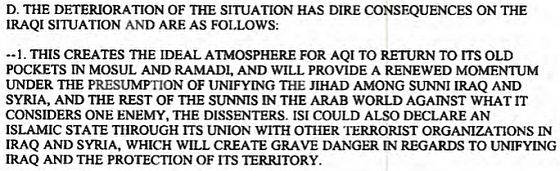
Fox News reports: Seventeen months before President Obama dismissed the Islamic State as a “JV team,” a Defense Intelligence Agency report predicted the rise of the terror group and likely establishment of a caliphate if its momentum was not reversed.
While the report was circulated to the CIA, State Department and senior military leaders, among others, it’s not known whether Obama was ever briefed on the document.
The DIA report, which was reviewed by Fox News, was obtained through a federal lawsuit by conservative watchdog Judicial Watch. Documents from the lawsuit also reveal a host of new details about events leading up to the 2012 Benghazi terror attack — and how the movement of weapons from Libya to Syria fueled the violence there. [Continue reading…]
ISIS killed hundreds as it took Iraq’s Ramadi
The Associated Press reports: Islamic State militants likely killed up to 500 Iraqi civilians and soldiers and forced 8,000 people to flee from their homes as they captured the Iraqi city of Ramadi, a provincial official said Monday, while the extremists went door-to-door looking for policemen and pro-government tribesmen.
Iraq’s government and Iranian-backed Shiite militias vowed to mount a counter-offensive and reclaim Ramadi, the capital of the overwhelmingly Sunni Anbar province. Iran’s Defense Minister Gen. Hossein Dehghan flew to Baghdad on a surprise visit for urgent talks with Iraqi leaders.
The fall of Ramadi was a stunning defeat for Iraq’s security forces and military, which fled as the Islamic State extremists overwhelmed the last hold-out positions of pro-government forces, despite the support of U.S.-led airstrikes targeting the extremists. Online video showed Humvees, trucks and other equipment speeding out of Ramadi, with soldiers desperate to reach safety gripping onto their sides.
Since Friday, when the battle for the city entered its final stages, “we estimate that 500 people have been killed, both civilians and military,” said a spokesman for the Anbar provincial government, Muhannad Haimour.
The figures could not be independently confirmed, but Islamic State militants have in the past killed hundreds of civilians and soldiers in the aftermath of their major victories.
Some 8,000 people fled the city, Haimour said. It was not immediately clear how many people remain in Ramadi — once a city of 850,000 that has been draining population for months amid fighting with the extremists besieging it. An enormous exodus took place in April, when the U.N. estimates some 114,000 residents streamed out of Ramadi and surrounding villages. [Continue reading…]