Category Archives: News

ISIS seizes two Yazidi villages as it advances on Mount Sinjar

The Washington Post reports: Islamic State militants advanced on Mount Sinjar on Monday, seizing two villages and blocking roads as besieged fighters from the minority Yazidi sect pleaded for U.S.-led airstrikes to save them.

Yazidi volunteers who have been protecting the area for more than two months said they retreated from the villages north of the mountain after the extremists attacked in the early hours of Monday under the cover of bad weather. The Yazidis pulled back to a shrine in the foothills of the mountain but said the militants were closing in — their armored vehicles visible just a few miles away as night fell.

“We have so little ammunition, and they are advancing,” said Khalid Qassim Shesho, a 44-year-old fighter trapped in the Sharfadin shrine. “I can see five Humvees without using binoculars. We need planes!”

The extremist gains around Mount Sinjar strike an embarrassing blow to the international campaign against the Islamic State. In August, President Obama authorized targeted airstrikes in Iraq to address the plight of thousands of Yazidis trapped on Sinjar in the face of an initial militant onslaught. [Continue reading…]

Facebooktwittermail

Victims of ISIS: Non-western journalists who don’t make the headlines

The Guardian reports: Last week, Islamic State militants released a fifth video of the British freelance journalist John Cantlie, wearing a Guantánamo Bay-style orange jumpsuit and appearing to read from a script.

The film’s release was widely reported. Unsurprisingly: since August, Isis has released videos showing its beheading of two American journalists, James Foley and Steven Sotloff, as well as two British aid workers, David Haines and Alan Henning. All have been huge news events.

Less widely covered were reports that, on 13 October, Isis shot and killed the Mosul correspondent of Iraq’s Sada news agency in the city’s al-Ghazlani camp. Several local sources, as well as a Kurdish Democratic party spokesman and a medical centre, confirmed Mohanad al-Aqidi’s death to numerous NGOs (members of his family have since disputed the reports, and al-Aqidi’s fate is currently unclear.)

There are no doubts about the public beheading on 10 October, in Samarra, 50km south-east of Tikrit, of Raad Mohamed al-Azaoui , an Iraqi cameraman and photographer for Sama Salah Aldeen TV. Azaoui, a 37-year-old father of three, was killed with his brother after Friday prayers. [Continue reading…]

Facebooktwittermail

In reversal, Turkey to open passage to Kobane for Iraqi Kurdish fighters

The Wall Street Journal reports: Turkey said Monday it would allow Iraqi Kurdish fighters to cross its territory to reinforce the embattled Syrian city of Kobani, reversing its long-standing opposition to such aid hours after U.S. airdrops of weapons and ammunition to the city’s Syrian Kurdish defenders.

Speaking in a news conference in the Turkish capital Ankara, Foreign Minister Mevlut Cavusoglu didn’t offer details how Turkish authorities would enable the transfer Kurdish Peshmerga fighters across Turkey or whether Syrian Kurdish authorities would accept additional forces.

“We are aiding the transfer of Peshmerga forces to Kobani for support. Consultations on this matter are ongoing,” Mr. Cavusoglu said. [Continue reading…]

Facebooktwittermail

U.S. airdrops weapons and supplies to besieged Syrian Kurds in Kobane

The Wall Street Journal reports: The U.S. dropped weapons, ammunition and medical supplies to Syrian Kurds fighting Islamic State extremists in the embattled city of Kobani, U.S. officials said Sunday.

Three U.S. C-130 cargo planes began dropping the weapons and supplies, provided by Kurdish authorities in Iraq, on Sunday, the officials said. Over several hours, the U.S. dropped 27 bundles of small arms, ammunition and supplies.

The mission marks a deeper U.S. involvement in the conflict and comes over the objections of U.S. ally Turkey, which strongly opposes arming the Syrian Kurds.

The U.S. has conducted some 135 airstrikes in the area of Kobani, itself a main focus of the Islamic State militant offensive. U.S. military officials said they have killed hundreds of fighters and damaged scores of combat equipment. [Continue reading…]

Reuters adds: The main Syrian Kurdish armed group defending the Syrian border town on Kobani against Islamic State attackers said on Monday arms air-dropped by the United States would not be enough for it to win the battle, and asked for more support.

Redur Xelil, a spokesman for the Kurdish YPG group, said the weapons dropped overnight would have a “positive impact” on the battle and the morale of fighters who have been out-gunned by Islamic State. But he added: “Certainly it will not be enough to decide the battle.”

“We do not think the battle of Kobani will end that quickly. The forces of (Islamic State) are still heavily present and determined to occupy Kobani. In addition, there is resolve (from the YPG) to repel this attack,” he told Reuters in an interview conducted via Skype.

Facebooktwittermail

The impact of airstrikes on the battle for Kobane

The Telegraph reports: The first signs that things could change came when planes appeared in the sky, circling for hours, but not attacking. The first strikes came on October 7 when US-made vehicles driven by Isil fighters to resupply the city were hit outside the town.

Scorched metal skeletons were all that remained of the jihadist’s prized Humvees.

“We had a walkie-talkie tuned on the Isil radio system, that we had taken from a jihadist that we killed,” said Mr Kharaba.

“When the first air strikes hit, we heard them on the radio screaming in panic.

“They were shouting ’Allah Akbhar’ (God is great) and listing the leaders who were killed: Abu Anas, Abu Hamza and many others.” Within a week, the air strikes had escalated from a few every day, to several every hour and by Tuesday the US and allies launched 21 air strikes on Isil positions in and around Kobane.

They bombed Tel Shair, a hill at the edge of Kobani, from which Isil had boastfully erected its black flag, and which it had used as a position to shell the town from.

Kurdish forces stormed the hill after the air strikes and cleaned it of their enemy.

“After we took the hill, I knew that Isil was on the back foot,” said Mr Kharaba.

“I knew it would be hard for them to keep Kobane.” The next day the strikes were hitting inside Kobane itself and the tide began to turn.

Pilots overhead grew in confidence and began to strike positions in the centre of Kobane, hitting Isil on their front lines.

Mr Kharaba described to the Telegraph being just metres from the air strike’s targets, and knowing he was safe: “They are incredibly accurate. If the Americans wanted to put a rocket in someone’s eye, even from hundreds of meters in the air, they could.”

The Syrian rebels and their Kurdish allies claimed they worked closely with the US planners to help set up the coordinates for the laser guided bombs.

Idris Nassan, 40, a senior spokesman for the Kurdish fighters told the Telegraph: “There is close co-ordination. We have a member of YPG who works directly with the Americans.”

Officially, the US government has shied away from directly admitting coordinating its attacks through the YPG, whose affiliate, the PKK, is on America’s terrorist list.

But John Allen, the US special envoy in charge of building the international coalition against Islamic State, admitted that Washington was open to receiving information on targets from all sources.

“Obviously, information comes in from all different sources associated with providing local information or potentially targeting information.

“And we’ll take it all when it comes in. It’s ultimately evaluated for its value,” Allen told reporters in Washington.

One fighter who asked not to be named recalled a battle on the eastern front of Kobane where his men were about to be forced into a retreat: “We called a Kurdish commander for help. He told us to move back a few meters. Then, minutes after, an air strike hit the men we had been fighting.”

The results have been increasingly effective. [Continue reading…]

Facebooktwittermail

President Rivlin: Time to admit that Israel is a sick society that needs treatment

The Jerusalem Post reports: The time has come to admit that Israel is a sick society, with an illness that demands treatment, President Reuven Rivlin said at the opening session on Sunday of a conference on From Hatred of the Stranger to Acceptance of the Other.

Both Rivlin and Prof. Ruth Arnon, president of the Israel Academy of Sciences and Humanities, which organized the conference at its premises on the capital’s Jabotinsky Street, spoke of the painful and bloody summer, and the resultant resurgence of animosity between Arabs and Jews that had escalated to new heights.

Referring to the mutual expressions of hatred and incitement, Arnon said that Jews, who in the Diaspora had been exposed to anti-Semitism and persecution, should be more sensitive to the dangers of incitement. “But are we?” she asked.

Rivlin wondered aloud whether Jews and Arabs had abandoned the secret of dialogue.

With regard to Jews he said: “I’m not asking if they’ve forgotten how to be Jews, but if they’ve forgotten how to be decent human beings. Have they forgotten how to converse?” [Continue reading…]

Facebooktwittermail

Fiercest fighting in days hits Kobane

Reuters reports: The fiercest fighting in days shook the Syrian border town of Kobani overnight as Islamic State fighters attacked Kurdish defenders with mortars and car bombs, sources in the town and a monitoring group said on Sunday.

Islamic State, which controls much of Syria and Iraq, fired 44 mortars at Kurdish parts of the town on Saturday and some of the shells fell inside nearby Turkey, according to the British-based Syrian Observatory for Human Rights. It said four more mortars were fired on Sunday. [Continue reading…]

Facebooktwittermail

Syrian Kurds say U.S. discussing arms supplies in direct talks

Rudaw reports: US officials have been holding direct talks with leaders of the Democratic Union Party (PYD) about arming its fighters in the war against the Islamic State (ISIS).

PYD spokesman Nawaf Xelil told the Arabic Asharq Al-Awsat daily that arms supplies for the People’s Protection Units (YPG), the group’s military wing, were discussed at a meeting in Paris a week ago. He said that talks between the two sides continued in Duhok on Thursday.

“The subject of arming Syrian Kurds was discussed” the newspaper quoted Xelil as saying.

He added that at the Duhok meeting, a US delegation and PYD leaders had discussed Western and Arab support for the YPG.

“They spoke about sending military support to the Kurds in Kobane,” Xelil told Asharq Al-Awsat. He said the PYD and the US had started their talks two years ago but that Washington had kept the issue under the radar “in order not to upset Turkey.”

US State Department spokesperson Jen Psaki confirmed Thursday that US officials had met with the PYD, but did not say where or what was discussed. [Continue reading…]

The Associated Press reports: Turkish President Recep Tayyip Erdogan says his country would not agree to any U.S. arms transfers to Kurdish fighters battling Islamic militants in Syria.

Turkey views the Kurdish fighters as an extension of the PKK, which has waged a 30-year insurgency in Turkey and is designated a terrorist group.

The state-run Anadolu news agency on Sunday quoted Erdogan as saying the fighters are “equal to the PKK” and that Turkey “would not say ‘yes’ to such a thing.”

Facebooktwittermail

‘Kobane battle far from over’ says defense chief

Facebooktwittermail

U.S.-led coalition jets strike Kobane, ISIS shells hit Turkey

Reuters reports: U.S.-led coalition jets pounded suspected Islamic State targets at least six times in the besieged Syrian town of Kobani on Saturday after the fiercest shelling in days by the insurgents shook the town’s center and hit border areas within Turkey.

Shelling continued after the strikes hit the center of Kobani. Several mortars fell inside Turkey near the border gate, called Mursitpinar, according to witnesses.

Facebooktwittermail

In policy shift, U.S. opens direct talks with Syrian Kurds linked to the PKK

McClatchy reports: The Obama administration acknowledged Thursday that a U.S. official for the first time met with a representative of a Syrian Kurdish political party that’s closely linked to a group on the U.S. terrorist list.

State Department spokeswoman Jen Psaki said a U.S. diplomat met with a counterpart from the main Kurdish political party in Syria – the Democratic Union Party, better known by its Kurdish acronym as the PYD – to discuss the U.S.-led fight against the Islamic State. The PYD’s militia is engaged in fierce battles with the Islamist extremists, especially near the town of Kobani along the border with Turkey.

The direct talks are a sign of the shifting alliances created by the rise of the Islamic State. In Iraq, for example, the U.S. is providing air cover for Iranian-backed Shiite Muslim militias that once targeted American forces. And now in Syria, it appears the United States is willing to work with a group that’s tied to the PKK, or Kurdistan Workers Party, which has waged a guerrilla war for Kurdish rights in Turkey for 30 years and which has been on the U.S. list of foreign terrorist organizations for nearly two decades. Turkey and the European Union also have blacklisted the PKK.

Psaki provided no details of the meeting beyond saying that it took place over the past weekend and outside of the Middle East. Kurdish and other media reports say Charles Rivkin, the undersecretary of state for economic affairs, and PYD leader Salih Muslim met in Paris.

The new face-to-face U.S. channel to the PYD is likely to rankle Turkey, which on Monday bombed PKK locations in Turkey and has battled Kurdish civilians near Kobani protesting the international response to the Islamic State assault on the town. [Continue reading…]

Facebooktwittermail

Lebanon pulled into war with ISIS

The Associated Press reports: With all eyes on the Islamic State group’s onslaught in Iraq and Syria, a less conspicuous but potentially just as explosive front line with the extremists is emerging in Lebanon, where Lebanese soldiers and Shiite Hezbollah guerrillas are increasingly pulled into deadly fighting with the Sunni militants along the country’s border with Syria.

The U.S. has been speeding up delivery of small ammunition to shore up Lebanon’s army, but recent cross-border attacks and beheading of Lebanese soldiers by Islamic State fighters — and the defection of four others to the extremists — has sent shockwaves across this Mediterranean country, eliciting fear of a potential slide into the kind of militant, sectarian violence afflicting both Syria and Iraq, and increasingly prompting minorities to take up arms.

The crisis was slow in coming.

For long, Lebanon managed to miraculously avoid the all-out chaos gripping neighboring countries — despite sporadic street clashes and car bombings, and despite being awash with weapons and taking in an endless stream of refugees from Syria who now constitute a staggering one third of its population of 4.5 million people.

Facebooktwittermail

Iraq crisis: MPs complete unity government

BBC News reports: Iraqi MPs have approved new defence and interior ministers, completing a unity government that is battling the spread of Islamic State militants.

Mohammed Salem al-Ghabban, a Shia, was appointed interior minister, while Khaled al-Obeidi, a Sunni, was confirmed as defence minister.

IS controls large parts of the country, and has been making gains despite US-led coalition air strikes.

On Friday, a curfew was imposed in the city of Ramadi amid fierce fighting.

The vote by Iraqi MPs will be a big relief both inside and outside Iraq after weeks of wrangling, says BBC Arab affairs editor Sebastian Usher.

Facebooktwittermail

Conflict of interest: Senior NSA official moonlights for former NSA chief in private firm

The Guardian reports: The former director of the National Security Agency has enlisted the US surveillance giant’s current chief technology officer for his lucrative cybersecurity business venture, an unusual arrangement undercutting Keith Alexander’s assurances he will not profit from his connections to the secretive, technologically sophisticated agency.

Patrick Dowd continues to work as a senior NSA official while also working part time for Alexander’s IronNet Cybersecurity, a firm reported to charge up to $1m a month for advising banks on protecting their data from hackers. It is exceedingly rare for a US official to be allowed to work for a private, for-profit company in a field intimately related to his or her public function.

Reuters, which broke the story of Dowd’s relationship with IronNet, reported that the NSA is reviewing the business deal.

Since retiring from the NSA in March and entering the burgeoning field of cybersecurity consulting, Alexander has vociferously defended his ethics against charges of profiting off of his NSA credentials. Alexander was the founding general in charge of US Cyber Command, the first military command charged with defending Defense Department data and attacking those belonging to adversaries. Both positions provide Alexander with unique and marketable insights into cybersecurity. [Continue reading…]

Facebooktwittermail

YPG spokesman: ‘If the West wants to defeat ISIS it will have to help us’

Deutsche Welle reports: Redur Xelil is the spokesman of the Kurdish People’s Protection Units, YPG.

DW: What is the current situation like in Kobani?

Redur Xelil: Clashes are still very heavy but we’ve made a significant step forward. Now we are not only resisting the assault but also striking back against enemy positions. However, we still rely on our light weapons against the heavy ones used by the “Islamic State” (IS) forces against us. We need supplies of all sorts as we are not facing just one armed group but the army of a whole state.

But you do have US air cover. What is the degree of coordination between the YPG and Washington?

Airstrikes are important but not enough to get rid of the enemy. Regarding coordination with Washington, it is obvious that we have to give them our exact position so that their bombs don’t fall on us. I cannot give you any further details about it. All I can say is that we’re looking forward to improve cooperation between us.

If airstrikes are not enough, will it be possible to defeat IS without the presence of international troops on the ground?

Mosul – Iraq’s second city – fell in three days while a town like Kobani has already endured a whole month of fighting, and that’s only thanks to our highly motivated fighters who are defending their land. So far, the YPG has proved to be the only armed force that has successfully fought IS. However, we’re not in a position to go beyond our borders, we cannot fight them outside our boundaries unless we coordinate with local Arabs in those areas, as we’ve done on previous occasions. International support is doubtless necessary but I think the different communities in the Middle East could defeat IS if they were properly armed, trained and coordinated. If the West wants to defeat the Islamists it will have to help us. [Continue reading…]

Facebooktwittermail

Fleeing Kobane: Taking only the things they could carry

Middle East Eye reports: When Islamic State militants began to close in on Kobane, the town erupted into chaos.

Most fled with just the clothes they were wearing, and any money stashed away in the house they could grab quickly.

Taking the time to pack bags was a gamble, especially for families living on the outskirts of the town, who had long heard about the notoriety of the advancing militants that have captured world attention for the particular brand of cruelty they unleash on their opponents.

Yet, even amid the chaos, a few individuals managed to take an object of sentimental value, an item that in their mind could not be left behind and could not be replaced. In disarray and terror, a small piece of comfort was nonetheless carried over the Syrian border to safety.

As mortars rained down on their hometown, and the fighting between the Peoples Protection Unit (YPG) Kurdish forces and Islamic State militants descended from the rural outskirts into the city, Khaled Khalil Bisiki and his family made the decision to flee Kobane.

Two weeks ago in the middle of the night, as they hurryingly packed their lives into the family’s small battered car, Bisiki ran back inside to grab the deeds to his lands in Kobane. His wife, Maram, quickly followed, grabbing precious family photos.

“We left so fast we couldn’t bring anything with us really, it was all so fast, so you just grab the things you think you can bring with you,” Khaled told Middle East Eye.

“When you remember something is important, it becomes so important. I remembered our land deeds, I want to always have proof that this is my family’s place – to never lose that – and my wife grabbed the family photos.” [Continue reading…]

Facebooktwittermail

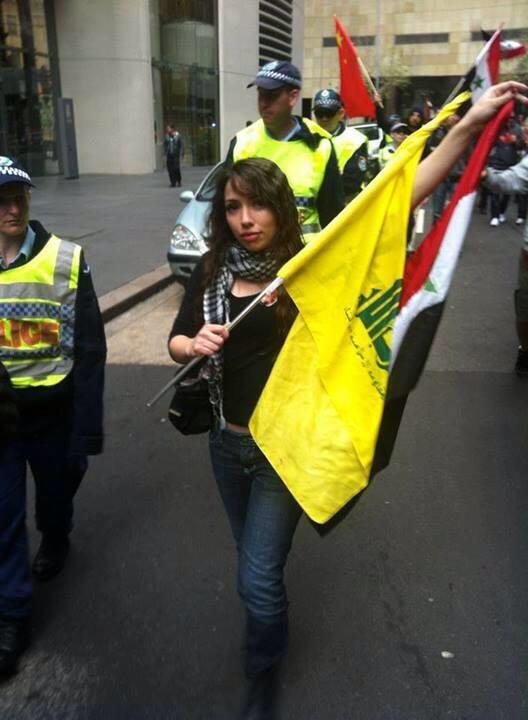
Partisangirl’s false-flag semaphore supporting Assad and her alliance with MIT’s Ted Postol

Ted Postol and Maram Susli

Ted Postol and Maram Susli

Noah Shachtman and Michael Kennedy write: She thinks that Ebola could be an American military bioweapon. She thinks that the Defense Department’s advanced research arm is covertly intervening in the GamerGate debate about feminism and video games. She’s fond of extremist groups like Hezbollah. She believes the Illuminati are leaving secret clues in, among other places, the viral Kony 2012 video. Oh, and she also says she’s in contact with the Syrian Electronic Army, the hacker group tied to the regime of Syrian dictator Bashar al-Assad.

Meet the Damascus regime’s biggest fangirl on social media — at least in English language social media. Her name is Maram Susli. Or Mimi al-Laham. Or Partisangirl. Or Syrian Girl. Or it would appear, or Syrian Sister. She goes by many handles.

As “Partisangirl,” Susli has emerged from the fever swamps of online conspiracy forums and onto social media to become a darling of truthers and state propaganda channels alike. Whenever there’s unpleasant news about the Syrian military or government, Susli (that’s her surname) seems to be there to interpret the false flag semaphore for her rapt audience. The chemical-weapons attack that killed hundreds in the Damascus suburbs? The rebels’ fault. The massacre of more than 100 men, women, and children in Houla? Oh, that was British intelligence. The U.S. bombing campaign against ISIS in Syria? Just an elaborate show, since American is taking it easy on ISIS. And the ghastly videos featuring the murder of Western aid workers? Many of them are fakes.

“There’s an elite and they’re trying to manipulate people’s minds,” Susli told The Daily Beast. “It’s claimed that we’re living in a free democracy but we’re really not. It’s just an illusion. And the more people know that, the more they distrust what they’re hearing.”

The Internet’s always had a well-populated fringe and Susli’s place in its firmament might not otherwise be noteworthy. But with the help of a distinguished MIT professor — whose work has been cited by a Pulitzer Prize-winning journalist — she’s trying to move beyond the chemtrails crowd. Her YouTube videos have racked up hundreds of thousands of views. She’s been interviewed uncritically by Vice. A lapsed graduate student in chemistry at the University of Western Australia, she’s been brought into the academy to become a source of expertise on the chemical-weapons attack that brought America to the brink of war in Syria last year. [Continue reading…]

Facebooktwittermail

ISIS holding thousands of women and children as slaves in Iraq and Syria

Emily Feldman reports: The Islamic State is currently holding thousands of people hostage inside ISIS territory, having taken members of the minority Yazidi sect captive this summer during a brutal campaign across northern Iraq.

While the United Nations has put the number of captives at about 2,500, other estimates are as high as 7,000. And prospects for any rescue are bleak.

Even as the U.S. and its allies bomb ISIS targets in Syria and Iraq, the group has managed to hold on to key cities where it is reviving the practice of slavery.

The latest edition of Dabiq, an ISIS magazine, includes an impassioned argument for the practice as well as an account of how the Yazidi women from the Sinjar region of Iraq were distributed among the fighters.

“The Yazidi women and children were divided according to the Shariah amongst the fighters of the Islamic State who participated in the Sinjar operation…to be divided as khums,” a kind of tax.

“The enslaved Yazidi families are now sold by the Islamic State soldiers.”

The magazine also warns “weak-minded and weak-hearted” ISIS followers who might question or object to the practice of slavery.

“Enslaving the families of the [infidels] and taking their women as concubines is a firmly established aspect of the Shariah,” the article says. “If one were to deny or mock [it], he would be denying or mocking the verses of the Quran.”

The article’s description of how prisoners were dealt with closely mirrors accounts from the few who have escaped or managed to contact their loved-ones by phone.

Women were sold at slave markets, forced to marry and imprisoned in the homes of ISIS fighters across both Iraq and Syria. [Continue reading…]

Facebooktwittermail