CBC News reports: Eight months ago, Umm Haritha, a 20-year-old woman from Canada, made her way to Turkey against her parents’ wishes with a half-empty suitcase and $1,500.
Within a week she was in Syria, and a few weeks later she was married to Abu Ibrahim al-Suedi, a 26-year-old Palestinian from Sweden fighting for Islamic State in Iraq and Syria (ISIS), the Sunni jihadist group battling the Syrian regime.
It is not clear whether Umm Haritha’s marriage to Abu Ibrahim was arranged before her travel to Syria. Regardless, it only lasted five months.
On May 5, Abu Ibrahim, whose real name is Taha Shade, was in a car en route to a meeting in Deir ez-Zor with members of rival faction Jabhat al-Nusra. What was meant to be a gathering to finalize a peace treaty between ISIS and al-Nusra turned deadly when an al-Nusra fighter on a motorbike sped up to Shade’s car and detonated his explosive belt.
At the time, Shade was wearing his own explosive belt, which also went off and blew him to pieces.
Two days later, Umm Haritha tweeted about her husband’s death, calling on “Allah” to “destroy those who backstabbed the brothers and resurrect Abu Ibrahim with noor [light] from every piece of his body.”
Umm Haritha’s journey to Syria highlights an underreported part of the western Jihadist experience in Syria. [Continue reading…]
Category Archives: News
Anbar tribal leader: Maliki is ‘more dangerous’ than ISIS
Rudaw reports: Sheikh Hatem al-Suleiman, 43, is one of Anbar province’s most influential tribal sheikhs and is chief of the powerful Dulaim tribe in Ramadi.
Suleiman is founding member of the Anbar Salvation Council, a key group in the Sunni Awakening that collapsed after Prime Minister Nouri al-Maliki refused to include the group in state and military institutions. As the leader of Anbar’s Tribes Revolutionary Council, he is a key leader in the Anbar insurgency and a sharp critic of Maliki. As early as 2006, he became a leader in mobilizing Sunni Arab rebels against Al-Qaeda.
In an exclusive interview with Rudaw, Suleiman claimed the Islamic State (formerly the Islamic State in Iraq and Syria, or ISIS) and Iraq’s Sunni Arab tribes have drastically different philosophies. He says that armed tribes can easily push out ISIS but that Maliki must first leave office. [Continue reading…]
Iraq parliament chaos deepens as MPs fail to agree on new speaker
AFP reports: A solution to the Iraq crisis appeared to slip away into the distance as a crucial parliament session aimed at kickstarting the formation of a government was delayed when MPs failed to agree on a new speaker.
They were reportedly bickering despite calls for unity to see off a jihadist offensive that has overrun swaths of the country.
The Iraqi security forces have struggled to repel the swift advance of fighters for the Islamic State in Iraq and the Levant, which has forced hundreds of thousands of people to flee their homes. The developments have also alarmed the international community and heaped pressure on Nouri al-Maliki, the prime minister, as he bids for a third term in office.
But the government formation process – which international leaders and top clerics have urged should be completed as quickly as possible – suffered a setback when the session set for Tuesday was postponed to 12 August because political leaders could not reach an agreement. [Continue reading…]
‘Water war’ threatens Syria lifeline
Al Jazeera reports: When severe water cuts began to hit Aleppo province in early May, residents started referring to a “water war” being waged at the expense of civilians. Images of beleaguered women and children drinking from open channels and carrying jerry cans of untreated groundwater only confirmed that the suffering across northern Syria had taken a turn for the worse.
However, lost in the daily reports was a far more pernicious crisis coming to a head: a record six-metre drop in Lake Assad, the reservoir of Syria’s largest hydroelectric dam and the main source of water for drinking and irrigation to about five million people.
Under the watch of the Islamic State group – formerly known as the Islamic State of Iraq and the Levant (ISIL) – levels in Lake Assad have dropped so low that pumps used to funnel water east and west are either entirely out of commission or functioning at significantly reduced levels. The shortages compel residents in Aleppo and Al Raqqa to draw water from unreliable sources, which can pose serious health risks.
The primary reason behind the drop appears to be a dramatic spike in electricity generation at the Euphrates Dam in al-Tabqa, which has been forced to work at alarmingly high rates.
“[Lake Assad] is pumping out more than it is receiving. This is because the electricity generators are working 24 hours a day, more than they should be,” Waleed Zayat, a mechanical engineer working for the Syrian opposition’s interim government’s Ministry of Water Resources and Agriculture in Aleppo, told Al Jazeera. [Continue reading…]
Egypt’s president says Al Jazeera journalists should never have been tried
The Associated Press reports: Egypt’s president has acknowledged for the first time that the heavy sentences handed down to three al-Jazeera journalists had a “very negative” impact on his country’s reputation, saying he wished they had never been put on trial.
The comments by Abdel Fatah al-Sisi to Egyptian media editors, published late on Sunday, are the first public recognition by Egyptian officials that the case has damaged the country’s international relations.
The sentencing of the Australian reporter Peter Greste, Egyptian-Canadian acting bureau chief Mohamed Fahmy and Egyptian producer Baher Mohamed on 23 June, after a five-month trial described as a “sham” by rights groups, caused an international outcry.
“The verdict issued against a number of journalists had very negative consequences, and we had nothing to do with it,” Sisi said, suggesting it had no political element. “I wished they were deported immediately after their arrest instead of being put on trial.” [Continue reading…]
Six Jewish suspects arrested over death of Palestinian teenager
Reuters reports: Israel has arrested six Jewish suspects in the abduction and killing of a Palestinian teenager whose death sparked violent protests in Jerusalem and Israeli Arab towns, a security source said on Sunday.
With tensions high along the Gaza border, Israel said its aircraft attacked 10 sites in the Palestinian enclave in response to persistent rocket strikes on southern Israeli towns.
But Prime Minister Benjamin Netanyahu signalled that broader Israeli action was not imminent.
The security source gave no details about the suspects arrested in the investigation into the abduction and killing of 16-year-old Mohammed Abu Khudair, other than to say they were Jewish and that police saw “nationalist motives” in the case. [Continue reading…]
American teen brutally beaten by Israeli police
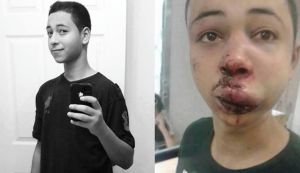
ABC News reports: A 15-year-old American high school student was beaten and jailed by Israeli police in what his mother called an “attempted murder,” as the incident happened a day after his cousin was killed.
The teen, Tariq Abu Khdeir from Tampa, Florida, was on a summer holiday with his parents and sisters in Jerusalem, visiting family in the eastern part of the city. Video clips posted online show three Israeli police officers in riot gear repeatedly beating a young Palestinian, identified as Abu Khdeir by his family, and dragging him away to arrest him.
On Wednesday morning, Tariq’s cousin, 16-year-old Muhammad Abu Khdeir, was murdered in what is widely believed to have been a revenge attack for the recent kidnapping and murder of three Israeli Jewish teens.
Tariq was arrested on Thursday evening. Photos of him in detention show his severely swollen and bruised face, which his mother, Suha Abu Khdeir, said was unrecognizable when she first saw him following the arrest. [Continue reading…]
Mossad chief: Palestinian conflict top threat to Israel’s security, not Iran
Haaretz reports: The biggest threat to Israel’s security is the conflict with the Palestinians and not Iran’s nuclear program, Mossad chief Tamir Pardo said Thursday at a meeting at a private home attended by 30 businesspeople.
According to a person present during the 90-minute talk, Pardo dealt largely with the organizational changes he had made at the Mossad, as well as management policies at the spy agency. But during the question-and-answer period, participants asked him to assess the greatest threats facing Israel.
Pardo said, according to the source, that the major threat to Israel is the conflict with the Palestinians. When some of the participants asked him to repeat what he said, he answered: “Yes, the biggest threat is the Palestinian issue.”
Someone asked whether the Iranian nuclear threat was the second largest threat. Pardo surprised his audience by saying Iran might produce or purchase a nuclear weapon in the future, but he wouldn’t “recommend rushing to obtain a foreign passport.”
One person noted that Pardo’s words suggested he did not share the urgency in speeches by Prime Minister Benjamin Netanyahu on Tehran’s nuclear program. It was clear that Pardo did not consider this issue a significant threat, let alone an existential one.
Pardo listed the threats facing Israel, including a takeover of parts of Iraq by the Islamic State organization and its threats to neighboring Jordan under King Abdullah.
“This is a worrisome problem for Israel,” Pardo said. “This organization is here to stay. They embrace the public like [Israeli ultra-Orthodox party] Shas does, with a welfare and education system. They espouse murder for its own sake. Hamas is a lightweight organization by comparison.” [Continue reading…]
Sadr urges Maliki’s bloc to choose new Iraq PM candidate
Reuters reports: Iraqi Prime Minister Nuri al-Maliki’s coalition should withdraw its support for his bid for a third term and pick another candidate, Shi’ite Muslim cleric Moqtada al-Sadr urged, amid parliamentary deadlock over the formation of a new government.
Maliki has come under mounting pressure since Islamic State militants took swathes of the north and west of Iraq last month and declared a caliphate on land they and other Sunni armed groups have captured in Iraq and Syria.
In a statement published on his website late on Saturday, Sadr said Maliki “has involved himself and us in long security quarrels and big political crises” and suggested that preventing Maliki from serving a third term would be a “welcome step”.
“It is necessary to demonstrate the national and paternal spirit by aiming for a higher, wider goal from individuals and blocs and by that I mean changing the candidates,” said Sadr, who gained political influence during the U.S. occupation.
Allawi warns risk of Iraq’s dismemberment unless Maliki goes
Reuters reports: Former Iraqi prime minister Iyad Allawi called on incumbent Nuri al-Maliki on Saturday to give up his bid for a third term in power or risk the dismemberment of Iraq.
Maliki on Friday rejected a chorus of such calls since militants of a group now calling itself the Islamic State rampaged through swathes of Iraq and declared a mediaeval-style caliphate in land they control in Iraq and neighbouring Syria.
“I think it is time for Mr Maliki to leave the scene,” Allawi told Reuters in an interview in Istanbul.
“If he stays on, I think there will be significant problems in the country and a lot of troubles. I believe that Iraq would go the route of dismemberment, ultimately, if this happens. [Continue reading…]
A Shiite family fleeing Tal Afar — among Iraq’s 1.2 million internally displaced citizens
McClatchy reports: The mortars rained down for 12 hours, an eternity for members of the Hassan family who huddled together in a single room, the children screaming and the adults praying to die in the shelling rather than be slaughtered by the Islamic State militants who rampaged into the northern Iraqi city of Tal Afar two weeks ago.
Unlike many of their neighbors, the Hassans survived, all 19 of them, and the next day they fled their hometown on the same road they’d used in two previous displacements — once when U.S. forces battled Sunni Muslim extremists in 2004, and again in 2005 during sectarian pogroms. But after a harrowing, five-day journey to this southern Shiite holy city, the family has given up on Tal Afar.
Qassim Hassan, 53, the patriarch of this clan of Shiite Muslim Turkmen, a minority that dates back to the 7th Century, said there hasn’t been a peaceful year since the U.S.-led invasion of Iraq in 2003. This third narrow escape will be their last, he declared, ending more than 200 years of his family’s presence in Tal Afar, which once was considered a showpiece of U.S. counterinsurgency successes.
“We’re desperate now,” Hassan said. “We can no longer live there because we are the targets every time, and the government cannot protect us. We’re starting from zero here. We’re building a new life.”
The sectarian cleansing of Tal Afar is now complete, according to accounts from the city that say not a single Shiite family remains. The Islamic State, an al Qaida splinter group that’s captured roughly a third of Iraq, views Shiites as heretics deserving of death.
Not that the Sunnis who stayed behind fared much better — witnesses reached by phone say the extremists demanded two women from each remaining tribe. Leaders refused and at least eight people were killed in a single night of clashes last week, creating another wave of fleeing families. [Continue reading…]
In NSA-intercepted data, those not targeted far outnumber the foreigners who are
The Washington Post reports: Ordinary Internet users, American and non-American alike, far outnumber legally targeted foreigners in the communications intercepted by the National Security Agency from U.S. digital networks, according to a four-month investigation by The Washington Post.
Nine of 10 account holders found in a large cache of intercepted conversations, which former NSA contractor Edward Snowden provided in full to The Post, were not the intended surveillance targets but were caught in a net the agency had cast for somebody else.
Many of them were Americans. Nearly half of the surveillance files, a strikingly high proportion, contained names, e-mail addresses or other details that the NSA marked as belonging to U.S. citizens or residents. NSA analysts masked, or “minimized,” more than 65,000 such references to protect Americans’ privacy, but The Post found nearly 900 additional e-mail addresses, unmasked in the files, that could be strongly linked to U.S. citizens or U.S.residents.
The surveillance files highlight a policy dilemma that has been aired only abstractly in public. There are discoveries of considerable intelligence value in the intercepted messages — and collateral harm to privacy on a scale that the Obama administration has not been willing to address. [Continue reading…]
ISIS leader on terrorism, freedom, and democracy
Abu Bakr al-Janabi, a Twitter supporter of ISIS, has posted an English translation of Abu Bakr al-Baghdadi’s first public speech. In one passage, the ISIS leader said:
Terrorism is to worship Allah as He ordered you. Terrorism is to refuse humiliation, subjugation, and subordination. Terrorism is for the Muslim to live as a Muslim, honourably with might and freedom. Terrorism is to insist upon your rights and not give them up.
But terrorism does not include the killing of Muslims in Burma and the burning of their homes. Terrorism does not include the dismembering and disemboweling of the Muslims in the Philippines, Indonesia, and Kashmir. Terrorism does not include the killing of Muslims in the Caucasus and expelling them from their lands. Terrorism does not include making mass graves for the Muslims in Bosnia and Herzegovina, and the slaughtering of their children. Terrorism does not include the destruction of Muslims’ homes in Palestine, the seizing of their lands, and the violation and desecration of their sanctuaries and families!
Terrorism does not include the burning of masājid in Egypt, the destruction of the Muslims’ homes there, the rape of their chaste women, and the oppression of the mujahidin in the Sinai Peninsula and elsewhere. Terrorism does not include the extreme torture and degradation of Muslims in East Turkistan and Iran, as well as preventing them from receiving their most basic rights. Terrorism does not include the filling of prisons everywhere with Muslim captives. Terrorism does not include the waging of war against chastity and hijab (Muslim women’s clothing) in France and Tunis. It does not include the propagation of betrayal, prostitution, and adultery. Terrorism does not include the insulting of the Lord of Mightiness, the cursing of the religion, and the mockery of our Prophet (peace be upon him). Terrorism does not include the slaughtering of Muslims in Central Africa like sheep, while no one weeps for them and denounces their slaughter.
All this is not terrorism. Rather it is freedom, democracy, peace, security, and tolerance!
The Telegraph has a profile of the ISIS leader.
His friends remember him as polite and rather quiet. In fact, few took notice of the bespectacled student who would sit at the back of the classroom.
The only time he shone was on the football field, playing for the team from the local mosque where he would also occasionally, though not very impressively, lead the congregation in prayer.
“He was the Messi of our team,” said Abu Ali, a fellow player and worshipper at the mosque, making comparison with the Lional Messi, the Argentinian striker. “He was our best player.”
Born Ibrahim Awad Ibrahim al-Badri to a family of preachers, the now leader of the Islamic State, lived his childhood in the Sunni heartland town of Samarra north of Baghdad.
But it is in the Iraqi capital that he spent his formative years, studying for his undergraduate and masters degrees, and eventually his PhD at the Islamic University.
For more than a decade, until 2004, he lived in a room attached to a small local mosque in Tobchi, a poor and ramshackle neighbourhood of made up of Sunni and Shia Muslim residents on the western fringes of Baghdad.
Sitting in his living room with the curtains drawn, as his brother kept a careful watch for militias outside, Abu Ali said: “When Ibrahim al-Badri arrived in Tobchi he was 18-years-old. He was a quiet person, and very polite.”
“He wasn’t a preacher as people say,” he added, referring to a profile recently published by the Islamic State that heralds Baghdadi as a grand imam. “The mosque here had it’s own imam. When the imam was away, religious students would take his place. Badri would sometimes lead the prayers but not give any sermons.”
Abu Ali did though concede that: “He had a nice voice, which was just right for the prayers.”
He came to know Baghdadi through group activities put on by the mosque clergy: “We’d play football. In Saddam’s time we’d all travel to places outside Baghdad, such as Anbar district, for picnics, or go we’d go swimming.”
The jihadist-to-be had been a “conservative Salafi” practitioner of Islam, his former neighbour said: “I remember one incident where was a wedding in the area and men and women were dancing and jumping happily in the same room. He was walking past on the street and saw this. He shouted ’How can men and women be dancing together like this? It’s irreligious’. He stopped the dance.”
When he finished his PhD, which was focused on the study of sharia law, at the start of this millennium, Baghdadi married and, less than a year later, his wife gave birth to their first child. The boy is now approximately 11-years-old.
As the war drums rumbled against then Iraqi dictator Saddam Hussein and then when the allies invaded in 2003, Baghdadi continued to live the life of a family man.
“He didn’t show any hostility to the Americans,” said Abu Ali. “He wasn’t like the hot blooded ones. He must have been a quiet planner.”

ISIS destroys mosques and shrines in Iraq
AFP reports: Jihadists who overran Mosul last month have demolished ancient shrines and mosques in and around the historic northern Iraqi city, residents and social media posts said Saturday.
At least four shrines to Sunni Arab or Sufi figures have been demolished, while six Shiite mosques, or husseiniyahs, have also been destroyed, across militant-held parts of northern Nineveh province, of which Mosul is the capital.
Pictures posted on the Internet by the Islamic State (IS) jihadist group showed the Sunni and Sufi shrines were demolished by bulldozers, while the Shiite mosques and shrines were all destroyed by explosives.
The photographs were part of an online statement titled “Demolishing shrines and idols in the state of Nineveh.”
Local residents confirmed that the buildings had been destroyed and that militants had occupied two cathedrals as well.
Photographs of ISIS destroying Shia mosques and shrines in "the State of Nineveh", Iraq, here: http://t.co/qS2eV9mg08 pic.twitter.com/lf5ZbPP2TX
— Mahmoud (@MahmoudRamsey) July 5, 2014
Maliki to run for a third term as Iraq’s prime minister
The New York Times reports: Despite sharp criticism from almost every political party in Iraq and pressure from friendly foreign powers to step down, Prime Minister Nuri Kamal al-Maliki announced Friday that he would seek a third term as prime minister.
He never suggested that he would step down. But the chorus of criticism over his sectarian policies, which helped create the conditions that led to a large portion of the country falling to Islamic extremists, had left many believing that lacking supporters, he might relinquish power.
They appear to have underestimated his desire to hold on to it.
“I will not give up my candidacy for a third term,” Mr. Maliki announced in a statement read on Iraqiya, the state television channel.
He noted that the bloc of lawmakers that supported his nomination was the largest in the Parliament and that they should not be asked to meet any conditions imposed by other legislative groups, such as supporting a different candidate. [Continue reading…]
Iranian pilot killed fighting in Iraq: Can Iran avoid ‘mission creep’?
The Wall Street Journal reports: Iran is pursuing a delicate strategy of supporting fellow Shiite Muslims and preserving its influence in neighboring Iraq—where the government is under siege by radical Sunni militants—without pushing the confrontation into outright sectarian warfare.
For the second straight week, influential clerics, who are appointed by the Islamic Republic’s Supreme Leader Ayatollah Ali Khamenei, used their Friday sermons to denounce the militant groups and support Iraq’s government. But their speeches steered clear of explicitly encouraging individual Shiites to act against the Sunni insurgents.
“We are ready to help Iraq as they ask for help,” Ayatollah Mohammad Saeedi told thousands of Iranians gathered for Friday prayers in Qom, Iran’s religious capital.
The country has openly sent top military advisers to help the Iraqi government, and blamed a collection of foreign enemies from Saudi Arabia to Israel and the U.S. for the violence. It deployed at least three battalions of elite Revolutionary Guards units to Iraq, according to Iranian security officials—an action Iran’s foreign ministry denied.
Yet it has stopped short of sending in large numbers of its own troops and discouraged ordinary Iranians from crossing the border to fight or defend holy sites in Iraq. [Continue reading…]
Al Jazeera reports: An Iranian pilot has been killed while fighting in Iraq, in what is thought to be the first military casualty that Tehran officially acknowledged during battles against Sunni fighters led by the Islamic State group.
Iran’s official IRNA news agency said on Saturday that Colonel Shoja’at Alamdari Mourjani was killed while “defending” the Shia Muslim holy sites in the city of Samarra, north of Baghdad.
Al Jazeera’s Imran Khan, reporting from Baghdad, said there were no reports of a plane being shot down in Iraq and the pilot probably died while fighting on the ground. [Continue reading…]
Palestinian Mohammad Abu Khdair ‘was burned alive’
BBC News reports: A Palestinian teenager killed in Jerusalem was burned alive, first post mortem examination findings quoted by the Palestinian attorney-general say.
“The direct cause of death was burns as a result of fire,” Mohammed al-A’wewy was quoted as saying.
Israeli authorities say the circumstances surrounding the death of Mohammad Abu Khdair, 16, are unclear.
His death followed the abduction and murder of three young Israelis, with violent clashes spreading overnight.
The post mortem examination on Mohammad Abu Khdair was carried out by Israeli doctors, with Saber al-Aloul, the director of the Palestinian forensic institute, in attendance.
The Palestinian official news agency Wafa quoted the attorney-general as saying that Mr Aloul had reported fire dust in the respiratory canal, meaning the victim had “inhaled this material while he was burnt alive”.
Mohammad Abu Khdair, who had also suffered a head injury, had burns to 90% of the body, it was reported.
German man arrested as spy implicates U.S.
The New York Times reports: In the latest turn in the yearlong tensions with Germany over American spying, a German man was arrested this week on suspicion of passing secret documents to a foreign power, believed to be the United States. The American ambassador, John B. Emerson, was summoned to the Foreign Office here and urged to help with what German officials called a swift clarification of the case.
The arrest came as Washington and Berlin were trying to put to rest a year of strains over the National Security Agency’s monitoring of Germans’ electronic data, including Chancellor Angela Merkel’s cellphone, and just months after the collapse of an effort by Germany to strike a “no spy” accord with the White House.
While the White House and American intelligence officials refused to comment on the arrest, one senior American official said that reports in the German news media that the 31-year-old man under arrest had been working for the United States for at least two years “threaten to undo all the repair work” the two sides have been trying to achieve.[Continue reading…]