




“Syria said it would cease production of chemical weapons and disclose the locations of its stockpiles to the United Nations, Russia and others, as Damascus seized on a possible diplomatic route to avert international military action,” the Wall Street Journal reported today.
The first half of that sentence is factual and the second half is interpretative. The media and others have been so quick to assume that the Assad regime’s swiftness in responding positively to Russia’s initiative is an expression of fear — that it serves as a demonstration of the effectiveness of the threat of force — few have paused to consider an alternative motivation: that giving up chemical weapons may ensure Bashar al-Assad’s survival and ultimate victory.
One thing about which no one should be in any doubt is that the Syrian government understands better than anyone else does, what would be involved in destroying its chemical weapons stockpiles. For them, this isn’t an abstract proposition.
Syria’s agreement to give up its chemical weapons will likely mean its acceptance of an undertaking that may take as long as a decade to complete, says Cheryl Rofer, who supervised a team destroying chemical warfare agents at Los Alamos.
The only people with the technical skills to carry this out are the U.S. and Russian militaries. Teams assigned with this task would have to operate with the protection of the Syrian army. The only way of ensuring that the operation could successfully be completed and that chemical weapons could be prevented from falling into the hands of opposition militias would be for Assad to remain in power. The United States and Russia would in effect become the guarantors of Assad’s continuing rule.
Moreover, even if a deal is finalized and all the relevant governments sign on, due to continuing fighting it might be months or years before its implementation even begins.
No wonder Damascus has been so quick to seize this opportunity.
Foreign Policy reports: Russia’s proposal for Syrian President Bashar al-Assad to place his chemical weapons under international supervision and then destroy them is quickly gaining steam. Assad’s government accepted the plan this morning. A few hours later, President Obama, British Prime Minister David Cameron and French President Francois Hollande announced that they’d seriously explore the proposal. It already has the backing of United Nations Secretary General Ban Ki-moon and a growing number of influential lawmakers from both parties. There’s just one problem: the plan would be nearly impossible to actually carry out.
Experts in chemical weapons disposal point to a host of challenges. Taking control of Assad’s enormous stores of the munitions would be difficult to do in the midst of a brutal civil war. Dozens of new facilities for destroying the weapons would have to be built from scratch or brought into the country from the U.S., and completing the job would potentially take a decade or more. The work itself would need to be done by specially-trained military personnel or contractors. Guess which country has most of those troops and civilian experts? If you said the U.S., you’d be right.
“This isn’t simply burning the leaves in your backyard,” said Mike Kuhlman, the chief scientist for national security at Battelle, a company that has been involved in chemical weapons disposal work at several sites in the U.S. “It’s not something you do overnight, it’s not easy, and it’s not cheap.”
The decades-long U.S. push to eliminate its own chemical weapons stockpiles illustrates the tough road ahead if Washington and Damascus come to a deal. The Army organization responsible for destroying America’s massive quantities of munitions says the effort will take two years longer than initially planned and cost $2 billion more than its last estimate. The delay means an effort that got underway in the 1990s will continue until roughly 2023 and ultimately cost approximately $35 billion. [Continue reading…]

Foreign Policy: Even before President Barack Obama put his plans to strike the Syrian regime on hold, he was losing the battle of public opinion about military intervention. Part of the credit, no doubt, goes to a successful media blitz by Syrian President Bashar al-Assad’s regime and its supporters. In an interview aired on Monday night, Assad himself advanced his government’s case to Charlie Rose, saying that the United States had not presented “a single shred of evidence” proving the Syrian military had used chemical weapons.
Assad has always been able to skillfully parry Western journalists’ criticisms of his regime — and, at times, it has won him positive international coverage. Before the uprising, the U.S. media often described the Assad family as Westernized leaders who were trying to bring their country into the 21st century. The most infamous example was Vogue‘s profile of Asma al-Assad, which described Syria’s first lady as “a thin, long-limbed beauty with a trained analytic mind … [with] a killer IQ.” But even experts in the field went along: Middle East historian David Lesch wrote a biography of Bashar describing the president as a modernizer, before changing his mind during the uprising.
The carnage over the past two and a half years put an end to much of this praise — but now pro-Assad media outlets have found a new way to influence the American debate. Assad supporters’ claims have repeatedly been republished unquestioningly by right-wing commentators in the United States, who share their hostility toward both Sunni Islamists and the Obama administration. It’s a strange alliance between American conservatives and a regime that was one of America’s first designated state sponsors of terror, and continues to work closely with Iran and Hezbollah.
“There is evidence — mounting evidence — that the rebels in Syria did indeed frame Assad for the chemical attack,” conservative talk show host Rush Limbaugh told his audience on Sept. 3. “But not only that, but Obama, the regime, may have been complicit in it. Mounting evidence that the White House knew and possibly helped plan the Syrian chemical weapon attack by the opposition!”
Limbaugh’s cited an article by Yossef Bodansky on Global Research, a conspiracy website that has advanced a pro-Assad message during the current crisis. “How can the Obama administration continue to support and seek to empower the opposition which had just intentionally killed some 1,300 innocent civilians?” Bodansky asked.
Bodansky is an ally of Bashar’s uncle, Rifaat al-Assad — he pushed him as a potential leader of Syria in 2005. Rifaat is the black sheep of the Assad family: He spearheaded the Syrian regime’s brutal crackdown on the Muslim Brotherhood in the early 1980s, but then was forced into exile after he tried to seize power from his brother, President Hafez al-Assad, in 1983. Despite his ouster, however, Rifaat is just as hostile to a Sunni Islamist takeover as other members of the Assad family — a position Bodansky appears to share. Ending Alawite rule in Syria, Bodansky wrote on another pro-Assad website, “will cause cataclysmic upheaval throughout the greater Middle East.” [Continue reading…]
The Wall Street Journal reports: Syria said it would cease production of chemical weapons and disclose the locations of its stockpiles to the United Nations, Russia and others, as Damascus seized on a possible diplomatic route to avert international military action.
The statement by Syrian Foreign Minister Walid Moallem represented the first direct admission by the Syrian government that it possesses chemical weapons. Mr. Moallem said Syria aimed to sign the international convention banning chemical weapons.
The offer came as Syria’s ally Russia clashed with France over a possible U.N. Security Council resolution aimed at forcing Syria to hand over its stockpiles, following what the U.S. and France said was the Syrian government’s use of chemical weapons in an attack outside Damascus on Aug. 21.
Syria has denied a role in the attack, blaming opposition rebels in the country’s 2½-year old civil war.
President Barack Obama has mounted a campaign at home and abroad for support for military action to punish Syrian President Bashar al-Assad’s regime for the attacks.
That campaign, and U.S. congressional debate over supporting military action, have been sidetracked by a Russian proposal that led to Syria’s unexpected offer.
Mr. Obama has agreed to explore the possibility of a Syrian chemical-weapons handover, the White House said, even as he continued to seek support for a U.S. military strike from a reluctant Congress.
Mr. Obama traveled to the Capitol to meet with Senate Democrats and Republicans on Tuesday, ahead of a prime-time speech to make his case to the American public. Secretary of State John Kerry and Defense Secretary Chuck Hagel again testified on Capitol Hill to press the case for military action.
Secretary of State John Kerry warned Tuesday that it would be “exceedingly difficult” for Syria to meet the international community’s conditions for giving up its chemical weapons and avoiding a threatened U.S. military strike.
But a new international debate also took shape over a possible U.N. resolution.
French Foreign Minister Laurent Fabius said France’s proposal would invoke Chapter 7, a clause that allows member states to use all possible means, including military action, to enforce a U.N. resolution.
Mr. Fabius said the resolution would call for consequences if the regime of Mr. Assad fails to comply with the proposed program, adding that “all options remain on the table.”
Russia’s Foreign Ministry rejected the French proposal because of the Chapter 7 reference, as well as the suggestion that the resolution would blame the Syrian government for deploying chemical weapons. [Continue reading…]
My headline might sound like it comes straight from the Onion but it’s a faithful rendering of the opening sentence in this report from the New York Times — the latest acrobatics from an administration that didn’t need the UN until it discovered it couldn’t manage without the UN:
The White House and a bipartisan group of senators joined the international diplomatic momentum on Tuesday to avert an American military attack on Syria over its use of chemical munitions in that country’s civil war, responding positively to a Russian proposal aimed at securing and destroying those weapons.
The group of senators, including some of President Obama’s biggest supporters and critics, were drafting an alternative Congressional resolution that would give the United Nations time to take control of the Syrian government’s arsenal of the internationally banned weapons.
If the alternative resolution gained political traction, it could stave off a Congressional vote — and possibly a debilitating defeat for the Obama administration — in the coming days on a more immediate resolution authorizing the use of force, which a majority of Americans appear to oppose. That resolution, approved by the Senate Foreign Relations Committee last week, had been losing ground in both parties in recent days. Passage appeared increasingly difficult in the House and possibly the Senate as well.
At the same time, a senior White House official said Tuesday that administration officials — who just last week had been dismissing the United Nations as ineffective in the Syrian conflict — had begun working with American allies at the United Nations to further explore the viability of the Russian plan, in which the international community would take control of the Syrian weapons stockpile.
“Debilitating defeat”? Enough with the euphemisms. Debilitating = humiliating.
So, Obama drove into a ditch and the Russians were kind enough to haul him out. The French were only too eager to cut themselves loose from a doomed project. The Assad regime possibly sees that it will end up a net winner by agreeing to give up its chemical weapons. And the international community can rally under the flag of the UN proud to have defended the conscience of the world in upholding the prohibition on the use of chemical weapons.
There’s just one small problem. There’s another party that will have to cooperate in this process — if it’s going to advance outside conference rooms — and that is the Syrian opposition.
Assad’s potential reward is that he can be confident that he will face no further threats from the U.S. — and perhaps he’ll gain even stronger support from Russia.
What’s in it for the opposition? Confidence that the next hundred thousand dead — just like the first hundred thousand — won’t be killed by chemical weapons?
A year ago U.S. officials were saying that 60,000 troops would be needed to secure Syria’s chemical weapons sites.
The United States ratified the Chemical Weapons Convention sixteen years ago and it still hasn’t completed the elimination of all its stockpiles.
George Monbiot writes: You could almost pity these people. For 67 years successive US governments have resisted calls to reform the UN security council. They’ve defended a system which grants five nations a veto over world affairs, reducing all others to impotent spectators. They have abused the powers and trust with which they have been vested. They have collaborated with the other four permanent members (the UK, Russia, China and France) in a colonial carve-up, through which these nations can pursue their own corrupt interests at the expense of peace and global justice.
Eighty-three times the US has exercised its veto. On 42 of these occasions it has done so to prevent Israel’s treatment of the Palestinians being censured. On the last occasion, 130 nations supported the resolution but Barack Obama spiked it. Though veto powers have been used less often since the Soviet Union collapsed in 1991, the US has exercised them 14 times in the interim (in 13 cases to shield Israel), while Russia has used them nine times. Increasingly the permanent members have used the threat of a veto to prevent a resolution being discussed. They have bullied the rest of the world into silence.
Through this tyrannical dispensation – created at a time when other nations were either broken or voiceless – the great warmongers of the past 60 years remain responsible for global peace. The biggest weapons traders are tasked with global disarmament. Those who trample international law control the administration of justice. [Continue reading…]
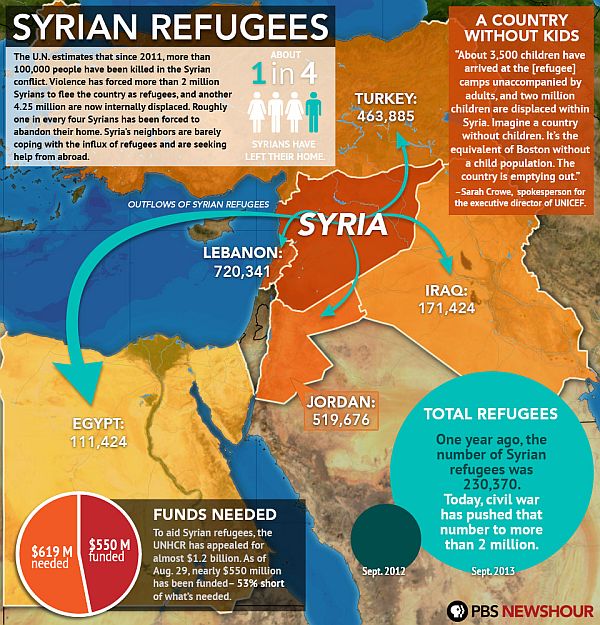
Note: Israel is by far the wealthiest country bordering Syria yet it hasn’t accepted any refugees. Some people may counter that Syrians wouldn’t want to seek refuge in the Jewish state. But Israel wouldn’t need to accommodate refugees inside Israel in order to accept them. Refugee camps could be created in the Golan Heights, which is to say, inside Israeli-occupied Syria.

Scott Lucas writes: Unresolved questions are flying over Russia’s proposal that Syria to give up chemical weapons stocks, in exchange for the US lifting its threat of airstrikes. Did Moscow seize upon a blunder by US Secretary of State John Kerry on Monday morning to make the proposal? Or did Russia and the Obama Administration work behind the scenes to come to an acceptable compromise?
In either case, the immediate outcome is that the Russians have gotten President Obama off the political hook.
Twenty-four hours ago, Obama was facing domestic and international humiliation, piled upon his indecision and mis-steps since the Assad regime’s August 21 chemical weapons attacks.
In the week following the attacks, the US President fumbled over whether the US would carry out a “limited” military response to the mass killing. Then on August 30, when US Secretary of State John Kerry finally put Washington on the verge of action with a tough speech, Obama abruptly changed course. The President believed a strike was necessary, but rather than taking the decision himself, he would put the issue to Congress.
For the sake of his domestic position, Obama had given the Assad regime a window of at least two weeks to resume a mass offensive against insurgent positions. But even the move on the home front was on the verge of backfiring last weekend: polling of Congressional representatives indicated there would be an embarrassing rejection of Obama’s proposal for limited intervention.
Other developments had hindered Obama. The British Parliament’s rejection of immediate action undermined a “coalition” for the airstrikes, and the President’s military has waged an internal but well-publicized battle against any intervention.
Still, the headline after Congress’s verdict looked set to be that the Commander-in-Chief had failed to Command.
And then on Monday, Russia offered salvation — whether as part of a smart, back-channel plan with the Americans or as an opportunistic gambit.
Moscow’s seizure of the political high ground, offering “peace” through Syria’s relinquishing of chemical weapons and the deferral of US airstrikes, meant that Obama could step back from the Congressional cliff. As the President told national television on Monday night that he supported the Russian plan in principle, the Senate postponed its vote, set for Wednesday. That in turn delays a decision by the House of Representatives, the more likely of the two chambers to reject intervention.
Of course, none of this — so far — offers a practical answer as to how Syria’s chemical weapons will be secured and handed over. Such a process is likely to take many weeks, and it can only be achieved if there is a cease-fire on the ground, a far-from-likely prospect. [Continue reading…]
The New York Times reporting on comments made today by Syria’s foreign minister, Walid al-Moallem:
Mr. Moallem said later in a statement that his government welcomed the Russian proposal [to put Syria’s stockpile of chemical weapons under international control and ultimately destroy them], Russia’s Interfax News Agency reported, in what appeared to be the first acknowledgment by the Syrian government that it even possesses chemical weapons. The Syrian government historically has neither confirmed nor denied possessing such weapons.
The New York Times, July 23, 2012:
Syrian officials warned Monday that they would deploy chemical weapons against any foreign intervention, a threat that appeared intended to ward off an attack by Western nations while also offering what officials in Washington called the most “direct confirmation” ever that Syria possesses a stockpile of unconventional armaments.
The warning came out of Damascus, veiled behind an assurance that the Syrian leadership would never use such weapons against its own citizens, describing chemical arms as outside the bounds of the kind of guerrilla warfare being fought internally.
“Any stock of W.M.D. or unconventional weapons that the Syrian Army possesses will never, never be used against the Syrian people or civilians during this crisis, under any circumstances,” a Foreign Ministry spokesman, Jihad Makdissi, said at a news conference shown live on Syrian state television, using the initials for weapons of mass destruction. “These weapons are made to be used strictly and only in the event of external aggression against the Syrian Arab Republic.”
Mr. Makdissi said that any such weapons were carefully monitored by the Syrian Army, and that ultimately their use would be decided by generals.
NBC News reports: With Obama set to address the nation Tuesday night to advocate U.S. intervention against Syrian President Bashar Assad’s regime, just 24 percent of Americans believe military action in response to Assad’s reported use of chemical weapons is in the United States’ interest.
CBS News: In an interview Monday, President Obama responded to a surprising late proposal that could head off a military strike against Syria. The Syrians agreed to a Russian proposal to put their chemical weapons under international control and destroy them.
I talked to President Obama about that, and about a threat Syrian dictator Bashar Assad made during an interview with Charlie Rose.
SCOTT PELLEY: Can you accept the Russian/Syrian proposal?
PRESIDENT OBAMA: Well, we don’t know the details of it yet. But I think that it is a potentially positive development. I don’t think that we would’ve gotten to the point where they even put something out there publicly, had it not been — and if it doesn’t continue to be a credible — military threat from the United States and those who support Syria’s responses to what happened inside of Syria. But, you know, my central goal throughout this process has not been to embroil ourselves in a civil war in Syria.
I have shown great restraint, I think, over the last two years, despite the heartbreak that’s happened there. But what I have said is that the ban on chemical weapon use is something that is of U.S. national interest. It protects our troops, so that they don’t have to wear gas masks whenever they’re in theater, the weapons by definition are indiscriminate and don’t differentiate between somebody in uniform and a child.
Which is to say, they are unlike America’s smart weapons systems which have supernatural powers of discrimination and target the guilty while protecting the innocent.
Whoever heard of an American bomb killing innocent people? Unless of course they happened to be attending a wedding or engaged in some other kind of suspicious behavior.
No doubt a 2 per cent accuracy rate in differentiating between civilians and suspected terrorists leaves room for improvement, but having set the benchmark for indiscriminate killing in Hiroshima, the United States has been making huge strides ever since.
The 15,000 lb Daisy Cutter that has been replaced by the 22,000 lb Mother of All Bombs. The blast from the later produces a shock wave that can kill people up to 1.7 miles away and obliterates everything up to a 1,000 yards. Maybe that’s a bit indiscriminate.
Perhaps Obama can stand on more solid ground if he avoids suggesting that one weapons system is significantly more discriminating than another.
The indiscriminate nature of the violence used by the Assad regime has had less to do with differences between conventional and unconventional weapons, and much more to do with the fact that these weapons are being used to destroy whole cities in Syria and cause a quarter of the population to flee their homes.
The use of chemical weapons last month certainly had catastrophic results, but let’s keep in mind the big picture: Syria is a country with a government whose actions have resulted in more than 6 million people becoming homeless.
The New York Times reports: As the diplomatic pace quickened around Russia’s plan for Syria to relinquish control of its chemical weapons, France said on Tuesday it would propose a United Nations Security Council resolution enshrining the idea while Moscow said it was working with the authorities in Damascus on a “workable, precise and concrete plan” to carry the proposal forward.
“We are hoping to present this plan in the near future,” Sergey V. Lavrov, the Russian foreign minister, said. “We will be ready to work through this plan and improve it with the participation of the U.N. general secretary, with chemical weapons control organizations and with the members of the Security Council.”
The Russian blueprint also won backing from China, which has resisted Western calls for military action against Syria but said on Tuesday that it supported Moscow’s avowed effort to avert an American strike following last month’s poison gas attacks outside Damascus.
Hours before President Obama planned to deliver a major national address on the Syrian crisis, the rapid-fire developments elicited skepticism from many regional and international players who questioned the motives behind the Russian gambit and questioned whether Moscow’s plan would enable the Syrian authorities to buy time. [Continue reading…]
Reuters reports: Any deal with Syria to hand over its chemical weapons in the middle of a chaotic civil war would be difficult for inspectors to enforce and destroying them would likely take years, U.S. officials and experts caution.
Syria’s strongest backer, Russia, proposed on Monday that Damascus save itself from a U.S. military strike over its alleged use of chemical weapons by putting its stockpiles under international control.
The proposal was welcomed by Syria and seized upon by the secretary-general of the United Nations. U.S. President Barack Obama said the offer was a potential breakthrough but had to be handled with skepticism.
Syria has never signed a global treaty banning the storage of chemical weapons and is believed to have large stocks of sarin, mustard gas and VX nerve agents. The actual use of chemical weapons is banned by a 1925 treaty to which Damascus is a signatory.
Accounting for Syria’s chemical arms cache – believed to be spread over dozens of locations – would be difficult, as would be shielding arms inspectors from violence.
“This is a nice idea but tough to achieve,” said one U.S. official speaking on condition of anonymity.
“You’re in the middle of a brutal civil war where the Syrian regime is massacring its own people. Does anyone think they’re going to suddenly stop the killing to allow inspectors to secure and destroy all the chemical weapons?” the official said.
Amy Smithson, an expert on nuclear, biological and chemical weapons at the James Martin Center for Nonproliferation Studies in Washington, said a lack of hard data on Syria’s chemical weapons inventory would complicate verification. [Continue reading…]
The Times of Israel reports: Details of a deal to put Syria’s chemical weapons under international control are highly murky, Knesset foreign affairs chief Avigdor Liberman said Tuesday, warning that the plan could potentially serve the interests of the Assad regime.
Speaking to Israel Radio, the head of the Knesset Foreign Affairs and Defense Committee said Syrian President Bashar “Assad is winning time and lots of it,” as a result of the Russian plan. Comparing the situation to that of Iran’s nuclear program, he noted that the Syrian leader could use the initiative to “buy time” and stall any real international involvement, military or other.
Liberman, a former foreign minister, warned that Israel was determined not to be dragged into the conflict but would not shy away from retaliating if the country was attacked, no matter who the aggressor may be.
The New York Times reports: The American Israel Public Affairs Committee, the powerful pro-Israel lobby in Washington, plans to dispatch 300 of its members to Capitol Hill on Tuesday as part of a broad campaign to press Congress to back President Obama’s proposed strike on Syria, the group said Monday.
The push by the group, known as Aipac, which included asking its supporters to call members of Congress, came as Israeli newspapers reported Monday that President Obama urged Prime Minister Benjamin Netanyahu to get personally involved in lobbying Congress. The reports said that Mr. Netanyahu had called several members himself.
But while those reports could not be confirmed, the intense push by Aipac and other Jewish and pro-Israel groups put Israel in a bind, after a week of trying to stay on the sidelines of the debate. Mr. Netanyahu’s government strongly supports an American strike to punish President Bashar al-Assad of Syria for his apparent use of chemical weapons, and as a warning to his Iranian patrons. But Israelis are deeply worried about being blamed by a wary American public for another military gambit in the Middle East, or of losing their broad bipartisan support if they land on the wrong side of the vote.
“It is a major dilemma, what Israel should do on the Hill,” a senior Israeli official said Monday, speaking on the condition of anonymity because of a dictate from Mr. Netanyahu not to discuss the Syria situation publicly. “We don’t want to be identified with pressing for a strike. This is not for us — we don’t want anybody to think this is for us,” the official said. “But if the president asks us for assistance, who are we to refuse?”
Mark Regev, a spokesman for Mr. Netanyahu, declined to discuss the prime minister’s conversations with Mr. Obama, or to say whether Mr. Netanyahu had indeed called members of Congress, as reported by the newspaper Yediot Aharonot. The Israeli official who spoke anonymously pointed to a Facebook post last week by Michael B. Oren, Israel’s ambassador to Washington, agreeing with President Obama’s argument for attacking Syria, as having given the green light for Aipac to spring into action.
But if Aipac, as an American organization, has a role to play in Washington debates, several Israeli analysts said that any direct involvement by Israeli officials was problematic.
“Israel as Israel should stay away from this campaign,” said Zvi Rafiah, a longtime Israeli diplomat and consultant on American politics. “We should not be the one that pushes the American people to do or not do anything they want or don’t want.”
Matthew Aid writes: Syria’s reported use of chemical weapons is threatening to turn the civil war there into a wider conflict. But the Bashar al-Assad government may not be the only one in the region with a nerve gas stockpile. A newly discovered CIA document indicates that Israel likely built up a chemical arsenal of its own.
It is almost universally believed in intelligence circles here in Washington that Israel possesses a stockpile of several hundred fission nuclear weapons, and perhaps even some high-yield thermonuclear weapons. Analysts believe the Israeli government built the nuclear stockpile in the 1960s and 1970s as a hedge against the remote possibility that the armies of its Arab neighbors could someday overwhelm the Israeli military. But nuclear weapons are not the only weapon of mass destruction that Israel has constructed.
Reports have circulated in arms control circles for almost 20 years that Israel secretly manufactured a stockpile of chemical and biological weapons to complement its nuclear arsenal. Much of the attention has been focused on the research and development work being conducted at the Israeli government’s secretive Israel Institute for Biological Research at Ness Ziona, located 20 kilometers south of Tel Aviv.
But little, if any, hard evidence has ever been published to indicate that Israel possesses a stockpile of chemical or biological weapons. This secret 1983 CIA intelligence estimate may be the strongest indication yet.
According to the document, American spy satellites uncovered in 1982 “a probable CW [chemical weapon] nerve agent production facility and a storage facility… at the Dimona Sensitive Storage Area in the Negev Desert. Other CW production is believed to exist within a well-developed Israeli chemical industry.”
“While we cannot confirm whether the Israelis possess lethal chemical agents,” the document adds, “several indicators lead us to believe that they have available to them at least persistent and nonpersistent nerve agents, a mustard agent, and several riot-control agents, marched with suitable delivery systems.”
Whether Israel still maintains this alleged stockpile is unknown. In 1992, the Israeli government signed but never ratified the Chemical Weapons Convention, which bans such arms. (The Israeli embassy in Washington did not respond to requests to comment on this article.) The CIA estimate, a copy of which was sent to the White House, also shows that the U.S. intelligence community had suspicions about this stockpile for decades, and that the U.S. government kept mum about Israel’s suspected possession of chemical weapons just as long. [Continue reading…]
The National reports: Western social media sites are outlawed for ordinary Iranians, but Iran’s new government is using them keenly in a concerted drive to improve the Islamic republic’s image.
Spearheading the cyber charm offensive is the president, Hassan Rouhani, and his US-educated foreign minister, Mohammad Javad Zarif, who garnered global attention last week when he used his new English-language Twitter account to wish Jews a happy new year and to proclaim that his country does not deny the Holocaust.
A day earlier, a tweet from an account in Mr Rouhani’s name wished “all Jews” a “blessed” new year on the holiday of Rosh Hashanah.
Iran’s entire cabinet has also opened Facebook pages in recent weeks.
The public diplomacy drive is preparing the ground for key events. Tehran is due in coming weeks to resume talks on its nuclear programme with six world powers, including the United States.
Mr Rouhani, who is regarded as a moderate pragmatist, transferred the handling of those negotiations last week to Mr Zarif’s foreign ministry, taking the portfolio away from hardline officials.
And later this month, Mr Rouhani will make his debut on the international stage when he addresses the United Nations General Assembly in New York.
The Jewish new year greetings were clearly aimed at distancing his administration from that of his predecessor. Mahmoud Ahmadinejad’s denials of the Holocaust made him toxic to western public opinion, fuelled fears over Tehran’s nuclear ambitions and embarrassed many Iranians.
“The Rouhani team is eager to quickly undo the eight years of damage that the Ahmadinejad government did to Iran’s standing and image,” said Trita Parsi, the president of the National Iranian American Council, an advocacy group. “In this new age, you can at times reach more people through a tweet than through a press release, and Rouhani and Zarif have shown that they know that.” [Continue reading…]
Shane Harris writes: On Aug. 1, 2005, Lt. Gen. Keith Alexander reported for duty as the 16th director of the National Security Agency, the United States’ largest intelligence organization. He seemed perfect for the job. Alexander was a decorated Army intelligence officer and a West Point graduate with master’s degrees in systems technology and physics. He had run intelligence operations in combat and had held successive senior-level positions, most recently as the director of an Army intelligence organization and then as the service’s overall chief of intelligence. He was both a soldier and a spy, and he had the heart of a tech geek. Many of his peers thought Alexander would make a perfect NSA director. But one prominent person thought otherwise: the prior occupant of that office.
Air Force Gen. Michael Hayden had been running the NSA since 1999, through the 9/11 terrorist attacks and into a new era that found the global eavesdropping agency increasingly focused on Americans’ communications inside the United States. At times, Hayden had found himself swimming in the murkiest depths of the law, overseeing programs that other senior officials in government thought violated the Constitution. Now Hayden of all people was worried that Alexander didn’t understand the legal sensitivities of that new mission.
“Alexander tended to be a bit of a cowboy: ‘Let’s not worry about the law. Let’s just figure out how to get the job done,'” says a former intelligence official who has worked with both men. “That caused General Hayden some heartburn.”
The heartburn first flared up not long after the 2001 terrorist attacks. Alexander was the general in charge of the Army’s Intelligence and Security Command (INSCOM) at Fort Belvoir, Virginia. He began insisting that the NSA give him raw, unanalyzed data about suspected terrorists from the agency’s massive digital cache, according to three former intelligence officials. Alexander had been building advanced data-mining software and analytic tools, and now he wanted to run them against the NSA’s intelligence caches to try to find terrorists who were in the United States or planning attacks on the homeland.
By law, the NSA had to scrub intercepted communications of most references to U.S. citizens before those communications can be shared with other agencies. But Alexander wanted the NSA “to bend the pipe towards him,” says one of the former officials, so that he could siphon off metadata, the digital records of phone calls and email traffic that can be used to map out a terrorist organization based on its members’ communications patterns.
“Keith wanted his hands on the raw data. And he bridled at the fact that NSA didn’t want to release the information until it was properly reviewed and in a report,” says a former national security official. “He felt that from a tactical point of view, that was often too late to be useful.”
Hayden thought Alexander was out of bounds. INSCOM was supposed to provide battlefield intelligence for troops and special operations forces overseas, not use raw intelligence to find terrorists within U.S. borders. But Alexander had a more expansive view of what military intelligence agencies could do under the law.
“He said at one point that a lot of things aren’t clearly legal, but that doesn’t make them illegal,” says a former military intelligence officer who served under Alexander at INSCOM. [Continue reading…]
When asked by a journalist this morning whether there was anything Bashar al-Assad could do to avert American military strikes, John Kerry answered: “Sure, he could turn over every single bit of his chemical weapons to the international community in the next week — turn it over, all of it, without delay and allow the full and total accounting. But he isn’t about to do it, and it can’t be done.”
To predict Syrian intransigence is one thing, but to suggest “it can’t be done” seems to imply that the Obama administration is so strongly committed to attacking Syria that it is now unwilling to consider any alternative. At the same time, this commitment is to what Kerry describes as “an unbelievably small, limited kind of effort.”
U.S. policy towards Syria as it is currently being articulated is a resolute commitment to engage in military action that will have no effect on the outcome of the war. Is this a policy? Or an affectation? Is this about sending a message or striking a pose?
Ten days ago, the Los Angeles Times reported:
One U.S. official who has been briefed on the options on Syria said he believed the White House would seek a level of intensity “just muscular enough not to get mocked” but not so devastating that it would prompt a response from Syrian allies Iran and Russia.
“They are looking at what is just enough to mean something, just enough to be more than symbolic,” he said.
It’s hardly any wonder that when the Chairman of the Joint Chiefs of Staff, Gen. Martin Dempsey, was asked in the Senate last week what the U.S. is seeking in Syria, he said: “I can’t answer that, what we’re seeking.”
President Obama and his accessories are treating this moment as a test of the conscience of the world. And now it appears even Russia and Syria are willing to participate in the charade.
Following Kerry’s offhand remark about what he regarded as a purely hypothetical situation, Russia seized on the opportunity. The Wall Street Journal reports:
Foreign Minister Sergei Lavrov of Russia, one of the strongest supporters of the Assad regime, urged Syria to comply with Mr. Kerry’s call.
“We are calling on the Syrian leadership not just to agree to put chemical-weapons stores under international control, but also to their subsequent destruction, as well as fully fledged accession to the Chemical Weapons Convention,” Mr. Lavrov said.
Syrian Foreign Minister Walid Moallem, in comments to reporters in Moscow, didn’t provide any specifics, other than to say that Syria welcomed the Russian proposal.
“The Syrian Arab republic welcomes the Russian initiative, motivated by the concerns of the Russian leadership for the lives of our citizens and the security of our country,” Mr. Moallem said, according to Russia’s Interfax news agency.
Mr. Moallem didn’t provide any further details of whether Damascus supported both turning over its chemical weapons to international monitors and ultimately destroying them, as Mr. Lavrov proposed.
Mr. Moallem didn’t address Russia’s call for Damascus to accede to the global convention banning chemical weapons.
He said Syria’s position on the Russian proposal was motivated “out of our faith in the wisdom of the Russian leadership, which is striving to prevent American aggression against our people.”
U.K. Prime Minister David Cameron said Syria should be encouraged to put its chemical weapons beyond use, but added that the international community must be wary in case it uses any such offers as a diversionary tactic.
United Nations Secretary-General Ban Ki-moon added his support to the proposal, and said he is drawing up plans for Syria’s chemical weapons to be moved to a secure location within the country where they could be eliminated under U.N. supervision.
Slim as the odds might currently seem, let’s suppose that Syria follows through. After all, given that the use of chemical weapons was Obama’s only red line and the Assad regime has had little trouble killing 100,000 of its citizens by conventional means, getting rid of these weapons might now seem like a relatively small trade-off in exchange for enjoying continued free rein in the ongoing task of wiping out the opposition.
In the event that Syria’s chemical weapons stockpiles are destroyed, President Obama, John Kerry, Samantha Power and the other self-appointed guardians of the world’s conscience can declare a great success and yet the misery of Syria’s people will not have been alleviated in the slightest.
But were Obama to set his vanity aside and forget about an offhand remark on red lines he made in a news conference a year ago, he might pause to remember a much more significant commitment he made five years ago when he was trying to persuade Americans that he had what it took to become a strong president:
Russia might be Syria’s most powerful supporter, yet because of the roles that the Revolutionary Guard and Hezbollah play in defending the Assad regime, it is Iran that wields the greatest amount of influence with its closest regional ally.
Unlike Israel, which has become increasingly transparent in expressing its desire for the war in Syria to continue — “let them both bleed, hemorrhage to death,” as a former Israeli diplomat put it last week — Iran has a much greater interest in arriving at a political solution to the conflict.
As Time notes:
Much like Washington, Tehran finds itself debating what to do with Syria.
Former Iranian President Mahmoud Ahmadinejad threatened several times to wipe Israel from the face of the earth and under him Iran’s nuclear program has grown enormously in defiance of international sanctions. But Iran has a new president. Hassan Rouhani won a resounding victory in June, in part due to his promises of engagement with the West.
Certainly, the tone out of Tehran has taken a 180. Last week, Rouhani tweeted a happy new year to “all Jews, especially Iranian Jews” celebrating Rosh Hashanah. And his newly appointed Foreign Minister Mohammad Javad Zarif, who is widely expected to lead the new round of nuclear talks with the West later this month, tweeted at House Minority Leader Nancy Pelosi’s daughter that Iran “never denied” the Holocaust and “the man who was perceived to be denying it is now gone.” He was presumably referring to Ahmadinejad.
Rouhani’s tone on Syria has also been different, not so much in what he’s said but in what he hasn’t. In a speech before the Assembly of Experts on Wednesday, Rouhani said if Syria is attacked by the West, “the Islamic Republic of Iran will do its religious and humanitarian duty and send food and medicine.” He notably didn’t threaten bombs or retaliation. In other speeches, Rouhani has noted that Iran has bitter experience with chemical weapons: some 20,000 Iranian soldiers were killed and upwards of 100,000 Iranians were injured by Iraqis using chemical weapons during the Iran-Iraq War. “We completely and strongly condemn the use of chemical weapons, because the Islamic Republic of Iran is itself a victim of chemical weapons,” Rouhani said on Aug. 24, according to the ISNA News Agency.
Former Iranian President Akbar Hashemi Rafsanjani, a reformist who threw his support behind Rouhani before the elections, went so far as to blame the Assad regime for the attack, while most Iranian hardliners have blamed the Syrian opposition. The remarks were censored and he later issued a statement supporting the Syrian regime. Still, his remarks reflect the raging debate within Iran about Syria.
Few in Washington can be blind to the changes taking place in Iran right now, yet from Obama downwards, virtually no one has the courage to advocate seizing the most significant diplomatic opportunity to have emerged in a decade. Dialogue with Iran not only holds the key to a possible end to the war in Syria but also the beginning of a path leading to a deescalation of tensions with Israel. Moreover, as Iran’s international isolation diminishes, Saudi Arabia will have less freedom to fuel Sunni-Shia sectarian tensions which have flared across the region.
Could talking to Iran yield so many benefits? Not all at once and not quickly, but the opportunity is there and the biggest obstacles lie in the United States and in Israel.
Since the end of the Cold War, the national security economies of both countries have thrived through the continuation of conflict in the Middle East. War and the threat of war have been good for business and good for bloated defense budgets.
Moreover, a region that seems locked in interminable conflict, serves as a convenient foil behind which Israel’s occupation of a future Palestinian state becomes ever more entrenched and the so-called peace process becomes a sideshow bereft of any credibility.
Maybe there’s one useful lesson Obama can draw from the last few days: When the supposedly all-powerful Israel lobby pulls out all the stops in order to rally the kind of Congressional support that only this lobby holds in its power, it looks like AIPAC and its allies can’t actually deliver.
Has a corner been turned? Has Washington discovered it no longer needs to live in fear of retribution from the lobby?