New claim that order for chemical attacks did not come from Assad

The Guardian reports: President Bashar al-Assad did not personally order last month’s chemical weapons attack near Damascus that has triggered calls for US military intervention, and blocked numerous requests from his military commanders to use chemical weapons against regime opponents in recent months, a German newspaper has reported, citing unidentified, high-level national security sources.

The intelligence findings were based on phone calls intercepted by a German surveillance ship operated by the BND, the German intelligence service, and deployed off the Syrian coast, Bild am Sonntag said. The intercepted communications suggested Assad, who is accused of war crimes by the west, including foreign secretary William Hague, was not himself involved in last month’s attack or in other instances when government forces have allegedly used chemical weapons.

Assad sought to exonerate himself from the August attack in which hundreds died. “There has been no evidence that I used chemical weapons against my own people,” he said in an interview with CBS.

But the intercepts tended to add weight to the claims of the Obama administration and Britain and France that elements of the Assad regime, and not renegade rebel groups, were responsible for the attack in the suburb of Ghouta, Bild said. [Continue reading…]

This report lends weight to the implications in a report published on August 27 which raised questions about culpability for the chemical massacre:

Last Monday, in the hours after a horrific chemical attack east of Damascus, an official at the Syrian Ministry of Defense exchanged panicked phone calls with leader of a chemical weapons unit, demanding answers for a nerve agent strike that killed more than 1,000 people. Those conversations were overheard by U.S. intelligence services, The Cable has learned. And that is the major reason why American officials now say they’re certain that the attacks were the work of the Bashar al-Assad regime — and why the U.S. military is likely to attack that regime in a matter of days.

But the intercept raises questions about culpability for the chemical massacre, even as it answers others: Was the attack on August 21 the work of a Syrian officer overstepping his bounds? Or was the strike explicitly directed by senior members of the Assad regime? “It’s unclear where control lies,” one U.S. intelligence official told The Cable. “Is there just some sort of general blessing to use these things? Or are there explicit orders for each attack?”

While some opponents of a military strike on Syria have been distracted by far-fetched theories about rebels being responsible for the chemical attack and by simplistic comparisons with the run up to the war in Iraq, there is a comparison with Iraq that might be much more pertinent.

Bush and Blair misled Americans and Britons by claiming to have much stronger intelligence than they actually possessed. Obama and Kerry may be guilty of doing almost the opposite, which is to say, limiting the amount of intelligence they reveal because it undercuts their rationale for attacking the Assad regime.

Administration officials have persistently dodged the question about whether they believe Assad ordered the chemical attack. They argue that irrespective of whether he issued the command, as the leader of his armed forces, he must be held responsible for their actions.

That argument is reasonable up to a point. That is, it is reasonable if Bashar al-Assad is indeed in control of his own forces.

But what if multiple intelligence sources provide evidence that that is not the case? What if the Obama administration has reason to believe that the chemical attack was conducted not only without Assad’s direct authorization but also, as the Bild report claims, in contradiction with his stated wishes? Why now hold Assad personally responsible?

There are several possible explanations. Firstly, the message that chemical attacks will be punished does not actually need to be directed at anyone specifically but applies to all Syrians who might be involved in such attacks in the future. Arguably, that’s a legitimate reason for not caring whether Assad himself ordered the attack.

A second explanation, however, would be political, and that is that the administration does not want to reinforce the perception that Assad’s hold on power is weak. If that is indeed part of the administration’s thinking, then it is withholding the release of important intelligence for wholly illegitimate reasons. It could in this scenario reasonably be accused of propping up the Assad regime.

Even in its public statements, the administration is already close to having assumed this position. Forgotten are the days when Obama was saying that Assad must go. The administration’s official position now is that it does not support either side in Syria’s civil war. John Kerry: “We make it crystal clear now in every statement that we have made, this action has nothing to do with engaging directly in Syria’s civil war on one side or the other.”

Facebooktwittermail

The U.S. has little credibility left: Syria won’t change that

Gary Younge writes: ‘I created Transjordan,” Winston Churchill once boasted, “with a stroke of a pen one Sunday afternoon in Cairo.” Take a look at what remains of Jordan 90 years later and you can see how. Straight borders drawn with a ruler carve indifferent frontiers through a complex region with the kind of callous colonial hubris that displayed scant regard for linguistic, ethnic or religious affiliation.

Much of the contemporary turmoil in the Middle East owes its origins to foreign powers drawing lines in the sand that were both arbitrary and consequential and guided more by their imperial standing than the interests of the region. The “red line” that president Barack Obama has set out as the trigger for US military intervention in Syria is no different.

He drew it unilaterally in August 2012 in response to a question about “whether [he envisioned] using US military” in Syria. “A red line for us is we start seeing a whole bunch of chemical weapons moving around or being utilised. That would change my calculus. That would change my equation.”

On 21 August there was a chemical weapons attack outside Damascus believed to have been carried out by the Syrian government. That changed both Obama’s calculus and his memory. “I didn’t set a red line,” he claimed last week. I didn’t draw it, he insisted, everybody did. “The world set a red line”.

This was news to the world, which, over the weekend, sought to distance itself from his line, as the US president doubled-down on his double-speak.

“My credibility is not on the line,” he argued. “The international community’s credibility is on the line. And America and Congress’s credibility is on the line …. The US recognises that if the international community fails to maintain certain norms, standards, laws, governing how countries interact and how people are treated, that over time this world becomes less safe.”

The alleged urgency to bomb Syria at this moment is being driven almost entirely by the White House’s desire to assert both American power and moral authority as defined by a self-imposed ultimatum. It is to this beat that the drums of war are pounding. But thus far few are marching. The American public is against it by wide margins. As a result it is not clear that Congress, whose approval he has sought, will back him. The justification and the objectives for bombing keep changing and are unconvincing. He has written a rhetorical cheque his polity may not cash and the public is reluctant to honour. On Tuesday night he’ll make his case to a sceptical nation from the White House.

Before addressing why people are right to be sceptical, it is necessary to attend to some straw men lest they are crushed in the stampede to war. The use of chemical weapons is abhorrent and the Syrian regime is brutal (whether it used chemical weapons in this case or not). With more than 100,000 dead in the civil war, diplomatic efforts have clearly not been successful thus far. Those who claim the principles of human solidarity and internationalism should not sit idly by while the killing continues. Nobody can claim, with any integrity, that they have a plan that will stem the bloodshed.

But the insistence that a durable and effective solution to this crisis lies at the end of an American cruise missile beggars belief. It is borne from the circular sophistry that has guided most recent “humanitarian interventions”: (1) Something must be done now; (2) Bombing is something; (3) Therefore we must bomb. [Continue reading…]

Facebooktwittermail

Kerry outlines ‘unbelievably small’ strike on Syria

The Globe and Mail reports: U.S. Secretary of State John Kerry said the United States is considering only an “unbelievably, small, limited” strike on Syria as punishment for allegedly using chemical weapons and he insisted military action will not end that country’s civil war.

“We’re not going to war,” Mr. Kerry told reporters Monday after meeting with British Foreign Secretary William Hague in London. “We will be able to hold [Syrian President] Bashar al-Assad accountable without engaging troops on the ground or any other prolonged kind of effort, in a very limited, very targeted, very short-term effort that degrades his capacity to deliver chemical weapons without assuming responsibility for Syria’s civil war. That is exactly what we are talking about doing; an unbelievably small, limited kind of effort.” [Continue reading…]

Facebooktwittermail

Kerry makes disingenuous ‘offer’ to Assad to resolve crisis

Reuters reports: U.S. Secretary of State John Kerry said on Monday Syrian President Bashar al-Assad could avoid a military strike by turning over all his chemical weapons within a week but immediately made clear he was sure that would never happen.

When asked by a reporter whether there was anything Assad’s government could do or offer to stop any attack, Kerry said:

“Sure, he could turn over every single bit of his chemical weapons to the international community in the next week – turn it over, all of it without delay and allow the full and total accounting (of it) but he isn’t about to do it and it can’t be done.”

It did not appear that Kerry was making a serious offer to the Syrian government, which the United States accuses of using chemical weapons in an August 21 attack.

Facebooktwittermail

Obama growing isolated on Syria as support wanes

Reuters reports: White House efforts to convince the U.S. Congress to back military action against Syria are not only failing, they seem to be stiffening the opposition.

That was the assessment on Sunday, not of an opponent but of an early and ardent Republican supporter of Obama’s plan for attacking Syria, the influential Republican chairman of the House intelligence committee, Mike Rogers.

Rogers told CBS’s “Face the Nation” the White House had made a “confusing mess” of the Syria issue. Now, he said, “I’m skeptical myself.”

Congress will be in session on Monday for the first time since the August recess. Debate on Syria could begin in the full Senate this week, with voting as early as Wednesday. The House of Representatives could take up the issue later this week or next.

Obama is expected to spend the next several days in personal meetings with members.

Some Democratic opponents of a military strike, meanwhile, were looking for a way to spare Obama’s administration the effects of a “no” vote.

Representative Jim McGovern of Massachusetts suggested that the president withdraw his request before it is defeated, saying on CNN’s “State of the Union” that there was insufficient support for it in Congress.

There are no signs that Obama is considering that, but speculation about the possibility that the administration might delay a vote surfaced on Sunday when Secretary of State John Kerry, speaking in Paris after meeting Arab foreign ministers, did not rule out returning to the United Nations Security Council to secure a Syria resolution.

A U.S. official who asked not to be named later squelched that speculation: “We have always supported working through the U.N. but have been clear there is not a path forward there.” [Continue reading…]

Facebooktwittermail

Iraq joins Iran in opposing U.S.-led military strike in Syria

The Washington Post reports: Iran won Iraqi support for its efforts to oppose a U.S.-led military strike on Syria during a visit to Baghdad on Sunday by the new Iranian foreign minister, highlighting how close the two countries have grown since U.S. forces withdrew in 2011.

Speaking during his first visit abroad since he was appointed last month, Iranian Foreign Minister Mohammad Javed Zarif warned that U.S. intervention in Syria risks igniting a regionwide war.

“Those who are short-sighted and are beating the drums of war are starting a fire that will burn everyone,” Zarif said during a news conference.

Standing alongside him, Iraqi Foreign Minister Hoshyar Zebari said all of Syria’s neighbors, including Iraq, would be harmed by American involvement in Syria’s two-year-old conflict.

“What I can say conclusively is that Iraq will not be a base for any attack, nor will it facilitate any such attack on Syria,” Zebari told reporters after holding talks with Zarif. [Continue reading…]

Facebooktwittermail

The folly of the false flag brigade

In the rather pretentious form of a “memorandum” for “the president”, former CIA analyst Ray McGovern writes:

There is a growing body of evidence from numerous sources in the Middle East — mostly affiliated with the Syrian opposition and its supporters — providing a strong circumstantial case that the August 21 chemical incident was a pre-planned provocation by the Syrian opposition and its Saudi and Turkish supporters. The aim is reported to have been to create the kind of incident that would bring the United States into the war.

According to some reports, canisters containing chemical agent were brought into a suburb of Damascus, where they were then opened. Some people in the immediate vicinity died; others were injured.

We are unaware of any reliable evidence that a Syrian military rocket capable of carrying a chemical agent was fired into the area. In fact, we are aware of no reliable physical evidence to support the claim that this was a result of a strike by a Syrian military unit with expertise in chemical weapons.

The “we” is the Steering Group, Veteran Intelligence Professionals for Sanity: Thomas Drake, Senior Executive, NSA (former); Philip Giraldi, CIA, Operations Officer (ret.); Matthew Hoh, former Capt., USMC, Iraq & Foreign Service Officer, Afghanistan; Larry Johnson, CIA & State Department (ret.); W. Patrick Lang, Senior Executive and Defense Intelligence Officer, DIA (ret.); David MacMichael, National Intelligence Council (ret.); Ray McGovern, former US Army infantry/intelligence officer & CIA analyst (ret.); Elizabeth Murray, Deputy National Intelligence Officer for Middle East (ret.); Todd Pierce, US Army Judge Advocate General (ret.); Sam Provance, former Sgt., US Army, Iraq; Coleen Rowley, Division Council & Special Agent, FBI (ret.); and Ann Wright, Col., US Army (ret); Foreign Service Officer (ret.).

Do these guys have no internet access? Of course that’s a facetious question. Even though I applaud the stand that many of these folks took in opposing the war in Iraq and continue to take on issues such as mass surveillance, the willingness of former intelligence analysts to attach their names to a statement like this should be taken as yet another indication that the term, U.S. intelligence, is an oxymoron.

“We are unaware…” “we are aware of no reliable physical evidence…” — this sounds like James Clapper testifying in Congress. Rather than parade their lack of awareness, maybe they should spend more time doing research and less time issuing memoranda.

Some people may feel that anything appearing on YouTube can’t qualify as reliable evidence, so if that includes you, don’t bother reading any more of this post.

What follows is primarily based on the work of Eliot Higgins who runs Brown Moses Blog. He has distinguished himself as one of the leading analysts of weapons being used in Syria and I see in his work no evidence that he has any political axe to grind. Even now, he suspends judgement on whether chemical weapons have been used and leaves this to be determined by the UN. Where he has focused a lot of attention is on the munitions associated with alleged chemical weapons attacks and this is where his work has recently been most informative.

Soon after August 21, when the false flag brigade swung into action, one of the first “smoking guns” to become popular was a video showing rebels using artillery fired gas tanks:

A couple of problems with this particular piece of “evidence” quickly emerged. Firstly, the original video turned out to be a month old, so the attack being shown clearly wasn’t the one that occurred on August 21. But more importantly, the weapon itself was already well-known — an improvised devise dubbed the “Hell Cannon.” Its producers were so proud of their accomplishment they created a promotional video showing how they turn propane tanks into fertilizer-filled bombs that can then be fired out of a cannon. While the video shows the ingenuity with which Syria’s rebels have made use of their scant resources (proof, incidentally, that contrary to a widely held belief, Syria is not awash in foreign supplied weapons), more than anything it shows the crudeness of the kinds of devices that can be created in a welding shop. Keep this in mind when reviewing the evidence that follows.

At this time, among reasonable observers, there is little doubt that a large number of Syrians died on August 21 and the dozens of videos available showing victims, strongly indicate that the cause of death was some kind of lethal airborne chemical.

McGovern and his fellow intel retirees apparently believe that the source of the deadly chemical was canisters that had been brought into the areas where the deaths took place and that the canisters had accidentally been opened.* I can’t quite figure whether this is supposed to be a false flag operation or a false flag operation gone wrong. In any case McGovern claims there is a “growing body of evidence from numerous sources in the Middle East” to support this theory.

McGovern is employing a commonly used rhetorical ploy when he says this: he is citing evidence yet gives no indication that he knows what this “evidence” actually is. Perhaps the evidence is so technical that one would need to be an intelligence professional to understand it, or, more likely, he hasn’t a clue whether there actually is any such evidence and is merely parroting someone else’s claim that such evidence exists.

My attitude is: show me the evidence, then I’ll decide whether it’s compelling. As things stand, all McGovern is doing is circulating rumors.

Eliot Higgins, on the other hand, has evidence that merits careful examination and it starts with the video below. (I posted a shorter version of this previously but it’s worth watching the whole thing.)

The first thing to note is a gray missile that can be seen at the beginning of the video being delivered to a missile launcher. The missile is about ten feet long with small guidance fins at the right end and a tank at the other that’s roughly 18″ wide and 36″ long. Above the missile is an orange hydraulic hoist that is presumably used to move the missile from the delivery vehicle to the launch vehicle. (The video does not show this happening. We see the launch vehicle without missile and then with missile.)

Aside from noting the dimensions and shape of the missile itself, it’s also worth noting the delivery vehicle: a new Mercedes tractor and trailer with hydraulic lift adds up to an expensive item, way beyond the means of any militia that is struggling just to pay for its bullets.

In a screenshot from an edited copy of the same video, the assumed structure of the missile (seen a fraction of a second after its launch) is highlighted:
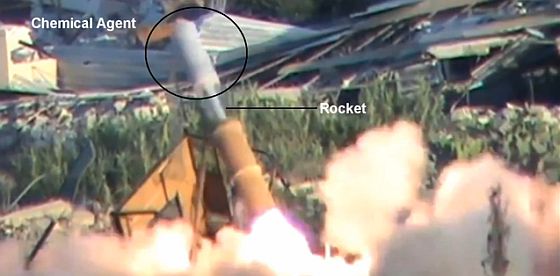
As Higgins notes, this is a missile design that has not been observed anywhere outside Syria. Unlike the Hell Cannon, this is not simply an explosive projectile – it is a rocket and as photographs below and the videos above make clear, the missile itself is industrially engineered, its design must have been rigorously tested, and the delivery system costs tens of thousands of dollars — multiple reasons to believe that this was not improvised by rebels.

One of the features of chemical weapons that has been widely noted is that they do not carry high explosives which would destroy the chemical agent only carry a small amount of explosive — they are designed to rip open on impact and as a result much of such a missile can be recovered. As a result a lot of evidence on the form of the missiles has been gathered at the site of the alleged chemical attacks.

One of Higgins’ findings has been that there are at least two forms of the missile linked to the chemical attacks. One believed to be armed with chemical agents and another with high explosives. The video below shows the latter variety in a missile that failed to explode and which is being dismantled by a rebel group in order to salvage the explosives. The shape of the missile corresponds with the one appearing above.

Among those who are skeptical about the claim that the regime would use chemical weapons at this time — a period in which their power seems to be on the rise — a question reasonably posed is this: Why now? What motivation could they have for an attack that would seem to be contrary to their own interests?

Firstly, the presence of rebels in the districts that were under attack has been intractable and poses a real threat to the security of the regime and Damascus. But the question, why now? contains within it what may be a false assumption: that chemical weapons have not already been used with some frequency.

While August 21 stands out because of the death toll, there have been several cases in which chemical weapons are believed to have been used before. The following disturbing video posted on YouTube in early August shows a dog in convulsions and several other dead animals, all of which appear to be victims of a chemical attack. The twisted remains of a missile nearby resemble the structure of the missile shown above, minus the canister casing which would have ripped off on impact.

The use of a design which could carry either high explosives or chemical agents may have been conceived specifically so that the use of chemical weapons could be concealed in the event that the sites of these attacks were later subject to inspection.

What happened on August 21 may have been planned as another routine chemical weapons attack. What might not have been planned and might even have been accidental, was the strength of the chemical agent employed.

Needless to say, none of this amounts to proof about what happened. Nevertheless, this is what I think can reasonably be called evidence-based speculation as opposed to rumor-based speculation of the kind Ray McGovern and others are promoting.

If in due course it becomes established with reasonable confidence (confidence not merely among Obama administration officials but also independent observers and the public at large) that chemical weapons were indeed used by the Assad regime on August 21, does that mean that the United States is both justified and wise in launching an attack on Syria in order to punish Assad and deter future use of chemical weapons?

The Obama administration is pressing its case as though such proof closes the argument. The argument about whether chemical weapons were used thus has less to do with the facts and is instead functioning as a proxy argument. Those who oppose military strikes seem to think they can only do so by questioning who was responsible for the chemical attack — some go a step further and question whether such an attack even took place.

The fundamental problem with this kind of skepticism is that as the administration convinces Americans that a devastating chemical weapons attack took place and that the Assad regime is most likely responsible, then the more solid this position becomes, the more willing people will be to defer to the administration in determining an appropriate response.

What the administration has not even attempted to demonstrate is why its plan for a calibrated attack would have much chance of bringing about its desired effect.

The result may be that the regime simply exercises more discretion in its future use of chemical weapons. It may also periodically make limited use of chemical weapons in order to test American willingness to escalate the conflict.

There is however one outcome from a U.S. attack on Syria that is virtually certain: Syria will become even more inaccessible to journalists and as a result the plight of its people will shift from garnering little American attention to no attention at all.

* A reader has correctly pointed out that McGovern did not describe the alleged opening of the alleged containers containing the alleged chemicals as having occurred accidentally. McGovern wrote: “According to some reports, canisters containing chemical agent were brought into a suburb of Damascus, where they were then opened.” Since it has been widely distributed, I’m assuming that the reports he’s referring to include a report in Mint Press in which a rebel is quoted saying, “unfortunately, some of the fighters handled the weapons improperly and set off the explosions.” Since McGovern didn’t provide links to any of his sources, he has left it to his readers to engage in a certain amount of guesswork.

Facebooktwittermail

In Syria, the best solution is a negotiated peace

Rory Stewart writes: Like hundreds of thousands of civilians, soldiers, contractors, UN and charity-staff, I have worked in Bosnia, Kosovo, Iraq and Afghanistan over the past 20 years.

I was in favour of the Prime Minister’s humanitarian motion on Syria but against a deeper intervention. I find it very difficult, however, to apply lessons from other countries to Syria. Many of those I have worked with feel the same.

This is in part because of the uncertainty and ignorance we experienced in Iraq and Afghanistan. You peer at the world through reinforced glass from armoured vehicles, live behind concrete blast-walls. You have very little contact with the local population. You don’t understand them, and they don’t understand you.

Sometimes, locals seem to give you the benefit of the doubt — in Kosovo, for example, our mistakes were largely interpreted as incompetence not malice. But in Afghanistan, I saw honest development projects interpreted as a conspiracy to steal oil, or a science-fiction material called “red mercury”.

In Bosnia — my first experience — our intervention finally improved a terrible situation. By 1995, 100,000 had been killed, a million refugees displaced, and the country was divided by militias and their checkpoints. Bosnian Serbs had massacred thousands in Srebrenica, and Sarajevo was being shelled.

The West was reluctant to intervene because people feared a second Vietnam; or that “centuries of ethnic hatred” would make the situation unresolvable.

Then, more than three years after the conflict began, the West bombed the Bosnian Serb artillery. Croat troops recaptured Serb territory. With the Serbs reeling, but not defeated, the US invited everyone, including war criminals, to a peace conference. And after the peace deal, the West deployed 60,000 soldiers, and established an international administration. The war ended.

Within the next decade, the militia had been disbanded, the internal borders had vanished, owners had retrieved a million properties, refugees had returned, and the war criminals had been brought to justice. This happened without a single US or British soldier being killed. The crime rate in Bosnia is now as low as Sweden.

But the key — and difficult – lesson for Syria is that Bosnia ultimately worked not because we took dramatic military action. It worked because our action was always not only principled, but cautious. Unlike in Iraq or Afghanistan, the West did not feel that Bosnia was “an existential threat” to its security. The aim was only to end the war, and improve local lives.

The West was reluctant to take risks. If it had proved too dangerous, we were always prepared to acknowledge that we had failed, and withdraw. In the first year, the international soldiers barely left their bases: there were more injuries on the basketball court than in the field. We were not committed to toppling Milosevic, and were prepared to talk to everyone, including war criminals.

The first refugee returns were led by Bosnian charities. The first moves against the war criminal Karadzic came from his allies. The genius of the international community lay in getting cautiously behind these Bosnian moves, and continuing a process that ended not just with peace but with Milosevic and Karadzic on trial at The Hague in 2001 and 2008.

9/11 made this kind of intervention much more difficult. Suddenly Iraq and Afghanistan were presented as a war against “an existential threat”, in which “failure was not an option”.

Rather than being reluctant to intervene, some leaders seemed eager. Rather than being prepared to work with almost anyone, and give space to local leaders, we refused to engage with our “enemies” (Sadrists or Taliban), and we focused with paranoid intensity on micromanaging the Iraqi and Afghan governments.

We tried to keep public support by over-emphasising the importance of the mission. We were drawn into betraying our principles, and strengthening warlords. And by the time it became clear that the mission was actually impossible, we were trapped by our boasts, promises, fears, and guilt. [Continue reading…]

Facebooktwittermail

Why America’s veteran generals are ambivalent over Syria

Mark Perry writes: When asked by Senator Bob Corker (R-TN) during Senate testimony on Tuesday what the United States is “seeking” in Syria, Gen. Martin Dempsey had nothing to say. “I can’t answer that, what we’re seeking,” he replied. Secretary of State John Kerry jumped in to answer for Dempsey, but the Joint Chiefs of Staff Chairman’s response to the senator’s question was noted, approvingly, by many at the Pentagon as something less than an endorsement of President Barack Obama’s Syria policy.

If Obama orders the military into action in Syria, the response will be unflinching. But there’s a discernible discomfort among recently retired generals and military intellectuals, echoed more quietly within the serving ranks, over fighting “wars of choice.” Then-Defense Secretary Robert Gates expressed this disquiet during a widely circulated address at West Point in April of 2008, when he cited the three axioms taught by legendary military tutor Maj. Gen. Fox Conner to guide decisions about when the U.S. should go to war: The U.S., Conner had said, should never fight unless it has to, never fight alone, and never fight for long.

It’s not known whether “Marty” Dempsey, as he is known within the top brass, embraces Conner’s principles, but it’s clear that he’s quietly asking the same questions over intervention in Syria: Is this war absolutely necessary; will we have to go it alone; and when does it end? They’re good questions, although Dempsey’s senior colleagues and close friends say his cautious counsel isn’t being sufficiently heeded in the White House. [Continue reading…]

Facebooktwittermail

Diplomacy is the best way to intervene in Syria

By Max Weiss, Princeton University

“Every time the Syrians mourn a martyr another martyr falls, and that’s the way funerals drag along behind them…more funerals.” So wrote Samar Yazbek in her diaries of the Syrian revolution that I translated from the Arabic.

The specter of greater violence and even more funerals now looms on the Syrian horizon.

Following the massacre of over 1,000 Syrians in an alleged chemical weapons attack, which crossed a “red line” uttered by President Obama last year, our country is now hurtling towards a military campaign against Damascus, ostensibly to punish President Bashar al-Assad.

“We cannot raise our children in a world where we will not follow through on the things we say, the accords we sign, the values that define us,” Obama declared, announcing that he would deign to seek congressional support for armed action in Syria.

However, Mr. Obama is finding it hard to justify intervention.

The White House might summon the responsibility to protect (R2P), an emerging doctrine meant to guide the ethical conduct of states and international institutions, as a justification for intervention. The elephant in the room is that the first 100,000 lives lost to bullets and non-chemical attacks did not seem to activate the moral sensors of the R2P crowd. The nature of the weapons involved—be that chemical or biological, nuclear or conventional—should have no bearing whatsoever on the responsibility of the international community.

They could cite humanitarian suffering as a justification for intervention, but the United States and its allies have consistently lacked the political will to mitigate the humanitarian catastrophe inside Syria as well as among the mushrooming refugee populations in Jordan, Iraq, Turkey and Lebanon. Given the deterioration of the security situation inside the country and the constantly shifting battleground, non-lethal aid has had a notoriously difficult time finding its way into the hands of those who need it most.

In June of this year, the White House rolled out $300 million in humanitarian assistance on top of $515 million that had already been committed, which sounds like a lot of money. But assuming a conservative estimate of over one and a half million refugees scattered around the region, and as many as 4 million people internally displaced, even if the entire $815 million were doled out in a single year and miraculously made it inside Syria, with no overhead costs, this would work out to $148/refugee. But the displacement crisis is years old now, and on the brink of spiraling out of control: the true assistance is probably closer to $40-50/refugee. In response to the UNHCR’s appeal for $4.4 billion, the largest in the organization’s history, the Obama administration responded by offering to take in 2,000 of the more than 5 million displaced.

So what justification for intervention is left?

For lack of a compelling legal, moral or humanitarian argument, the U.S. administration seems to be ramping up for what might be called Operation Save Face. Obama wants to drop bombs because he once said he would. Such a callous calculus is hardly grounds for a just and viable Middle East policy.

Key figures in the Syrian opposition abroad and inside the country reject negotiations with the regime; they want al-Assad’s head on a pike. Yet there is good reason to believe that military escalation in Syria will likely only result in further military escalation in Syria. Bashar al-Assad is unlikely to respond without a credible threat, but a stick-heavy approach devoid of carrots is a policy bound to fail.

The best course of action for the United States in Syria remains aggressive diplomacy and a more robust commitment to humanitarian assistance.

To begin with, U.S. diplomats and government representatives must live up to their titles and redouble their efforts to unclog sclerotic diplomatic channels. We could urge Saudi Arabia and the Gulf States to stop fanning the flames by arming various rebel groups. We could make every effort to ensure that the upcoming Geneva peace talks do not fail. We could throw our weight behind the Friends of Syria initiative that is set to reconvene in Paris soon. Obama should set aside his dispute with President Vladimir Putin over Edward Snowden and demand a sit-down to resume discussion on this burning issue. Moreover, the election of moderate Iranian president Hassan Rouhani and U.S diplomat Jeffrey Feltman’s recent visit to Tehran represent an opportunity to improve U.S.-Iranian relations that must not be squandered. Unless the White House immediately builds upon these developments, then U.S. diplomacy is once again consigned to enabling militancy rather than defusing conflict.

“Just longing for peace does not necessarily bring it about,” Secretary of State John Kerry concluded in his recent remarks on the crisis in Syria. Through Kerry, the Obama administration affirmed its commitment to “a diplomatic process that can resolve” the conflict “through negotiation.” If diplomacy is the ultimate goal, how does a limited bombing campaign advertised well in advance work in the service of such a negotiated solution?

The Obama administration has made clear once again that the “values that define us” include unilateralism and punitive foreign policy — in other words, vigilantism and thuggery.

If the Obama administration remains loath to actively engage the diplomatic front with the same tenacity it seems to be pursuing military action, then we ought to drop the charade that the Syria crisis has escalated over a concern to protect the Syrian people and acknowledge that this is a policy of machismo: we said we would use our stick, and now we must prove to the world that we can.

Max Weiss is assistant professor of History and Near Eastern Studies at Princeton University.

Facebooktwittermail

Rebels ‘too disorganised’ to take over after attack on Syria, report warns

The Telegraph reports: The two-year-old uprising against the Damascus regime has broken down into countless battlefields fought over by a “vast array” of different rebel groups.

Rebel fighters may be able to make local gains behind a barrage of missile strikes, but are unlikely to overthrow Assad’s government.

The analysis from IHS Jane’s, a defence consultancy, comes as American military planners have been told to widen a list of potential targets for a more ambitious campaign of strikes.

President Barack Obama is now considering using long-range bombers to hit Assad’s forces harder and ensure they are unable to launch more chemical weapons attacks like the one that killed up to 1,400 people in an east Damascus suburb.

Charles Lister, author of the analysis, said: “The Syrian conflict has seen a vast array of armed groups emerge across the country.

“While it is perfectly feasible that localised insurgent groupings could take advantage of strikes that target government air assets and key artillery positions, it is unlikely that this will lead to a nationwide surge in opposition victories and any perceivable imminent overthrow of the government.”

The US has five guided-missile destroyers and at least one submarine in the eastern Mediterranean, each loaded with cruise missiles.

Planners are also considering bombing strikes from B52s or B2 stealth jets based in the US, which would be able to jam or evade Syria’s air defences.

A hit list being drawn up in Washington is reported to exceed more than 50 possible targets in Syria. [Continue reading…]

Facebooktwittermail

Obama administration had restrictions on NSA reversed in 2011

The Washington Post reports: The Obama administration secretly won permission from a surveillance court in 2011 to reverse restrictions on the National Security Agency’s use of intercepted phone calls and e-mails, permitting the agency to search deliberately for Americans’ communications in its massive databases, according to interviews with government officials and recently declassified material.

In addition, the court extended the length of time that the NSA is allowed to retain intercepted U.S. communications from five years to six years — and more under special circumstances, according to the documents, which include a recently released 2011 opinion by U.S. District Judge John D. Bates, then chief judge of the Foreign Intelligence Surveillance Court.

What had not been previously acknowledged is that the court in 2008 imposed an explicit ban — at the government’s request — on those kinds of searches, that officials in 2011 got the court to lift the bar and that the search authority has been used.

Together the permission to search and to keep data longer expanded the NSA’s authority in significant ways without public debate or any specific authority from Congress. The administration’s assurances rely on legalistic definitions of the term “target” that can be at odds with ordinary English usage. The enlarged authority is part of a fundamental shift in the government’s approach to surveillance: collecting first, and protecting Americans’ privacy later. [Continue reading…]

Facebooktwittermail

Doubts raised about independence of White House panel on NSA privacy

McClatchy reports: President Barack Obama has announced the names of the five members of a task force to examine the National Security Agency’s controversial collection of Internet and cell phone records, but privacy and open government advocates say they don’t believe the panel is likely to be very critical of the NSA program.

At the time Obama announced the panel’s creation Aug. 9, anger at the extent of the NSA collection efforts was at its height, and the president’s move was intend to calm growing congressional calls for curbs on the program. Obama said the panel would be made up of outside experts and would review the government’s use of its intelligence-gathering capabilities and whether it adhered to constitutional standards.

“The review group will assess whether, in light of advancements in communications technologies, the United States employs its technical collection capabilities in a manner that optimally protects our national security and advances our foreign policy while appropriately accounting for other policy considerations, such as the risk of unauthorized disclosure and our need to maintain the public trust,” a White House memorandum on the panel said.

But advocates note that four of the five people named to the panel last week have long histories in government or in the intelligence community, and they said that made it unlikely the panel would be critical of the government’s practices when it completes its required final report, which is due on Dec. 15.

Steven Aftergood, director of the Federation of American Scientists’ project on Government Secrecy, said even the panel’s assignment misses the major concerns that have been expressed about the NSA programs, which had been kept largely secret from the public until their extent was leaked in June by fugitive former NSA contractor Edward Snowden.

“Basically, they’re saying, ‘Well how can we optimize surveillance while taking privacy in to account?’ Aftergood said. But what people really want to know is whether the NSA violates the law and the Constitution, he added. “I’m not sure that that sense of urgency has been adequately communicated to the review board.” [Continue reading…]

Facebooktwittermail

Don’t use U.S. credibility as a reason to attack Syria

Rajan Menon writes: What’s striking about the debate over President Obama’s plan for a punitive strike against Syrian President Bashar Assad is the extent to which it centers on countries other than Syria. There’s a reason for this. A concept that has had a long, significant though subtle influence on U.S. foreign policy is at work again: credibility.

The foundational assumption — certainly the subtext — of many arguments for hitting Assad is that America’s reputation is on the line. It’s said that many bad things will happen if Obama folds: Various friends and allies will doubt America’s pledges to protect them; adversaries (Iran, North Korea, Hezbollah, Al Qaeda and others), smelling weakness, will act with impunity.

“Credibility” has great power in national security debates. It conveys strategic sagacity by using historical analogies. (Neville Chamberlain at Munich is a staple.) It warns of consequences that transcend specific nations or issues. It points to the “big picture” and to complex interconnections. It invokes the United States’ unique responsibilities for maintaining global order.

In reality, the credibility gambit often combines sleight of hand with lazy thinking (historical parallels tend to be asserted, not demonstrated) and is a variation on the discredited domino theory. This becomes apparent if one examines how it is being deployed in the debate on Syria.

Obama made a bad decision by publicly, and needlessly, warning a brutal strongman that the United States would resort to military force were he to use chemical weapons. With the White House having announced that Assad had done just that, Obama appears tangled in his own red lines.

But he should not make another mistake now just because he made one earlier. Yet that’s what those who invoke credibility in effect recommend because they don’t explain convincingly why it’s important for him to prove his resolve in this instance. They present credibility as an end in itself, not as a means to achieve a desired outcome, which is what it is.

The concept often serves as an all-purpose rationale. The result is that it can permit the past to dictate the future and give choice and prudence, the essentials of sound statecraft, short shrift. [Continue reading…]

Facebooktwittermail

In Syria the killing continues

As Americans hear seemingly endless debate about Syria — debate that mostly involves political analysts and reporters based in Washington — there is probably an increasing amount of Syria-fatigue setting in. Haven’t we already heard more than enough?

The reality, though, is that there is a world of difference between hearing people talking about Syria and knowing that much about what’s going on there.

August 21 has been marked as the day everything changed, but how many Americans are aware that since 1,400 people died on that day, another 1,400 Syrians have subsequently been killed?

These were the deaths that few in the Western media see any reason to mention.

64 deaths yesterday, 87 on Thursday, 72 on Wednesday, 66 on Monday, 107 on Sunday, 118 on Saturday, and on and on — the daily deaths in dozens that have become the signature of Bashar al-Assad’s rule.

Facebooktwittermail
