American aid makes the U.S. complicit in the Egyptian army’s massacres

Robert Kagan writes: Twice last month, the Egyptian military opened fire on supporters of ousted president Mohamed Morsi, killing more than 100 people. A few days ago, the military’s leader, Gen. Abdel Fatah al-Sissi, asked Egyptians to go into the streets and give him a popular “mandate” to fight “terrorism.” On Wednesday, the military-backed government ordered security forces to break up protests in Cairo.

The stage is set for a deadly government assault not only against the Muslim Brotherhood but also against the millions of Egyptians who voted for the Brotherhood in elections over the past two years. Combined with the arrests on trumped-up charges of Morsi and others linked to the Brotherhood, the military appears intent on eradicating the organization from Egypt’s politics, jailing its leaders and followers or driving them underground.

Through its continued support of the Egyptian military, the United States is complicit in these acts. Despite our repeated claims of neutrality and our calls for reconciliation, in reality we have taken sides in the burgeoning violent confrontation. We winked at the coup against a democratically elected government, and, most important, we remain the leading provider of assistance to Egypt’s military: Even as violent and undemocratic intentions have become increasingly clear, the administration and Congress are pressing ahead with the annual provision of $1.3 billion in military assistance.

Some supporters of the aid claim that it gives us leverage over the military’s behavior — that fear of an aid cutoff will curb Sissi’s more extreme inclinations and lead the government to moderation. Recent events suggest the opposite. Why should military leaders fear losing aid when the Obama administration did not even abide by U.S. law requiring it to cut off that aid after the coup? The recent delay of F-16 deliveries had no effect. [Continue reading…]

Facebooktwittermail

Syria’s Assad says he certain to defeat rebels

Reuters reports: Syrian President Bashar al-Assad said on Thursday he was confident of victory against rebels and made a symbolic visit to a town once overrun by insurgents and now mostly retaken by his army.

But Assad’s forces took a blow in the central city of Homs, where at least 40 people were killed in a huge explosion that hit a weapons cache and in mortar attacks on mainly Alawite districts – the same minority sect as Assad – and guarded by pro-Assad militia, opposition activists said.

Loyalists retaliated by bombarding the north-western district of al-Waer, killing 22 people, mostly civilians. Tens of thousands of Sunni Muslim refugees had taken refuge at al-Waer, fleeing bombardment by Assad’s forces on rebellious Sunni neighbourhoods in the centre of Homs, they said.

Assad’s visit to the battered town of Daraya, southwest of Damascus, and a defiant speech illustrate the confidence of a president who is taking the upper hand in a conflict two years after many Syrians believed he was about to be toppled.

Facebooktwittermail

More than 1,000 people killed in Iraq last month, highest monthly death toll in 5 years

The Associated Press reports: More than 1,000 people were killed in Iraq in July, the highest monthly death toll in five years, the U.N. said Thursday, a grim figure that shows rapidly deteriorating security as sectarian tensions soar nearly two years after U.S. troops withdrew from the country.

Violence has been on the rise all year, but the number of attacks against civilians and security forces has spiked during the Islamic holy month of Ramadan, which began early last month. The increased bloodshed has intensified fears that Iraq is on a path back to the widespread chaos that nearly tore the country apart in the aftermath of the U.S.-led invasion that ousted Saddam Hussein in 2003.

Months of rallies by Iraq’s minority Sunnis against the Shiite-led government over what they contend is second-class treatment and the unfair use of tough anti-terrorism measures against their sect set the stage for the violence.

The killings significantly picked up after Iraqi security forces launched a heavy-handed crackdown on a Sunni protest camp in the northern town of Hawija on April 23. A ferocious backlash followed the raid, with deadly bomb attacks and sporadic gunbattles between insurgents and soldiers — this time members of the Iraqi security forces rather than U.S. troops.

Facebooktwittermail

News police at Wired jump into action

Wired magazine’s news editor Kevin Poulsen and senior writer David Kravets followed up on yesterday’s pressure cooker story and are admonishing everyone else who ran with it to now focus on the “real news.”

A visit by law enforcement to the Catalano family in Long Island, turns out not to have been triggered by NSA mass surveillance.

[T]he local police department that actually visited Catalano’s husband finally explained themselves, and it turns out the story is more about a dispute with the husband’s former employer than rampant secret police surveillance. Here’s the statement from the Suffolk County Police Department:

Suffolk County Criminal Intelligence Detectives received a tip from a Bay Shore based computer company regarding suspicious computer searches conducted by a recently released employee. The former employee’s computer searches took place on this employee’s workplace computer. On that computer, the employee searched the terms ‘pressure cooker bombs’ and ‘backpacks.’

After interviewing the company representatives, Suffolk County Police Detectives visited the subject’s home to ask about the suspicious internet searches. The incident was investigated by Suffolk County Police Department’s Criminal Intelligence Detectives and was determined to be non-criminal in nature.

Catalano did not respond to repeated inquiries via e-mail and Twitter for this story, and her husband did not respond to a message sent through LinkedIn. But Catalano’s Twitter timeline indicates that her husband lost his job in May.

At a time where we’re treated almost daily to new revelations about covert government surveillance, it’s easy to see why this story found traction. But bogus claims of secret data mining and “profiling” detract from the real news. So please let’s stop.

OK. So this turns out not to be a story about mass surveillance — at least not the kind in which the NSA engages. But maybe Wired should exercise a bit of caution before they start preaching to everyone about what constitutes the “real news.”

Firstly, by referring to “bogus claims of secret data mining and ‘profiling'” Wired is insinuating that Catalano’s story was fabricated. She now says: “We found out through the Suffolk Police Department that the [web] searches involved also things my husband looked up at his old job. We were not made aware of this at the time of questioning and were led to believe it was solely from searches from within our house.”

Wired says Catalano did not respond to repeated inquiries via e-mail and Twitter, but did they make any attempt to contact her husband’s former employer?

There is a story here and it sounds like it involves a different kind of mass surveillance. Instead of it directly involving the NSA, this is about Americans spying on each other, much like informants providing tips to the secret police in East Germany.

Did Catalano’s husband’s former employer actually suspect he might be a terrorist? More likely, they were trying to preempt an unfair dismissal lawsuit and thought they could dig some “dirt” out of his browser history. Armed with “suspicious” searches, they knew that if they were to pass these “tips” to law enforcement that there isn’t a single police department in America that will blow off a warning about terrorism — however flimsy that warning might be.

I’m just guessing how this played out. Wired on the other hand might have looked into this angle of the story before deciding that there was no story.

Some people might think that a society in which citizens never hesitate to alert the authorities about suspicious activity is a society in which everyone who is law-abiding can feel safe. This could be a kind of civic-mindedness in which we all look out for one another. But reasonable caution can slide into paranoia and the powers of the state allowed to expand as individuals are encouraged to distrust each other.

When a government insists on promoting fear, we should indeed be afraid — of the government.

Facebooktwittermail

The perils of shopping online in America today

Michele Catalano tells a story that is emblematic of the far reach of America’s national security state, the stupidity by which it is guided, and the incompetence with which it executes its operations.

In a country where we now know nothing is concealed from the NSA’s all-seeing, never-blinking eye, it’s easy to imagine that with hair-trigger sensitivity the counter-terrorism apparatus can now swing into action at an instant, stamping out any emerging threat.

Inspired by the Tsarnaev brothers, the next miscreant goes online in search of some instruments of death, but before he’s had time to weigh up merits of Fargo versus Presto pressure cookers, law enforcement pounces and nips another plot in the bud — just another day in the relentless effort to keep America safe. Or not.

The Catalano family in Long Island fit the profile. Anyone interested in buying a pressure cooker and a backpack could surely be up to no good and the police were not going to take any chances.

How were the police provided with information about this particular American family’s web-browsing habits? We can only wait to see whether Gen Alexander or any of his cohorts at the NSA are kind enough to volunteer an answer.

Since Catalano recounted her story on Medium earlier today, it’s been picked up by The Guardian and the Atlantic. Naturally, this is being viewed as evidence that in America today, even the most innocent behavior can come under the scrutiny of the state. But a detail that seems just as important is this: the supposedly suspicious behavior that led to this police investigation occurred weeks before the police showed up.

This detail more than anything else perfectly illustrates the way in which excessive state power works: not only is it excessively intrusive but it is equally incompetent. The larger organizations become, the more inefficient they become.

The raison d’être of the national security state is not its claimed desire to “keep Americans safe” — it is self-perpetuation and growth. Don’t picture Minority Report – picture Brazil

Michele Catalano writes: It was a confluence of magnificent proportions that led six agents from the joint terrorism task force to knock on my door Wednesday morning. Little did we know our seemingly innocent, if curious to a fault, Googling of certain things was creating a perfect storm of terrorism profiling. Because somewhere out there, someone was watching. Someone whose job it is to piece together the things people do on the internet raised the red flag when they saw our search history.

Most of it was innocent enough. I had researched pressure cookers. My husband was looking for a backpack. And maybe in another time those two things together would have seemed innocuous, but we are in “these times” now. And in these times, when things like the Boston bombing happen, you spend a lot of time on the internet reading about it and, if you are my exceedingly curious news junkie of a twenty-year-old son, you click a lot of links when you read the myriad of stories. You might just read a CNN piece about how bomb making instructions are readily available on the internet and you will in all probability, if you are that kid, click the link provided.

Which might not raise any red flags. Because who wasn’t reading those stories? Who wasn’t clicking those links? But my son’s reading habits combined with my search for a pressure cooker and my husband’s search for a backpack set off an alarm of sorts at the joint terrorism task force headquarters.

That’s how I imagine it played out, anyhow. Lots of bells and whistles and a crowd of task force workers huddled around a computer screen looking at our Google history.

This was weeks ago. I don’t know what took them so long to get here. Maybe they were waiting for some other devious Google search to show up but “what the hell do I do with quinoa” and “Is A-Rod suspended yet” didn’t fit into the equation so they just moved in based on those older searches. [Continue reading…]

President Obama would have us believe that the Boston bombing does not demonstrate the limitations of mass surveillance but on the contrary that the NSA demonstrated its value after the bombing by ruling out the existence of a wider plot.

Or, to put it another way and extend this overused metaphor once more: the NSA’s greatest talent is not its ability to find needles in haystacks but in finding hay in haystacks.

Facebooktwittermail

When Snowden informs the public, it’s espionage; when Clapper reveals same information, it’s a ‘public service’

Tim Cushing writes: Perhaps spurred on by the success of the Snowden leaks, the NSA has made its own “me too” effort and declassified a few documents ahead of Senate Judiciary Committee hearing dealing with bulk records collection and FISA oversight.

Given the choice, I’m sure we’d all rather read the unredacted versions of these documents, like those supplied by Ed Snowden, but all the same, it’s refreshing to see an intelligence agency being forced into some minimal transparency.

What the NSA revealed isn’t necessarily a surprise, but there are a few (perhaps unintentional) aspects of the declassified documents that are worth noting.

The first notable aspect, one that simply can’t be ignored, is the statement from James Clapper’s office that accompanied the unveiling.

A statement issued by Clapper’s office said he “has determined that the release of these documents is in the public interest.”

So, when Clapper releases documents, it’s in the “public’s interest.” When Snowden does it, it’s espionage that does “grave and serious damage to national security.”

Granted, the NSA’s releases are heavily redacted (for security!), but if all that’s being sought is so-called “business records/metadata” that have no expectation of privacy, what difference does it make who breaks the news and how much they expose? It’s all above board and, according to the DNI’s general counsel, everyone affected already knows they have no “expectation of privacy” in terms of the data collected. If we follow that logic, there’s no reason these documents should ever have been classified. After all, it’s pretty much the NSA/FBI equivalent of a FOIA request — all public records, all available without a warrant. [Continue reading…]

Facebooktwittermail

The ECHELON trail — Part Four: The Omega Foundation

By Steve Wright

(The first part in this series can be read here, second part here, third part here, and an introduction to the series here.)

The Omega Foundation

It was a long time before I could create the requisite networks of solidarity and understanding, moving to Manchester in 1981 to return to my roots after the riots of the summer when I published a full page article in the Guardian about the hard military policing style which was on the horizon. Oftentimes I felt like a sorcer’s apprentice but in 1984 I succeeded in my application to become Head of Manchester City Council’s Police Monitoring Unit. This provided a firm grounding in politics as ‘the art of the possible’ as well as providing ample opportunities to re-examine police accountability. It also brought me back into contact with Tony Bunyan who had been a central figure in the ABC Defence Committee and a solid source of insight and support during those difficult times. Tony was now the head of London’s Police Monitoring Committee with an awesome remit. He was and is a great teacher on how even small group in civil society can make a political change.

In 1989, after the demise of the Police monitoring initiatives in the UK as the leftwing Labour City Hall Council’s which had originally financed them, lost ground to the Labour political right, I went on to work a trusted friend to set up the Omega Foundation, to track the proliferation of military, police and security equipment to the torturing states.

Scientific And Technological Options Assessment (Stoa) And An Appraisal Of The Technology Of Political Control

In 1996, the Omega Foundation was commissioned by the European Parliament to write ‘An Appraisal of the Technologies of Political Control.’ Late in the day, I decided that maybe the time was right to raise the issue of the interception of communications. Duncan Campbell had returned to the subject in 19881 and recently that work had been extended by the New Zealander Nicky Hager in his book Secret Power.2 It was complete serendipity since I accidentally came across adverts for the book in Washington whilst visiting Terry Allen, then editor of Covert Action Quarterly.

It raised important issues about political control of a system which could technologically bypass any constitutional guarantees any state had protecting citizens from illegal surveillance. Its existence went beyond just privacy, a global network of surveillance which could target financial and political institutions was an instrument for political management: ubiquitous but invisible.

I also wanted to include new work on the FBI’s collusion with EC authorities to get more intimate access to European telecommunications for policing purposes. Tony Bunyan had hundreds of documents on this but in the winter of 1996 had yet to write them up. I inadvertently gate crashed the Statewatch staff Christmas party and in an expansive mood, Tony Bunyan agreed to publish his findings in the next issue of Statewatch. I could then quote his report as an authoritative source in the report I was writing for the European parliament’s Science & Technological Options Panel, which was deadlined for March 1997. However, it did not go to committee until December 1997 and would have been largely ignored had it not been for a Daily Telegraph article by Simon Davies which alerted the international media.

ECHELON Exposed

The section dealing with ECHELON in the STOA report only ran to a few pages. The paragraph which drew most attention concluded:

Within Europe, all email, telephone and fax communications are routinely intercepted by the United States National Security Agency, transferring all target information from the European mainland via the strategic hub of London, then by satellite to Fort Meade in Maryland via the crucial hub at Menwith Hill in the North York Moors of the UK. Unlike many of the electronic spy systems developed during the Cold War, ECHELON is designed for primarily non-military targets: governments, organisations and businesses in virtually every country. The ECHELON system works by indiscriminately intercepting very large quantities of communications then siphoning out what is valuable using artificial intelligence aids like Memex to find key words. Whilst there is much information gathered about potential terrorists, there is a lot of economic intelligence, notably intensive monitoring of all the countries participating in the GATT negotiations. With no system of accountability, it is difficult to discover what criteria determine who is not a target.

Nothing in the STOA report was new but its packaging in a formal report for the European Parliament led to a ‘tipping point’. Interest in ECHELON mushroomed and all the European Member States had parliamentary debates about it. In September 1998, I was asked to produce an edited study updating the earlier report and included calls for a series of new studies to determine the level and extent of ECHELON’s activities. Of these, Duncan Campbell’s Interception Capabilities 2000 was the most informative and helped to redefine our knowledge of the role, function and activities of ECHELON.3

These reports laid the foundation of the European Parliament’s temporary ECHELON Committee, which created some of the best most informed organised knowledge on the existence of ECHELON, its activities and limitations.4 Almost every serious newspaper in the world has now covered ECHELON. Why? Because one package of organised knowledge, put together in a serious format was able to catalyse subsequent interest. Nevertheless, that package in itself was the fruit of scores of other researchers’ activities, not least, the courageous Menwith Hill Women’s camp activists who gleaned much of the secret documentation on which Duncan Campbell based his studies. The documents were ‘liberated’ via the time honoured research methodology of ‘bin-ology’ – the illegal raiding of bins and plastic rubbish bags inside the base.

Conclusion

The moral of the ECHELON story is that a network of researchers can both model, reinterpret, understand and politically challenge even awesomely funded and politically sensitive surveillance organisations such as the NSA (although I might admit to having second thoughts if I had seen the Gene Hackman movie ‘Enemy of the State’ before I wrote the STOA report.) Even at that juncture, the early reception of the European Parliament was hostile in some quarters with questions about whether ECHELON even existed.

However, the STOA report contained detailed recommendations for further work on understanding new surveillance technologies and their political impact including the commissioning of new work on ECHELON. It was no coincidence that on my recommendation, the author of the key final document proving ECHELON’s role was Duncan Campbell, the original ECHELON researcher and ABC defendant. His report, to STOA, Interception Capabilities 2000 remains one of the clearest expositions on the way that ECHELON works as well as a healthy self-critique of some of the assumptions made including the capacity of the NSA to do continuous real time speech recognition, authentication and direct printout. There were limits but these were burgeoning new research areas too. These reports provoked an intense debate in the European Parliament and the setting up of a Temporary ECHELON Committee5 There is now a rich literature on ECHELON which stretches way beyond what any one researcher could have accomplished. The more important sites are available via Surveillance and Society home pages. How was that paradigm shift achieved? Essentially by a network of researchers working on a variety of different jigsaw puzzle pieces – with one researcher injecting these findings into an appropriate political arena, at the right time.

Has the debate continued? Well yes and no. Immediately after the terrorist attacks on New York in 2001, I requested the STOA committee investigate the political implications of the failure of ECHELON to pre-empt the attack on the basis that such a highly invasive intelligence set up could only justify its existence if it was a prophylactic entity preventing such atrocities before they happened. STOA did commission the report but to its own chosen think-tank. There was not going to be any deeply critical NGO questioning of the role and functioning of sensitive intelligence agencies this time.

After 9/11, the debate rumbles on and many are beginning to fear that in the future such collaborative research will be thwarted by bogus security requirements and restrictions. Research scholars have to take the long view, assemble their findings and grow the supportive networks necessary for sustaining their effective work in the future. To quote my former supervisor, Paul Smoker – every major change requires a happener – and if it has happened – it’s possible! It would be good to see these pages being used to explore the new role of ECHELON post 9/11. At a time when the newly joined former Eastern European states are being used for ‘rendering’ a.k.a. torturing political detainees, we might anticipate that ECHELON is being offered to many more policing and foreign intelligence agencies in the so called ‘War Against Terror’. It is fairly probable that new algorithms for tracking down friendship networks and associates have emerged, based on what could well be dodgy social science assumptions of ‘proximity equals collusion’. How can we locate the new ECHELON in the new world order? In the surveillance world, ECHELON and the NSA are the equivalent of the 900 lb gorilla. It is a challenge that future surveillance scholars will have to face.

1. Campbell, D. 1988 They’ve got it taped, New Statesman, 12 August.

2. Hager, N. (1996) Secret Power: New Zealand’s Role in the International Spy Network, Craig Potton Publishing, PO Box 555, Nelson, New Zealand.

3. See http://www.iptvreports.mcmail.com/ic2kreport.htm accessed December 2005

4. For the final report see http://cryptome.org/ECHELON-ep-fin.htm accessed December 2005

5. A full copy of interception capability 2000 can be found at http://www.iptvreports.mcmail.com/interception_capabilities_2000.htm accessed December 2005

References

Campbell, D. (1988) They’ve got it taped, New Statesman, 12 August.

Hager, N. (1996) Secret Power: New Zealand’s Role in the International Spy Network Nelson, New Zealand: Craig Potton Publishing

Inglis, B. (1986) The Hidden Power London: Jonathon Cape Laurie, P. (1970) Beneath the City Streets, Harmondsworth: Penguin

Lawrence, B. (1977) Nasty Branch hit Bailrigg, Scan 1, 26 April: 1

Snow, C.P. (1959) The Two Cultures and the Scientific Revolution, Cambridge: Cambridge University Press

Wood, D. (2001) The Hidden Geography of Transnational Surveillance, Unpublished PhD thesis, University of Newcastle upon Tyne, UK. http://www.staff.ncl.ac.uk/d.f.j.wood/thesis.htm [Accessed 01/12/05]

(This article originally appeared in Surveillance & Society 3 (2/3) and is republished here with the permission of the author.)

Facebooktwittermail

Obama presents Boston bombings as an NSA success story

Mike Masnick writes: Huffington Post has an article about how President Obama is meeting with many of the biggest Congressional critics of the NSA surveillance programs to discuss their concerns. However, on Wednesday he also met with larger groups in the House and Senate, where he continued to stand behind the programs. At the very bottom of the article is this stunning tidbit:

Obama reiterated his call for a “balance” between privacy and national security, but also invoked the Boston Marathon bombings as an example of where data collected by the NSA helped “identify whether there was a great plot.”

Right. So, after there was a bombing which no intelligence agency spotted beforehand, he’s now claiming that the NSA got to jump into action to find out that there wouldn’t be any more bombings because there was no bigger plot. We’re not even in the silly debunked realm of “preventing terrorist events” anymore. Now we’re at “Great work everyone! We found out that there’s no larger plot to worry about — sorry about the explosions and related mess.”

Facebooktwittermail

Black Hat doesn’t welcome NSA ‘bullshit’

Andy Greenberg: When NSA Director Keith Alexander appeared at the Las Vegas security conference Black Hat Wednesday morning, he hoped to mend the NSA’s reputation in the eyes of thousands of the conference’s hackers and security professionals. It didn’t go exactly as planned.

Alexander was about a half hour into his talk when a 30-year-old security consultant named Jon McCoy shouted “Freedom!”

“Exactly,” responded Alexander. “We stand for freedom.”

“Bullshit!” McCoy shouted.

“Not bad,” Alexander said, as applause broke out in the crowd. “But I think what you’re saying is that in these cases, what’s the distinction, where’s the discussion and what tools do we have to stop this.”

“No, I’m saying I don’t trust you!” shouted McCoy.

“You lied to Congress. Why would people believe you’re not lying to us right now?” another voice in the crowd added.

“I haven’t lied to Congress,” Alexander responded, visibly tensing. “I do think it’s important for us to have this discussion. Because in my opinion, what you believe is what’s written in the press without looking at the facts. This is the greatest technical center of gravity in the world. I ask that you all look at those facts.”

Facebooktwittermail

What is XKEYSCORE?

Marc Ambinder writes: XKEYSCORE is not a thing that DOES collecting; it’s a series of user interfaces, backend databases, servers and software that selects certain types of metadata that the NSA has ALREADY collected using other methods. XKEYSCORE, as D.B. Grady and I reported in our book, is the worldwide base level database for such metadata. XKEYSCORE is useful because it gets the “front end full take feeds” from the various NSA collection points around the world and importantly, knows what to do with it to make it responsive to search queries. As the presentation says, the stuff itself is collected by some entity called F6 and something else called FORNSAT and then something with the acronym SSO.

Deciphered, F6 means a Special Collection Service site located in a U.S. embassy or consulate overseas. The stuff is shunted by these sites to the SCS’s headquarters in Beltsville, Maryland, because the F6 sites are located in countries where it would be impossible to use regular telephonic or fiber optic cables to send it back to HQ. I should probably refrain from being more specific. FORNSAT simply means “foreign satellite collection,” which refers to NSA tapping into satellites that process data used by other countries. And SSO — Special Source Operations — refers to the branch of NSA’s Signals Intelligence Division that taps cables, finds microwave paths, and otherwise collects data not generated by F6 or foreign satellites. Basically, everything else. The presentation [published by The Guardian] suggests that the NSA collects internet traffic from 150 sites — specific facilities — worldwide.

Much of the presentation instructs analysts to query their targets carefully because there’s so much stuff that the NSA can’t even retain it all. I should amend that sentence to add that there are so many different types of data, too, that asking for “all the Internet traffic associated with Pakistan” is going to blow some circuits. Fortunately, the program is set up to allow analysts to look at slices of data that XKEYSCORE has structured. If the NSA needs to figure out the new virtual private networks that the Haqqani network is using in Pakistan, an analyst can task XKEYSCORE to provide it with a list of VPNs that the collection systems have picked up within a particular timeframe. The analyst will then use other databases and tools to figure out where and when the VPN came online, who might be using it, and what subset of other internet data he or she needs to see. [Continue reading…]

Facebooktwittermail

600 lashes for Raif Badawi: Saudi Arabia’s latest savagery

David Keyes writes: “I feel sick. I think I’m going to throw up,” a prominent Saudi academic told me yesterday. “I was waiting for something like this to happen but I didn’t think it would be Raif. I’m thinking of his wife and kids. I really feel sick.”

On July 29, Raif Badawi, founder of the Free Saudi Liberals website, was sentenced to 600 lashes and seven years in prison. His crime? Insulting Islam, speaking ill of Saudi Arabia’s religious police and, most puzzling of all, “parental disobedience.”

Badawi is a 30-year-old man. Can an adult be imprisoned for disobeying his father? In Saudi Arabia, where all citizens are treated as children, the answer to that question is ‘yes.’ The Saudi dictatorship doesn’t trust its citizens to speak their mind, and so impose paternalistic and draconian laws to keep in check those who might think differently.

Women in particular are infantilized, and their ability to move around, unaccompanied by a male guardian, is severely restricted. Women are banned from driving. They cannot go to coffee shops or restaurants alone. And according to Saudi law, a woman cannot decide for herself to go on religious pilgrimage. She must have a man’s approval and be accompanied by her guardian.

Saudi Arabia is considered a close U.S. ally. Yet every few weeks a case like Badawi’s reminds us that despite a massive PR effort, the Kingdom remains a vicious tyranny that will lock you away for speaking openly about politics or religion. [Continue reading…]

Facebooktwittermail

Russia grants Snowden one year asylum

The New York Times reports: After a month holed up in the transit zone of Moscow’s Sheremetyevo airport, Edward J. Snowden, the former intelligence contractor wanted by the United States for leaking details of surveillance programs, has received temporary refugee status in Russia and left the airport, his lawyer said Thursday.

The movement from the airport’s international transit zone marked a significant change in Mr. Snowden’s status for the first time since he left the United States and began leaking details of the National Security Agency’s surveillance.

The refugee status in Russia marks the first formal support from another government for Mr. Snowden, 30, and seems likely to elicit strong objections from the United States.

The temporary refugee status allows Mr. Snowden to move freely within the country and is valid for one year, Anatoly Kucherena, a Russian lawyer assisting Mr. Snowden with the asylum request, said in a telephone interview.

Facebooktwittermail

How secret is X-Keyscore?

Here’s a telling insight into the operation of American intelligence.

How does the NSA spot a foreigner? It’s easy. Those are the people who use “foreign” languages.

The name X-Keyscore hadn’t appeared in the mainstream English-language media until today, but for Brazilians this news is close to a month old.

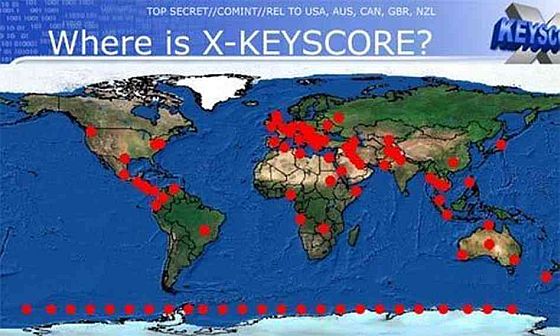
An article in Brazil’s O Globo newspaper published on July 9 co-authored by Glenn Greenwald included several of the X-Keyscore slides. A translation provided by Cryptome describing the slide (shown above) titled “Where is X-Keyscore?” says:

Map in 2008 shows Brazil among countries surveilled by the X-Keystore [sic] program, which details the presence of foreigners by the language used in emails and phone calls.

From this description it’s reasonable to deduce that the NSA — like many American bigots — figures it’s easy to identify foreigners, ’cos those are the folks that talk and write funny. And that probably explains why the NSA can boast no more than a 51 percent level of confidence in identifying their target’s “foreignness.”

The PowerPoint slides published today in The Guardian have been described as “training materials,” but I think Shane Harris’ description of this as a “marketing document” is closer the mark. In other words, this looks more like a presentation of a product’s claimed value as that would be promoted to a customer (such as the Department of Defense), rather than instructions on how to use the application.

A June 20 job posting by the major defense technology contractor SAIC for an “XKEYSCORE Systems Engineer” could indicate that SAIC itself created X-Keyscore and now provides its customers with support for its “fielded mission systems.”

Even if this application was created for the NSA, it appears to be accessible by multiple agencies and contractors.

CGI, a multinational information technology corporation which handles defense contracts for the U.S. Army, U.S. Navy and U.S. Marine Corps, has since July 19 been advertising a position for a Computer Network Operations (CNO) Analyst whose required skills include: “Familiarity using the following tools: Cadence, Surrey, TrafficThief, CNE Portal and X-Keyscore.” (If the name “TrafficThief” sounds familiar, that might be because it showed up on an earlier NSA slide: “PRISM Collection Dataflow.”)

Interestingly, such an analyst also requires: “Working knowledge of system and network exploitation, attack pathologies and intrusion techniques; denial of service attacks, man in the middle attacks, malicious code delivery techniques, fuzzing, automated network vulnerability and port scanning, botnets, password cracking, social engineering, network and system reconnaissance.”

This sounds like a position for an experienced hacker whose job is to defend the U.S. Army from other hackers. The analyst will: “Review threat data from various sources, including appropriate Intelligence databases, to establish the identity and modus operandi of hackers active in customer networks and posing potential threat to customer networks.” Accessing those appropriate intelligence databases presumably involves, among other things, the use of X-Keyscore.

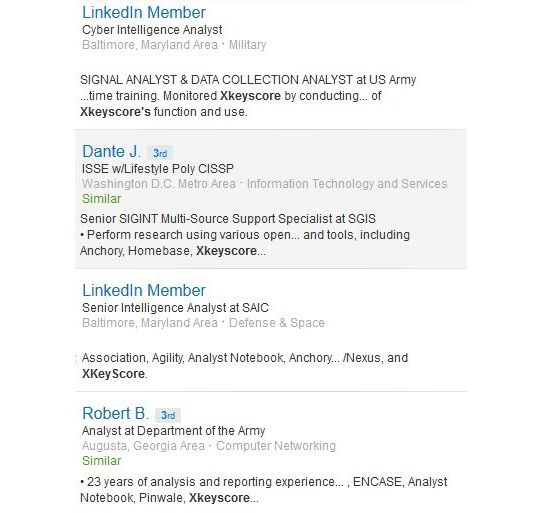
That this is a widely used application is also evident from LinkedIn where numerous intelligence analysts proudly include use of X-Keyscore in their background experience:

However secret the use of X-Keyscore might be, it’s certainly not so secret that anyone seems particularly nervous about mentioning its name.

Facebooktwittermail

XKeyscore: NSA tool collects ‘nearly everything a user does on the internet’

Glenn Greenwald reports: A top secret National Security Agency program allows analysts to search with no prior authorization through vast databases containing emails, online chats and the browsing histories of millions of individuals, according to documents provided by whistleblower Edward Snowden.

The NSA boasts in training materials that the program, called XKeyscore, is its “widest-reaching” system for developing intelligence from the internet.

The latest revelations will add to the intense public and congressional debate around the extent of NSA surveillance programs. They come as senior intelligence officials testify to the Senate judiciary committee on Wednesday, releasing classified documents in response to the Guardian’s earlier stories on bulk collection of phone records and Fisa surveillance court oversight.

The files shed light on one of Snowden’s most controversial statements, made in his first video interview published by the Guardian on June 10.

“I, sitting at my desk,” said Snowden, could “wiretap anyone, from you or your accountant, to a federal judge or even the president, if I had a personal email”.

US officials vehemently denied this specific claim. Mike Rogers, the Republican chairman of the House intelligence committee, said of Snowden’s assertion: “He’s lying. It’s impossible for him to do what he was saying he could do.”

But training materials for XKeyscore detail how analysts can use it and other systems to mine enormous agency databases by filling in a simple on-screen form giving only a broad justification for the search. The request is not reviewed by a court or any NSA personnel before it is processed. [Continue reading…]

The complete XKeyscore Power Point presentation can be viewed here.

Facebooktwittermail