The Iranian people challenge the West

Paul Pillar writes: Hassan Rouhani’s stunning and sweeping victory in the Iranian presidential election is already generating much debate among expert Iran-watchers about how to interpret this outcome. There are different views, for example, on what inference should be drawn regarding the posture of Supreme Leader Khamenei toward the election. Was this outcome one that the leader might have anticipated and is part of a skillful management of contending factions, or does the election result instead indicate that the leader’s control of Iranian politics is less than was often surmised? There also are different views on what role sanctions-induced economic strain may have had on the election. These are genuine questions on which objective and well-informed observers can disagree. Not genuine is the spin from some other fast-off-the-mark commentators who are endeavoring to deny any significance to Rouhani’s victory and to portray the Iranian regime as nothing but the same old recalcitrant adversary—a spin motivated by opposition to reaching agreements with Iran and the favoring of confrontation and even war with it.

Useful implications for policy toward Iran can be drawn without resolving all these analytical questions, even the genuine ones. Sometimes a particular course of action is the best course under any of several different interpretations of exactly what is going on in another nation’s capital. This is one of those instances. In particular, there are clear implications for approaching the next stage of negotiations on, and policy toward, Iran’s nuclear program—which, for better or for worse, is the subject dominating discussion of relations with the Islamic Republic.

One thing that the Iranian election would have changed no matter what the outcome on election day is that we soon will not have Mahmoud Ahmadinejad to kick around any more. The end of his distracting and annoying presence can only be to the good. Perhaps at least a little more serious attention will be devoted in the United States to policy and diplomacy when there is a little less energy allocated to expressing outrage over the outgoing Iranian president’s mistranslated quotes about wiping maps and his other intentionally inflammatory rhetoric. [Continue reading…]


Facebooktwittermail

How Rouhani won the Iranian presidential election

Mahmoud Reza Golshanpazhooh writes: Although some analysts are trying to argue that the vote for Mr. Hassan Rouhani was, in fact, a negative vote to the Islamic establishment’s policies, it was, in reality, a vote to moderation and foresight. These two concepts were major components of Mr. Rouhani’s election campaign as well. The high vote garnered by Mr. Rouhani was the result of the collective effect of a number of variables as follows:

– His fair – and at the same time categorical – criticism of certain policies followed by the incumbent administration;

– His finesse in defending his own viewpoints, track records, and policies in televised debates, especially in the second and third debates;

– The full and all-out support provided to Mr. Rouhani by former presidents, Akbar Hashemi Rafsanjani and Mohammad Khatami;

– The smart move by the other reformist candidate, Mohammad Reza Aref, in withdrawing his presidential bid without declaring his official support for Mr. Rouhani. As a result, the clear demarcation between Mr. Aref’s purely reformist attitude and Mr. Rouhani’s moderate views was maintained;

– Increased political understanding on the part of the Iranian people as they were well aware that they could only play a crucial part in determining their own fate through participating in the political process, not by boycotting it;

– The great effort made by Mr. Rouhani and his election campaign to carefully observe the rules of the political game and their clear commitment to pursuing any possible protests to election process through legal channels as specified by the Iranian Constitution. This was very important because it redirected the votes of the mostly traditional sectors of the Iranian society toward him as they were afraid that voting for the reformists would only increase conflicts and tension in the society.

– Another important factor was the clerical nature of Mr. Rouhani, which played an effective role in attracting the votes of a large part of the religious people to him as well as the votes cast by the ordinary people in villages and small towns. There were also many other, less significant factors at work. [Continue reading…]

Facebooktwittermail

Gezi Park has become a hotbed of activity as Turks make their stand

Constanze Letsch writes: It is one of the most beautiful successes of the Gezi Park protests: cramped together inside an endangered inner city park, united in their anger at an authoritarian prime minister, protesters of all colours – leftists, nationalists, feminists, anarchists, religious groups, secularists, students, bankers – are engaging in dialogue.

Ahmet Metin, head of the Istanbul branch of the nationalist Association for Kemalist Thought, says he led “some wholesome discussions” with Kurdish protesters, LGBT activists and liberals, for the first time. “We don’t share the same political views, and we don’t agree on everything,” he admits. “But we’re all here to defend democratic rights. It’s a point of departure.”

Few romanticise this unexpected eruption of pluralist civil society. Every now and then, small verbal skirmishes break out: nationalists grumble at flags of the jailed Kurdish PKK leader Abdullah Öcalan, hoisted in one corner of the park. Kurds are uneasy about protesters claiming to be soldiers of modern Turkey’s founder, Mustafa Kemal Atatürk. Posters ask activists not to use sexist or racist language in their slogans. “Before you call anyone ‘a faggot’, remember that faggots have been on the frontline of this struggle all along,” one cardboard sign reminds passersby.

Hamdi, a 29-year-old architect who quit his job in the central Anatolian city of Kayseri to join the Gezi park protests, underlines that no political party has managed to force its label on to the movement. “We all know what we want from this and that’s enough to keep us together. We don’t need pre-packed ideologies.” [Continue reading…]

Facebooktwittermail

Turkey expands crackdown on street unrest

The New York Times reports: The Turkish authorities widened their crackdown on the antigovernment protest movement on Sunday, taking aim not just at the demonstrators themselves, but also at the medics who treat their injuries, the business owners who shelter them and the foreign news media flocking here to cover a growing political crisis threatening to paralyze the government of Prıme Minister Recep Tayyip Erdogan.

After an intense night of street clashes that represented the worst violence in nearly three weeks of protests, Mr. Erdogan rallied hundreds of thousands of his supporters on Sunday — many of them traveling on city buses and ferries that the government had mobilized for the event — at an outdoor arena on the shores of the Sea of Marmara. In some of his toughest language yet, he called his opponents terrorists and made clear that any hope of a compromise to end the crisis was gone.

“It is nothing more than the minority’s attempt to dominate the majority,” he said of the protesters. “We will not allow it.”

The escalating tensions have raised the risk of an extended period of civil unrest that could undermine Turkey’s image as a rising global power and a model of Islamic democracy, which Mr. Erdogan has cultivated over a decade in power. [Continue reading…]

Facebooktwittermail

Defector Syrian general will be conduit for U.S. military aid to rebels

The Washington Post reports: A mild-mannered ­Syrian general who taught at a military academy before he defected last year is poised to play a key role in shaping the outcome of Syria’s war now that the United States has said it will provide direct military assistance to the rebels.

Gen. Salim Idriss, 56, heads the Supreme Military Council of the fragmented Free Syrian Army, and the Obama administration has anointed him as the sole conduit of weapons to the rebels, whether supplied by the United States or by allies such as Saudi Arabia and Qatar, which have already been sending arms.

The United States still has not committed to providing any weaponry, Idriss said Sunday in a phone interview from the Turkish capital, Ankara, after two days of talks with U.S. officials over what form the unspecified military assistance announced last week would take.

He urged the United States to move swiftly on the arms deliveries before opposition fighters suffer further setbacks on the battlefield.

“We need help. I can tell you very clearly, very urgently, we need it as soon as possible,” he said in the interview before heading back to his headquarters in the northern Syrian province of Idlib.

Recent advances by forces loyal to President Bashar al-Assad have been facilitated by his allies Iran and Russia, which are providing vast quantities of arms and ammunition to prop up Syrian government forces, Idriss said. Fighters from the Lebanese Shiite Hezbollah movement are bolstering the ranks of Assad’s conventional army, which is weary from more than two years of battling the rebellion. [Continue reading…]

Facebooktwittermail

I saw Nasrallah in Qusair

Ali Hashem writes: In the center of the city, I stood in the middle of the main road as a huge, black four-wheel-drive came my way.

I stared at the man sitting beside the driver: The face was familiar, but something was missing. It was clear I was face to face with Hezbollah Secretary-General Sayyed Hassan Nasrallah, without a turban, wearing a military uniform. He smiled and nodded to me, and while I was still in shock, the car was out of sight. There was no convoy, only one car, but as I said before, there were security measures taken in the city and around.

It took me some time to confirm that whom I saw was Nasrallah. When I returned to Beirut, I started my investigations to confirm it, and I did.

While investigating, I came across another piece of information: this visit wasn’t the first for Nasrallah to Qusair during this very crisis. “Sayyed Nasrallah went to Qusair a day before the start of the battle: he met the commanders, visited some injured fighters and gave a speech,” a source close to Hezbollah told me, “He spoke for around half an hour with his main commanders exchanging ideas on the battle and the expectations and how many days it’ll take them to finish it.”

As for the latest visit, the one day after the offensive, our source said that Nasrallah visited the city of Qusair and the towns around it in the country side. He added, “Sayyed Nasrallah wanted to thank the fighters personally, he met them, met the injured, and went around the area.”

Facebooktwittermail

Want to learn how to think? Read fiction

Pacific Standard: Are you uncomfortable with ambiguity? It’s a common condition, but a highly problematic one. The compulsion to quell that unease can inspire snap judgments, rigid thinking, and bad decision-making.

Fortunately, new research suggests a simple antidote for this affliction: Read more literary fiction.

A trio of University of Toronto scholars, led by psychologist Maja Djikic, report that people who have just read a short story have less need for what psychologists call “cognitive closure.” Compared with peers who have just read an essay, they expressed more comfort with disorder and uncertainty — attitudes that allow for both sophisticated thinking and greater creativity.

“Exposure to literature,” the researchers write in the Creativity Research Journal, “may offer a (way for people) to become more likely to open their minds.”

Djikic and her colleagues describe an experiment featuring 100 University of Toronto students. After arriving at the lab and providing some personal information, the students read either one of eight short stories or one of eight essays. The fictional stories were by authors including Wallace Stegner, Jean Stafford, and Paul Bowles; the non-fiction essays were by equally illustrious writers such as George Bernard Shaw and Stephen Jay Gould. [Continue reading…]

Facebooktwittermail

Larry Hunter’s prescient warnings about the digital threat to privacy

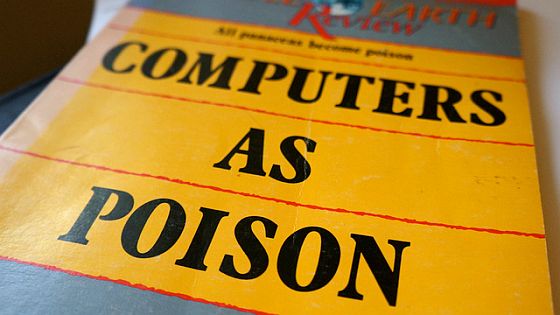
The cover of Whole Earth Review, January, 1985

The Boston Globe’s Ideas section: In the mid 1980s, when Mark Zuckerberg was still in diapers, computers ran on floppy disks, and a web was something a spider built, a computer-science graduate student at Yale University started to worry about a problem that would have struck most people as far-fetched.

Larry Hunter began to realize that as computers became bigger parts of our lives, they would come to know more and more about us, whether we liked it or not. They would gather data and build profiles, and this technology would someday have meaningful implications for our privacy and freedom of choice.

In January 1985 he published a warning essay in the inaugural issue of a techno-revolutionary journal called The Whole Earth Review. “The ubiquity and power of the computer blur the distinction between public and private information,” he wrote. “Our revolution will not be in gathering data — don’t look for TV cameras in your bedroom — but in analyzing information that is already willingly shared.”

In just the past few years, Hunter’s concerns — recently unearthed and reposted on the Smithsonian Magazine’s Paleofuture blog — have come to look almost spookily prescient. His solution, however — new laws to give people property rights over their information — has never come to pass. Today, every time we click a link, shop on Amazon, or retweet a news story, we offer the vast digital world one more free clue about who we are and what we like. All this information is stored and analyzed, bought and sold — last week, it emerged that the FBI and National Security Agency have been collecting this data directly from some of the largest Internet companies. The scope of our private lives is shrinking, and we still don’t really know the implications of this shift.

Hunter is now a professor of computational biology at the University of Colorado Denver, where he creates software that pulls together distant strands of biomedical research. Though he has also kept a finger in the privacy debate, his personal positions on privacy aren’t necessarily what you might think: He encrypts e-mails to friends and extols the privacy benefits of all-cash transactions, but he’s also posted his genetic data online.

Ideas reached out to him for his perspective on how the last 30 years have unfolded, and to ask what he sees as the next big privacy concerns. This transcript was edited from interviews by phone and e-mail. [Continue reading…]

Facebooktwittermail

GCHQ intercepted foreign politicians’ communications at G20 summits

The Guardian reports: Foreign politicians and officials who took part in two G20 summit meetings in London in 2009 had their computers monitored and their phone calls intercepted on the instructions of their British government hosts, according to documents seen by the Guardian. Some delegates were tricked into using internet cafes which had been set up by British intelligence agencies to read their email traffic.

The revelation comes as Britain prepares to host another summit on Monday – for the G8 nations, all of whom attended the 2009 meetings which were the object of the systematic spying. It is likely to lead to some tension among visiting delegates who will want the prime minister to explain whether they were targets in 2009 and whether the exercise is to be repeated this week.

The disclosure raises new questions about the boundaries of surveillance by GCHQ and its American sister organisation, the National Security Agency, whose access to phone records and internet data has been defended as necessary in the fight against terrorism and serious crime. The G20 spying appears to have been organised for the more mundane purpose of securing an advantage in meetings. Named targets include long-standing allies such as South Africa and Turkey.

There have often been rumours of this kind of espionage at international conferences, but it is highly unusual for hard evidence to confirm it and spell out the detail. The evidence is contained in documents – classified as top secret – which were uncovered by the NSA whistleblower Edward Snowden and seen by the Guardian. [Continue reading…]

Facebooktwittermail

The whistleblowers are the new generation of American patriots

Gary Younge writes: When Darrell Anderson, 22, joined the US military he knew there was going to be a war, and he wanted to fight it. “I thought I was going to free Iraqi people,” he told me. “I thought I was going to do a good thing.”

Until, that is, he realised precisely what he had to do. While on patrol in Baghdad, he thought: “What are we doing here? Are we looking for weapons of mass destruction? No. Are we helping the people? No, they hate us. What are we working towards, apart from just staying alive? If this was my neighbourhood and foreign soldiers were doing this then what would I be doing?” Within a few months, he says, “I was cocking my weapon at innocent civilians without any sympathy or humanity”. While home on leave he realised he was not going to be able to lead a normal life if he went back. His mum drove him to Canada, where I met him in 2006 at a picnic for war resisters in Fort Erie.

Anderson’s trajectory, from uncritical patriotism to conscious disaffection and finally to conscientious dissent, is a familiar one among a generation of Americans who came of political age after 9/11. Over time, efforts to balance the myth of American freedom on which they were raised, with the reality of American power that they have been called on to monitor or operate, causes a profound dislocation in their world view. [Continue reading…]

Facebooktwittermail

Obama mustn’t waste the opportunity he has been handed by the Iranian people

Vali Nasr writes: Rowhani was widely excoriated in Iran for ostensibly betraying the national interest in 2003, when, as the country’s nuclear negotiator, he signed on to a voluntary suspension of uranium enrichment. That concession was meant as a confidence-building measure to build momentum for a broader nuclear deal, but the reformist hope turned into defeat when talks failed amid allegations that Iran had violated protocols laid out by the International Atomic Energy Agency. The supreme leader and his conservative coterie concluded that the suspension had been construed as Iranian weakness and only invited greater international pressure. They blamed Rowhani for having put Iran on its heels. The defeatist image became a stain on the reformists’ reputation and contributed to the conservative juggernaut that swept Mahmoud Ahmadinejad to power in 2005.

Ahmadinejad lost no time reversing the suspension. In a matter of days, the West offered Iran a new diplomatic package that reportedly included trade incentives, the promise of long-term access to nuclear supplies, and assurances of non-aggression. Rowhani’s boss, the reformist President Mohammad Khatami, complained that in doing so the West had rewarded Ahmadinejad’s brazen defiance over the reformists’ gesture of compromise.

Once bitten twice shy, Rowhani is unlikely to yet again risk being branded as soft on the West. He will venture concessions only if he is assured of tangible returns. This time it has to be Rowhani who gets more out of the United States than Ahmadinejad and Jalili did — and they had been offered spare aircraft parts and, in the last round of talks, relief from international sanctions on trade in gold and precious metals. Rowhani will be looking for real sanctions relief and a promise of recognition of Iran’s right to enrichment.

The dilemma for Washington is that, as a reformist, Rowhani is an outsider, weaker than Ahmadinejad when it comes to selling any compromise with the West to Iran’s suspicious conservative establishment. Rowhani’s electoral mandate gives him room to maneuver, but that is not enough to shield him from the backlash that would follow any rebuff at the negotiating table. So he will likely wait for a signal of American willingness to make serious concessions before he risks compromise. [Continue reading…]

Facebooktwittermail

Israeli hostility towards Iran undiminished after election result

The Independent reports: The Israeli government greeted the election of Iran’s new president, Hassan Rouhani, with a mixture of scepticism and cynicism today, as senior politicians said that the threat posed by Tehran’s nuclear programme had not diminished.

Speaking before Israel’s weekly cabinet meeting, Prime Minister Benjamin Netanyahu, who has made Iran his priority since being returned to office in January, warned that the election was unlikely to bring any change.

“Regarding the results of the elections in Iran let us not delude ourselves,” he said. “The international community must not become caught up in wishes and be tempted to relax the pressure on Iran to stop its nuclear [programme]. It must be remembered that the Iranian ruler, at the outset, disqualified candidates who did not fit his extremist outlook and from among those whose candidacies he allowed was elected the candidate who was seen as less identified with the regime, who still defines the State of Israel as ‘the great Zionist Satan’.”

The minister with responsibility for Iranian issues, the hawkish Yuval Steinitz, who has in the past called on Western governments to present the Islamic Republic with a “credible military threat,” echoed Mr Netanyahu’s statement, saying that despite the departure of Mahmoud Ahmadinejad, the real power in Iran – Supreme Leader, Ayatollah Ali Khamenei – would continue to dictate foreign policy.

“Kudos to the Iranian people for electing a moderate statesman, but I doubt the real authority Khamenei will change his tune on military and nuclear affairs without being strongly motivated to do so by increased international economic sanctions,” he told Israeli Army Radio. [Continue reading…]

Facebooktwittermail

How Iran’s Supreme Leader paved the way for Rouhani’s victory

Al-Monitor: Two days before Iranians voted for who would succeed Mahmoud Ahmadinejad as president of the Islamic Republic, Supreme Leader Ayatollah Ali Khamenei offered a rhetorical olive branch to the country’s opposition. He said that even those who “do not support the Islamic system” should come out and vote.

Khamenei’s message was a direct and unprecedented acknowledgement of the reformists and millions of silent secularists who comprise Iran’s “opposition” as stakeholders in the country. It was also a message to them that their votes would count.

This overture should be considered now that Hassan Rouhani — a candidate supported by reformists, and a reformist himself in all but name — has become the seventh president of the Islamic Republic of Iran.

The Supreme Leader’s comments actively contributed to the success of a candidate that is not within the conservative confines of his “principlist” political stable, in the process creating a more inclusive and pluralistic Iran. Contrary to endless punditry about Saeed Jalili being Khamenei’s favored candidate and even the front-runner, it now appears that the Supreme Leader made the calculated decision to acquiesce to the will of the Iranian people. [Continue reading…]

Facebooktwittermail

Noam Chomsky interview: Sykes-Picot is failing

Al-Akhbar English: Maha Zaraket: What is the title of your [commencement] speech [at the American University of Beirut]?

Noam Chomsky: I do not remember if it has a title, but it is going to be some comments on legitimacy of borders and states and possibilities of eroding them.

MZ: Do you think the Middle East is going through a rewrite of Sykes-Picot agreement?

NC: I think the Sykes-Picot agreement is falling apart, which is an interesting phenomenon. That is a century. But, the Sykes-Picot agreement was just an imperial imposition that has no legitimacy; there is no reason for any of these borders – except the interests of the imperial powers.

It is the same all over the world. it is hard to find a single border that has any justification, including the US-Mexico border and the US-Canada border. You look around the world, just about every conflict that is going on results from the imposition of imperial borders that have nothing to do with the population.

I think as far as Sykes-Picot is concerned, it is beginning to erode. Whatever happens in Syria – it’s hard to imagine – but if anything survives, parts of Syria will be separated. The Kurdish areas are almost autonomous now and they are beginning to link up with the almost-autonomous parts of Northern Iraq Kurdish areas, and may spill over to some extent to southeastern Turkey. What will happen in the rest of the country is hard to say.

MZ: Do you think the new borders will be made by the local population? Or new imperialisms?

NC: I wish that were true, but that is not how the world works. Maybe someday, but not yet, not today.

MZ: What do you think of the Hezbollah intervention in Syria?

NC: They are in a very difficult position. If the rebels win in Syria, they become very exposed. That may mean their demise. There is reason behind it, I am not sure this is the right one, you could argue about it, but it is understandable.

MZ: Are you going to meet Nasrallah this time?

NC: No, I do not know if it is possible. But it is deeply in mind. It is difficult.

MZ: If you meet him again, what would you tell him?

NC: I would like to meet him, but just to find out more about their thinking and their plans. They are not coming to me for advice. You know.

MZ: You called for support of the Turkish protesters. How do you see the uprising in Turkey?

NC: I think the [Taksim demonstrators] are doing a great thing. I think it is extremely important. Of global importance. The initial reaction of the Erdogan regime was pretty similar to Mubarak and Assad: harsh brutal response to a legitimate set of demands. [Continue reading…]

Facebooktwittermail

Secret court ruling put tech companies in data bind

The New York Times reports: In a secret court in Washington, Yahoo’s top lawyers made their case. The government had sought help in spying on certain foreign users, without a warrant, and Yahoo had refused, saying the broad requests were unconstitutional.

The judges disagreed. That left Yahoo two choices: Hand over the data or break the law.

So Yahoo became part of the National Security Agency’s secret Internet surveillance program, Prism, according to leaked N.S.A. documents, as did seven other Internet companies.

Like almost all the actions of the secret court, which operates under the Foreign Intelligence Surveillance Act, the details of its disagreement with Yahoo were never made public beyond a heavily redacted court order, one of the few public documents ever to emerge from the court. The name of the company had not been revealed until now. Yahoo’s involvement was confirmed by two people with knowledge of the proceedings. Yahoo declined to comment.

But the decision has had lasting repercussions for the dozens of companies that store troves of their users’ personal information and receive these national security requests — it puts them on notice that they need not even try to test their legality. And despite the murky details, the case offers a glimpse of the push and pull among tech companies and the intelligence and law enforcement agencies that try to tap into the reams of personal data stored on their servers. [Continue reading…]

Facebooktwittermail

The NSA’s PRISM creates smaller haystacks — it can’t find needles

Whenever the frequency of an event of interest is extremely low — such as with acts of terrorism — even a very accurate test will fail very often. Corey Chivers explains why.

Recent revelations about PRISM, the NSA’s massive program of surveillance of civilian communications have caused quite a stir. And rightfully so, as it appears that the agency has been granted warrantless direct access to just about any form of digital communication engaged in by American citizens, and that their access to such data has been growing significantly over the past few years.

Some may argue that there is a necessary trade-off between civil liberties and public safety, and that others should just quit their whining. Lets take a look at this proposition (not the whining part). Specifically, let’s ask: how much benefit, in terms of thwarted would-be attacks, does this level of surveillance confer?

Lets start by recognizing that terrorism is extremely rare. So the probability that an individual under surveillance (and now everyone is under surveillance) is also a terrorist is also extremely low. Lets also assume that the neck-beards at the NSA are fairly clever, if exceptionally creepy. We assume that they have devised an algorithm that can detect ‘terrorist communications’ (as opposed to, for instance, pizza orders) with 99% accuracy.

P(+ | bad guy) = 0.99

A job well done, and Murica lives to fight another day. Well, not quite. [Continue reading…]

Facebooktwittermail