Iran’s new president hails ‘victory of moderation’

Reuters reports: Moderate cleric Hassan Rohani won Iran’s presidential election on Saturday with a resounding defeat of conservative hardliners, calling it a victory of moderation over extremism and pledging a new tone of respect in international affairs.

Though thousands of jubilant Iranians poured onto the streets in celebration of the victory, the outcome will not soon transform Iran’s tense relations with the West, resolve the row over its nuclear program or lessen its support of Syria’s president in the civil war there – matters of national security that remain the domain of Supreme Leader Ayatollah Ali Khamenei.

But the president runs the economy and wields broad influence in decision-making in other spheres. Rohani’s resounding mandate could provide latitude for a diplomatic thaw with the West and more social freedoms at home after eight years of belligerence and repression under President Mahmoud Ahmadinejad, who was legally barred from seeking a third consecutive term.

“This victory is a victory of wisdom, a victory of moderation, a victory of growth and awareness and a victory of commitment over extremism and ill-temper,” Rohani told state television, promising to work for all Iranians, including the hardline so-called “Principlists” whom he defeated at the poll.

“I warmly shake the hands of all moderates, reformists and Principlists,” he said.

The mid-ranking cleric seemed to strike a new tone in the way he talked about Iran’s relations with the rest of the world.

Rohani said there was a new chance “in the international arena” for “those who truly respect democracy and cooperation and free negotiation”.

Celebrating crowds sprang up near Rohani’s headquarters in downtown Tehran and across the city and country as his victory was confirmed.

Barbara Slavin writes: It is too soon to say whether the election results — which gave Rouhani 18.6 million of the 37 million votes cast — will cause a swift change in Iranian policy or negotiating strategy. However, the poor showing for more conservative candidates — particularly current chief nuclear negotiator Saeed Jalili, who came in third — is too strong a signal for Iran’s leader to ignore.

By entering the race, Jalili insured that the nuclear issue — which is normally taboo for public debate in Iran — would be discussed during the brief campaign. In a final televised debate a week before the elections, the other candidates harshly criticized Jalili’s stewardship of talks with the five permanent members of the UN Security Council plus Germany (P5+1).

Former Foreign Minister Ali Akbar Velayati, who might resume that post under Rouhani, was scathing:

“You want to take three steps and you expect the other side to take 100 steps, this means that you don’t want to make progress,” he said. “This is not diplomacy. … We can’t expect everything and give nothing.”

During the campaign, Rouhani repeatedly noted the connection between the lack of agreement on the nuclear front and Iran’s deteriorating economy. It was nice that more centrifuges are spinning, he said, but it would be better if they were gears in Iran’s shuttered factories.

Ali Vaez, Iran analyst for the International Crisis Group, told Al-Monitor in an email “the nuclear issue became — by design or accident — a central theme in the elections. As such, the outcome will inevitably impact the country’s nuclear policy.”

Vaez added, “The electoral defeat of Saeed Jalili and his narrative cannot be inconsequential. Khamenei’s bottom lines — recognition of Iran’s right to domestic enrichment and removal of sanctions — are unlikely to change. But Iran’s approach to nuclear diplomacy will.”


Facebooktwittermail

Landslide win for Rowhani in Iran elections

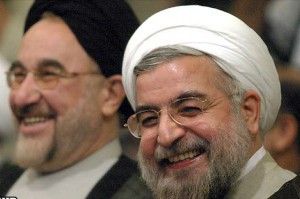
Hassan Rowhani with former president Mohammad Khatami

The Washington Post reports: Hassan Rouhani, a moderate Shiite cleric known as one of Iran’s leading foreign policy experts, has won the election to succeed Mahmoud Ahmadinejad as the Islamic Republic’s next president, Interior Minister Mostafa Mohammad-Najjar announced Saturday evening.

With results from all the precinct in, Rouhani had won 50.7 percent of the votes, avoiding a runoff, Mohammad-Najjar said.

Bloomberg reports: Support for Rohani swelled in the final days of the campaign after former presidents Ali Akbar Rafsanjani and Mohammad Khatami joined forces to endorse him.

Addressing a packed Tehran stadium last week, Rohani, who campaigned on the slogan “prudence and hope,” urged his young supporters to overcome political apathy and their frustration over the lack of jobs and vote for him. Rohani waved a giant key at his rallies as a symbol that he will unlock closed doors.

“Though hardliners remain in control of key aspects of Iran’s political system, the centrists and reformists have proven that even when the cards are stacked against them, they can still prevail due to their support among the population,” Trita Parsi, author of “A Single Roll of the Dice: Obama’s Diplomacy with Iran” and president of the National Iranian-American Council in Washington, wrote in an e-mail.

Long lines at polling stations yesterday led to voting being extended several times, to 11 p.m. local time. State-run Press TV estimated voter turnout at about 80 percent.

The departure of Mohammad Reza Aref from the campaign on June 10 meant Rohani had the reformist platform to himself against a field of five conservatives who failed to agree on a unity candidate.

Rohani has spoken in favor of increased freedom for the press and non-governmental organizations. He has also called for the easing of social restrictions, criticizing the government’s “unwarranted interventions” in Iranians’ lives.
Economy ‘Critical’

In April, Rohani promised that his government would pursue “dialogue and interaction with the world.” He also said the economy is in a “critical” situation and that sanctions can’t be blamed for the country’s “weaknesses.”

Still, he said sanctions must be tackled for the economy to take a new direction away from a 30 percent inflation rate and unemployment that left a quarter of Iranians age 15 to 29 without jobs in the year ended March 20.

Earlier this week, Farideh Farhi wrote: The decision by the reformist candidate Mohammadreza Aref to withdraw his candidacy — and in effect open the path for the centrist Hassan Rowhani to become the unified candidate of both the centrists and reformists — is an important development in Iranian politics. Its impact will reach beyond this election.

This isn’t only because the centrist and reformist forces, currently led by former presidents Akbar Hashemi Rafsanjani and Mohammad Khatami, respectively, have done what the conservative forces failed to do. After all, the conservatives — or the array of forces known as the “Principlists” in Iran, also began with the idea of coalition-building in mind. The trio – former foreign minister Ali Akbar Velayati, Tehran mayor Mohmmad Baqer Qalibaf, and former Parliament Speaker Gholamreza Haddad Adel — had agreed that only one of them would stand on Election Day. Today, however, only Haddad Adel has dropped out without specifying his preferred candidate.

Beyond Velayati and Qalibaf, other principlist candidates, including nuclear negotiator Saeed Jalili and former IRGC commander Mohsen Rezaie, remain in the race. So now a splintered principlist field faces a candidate that has the backing of significant political and social forces; a candidate who may, just may, become president if the Iranian electorate decides to vote in larger than expected numbers and, of course, there is no ballot box-tampering.

Just this thought, for me, represents an amazing turn of events in Iran’s ongoing election saga. But even if this form of strategizing does not yield success for whatever reason, the process that led to this alliance is an important one; one that may have a lasting impact on Iranian politics. [Continue reading…]

Facebooktwittermail

The Syria strategy vacuum

Marc Lynch writes: Many of the advocates of aggressive intervention define the Syrian conflict primarily as a front in the cold war against Iran. From this perspective, Hezbollah’s entry into the fray and the fall of Qusayr are not necessarily a bad thing — Washington now has an opportunity to strike directly at one of Iran’s most valuable assets in the Middle East. The enemy’s queen, to use a chess metaphor, has now moved out from behind its wall of pawns and is open to attack. Fear of a rebel defeat — and of a victory for Hezbollah and Iran — should squeeze more cash and military support out of the Arab Gulf, Europe, and the United States.

If Washington endorses the goal of bleeding Iran and its allies through proxy warfare, a whole range of more interventionist policies logically follow. The model here would presumably be the jihad against the Soviet occupation of Afghanistan — a long-term insurgency coordinated through neighboring countries, fueled by Gulf money, and popularized by Islamist and sectarian propaganda.

“Success” in this strategy would be defined by the damage inflicted on Iran and its allies — and not by reducing the civilian body count, producing a more stable and peaceful Syria, or marginalizing the more extreme jihadists. Ending the war would not be a particular priority, unless it involved Assad’s total military defeat. The increased violence, refugee flows, and regionalization of conflict would likely increase the pressure on neighboring states such as Turkey, Jordan, Lebanon, Israel, and Iraq. It would also likely increase sectarianism, as harping on Sunni-Shiite divisions is a key part of the Arab Gulf’s political effort to mobilize support for the Syrian opposition (and to intimidate local Shiite populations, naturally). And the war zone would continue to be fertile ground for al Qaeda’s jihad, no matter how many arms were sent to its “moderate” rivals in the opposition.

What follows if the conflict were understood instead as a Syrian civil war and humanitarian catastrophe? Resolving these twin crises has long been the focus of international and U.S. diplomatic efforts and is again at the fore of the proposed (but probably stillborn) Geneva II conference, which aims to bring the Syrian regime and opposition together to reach a negotiated deal. Such a settlement could in theory reduce the killing, allow the return of refugees, reduce pressure on Syria’s neighbors, marginalize the jihadists, and assuage the region’s spiraling sectarian hatreds. But it would not mark a defeat of Iran and its allies. [Continue reading…]

Facebooktwittermail

CIA preparing to deliver rebels arms through Turkey and Jordan

The Washington Post reports: The CIA is preparing to deliver arms to rebel groups in Syria through clandestine bases in Turkey and Jordan that were expanded over the past year in an effort to establish reliable supply routes into the country for nonlethal material, U.S. officials said.

The bases are expected to begin conveying limited shipments of weapons and ammunition within weeks, officials said, serving as critical nodes for an escalation of U.S. involvement in a civil war that has lately seen a shift in momentum toward the forces of President Bashar al-Assad.

Syria experts cautioned that the opposition to Assad remains a chaotic mix of secular and Islamist elements, highlighting the risk that some American-provided munitions may be diverted from their intended recipients.

But U.S. officials involved in the planning of the new policy of increased military support announced by the Obama administration Thursday said that the CIA has developed a clearer understanding of the composition of rebel forces, which have begun to coalesce in recent months. Within the past year, the CIA also created a new office at its headquarters in Langley to oversee its expanding operational role in Syria. [Continue reading…]

Politico: “Arming the rebels … I don’t think it will really matter a whole lot,” said Shadi Hamid of the Brookings Institution. “That, by itself, is not enough to tip the balance decisively one way or the other. … It’s taken the administration a year and a half to get to the point I think that they should have been at a year and a half ago, so it’s hard for me to imagine them doing a 180.”

“The tendency so far by the administration has been to escalate slowly — and perhaps too slowly,” said Anthony Cordesman of the Center for Strategic and International Studies. “I would be surprised if the administration escalated suddenly to the highest level.”

Cordesman said the White House may have missed the moment when the rebels had enough momentum that modest increases in U.S. military aid might have helped rout the regime.

“A year ago, mortar, light artillery, RPG-type systems, enough ammunition and overcoming the lack of training, that might have made a decisive difference,” said the analyst. Now, “it can only buy time.”

“We have to all admit the rebels are losing now,” Hamid added. “Just providing some more advanced weapons, even if does have an impact, that will be many months before we see tangible results of that. I just think the ground that has to be gained by the rebels at this point is so much that I don’t see how weapons are enough.”

Notably, White House officials did not claim that the new assistance would fundamentally alter the military balance between the regime and the rebels.

Facebooktwittermail

The sickening Snowden backlash

Kirsten Powers writes: Hell hath no fury like the Washington establishment scorned.

Since Edward Snowden came forward to identify himself as the leaker of the National Security Agency spying programs, the D.C. mandarins have been working overtime to discredit the man many view as a hero for revealing crucial information the government had wrongfully kept secret. Apparently, if you think hiding information about spying on Americans is bad, you are misguided. The real problem is that Snowden didn’t understand that his role is to sit and be quiet while the “best and the brightest” keep Americans in the dark about government snooping on private citizens.

By refusing to play this role, Snowden has been called a “traitor” by House Majority Leader John Boehner. Sen. Dianne Feinstein called the leaks “an act of treason.” The fury among the protectors of the status quo is so great that you have longtime Washington Post columnist Richard Cohen smearing Snowden as a “cross-dressing Little Red Riding Hood.” The New York Times’s David Brooks lamented that Snowden, who put himself in peril for the greater good, was too “individualistic.” It seems that he wasn’t sufficiently indoctrinated to blindly worship the establishment institutions that have routinely failed us. Brooks argued that “for society to function well, there have to be basic levels of trust and cooperation, a respect for institutions and deference to common procedures.”

This is backward. It’s the institutions that need to demonstrate respect for the public they allegedly serve. If Snowden or any other American is skeptical of institutional power, it is not due to any personal failing on their part. The lack of respect is a direct outgrowth of the bad behavior of the nation’s institutions, behavior that has undermined Americans’ trust in them. According to Gallup’s “confidence in institutions” poll, trust is at an historic low, with Congress clocking in at a 13 percent approval rating in 2012. Yes, this is the same Congress that has “oversight” of the government spying programs. [Continue reading…]

Facebooktwittermail

Hong Kong lawmakers urge Obama to ‘tread very carefully’ on Snowden case

The South China Morning Post reports: Two pan-democratic lawmakers urged US President Barack Obama on Friday to stop all legal action against and “consider letting go” NSA whistle-blower Edward Snowden who has taken refuge in Hong Kong.

They made the comments at a press conference at which they also made public a letter they have sent to Obama urging him to not allow “national security” claims to justify abuse of state power.

In an exclusive interview with the South China Morning Post on Wednesday, Snowden, a 29-year-old former Central Intelligence Agency analyst, made the explosive claims that the US government had been hacking into computers in Hong Kong and on the mainland for years. He had earlier revealed that the US has been secretly collecting the phone and online data of its citizens for national security reasons.

In the 400-word letter, Claudia Mo Man-ching of the Civic Party and Gary Fan Kwok-wai of the NeoDemocrats, democratically elected members of the Legislative Council urged Obama to “tread very carefully and take into account the views of America’s democratic friends around the world.”

Facebooktwittermail

The real war on reality

Peter Ludlow writes: To get some perspective on the manipulative role that private intelligence agencies play in our society, it is worth examining information that has been revealed by some significant hacks in the past few years of previously secret data.

Important insight into the world these companies came from a 2010 hack by a group best known as LulzSec (at the time the group was called Internet Feds), which targeted the private intelligence firm HBGary Federal. That hack yielded 75,000 e-mails. It revealed, for example, that Bank of America approached the Department of Justice over concerns about information that WikiLeaks had about it. The Department of Justice in turn referred Bank of America to the lobbying firm Hunton and Willliams, which in turn connected the bank with a group of information security firms collectively known as Team Themis.

Team Themis (a group that included HBGary and the private intelligence and security firms Palantir Technologies, Berico Technologies and Endgame Systems) was effectively brought in to find a way to undermine the credibility of WikiLeaks and the journalist Glenn Greenwald (who recently broke the story of Edward Snowden’s leak of the N.S.A.’s Prism program), because of Greenwald’s support for WikiLeaks. Specifically, the plan called for actions to “sabotage or discredit the opposing organization” including a plan to submit fake documents and then call out the error. As for Greenwald, it was argued that he would cave “if pushed” because he would “choose professional preservation over cause.” That evidently wasn’t the case.

Team Themis also developed a proposal for the Chamber of Commerce to undermine the credibility of one of its critics, a group called Chamber Watch. The proposal called for first creating a “false document, perhaps highlighting periodical financial information,” giving it to a progressive group opposing the Chamber, and then subsequently exposing the document as a fake to “prove that U.S. Chamber Watch cannot be trusted with information and/or tell the truth.”

(A photocopy of the proposal can be found here.)

In addition, the group proposed creating a “fake insider persona” to infiltrate Chamber Watch. They would “create two fake insider personas, using one as leverage to discredit the other while confirming the legitimacy of the second.”

The hack also revealed evidence that Team Themis was developing a “persona management” system — a program, developed at the specific request of the United States Air Force, that allowed one user to control multiple online identities (“sock puppets”) for commenting in social media spaces, thus giving the appearance of grass roots support. The contract was eventually awarded to another private intelligence firm.

This may sound like nothing so much as a “Matrix”-like fantasy, but it is distinctly real, and resembles in some ways the employment of “Psyops” (psychological operations), which as most students of recent American history know, have been part of the nation’s military strategy for decades. The military’s “Unconventional Warfare Training Manual” defines Psyops as “planned operations to convey selected information and indicators to foreign audiences to influence their emotions, motives, objective reasoning, and ultimately the behavior of foreign governments, organizations, groups, and individuals.” In other words, it is sometimes more effective to deceive a population into a false reality than it is to impose its will with force or conventional weapons. Of course this could also apply to one’s own population if you chose to view it as an “enemy” whose “motives, reasoning, and behavior” needed to be controlled. [Continue reading…]

Facebooktwittermail

Defenders of NSA surveillance omit most of Mumbai plotter’s story

By Sebastian Rotella, ProPublica, June 12, 2013

June 12: This story has been updated with NSA Director Gen. Keith Alexander’s Senate testimony on surveillance.

Defending a vast program to sweep up phone and Internet data under antiterror laws, senior U.S. officials in recent days have cited the case of David Coleman Headley, a key plotter in the deadly 2008 Mumbai attacks.

James Clapper, the director of national intelligence, said a data collection program by the National Security Agency helped stop an attack on a Danish newspaper for which Headley did surveillance. And Sen. Dianne Feinstein, D-Calif., the Senate intelligence chairwoman, also called Headley’s capture a success.

But a closer examination of the case, drawn from extensive reporting by ProPublica, shows that the government surveillance only caught up with Headley after the U.S. had been tipped by British intelligence. And even that victory came after seven years in which U.S. intelligence failed to stop Headley as he roamed the globe on missions for Islamic terror networks and Pakistan’s spy agency.

Supporters of the sweeping U.S. surveillance effort say it’s needed to build a haystack of information in which to find a needle that will stop a terrorist. In Headley’s case, however, it appears the U.S. was handed the needle first 2014 and then deployed surveillance that led to the arrest and prosecution of Headley and other plotters.

Continue reading

Facebooktwittermail

U.S. agencies said to swap data with thousands of firms

Bloomberg reports: Thousands of technology, finance and manufacturing companies are working closely with U.S. national security agencies, providing sensitive information and in return receiving benefits that include access to classified intelligence, four people familiar with the process said.

These programs, whose participants are known as trusted partners, extend far beyond what was revealed by Edward Snowden, a computer technician who did work for the National Security Agency. The role of private companies has come under intense scrutiny since his disclosure this month that the NSA is collecting millions of U.S. residents’ telephone records and the computer communications of foreigners from Google Inc. and other Internet companies under court order.

Many of these same Internet and telecommunications companies voluntarily provide U.S. intelligence organizations with additional data, such as equipment specifications, that don’t involve private communications of their customers, the four people said.

Makers of hardware and software, banks, Internet security providers, satellite telecommunications companies and many other companies also participate in the government programs. In some cases, the information gathered may be used not just to defend the nation but to help infiltrate computers of its adversaries. [Continue reading…]

Facebooktwittermail

Netflix, Facebook — and the NSA: They’re all in it together

Andrew Leonard writes: For decades, so-called gift economy collaboration, in which the community as a whole benefits from the freely donated contributions of its members, has been a potent driver of Internet software evolution. As I wrote 16 years ago, when chronicling the birth of the Apache Web server, the success of open source software “testifies to the enduring vigor of the Internet’s cooperative, distributed approach to solving problems.” Hadoop [an open source platform which is becoming the standard platform for big data analytics], which down to its fundamental structural essence is a distributed approach to solving problems, emblematized this philosophy at its core.

So, in a sense, Hadoop’s success was just the same old story. But back in the mid-’90s, around the time that one of the first open source success stories, the Apache Web server, was taking off, I’m not sure that anyone would have predicted that the National Security Agency and CIA would end up becoming stalwart participants in the gift economy. Even though it makes total sense, in principle, that the fruits of government-funded software development should be shared with the general public, there’s still something cognitively disjunctive about intelligence agencies that shroud their every activity in great secrecy contributing to projects built on openness and transparency. On the one hand, employees of the NSA are appearing at conferences discussing how they have adapted Hadoop to solve the problems of dealing with unimaginably huge data sets, but on the other hand, we’re not supposed to know anything about what they are actually doing with that data.

The intertwining of the intelligence agencies with the larger open source software community could hardly be more incestuous. In 2008, a group of Yahoo employees that eventually included Doug Cutting formed a start-up designed to commercialize Hadoop called Cloudera. The CIA, through its In-Q-Tel (named after James Bond’s Q character) venture capital arm, was an early investor in, and customer of, Cloudera. The NSA built a significant piece of software that works “on top” of Hadoop called Accumulo designed to add sophisticated security controls managing how data could be accessed, and then promptly donated that code to the Apache Software Foundation. Later, a group of NSA software engineers formed another spinoff company, Sqrrl, to commercialize Accumulo.

What all this means is that the improvements to tools that the NSA is making, with the aim of more efficiently catching terrorists, are propagating into the private sector where they will be used by Facebook and Neftlix and Yahoo to more accurately target ads or influence our purchasing behavior or provide us with content algorithmically shaped to our very specific desires. And vice versa. Innovations and increased capabilities pioneered by private companies trickle back to the NSA. The collective boot-strapping never stops.

Again, in principle, there is nothing necessarily wrong going on here. There is no one to blame. Some of the fiercer apologists for unfettered free markets might complain that government involvement in open source projects unfairly competes with private sector proprietary businesses, but a much stronger case can be made that any software development work that is funded by taxpayer money should by definition be considered freely sharable with the wider public. The NSA should probably be applauded for helping to improve Hadoop. And if the capabilities unlocked by Hadoop result in the prevention of some horrific terrorist act, then every programmer who contributed a line of code to the project justly deserves some congratulation.

But there’s also an intriguing inversion occurring here of what, for better or worse, we might call the purpose of the Internet. The Internet was initially created by the U.S. government to facilitate the sharing of information between geographically separate research centers. The Internet took off in the mid-’90s in large part because the general public recognized it as a phenomenal tool for sharing information with each other. The fact that so much of the Internet’s infrastructure was also built from code that was freely shared seemed like a pleasing match of form and function.

Free software and open-source software evolution is frequently driven not so much by hope for financial gain but by individuals looking to solve their immediate engineering problems. Over time, on the Internet at large, one of those problems has turned out to be the gnarly challenge of how to manage all the data created by all those people sharing so promiscuously with each other. Hadoop can justly be seen as the natural response to all that promiscuous sharing. And it certainly helped solve the problems faced by engineers at Facebook and elsewhere.

But what ended up getting enabled by the success of Hadoop is something significantly different than good old peer-to-peer sharing. The ability to make sense out of petabytes of data isn’t necessarily useful to you or me. But it’s god’s gift to the profit-minded corporations and terrorist-seeking intelligence agencies seeking to leverage the data we generate for their own purposes, to measure our behavior and ultimately to influence it. That could mean Netflix figuring out exactly what combination of plot twists and acting talent proves irresistible to streaming video watchers or Facebook figuring out exactly how to stock our newsfeeds with advertisements that generate acceptable click-through or Twitter knowing exactly where we are on the surface of the planet so it can pop up a sponsored tweet pushing a coupon for a happy hour at the bar just down the street — or the NSA spotting a peculiar pattern of pressure cooker purchases. This is no longer about sharing information with each other; it’s about manipulation, control and punishment. It’s about keeping stock prices up. We’re a long, long way here from the ideal gift economy, where everyone brings their home-cooked delicacy to the potlatch. We’ve arrived at a destination where the tools offer more power to them than to us. [Continue reading…]

Facebooktwittermail

FBI chief Mueller wants you to be afraid

The Guardian reports: The FBI has shrugged off growing congressional anxiety over its surveillance of US citizens, claiming such programs could have foiled the 9-11 terrorist attacks and would prevent “another Boston”.

The FBI director, Robert Mueller, also revealed that US authorities would be taking action against whistleblower Edward Snowden for revealing the extent of its activities, confirming that the FBI and department of justice were taking “all necessary steps to hold the person responsible”.

But Mueller’s testimony before the House judicial oversight committee brought angry responses from many congressmen, who questioned whether such surveillance was lawful and demanded to know why it had failed to prevent the Boston bombing if it were so effective.

Preventing airline passengers from carrying knives on board; not basing thousands of American troops in Saudi Arabia — there are all sorts of things that could have prevented 9/11.

What Mueller and other government officials are now doing is attempting to terrorize Americans. They are in effect saying that unless the citizens of this country are willing to live under mass surveillance, they or their loved ones are more likely to meet a premature and violent death. It’s called security-state blackmail.

Facebooktwittermail

Senators challenge NSA’s claim to have foiled ‘dozens’ of terror attacks

The Guardian reports: Two prominent Senate critics of the NSA’s dragnet surveillance have challenged the agency’s assertion that the spy efforts helped stop “dozens” of terror attacks.

Mark Udall and Ron Wyden, both members of the Senate intelligence committee, said they were not convinced by the testimony of the NSA director, General Keith Alexander, on Capitol Hill on Wednesday, who claimed that evidence gleaned from surveillance helped thwart attacks in the US.

“We have not yet seen any evidence showing that the NSA’s dragnet collection of Americans’ phone records has produced any uniquely valuable intelligence,” they said in a statement released on Thursday ahead of a widely anticipated briefing for US senators about the National Security Agency’s activities.

“When you’re talking about important liberties that the American people feel strongly about, and you want to have an intelligence program, you’ve got to make a case for why it provides unique value to the [intelligence] community atop what they can already have,” Wyden, an Oregon Democrat, told the Guardian in an interview on Thursday.

Facebooktwittermail

Robert Mueller just wants your metadata

Marcy Wheeler writes: The director of the FBI, Robert Mueller, made it clear Thursday that he believes the FBI should have access to any of your data not covered by the fourth amendment of the US constitution. Yet he seemed unwilling to turn over the FBI’s own metadata in return.

At issue is at least one of the NSA programs disclosed by the Guardian last week: the government’s use of a provision of the Patriot Act to collect the call data of most Americans’ phone calls to create a master database of all calls made in the US for the last five years. According to Senate intelligence committee chair Dianne Feinstein and others, the government uses the database to check whether Americans have called numbers associated with suspected terrorists.

In a hearing before the House judiciary committee, a number of representatives – including John Conyers, Jim Sensenbrenner, Jerry Nadler, Bobby Scott, Sheila Jackson-Lee, and Jason Chaffetz – asked the director to justify obtaining data on all Americans. Sensenbrenner pointed out, for example, that the FBI could use a grand jury subpoena or a “national security letter” to obtain the same information directly from a phone company.

And while Mueller did claim that the dragnet program would have prevented 9/11 (ignoring that the FBI had authority to get the information in question at the time, and that a number of other bureaucratic failures may have contributed to the intelligence community’s failure to prevent the attack, too), his favorite justification for gathering all the metadata from all US phone calls amounts to “because we can”. [Continue reading…]

Facebooktwittermail

First round in Iran’s presidential election

The Los Angeles Times reports: Polls cited in state-run media and reported by Western news agencies suggested for the first time in the closing hours of the campaign that Rowhani would get about 15% of the vote. A survey by the Mehr Center for Opinion Polling projected Tehran Mayor Mohammed Baqer Qalibaf would garner about 18% and chief nuclear negotiator Saeed Jalili about 10%. A survey cited by the Fars News Agency two days earlier said Rowhani would come in third behind Qalibaf and Jalili.

Analysts note that the opportunity to derail the carefully orchestrated election could be as much of a lure for reformists to abandon their intended boycott as is the prospect of a moderate winning or at least making it into the runoff.

“The whole purpose of having Aref drop out and having Rowhani become the favorite son of the reform camp was deliberately and unquestionably intended to get people to come out and vote,” said Gary Sick, a senior research scholar at Columbia University and a former National Security Council member under presidents Ford, Carter and Reagan.

“What has happened in virtually every election is that, when given the least opportunity, the people of Iran vote against the regime,” said Sick, who was chief White House aide for Iran during the revolution and hostage crisis. “It is not at all inconceivable that the reformist camp, if enough people decide to vote, could come through this election in good shape.”

Trita Parsi writes: There are three factors that may create opportunities for resolving tensions with Iran if Mr. Rouhani wins the elections – and the regime is forced to respect that result.

First, it’s not just about Rouhani; it’s about the personnel that would follow him into government and populate key ministries and institutions and reconfigure the political makeup of the regime’s decision-making table. When Mahmoud Ahmadinejad came to power, within months he fired 80 of Iran’s most experienced ambassadors and foreign policy profiles. Many of these were Iran’s most pragmatic and competent foreign policy hands, often key players in Iran’s more conciliatory decisions, such as the collaboration with the United States in Afghanistan and the suspension of enrichment in 2004. They were replaced by inexperienced ideologues hired not for their capabilities but their loyalty to Mr. Ahmadinejad. A reversal of this trend can prove quite valuable.

Second, Mr. Rouhani and his entourage hold a different world view than those close to Mr. Ahmadinejad and the supreme leader. While still suspicious and distrustful of the West, and while still committed to Iran’s bottom line on the nuclear issue, the elite that associates with Mr. Rouhani does not see the world in Manichean black and white. The outside world may be seen as hostile, but common interests can still be found. Collaboration is still possible. Rather than emphasizing ideology and resistance, they pride themselves on being pragmatic and results-oriented (of course, within the context of the political spectrum of the Islamic republic). It is not a surprise that most of the sensitive arrangements Iran have entered into came about during periods that this current dominated Iran’s decision making.

Third is the difference in assessing the risks of peacemaking versus confrontation. The hardliners’ insistence on resistance at any cost combined with their hesitance about compromise, indicates far greater willingness to accept risks for escalation and confrontation than for compromise. A similar problem exists on the American side, where risks for confrontation are easier accepted and assessed to be smaller than the risks one inevitably has to take to strike a deal. This psychological dimension of Tehran’s cost-benefit analysis should not be discounted.

Facebooktwittermail

How Erdogan’s language fans the flames

Ali Yenidunya writes: It is now almost two weeks since mass demonstrations arose against his Government, but Prime Minister Recep Tayyip Erdogan shows no sign of relenting in his decision to re-develop Istanbul’s Gezi Park, the catalyst for the protests, or to give way on wider demands, such as holding police accountable for violence that has killed three protesters and injured thousands.

Instead, on Tuesday, Erdogan justified police attacks to clear Istanbul’s Taksim Square and other protest sites: “What were we supposed to do? Kneel in front of these people and ask them remove the banners? How would those illegal rags be removed from public buildings?”

The Prime Minister stigmatised dissent, “Violent actions that took place in many cities of Turkey have camouflaged themselves behind the Gezi Park protests.”

This is dangerous language. It divides the country into two inimical camps, simplifies the crisis, and embedding it in a politics in which “democracy” is defined only through the “ballot box” and every opposing demand is labeled “illegitimate”. [Continue reading…]

Facebooktwittermail

The Supreme Court’s GM-friendly patent ruling

Wired: The U.S. Supreme Court’s unanimous ruling that naturally occurring genes can’t be patented looks, on the surface, like terrible news for biotech companies. It would appear to strike down thousands of patents claiming intellectual property rights over isolated genetic sequences — the very DNA patents that anchor countless business plans.

Yet biotech stocks saw a small increase on the Nasdaq Biotechnology Index yesterday, and the effect of the ruling was even more dramatic for Myriad Genetics, the Utah company whose patents were in question. Myriad’s stock price closed up nearly 10 percent, at one point topping $38. That’s the highest since 2009, the year the lawsuit against its patents on BRCA1 and BRCA2, two genes associated with early-onset breast and ovarian cancer, was filed.

There’s a reason investors rejoiced over a decision that, superficially, seems to strip so many companies of their most valuable assets. John Wilbanks, who runs the Science Commons project at Creative Commons, says that competitive advantage comes not from the DNA data itself but from the ways companies figure out to use it.

“It’s clearly not as terrifying a ruling for the industry compared to what it could have been,” Wilbanks said. “It’s a decision that says that data is free, and that’s in line with what patent law has always said, which is that you can’t patent data. That’s what a gene sequence is.

“By making that data free, there is a lot of room for public good and public and private innovation.”

At the same time, the court did not strike down patents on “new applications of knowledge,” or on DNA whose sequence has been altered. In other words, biotechnologists still have plenty of room to develop proprietary innovations that use DNA data in new ways. Businesses can be build on genetic insights applied to new processes, methods or algorithms, which in most cases would still be patentable.

This distinction between the data and its uses echoes the sentiment among experts that real innovation comes after genes and gene mutations are identified. [Continue reading…]

Facebooktwittermail