E. Douglas Kihn writes: Remember when Reagan was elected in 1980? He came in just at the beginning of the recession of 1981, when thousands of Americans suddenly found their incomes slashed or eliminated. His administration soon took on the unions, with the aim of breaking them. The first famous victim was PATCO – the Professional Air Traffic Controllers Organization.
On August 3, 1981, the union declared a strike, seeking better working conditions, better pay and a 32-hour workweek. On August 5, following the PATCO workers’ refusal to return to work, Reagan fired the 11,345 striking air traffic controllers who had ignored the order and banned them from federal service for life. PATCO was decertified from its right to represent workers by the Federal Labor Relations Authority on October 22, 1981.
From that time onwards, American unions have taken a savage beating to the point where only 7 percent of private enterprises are unionized today, and public service union employees – teachers, nurses, office workers, firefighters – are fighting everywhere to keep their jobs and unions.
It was during Reagan’s first term that the phrase bean counter came into prominent usage. These were the efficiency experts whose job it was to increase profits for the major corporations, mainly by introducing speedups, job consolidations, forced overtime, the hiring of part-time workers – along with artful and ruthless union-busting.
This was also the beginning of the “War on Iran,” the “War on Drugs,” the war against the people of Nicaragua and El Salvador (all of them Marxists doubtless bent on rampaging through the streets of US cities) and a dangerous escalation of threats against the Soviet Union/Evil Empire.
As social fear and insecurity rise, mental health declines.
Apparently, so does physical health. According to a new study from Rice University and the University Colorado at Boulder in Social Science Quarterly, despite modest gains in lifespan over the past century, the United States still trails many of the world’s countries when it comes to life expectancy, and its poorest citizens live approximately five years less than more affluent people. The United States, which spends far more money on medical care than other advanced industrialized countries, has the sickest residents in every category of unwellness.
The result of all of this hysteria and whip-cracking on the backs of the American workforce is that we feel harried and harassed, with little reward to show for it. Mental health has been worsening for a long time in the United States, and this mental decline has been the culprit behind so many – probably the majority – of physical health problems as well. One of them, as we shall see later, is obesity.
Chinese medicine can help to make sense of most mental and physical problems in the United States and organize them into three main categories: those of chronic tension, excessive interior heat and excess weight. Together, they form a super-syndrome some would call the American Syndrome, since it seems to be a universal phenomenon. [Continue reading…]
Linguists identify words that have changed little in 15,000 years
You, hear me! Give this fire to that old man. Pull the black worm off the bark and give it to the mother. And no spitting in the ashes!
It’s an odd little speech but if it were spoken clearly to a band of hunter-gatherers in the Caucasus 15,000 years ago, there’s a good chance the listeners would know what you were saying. That’s because all the nouns, verbs, adjectives and adverbs in the four sentences are words that have descended largely unchanged from a language that died out as the glaciers were retreating at the end of the last Ice Age.
The traditional view is that words can’t survive for more than 8000 to 9000 years. Evolution, linguistic “weathering” and the adoption of replacements from other languages eventually drive ancient words to extinction, just like the dinosaurs of the Jurassic era.
But new research suggests a few words survive twice as long. Their existence suggests there was a “proto-Eurasiatic” language that was the common ancestor of about 700 languages used today – and many others that have died out over the centuries.
The descendant tongues are spoken from the Arctic to the southern tip of India. Their speakers are as apparently different as the Uighurs of western China and the Scots of the Outer Hebrides. [Continue reading…]
Music: Yamandu Costa — ‘Ao Vivo’
Sword of division is poised over Iraq
The Los Angeles Times reports: Less than a year and a half after the last U.S. troops left, Iraq’s political leaders are openly debating the prospect of two dangerous paths for their country: de facto division or civil war. Perhaps both.
Tension between the Shiite majority, now in control of the levers of power, and the Sunni Arab minority, which dominated under Saddam Hussein, has been building for months. But politicians on all sides agree that the country has entered a perilous new phase, highlighted in late April by an attack on a Sunni protest camp by security forces that killed at least 45 people.
As word of the shootings spread, fighting erupted around the country, leaving more than 200 people dead. Overall, the United Nations said, more than 700 people were killed in Iraq in April, the highest monthly toll in five years.
Polarized political leaders openly discuss the threat of more bloodshed and the gradual breakup of the country, either through an informal declaration of an independent Sunni Arab region, modeled on the Kurds’ region in northern Iraq, or outright war. [Continue reading…]
Video: Interview with outgoing president of the Syrian National Coalition
Pakistani authorities say CIA drone strikes have killed 896 civilians; high court accuses U.S. of war crimes
The Times of India reports: A Pakistani high court on Thursday declared the US drone strikes in the country’s tribal regions illegal and directed the government to use force to “protect the right to life” of its citizens. Stating that the United States strikes must be declared war crime as these kill innocent people, it also called the government to move a UN resolution against such attacks.
The high court in Pakistan’s north-western city of Peshawar announced the verdict against the CIA-driven drone strikes on four writ petitions, stating that these attacks kill innocent civilians and cause collateral damage. Time and again, Washington has said that drone attacks target al-Qaida and Taliban safe havens in Pakistan’s tribal areas, from where they carry out cross-border attacks in Afghanistan.
According to a report submitted by political authorities of North Waziristan Agency, 896 Pakistani civilians living there were killed in the last five years until December 2012 while 209 were seriously injured. “In these drone attacks only 47 foreigners were killed and six injured. Many houses and vehicles and cattle heads worth millions of dollars were destroyed in these attacks. Similarly, in South Waziristan Agency, 70 drone strikes were carried out in the last five years until June 2012 in which 553 people were killed and 126 injured,” the report said.
“In view of the established facts, undeniable in nature, under the UN Charter & Conventions, the people of Pakistan have every right to ask the security forces either to prevent such strikes by force or to shoot down intruding drones,” the court verdict said.
“The government of Pakistan must ensure that no drone strike takes place in the future,” it added and also asked the ministry of foreign affairs to table a resolution in the UN against the US attacks.
Israel has no desire for Assad to fall
Efraim Halevy, the former chief of Mossad, writes: In October 1995, Israeli Prime Minister Yitzhak Rabin telephoned Egyptian President Hosni Mubarak to inform him that peace was at hand between Israel and Syria. Two weeks later, Rabin was dead, killed by a reactionary Jewish Israeli fanatic; the peace agreement that Rabin referenced died not long thereafter. But Israeli hopes for an eventual agreement with the Assad regime managed to survive. There have been four subsequent attempts by Israeli prime ministers — one by Ehud Barak, one by Ehud Olmert, and two by Benjamin Netanyahu — to forge a peace with Syria.
This shared history with the Assad regime is relevant when considering Israel’s strategy toward the ongoing civil war in Syria. Israel’s most significant strategic goal with respect to Syria has always been a stable peace, and that is not something that the current civil war has changed. Israel will intervene in Syria when it deems it necessary; last week’s attacks testify to that resolve. But it is no accident that those strikes were focused solely on the destruction of weapons depots, and that Israel has given no indication of wanting to intervene any further. Jerusalem, ultimately, has little interest in actively hastening the fall of Bashar al-Assad.
Israel knows one important thing about the Assads: for the past 40 years, they have managed to preserve some form of calm along the border. Technically, the two countries have always been at war — Syria has yet to officially recognize Israel — but Israel has been able to count on the governments of Hafez and Bashar Assad to enforce the Separation of Forces Agreement from 1974, in which both sides agreed to a cease-fire in the Golan Heights, the disputed vantage point along their shared border. Indeed, even when Israeli and Syrian forces were briefly locked in fierce fighting in 1982 during Lebanon’s civil war, the border remained quiet. [Continue reading…]
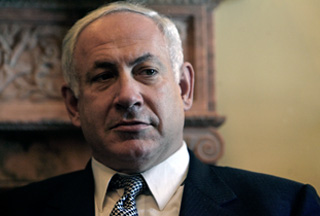
Benjamin Netanyahu wants to teach Stephen Hawking how to be a scientist
The Jerusalem Post reports: Prime Minister Binyamin Netanyahu slammed Prof. Stephen Hawking for joining the boycott against Israel and cancelling plans to attend President Shimon Peres’s conference next month, saying the celebrated physicist should “study the facts.”
Asked by The Jerusalem Post about Hawking’s boycott at a press briefing, Netanyahu said, “He should investigate the truth, he is a scientist. He should study the facts and draw the necessary conclusions: Israel is an island of reason, moderation and a desire for peace.”
Netanyahu said that Hawking knows that there are many false theories in science. “There are also false theories in politics, and this [the slandering of Israel] is one of them, maybe the foremost among them,” he said. “There is no state that yearns for peace more than Israel, nor any state that has done more for peace than Israel.”
One official in the prime minister’s entourage went even further, comparing Hawking to Shakespeare and Voltaire, both of whom held anti-Semitic sentiments.
“History shows that there are people who are no less great than Hawking who believed things about Jews that it was impossible to imagine they actually believed,” he said. “I am talking about Voltaire, or Shakespeare. How do you explain that someone with the encyclopedic knowledge of Voltaire believed what he did about the Jews. How can you explain it? But it is a fact.”
Apparently, the official continued, “intelligence and achievements are no guarantee for understanding the truth about the Jews or their state.
What was true regarding Jews for generations, is now true about the state of the Jews.”
Let’s first consider Netanyahu’s own powers of reasoning and, for the sake of argument, take at face value his claim that there is “no state that yearns for peace more than Israel.”
Indeed, no state could yearn for peace more than one that throughout its history has never lived in peace. Likewise, a drunk can passionately wish he was sober.
But those who judge Israel negatively generally base their judgements on the Jewish state’s actions — not the peace-loving statements of its leaders. Judge us by what we do, not what we say — what could be more eminently reasonable, Mr Netanyahu?
As for Netanyahu’s nameless sidekick who predictably pulled out the antisemite card, how would he explain the fact that Hawking had initially accepted the invitation to attend the Peres conference? Did Hawking have a momentary lapse, initially forgetting he was an antisemite and only to later remember why he would hate visiting Israel?
What both Netanyahu and the official exhibit is a tendency common among Zionists: a fixation on personal identity — which is nothing more than a smokescreen used to avoid honest debate about Israel’s behavior. Judge us by who we are, not what we do, is the way they would have it. But that’s not the way the rest of the world works and not even the survivors of the Holocaust get a free pass.
Stephen Hawking’s support for the boycott of Israel is a turning point
Ali Abunimah writes: A standard objection to the Palestinian campaign for the boycott of Israel is that it would cut off “dialogue” and hurt the chances of peace. We’ve heard this again in the wake of Professor Stephen Hawking’s laudable decision to withdraw from Israel’s Presidential Conference in response to requests from Palestinian academics – but it would be hard to think of a more unconvincing position as far as Palestinians are concerned.
One of the most deceptive aspects of the so-called peace process is the pretence that Palestinians and Israelis are two equal sides, equally at fault, equally responsible – thus erasing from view the brutal reality that Palestinians are an occupied, colonised people, dispossessed at the hands of one of the most powerful militaries on earth.
For more than two decades, under the cover of this fiction, Palestinians have engaged in internationally-sponsored “peace talks” and other forms of dialogue, only to watch as Israel has continued to occupy, steal and settle their land, and to kill and maim thousands of people with impunity.
While there are a handful of courageous dissenting Israeli voices, major Israeli institutions, especially the universities, have been complicit in this oppression by, for example, engaging in research and training partnerships with the Israeli army. Israel’s government has actively engaged academics, artists and other cultural figures in international “Brand Israel” campaigns to prettify the country’s image and distract attention from the oppression of Palestinians. [Continue reading…]
The ongoing campaign to cover up Obama’s indiscriminate killing program
Micah Zenko writes: Like many former senior Obama administration officials, Harold Koh has expressed his concerns about U.S. drone strike policies. As the former State Department legal adviser, he played an essential role in articulating and defending the international legal principles that supported “U.S. targeting practices, including lethal operations conducted with the use of unmanned aerial vehicles,” as he stated in a March 2010 speech. Koh was also responsible for coordinating the official U.S. government response to questions raised by U.N. special rapporteurs and within the Human Rights Council. As Koh proclaimed last summer, “I did not come to government because I wanted to work on killing people.”
Unfortunately for him, because President Barack Obama authorized over 375 drone strikes killing over 3,000 people while Koh was the State Department’s lead lawyer, he’s been forced to dedicate a great deal of time to killing people.
Unfortunately, in a speech made two days ago at the Oxford Union, Koh demonstrated that he plans to maintain the fundamental myth of the Obama administration’s targeted killing program: that everyone killed is a senior al Qaeda official or member who poses an imminent threat of attack on the U.S. homeland. In April 2010, Koh claimed, regarding targeted killings: “I have never changed my mind. Not from before I was in the government — or after.” Apparently, that sentiment remains true today. [Continue reading…]
Micah Zenko continues in his relentless effort to focus critical attention on the Obama administration’s inexcusable use of drone warfare, but there’s one point on phrasing where he and others could help shift the way we talk about this issue: abandon the use of the term “targeted killing.”
The 9/11 attacks were themselves highly targeted. The hijackers were very precise about which buildings they wanted to strike and they did indeed hit their selected targets, yet most people would find it deeply offensive to describe these attacks as forms of targeted killing.
Why? Because targeted implies that the killer has identified his victims and that the killing is not indiscriminate.
But consider this fact. As a memorial has been created and a memorial museum will soon be opened in remembrance of every single innocent victim of 9/11 all of whose identities are known, the majority of the people killed in Obama’s drone war are people whose names were unknown to the U.S. government at the time they were killed. Some were identified merely as being males of military age and others not identified in any way at all as buildings were destroyed with no way of knowing who or how many people might reside within.
The precision of a missile’s guidance system should not be used to disguise its role in indiscriminate killing.
Hezbollah and Israel spar as Syria’s conflict threatens to spin out of control
Nicholas Blanford writes: A dangerous game of brinkmanship is unfolding in the Middle East pitting Israel against Syria and its militant Shi‘ite ally Hizballah in what threatens to expand the two-year Syrian civil war into a full-blown regional conflict. On three separate occasions since January — two of them within 48 hours of each other last Friday and Sunday — Israeli jets have attacked Syrian military bases, targeting consignments of advanced weaponry supplied allegedly by Iran that were pending transfer to Hizballah across the nearby border with Lebanon. The air raids were unprecedented. Israel has never before risked striking at Hizballah’s Iranian-supplied weapons inside Syria.
For now, though, Israel’s gamble seems to have paid off. Other than some initial huffing and puffing from Damascus, no immediate retaliation was forthcoming. But rather than acting as a deterrence, the air strikes appear to have galvanized Syria to promise even greater amounts of sophisticated weaponry to Hizballah and also to announce the launch of a popular resistance campaign to liberate the Golan Heights, the strategic volcanic plateau in the southwest corner of the country that has been occupied by Israel since 1967.
Israel’s intervention into the grueling Syrian civil war comes amid faint glimmers of a diplomatic breakthrough with the U.S. and Russia agreeing to an international conference to help end a conflict that has left more than 70,000 people dead. But the regime of Syrian President Bashar Assad has gained some tactical military successes of late, launching mini-offensives to retake territory previously lost to opposition rebels. The rebel setbacks may have strengthened the Assad regime’s grim resolve to win the conflict, especially given its confidence in the continued support of regional allies, Iran and Hizballah. [Continue reading…]
Morsy and the Brothers
Shadi Hamid writes: Many Americans — and many Egyptians — are souring on the Muslim Brotherhood. Some are rather smugly saying, “I told you so.” From the American and Arab liberal perspectives, the Brotherhood seems run by hyper-charged Islamists bent on imposing their will on the Egyptian people. Like most things in politics, though, it depends on what exactly you’re comparing them to. More than two years into the Arab revolts, Islamists are weighing the virtues of moving more aggressively to implement their agenda versus the benefits of proceeding cautiously in an attempt to placate their critics and opponents.
There is little doubt that the Brotherhood has veered to the right. The real debate within the group is whether they’ve veered far enough. With Egypt as polarized as ever, the country’s largest Islamist movement has effectively given up on reaching out to liberals and leftists, focusing instead on closing ranks and rallying its base. During the presidential race, Khairat al-Shater, the Brotherhood’s original candidate, chose a Salafi-leaning council of scholars for his first campaign event, where he affirmed that the application of sharia law was his ultimate goal and that he would form a committee of scholars to help parliament achieve that goal. After Shater’s disqualification, Mohammed Morsy — a weaker, less convincing candidate — doubled down on Shater’s back-to-basics message. “Needless to say,” Morsy said, “[I am] currently the only contender who offers a clearly Islamic project.”
After winning the presidency, Morsy took a brief stab at rising above his partisan origins. But the tragic events of Dec. 4, when anti-Brotherhood protesters and government supporters clashed outside the presidential palace, rendered such efforts moot. The violence of that night — provoked by the Brotherhood when it called on supporters to confront protesters — claimed “martyrs” on both sides. For many in the opposition, this was the point of no return — blood had been spilled.
For the Brotherhood, it had much the same effect. As one Brotherhood official told me, “there was a return to the mentality of mihna [inquisition]” after that day. The subsequent months saw the presidential office hiring a steady stream of Brotherhood members. The Brothers had no one to turn to — not even the Salafis — but each other. [Continue reading…]
Egypt NGO law could betray revolt’s ideals, says UN human rights chief
Reuters reports: The U.N.’s human rights chief said on Wednesday Egypt risked betraying the ideals behind the 2011 revolution and slipping into authoritarianism with a new civil society law.
The Arab country was at a “critical moment” more than two years after the uprising that ousted autocratic President Hosni Mubarak, U.N. High Commissioner for Human Rights Navi Pillay said, citing a range of social and political rights concerns.
She singled out a law backed by the Muslim Brotherhood’s Freedom and Justice Party (FJP) that she said risked making non-governmental organizations (NGOs) worse off than they were under Mubarak by imposing curbs including funding restrictions.
Video: Paul Ehrlich on human evolution and the environment
This lecture was given at the Woodrow Wilson Center on September 18, 2008, to accompany the publication of The Dominant Animal: Human Evolution and the Environment.
Music: Avishai Cohen — ‘Leolam’
The U.S. can’t remake Syria
Andrew J. Bacevich writes: As you contemplate the ongoing violence in Syria, here are the three things to keep in mind.
First, the United States undoubtedly possesses the wherewithal to topple the regime of Bashar Assad. On this score, the hawks are surely right. Whether acting alone, with allies, or through proxies, Washington over the past decade or so has demonstrated an impressive capacity to overthrow governments. Skeptical? Consider the fate of various evil-doers on whom we trained our gun-sights in Afghanistan, Iraq, and Libya.
Second, once Washington has removed Assad as it did Saddam Hussein, the likelihood of the United States being able to put things right — creating a “new” Syria that is stable, humane, and grateful for American assistance — is approximately nil. Here the evidence supports the doves. Skeptical? Again, consider the course of events in Afghanistan, Iraq, and Libya once the evil-doers departed the scene.
These two points define the poles around which the policy debate in Washington incessantly revolves. In one camp are those who are fired by humanitarian concerns or persuaded that Assad threatens US (or Israeli) security. They are keen to put American muscle once more to work, and chastise President Obama for his reluctance to act. In the second camp are those wary of the United States once again stumbling into a quagmire. They commend Obama for (thus far) exercising restraint, fearing that American meddling will create more problems than it will solve.
This debate overlooks the third point, which obviates the first two: Whatever Obama does or doesn’t do about Syria won’t affect the larger trajectory of events. Except to Syrians, the fate of Syria per se doesn’t matter any more than the fate of Latvia or Laos. The context within which the upheaval there is occurring — what preceded it and what it portends — matters a great deal. Yet on this score, Washington is manifestly clueless and powerless. [Continue reading…]
Americans have drifted from a market economy to a market society
Michael J. Sandel writes: We live in a time when almost everything can be bought and sold. Over the past three decades, markets—and market values—have come to govern our lives as never before. We did not arrive at this condition through any deliberate choice. It is almost as if it came upon us.
As the Cold War ended, markets and market thinking enjoyed unrivaled prestige, and understandably so. No other mechanism for organizing the production and distribution of goods had proved as successful at generating affluence and prosperity. And yet even as growing numbers of countries around the world embraced market mechanisms in the operation of their economies, something else was happening. Market values were coming to play a greater and greater role in social life. Economics was becoming an imperial domain. Today, the logic of buying and selling no longer applies to material goods alone. It increasingly governs the whole of life.
The years leading up to the financial crisis of 2008 were a heady time of market faith and deregulation—an era of market triumphalism. The era began in the early 1980s, when Ronald Reagan and Margaret Thatcher proclaimed their conviction that markets, not government, held the key to prosperity and freedom. And it continued into the 1990s with the market-friendly liberalism of Bill Clinton and Tony Blair, who moderated but consolidated the faith that markets are the primary means for achieving the public good.
Today, that faith is in question. The financial crisis did more than cast doubt on the ability of markets to allocate risk efficiently. It also prompted a widespread sense that markets have become detached from morals, and that we need to somehow reconnect the two. But it’s not obvious what this would mean, or how we should go about it.
Some say the moral failing at the heart of market triumphalism was greed, which led to irresponsible risk-taking. The solution, according to this view, is to rein in greed, insist on greater integrity and responsibility among bankers and Wall Street executives, and enact sensible regulations to prevent a similar crisis from happening again.
This is, at best, a partial diagnosis. While it is certainly true that greed played a role in the financial crisis, something bigger was and is at stake. The most fateful change that unfolded during the past three decades was not an increase in greed. It was the reach of markets, and of market values, into spheres of life traditionally governed by nonmarket norms. To contend with this condition, we need to do more than inveigh against greed; we need to have a public debate about where markets belong—and where they don’t.
Consider, for example, the proliferation of for-profit schools, hospitals, and prisons, and the outsourcing of war to private military contractors. (In Iraq and Afghanistan, private contractors have actually outnumbered U.S. military troops.) Consider the eclipse of public police forces by private security firms—especially in the U.S. and the U.K., where the number of private guards is almost twice the number of public police officers.
Or consider the pharmaceutical companies’ aggressive marketing of prescription drugs directly to consumers, a practice now prevalent in the U.S. but prohibited in most other countries. (If you’ve ever seen the television commercials on the evening news, you could be forgiven for thinking that the greatest health crisis in the world is not malaria or river blindness or sleeping sickness but an epidemic of erectile dysfunction.)
Consider too the reach of commercial advertising into public schools, from buses to corridors to cafeterias; the sale of “naming rights” to parks and civic spaces; the blurred boundaries, within journalism, between news and advertising, likely to blur further as newspapers and magazines struggle to survive; the marketing of “designer” eggs and sperm for assisted reproduction; the buying and selling, by companies and countries, of the right to pollute; a system of campaign finance in the U.S. that comes close to permitting the buying and selling of elections.
These uses of markets to allocate health, education, public safety, national security, criminal justice, environmental protection, recreation, procreation, and other social goods were for the most part unheard-of 30 years ago. Today, we take them largely for granted. [Continue reading…]