First detailed genetic history of Europe reveals multiple waves of migration

A new study, published in the journal Nature Communications, provides the first detailed genetic history of Europe.

National Geographic reports: Rather than a single or a few migration events, Europe was occupied several times, in waves, by different groups, from different directions and at different times.

The first modern humans to reach Europe arrived from Africa 35,000 to 40,000 years ago. By about 30,000 years ago, they were widespread throughout the area while their close cousins, the Neanderthals, disappeared. Hardly any of these early hunter-gatherers carried the H haplogroup in their DNA.

About 7,500 years ago during the early Neolithic period, another wave of humans expanded into Europe, this time from the Middle East. They carried in their genes a variant of the H haplogroup, and in their minds knowledge of how to grow and raise crops.

Archeologists call these first Central European farmers the linear pottery culture (LBK) — so named because their pottery often had linear decorations.

The genetic evidence shows that the appearance of the LBK farmers and their unique H haplogroups coincided with a dramatic reduction of the U haplogroup—the dominant haplogroup among the hunter-gatherers living in Europe at that time.

The findings settle a longstanding debate among archaeologists, said Wells, who is also a National Geographic explorer-in-residence.

Archaeology alone can’t determine whether cultural movements — such as a new style of pottery or, in this case, farming—were accompanied by the movements of people, Wells said in an email.

“In this study we show that changes in the European archaeological record are accompanied by genetic changes, suggesting that cultural shifts were accompanied by the migration of people and their DNA.”

The LBK group and its descendants were very successful and spread quickly across Europe. “They became the first pan-European culture, if you like,” Cooper said.

Given their success, it would be natural to assume that members of the LBK culture were significant genetic ancestors of many modern Europeans.

But the team’s genetic analysis revealed a surprise: About 6,500 years ago in the mid-Neolithic, the LBK culture was itself displaced. Their haplogroup H types suddenly became very rare, and they were subsequently replaced by populations bearing a different set of haplogroup H variations. [Continue reading…]


Facebooktwittermail

The strange non-death of neoliberalism

Review by Henry Farrell: The Strange Non-Death of Neo-Liberalism looks at the prospects of neo-liberalism (which [Colin] Crouch sees as claiming that “optimal outcomes will be achieved if the demand and supply for goods and services are allowed to adjust to each other through the price mechanism, without interference by government or other forces”) post-2008, and argues that they are pretty good. Even if neoliberalism should have been discredited, it is emerging more powerfully than ever, as states cut back welfare and public spending in the wake of the crisis. Crouch argues that neoliberalism, despite its claims, is effectively “devoted to the dominance of public life by the giant corporation.” What neo-liberals, and some leftists, see as a conflict between the market and the state is in fact an argument over how the two should relate to each other. Neoliberals are not pushing for free markets so much as a certain style of politics, which masquerades as a commitment to free markets, independent of politics, but in fact is an unhealthy hybridization of the two. To the extent that politics pervades markets, and markets pervades politics, both suffer.
[…]
Crouch depicts classical liberalism and social democracy as mirror images of each other. Both are intensely suspicious of the intermediate zone where politics and markets influence each other, classical liberals because they fear that politics will distort markets, social democrats because they fear that markets will distort politics. But neoliberals have settled for solutions which greatly widen the zone of interaction. As neoliberals have been unable to convince the public that government should simply stop providing key collective goods, and instead leave them to the market, they have instead opted for intermediate arrangements, such as privatization (but with regulators) and the contracting out of government work.

This argument leads directly into a damning (and to me entirely convincing) indictment of the UK government’s privatization and ‘marketization’ of public services from Margaret Thatcher on. These have not created true markets. Instead, they have resulted in a kind of horrid chimera of government and private actor, with no obvious lines of accountability. The UK government turns to the private sector for project financing – but the private sector firm which leases the relevant facility back to the government has control for 20 or 30 years, under a fixed contract. “Long PFI contracts bring in private firms while limiting the role of the market, again demonstrating how the neoliberal policy shift is more about firms than about markets.” Lengthy chains of contracting and subcontracting relations mean that no-one is really accountable. The businesses who win these contracts win because they have a comparative advantage – in winning government contracts. [Continue reading…]

Facebooktwittermail

The American papacy

Robert E. Hunter, a former U.S. ambassador to NATO, writes:

[T]he president can be said to have painted himself into a corner with Syria on two occasions, initially as early as August 2011, and repeated since, by declaring that “Assad must go.”

Of course, Assad has not gone, thus demonstrating once again the first rule of being US President: never call for something, especially in a simple declaratory sentence, if you are not prepared to follow through and make it happen.

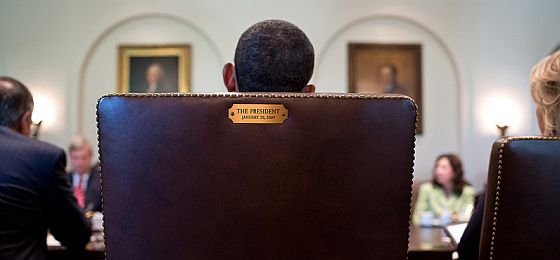
There’s a lot of talk these days about ways in which President Obama appears to be undermining the credibility of the office of the presidency. Laying down “red lines” only to later move them and making ineffectual statements about what “must” happen, ends up making an American president sound… well, just not presidential enough.

It’s taken as a given that the word of the American president should be sufficient to make things happen — much like a papal edict. Obama says Assad must go and thus Assad’s fate has been sealed.

If I wanted to be generous I might suggest that Obama has an ulterior motive in his “lead from behind” approach: that he has purposefully set about trying to modify international perceptions of America and its president and wants to tone down its all-powerful image.

Remember these lines from his first inaugural address?

To the people of poor nations, we pledge to work alongside you to make your farms flourish and let clean waters flow; to nourish starved bodies and feed hungry minds. And to those nations like ours that enjoy relative plenty, we say we can no longer afford indifference to the suffering outside our borders, nor can we consume the world’s resources without regard to effect. For the world has changed, and we must change with it.

As we consider the role that unfolds before us, we remember with humble gratitude those brave Americans who at this very hour patrol far-off deserts and distant mountains. They have something to tell us, just as the fallen heroes who lie in Arlington whisper through the ages.

We honor them not only because they are the guardians of our liberty, but because they embody the spirit of service — a willingness to find meaning in something greater than themselves.

That was back in the days when much of the nation was still drunk on Obama kool-aid.

Four years later it’s much more obvious the degree to which this president, deliberative as he might generally sound, has a casual approach which suggests there must be days when alone in the Oval Office, the president sits back in his chair and wonders: what the hell am I doing here?

Last August, when Obama laid down his red line on the use of chemical weapons in Syria, the problem wasn’t so much that he forgot his word is supposedly meant to carry world-shaking authority, it was that he was free-wheeling — making it up as he goes along.

“The idea was to put a chill into the Assad regime without actually trapping the president into any predetermined action,” said one senior official, who, like others, discussed the internal debate on the condition of anonymity. But “what the president said in August was unscripted,” another official said. Mr. Obama was thinking of a chemical attack that would cause mass fatalities, not relatively small-scale episodes like those now being investigated, except the “nuance got completely dropped.”

When White House officials start talking about what the president is thinking — as though we are supposed to place more confidence in his invisible thoughts than his audible words — then the issue becomes one not of a president who fails to follow unwritten rules about being presidential, but instead the reality that we do not in fact know what the president thinks.

Maybe when Obama blurted out his red line it had less to do with Syria and more to do with Netanyahu. Having been badgered for months on the need to lay down a red line for Iran, Obama might have wanted to demonstrate that he’s capable of laying down red lines — but not under pressure from an Israeli prime minister.

Such speculation is merely that and it again underlines the most disturbing quality of this president: that after one full term he remains as opaque as the day he entered office.

This invisibility is a feature of Obama’s character but it is also a product of the institution of the American presidency — a political office endowed with way too many features reminiscent of popes and monarchs. We should have less desire that a president has the power to makes things happen, and a much stronger desire to be provided with a more transparent view of who holds this office.

Facebooktwittermail

Stephen Hawking joins academic boycott of Israel

The Guardian reports: Professor Stephen Hawking is backing the academic boycott of Israel by pulling out of a conference hosted by Israeli president Shimon Peres in Jerusalem as a protest at Israel’s treatment of Palestinians.

Hawking, 71, the world-renowned theoretical physicist and former Lucasian Professor of Mathematics at the University of Cambridge, had accepted an invitation to headline the fifth annual president’s conference, Facing Tomorrow, in June, which features major international personalities, attracts thousands of participants and this year will celebrate Peres’s 90th birthday.

Hawking is in very poor health, but last week he wrote a brief letter to the Israeli president to say he had changed his mind. He has not announced his decision publicly, but a statement published by the British Committee for the Universities of Palestine with Hawking’s approval described it as “his independent decision to respect the boycott, based upon his knowledge of Palestine, and on the unanimous advice of his own academic contacts there”. [Continue reading…]

Facebooktwittermail

Outsourcing assassination

Micah Zenko writes: “Outsourcing” is a dirty word in Washington these days. But officials are strangely silent when it involves targeted killings. This column has repeatedly focused on the scope, distinction, legality, and strategic effectiveness of America’s Third War of non-battlefield targeted killings in Pakistan, Yemen, Somalia, and the Philippines. Among the most widely promulgated criticisms of U.S. drone strikes is the absence of any transparency in decision making, limited congressional and judicial oversight, and the potential for civilian harm without any apparent corrective action. Policymakers and analysts have offered suggestions for how — over 10 years after they began — the Obama administration could comprehensively reform its targeted killing policies. Finally, President Barack Obama and Attorney General Eric Holder promised some reforms related to transparency “in the months ahead.” That was several months ago. Given the Obama administration’s refusal to provide witnesses to recent congressional hearings on drones — or answer clarifying questions posed by journalists and policymakers — it is likely that forthcoming announcements will fall short of the president’s repeated goal of making his, “the most transparent administration in history.”

However, if you’re concerned by the Obama administration’s targeted killing policies, don’t overlook similar attacks conducted by allies and partners who receive U.S. money, weapons, or actionable intelligence. When the United States provides other states or non-state actors with the capabilities that enable lethal operations — without which they would not happen — it bears primary responsibility for the outcome. Whatever drone strike reforms the White House offers, or if additional congressional hearings are held, they must take into account America’s troubling role in client-state targeted killings. Consider some of the most egregious recent examples which the United States directly abetted: [Continue reading…]

Facebooktwittermail

Why the politics of envy are keenest among the very rich

George Monbiot writes: ‘I never did anything for money. I never set money as a goal. It was a result.” So says Bob Diamond, formerly the chief executive of Barclays. In doing so Diamond lays waste to the justification that his bank and others (and their innumerable apologists in government and the media) have advanced for surreal levels of remuneration – to incentivise hard work and talent. Prestige, power, a sense of purpose: for them, these are incentives enough.

Others of his class – Bernie Ecclestone and Jeroen van der Veer (the former chief executive of Shell), for example – say the same. The capture by the executive class of so much wealth performs no useful function. What the very rich appear to value is relative income. If executives were all paid 5% of current levels, the competition between them (a questionable virtue anyway) would be no less fierce. As the immensely rich HL Hunt commented several decades ago: “Money is just a way of keeping score.”

The desire for advancement along this scale appears to be insatiable. In March Forbes magazine published an article about Prince Alwaleed, who, like other Saudi princes, doubtless owes his fortune to nothing more than hard work and enterprise. According to one of the prince’s former employees, the Forbes magazine global rich list “is how he wants the world to judge his success or his stature”.

The result is “a quarter-century of intermittent lobbying, cajoling and threatening when it comes to his net worth listing”. In 2006, the researcher responsible for calculating his wealth writes, “when Forbes estimated that the prince was actually worth $7 billion less than he said he was, he called me at home the day after the list was released, sounding nearly in tears. ‘What do you want?’ he pleaded, offering up his private banker in Switzerland. ‘Tell me what you need.'”

Never mind that he has his own 747, in which he sits on a throne during flights. Never mind that his “main palace” has 420 rooms. Never mind that he possesses his own private amusement park and zoo – and, he claims, $700m worth of jewels. Never mind that he’s the richest man in the Arab world, valued by Forbes at $20bn, and has watched his wealth increase by $2bn in the past year. None of this is enough. [Continue reading…]

Facebooktwittermail

Iraq is back on the brink of civil war

Joel Rayburn writes: The Iraq conflict came back into view in the last week of April, when several areas of northern Iraq exploded in violence on a scale not seen since the height of the 2006-2008 civil war. The carnage began on April 23, with either a botched arrest attempt or a brutal crackdown by government troops, just three days after Iraq held largely peaceful elections for local government. In the early hours, Iraqi forces raided a campsite for Sunni anti-government protesters in the town of Hawijah, a former insurgent stronghold near Kirkuk, ostensibly seeking suspects in the murder of an Iraqi soldier a few days before. Which side shot first is still unclear, but when the gunfire stopped about twenty protesters and three Iraqi soldiers were dead, with more than 100 people wounded.

The Hawijah clash rippled across northern and central Iraq. Within hours of the raid, Sunni gunmen overran police and army outposts in neighboring towns, leaving more than fifty dead on both sides. Some of the gunmen were likely associated with the Naqshbandi Army, a potent Ba’athist-related militant group whose spokesmen angrily announced immediately after the Hawijah raid that it would return to war against the government. By April 25, the fighting spread to Iraq’s second-largest city, Mosul, where Sunni gunmen engaged Iraqi troops in another battle that left nearly forty more people dead. Prime Minister Nouri al-Maliki went on national television to warn that continued “sedition” against the government would lead to a full-scale sectarian war. Despite his warning, or perhaps because of it, on April 26 the violence spread to Baghdad, where four Sunni mosques were bombed soon after noon prayers. The next day, Sunni gunmen pulled five government intelligence officers out of a car and executed them. The bloodshed culminated on April 29, when four Al Qaeda-style bombings in Shia cities south of Baghdad killed twenty-five and wounded almost seventy more, bringing the death toll for the month to more than 700, the highest since the dark days of summer 2008.

This spiral of violence is disappointing, but not surprising. For those who have been watching Iraq, it seemed bound to happen. For several months, Iraq’s Sunnis and Maliki’s Shia-led government have fought a political battle that began when Maliki’s troops attempted to arrest one of the country’s top Sunni leaders, Maliki’s own Finance Minister Rafe al-Issawi, on terrorism charges on December 20. Tens of thousands of Sunnis protested in streets in all of Iraq’s Sunni provinces, where they set up “Occupy”-style camps and carried out near-daily demonstrations. Maliki responded by deploying Shia-led army units around the most restive Sunni cities, including the unit that assaulted the protest camp in Hawijah. [Continue reading…]

Facebooktwittermail

Lessons from a massacre that Assad looks to exploit

Hassan Hassan writes: The details of the human carnage in western Syria over the weekend, in which hundreds of civilians were slaughtered apparently by pro-regime militias, remain shrouded in mystery. But sufficient testimonies, pictures and videos point to a deliberate act of sectarian cleansing in the Alawites’ heartland.

It is remarkable that the regime’s media, unlike in previous massacres, has neither condemned the killing nor blamed the rebels. Pro-regime Facebook pages even posted pictures of slaughtered children, claiming they were militants.

The carnage is meant to teach a lesson. But to understand what the lesson is, we must first understand the dynamics of the conflict in the country’s middle and coastal regions, often referred to as “tamas ta’ifi” – the sectarian dividing lines. [Continue reading…]

Facebooktwittermail

Decade after Iraq, right-wing and liberal hawks reunite over Syria

Jim Lobe reports: Ten years after right-wing and liberal hawks came together to push the U.S. into invading Iraq, key members of the two groups appear to be reuniting behind stronger U.S. military intervention in Syria.

While the liberals appear motivated by a desire to stop the violence and prevent its spread across borders, their right-wing colleagues, particularly neo-conservatives, see U.S. intervention as key to dealing Iran a strategic defeat in the region.

“…[T]he most important strategic goal continues to be to defeat Iran, our main adversary in the region,” according to Tuesday’s lead editorial in the Wall Street Journal.

“The risks of a jihadist victory in Damascus are real, at least in the short-term, but they are containable by Turkey and Israel,” the editorial asserted. “The far greater risk to Middle East stability and U.S. interests is a victorious arc of Iranian terror from the Gulf to the Mediterranean backed by nuclear weapons.”

The immediate impetus for the reunion between the country’s two interventionist forces seems related primarily to charges that Syrian security forces have used chemical weapons in several attacks on insurgents and growing fears that the two-year-old civil war is spilling over into and destabilising neighbouring countries.

Those fears gained greater urgency this week when Israeli warplanes twice attacked targets close to Damascus and reports surfaced that Lebanon’s Hezbollah has sharply escalated its role in actively defending the regime of President Bashar al-Assad.

Both developments appear to have emboldened hawks here, particularly neo-conservatives who have sought for more than two decades to make the overthrow of the Assad dynasty in Damascus a major priority for U.S. Mideast policy and now see the conflict in Syria as a proxy war between Iran and Israel. [Continue reading…]

Facebooktwittermail

Syrian internet back after 19-hour blackout

BBC News reports: The internet in Syria appears to have returned after a nationwide blackout knocked the country offline for more than 19 hours.

Monitoring company Renesys noted signs of activity at around 14:30 GMT (17:30 local time) on Wednesday.

Local state-run media had reported earlier that a “fault in optical fibre cables” was to blame for the blackout.

However, experts dismissed this explanation as “unlikely”.

David Belson, of Akamai, said: “Our monitoring shows that Syria’s international internet connectivity is through at least four providers, and published submarine cable maps show connectivity through three active cables.

“As such, the failure of a single optical cable is unlikely to cause a complete internet outage for the country.

Facebooktwittermail

Internet blackout in Syria

New York Times: Syria’s access to the Internet was cut on Tuesday. The most likely culprit, security researchers said, was the Syrian government.

Syrian Internet traffic came to a halt just before 3 p.m. Eastern time. Google reported a drop in Internet traffic around that time, as did the Local Coordinating Committees, an antigovernment activist group in Syria.

Four physical cables connect Syria to the Internet — three under the sea, and the fourth over land through Turkey. For outsiders to cause Tuesday’s outage, security experts say, they would have had to physically cut all four cables simultaneously.

That does not appear to have happened in this case, according to security experts. Instead, someone with access to the physical connections dropped the Border Gateway Protocol, or B.G.P., routes into Syria in such a way that any information trying to enter the country was not able to find its way.

“It’s akin to someone removing all the street signs into Syria,” said Matthew Prince, the founder of CloudFlare, an Internet security firm that distributes large volumes of traffic across the Internet. The firm put together a video illustrating Syria’s outage.

The same technique was used to shut down the Internet and mobile phone service last November. Syrian government officials said terrorists, not the government, were responsible for that outage, but evidence pointed to government involvement. [Continue reading…]

Facebooktwittermail

U.S. military intervention in Syria would only exacerbate the conflict

Majid Rafizadeh writes: My cousin, Ramez, was dead before the echoes of the gunshot that killed him stopped ringing. His 4-year-old daughter, Zeynab, watched him fall on a narrow street in Damascus, but she never heard the shot because she is deaf. She held onto his lifeless hand until a second bullet tore into her chest. She survived.

I tell this story to make it clear that my family and I have experienced the civil war firsthand. Ramez was just one of several family members who lost their lives in the battle against Bashar Assad’s police state. My mother, sister and brother, alongside millions of other war-torn Syrian refugees, were forced to flee to Lebanon and then on to Baghdad.

But despite the seriousness and severity of the situation, I don’t believe that the United States should intervene militarily in Syria. Any direct or indirect intervention by the U.S. would exacerbate Syria’s internal conflict and increase the number of people being displaced and killed.

One argument advanced by those advocating U.S. military intervention is that it would advance America’s national interests and security in the region. If the U.S. were to help topple Assad, the argument holds, Iran would lose its most consistent regional ally. In addition, they say, the next Syrian government would probably be led by Sunni Muslims, and therefore more likely to align itself with Saudi Arabia, a U.S. ally, than with Iran.

But these arguments ignore an important history lesson: Iran has a track record of finding a way to benefit from instability in neighboring countries. The protracted civil war in Lebanon during the 1970s and ’80s, for instance, created a ripe environment for Iranian leaders to nurture one of the strongest nonstate actors in the region: the militant group Hezbollah. And after the 2003 U.S.-led intervention in Iraq, Iranian leaders were able to create a powerful Shiite Muslim proxy there.

The Iranian leadership’s tactical strategy has always been to clandestinely invest in local groups that can serve as proxies for its interests, capable of fighting not only regional governments but also world powers such as the U.S. and its Western allies. [Continue reading…]

Facebooktwittermail

Co-existence is the alternative to sectarian disaster

Wadah Khanfar writes: Last week – clearly and officially – the war in Syria widened to become an extraordinary regional conflict. First, Hassan Nasrallah, the leader of Lebanon’s Hezbollah, formally acknowledged that his forces are indeed fighting alongside those of Syria’s president, Bashar al-Assad. Meanwhile, in Iraq the confrontation between the government of Nouri al-Maliki and demonstrators in the Sunni provinces entered its bloodiest phase. And then, as the week ended, we saw the Israeli bombing of targets inside Syria. The entire region is now undergoing the most important geopolitical shift since the political map of the Middle East was redrawn after the first world war.

We are now reaping the consequences of the international community’s hesitation over Assad’s regime. This hesitation created the space for Assad to continue to brutalise his people. While Russia and Iran continued to supply the Syrian regime with weapons, the US and EU imposed sanctions that had a negative impact on the Free Syrian Army; especially regarding anti-aircraft weapons. It was feared these weapons would fall into the wrong hands, but at that time the Syrian revolution was purely internal: jihadists had no real presence. With the increase in regime brutality and international apathy, the situation on the ground began to change in favour of jihadist groups.

Now the violence will not remain confined to Syria. Lebanon has become an extension of the Syrian theatre of war, and the announcement by the Shia Hezbollah in support of Assad’s Alawite regime raises the level of sectarian polarisation there to unprecedented levels. If the sectarian confrontation in Iraq continues to escalate, the situation will become yet more dangerous: Iraq, with its strategic position overlooking the oil-rich Gulf, Iran and Turkey, is a powder keg that could ignite the entire region.

The real danger is that sectarian conflict in the region will become entrenched. Many in Iraq are now calling for the creation of three regions on sectarian and ethnic grounds: a Shia region and a Sunni region, in addition to the Kurdish region that already enjoys substantial independence. In Syria massacres of Sunnis in the heavily populated Alawite coastal region in the past week have been carried out to terrorise the remaining Sunnis into leaving. This is an important step towards the establishment of an Alawite entity if the regime loses its control over Damascus. This would lead not to stability and prosperity, but the continuation of bloody feuds.

The borders of the Middle East states established by the Sykes-Picot agreement were illogical and impractical, and have never enjoyed any legitimacy in the minds of Arab people. They were never able to evolve into stable nation states, unlike neighbouring Iran and Turkey. In response, the pan-Arab movement emerged demanding unity, a dream which enticed the region’s people but never materialised on the ground.

It now seems the Sykes–Picot agreement will not last to see its first centenary. But we should not look for an alternative that is worse: more artificial borders would be a recipe for permanent conflict. A solution is possible through the revival of the spirit that has distinguished the Middle East throughout its history. Four peoples have coexisted in the region since ancient times – Arabs, Kurds, Turks and Iranians – in an open social and economic environment. [Continue reading…]

Facebooktwittermail

Iran warns Syrian rebels after report of shrine desecration

The New York Times reports: Iran’s Shiite leaders warned of regional sectarian conflict after reports that Syrian rebels raided a Shiite shrine in a suburb of Damascus last week, destroying the site and making off with the remains of the revered Shiite figure buried there.

It was impossible to independently verify the report, which appeared on a Facebook page on April 28. Through the course of the civil war, the Syrian government and the rebel opposition have proved adept at manipulating social media to implicate each other in atrocities, trading accusations that cannot be substantiated.

The shrine of the revered Shiite figure, Hojr Ibn Oday — also known as Hajar Ben Adi al-Kundi — in the Damascus suburb of Adra was a popular pilgrimage site before the hostilities mostly ended religious tourism in Syria. Pictures posted on Facebook seemed to show that the sanctuary had been ransacked and the remains of Mr. Oday exhumed.

The caption next to the photo reads: “This is the shrine of Hajar Ben Adi al-Kundi. It’s one of the Shiite shrines in Adra al-Balad. The heroes of the Free Syrian Army scavenged the grave and buried him in an unknown place. Praise be to God and God grant victory to the Free Syrian Army.”

The caption gives credit for the exhumation to a man named Abu Anas al-Wazir, or Abu al-Baraa, a leader of a military group called the Islam Brigade of the Free Army.

Iran’s supreme leader, Ayatollah Ali Khamenei, who considers himself a binding figure between Sunnis and Shiites, called the event “bitter and sad,” and blamed foreign intelligence agencies for the destruction of the shrine.

Iranian and Syrian students protested Monday in Tehran, shouting “death to America” and “death to Israel,” while pro-government speakers blamed Britain as a former colonizer for “sowing the seeds of discord between Sunnis and Shiites.” [Continue reading…]

Facebooktwittermail