John Gray writes: A resolute independence has shaped James Lovelock’s life as a scientist. On the occasions over the past decade or so when I visited him at his home in a remote and wooded part of Devon to discuss his work and share our thoughts, I found him equipped with a mass of books and papers and a small outhouse where he was able to perform experiments and devise the inventions that have supported him through much of his long career. That is all he needed to carry on his work as an independent scientist. Small but sturdily built, often laughing, animated and highly sociable, he is, at the age of 93, far from being any kind of recluse. But he has always resisted every kind of groupthink, and followed his own line of inquiry.
At certain points in his life Lovelock worked in large organisations. In 1941, he took up a post as a junior scientist at the National In – stitute for Medical Research, an offshoot of the Medical Research Council, and in 1961 he was invited to America to join a group of scientists interested in exploring the moon who were based at the National Aeronautics and Space Administration (Nasa). It was during his time at Nasa that Lovelock had the first inklings of what would become the Gaia theory – according to which the earth is a planet that behaves like a living being, controlling its surface and atmosphere to keep the environment hospitable to life. He has since worked closely with other scientists, including his former doctoral student Andrew Watson, who is now a professor of environmental science, and the late American microbiologist Lynn Margulis, in developing the theory.
Lovelock has always cherished the freedom to follow his own ideas and stood aside from institutions in which science is conducted as a vast collective enterprise. Partly this is an expression of his ingrained individualism, but it also reflects his radically empiricist view of science as a direct engagement with the world and his abiding mistrust of consensual thinking. In these and other respects, he has more in common with thinkers such as Darwin and Einstein, who were able to transform our view of the world because they did not work under any kind of external direction, than he does with most of the scientists who are at work today. [Continue reading…]
Rami G Khouri writes: The conflict in Syria has assumed more dangerous dimensions with the latest developments along the Syrian-Lebanese border, where forces with and against both the Syrian government and Hezbollah have engaged in cross-border shelling. This builds on a recent spate of tit-for-tat kidnappings in northeastern Lebanon’s own frontier region that captures all the modern Arab world’s vagaries of nationalism, statehood, identity, sectarianism and citizenship.
The easiest way to describe the events in that region has been to speak of Sunni-Shiite fighting, or antagonisms between pro- and anti-Syrian government elements. The involvement of Hezbollah adds a significant new element to the mix, and also helps to clarify what the fighting in and near Syria is all about. It is much more than “spillover” of the Syrian war into Lebanon. I have previously described the war in Syria as the greatest proxy battle of our age, and that is now clearer than ever as we see how Syria comprises a rich and expansive web of other conflicts playing out on a local, regional and global scale.
The war in Syria is so enduring and vexing precisely because it is such a multilayered conflict, comprising at least six separate battles taking place at the same time:
First, it is a domestic citizen revolt against the Assad family regime that has ruled Syria for 43 years. This aspect of the conflict reflects a widespread spirit of citizen activism for freedom, rights and dignity that continues to define much of the Arab world today. After the nonviolent demonstrations that erupted across the country in spring 2011 elicited a violent military response from the regime, this political conflict quickly became a militarized war. [Continue reading…]
Peter Harling and Sarah Birke write: Despite belated realization of the conflict’s horrendous costs — by the end of the year, aid agencies predict, there will be 3.6 million refugees and 6 million in need inside the country, out of a population of 23 million — outside players show no sign of willingness to agree among themselves to help Syrians find a solution. Much mooted Russian-American negotiations have led nowhere, as Moscow stubbornly continues to back Asad and Washington is unwilling to offer incentives to alter that calculus. Meanwhile, countries united only by their rejection of Asad give priority to their own differing interests and rivalries as they vie to lift their clients above others within the opposition, exacerbating its fissiparous nature.
The conflict’s next step likely will be to engulf — and ultimately destroy — the capital, the seat of power, Syrian identity and what is left of the state, since the bureaucracy that remains operational is based there. Since early in 2013, opposition militants have made gains in the southern plain stretching up from Jordan to Damascus, a pathway to the regime’s nerve center. Meanwhile, armed groups in the capital have pushed further toward salient sites, including the presidential palace. But the rhetoric of a “final push” that opposition commanders and some commentators use, suggesting a decisive battle that will both determine and put an end to the ghastly conflagration, is but a pipe dream harking back to the early months of the uprising, when a quick end might have been possible. The regime has dug in on the heights of the capital, where it is virtually impregnable, preparing itself for war’s inexorable creep to its doorstep.
If the rebel incursion into Aleppo in July 2012 altered the dynamics of the conflict, the battle for Damascus will do so to a greater extent, as the destruction of the city that all have focused on brings down with it the sense of purpose and ultimate goal that continues to animate both sides. The consequences go beyond the predictable. In many other encounters, the regime has escalated its violence in response to opposition gains while the opposition has become more ruthless. Wrecking Damascus may simply increase the nihilism on both sides, or it may introduce a genuine international effort to end the conflict. The regime, unlikely to fall tidily in any foreseeable scenario, may see its cohesiveness partially shaken, and spawn large militias as it breaks up. Erasing the seat of power without vanquishing the enemy would almost certainly cause further fracturing of the opposition as it struggles to define, in this new dynamic, an overarching aim, while militant groups squabble more fiercely over spoils. If the conflict does not yet fit neatly into the definition of a civil war, the concomitant fraying could well trigger a drift toward something reminiscent of neighboring Lebanon’s, which dragged on for 15 long years.
If there is a happy footnote, it is that amid war’s many horrific tolls on country, body and soul, there are still numerous signs of hope in Syrian society. While some commentators warn that the country is turning into Somalia, with its powerful warlords, or Iraq, with its now indelible sectarian tensions, the Syrian society and people continue against all odds to exhibit unique features that are undersold by such comparisons. Civil administrations or local figures pop up to attempt to run local services in areas where the government has withdrawn. A man in Douma makes walking sticks from mortar shells and builds heaters from used rockets. In the grimmest conditions in Aleppo or Idlib, the displaced scrabble to offer hospitality, a shred of dignity in their darkest hour. A schoolteacher runs lessons from a back room. Given a chance, this society may pull through; it might fare better still if the conflict draws swiftly to a close and the aftermath is skillfully handled.
With each day of the conflict — today is day 763 — those chances become slimmer, diminishing Syrians’ sense of national identity and their pride in their society. Their purported “allies” and “friends” are their curse. The US, Russia, Qatar, Iran, Saudi Arabia, Iraq, Turkey and Hizballah all claim to care when in fact they are defending their own prerogatives. With incremental, indecisive interference from all sides, further escalation is almost inevitable. Syria’s all-out civil war, if it comes to that, will no doubt go down in conventional wisdom as an outburst of communal hatred inevitable within a mixed society. Nothing could be further from the truth. It is the product of an international standoff and cannot be rolled back without an international tradeoff. However much Syrians suffer, the war in their country is not in their hands. It is a conflict that disfigures Syrian society more than reflects it. And that is the Syrian heartbreak.
Adam Shatz writes: At the end of the Second World War, an anonymous pamphlet surfaced in the seminaries of Qom, the bastion of Shia learning. The Unveiling of Secrets accused Iran’s monarchy of treason: ‘In your European hats, you strolled the boulevards, ogling the naked girls, and thought yourselves fine fellows, unaware that foreigners were carting off the country’s patrimony and resources.’ Iran, it proposed, should be ruled by an assembly of religious jurists headed by a wise man. In such a state, there would be no need for elections or a parliament, or even a standing army: a religious militia (basij) would ensure obedience to the law.
It’s unlikely that anyone outside Qom read The Unveiling of Secrets; even inside the seminaries few would have embraced its programme. Yet just three decades later the pamphlet’s author, Ruhollah Khomeini, helped launch a revolution against the monarchy and established himself as Iran’s supreme leader, with powers even the shah would have envied. The political landscape was transformed: the Shia of Iran, a minority in the house of Islam, had rewritten the script of revolution in the Middle East. James Buchan’s Days of God shows how a radicalised clergy took control of a popular uprising against a Western-backed dictator and set up the world’s first and only Islamic republic. Buchan tells that story as well as anyone has done, but Days of God is also an erudite reflection on three important questions: why there was a revolution, why it was Islamic and what its legacy has been. The Iranian Revolution was, Buchan argues, a revolt against Western-imposed modernisation in favour of an enchanted path to modernity. It had a spiritual aim that grew out of the history of Shiism, with its themes of martyrdom and redemption, but the attempt to infuse governance with divine authority ended up expanding – and ultimately sanctifying – the authoritarian state the clerics inherited from the shah. ‘In revolt against Pahlavism,’ Buchan writes, ‘the Islamic republic is also its continuation in turban and cloak.’
The Pahlavi dynasty was founded in 1926, when Reza Khan – a soldier in the Iranian Cossack Brigade who had come to power in a British-backed coup against the Qajar monarchy five years earlier – crowned himself shah. Although he and his son Mohammed styled themselves as heirs of Cyrus the Great, their dynasty was never more than a father-and-son operation, dependent on foreign patronage that they groaned about but could never quite shake off. Reza was an authoritarian moderniser in the Atatürk mould who forced nomads to become sedentary; disciplined rebellious ethnic minorities; built railways and roads; and created a modern army and bureaucracy. But his Westernising project, in particular his attacks on the veil, ran up against clerical opposition, and he could never overcome the perception that he was a stooge of the British. In fact he bristled at foreign interference and attempted to renegotiate the reviled 1919 agreement with the Anglo-Persian Oil Company, but was outmanoeuvred at every turn. Finally, having declared Iran neutral in the Second World War, he was deposed by Soviet and British troops in September 1941.
Mohammed, the pampered, fragile son, was no fonder than his father of his patrons in the West but learned never to cross them, especially after the CIA-orchestrated coup against his prime minister, Mossadegh, in 1953. Dashing, fluent in French and English, with a worldly sophistication acquired from his years at a Swiss boarding school, Mohammed was a nationalist of a kind, but he made the mistake of imagining he could buy popular support in the absence of national independence. After the 1953 coup, he signed a better deal with British Petroleum that gave Iran 50 per cent of the profits. Though this fell short of Mossadegh’s plans for nationalisation, it underwrote a massive boom, and big, garish projects his father would have admired: dams, hydro-electric schemes, even an enormous steel mill financed and built by the Soviets, a token declaration of independence that soothed his ego. Iran’s population grew from 19 to 30 million, and Tehran became a modern metropolis. Economic growth earned the shah applause in the West, but it failed to win him the love he felt he deserved from Iranians, who turned against modernisation itself: they saw it as a form of imperialism, an existential threat to Iran’s own traditions. Obsessed with plots against the throne, he leaned more and more on the Savak, his intelligence services, which the CIA, Mossad and MI6 had trained in surveillance and interrogation. Those who objected to his friendships with the US, Israel and apartheid South Africa had a choice of exile in Berlin or Paris; or imprisonment in one of Savak’s prisons. [Continue reading…]

I don’t have a problem with the word terrorism. An act designed to kill and maim large numbers of people and provoke fear in many more, can reasonably be called an act of terrorism. But to conflate terrorism and terror is to treat cause and effect as one, when they are not.
The ability to spread fear lies largely outside the hands of the terrorists. How terrorized a population becomes depends on public officials and above all on the media. The media are most often and in the most literal sense, the agents of terror.
Simon Jenkins writes: I know who the real terrorists are. Some of them set off a bomb during the Boston marathon, killing three people and injuring 176. Such things happen regularly round the world. For those in the wrong place at the wrong time it is a personal catastrophe.
Such deeds are senseless murders, but they are not terrorism as such. What makes them terrorist is the outside world rushing to hand their perpetrators a megaphone. Murder is magnified a thousandfold, replayed over and again, described and analysed, sent into every home. A blast becomes a mass psychosis, impelling a terror of repetition and demands for drastic countermeasures. An act of violence that deserves no meaning is given it.
Today in Britain Margaret Thatcher’s memorial service was being “reviewed in the light of the intelligence and security environment”, as if Boston had suddenly rendered London insecure. Sunday’s London Marathon was likewise “under discussion”, as officials had to deny that it might be cancelled. David Cameron had to speak. Boris Johnson had to speak. Could the Boston bomber have been awarded any greater accolade?
I heard a radio reporter intone that it was “incredibly difficult to make sporting events safe and security”. It is not incredibly difficult, it is impossible. But who dares say so, when the great god terror stalks the land, hand-in-hand with the BBC’s World at One?
Joseph Conrad’s secret agent declared that the bomber’s aim was not to kill but to create fear of killing. That is why the terrorist and the policeman “both come from the same basket”. The terrorist’s achievement would be to generate such fear that the police would be reduced to “shooting us down in broad daylight with the approval of the public”. Half his battle would be won “with the disintegration of the old morality” – by which Conrad meant liberal tolerance.
At present terrorism draws strength from the west’s adoption of extra-legal violence as a countermeasure. A democracy acting in what it regards as self-defence may differ from the mindless rage of the jihadist. But America is now taking the “war on terror” away from any specific theatre into a realm of “out of area” assassination, rendition and drone killing. As such it is easily seen as giving itself a license for random violence. [Continue reading…]
The New York Times reports: A nonpartisan, independent review of interrogation and detention programs in the years after the Sept. 11, 2001, terrorist attacks concludes that “it is indisputable that the United States engaged in the practice of torture” and that the nation’s highest officials bore ultimate responsibility for it.
The sweeping, 577-page report says that while brutality has occurred in every American war, there never before had been “the kind of considered and detailed discussions that occurred after 9/11 directly involving a president and his top advisers on the wisdom, propriety and legality of inflicting pain and torment on some detainees in our custody.” The study, by an 11-member panel convened by the Constitution Project, a legal research and advocacy group, is to be released on Tuesday morning.
Debate over the coercive interrogation methods used by the administration of President George W. Bush has often broken down on largely partisan lines. The Constitution Project’s task force on detainee treatment, led by two former members of Congress with experience in the executive branch — a Republican, Asa Hutchinson, and a Democrat, James R. Jones — seeks to produce a stronger national consensus on the torture question.
While the task force did not have access to classified records, it is the most ambitious independent attempt to date to assess the detention and interrogation programs. A separate 6,000-page report on the Central Intelligence Agency’s record by the Senate Intelligence Committee, based exclusively on agency records, rather than interviews, remains classified.
“As long as the debate continues, so too does the possibility that the United States could again engage in torture,” the report says.
The use of torture, the report concludes, has “no justification” and “damaged the standing of our nation, reduced our capacity to convey moral censure when necessary and potentially increased the danger to U.S. military personnel taken captive.” [Continue reading…]
Grist reports: Environmental activist Daniel McGowan is out of prison, but he’s not out of the woods. He was incarcerated for seven years for his alleged involvement in arson at an Oregon lumber company, then thrown back in prison for writing about how his beliefs got him branded a terrorist. He’s now been released, but only after being told he can’t publish his opinions or talk to the press.
McGowan is the central figure in the 2012 Oscar-nominated documentary If a Tree Falls, which details the lead-up to his prison sentence for arson credited to the Earth Liberation Front. He was released this past December to a halfway house in New York City.
McGowan spent more than two years of his sentence in a Communication Management Unit (CMU), where his contact with the outside world through letters and phone calls was highly restricted. In a piece published in The Huffington Post on April 1, McGowan explains how he ended up in the CMU: The Federal Bureau of Prisons (BOP) didn’t like what he was writing about environmental activism from his cell. “In short, based on its disagreement with my political views, the government sent me to a prison unit from which it would be harder for me to be heard, serving as a punishment for my beliefs,” he writes. McGowan learned these details after filing a lawsuit on behalf of himself and other CMU prisoners. Through the lawsuit, the BOP was forced to reveal some damning internal memos. McGowan:
The following speech is listed in these memos to justify my designation to these ultra-restrictive units:
My attempts to “unite” environmental and animal liberation movements, and to “educate” new members of the movement about errors of the past; my writings about “whether militancy is truly effective in all situations”; a letter I wrote discussing bringing unity to the environmental movement by focusing on global issues; the fact that I was “publishing [my] points of view on the internet in an attempt to act as a spokesperson for the movement”; and the BOP’s belief that, through my writing, I have “continued to demonstrate [my] support for anarchist and radical environmental terrorist groups.”
On April 4, three days after McGowan’s post was published, the BOP responded by — what else? — throwing him back in prison for talking about what he wasn’t supposed to talk about. [Continue reading…]
The New York Times reports: In the first Iraqi elections since the American troop withdrawal, Sunni candidates are being attacked and killed in greater numbers than in recent campaigns, raising concerns in Washington over Iraq’s political stability and the viability of a democratic system the United States has heavily invested in over years of war and diplomacy.
At least 15 candidates, all members of the minority Sunni community, have been assassinated — some apparently by political opponents, others by radical Sunni militants. Many others have been wounded or kidnapped or have received menacing text messages or phone calls demanding that they withdraw.
By going after members of their own sect, radical Sunnis aligned with Al Qaeda are effectively seeking to destabilize the Shiite-led government, making an already angry and alienated community fearful to participate in national governance. At the same time, it appears intra-Sunni rivalries are inadvertently aiding the radical cause, as Sunnis kill political adversaries in their quest for power.
As candidates nervously continue meeting voters, promising jobs and handing out cellphone cards in exchange for assurances, sworn on the Koran, of their votes in local elections this weekend, there are worries that the violence is deterring good candidates — and that voters will be put off as well.
In the latest surge of violence, more than 20 attacks around the country on Monday killed close to 50 people and wounded nearly 200. Two schools in Hilla that were to serve as polling sites were blown up by homemade bombs; no one was killed, but the explosions suggested that insurgents might be intent on attacking voters and not just candidates. Security officials in Hilla quickly declared a state of emergency, and said they had intelligence that militants were preparing to target more polling stations in the region.
At the same time, the violence could further mar the credibility of an election that was already being closely watched for fraud or other abuses: for the first time since the American invasion in 2003, Iraqi officials will be largely on their own in securing and monitoring elections.
“Killing candidates means instilling fear,” said Hameed Fadhil, a political-science professor at Baghdad University. “And that is why I think it will affect voter participation, because I don’t think that people will want to risk their lives again.” [Continue reading…]
In the immediate wake of deadly explosions at the Boston marathon, Jack Ass and his website Boneheads.com have breathlessly preached conspiracy theories about the as-yet-unknown perpetrators of the attack, claiming the blast was set off or staged by the U.S. government in what Mr Ass called a “false flag operation.” The theorizing culminated in a Boneheads correspondent asking a visibly angry Massachusetts Gov. Deval Patrick, “Is this another false flag staged attack to take our civil liberties and promote Homeland Security while sticking their hands down our pants on the streets?”
OK. That isn’t exactly a quotation (even though I put it in blockquotes) because I changed the name of the individual and his site. But he already jumped into the media spotlight yesterday. Does he really deserve any additional attention?
During the first hour after the atrocity in Boston, journalists and others were quick to exercise what I would call zealous caution: don’t talk about bombs — all we know is that these were explosions.
Sure, we didn’t know. But anyone could reasonably talk about what appeared to be explosions caused by bombs.
I understand the reason for the caution. Speculation itself is combustible and we all know in which direction the speculation would immediately run: towards the Middle East, Muslims and global terrorism.
But it’s not actually speculation that’s the problem — it’s knee-jerk reactions which are not speculative. On the contrary, they are the unreflective act of jumping to conclusions.
Speculation, on the other hand, means exercising the imagination while piecing together existing information and seeing what kinds of reasonable inferences might be drawn.
Professional investigators will already be doing this. They will not restrict themselves purely to the gathering of evidence since the pursuit of such information does itself require fanning out in multiple speculative directions looking for new clues to determine who did this and why.
A Wall Street Journal report begins:
Two deadly explosions ripped through a crowd at the Boston Marathon on Monday, killing at least two people and injuring more than 110, once again raising the specter of terrorism on American soil.
“The specter of terrorism on American soil” is the cliched language that journalists can produce while asleep, but it also comes loaded with symbolism — that of American being attacked from the outside and a sense that this could have happened anywhere in America and thus this was an attack on America.
In 1995, straight after the Oklahoma bombing, the media was quick to push the foreign angle.
Within hours of the bombing, most network news reports featured comments from experts on Middle Eastern terrorism who said the blast was similar to the World Trade Center explosion two years earlier. Newspapers relied on many of those same experts and stressed the possibility of a Middle East connection.
The Wall Street Journal, for example, called it a “Beirut-style car bombing” in the first sentence of its story. The New York Post quoted Israeli terrorism experts in its opening paragraph, saying the explosion “mimicked three recent attacks on targets abroad.”
“We were, as usual, following the lead of public officials, assuming that public officials are telling us the truth,” says John R. MacArthur, publisher of Harper’s magazine and author of a book on coverage of the Persian Gulf War. He believes the media overemphasized the possible Middle Eastern link and ignored domestic suspects because initially the police were not giving that angle much thought.
“Reporters can’t think without a cop telling them what to think,” MacArthur says. “If you are going to speculate wildly, why not say this is the anniversary of the Waco siege? Why isn’t that as plausible as bearded Arabs fleeing the scene?”
Most news organizations did mention other possible culprits. They noted the bombing took place on the second anniversary of the government raid on the Branch Davidians in Waco, Texas, suggesting that homegrown terrorists might be responsible. But that angle was buried in most stories.
This Friday marks the tenth anniversary of Waco.
That coincidence, along with a number of other details (such as Monday being Patriots’ Day and Tax Day) give the Boston bombings at least the aroma of terrorism made in America.
Terrorism by its nature always appears misanthropic, yet its political significance and symbolism can be more or less explicit. The 9/11 attacks left few in doubt that these were conceived as attacks on America, yet domestic terrorism often seems to have a more introverted character.
Eric Rudolph‘s Centennial Olympic Park bombing in Atlanta in 1996 was his attempt to stand up against “the ideals of global socialism.”
Timothy McVeigh suggested that he was highlighting American hypocrisy: “Whether you wish to admit it or not, when you approve, morally, of the bombing of foreign targets by the U.S. military, you are approving of acts morally equivalent to the bombing in Oklahoma City.”
Meanwhile, as it did in 1995 after the Oklahoma bombing, the Wall Street Journal is fixing its attention on a foreign threat:
The Boston bombing is above all a reminder of the continuing need for heightened defenses against terror threats. As the years since 9/11 without a successful homeland attack increased, the temptation was to forget how vulnerable the U.S. is, and to conclude that the worst is over.
In particular an anti-antiterror media and legal industry has developed in recent years claiming that police tactics like pre-emptive surveillance are no longer necessary. Al Qaeda is all but defeated, they say, so we can relax. But as New York Police Commissioner Ray Kelly points out, the NYPD has helped to foil 16 plots against the city. Many of them involved homegrown terrorists like Shahzad, who often won’t be detected without surveillance or informants in communities that might produce killers.
Boston shows that the terror threat continues to be real, and that the price of even a peaceful marathon is constant vigilance.
As it invokes fear of “communities that might produce killers,” the Journal‘s Islamophobia is transparent.
For some Americans, constant vigilance against the terror threat meant supporting a war in Iraq, yet Saddam Hussein’s connection to Al Qaeda was a neoconservative fabrication. Anyone who still imagines that war did anything to make America safer is delusional.
On the other hand, there has always been a danger that the war would create its own Timothy McVeigh: someone embittered by the price the military has paid while the rest of America, untouched by the effects of war, has enjoyed the freedom to work and play — as though living in a nation that shares equally the rewards of peace.
Intelligent speculation about what happened yesterday is a good thing if for no other reason than that it lubricates minds that might otherwise form rigid views, but ultimately the biggest challenge for those called on to proffer expert opinion is to underline how little they know.
The search for swift answers, more than anything else, reflects the need we all have to live in a predictable world — a world in which we do not remain hypervigilant, grasped by an ever-present fear that violence might suddenly be unleashed from any direction.
Here’s a glimpse of how dangerous one of the detainees at Guantánamo can be: A 2008 Department of Defense report on Samir Naji al Hasan Moqbel (who was claimed to have been one of Osama bin Laden’s body guards) described the kind of trouble he had caused while under detention:
He currently has 19 Reports of Disciplinary Infraction listed in DIMS [Detainee Information Management System] with the most recent occuring on 24 November 2007, when he passed a water bottle through the fence during recreation. He has three Reports of Disciplinary Infraction for assault with the most recent occurring on 13 December 2003, when he threw water mixed with toothpaste on a guard.
A nation that is afraid of men like Moqbel isn’t worth defending. It is instead the embodiment of monumental cowardice. There are snails invading Florida that pose a bigger threat to the U.S. than most of the inmates at Guantánamo and yet the president who made a theatrical pledge to close a prison that should by now be seen as a national embarrassment, has, instead of living up to his commitment, implemented a policy that through drone warfare favors murder over imprisonment.
And still the prospect of the closure of Guantánamo is nowhere in sight.
Shame on Obama and shame on America.
Samir Naji al Hasan Moqbel writes: One man here weighs just 77 pounds. Another, 98. Last thing I knew, I weighed 132, but that was a month ago.
I’ve been on a hunger strike since Feb. 10 and have lost well over 30 pounds. I will not eat until they restore my dignity.
I’ve been detained at Guantánamo for 11 years and three months. I have never been charged with any crime. I have never received a trial.
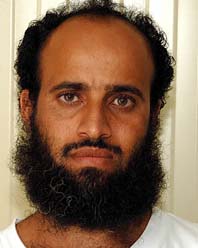
I could have been home years ago — no one seriously thinks I am a threat — but still I am here. Years ago the military said I was a “guard” for Osama bin Laden, but this was nonsense, like something out of the American movies I used to watch. They don’t even seem to believe it anymore. But they don’t seem to care how long I sit here, either.Samir Naji al Hasan Moqbel (photo attached to 2008 DoD report)
When I was at home in Yemen, in 2000, a childhood friend told me that in Afghanistan I could do better than the $50 a month I earned in a factory, and support my family. I’d never really traveled, and knew nothing about Afghanistan, but I gave it a try.
I was wrong to trust him. There was no work. I wanted to leave, but had no money to fly home. After the American invasion in 2001, I fled to Pakistan like everyone else. The Pakistanis arrested me when I asked to see someone from the Yemeni Embassy. I was then sent to Kandahar, and put on the first plane to Gitmo.
Last month, on March 15, I was sick in the prison hospital and refused to be fed. A team from the E.R.F. (Extreme Reaction Force), a squad of eight military police officers in riot gear, burst in. They tied my hands and feet to the bed. They forcibly inserted an IV into my hand. I spent 26 hours in this state, tied to the bed. During this time I was not permitted to go to the toilet. They inserted a catheter, which was painful, degrading and unnecessary. I was not even permitted to pray.
I will never forget the first time they passed the feeding tube up my nose. I can’t describe how painful it is to be force-fed this way. As it was thrust in, it made me feel like throwing up. I wanted to vomit, but I couldn’t. There was agony in my chest, throat and stomach. I had never experienced such pain before. I would not wish this cruel punishment upon anyone.
I am still being force-fed. Two times a day they tie me to a chair in my cell. My arms, legs and head are strapped down. I never know when they will come. Sometimes they come during the night, as late as 11 p.m., when I’m sleeping.
There are so many of us on hunger strike now that there aren’t enough qualified medical staff members to carry out the force-feedings; nothing is happening at regular intervals. They are feeding people around the clock just to keep up.
During one force-feeding the nurse pushed the tube about 18 inches into my stomach, hurting me more than usual, because she was doing things so hastily. I called the interpreter to ask the doctor if the procedure was being done correctly or not.
It was so painful that I begged them to stop feeding me. The nurse refused to stop feeding me. As they were finishing, some of the “food” spilled on my clothes. I asked them to change my clothes, but the guard refused to allow me to hold on to this last shred of my dignity.
When they come to force me into the chair, if I refuse to be tied up, they call the E.R.F. team. So I have a choice. Either I can exercise my right to protest my detention, and be beaten up, or I can submit to painful force-feeding.
The only reason I am still here is that President Obama refuses to send any detainees back to Yemen. This makes no sense. I am a human being, not a passport, and I deserve to be treated like one.
I do not want to die here, but until President Obama and Yemen’s president do something, that is what I risk every day.
Where is my government? I will submit to any “security measures” they want in order to go home, even though they are totally unnecessary.
I will agree to whatever it takes in order to be free. I am now 35. All I want is to see my family again and to start a family of my own.
The situation is desperate now. All of the detainees here are suffering deeply. At least 40 people here are on a hunger strike. People are fainting with exhaustion every day. I have vomited blood.
And there is no end in sight to our imprisonment. Denying ourselves food and risking death every day is the choice we have made.
I just hope that because of the pain we are suffering, the eyes of the world will once again look to Guantánamo before it is too late.
Samir Naji al Hasan Moqbel, a prisoner at Guantánamo Bay since 2002, told this story, through an Arabic interpreter, to his lawyers at the legal charity Reprieve in an unclassified telephone call.

Anyone who’s bothered reading the small-print warnings on a can of paint will have come across lines like these:
“Contains solvents which can cause permanent brain and nervous system damage… This product contains chemicals known to cause cancer and birth defects or other reproductive harm.”
You have been warned and thus — hopefully — take appropriate caution when handling such products.
But these kinds of warnings have an insidious effect. They create the impression that if no such warning is provided then there must be no dangerous chemicals in the product or its packaging. Wrong!
For instance, if canned goods were marked appropriately, virtually every canned food you find in the supermarket would carry a warning like this: this product contains chemicals which may increase your risk of cancer, cause birth defects or other reproductive problems, cause brain damage and disrupt the endocrine system.
The cause of the risk is bisphenol A, known as BPA, which is used as a can lining. Alert consumers are on the lookout for labeling that says “BPA-free”, but since many people don’t know what BPA is, they likewise have little reason to steer clear of every can that lacks such a declaration.
Back in 2010, Canada became the first country to identify BPA as a toxin, but two years later walked back on that position by declaring that the chemical’s use in food packaging does not pose a health risk.
Thus, predictably, runs the standard defense strategy through which industry repeatedly responds to what it perceives as commercial threats. First comes the denial — our product is harmless. Then, after research makes the danger undeniable, comes minimization — yes it’s dangerous, but not at these levels of exposure. Only after decades of harm and copious epidemiological evidence comes the mea culpa, with a small fraction of earlier profits used to cover the cost of legal settlements.
In the U.S. the FDA colluded in a PR charade by last year banning the use of BPA in baby bottles. It did so at the request of industry which had long ceased using BPA in such products. Manufacturers clearly felt that the FDA ban would serve their own marketing interests.
The New York Times reports: Unlike pharmaceuticals or pesticides, industrial chemicals do not have to be tested before they are put on the market. Under the law regulating chemicals, producers are only rarely required to provide the federal government with the information necessary to assess safety.
Regulators, doctors, environmentalists and the chemical industry agree that the country’s main chemical safety law, the Toxic Substances Control Act, needs fixing. It is the only major environmental statute whose core provisions have not been reauthorized or substantively updated since its adoption in the 1970s. They do not agree, however, on who should have to prove that a chemical is safe.
Currently this burden rests almost entirely on the federal government. Companies have to alert the Environmental Protection Agency before manufacturing or importing new chemicals. But then it is the E.P.A.’s job to review academic or industry data, or use computer modeling, to determine whether a new chemical poses risks. Companies are not required to provide any safety data when they notify the agency about a new chemical, and they rarely do it voluntarily, although the E.P.A. can later request data if it can show there is a potential risk. If the E.P.A. does not take steps to block the new chemical within 90 days or suspend review until a company provides any requested data, the chemical is by default given a green light.
The law puts federal authorities in a bind. “It’s the worst kind of Catch-22,” said Dr. Richard Denison, senior scientist at the Environmental Defense Fund. “Under this law, the E.P.A. can’t even require testing to determine whether a risk exists without first showing a risk is likely.”
As a result, the overwhelming majority of chemicals in use today have never been independently tested for safety. [Continue reading…]
Ars Technica: Since the 1980s, patent lawyers have been claiming pieces of humanity’s genetic code. The United States Patent and Trademark Office has granted thousands of gene patents. The Federal Circuit, the court that hears all patent appeals, has consistently ruled such patents are legal.
But the judicial winds have been shifting. The Supreme Court has never ruled on the legality of gene patents. And recently, the Supreme Court has grown increasingly skeptical of the Federal Circuit’s patent-friendly jurisprudence.
Meanwhile, a growing number of researchers, health care providers, and public interest groups have raised concerns about the harms of gene patents. The American Civil Liberties Union estimates that more than 40 percent of genes are now patented. Those patents have created “patent thickets” that make it difficult for scientists to do genetic research and commercialize their results. Monopolies on genetic testing have raised prices and reduced patient options.
On Monday, the high court will hear arguments about whether to invalidate a Utah company’s patents on two genes associated with breast cancer. But the legal challenge, spearheaded by the American Civil Liberties Union and the Public Patent Foundation, could have much broader implications. A decision could invalidate thousands of patents and free medical researchers and clinicians to practice medicine without interference from the patent system. [Continue reading…]
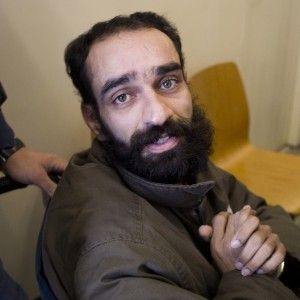
Samer Issawi has been on hunger strike for eight months.
Last week he wrote a message which included this challenge to Israeli intellectuals, writers, lawyers and journalists, associations, and civil society activists:
I’m looking for an intellectual who is through shadowboxing, or talking to his face in mirrors. I want him to stare into my face and observe my coma, to wipe the gunpowder off his pen, and from his mind the sound of bullets, he will then see my features carved deep in his eyes, I’ll see him and he’ll sees me, I’ll see him nervous about the questions of the future, and he’ll see me, a ghost that stays with him and doesn’t leave.
You may receive instructions to write a romantic story about me, and you could do that easily after removing my humanity from me, you will watch a creature with nothing but a ribcage, breathing and choking with hunger, loosing consciousness once in a while.
And, after your cold silence, Mine will be a literary or media story that you add to your curricula, and when your students grow up they will believe that the Palestinian dies of hunger in front of Gilad’s Israeli sword, and you would then rejoice in this funerary ritual and in your cultural and moral superiority.
In a collective act of contemptuous hand-wringing, several Israeli authors and scholars called on Issawi to end his hunger strike in their hope that he will accept an offer of exile rather than die of starvation.
Haaretz reports: The public appeal came in response to a message written by Issawi and posted on Facebook, in which he asked Israelis to intervene on his behalf. The security prisoner has refused solid food for eight months and is now in Kaplan Hospital in Rehovot because of his deteriorating medical condition.
The group, which includes literary luminaries A. B. Yehoshua, Amos Oz and Yehoshua Kenaz, offered their sympathy but suggested his death would hamper efforts to settle the conflict between Israel and the Palestinians.
“We have read about your hunger strike with agony,” the message said. “We are horrified by your deteriorating condition. We feel that the suicidal act you are about to commit will add another facet of tragedy and desperation to the conflict between the two peoples – a conflict that peace-seekers on both sides wish to end.
“Please, Samer Issawi, don’t pile more despair on the despair already in existence. Give yourself hope, thus strengthening the hope within all of us,” it said.
The authors noted that there are “new encouraging signs that the negotiations between the sides will resume,” adding that these measures may secure Issawi’s release alongside other Palestinians imprisoned in Israel.
“We urge you to stop your hunger strike and choose life, because we are committed to tirelessly striving toward peace between the two peoples, who will live side by side forever in this country,” the authors concluded.
Writer Eli Amir, who has signed the letter, told Haaretz the message is not meant to be “patronizing.”
“We have heard rumors recently that the government is proposing to deport him to one of the European states,” he said. “[Issawi] has asked why public officials, authors and everyone else is standing by while he is starving and turning into a skeleton. We are trying to help him regardless of what he has done or his opinions.”
In 2002, Issawi was sentenced to 26 years in prison after being convicted on several counts of attempted murder, possession of weapons, arms trade, illegal military training and belonging to a terrorist group.
He was one of the 1,027 prisoners released from Israeli prison in 2011 as part of the deal that secured the freedom of Gilad Shalit, but was re-arrested last August for violating the terms of his release. Shortly after his return to prison, he began a hunger strike, and now receives only liquids fortified with vitamins, which are keeping him alive. The doctors treating him say his condition has deteriorated drastically and there is a real threat to his life.
Earlier on Saturday, police detained two left-wing activists who tried to enter Kaplan Hospital with the intent to visit him.

NBC News: Boosted by newly discovered natural resources, Israel is surging ahead economically – a success that is pushing the issue of the country’s $3 billion in annual aid from the United States onto the agenda.
The country made its first intervention in the foreign currency market in almost two years Tuesday, buying $100 million to peg back the growing strength of its shekel.
A Bloomberg survey this week said the shekel was the strongest of 31 major currencies tracked over the last six months.
Last week, Israel passed another milestone, a potential gamechanger for its economy. Gas began to flow from gas fields off the coast. By 2015 Israel is expected to be fully energy independent, and may be a net exporter.
And there’s more good news: In this water-challenged region, Israel is well on the way to water independence. Its water desalination industry supplies up to 40 percent of the country’s demand for water, and another 40 percent comes from recycled water from domestic and commercial consumption. Israel reuses its water two to three times.
The boom may give a louder voice to calls for a reduction to the $3 billion worth of financial assistance Israel receives from the U.S. each year – especially in the Washington, where budget battles continue.
U.S. campaign groups such as Stop The Blank Check and the Council for the National Interest have long campaigned for the aid program to end, but Republican Sen. Rand Paul recently joined the debate by saying the U.S. could no longer afford to keep borrowing money and then handing it out to others. [Continue reading…]
Haaretz reports: Prime Minister Benjamin Netanyahu’s cabinet decided unanimously on Sunday to extend the Citizenship Law restricting the “family reunification” of Israeli citizens with certain foreign partners for an additional year.
The law denies entry or living permits to partners who are considered a security threat, among them Palestinians from the West Bank and Gaza, and citizens of enemy countries or from areas involved in long-term conflict with Israel. The law affects mainly Israeli Arab citizens and their families from the West Bank and Gaza.
The proposal brought before the cabinet on Sunday was submitted by Interior Minister Gideon Sa’ar, and was formulated based on a Shin Bet opinion regarding the volatility of partners from the Gaza Strip.
Meretz party head Zahava Gal-On slammed the decision as placing “draconian restrictions on Israeli Arab citizens’ right to marry,” calling the designation of all Palestinians as a security threat “racist” and discriminatory.
Gal-On, who petitioned the High Court against the Citizenship Law, said that “the only correct way is to individually evaluate everyone asking for family unification.” She added that the government’s approach was preventing thousands of people who live in Israel from attaining citizenship and achieving social rights.
Palestinian official Saeb Erekat called the law “racist” and an attempt to “distort the Palestinian social fabric and force the displacement of Palestinian families.” He called on the international community to “seriously examine the pattern of Israeli policies contributing to a situation of apartheid and to look into the wider effects and implications of the Israeli government’s precondition of being recognized as a Jewish State.”
Israel generally grants citizenship to spouses of Israelis in a gradual process. In the spirit of this process, a similar process was instituted for the naturalization of spouses of permanent residents, though the process is a little longer. A 2002 temporary order excluded Palestinian spouses from these processes and barred them from becoming Israeli citizens.
In May 2006, the High Court rejected numerous petitions asking to overturn the Citizenship Law. However, most of the justices wrote that the law constitutes a violation of basic rights, mainly the right to a family life.
In March 2007, in a hearing surrounding later petitions against the law, the state said that an amended version of the temporary order was expected to be approved by the Knesset, and the court consequently ruled that the petitioners would have to revise their petitions in accordance with the amended orders after they were made public. After the hearing, the amended law was made public, and the petitioners maintained that the new version not only extended the validity of the law until July 2008, it also expanded the geographic jurisdiction of the law, making it applicable to spouses from Iran, Lebanon, Syria and Iraq as well as other areas on which the government was free to decide.
Arabs make up about 20 percent of Israel’s population of 7 million. About 3 million Palestinians live in the West Bank and Gaza Strip. Many families were divided by cease-fire lines after wars, and over the years, marriage between the two groups has been common.
Since 1993, more than 100,000 Palestinians have obtained Israeli permits in this manner and some Israelis see this as a security threat.