Joshua Foust writes: Early reports suggest that the two suspected Boston Marathon bombers, Tamerlan and Dzhokhar Tsarnaev, are ethnically Chechen. Media reports suggest their family lived in Chechnya in the 1990s and later moved to neighboring Dagestan and then Kyrgyzstan. The Tsarnaevs moved to the United States about a decade ago, and the younger brother, Dzhokhar, became an American citizen last year. The connection between Chechen expatriates and the former Soviet Union might prove critical to understanding why these two men allegedly turned to terrorism.
Russia and Chechnya do not get along, to put it lightly. Chechnya is a tiny, autonomous republic in the southwest of Russia — part of the Caucasus region between Europe and Asia between the Black and Caspian Seas. In 1944, Josef Stalin deported the entire population of the North Caucasus — about 600,000 people in the republics of Ingushetia, Chechnya, and North Ossetia — across the Caspian Sea to the Soviet republics of Central Asia on the suspicion they were collaborating with Nazi Germany.
The mass deportation was catastrophic: Crowded, poorly ventilated trains dumped people in the middle of the steppe between Kazakhstan and Kyrgyzstan, stranding them in the vast wastelands with no supplies. Although Nikita Khrushchev eventually returned the displaced Chechens to the Caucasus in 1957, the scars of that dislocation never went away. In many ways, the Caucasian displacement led to the militancy and separatism that still haunt the region.
After the fall of the U.S.S.R., some Soviet republics gained their independence. The “stans” of Central Asia — Kazakhstan, Kyrgyzstan, Uzbekistan, Tajikistan, and Turkmenistan — all became independent countries. So, too, did the countries of the South Caucasus — Georgia, Armenia, and Azerbaijan. The North Caucasus, however, never gained independence from Moscow, though many wanted it. In the years after independence, the South Caucasus was ravaged by brutal ethnic wars in Georgia and between Armenia and Azerbaijan. By 1994, Chechnya had declared its own independence, and the Russian military surged into the country.
The first Chechen war killed thousands of people, mostly civilians, and thousands more fled the republic looking for refuge. A lot of them settled in Central Asia because a sizable Chechen population had remained there since Stalin’s forced relocation, particularly in Kazakhstan. But, over the subsequent two decades, they had trouble integrating and settling down. Refugees living in the former capital of Almaty reported being harassed by the police after the 9/11 attacks on the assumption they were terrorists. Chechens who settled in the northern part of the country faced arbitrary arrest and deportation back to Russia. In 2007, Refugees International wrote a scathing assessment of Kazakhstan’s treatment of Chechen refugees, noting that the Kazakhstan government prioritized its relations with Russia over treating refugees fairly. [Continue reading…]
A ‘whom do you hang with?’ map of America
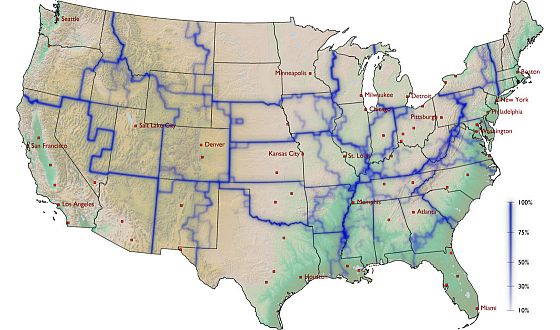
Robert Krulwich writes: Look at the center of this map, at the little red dot that marks Kansas City. Technically, Kansas City is at the edge of Missouri, but here on this map it’s in the upper middle section of a bigger space with strong blue borders. We don’t have a name for this bigger space yet, but soon we will.
I would call it, for the moment, “The Part Of America Kansas City Hangs With” because that’s what this map is saying. It’s a new, intriguing way to see our country. This one was built by tracking dollar bill circulation. There’ve been similar maps built from phone call data. The idea here is to show America not as 50 states, but as regions where people do stuff together. In other words, a “Whom Do You Hang With?” map.
Here’s the notion. A few years ago, Dirk Brockmann, a theoretical physicist from Germany, was visiting his American friend Dennis, and they got talking about population mobility. Dirk knew Americans move around a lot, but he wondered how to capture where they go, who they talk to. His friend said, “Have you ever heard of Where’s George? Dirk hadn’t.
It’s a website that tracks the movement of dollar bills. Thousands of people participate. All you do is take a bill out of your wallet, type the denomination, serial number, the date and your zip code onto the Where’s George? site, and then, with a pen or a stamp, deface the bill with the words “WheresGeorge.com.” After which (and this is key), you spend it. So now your bill is moving from business to business, person to person, and if and when another Where’s George volunteer discovers it, she or he will note where, note when and spend it again. Since dollar bills pass between people, Dennis suggested why not us the “Where’s George?” data to get a sense of where people go, and, just as interesting, where they don’t go?
That’s what Dirk did. After checking 1,033,095 reports (describing the movement of 464,670 bills), he came up with this map. [Continue reading…]
Music: Avishai Cohen — ‘Seven Seas’
Could a nuclear-armed Iran be contained?
Kingston Reif writes: On September 4, 1962, President John F. Kennedy released a statement in response to intelligence reports of a Soviet arms buildup in Cuba. Kennedy said the United States did not have evidence “of the presence of offensive ground-to-ground missiles; or of other significant offensive capability either in Cuban hands or under Soviet direction and guidance.” However, he warned, “Were it to be otherwise, the gravest issues would arise.”
Of course, the next month Kennedy found out that the Soviet Union was in fact deploying offensive missiles and nuclear warheads in Cuba, prompting a deep crisis that brought the planet within a hair’s breadth of nuclear catastrophe. Historian Michael Dobbs writes that Kennedy later regretted making his September statement, as “[h]e was compelled to take action, not because Soviet missiles on Cuba appreciably changed the balance of military power, but because he feared looking weak.”
Fast forward 50 years to March 4, 2012. In a high-profile speech to the American Israeli Public Affairs Committee (AIPAC), President Obama declared: “Iran’s leaders should understand that I do not have a policy of containment; I have a policy to prevent Iran from obtaining a nuclear weapon.” Obama reiterated this position last month to Israeli students in Jerusalem: “Iran must not get a nuclear weapon. This is not a danger that can be contained, and as President, I’ve said all options are on the table for achieving our objectives.”
Might Obama, like Kennedy, later regret issuing such an ultimatum? [Continue reading…]
Video: Gun control, immigration reform, and govt. monitoring internet usage
The Middle East’s kings of cowardice
Marc Lynch writes: Egyptian comedian Bassem Youssef rocketed to global celebrity last month after being charged for insulting President Mohamed Morsy. The escalation against Youssef was rooted in the intense polarization of local Egyptian politics and the prickly, insecure nature of the Muslim Brotherhood-led government.
The move badly backfired on the Egyptian government: It inspired widespread global contempt for Morsy, global fame and celebrity for Youssef, a minor diplomatic crisis, and much-feared mockery by Jon Stewart. Youssef was even selected as one of TIME magazine’s 100 most influential people in the world in the wake of the incident. But while Youssef’s prosecution drew massive media attention, a wave of increasingly disproportionate crackdowns for “insulting” leaders across the Gulf might actually be more significant.
For an area that most people still believe remains unaffected by the Arab uprisings, the Gulf has been awfully tough on public critics of late. Kuwait plunged into days of intense protests and political turmoil this week after leading opposition figure Musallam al-Barrak was sentenced to five years in prison for publicly challenging the emir to avoid autocratic rule. The attempt to arrest Barrak — which itself turned into something of a farce when he eluded the police for days — was only the latest in an escalating campaign of Kuwaiti repression. [Continue reading…]
Video: ‘Manufacturing Consent’ 25 years later
Both Boston Marathon bombers lived in the U.S. from childhood
(Updates below)
Aside from the names themselves, Tamerlan Tsarnaev, aged 26 and now dead, and Dzhokhar Tsarnaev, aged 19 and at this time on the run, the other detail about the brothers linked to the bombings that will receive greatest attention in the media today is their connection to Chechnya. USA Today already has a headline: “Russia’s Chechnya, Caucasus: A breeding ground for terror“.

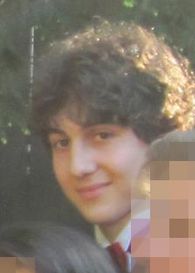
Dzokhar Tsarnaev at prom party.
More significantly perhaps than their Chechen origin could be that these are two young men whose identities will inevitably have been shaped by the post-9/11 zeitgeist and the gulf this has created between Americanness and foreignness.
Alienation is no excuse for terrorism, but every American should pause to consider what it means for those who grow up in this country yet in multiple ways receive the message that they don’t belong here.
As has been the case throughout the last decade, the greatest threat to America is not terrorism; it is xenophobia. This is the virus of suspicion that makes a foreign name and a slightly darker complexion, reason to trust someone less and for no other reason than that they are not white.
Update 1: J.M. Berger, a regular contributor to Foreign Policy and someone widely viewed as a level-headed “terrorism expert”, tweets:
So all I, and it seems anyone else, knows for sure right now is that these guys are Chechens.
— J.M. Berger (@intelwire) April 19, 2013
Chechen identity must be baked in at birth. The first nine years of Dzhokhar Tsarnaev’s life in Russia must have influenced him much more deeply than the following ten in the United States. Likewise, his older brother’s apparent interest in jihadist teachings again speaks most loudly of his Chechen roots. Or perhaps not.
The search for identity and the need for roots often becomes most intense among those who feel rootless. It seems less likely that as children the Tsarnaev brothers brought their extremism from Chechnya than that their experience of living in America led them in search of something they either couldn’t find here or felt excluded from here.
Update 2: From this report, it sounds like if alienation figures in this story, it may apply much more to the older than the younger brother. Dzhokhar’s involvement might hinge on nothing more than sibling dynamics in which the older brother cultivates the admiration and loyalty of his younger brother and the younger tries to impress the older by his willingness to take risks.
Update 3: On a day when so-called experts will be circulating round news shows describing Chechnya as a hotbed of Islamic extremism, I’m sure this will be making Vladamir Putin happy. Easily forgotten is that before 9/11 Chechnya was synonymous with Russian brutality.
In 2000, U.S. Secretary of State Madeleine Albright at the UN said:
We cannot ignore the fact that thousands of Chechen civilians have died and more than 200,000 have been driven from their homes. Together with other delegations, we have expressed our alarm at the persistent, credible reports of human rights violations by Russian forces in Chechnya, including extrajudicial killings.
That was before the U.S. government itself adopted the practice of extrajudicial killing through drone warfare.
The Boston Marathon bombing suspects — a few thoughts (updated)
Update: Early hours Friday morning — “One suspect in custody, another remains on the loose” — sounds like this story will become much clearer in the next few hours.

Col Allan (left), two individuals circled in red and wrongly linked to the bombings by Allan's paper, and on the right the two suspects identified by the FBI.
At this time, the New York Post’s editor, Col Allan, shown on the left in the photo above, has not been identified as a suspect involved in the Boston Marathon bombing. However, by publishing photos of the two individuals circled in red above — individuals who the FBI has indicated have no connection to the bombing — Allan’s paper could be playing a role in helping the bombing suspects evade arrest. Does that mean Allan knows more about the bombing than he has let on?
This isn’t the first time the New York Post has published misleading information about the case. Earlier it reported on a Saudi suspect in the case — again, pure fiction.
Does Allan have an interest in preventing the FBI making any arrests?
This looks like a case that Alex Jones needs to investigate.
But seriously, since suspects, suspicions and a limited amount of evidence are what could at this point be described as the signature of the Marathon bombings, it’s worth attempting to transpose this event into a different context: President Obama’s drone war.
“Yes, we’ll find you and, yes, you will find justice and we’ll hold you accountable,” Obama said today.
If the individuals shown above (the two on the right) are found in the United States, unless they put up resistance, they will most likely be arrested. And if the FBI has sufficient evidence they will be charged and face trial.
But suppose they are spotted in Yemen and no more is known about them then than is known now. Will Obama authorize their killing?
(And just to be clear: by posing this particular hypothetical, I’m not implying that the suspects look Middle Eastern. As far as I can tell, they appear to come from somewhere between California and Japan.)
This much we already know: the president has authorized the killing of hundreds of men about whom he knew just as little as he now knows about the perpetrators of the Boston bombings — men whose names will almost certainly never be known and whose “guilt” consisted of nothing more than that they fit a certain profile.
This administration might exercise more caution before acting on its suspicions than does the editor of the New York Post. But whereas Allan’s suspicions lead him to publish photos of innocent men, Obama suspicions lead him to authorize assassinations. The killings occur without any judicial review. The guilt or innocence of the dead is never established.
Obama administration obstructs Senate investigation of drone war’s legality
McClatchy reports: The Obama administration does not intend to send a witness to testify at a Senate hearing next week on the legality of the U.S. targeted killing program, the White House said Wednesday.
The decision illustrates the limits of President Barack Obama’s pledge in his State of the Union speech on Feb. 12 to provide greater transparency into top-secret drone operations that have killed thousands of suspected terrorists in Pakistan, Somalia and Yemen.
The Senate Judiciary Committee’s Constitution subcommittee was to have held a hearing Tuesday on the legality of targeted killings, those who can be targeted and the creation of a “transparent legal framework for the use of drones.” The session, however, was postponed until April 23 to allow more time for the White House to agree to send a witness.
That effort, however, appeared to have fallen through.
“We do not currently plan to send a witness to this hearing and have remained in close contact with the committee about how we can best provide them the information they require,” Caitlin Hayden, a National Security Council spokeswoman, wrote in an email to McClatchy.
She added that the White House would continue working with lawmakers “to ensure not only that our targeting, detention and prosecution of terrorists remains consistent with our laws and system of checks and balances, but that our efforts are even more transparent to the American people and the world.”
Hayden declined to say why the administration doesn’t plan to provide a witness for the hearing. [Continue reading…]
Video: The practice of torture by the United States government
Syria’s conflict is rich fodder for anti-Islamist propaganda
Hassan Hassan writes: Tunisia has recently required Syrians to obtain visas before they travel to Tunis. The reason for this change of policy has not been made public.
But according to Tunisian officials, the reason is related to Tunisian jihadis in Syria. Sources say that Damascus has refused to hand over the bodies of Tunisian fighters who died in battles against the Syrian regime. Damascus wants Tunis, in exchange for handing over the bodies, to reopen diplomatic channels with Syria, including the Syrian embassy there which was shut down by Tunisian authorities in February. Earlier this month, foreign ministry officials in Tunis publicly said they intend to hand over the closed embassy to the Syrian opposition’s National Coalition, clearly to pressure Damascus.
There are of course deeper issues involved. No country has dedicated more media coverage to the issue of jihadis flowing out of their region than Tunisia, where television channels host jihadi returnees almost on a weekly basis. Live on television they engage in intense discussions and interactions with the public. This has given the impression that Tunisians make up a majority of Syria’s foreign fighters.
There have also been media reports claiming that religious clerics from Tunisia had issued a fatwa permitting Muslim women to perform “sex jihad” in Syria. It claims that Muslim fighters in Syria could engage in sexual acts with consenting Muslim women to raise morale.
This fatwa turned out to be bogus; media first attributed it to the celebrity cleric Mohammed Al Arefe from Saudi Arabia, but he denied that. Reports then claimed the clerics who issued the fatwas were anonymous but “they are among those who are influenced by Saudi clerics”.
Yet even after the fatwa was disavowed, people still believed in it. At least 13 Tunisian female teenagers were reported to have travelled to Syria to perform religious duties. One television channel reported that a man divorced his wife after he decided to fight in Syria to enable her to perform her own jihad there.
It is understandable if media outlets loyal to the Syrian regime would try to portray the fight against it as driven by fanaticism and lust. But why would Tunisian media carry such clearly fabricated reports?
As elsewhere in the region, the opposition in Tunisia is increasingly using the Syrian uprising to settle scores at home. Reviewing the media reports that carried the fatwa shows that there is a clear focus on Tunisian Islamists who play a role in radicalising young people.
Aaron Zelin, an expert on jihadi groups at The Washington Institute for Near East Policy, says the maximum number of foreign fighters to have fought in Syria over the course of the entire conflict is estimated to be 5,500 – but the numbers are probably lower.
Tunisian media, meanwhile, has reported that over 3,500 fighters from Tunisia have gone to Syria, driven by fatwas by Tunisian extremists. Clearly this figure is exaggerated. But the media focus on Tunisian radicals in Syria is meant to undermine the Islamist government at home more than anything else. [Continue reading…]
The tragedies of other places
Rafia Zakaria writes: As a weekly columnist for the Pakistani newspaper Dawn, I’ve become adept at writing about bombings. Pakistan suffered 652 of these last year; terrorist attacks took down everything from girls’ schools to apartment buildings and felled members of Parliament, singers, and school children—each person sentenced by coincidence to be at a given location in the moment it became a bomber’s target. Through my columns, I have offered up fumbled expressions of grief and comfort to Pakistani readers whose stores of empathy are bled daily without any promise of replenishment. I believe that these rituals of caring, made so repetitious in Pakistan by the sheer frequency of terror attacks, are crucial; in preventing the normalization of violence and senseless evil, they keep a society human.
The bombings in Boston on April 15, 2013 pose their own conundrum to those like me who are in the habit of writing about bloodier conflicts with more frequent conflagrations. There is an inherent cruelty in every terror attack — an undeniable reverberation of evil in the destruction of an ordinary moment and the forced marriage of that moment to sudden violence. Boston is no different, no more or less tragic than the bombings that have razed the marketplaces of Karachi, the school in Khost, the mosque in Karbala.
And yet it seems so. Attacks in America are far more indelible in the world’s memory than attacks in any other country. There may be fewer victims and less blood, but American tragedies somehow seem to occur in a more poignant version of reality, in a way that evokes a more sympathetic response. Within minutes American victims are lifted from the nameless to the remembered; their individual tragedies and the ugly unfairness of their ends are presented in a way that cannot but cause the watching world to cry, to consider them intimates, and to stand in their bloody shoes. Death is always unexpected in America and death by a terrorist attack more so than in any other place. [Continue reading…]
The Saudi Marathon man
Amy Davidson writes: A twenty-year-old man who had been watching the Boston Marathon had his body torn into by the force of a bomb. He wasn’t alone; a hundred and seventy-six people were injured and three were killed. But he was the only one who, while in the hospital being treated for his wounds, had his apartment searched in “a startling show of force,” as his fellow-tenants described it to the Boston Herald, with a “phalanx” of officers and agents and two K9 units. He was the one whose belongings were carried out in paper bags as his neighbors watched; whose roommate, also a student, was questioned for five hours (“I was scared”) before coming out to say that he didn’t think his friend was someone who’d plant a bomb — that he was a nice guy who liked sports. “Let me go to school, dude,” the roommate said later in the day, covering his face with his hands and almost crying, as a Fox News producer followed him and asked him, again and again, if he was sure he hadn’t been living with a killer.
Why the search, the interrogation, the dogs, the bomb squad, and the injured man’s name tweeted out, attached to the word “suspect”? After the bombs went off, people were running in every direction — so was the young man. Many, like him, were hurt badly; many of them were saved by the unflinching kindness of strangers, who carried them or stopped the bleeding with their own hands and improvised tourniquets. “Exhausted runners who kept running to the nearest hospital to give blood,” President Obama said. “They helped one another, consoled one another,” Carmen Ortiz, the U.S. Attorney for Massachusetts, said. In the midst of that, according to a CBS News report, a bystander saw the young man running, badly hurt, rushed to him, and then “tackled” him, bringing him down. People thought he looked suspicious.
What made them suspect him? He was running — so was everyone. The police reportedly thought he smelled like explosives; his wounds might have suggested why. He said something about thinking there would be a second bomb—as there was, and often is, to target responders. If that was the reason he gave for running, it was a sensible one. He asked if anyone was dead — a question people were screaming. And he was from Saudi Arabia, which is around where the logic stops. Was it just the way he looked, or did he, in the chaos, maybe call for God with a name that someone found strange?
What happened next didn’t take long. [Continue reading…]
How the gun lobby has already blocked Boston’s bombing investigators
MSNBC: One avenue of investigation is already closed off to forensic officials working the Boston Marathon bombing case due to efforts dating back decades by the National Rifle Association and gun manufacturers.
The FBI said Tuesday that gunpowder, along with pieces of metal and ball bearings, were packed into at least one pressure cooker and another device to make the crude bombs that killed three people—including an 8-year-old boy—and wounded more than 170 more during the Boston Marathon Monday.
But a crucial piece of evidence called a taggant that could be used to trace the gunpowder used in the bombs to a buyer at a point of sale is not available to investigators.
“If you had a good taggant this would be a good thing for this kind of crime. It could help identify the point of manufacturer, and chain of custody,” Bob Morhard, an explosives consultant and chief executive officer of Zukovich, Morhard & Wade, LLC., in Pennsylvania, who has traced explosives and detonators in use in the United States and Saudi Arabia, told MSNBC.com. “The problem is nobody wants to know what the material is.”
Explosives manufacturers are required to place tracing elements known as identification taggants only in plastic explosives but not in gunpowder, thanks to lobbying efforts by the NRA and large gun manufacturing groups.
Life before Earth

Panspermia — the hypothesis that life exists throughout the universe — has been kicking around among astrophysicists for decades, one of its most recent and prominent proponents being Stephen Hawking.
A couple of geneticists, Alexei Sharov of the National Institute on Aging in Baltimore, and Richard Gordon of the Gulf Specimen Marine Laboratory in Florida, have now proposed that the rate at which evolution advances necessitates that life must be much older than the Earth and may trace back to within the first 2 billion years of the universe’s existence.
They argue that life grows in complexity at a rate that parallels Moore’s Law.
Moore’s Law is the observation that computers increase exponentially in complexity, at a rate of about double the transistors per integrated circuit every very two years. If you apply Moore’s Law to just the last few years’ rate of computational complexity and work backward, you’ll get back to the 1960s, when the first microchip was, indeed, invented.
Sharov and Gordon argue that similar exponential growth applies to genetic complexity with a doubling in complexity every 376 million years. Following this cycle back through the course of evolution would trace life’s origin to about 9 billion years ago. The Earth is only 4.5 billion years old.
This cosmic time scale for the evolution of life has important consequences: (1) life took a long time (ca. 5 billion years) to reach the complexity of bacteria; (2) the environments in which life originated and evolved to the prokaryote stage may have been quite different from those envisaged on Earth; (3) there was no intelligent life in our universe prior to the origin of Earth, thus Earth could not have been deliberately seeded with life by intelligent aliens; (4) Earth was seeded by panspermia; (5) experimental replication of the origin of life from scratch may have to emulate many cumulative rare events; and (6) the Drake equation for guesstimating the number of civilizations in the universe is likely wrong, as intelligent life has just begun appearing in our universe.
Much as the following observation might offend the likes of Richard Dawkins and his ilk, it’s hard not to see in this new view of the origin of life some echoes of ancient religious assertions about the uniqueness of human beings and about the intimate connection between life and existence.
The image here is of a universe seeded with life which then coalesces in a crescendo of complexity on Earth, leading to the appearance of humanity as in some sense a fulfillment of the universe’s reason for existence. Small wonder that as the fruit of such a ‘design’, humans would become fascinated by ideas about divine causality.
At the same time, if we really are this isolated beacon of intelligence, then so much greater is the irony about how we choose to live.
After 9 or even 12 billion years of evolution spanning the universe, we arrive at this: Gangnam Style, Justin Bieber, and Generation Text? Climate change, mass extinction of species, and destruction of the ethnosphere? Is this a cosmic plan or a cosmic joke?
Waco and mainstream America
April is the month when right-wing extremists seem to come out of the woodwork in America and nothing symbolizes the divide between the far-right and the establishment more potently than Waco.
As portrayed in the media, the followers of David Koresh were seen as cultists who became the victims of their own blind and misguided faith. How could people so foolishly sacrifice their own lives by becoming followers of a con man?
At the same time, no one seriously questions that anyone who hopes to become president of the United States will in the course of their campaign be expected to make some kind of plausible declaration of their faith.
Barack Obama has spoken about how “I came to know Jesus Christ for myself and embrace Him as my lord and savior,” and few Americans take this as an indication that he might be delusional.
One can express ones faith in a being unseen and even claim to receive this mysterious figure’s guidance and not be viewed as unhinged. Yet someone who places even deeper faith in a person whose actions they can actually observe has supposedly thrown rationality to the wind.
If blind faith was not so widely accepted in America, it would be easier to see why the cultists get marginalized, but given America’s mainstream religious identity, perhaps those on the hyperfaithful margins trouble their neighbors in a different way: by highlighting American religious hypocrisy.
After all, the New Testament is unambiguous in calling the faithful to give their whole lives to Jesus — not just show up on Sunday morning while devoting the rest of their time to the service of business.
In most of America, however, the pursuit of wealth and declarations of faith go hand in hand, yet one is clearly the master of the other.
Make no mistake: cults destroy lives. But in an insidious and far more pervasive way, hypocrisy is destructive too.
Tim Madigan, author of See No Evil: Blind Devotion and Bloodshed in David Koresh’s Holy War, returned to Waco 20 years after the fire.
Clive Doyle is a pleasant-looking man of 72, with wavy graying hair. Australia lingers in his accent. He wore a leather jacket on the chilly recent afternoon when we spent more than an hour together at a picnic table in a Waco park. He was soft-spoken, articulate and seemingly very sane.
Yet 20 years ago this Friday, this same man was one of only nine Branch Davidians to survive the internationally televised inferno on the Texas prairie. Killed that day near Waco were cult leader David Koresh and 73 followers, including Doyle’s 18-year-old daughter, Shari, and 20 children under 14. Before the fire and the 51-day standoff with the federal government, Doyle’s daughter had been one of many women and girls of the cult taken into Koresh’s bed. Koresh — who preached that he was the Lamb of God, drove a sports car and motorcycle, and had a rock band and an arsenal of illegal weapons — had ordered his male followers to be celibate.
Doyle has had two decades to reflect on these things, and clearly he has. So my question was obvious.
“You mean, have I woken up?” Doyle said to me with a smile.
Well, yes.
“I’ve had questions and adjusted my beliefs somewhat,” Doyle said that day in the park. “But I still believe that David was who he claimed to be. You are sitting there listening to him. You hear all these things and the Scriptures come alive. And at the time, everything seems so imminent. That’s why I believed the way I did.
“I believe he was a manifestation, yes, of God taking on flesh,” Doyle said. “God has done that more than once.”
Most of the other survivors remain similarly steadfast, Doyle said, a handful of people who still gather in Waco on Saturday mornings to pray. Thus one of the most tragic and bizarre episodes of American history remains just that. Bizarre, unexplainable.
It began on a rainy Sunday morning, Feb. 28, 1993, with an ill-fated raid by agents of the Bureau of Alcohol, Tobacco and Firearms. The assault on what was known as Mount Carmel followed a long federal investigation into Koresh’s growing arsenal. Local social services agencies had also looked into reports that the leader was having sex with underage girls who were part of the community.
Four federal agents were killed in a bloody gunbattle with the cultists that Sunday, and 20 more were wounded. Six Branch Davidians died. By that evening, the muddy encampment called Satellite City had sprouted nearby. Hundreds of reporters from around the world loitered for the next six weeks, eating Salvation Army doughnuts, getting haircuts, practicing their golf swings, and chronicling a darkly comic cat-and-mouse game between Koresh and FBI negotiators.
Souvenir vendors sold T-shirts that said Waco was really an acronym for “We Ain’t Coming Out.” Leno, Letterman and Saturday Night Live had a fresh supply of punch lines for weeks.
“This just in,” SNL’s Kevin Nealon reported on Weekend Update. “David Koresh has admitted he’s not really Jesus but actually is a disgruntled postal employee.”
Most assumed that the nuts near Waco would eventually come marching out. Not me. [Continue reading…]
As a Bostonian and Muslim, I wept Monday — and worried
Rabail Baig writes: “Shave your stubble before you come to bed, Haider,” I told my husband Monday night. He looked up at me from the computer chair without the slightest hint of protest and smiled, “of course”. A couple of hours into the night, with him sound asleep right next to me – asleep like nothing had happened – I shivered from post-traumatic stress. Cold sweat trickled down the side of my forehead meeting warm tears at the corner of my eye and disappearing into a big, wet circle on the pillow. It was my second Patriot’s Day Boston Marathon, my husband’s third. I recalled spending all evening answering calls from back home in Pakistan, saying often, “Allah nay bachaya,” (Allah saved us). But did he?
Earlier on Monday, I was sitting with Haider and three other friends around small tables at the Prudential Center food court when we heard, and felt, the loud thud. If we were around a table somewhere in Karachi, Pakistan, my hometown, we would have said a little prayer in our hearts and continued eating, hoping that by the time we were done, the roads would re-open and life would resume. Such is our threshold for bomb-like noises and actual life-consuming explosions.
But in the heart of Boston, on a day of celebration, it could only be Godzilla, or some other giant lizard, someone joked. Within 20 seconds, though, buried under a horde of people and after the ensuing stampede, we ended up on the terrace looking over Boylston Street – a stone’s throw away from where the second blast had just occurred. Soon, a distraught mob pushed us right back into the food court. Unfinished bites and sentences, deserted strollers and upturned chairs – the large mall appeared ghastly.
As we rushed out on to Huntington Avenue, unable to wipe that dreadful sight from our heads, my phone rang. A call from Pakistan. Just then, in those very few seconds, our lives, our identities, made me want to not answer it. Our future – my husband’s career in medicine and mine in journalism, our plans of having a baby, of buying a home of our own, living the American dream someday – ran through my head. I had and have never been more afraid. But I had to answer it. It was Haider’s sister calling to say hello, completely unaware of what had taken place. I quickly hung up after telling her we were safe. Were we? [Continue reading…]