
The internationalization of the war in Syria


View Internationalization of Syria’s Civil War in a larger map

Foreign Policy: Last week, on March 25, unnamed foreign and U. S. government officials revealed to the Associated Press that the United States has been secretly training Syrian rebels in Jordan, and the New York Times reported that U.S. intelligence services facilitated large arms purchases for rebel forces by Saudi Arabia. It marked a milestone in the militarization of Syria’s bloody civil war: Barely a week before, Secretary of State John Kerry told reporters, “[T]he United States does not stand in the way of other countries that have made a decision to provide arms, whether it’s France or Britain or others.”

The disclosures are a departure from public U.S. policy on Syria, which has attempted to regulate the distribution of arms through a “security coordination committee” without getting embroiled in the conflict. But the U.S. training program and role in procuring arms for rebels are just the latest instances of the internationalization of Syria’s civil war.

In this map, we’ve tried to track some of the international incidents and influences of the Syrian civil war. It is not comprehensive, and suggestions are welcome. It shows an uprising that increasingly travels like an electric current across filaments of ethnic and sectarian identity, regardless of borders. As the power vacuum grows, so will the opportunities for foreign countries to interject themselves further into the conflict. [Continue reading…]

Facebooktwittermail

North Korea ‘moves mid-range missile’

BBC News reports: North Korea has shifted a missile with “considerable range” to its east coast, South Korea’s foreign minister says.

Kim Kwan-jin played down concerns that the missile could target the US mainland, and said the North’s intentions were not yet clear.

Pyongyang earlier renewed threats of a nuclear strike against the US, though its missiles are not believed to be capable of carrying nuclear warheads.

The US is responding to North Korea by moving missile defence shields to Guam.

The Pentagon said the shield on its Pacific island territory would be ready within weeks, adding to warships already sent to the area.

The North has previously named Guam among a list of possible targets for attack that included Hawaii and the US mainland.

Japanese and South Korea reports had suggested the missile being moved by the North was a long-range one with a capability of hitting the US west coast.

However, experts believe the North’s most powerful rocket, which it test-fired last December, has a range of 6,000km (3,700 miles) and can reach no further than Alaska.

Facebooktwittermail

How the Obama administration ignored North Korean offers to relinquish its nuclear fuel stockpile

Joel Wit writes: [I]n November 2010, senior North Korean Foreign Ministry officials made it very clear that they were willing to relinquish thousands of fuel rods in their possession that could have been used by the reactor, rods that could help produce as many as eight nuclear bombs. That would have been a first step toward permanently disabling the facility, making sure the reactor would never again be a threat. Of course, the North Koreans wanted compensation — standard practice in the international nuclear fuel industry — and they wanted more than the rods were worth. But that was clearly their opening position. The offer was repeated during meetings in March 2011 in Berlin and once again in Pyongyang at the end of that year.

Each time, the North Korean proposal was dutifully reported to the Obama administration in briefings for the White House, the State Department, the Department of Defense, and the intelligence community. The Lee Myung-bak administration was familiar with the offer, as they would have been intimately involved in any effort to shut Yongbyon down because Lee’s predecessor had been willing to pay for the rods to take them off North Korea’s hands.

The North Korean initiative was duly noted, but the United States and South Korea failed to take advantage of the opportunity to ensure that North Korea wasn’t able to restart the reactor and turn the rods into new nuclear bombs. [Continue reading…]

Facebooktwittermail

North Korea warns U.S. of approval for ‘lighter’ nuclear attack

Bloomberg reports: North Korea’s military escalated its threats, citing a law ratified this week as authorizing plans for “counter-actions” against U.S. aggression, including use of a “cutting-edge smaller, lighter and diversified nuclear strike.”

Kim Jong Un’s regime, which hasn’t demonstrated it has a nuclear weapon or a missile capable of delivering one to the U.S. mainland, didn’t elaborate on the armaments it claimed to have in a statement today by a military spokesman, which was distributed by the state-run Korean Central News Agency.

The warning was presented as a response to what North Korea called an “ever-escalating U.S. hostile policy,” citing moves including the use of long-range bombers in a U.S.-South Korea exercise being conducted this month. While tensions have escalated over North Korea’s nuclear weapons program and United Nations sanctions against it, U.S. officials have emphasized this week that they have seen no unusual troop movements by North Korea.

Facebooktwittermail

U.S. dials back on Korean show of force

The Wall Street Journal reports: After a high-visibility display of military power aimed at deterring North Korean provocations, the White House is dialing back the aggressive posture amid fears that it could inadvertently trigger an even deeper crisis, according to U.S. officials.

The U.S. is putting a pause to what several officials described as a step-by-step plan the Obama administration approved earlier this year, dubbed “the playbook,” that laid out the sequence and publicity plans for U.S. shows of force during annual war games with South Korea. The playbook included well-publicized flights in recent weeks near North Korea by nuclear-capable B-52 and stealth B-2 bombers, as well as advanced F-22 warplanes.

The U.S. stepped back from the plans this week, as U.S. officials began to worry that the North, which has a small nuclear arsenal and an unpredictable new leader, may be more provoked than the U.S. had intended, the officials said.

“The concern was that we were heightening the prospect of misperceptions on the part of the North Koreans, and that that could lead to miscalculations,” a senior administration official said.

Facebooktwittermail

People are not illegal

The Associated Press has taken the bold move of proscribing the use of “illegal immigrant” in an update to its widely used style guide.

Except in direct quotes essential to the story, use illegal only to refer to an action, not a person: illegal immigration, but not illegal immigrant.

Even though (if I had the power) I’d burn all style guides including AP’s — they provide an unnecessary regimentation to writers whose attention would be better focused simply on writing well rather than in conformity with the petty dictates of a style guide — I think AP’s decision is good if it has the effect of making journalists think more carefully about the implications of the language they use. So far, I have yet to see evidence of this effect.

“AP apparently now feels that there’s no acceptable way to refer to people who are in the country illegally. Neither ‘undocumented immigrant’ nor ‘unauthorized immigrant,’ is acceptable, and neither is anything else. Labels are flatly not allowed, despite the fact that we label people all the time. Kevin Drum is a blogger. Barack Obama is a politician. Etc.” writes Mother Jones blogger, Kevin Drum.

“Some argue that use of the word ‘illegal’ carries a negative connotation and suggests criminality,” writes MSNBC host Lawrence O’Donnell, as though it’s debatable whether the term really is loaded in this way.

Although AP appears to be rejecting all labels, it seems to me that it isn’t labels per se that are the issue — it is labels that people would generally not apply to themselves.

Why would someone who grew up in this country — as many such immigrants have — and has known no other home, call themselves ‘illegal’ or accept such being tarred with such a slur? “Illegal immigrant,” just like every other pejorative, is a finger and a scowl directed at someone else.

“Someone who crosses our borders illegally is here illegally,” Republican Sen. John McCain said. “You can call it whatever you want to, but it’s illegal.”

The head of Homeland Security has no objection to the use of the term “illegal immigrant.”

When speaking to reporters, it said: “I don’t really get caught up in the vocabulary wars. They are immigrants who are here illegally. It’s an illegal immigrant.” The entity in charge of immigration control also said: “They are immigrants who are here without documents. That’s an undocumented immigrant.” (I’m assuming Janet Napolitano won’t mind being referred to as “it” since it apparently doesn’t see anything dehumanizing in referring to people as, “It’s an illegal immigrant.”)

Although it may come as news to John McCain, a lot of people living in America illegally, actually crossed the border legally. They came into the U.S. through New York or some other point of entry, were fully documented with a valid passport and a valid entry visa but instead of leaving before their visa expired, they decided to stay. Many of these “illegals” are invisible. Invisible why? Because they are white.

“Illegal immigrant” is more than a technical description of someone’s status in the eyes of the immigration system. It’s code for unwelcome Latino. Even though the people being referred to harvest our food, care for our children, mow our lawns, wash our cars, clean our tables, and make up one of the most productive segments of American society — and even though in terms of their own ancestry which traces back thousands of years on this continent, these are to my eye the real Americans — these are people that much of white America still denigrates by branding them “illegal.”

AP’s move might not do much to elevate the status of people who deserve to be raised up rather than put down, but it’s a nudge in the right direction.

Facebooktwittermail

Experimental evidence that meditation promotes acts of kindness

Northeastern University College of Science: Scientists have mostly focused on the benefits of meditation for the brain and the body, but a recent study by Northeastern University’s David DeSteno, published in Psychological Science, takes a look at what impacts meditation has on interpersonal harmony and compassion.

Several religious traditions have suggested that mediation does just that, but there has been no scientific proof — until now.

In this study, a team of researchers from Northeastern University and Harvard University examined the effects meditation would have on compassion and virtuous behavior, and the results were fascinating.

This study — funded by the Mind and Life Institute — invited participants to complete eight-week trainings in two types of meditation. After the sessions, they were put to the test.

Sitting in a staged waiting room with three chairs were two actors. With one empty chair left, the participant sat down and waited to be called. Another actor using crutches and appearing to be in great physical pain, would then enter the room. As she did, the actors in the chair would ignore her by fiddling with their phones or opening a book.

The question DeSteno and Paul Condon — a graduate student in DeSteno’s lab who led the study — and their team wanted to answer was whether the subjects who took part in the meditation classes would be more likely to come to the aid of the person in pain, even in the face of everyone else ignoring her. “We know meditation improves a person’s own physical and psychological wellbeing,” said Condon. “We wanted to know whether it actually increases compassionate behavior.”

Among the non-meditating participants, only about 15 percent of people acted to help. But among the participants who were in the meditation sessions “we were able to boost that up to 50 percent,” said DeSteno. This result was true for both meditation groups thereby showing the effect to be consistent across different forms of meditation. “The truly surprising aspect of this finding is that meditation made people willing to act virtuous – to help another who was suffering – even in the face of a norm not to do so,” DeSteno said, “The fact that the other actors were ignoring the pain creates as ‘bystander-effect’ that normally tends to reduce helping. People often wonder ‘Why should I help someone if no one else is?’”

These results appear to prove what the Buddhist theologians have long believed — that meditation is supposed to lead you to experience more compassion and love for all sentient beings. But even for non-Buddhists, the findings offer scientific proof for meditation techniques to alter the calculus of the moral mind.

Facebooktwittermail

Scientific racism, militarism, and the new atheists

After briefly reviewing the history of scientific racism, Murtaza Hussain writes: In the present atmosphere, characterised by conflict with Muslim-majority nations, a new class of individuals have stepped in to give a veneer of scientific respectability to today’s politically-useful bigotry.

At the forefront of this modern scientific racism have been those prominently known as the “new atheist” scientists and philosophers. While they attempt to couch their language in the terms of pure critique of religious thought, in practice they exhibit many of the same tendencies toward generalisation and ethno-racial condescension as did their predecessors – particularly in their descriptions of Muslims.

To be utterly clear, Islam itself does not denote a race, and Muslims themselves come from every racial and ethnic grouping in the world. However, in their ostensibly impartial critiques of “religion” – and through the impartation of ethno-cultural attributes onto members of a religious group – the most prominent new atheists slide with ease into the most virulent racism imaginable.

That this usefully dovetails with government policies promoting the military subjugation of Muslim-majority countries is telling with regard to what purpose these contemporary scientist-philosophers serve.

While one could cite Richard Dawkins’ descriptions of “Islamic barbarians” and Christopher Hitchens’ outright bloodlust towards Muslims – including lamentations of the ostensibly too-low death toll in the Battle of Fallujah and his satisfied account of cluster bombs tearing through the flesh of Iraqis – these have been widely discussed and are in any case not the most representative of this modern phenomena.

Indeed, the most illustrative demonstration of the new brand of scientific racism must be said to come from the popular author and neuroscientist Sam Harris. Among the most publicly visible of the new atheists, in the case of Muslims Harris has publicly stated his support for torture, pre-emptive nuclear weapons strikes, and the security profiling of not just Muslims themselves, but in his own words “anyone who looks like he or she could conceivably be Muslim”. [Continue reading…]

Facebooktwittermail

New York needs the NYPD to stop stop-and-frisk — and stop it now

John Liu writes: The numbers don’t lie: New York City police have conducted 5m “stop-and-frisk” searches since 2002. More than 86% of individuals targeted were black or Hispanic, and 88% were innocent of any crime. The stop-and-frisk tactic is clearly discriminatory, often humiliating, and totally ineffective. It must be abolished.

Just as astonishing as the raw numbers were the stories from my series of stop-and-frisk” town hall meetings last month in Queens, the Bronx, and Brooklyn. Young men and less-young men, black and brown, came to church halls and community rooms to tell of how, time and time again, they had been verbally abused by police, pushed up against walls, made to stand spreadeagled, and forced to empty their pockets – all for doing nothing wrong and while passers-by watched.

Rather than making the city safer, stop-and-frisk instils fear and undermines trust. If anything, this tactic is serving to deepen the chasm between communities and police – a relationship that is vital to maintaining a safe and secure city for all New Yorkers.

The policy is also a potential financial issue for the City and its taxpayers. As it is, claim settlements and judgments – including those involving civil rights actions – brought against the New York Police Department have risen from $74.1m in fiscal year 2002 to $185.6m in fiscal year 2011, according to numbers compiled by my office (pdf). Amidst this environment, stop-and-frisk has so angered communities that it is now at the heart of three federal lawsuits, one of them the class action case Floyd v the City of New York. [Continue reading…]

Facebooktwittermail

Iran and world powers should focus on action steps for short-term agreement

Ali Vaez writes: Something changed in the nuclear talks between Iran and world powers last month in Almaty, Kazakhstan. For the first time, the two sides negotiated in earnest.

Gone were the preconditions and meandering lectures of the past. Instead of maximalist upfront demands in return for nebulous future rewards, the envoys discussed explicit quid-pro-quo options. Both sides described the meetings with adjectives ranging from “useful” to “pivotal”.

Yet the follow-up 13.5-hour meeting in Istanbul between the parties’ arms control officials revealed that a great gulf remains in expectations. It was a sobering reminder that the diplomatic process is as fragile as the prospect of an agreement is elusive. Misperception and brinkmanship might yet make this opening another instance of what historian G.M. Tevelyan called “the turning point at which history fails to turn.”

As negotiators prepare for the next meeting in Kazakhstan on April 5-6, their focus should be on what is politically as well as logistically achievable at this stage. [Continue reading…]

Facebooktwittermail

Conflict with North Korea could go nuclear

At Foreign Affairs, Keir A. Lieber and Daryl G. Press write: As North Korean dictator Kim Jong Un issues increasingly over-the-top threats — including intimations that he might launch nuclear strikes against the United States — officials in Washington have sought to reassure the public and U.S. allies. North Korea, they say, may initiate cyberattacks or other limited provocations, but the leaders in Pyongyang wish to survive, so they are highly unlikely to do anything as foolhardy as using nuclear weapons.

Despite those assurances, however, the risk of nuclear war with North Korea is far from remote. Although Pyongyang’s tired threats are probably bluster, the current crisis has substantially increased the risk of a conventional conflict — and any conventional war with North Korea is likely to go nuclear. Washington should continue its efforts to prevent war on the Korean Peninsula. But equally important, it must rapidly take steps — including re-evaluating U.S. war plans — to dampen the risks of nuclear escalation if conventional war erupts.

Ironically, the risk of North Korean nuclear war stems not from weakness on the part of the United States and South Korea but from their strength. If war erupted, the North Korean army, short on training and armed with decrepit equipment, would prove no match for the U.S.–South Korean Combined Forces Command. Make no mistake, Seoul would suffer some damage, but a conventional war would be a rout, and CFC forces would quickly cross the border and head north.

At that point, North Korea’s inner circle would face a grave decision: how to avoid the terrible fates of such defeated leaders as Saddam Hussein and Muammar al-Qaddafi. Kim, his family, and his cronies could try to escape to China and plead for a comfortable, lifelong sanctuary there — an increasingly dim prospect given Beijing’s growing frustration with Kim’s regime. Pyongyang’s only other option would be to try to force a cease-fire by playing its only trump card: nuclear escalation. [Continue reading…]

“Thermonuclear war will be our only option” is the title for this North Korean state television broadcast posted on YouTube on March 27. The English voiceover is barely any louder than the presenter’s Korean, so it’s a bit hard to follow. The second video it titled “Worker-Peasant Red Guards Members Ready for All-out Action” and is partially subtitled and was posted April 2.

Facebooktwittermail

North Korea says it will restart reactor to expand nuclear arsenal

The New York Times reports: North Korea announced plans on Tuesday to restart a mothballed nuclear reactor, the latest in a series of provocations by its leader, Kim Jong-un, to elicit a muted response from American officials, who believe they can wait out Mr. Kim’s threats until he realizes his belligerent behavior will not force South Korea or the United States to make any concessions.

“Right now, they’re testing the proposition that we’ll choose peace and quiet, and put it on our MasterCard,” said a senior American official, who spoke on condition of anonymity to discuss the administration’s internal calculations. “When they get through this cycle, they will have gotten no return on their investment.”

Secretary of State John Kerry, using time-tested diplomatic language, said North Korea’s plan to restart the reactor would be a “provocative act” that is “a direct violation of their international obligations.” Speaking in Washington after his first meeting with South Korea’s foreign minister, Yun Byung-se, Mr. Kerry reaffirmed the determination of the United States to defend its ally.

American officials still worry about the consequences of any miscalculation, given the hair-trigger tensions on the Korean Peninsula and Mr. Kim’s inexperience at this type of brinkmanship. The top American commander in South Korea, Gen. James D. Thurman, described the situation as “tense” and “volatile” in an interview with ABC News.

But the senior official predicted that North Korea would eventually back down, as Mr. Kim’s need for food aid and hard currency outweighed the domestic political gains from his threats to shoot missiles at American cities. [Continue reading…]

Facebooktwittermail

Kim Jong Un is not crazy

Stephan Haggard writes: March brought us a series of what pundits like to call “provocations” by North Korea. On closer inspection, Pyongyang has opted for rhetoric over actual military actions.

While Kim Jong Un’s pursuit of nuclear and missile capability remains worrisome, escalating signals of resolve could suggest nervousness as much as strength.

So, is the regime in trouble?

The first round of saber-rattling came as the U.N. Security Council deliberated on a new sanctions resolution after North Korea’s satellite launch in December and its third nuclear test in February. The Supreme Command of the Korean People’s Army, the Ministry of Foreign Affairs and a party organ dealing with North-South relations began putting out public statements in an effort to chip away at the institutions of the armistice, such as military hot lines and the stationing of a North Korean military mission in Panmunjom.

North Korea ultimately “withdrew” from the armistice, but it had done so before and it is not clear what its recent statements actually mean. The armistice is not a peace treaty, but merely a cease fire. The armistice is stable not because of verbal commitments but because of the deterrent capability of both sides. [Continue reading…]

Facebooktwittermail

North Korea delays South Koreans entry to Kaesong industrial park

AFP reports: North Korea on Wednesday delayed the entry of South Koreans to a joint industrial complex in a rare move amid high tensions on the Korean peninsula, the South’s Unification Ministry said.

“North Korea has not yet given us the daily permission for the entry of 484 South Koreans into Kaesong today,” a South Korean Unification Ministry spokeswoman told AFP.

The border crossing usually takes place at 8:30 am (2330 GMT), but there has been no word from the North’s officials for almost an hour, she said.

The delay sparked fears the North could carry out its threatened shutdown of the Seoul-invested industrial estate, which has continued to run during previous crises on the peninsula.

Border crossings for Kaesong, which lies 10 kilometres (six miles) inside North Korea, have been functioning normally despite soaring tensions in recent weeks between the North and the South.

The operating stability of the complex is seen as a bellwether of inter-Korean relations, and its closure would mark a clear escalation of tensions beyond all the military rhetoric.

Facebooktwittermail

How science devalues non-scientific knowledge

Riverside, IL

Systematic differences in EEG recordings were found between three urban areas in line with restoration theory. This has implications for promoting urban green space as a mood-enhancing environment for walking or for other forms of physical or reflective activity.”

In other words, getting away from a frenetic office and city traffic and taking a walk in a peaceful leafy park is good for you.

Gretchen Reynolds writes:

The idea that visiting green spaces like parks or tree-filled plazas lessens stress and improves concentration is not new. Researchers have long theorized that green spaces are calming, requiring less of our so-called directed mental attention than busy, urban streets do. Instead, natural settings invoke “soft fascination,” a beguiling term for quiet contemplation, during which directed attention is barely called upon and the brain can reset those overstretched resources and reduce mental fatigue.

But this theory, while agreeable, has been difficult to put to the test. Previous studies have found that people who live near trees and parks have lower levels of cortisol, a stress hormone, in their saliva than those who live primarily amid concrete, and that children with attention deficits tend to concentrate and perform better on cognitive tests after walking through parks or arboretums. More directly, scientists have brought volunteers into a lab, attached electrodes to their heads and shown them photographs of natural or urban scenes, and found that the brain wave readouts show that the volunteers are more calm and meditative when they view the natural scenes.

But it had not been possible to study the brains of people while they were actually outside, moving through the city and the parks. Or it wasn’t, until the recent development of a lightweight, portable version of the electroencephalogram, a technology that studies brain wave patterns.

For the new study, published this month in The British Journal of Sports Medicine, researchers at Heriot-Watt University in Edinburgh and the University of Edinburgh attached these new, portable EEGs to the scalps of 12 healthy young adults. The electrodes, hidden unobtrusively beneath an ordinary looking fabric cap, sent brain wave readings wirelessly to a laptop carried in a backpack by each volunteer.

The researchers, who had been studying the cognitive impacts of green spaces for some time, then sent each volunteer out on a short walk of about a mile and half that wound through three different sections of Edinburgh.

The first half mile or so took walkers through an older, historic shopping district, with fine, old buildings and plenty of pedestrians on the sidewalk, but only light vehicle traffic.

The walkers then moved onto a path that led through a park-like setting for another half mile.

Finally, they ended their walk strolling through a busy, commercial district, with heavy automobile traffic and concrete buildings.

The walkers had been told to move at their own speed, not to rush or dawdle. Most finished the walk in about 25 minutes.

Throughout that time, the portable EEGs on their heads continued to feed information about brain wave patterns to the laptops they carried.

Afterward, the researchers compared the read-outs, looking for wave patterns that they felt were related to measures of frustration, directed attention (which they called “engagement”), mental arousal and meditativeness or calm.

What they found confirmed the idea that green spaces lessen brain fatigue.

Research of this kind is not worthless. If urban planners are able to win approval for the construction of more parks because they can use findings like these in order to argue that parks have economic and health value to the populations they serve, all well and good.

But we don’t need electronic data or studies published in peer-reviewed scientific journals in order to recognize the value of parks. Least of all should we imagine that in the absence of such information we cannot have confidence in making judgements about such matters.

A pernicious effect of studies of the kind described above is that they can lead people to believe that unless one can find scientific evidence to support conclusions about what possesses value in this world, then perceptions, intuitions and convictions will offer no real guidance. They belong to the domain of subjectivity and the contents of the human mind — an arena into which science cannot venture.

Frederick Law Olmsted (1822-1903), the father of American landscape architecture, didn’t have access to portable EEGs and for that and other reasons might not have been able to establish scientifically that the parks he designed were good for people. Yet the value they provided didn’t need to be proved through data. The simple testimony of the parks’ visitors was proof enough. Moreover, the principles of design he employed could not be reduced to quantifiable formulae yet they were teachable as an art.

Matt Linderman describes ten lessons from Olmsted’s approach:

1) Respect “the genius of a place.”
Olmsted wanted his designs to stay true to the character of their natural surroundings. He referred to “the genius of a place,” a belief that every site has ecologically and spiritually unique qualities. The goal was to “access this genius” and let it infuse all design decisions.
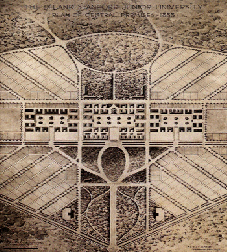
This meant taking advantage of unique characteristics of a site while also acknowledging disadvantages. For example, he was willing to abandon the rainfall-requiring scenery he loved most for landscapes more appropriate to climates he worked in. That meant a separate landscape style for the South while in the dryer, western parts of the country he used a water-conserving style (seen most visibly on the campus of Stanford University, design shown at right).

2) Subordinate details to the whole.
Olmsted felt that what separated his work from a gardener was “the elegance of design,” (i.e. one should subordinate all elements to the overall design and the effect it is intended to achieve). There was no room for details that were to be viewed as individual elements. He warned against thinking “of trees, of turf, water, rocks, bridges, as things of beauty in themselves.” In his work, they were threads in a larger fabric. That’s why he avoided decorative plantings and structures in favor of a landscapes that appeared organic and true.

3) The art is to conceal art.
Olmsted believed the goal wasn’t to make viewers see his work. It was to make them unaware of it. To him, the art was to conceal art. And the way to do this was to remove distractions and demands on the conscious mind. Viewers weren’t supposed to examine or analyze parts of the scene. They were supposed to be unaware of everything that was working.

He tried to recreate the beauty he saw in the Isle of Wight during his first trip to England in 1850: “Gradually and silently the charm comes over us; we know not exactly where or how.” Olmsted’s works appear so natural that one critic wrote, “One thinks of them as something not put there by artifice but merely preserved by happenstance.”

4) Aim for the unconscious.
Related to the previous point, Olmsted was a fan of Horace Bushnell’s writings about “unconscious influence” in people. (Bushnell believed real character wasn’t communicated verbally but instead at a level below that of consciousness.) Olmsted applied this idea to his scenery. He wanted his parks to create an unconscious process that produced relaxation. So he constantly removed distractions and demands on the conscious mind. [Continue reading…]

Facebooktwittermail