Al-Monitor: Dr. Ghazi Hamad, deputy foreign minister in the Hamas government, is thought to be one of the people spearheading the movement’s pragmatic wing. Two years ago, the secret channel of communication he maintained with Dr. Gershon Baskin led to a breakthrough in the protracted negotiations over the release of abducted Israeli soldier Gilad Shalit, in exchange for the release of over 1,000 Palestinians held in Israeli prisons. There can be no doubt that the results of these negotiations earned Hamad a position of honor within the Hamas movement and, more broadly, among the Palestinian public.
Hamad is considered to be very close to Hamas Prime Minister Ismail Haniyeh, whom he once served as spokesman, and to the chief of Hamas’ political bureau, Khaled Meshaal, the movement’s newly reelected leader.
In an exclusive interview with Al-Monitor, Hamad analyzes the next steps that his movement will take, now that Khaled Meshaal has been reelected to head its reconstituted political bureau, and following the change within the movement’s bureau .
Al Monitor: Does Meshaal’s election signify a change in Hamas’ attitudes?
Hamad: First of all, we must remember that these were democratic elections, and as such, they are a credit to the movement. Elections for Hamas’ other institutions ended a year ago, and that was the last time that the Hamas movement expressed confidence in its leaders and their proposal to institute changes to Hamas’ policy. This included reconciliation with Fatah, among other things.
Al Monitor: When you talk about new policy, do you mean an end to the armed struggle and a transition to what Meshaal calls a “popular uprising”?
Hamad: As leader of the movement, Khaled Meshaal agreed to shift to a popular uprising. All of that began during the reconciliation talks. It emerged from a comprehensive vision of the movement’s future and the type of leadership that the Palestinian people need. And yet, though Meshaal is prepared to make a tactical shift to a popular uprising, armed struggle remains a legitimate right as long as the Occupation continues. At the same time, there is an extensive political and diplomatic program which we must advocate and work toward, and that includes joining the official institutions of the PLO. Those are our objectives, and that is our new approach.
Al Monitor: Does that include agreement to go back to the 1967 borders?
Hamad: Hamas has stated that it is prepared to accept a state within the 1967 borders.
Al Monitor: A two-state solution?
Hamad: We do not say “two states.” We agree to the establishment of a Palestinian state with Jerusalem as its capital, within the 1967 borders, and that this would include a solution to the refugee problem. What I can tell you is that all factions in the movement agree to this and are prepared to accept it. [Continue reading…]
How Israel helped apartheid South Africa build nuclear weapons
Derek Leebaert writes: There have been rumors since the late 1970s of Israeli cooperation in South Africa’s effort to become a nuclear power. A double flash over the Indian Ocean detected by a U.S. satellite in 1979, for example, was suspected (but never confirmed) to be a joint, low-yield Israeli-South African nuclear test.
South African documents that appeared to show Israel offering to sell nuclear weapons were refuted by Israeli President Shimon Peres, in 2010, as “selective interpretation.” Here we show what really occurred — and how.
According to new CIA evidence, Israel proved “absolutely vital” to South Africa’s apartheid regime 30 years ago in building six Hiroshima-size bombs. New details about this collaboration arose in a series of interviews I conducted with Tyler Drumheller, the former chief of CIA covert operations in Europe and, at the time of the events described here, a clandestine officer serving in Pretoria, South Africa. The interviews were conducted in Washington, D.C., in 2010.
Drumheller is an unusually credible and outspoken man. In his book, On the Brink: An Insider’s Account of How the White House Compromised American Intelligence and in interviews with the CBS News program “60 Minutes,” he was the most senior of former CIA officials to tell the truth about faulty intelligence in the run-up to the U.S. invasion of Iraq.
He showed how the Bush-Cheney White House had promoted intelligence it liked on Iraq — and specifically on Iraq’s supposed weapons of mass destruction — while ignoring intelligence it didn’t like.
Having begun his career in the unusually risky role of “NOC” (non-official cover) in Asia, Drumheller’s operational abilities remain legendary within the CIA’s Clandestine Service.
During our interviews, he reflected on earlier experiences in his career. In 1980, “we had 11 case officers in South Africa, four of them with deep cover.” They had penetrated the apartheid regime’s “Project Circle,” which was already within reach of perfecting a usable, deliverable atomic bomb.
“We were regularly able to obtain swipe samples from its enrichment facilities. We could monitor progress,” Drumheller told me.
They also monitored the deep cover “black station” of Israel’s intelligence agency, the Mossad. Drumheller said this was a front company called TamCo. The Israelis had no idea they were under such close U.S. scrutiny.
Washington had tried to impede Pretoria’s effort by embargoing the shipment of a VAX computer from Massachusetts-based Digital Equipment Corporation. “Project Circle needed that VAX” to complete the project, Drumheller said.
The CIA station in Pretoria learned that South Africa was able to get around the embargo by having the computer — the same powerful VAX model — transshipped from the United States. “It came via the Israelis and TamCo,” Drumheller said.
Israel contributed another vital piece to Project Circle’s success by supplying the tritium, a radioactive form of hydrogen that is manufactured in nuclear reactors, for the bombs’ triggering mechanisms. In addition, Israel provided Pretoria with an essential avionics package that would allow the bombs to be dropped by South African Air Force jets.
The CIA was able to obtain these and other details about the Israeli-South African collusion, Drumheller explained, from a stellar agent that the CIA had placed within Project Circle.
The CIA station in Pretoria was tracking full-scale government-to-government collaboration that was taking place despite a UN Security Council resolution that had imposed a mandatory arms embargo against the white supremacist state in 1977.
Washington, meanwhile, had enough on its hands with Israel during this period. Strains in relations included Israel’s 1982 Operation Peace for Galilee invasion of Lebanon. The extent of the invasion’s civilian carnage led President Ronald Reagan (choosing his words carefully, as is known from his diary) to denounce the bombing and shelling of civilians to Israel’s prime minister as “a holocaust.”
In any event, Pretoria finally took it upon itself to dismantle its jointly developed bombs in 1989, two years before signing the Nuclear Non-Proliferation Treaty. All of this happened in the apartheid regime’s dying days, before its complete collapse in 1994.
Are these collusions historical bygones? Too long ago to matter today? Certainly not, given what’s now underway with regard to U.S policy on Iran.
The key question now is how Washington will act, or react, regarding the Iranian nuclear challenge. To judge from comments by figures in leading U.S. foreign policy circles outside the government, no one in Washington has a clue as to what Tehran intends to do with its nuclear program.
What is apparent, however, is the influence of Israeli fears, or bluster: If Washington doesn’t prevent Iran from getting the bomb, it is assumed, then Israel will.
Even so, Israel’s own nuclear capabilities are almost never discussed. And, quite conveniently, Israel’s record of proliferation is barely known or, rather, swept under the carpet. [Continue reading…]
The ATF wants ‘massive’ online database to find out who your friends are
Wired reports: The ATF doesn’t just want a huge database to reveal everything about you with a few keywords. It wants one that can find out who you know. And it won’t even try to friend you on Facebook first.
According to a recent solicitation from the Bureau of Alcohol, Tobacco, Firearms and Explosives, the bureau is looking to buy a “massive online data repository system” for its Office of Strategic Intelligence and Information (OSII). The system is intended to operate for at least five years, and be able to process automated searches of individuals, and “find connection points between two or more individuals” by linking together “structured and unstructured data.”
Primarily, the ATF states it wants the database to speed-up criminal investigations. Instead of requiring an analyst to manually search around for your personal information, the database should “obtain exact matches from partial source data searches” such as social security numbers (or even just a fragment of one), vehicle serial codes, age range, “phonetic name spelling,” or a general area where your address is located. Input that data, and out comes your identity, while the computer automatically establishes connections you have with others.
Many other specific requirements are also to be expected for a federal law enforcement agency: searching names, phone numbers, “nationwide utility data” and reverse phone searches. The data will then be collected to help out during investigations and provide “relevant information and intelligence products.” There’s no hint the database is to be used to track gun sales, which is a big part of the ATF’s job, as the bureau is prohibited by law from establishing a centralized electronic database for gun purchases. [Continue reading…]
War without end: the price of inaction in Syria
Christoph Reuter writes: Western leaders — and German ones, in particular — have come up with countless reasons for not providing military support to Syrian rebels. But this just plays into the hands of Assad, who has nothing to win, but plenty to destroy.
Take a moment to imagine it the other way around: A Syrian dictator with a full beard — an Islamist harboring al-Qaida sympathies — has the Christian population of his country shot, starved and bombed, lets fanatical militias massacre non-believers and burns the country down to ashes. Were that the case, an alliance of Western nations would step up to intervene faster than you could say “Mali.”
Yet the people of Syria have been trying to rid themselves of a dictator for two years now. They spent months getting shot at while participating in peaceful demonstrations before they starting putting up violent resistance, and now they are facing a regime that intends to annihilate them. But it would seem that they’re simply out of luck.
The reason isn’t hard to see: Most of these rebels are Sunnis or, more broadly, Muslims. Many of them also have beards and shout “Allahu akbar” (as do the much smaller numbers of Ismailis, Druzes and Christians who fight alongside them). Sunnis also live in the areas that are being bombed almost daily when visibility is good.
Muslims rising up against their rulers to demand justice simply doesn’t fit into our worldview. Over the past decades, this view has been fed on news of the Taliban, of radical Islamist clerics preaching messages of hate, of “honor” killings, of battles over a Danish cartoon and of the events of 9/11. Held responsible for the sum total of all we have heard over the years, Syria’s Muslims are finding that the world views their struggle with suspicion and as just another attempt to establish a Muslim theocracy.
If they were Tibetans, you could bet things would be different. But, as is, Bashar Assad’s air force has been allowed to bomb with impunity. Scud missiles level entire city blocks, while Syria gradually empties out. Over 70,000 people have died in the conflict, and more than 1 million have fled the country. [Continue reading…]
Video: Obama’s promotion of a promoter of torture and failure to close Guantanamo
The inner syntax of Palestinian stone-throwing
Amira Hass writes: Throwing stones is the birthright and duty of anyone subject to foreign rule. Throwing stones is an action as well as a metaphor of resistance. Persecution of stone-throwers, including 8-year-old children, is an inseparable part − though it’s not always spelled out − of the job requirements of the foreign ruler, no less than shooting, torture, land theft, restrictions on movement, and the unequal distribution of water sources.
The violence of 19-year-old soldiers, their 45-year-old commanders, and the bureaucrats, jurists and lawyers is dictated by reality. Their job is to protect the fruits of violence instilled in foreign occupation − resources, profits, power and privileges.
Steadfastness (Sumud) and resistance against the physical, and even more so the systemic, institutionalized violence, is the core sentence in the inner syntax of Palestinians in this land. This is reflected every day, every hour, every moment, without pause. Unfortunately, this is true not only in the West Bank (including East Jerusalem) and Gaza, but also within Israel’s recognized borders, although the violence and the resistance to it are expressed differently. But on both sides of the Green Line, the levels of distress, suffocation, bitterness, anxiety and wrath are continually on the rise, as is the astonishment at Israelis’ blindness in believing that their violence can remain in control forever.
Often hurling stones is borne of boredom, excessive hormones, mimicry, boastfulness and competition. But in the inner syntax of the relationship between the occupier and the occupied, stone-throwing is the adjective attached to the subject of “We’ve had enough of you, occupiers.”
After all, teenagers could find other ways to give vent to their hormones without risking arrests, fines, injuries and death.
Even if it is a right and duty, various forms of steadfastness and resisting the foreign regime, as well as its rules and limitations, should be taught and developed. Limitations could include the distinction between civilians and those who carry arms, between children and those in uniform, as well as the failures and narrowness of using weapons.
It would make sense for Palestinian schools to introduce basic classes in resistance: how to build multiple “tower and stockade” villages in Area C; how to behave when army troops enter your homes; comparing different struggles against colonialism in different countries; how to use a video camera to document the violence of the regime’s representatives; methods to exhaust the military system and its representatives; a weekly day of work in the lands beyond the separation barrier; how to remember identifying details of soldiers who flung you handcuffed to the floor of the jeep, in order to submit a complaint; the rights of detainees and how to insist on them in real time; how to overcome fear of interrogators; and mass efforts to realize the right of movement. Come to think of it, Palestinian adults could also make use of these lessons, perhaps in place of their drills, training in dispersing protests, and practice in spying on Facebook posts.
When high school students were drafted two years ago for the campaign of boycotting settlement products, it seemed like a move in the right direction. But it stopped there, without going further, without broadening the context. Such lessons would have been perfectly in tune with the tactics of appealing to the United Nations − civil disobedience on the ground and defiance of power in diplomacy.
So why are such classes absent from the Palestinian curriculum? Part of the explanation lies with the opposition of the donor states and Israel’s punitive measures. But it is also due to inertia, laziness, flawed reasoning, misunderstanding and the personal gains of some parts of society. In fact the rationale for the existence of the Palestinian Authority engendered one basic rule in the last two decades − adaptation to the existing situation. Thus, a contradiction and a clash have been created between the inner syntax of the Palestinian Authority and that of the Palestinian people.
Video — Chris Hedges: Why I resigned from PEN
How most of the dead in Iraq disappeared
Muhammad Idrees Ahmad writes: ‘So many’, wrote TS Eliot, reflecting on the waste land left by the First World War. “I had not thought death had undone so many.”
This notion is unlikely to cross the minds of those surveying the devastation left by the 2003 invasion of Iraq. The most frequently quoted fatality figure – about 115,000 Iraqis killed – is shocking. But compared to major conflicts of the past century, it is a relatively modest toll. The 1916 battle of the Somme alone killed three times as many. More than that were killed by a single atomic bomb dropped on Hiroshima during the Second World War.
Former British prime minster Tony Blair, and then-US vice president Dick Cheney, were perhaps conscious of this when they expressed “no regrets” on the 10th anniversary of the war last month.
That the perpetrators of an aggressive war should accept the lowest costs for their folly is unsurprising. What is less explicable is why so many supposed critics of the war are crediting the same estimate. Brown University’s Costs of War project and the Centre for American Progress’s Iraq War Ledger use it as their main source.
This is particularly puzzling when there are two peer-reviewed epidemiological surveys that give a far more comprehensive accounting of the war’s human cost. A Johns Hopkins Bloomberg School of Public Health Survey published in the Lancet, and the Iraq Public Health Survey published in the New England Journal of Medicine, gave figures of 655,000 and 400,000 excess deaths respectively. (Both were concluded in June 2006, a month before the violence peaked, suggesting the actual toll is even higher).
It is odder still that when epidemiological surveys have come to be accepted as the standard method for estimating conflict fatalities – the method has been used without controversy in Congo, Bosnia and Darfur – an exception is made in the case of Iraq. [Continue reading…]
Video: Economics, the environment and our common wealth
Interview with James K Boyce, author of Economics, the Environment and Our Common Wealth:
Part Three:
Part Two:
Part One:
Obama’s big BRAIN project
Kas Thomas writes: President Obama’s kickoff of the BRAIN initiative was a major news item the other day. Widely lauded as the kind of program that can keep America at the forefront of science, Brain Research through Advancing Innovative Neurotechnologies (or, if you prefer, Big Ridiculous Acronyms Inspired by Nonsense) was compared to the Apollo moon program, which “gave us CAT scans” (the President said) and to the Human Genome Project, which altered economic reality as we know it by creating $140 in return for every dollar invested.
The President hailed BRAIN as “a bold new research effort to revolutionize our understanding of the human mind and uncover new ways to treat, prevent, and cure brain disorders like Alzheimer’s, schizophrenia, autism, epilepsy, and traumatic brain injury.”
And for all this great knowledge, we’re going to pay just $100 million (first year).
Thomas goes on to spell out why that amount is nothing more than pocket change, but small as the funding is, it also seems worth noting that half of it is going to DARPA — the Defense Advanced Research Projects Agency, the research wing of the Pentagon.
“DARPA hopes to build tools that can view, measure and control the brain from the cellular and neuronal to the macroscopic levels,” reports the Army Times.
How Eric Harroun, the American fighter in Syria, was duped by the FBI
Robert Young Pelton writes: On April 8, Eric Harroun will appear with his public defender in an Alexandria, Virginia, court to answer charges that he conspired to use a weapon of mass destruction outside the United States. While such legal wording may suggest that he was looking to get his hands on a chemical or nuclear weapon, Harroun’s alleged crime is actually much more mundane: He stands accused of using a rocket-propelled grenade launcher while fighting with rebels who aim to topple Syrian President Bashar al-Assad’s regime.
If this story sounds familiar, it should: The 30-year old Harroun has joined a small but controversial club: young Americans who decided to fight in foreign jihads. And I’ve met a lot of them. In 1999, I traveled with the red-haired, blue-eyed Irish-American Aukai Collins on his journey to fight against the invading Russians in Chechnya. In December 2001, I met John Walker Lindh, an American who joined up with the Taliban, who insisted that he was fighting a pre-9/11 war against brutal warlords, not a jihad against the United States. But even when these freelance soldiers join the same side that the U.S. government is supporting, they also often run afoul of the U.S. legal system — and Harroun is now the latest to face punishment for his adventure overseas.
On March 11, I contacted Harroun via Facebook to interview him for my new magazine, Dangerous. He replied “R U A Zionist?” Three days later, I finally reached Harroun on Skype. He had left Syria, and was staying in the upscale Istanbul neighborhood of Taksim. He said he had visited the American consulate in Istanbul.
Harroun had just finished an interview with an editor from the Times of Israel. He explained that the interview was combative, including numerous insults and even shouting matches with the Israeli reporters. When the article was published on Fox News, it highlighted Harroun’s statement that he had fought alongside the Syrian rebel group Jabhat al-Nusra, which the State Department has labeled an alias for al Qaeda in Iraq.
The article rattled Harroun. He decided to check in with the American consulate, with the aim of telling U.S. officials exactly what transpired while he was in Syria. He was surprised to see a print out of the Fox News story sitting on the desk of the FBI agent when he walked in for what turned out to be a four-hour interview.
Harroun told me that he insisted to the FBI and CIA that he joined the “Amr ibn al-‘As Brigade.” According to the Institute for the Study of War, a Washington think tank, the brigade is a faction of the rebel Free Syria Army formed under the command of Col. Abdul-Jabar Mohammed Egeydi.
But the consulate also had evidence that Harroun had been in contact with Jabhat al-Nusra. A video shot by Harroun and uploaded to Youtube on Jan. 26 showed him in a truck loaded with his jihadist friends, driving toward a recently downed Syrian military helicopter.
When I reached Harroun, he described his association with Jabhat al-Nusra as accidental. “I was separated from my unit in the fighting. I found these guys,” he said. “I didn’t even know they were al-Nusra until later. I said, ‘I need a ride back to my commander.’ It took 25 days to get them to give me a ride.”
“When they would go out and fight, I’d go along with them. What was I supposed to do?” he asked. “We are all fighting for the same thing. We’re trying to kill the same people. It’s not like I chose to fight with al-Nusra.” [Continue reading…]
Saudi Arabia’s expanding foothold in Texas
The New York Times reports: It is hard to imagine the desert sands of the Persian Gulf being any farther away than from this swampy refinery port known for Cajun food, sport fishing and being the birthplace of Janis Joplin.
But right in the middle of town stands a strategic outpost for Saudi Arabia’s global ambitions, although one that the Saudis appear loath to publicize.
The giant Motiva oil refinery, which just completed a $10 billion expansion that makes it the largest processor of gasoline, diesel and other petroleum products in the United States, is owned by Saudi Aramco and Royal Dutch Shell in a 50-50 partnership.
Saudi Aramco’s investment in the refinery expansion is meant to ensure that Saudi Arabia will retain an important market for its crude in the United States at a time when American politicians are declaring their intention to wean the country off imported oil. Adding to the urgency for the Saudis is the fact that the United States is vastly increasing its production and replacing OPEC crude with that from oil sands in Canada.
The expansion of the Port Arthur refinery comes during a particularly complicated period in United States-Saudi relations, as the two countries try to manage changes sweeping the Arab world. While Riyadh has cracked down on dissent and generally resisted efforts to spread democracy in the region, the Obama administration has been less resistant to the changes.
But the Saudis have helped the United States and the global economy by increasing exports to moderate oil prices and top up worldwide supplies as the West applies sanctions against Iran. Saudi Arabia has been able to tap into its spare capacity, mostly lower-quality heavy sour crudes, to stretch its exports. Most refineries cannot easily process those crude oils, but the expanded Motiva refinery here can, freeing other Saudi grades for other markets.
“The Saudis are securing a home for their heavy crude,” said Fadel Gheit, a senior oil analyst at Oppenheimer & Company. “But there is no question that security is also part of the equation. In Saudi Arabia, oil and politics always mix.” [Continue reading…]
Saudi paralysis sentencing ‘grotesque’, says UK govt
BBC News reports: The UK has urged Saudi Arabia not to carry out a reported sentencing of paralysis for a Saudi man as punishment for paralysing another man.
A Foreign Office spokesperson said London was “deeply concerned” by the sentence, describing it as “grotesque”.
Such punishment was “prohibited under international law”, the official added.
Saudi media reports earlier said the 24-year-old man could be paralysed from the waist down if he could not pay his victim £250,000 in compensation.
Ali al-Khawahir was 14 when he stabbed a friend in the back in the Eastern Province town of al-Ahsa. He has been in prison for 10 years.
The judge in the case has reportedly interpreted the Islamic law of qisas, or retribution, that Saudi Arabia follows as meaning that he in turn could face being paralysed.
Amnesty International has described this as tantamount to torture.
The sentencing is the latest example of Saudi Arabia’s fundamentalist interpretation of Islamic law attracting international criticism.
BBC diplomatic correspondent Jonathan Marcus says the Foreign and Commonwealth Office’s comments mark an unusually strong plea to the Saudi authorities in what is, by any standards an unusual and disturbing case.
Successive British governments have struggled at times to harmonise their concerns about human rights in Saudi Arabia with the fact that the Kingdom remains a key ally and a major customer for British weaponry, he adds.
And the response from the U.S. government? Thus far — as far as I’m aware — none.
I guess since the U.S. is the last remaining Western country to use capital punishment and does so with a frequency not far behind Saudi Arabia’s, along with the fact that U.S. places prisoners in indefinite solitary confinement, detains suspects indefinitely without charge, and also conducts extrajudicial executions, all makes American officials reticent to pass judgement on the practices of its close Saudi allies.
Re-elected Hamas chief says will work for unity
AFP reports: The newly re-elected chief of Hamas, Khalid Mashaal, pledged on Thursday to work to end a rift with his West Bank rival, President Mahmoud Abbas.
Mashaal, speaking at a pro-Palestinian conference in Cairo, “affirmed his movement’s solicitude for ending the division with its negative effects,” the Safa news agency quoted his as saying.
But he hinted that Hamas would not renounce its opposition to Israel’s existence nor its use of violence, conditions for Israel and the United States to accept it as a partner in a Palestinian government.
“The (Israeli) occupation exploits the division and placed hurdles before a reconciliation (with Fatah),” he said. Hamas would work for unity “but that does not mean abandoning fixed positions.”
Mashaal’s reelection was confirmed on Tuesday, drawing a cautious welcome from his Fatah rivals.
Meanwhile, AFP also reported: Hamas on Friday urged the United Nations to reconsider its suspension of food aid for Palestinian refugees, imposed after protesters stormed a UN depot.
The UN Relief and Works Agency, or UNRWA, stopped food deliveries after dozens of Gazans forced their way into the field office on Thursday, demanding reinstatement of a monthly cash allowance to poor families which was halted from April 1 due to budget cuts.
“This is an unjustified step from UNRWA,” Hamas spokesman Sami Abu Zuhri said.
“There is a right of peaceful protest for Palestinian refugees,” he said, adding: “We call on UNRWA to reevaluate its position and not to overreact to residents’ protest.”
Cear signs that China is losing patience with North Korea
The Telegraph reports: There are clear signs that China is losing patience with North Korea, America’s former top diplomat in Asia has said.
For several decades, China has been North Korea’s closest ally, largest trade partner and primary source of aid.
However, Kurt Campbell, the former head of the State department in Asia, said there are signs that a relationship once described by Chairman Mao to be “as close as lips and teeth” is wearing thin.
“There is a subtle shift in Chinese foreign policy. Over the short to medium term, that has the potential to affect the calculus in north east Asia,” Mr Campbell said at a forum at John Hopkins university.
“You have seen it at the United Nations (Security Council). We have seen it in our private discussions and you see it in statements in Beijing,” he added.
Mr Campbell, who left the State department in February to found his own consultancy firm, was one of the architects of the US diplomatic and military “pivot” towards Asia.
Mali insurgency endangers French pull-out plan
Reuters reports: France wants to cut its forces in Mali sharply by the year-end and is urging its ex-colony to hold elections in July, but an Islamist insurgency is threatening that timetable.
Many people in northern Mali who lived under the rebels’ brutal form of Islamic law last year are apprehensive about French plans to leave just 1,000 of the current 4,000 troops in the country by December, with U.N. peacekeepers filling the gap.
“The Islamists are waiting for the French to leave to open the gates to hell. Let’s hope the U.N. will take over quickly because the Malian army alone cannot face the terrorism threat,” said Alhassane Maîga, a teacher in the ancient trading post of Timbuktu.
Last weekend Islamist militants launched their second attack on Timbuktu in a fortnight, shortly after French President Francois Hollande insisted the elections must take place as scheduled and unveiled the plan to slash troop numbers.
Launched in January, the French-led offensive quickly succeeded in pushing a mix of Islamists out of their northern strongholds and remote mountain bases, hitting the local leadership of the al Qaeda-linked groups.
But new clashes have followed a handful of suicide attacks and raids on towns won back from the rebels, underscoring the task of securing the country as France prepares to hand over to the Malian army and a 7,000-strong regional African force.
The nightmare scenario is that of a repeat of the Afghan war, where Taliban insurgents have prevented a full pull-out of NATO-led troops after a 13-year conflict that has cost tens of thousands of lives.
Sam Harris isn’t a racist — his hatred is very discerning

“There is no such thing as ‘Islamophobia.’ This is a term of propaganda designed to protect Islam from the forces of secularism by conflating all criticism of it with racism and xenophobia.” — Sam Harris in an email exchange with Glenn Greenwald.
Let’s unpack that statement.
To establish whether there is indeed no such thing as Islamophobia, we’ll need a reasonably uncontroversial definition of the term.
The etymology is transparent and so a literal interpretation seems sufficient, which is to say, Islamophobia is an irrational fear of Islam.
Those who say that there is such a thing as Islamophobia would also say that the fear of Islam which it embodies also often expresses itself as hatred of Islam. Indeed, Harris himself is quite explicit in expressing hatred for Islamic doctrine. His concern, apparently, is that his hatred of Islam should not be confused for a hatred of Muslims:
Needless to say, there are people who hate Arabs, Somalis, and other immigrants from predominantly Muslim societies for racist reasons. But if you can’t distinguish that sort of blind bigotry from a hatred and concern for dangerous, divisive, and irrational ideas — like a belief in martyrdom, or a notion of male “honor” that entails the virtual enslavement of women and girls — you are doing real harm to our public conversation. Everything I have ever said about Islam refers to the content and consequences of its doctrine.
So, Harris is straightforward is saying that he hates Islamic doctrine, but he doesn’t hate Muslims. And since I don’t think he would regard it as misrepresentation to suggest that he draws no distinction between Islamic doctrine and Islam, it’s reasonable to conclude that he hates Islam.
Presumably, when Harris says there is no such thing as Islamophobia, he is not denying that some people hate Islam — he is denying that this hatred is irrational.
For those of us who think that there really is such a thing as Islamophobia, Pastor Terry Jones serves as a classic example of its expression. Like Sam Harris, Jones claims he hates Islam but bears no animosity towards Muslims — both employ the popular evangelical gambit: hate the sin, love the sinner.
Here’s Jones’ latest message pressing a common theme among those accused of being Islamophobic: their fear that Muslims are taking over America.
This sounds like Islamophobia to me, but maybe I’m not as rational as Harris.
But how rational is he? In what he presents as a rational approach to airport security, he says: “We should profile Muslims, or anyone who looks like he or she could conceivably be Muslim”.

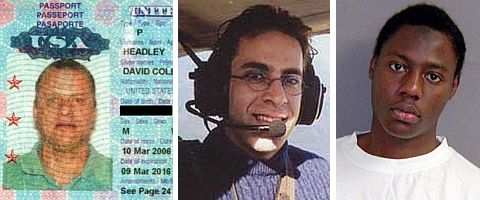
David Headley, a Pakistani-American convicted of helping plan the 2008 Mumbai attacks; Ziad Jarrah, hijacker-pilot of United Airlines Flight 93 on September 11, 2001; Umar Farouk Abdulmutallab, the so-called 'underwear bomber, arrested on December 25, 2009.

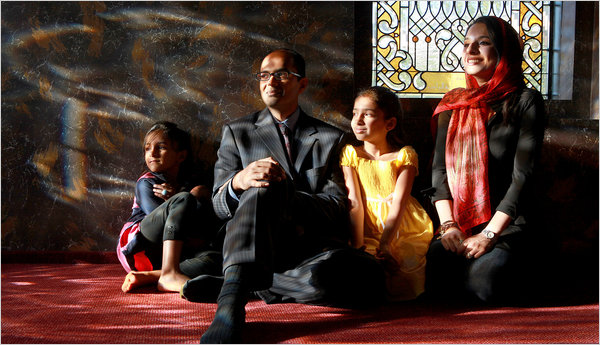
Dr. Ferhan Asghar at a Muslim center in West Chester, Ohio, with his wife, Pakeeza, and daughters Zara, left, and Emaan.
If, in accordance with Harris’ recommendation, TSA officers want to start profiling Muslims, it’s easy to see which of the above individuals will face closer scrutiny: the ones who “look like Muslims.” And the result will be no less absurd than searches conducted on eighty-year-old grandmothers.
Profiling doesn’t have to be racist (though it most often is) — it’s just plain stupid. How does a screening process get streamlined and made more efficient by narrowing the range of suspects to 1.5 billion individuals?
“Imagine how fatuous it would be to fight a war against the IRA and yet refuse to profile the Irish? And yet this is how we seem to be fighting our war against Islamic terrorism.”
And what do “the Irish” look like Mr Rationality? Plenty of the IRA’s members were British citizens and plenty of their supporters were Americans.
Which brings me to what bugs me most about Harris: he postures with the gravitas of a learned intellectual and yet when you strip away the über-rational styling, he can at times sound about as smart as Terry Jones.
What war on the Korean peninsula would look like
Dr. Patrick M. Cronin writes: The Korean Peninsula is on a knife’s edge, one fateful step from war. While Koreans are accustomed to periodic spikes in tensions, the risk of renewed hostilities appears higher than at any time in the past 60 years, when American, North Korean, and Chinese generals signed an armistice agreement. Far more than 1 million people died in the Korean War, with at least that many troops and civilians injured over the course of the three-year campaign.
The exact leadership dynamics at play in Pyongyang remain mysterious, but the domestic survival of the Kim family dynasty appears to hinge on maintaining a credible nuclear and missile threat — backed up by a local great power, China. To achieve the former, Kim Jong Un appears willing to risk the latter. His regime’s unrelenting verbal threats are intended to rally domestic support, and its reckless brinksmanship is aimed at forcing the outside world to back down and back off. In the past days and weeks — adding to the tension created by its recent nuclear and missile tests — Pyongyang has severed a hotline with Seoul, renounced the 1953 armistice, conducted cyberattacks, and, against its own financial interests, closed down the Kaesong Industrial Complex, which is the only economic thread holding together relations with the South.
There is no single red line that, when crossed, would trigger war, but the potential for miscalculation and escalation is high. North Korea has a penchant for causing international incidents — in 2010 alone it used a mini-submarine to sink the South Korean naval vessel Cheonan and shelled South Korea’s Yeonpyeong Island. The brazen and unprovoked killing of military personnel and civilians shocked many South Koreans, some of whom faulted then-President Lee Myung Bak for a tepid response. The new president, Park Geun Hye (South Korea’s “Iron Lady”) is determined not to echo that weakness and has vowed a strong response to any direct provocation. Meanwhile, the United States, via the annual Foal Eagle and Key Resolve exercises, has many troops, ships, and planes on maneuvers in the region and, as an additional show of resolve, flew long-range B-2 stealth bombers from Missouri to Korea and dispatched F-22 fighter jets as well.
The desire to show strength, the fear of looking weak, and the presence of tons of hardware provides more than enough tinder that a spark could start a peninsula-wide conflagration. [Continue reading…]