The Forward reports: From his temporary office on the Pentagon’s third floor, Chuck Hagel is already working at full speed. He’s devoting his time not just to learning a new job, but also to clarifying his positions on Iran — the issue his former Senate colleagues have vowed to question him on most intensively when his nomination for secretary of defense comes up for confirmation.
The new image Hagel is fashioning for himself is less contrarian than the persona he adopted during his years in the Senate. On January 15, in a meeting with New York Senator Charles Schumer, the former Republican senator from Nebraska, who earlier criticized U.S. sanctions against Iran as counterproductive, and military action against it as potentially ruinous, “rejected a strategy of containment and expressed the need to keep all options on the table in confronting that country,” Schumer said in a statement after the meeting. “But he didn’t stop there,” Schumer added. “In our conversation, Senator Hagel made a crystal-clear promise that he would do ‘whatever it takes’ to stop Tehran from obtaining nuclear weapons, including the use of military force.”
This does not make Hagel an Iran hawk. Washington analysts still see him as a member of the war-averse faction in Obama’s future Cabinet, at a time when the president has gradually inched toward more openness to the use of military force against Iran if talks and sanctions fail to stop its nuclear program. But it does bring him closer in line with today’s Washington consensus — a consensus that is itself more war-averse compared with the days shortly before President George W. Bush’s 2003 invasion of Iraq, when an administration official told Newsweek: “Everyone wants to go to Baghdad. Real men want to go to Tehran.”
Obama’s view, said Dov Zakheim, who served as under secretary of defense in the Bush administration, now prevails among military and civilian policymakers.
“There is a consensus in Washington that every effort should be made to avoid a military strike,” said Zakheim, who added that the powerful impact of sanctions on Iran’s economy, as well as the unity of the international community in hewing to those sanctions, were important factors in this thinking. But if this approach ultimately fails, secretaries of defense “tend not to be ideological,” Zakheim said. “They look at the intelligence and the advice in front of them. My guess is that Hagel will do the same.”
In effect, Hagel’s acceptance of the “all options on the table” approach and the Washington establishment’s evolution toward seeing military intervention in Iran as unwelcome except as an absolute last resort enable both sides to move toward each other. The dual movements make Hagel’s transition into the role of Obama’s right hand on military issues much easier. [Continue reading…]
The neocons overreach on Hagel
Scott McConnell writes: The neoconservative decison to charge that Chuck Hagel is an anti-Semite strikes me as a tactical blunder — a decision grounded in the idea that since they can’t defeat the nominee on the issues, their better option was to try to assassinate Hagel’s character, presumed to be one of his greatest strengths. Such accusations raise the temperature around the nomination, with consequences difficult to foresee. But just as anti-Semitism is a blight, so are false accusations of it. Peter Beinart has perceptively noted that no one in America ever pays a penalty for falsely maligning someone as an anti-Semite. This may be true today, but like all social rules, it is subject to renegotiation.
Ali Gharib at Open Zion has done a superb job deconstructing the evidence, or, I should say, “evidence,” on which the charge is based: leaders of the Nebraska Jewish community who are alleged to think that Hagel has a Jewish problem deny there is anything of the sort. Hagel may not always have acted like Alfonse D’Amato in his attending to them, but really, why should he?
Since we know that genuine anti-Semitism has deep social and psychic roots in Western societies, it shouldn’t be surprising that the leveling of false anti-Semitism charges for political ends also has contours worth exploring. Quite unexpectedly, the Hagel nomination is opening a rich vein for their study. One thing one finds is that those who are quick to deploy false charges of anti-Semitism have begun to take on traits historically associated with bigoted paranoia.
Take for example the Wall Street Journal‘s Bret Stephens, the first to play the anti-Semitism card against Hagel. Last month he notoriously wrote, “Prejudice—like cooking, winetasting, and other consummations has an olfactory element. [With] Chuck Hagel…the odor is especially ripe.” Beinart and others have deconstructed Stephens’s charge, the centerpiece of which is that Hagel, in an interview, used the term “Jewish lobby” instead of “Israel lobby.” But connoisseurs of literary criticism may notice an eerie parallel to Stephens’ toxic paragraph. If evidence of Hagel’s anti-Semitism cannot be substantiated by facts or logic, it can nonetheless be smelled. It’s as if Stephens is seeking to transport us back to the world of Marcel Proust and the Dreyfus Affair, where the anti-Dreyfusards (the anti-Semitic precursors of French fascism, and, via Theodore Herzl, a propellant fuel for the birth of Zionism) were confident they could smell the Jew, an outsider even when an habitué of the best salons of Paris. Only, of course, Stephens has reversed the roles, as it is he who smells Hagel. [Continue reading…]
Mali’s rebels hold the advantage in a ground war on desert plains
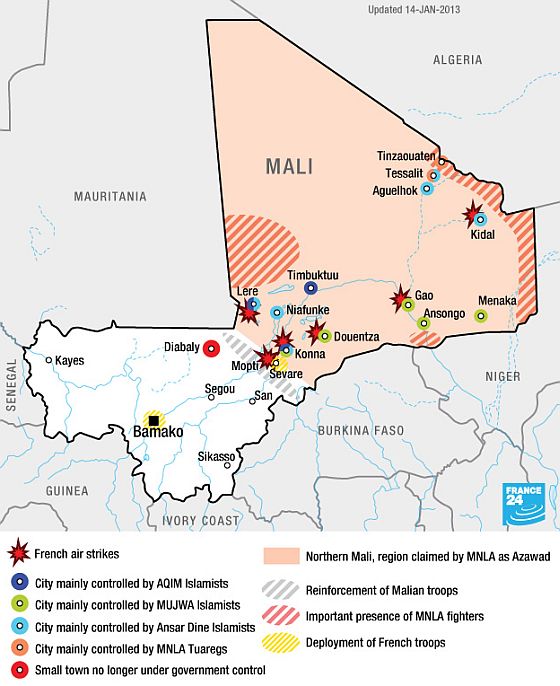
Andy Morgan writes: Fortunately for the French, there’s been no sign of the surface-to-air missiles that the Salafist mujahideen in northern Mali are reported to have stolen from Libya. But taking control of the skies is one thing, winning a ground war and restoring peace is an altogether different prospect.
The French government claim they are merely softening up the territory for military intervention led by the Malian army and a coalition of regional Ecowas forces. What they have failed to mention is that the Malian army hasn’t won a military encounter against Tuareg rebels in the north since the early 1960s, at least not without the help of pro-government Tuareg and Arab militias who know the terrain. Unfortunately, these militias won’t be on hand to help this time round – not in the short term at least.
The north of Mali is as alien to the average soldier from southern Mali as the Alaskan tundra is to a citizen of Massachusetts or Manchester. That sense of alienation will be felt even more keenly by troops from Nigeria, Senegal, Benin and Ivory Coast, used to jungle and savannah bush warfare, when they finally roll onto the vast treeless plains of the southern Sahara.
This is the land where the local Tuareg or Arab in his souped-up turbo 4×4 is king. Iyad Ag Ghali, the Tuareg leader of the Salafist Ansar Dine militia, is a master of the kind of hit-and-run guerrilla warfare that suits the desert conditions and the sheer size of territory, roughly equal to that of Spain. His mujahideen showed their verve last Sunday by capturing the small town of Diabaly, north of Mopti, with a lightening strike that originated over the border in Mauritania. This ability to crisscross borders is another important aspect of the Islamists’ Houdini-esque style of combat. [Continue reading…]
War in northern Mali

A brief listening tour of the amazing music of Mali
Max Fisher writes: When Islamist extremists took over the northern half of Mali, an African country that is economically poor but rich in culture, one of their more barbaric impositions was to ban music. To understand why this has been so painful for Malians, why The Post’s Sudarsan Raghavan called it “a shattering of their culture” after visiting the country, you have to listen to the music yourself.
Now that French forces have intervened militarily to stop the rebels’ advance, opening what could potentially be a protracted conflict in Mali, it’s worth hearing the music at the heart of this country’s culture, if you haven’t already. Teju Cole, a Nigerian-American novelist whom I once had the pleasure of editing, tweeted out a 10-track playlist of Malian music last year. I’ve embedded the songs and reproduced his commentary here.
After listening to a few of these, you’ll understand why the country is considered “one of the richest reservoirs of music on the continent,” as Raghavan wrote, why the music has found such success in the West, and perhaps a small part of what makes the Islamists’ rule so painful.
See the rest of Fisher’s post to hear Cole’s selection of music from Mali.
Over the last two years, I’ve posted quite a lot of Malian music, so here it all is again in one post:
Assad tests Obama’s ‘red line’ on the use of chemical weapons
Foreign Policy‘s blog, The Cable, reports: A secret State Department cable has concluded that the Syrian military likely used chemical weapons against its own people in a deadly attack last month, The Cable has learned.
United States diplomats in Turkey conducted a previously undisclosed, intensive investigation into claims that Syrian President Bashar al-Assad used chemical weapons, and made what an Obama administration official who reviewed the cable called a “compelling case” that Assad’s military forces had used a deadly form of poison gas.
The cable, signed by the U.S. consul general in Istanbul, Scott Frederic Kilner, and sent to State Department headquarters in Washington last week, outlined the results of the consulate’s investigation into reports from inside Syria that chemical weapons had been used in the city of Homs on Dec. 23.
The consul general’s report followed a series of interviews with activists, doctors, and defectors, in what the administration official said was one of the most comprehensive efforts the U.S. government has made to investigate claims by internal Syrian sources. The investigation included a meeting between the consulate staff and Mustafa al-Sheikh, a high-level defector who once was a major general in Assad’s army and key official in the Syrian military’s WMD program.
An Obama administration official who reviewed the document, which was classified at the “secret” level, detailed its contents to The Cable. “We can’t definitely say 100 percent, but Syrian contacts made a compelling case that Agent 15 was used in Homs on Dec. 23,” the official said.
The use of chemical weapons by the Assad regime would cross the “red line” President Barack Obama first established in an Aug. 20 statement. “We have been very clear to the Assad regime, but also to other players on the ground, that a red line for us is we start seeing a whole bunch of chemical weapons moving around or being utilized. That would change my calculus. That would change my equation,” Obama said.
James S Ketchum MD and Frederick R Sidell MD describe the effects of BZ*. In the 1960s, Ketchum, a psychiatrist, was the U.S. Army’s leading expert and investigator in the use of chemical weapons. Although BZ was weaponized, it was later determined it could have no value in the battlefield and the U.S. stockpile was destroyed. A Soviet version was developed and also one in Iraq, known as Agent 15.
When delirium is present in its full-blown state, the individual seems to be in a “waking dream,” often staring and muttering, sometimes shouting, as simple items in the environment are variably perceived as elaborate structures, animals, or people. These hallucinations may arise from some trivial aspect of the surroundings, such as a strip of molding, a pillow, or an irregular spot on the floor. A total lack of insight generally surrounds these misperceptions.
Another striking characteristic of delirium is its fluctuation from moment to moment, with occasional lucid intervals and appropriate responses. An individual might answer “Shakespeare” when asked who wrote Hamlet, but when asked the same question 5 minutes later, might get down on the floor and attempt to remove an imaginary manhole cover, or become absorbed in a miniature World Series game being played out before his eyes.
“Phantom” behaviors, such as plucking or picking at the air or at garments, is characteristic (whence the old term “woolgathering”). This “carphologia,” as it was known in the 19th century, can be comical at times. When two individuals are both delirious they may play off of each other’s imaginings. A subject was once observed to mumble, “Gotta cigarette?” and when his companion held out an invisible pack, he followed with, “S’okay, don’t wanna take your last one.”
Recovery from drug-induced delirium is gradual, with a duration presumably determined by the pharmacokinetic persistence of the causative agent. The more spectacular and florid hallucinations are gradually replaced by more modest distortions in perception. (Instead of large animals, mice and insects are described by the subject.) Awareness gradually returns and with it comes the subject’s partial insight that his mental faculties are not what they should be. Ironically, paranoid tendencies often emerge at this stage, as the individual senses that something is amiss but cannot carry out the reality testing required to rule out malevolent manipulation of the environment by others. A period of restorative sleep generally precedes the return to normal cognitive function.
The Cable spoke to two doctors who treated victims in Homs on December 23:
Both doctors said that the chemical weapon used in the attack may not have been Agent 15, but they are sure it was a chemical weapon, not a form of tear gas. The doctors attributed five deaths and approximately 100 instances of severe respiratory, nervous system, and gastrointestinal ailments to the poison gas.
If the Assad regime wanted to test President Obama’s resolve in laying down a “red line” on the use of chemical weapons, then an obvious way to pose such a challenge would be to employ a weapon whose effects might mostly be non-lethal. This would then leave Washington with the dilemma it now seems to face. Should it now make good on its earlier commitment that unspecified consequences would follow the use of chemical weapons, or does it fudge its “red line” and thus invite a more extreme test?
So far, each test of Obama’s boundaries has indicated that they are quite elastic.
*It’s important to note that descriptions of the effects of BZ as provide through research in which carefully measured amounts of the drug were administered, cannot reliably indicate the effects of the drug released in a battle where levels of exposure will vary widely. However, one symptom the doctors in Homs described observing in the victims — “They all had miosis — pinpoint pupils” — does not correspond with the effects of an anticholinergic such as BZ, which causes pupil dilation.

Humanity’s march towards self-destruction

Chris Hedges writes: Clive Hamilton in his “Requiem for a Species: Why We Resist the Truth About Climate Change” describes a dark relief that comes from accepting that “catastrophic climate change is virtually certain.” This obliteration of “false hopes,” he says, requires an intellectual knowledge and an emotional knowledge. The first is attainable. The second, because it means that those we love, including our children, are almost certainly doomed to insecurity, misery and suffering within a few decades, if not a few years, is much harder to acquire. To emotionally accept impending disaster, to attain the gut-level understanding that the power elite will not respond rationally to the devastation of the ecosystem, is as difficult to accept as our own mortality. The most daunting existential struggle of our time is to ingest this awful truth — intellectually and emotionally — and continue to resist the forces that are destroying us.
The human species, led by white Europeans and Euro-Americans, has been on a 500-year-long planetwide rampage of conquering, plundering, looting, exploiting and polluting the Earth — as well as killing the indigenous communities that stood in the way. But the game is up. The technical and scientific forces that created a life of unparalleled luxury — as well as unrivaled military and economic power—for the industrial elites are the forces that now doom us. The mania for ceaseless economic expansion and exploitation has become a curse, a death sentence. But even as our economic and environmental systems unravel, after the hottest year in the contiguous 48 states since record keeping began 107 years ago, we lack the emotional and intellectual creativity to shut down the engine of global capitalism. We have bound ourselves to a doomsday machine that grinds forward, as the draft report of the National Climate Assessment and Development Advisory Committee illustrates.
Complex civilizations have a bad habit of destroying themselves. Anthropologists including Joseph Tainter in “The Collapse of Complex Societies,” Charles L. Redman in “Human Impact on Ancient Environments” and Ronald Wright in “A Short History of Progress” have laid out the familiar patterns that lead to systems breakdown. The difference this time is that when we go down the whole planet will go with us. There will, with this final collapse, be no new lands left to exploit, no new civilizations to conquer, no new peoples to subjugate. The long struggle between the human species and the Earth will conclude with the remnants of the human species learning a painful lesson about unrestrained greed and self-worship. [Continue reading…]
The dishonorable smear of Chuck Hagel — a warrior who despises war
At Forbes, Doug Bandow writes about the ongoing no-holds-barred campaign to prevent Chuck Hagel being confirmed as the next secretary of defense: The overriding objection to him is that he is the living refutation of everything the War Party stands for. He fought in battle, understands the human cost, offers skepticism rather than enthusiasm for new interventions, and would be no Pentagon rubber stamp. A liberal with no military experience and little confidence in military matters might be cowed or, better yet, coopted. Not Hagel.
Of course, it wouldn’t do even for the Neoconservatives to charge Hagel with being insufficiently enthusiastic for war. So they have come up with a number of other charges. For instance, he opposed some sanctions again Iran and even urged — shock, shock! — negotiations with Tehran. However, this makes eminent sense. If you liked war with Iraq, you would love war with Iran. Lighting a match to the Middle East, the likely consequence of an attack on Iran, should be a very last resort. After being lied into war with Iraq, Americans want to make sure the same does not happen again with regard to Iran.
Even more serious to Neocons is the claim that Hagel is anti-Israel. Never mind that he routinely voted for aid to Israel and backed Israel in other ways. And that Aaron David Miller, a former U.S. diplomat now at the Woodrow Wilson International Center for Scholars, commented after interviewing Hagel in 2008: “Hagel is a strong supporter of Israel and a believer in shared values.” The latter didn’t — the mind boggles at the thought! — sign every letter presented to him by AIPAC, the spear point of the Israel Lobby in America. Indeed, Hagel had the temerity to call some of them “stupid.”
Moreover, he did not automatically absolve Israel from responsibility for the consequences of its actions. To the contrary, he joined with many Israelis in recognizing that after decades of military occupation of millions of Palestinians, Israel shared responsibility for the tragic results: “Both Israelis and Palestinians are trapped in a war not of their making.”
Worse, Hagel understood that shared people and values did not mean that the U.S. and Israel always shared the same interests. This truth is anathema to Neocons, who insist that Washington policy should be defined by the demands of the most extreme parties in Israel. However, Hagel believed that the duty of American officials is to promote America’s, not Israel’s, interests. As Hagel explained: “I’m a United States senator. I support Israel. But my first interest is I take an oath of office to the Constitution of the United States. Not to a president. Not a party. Not to Israel. If I go run for Senate in Israel, I’ll do that.” This same sentiment should apply if a legislator is a Polish-American, a Southerner, a fraternity member, or a Mason.
Since Hagel’s positions fit well within mainstream support for Israel, some of his critics pulled out the Big Smear: he obviously is an anti-Semite. Normally one would expect the burden of proof to fall on those who made the charge, but his critics offer no personal statements or actions that actually are anti-Semitic. They prefer innuendo. One of the more vicious pieces came from Danielle Pletka of the American Enterprise Institute who intoned: “I do not know that he is one, nor am I convinced that he is not.” Among her evidence that he might be: “It could even be his questionable taste in friends around Washington, or the fact that the government of Iran has welcomed his nomination.”
Others complain that he pointed out the obvious (that there is an Israel Lobby). He once referred to the “Jewish Lobby” (which he acknowledged was a mistake, and he referred to “Israel Lobby” elsewhere in the same interview). And he did all those other terrible things, such as refuse to turn on his autopen for whatever letters AIPAC sent his way. Oh my!
Were the smear not so vicious it would be worth a laugh. Just as anyone who dissents from liberal orthodoxy risks being called a racist, so too anyone who dissents from Neoconservative orthodoxy now risks being called an anti-Semite. Indeed, the definition of anti-Semitism has changed. It once meant someone who hates Jews. Today anti-Semitism means someone hated by Neocons.
There’s a tragic danger of calling wolf once too often. There are anti-Semites. They should be shunned by polite society and denied political power. But Hagel is not one. By promiscuously using the charge to intimidate and bully for political purposes, the Neoconservatives are making it less likely they will be believed if a real anti-Semite arrives on the scene. Unfortunately, today no one can believe any charge of anti-Semitism coming from the usual suspects.
Mali and the sandstorm of war
Andy Morgan writes: The vastly conflicting accounts of victories, defeats, advances, retreats, casualties and captives that have come spewing forth from the mouths of the spokespersons on either side of the conflict in recent days illustrate the dire opacity of this conflict and the near impossibility for a journalist to find the copper-bottomed truth about what is going on. A friend who works for Al Jazeera recently told me that in her honest opinion, the war in Northern Mali is the hardest conflict to understand in the world. Even obsessives like myself, who spend more time reading reports and analyses about the crisis or talking to people closely involved than is strictly healthy, have to admit that more often than not we are enveloped in a sandstorm of supposition and guess work.
Such is the case with the recent Islamist advance. I’ll give you my hunch, but it’s only a hunch. Short of trading my safe European home for a god-forsaken AQIM hostage camp in the Tegharghar mountains, I can’t do any better. My guess is that the Iyad Ag Ghali, emir of the Touareg lead Islamist militia Ansar ud-Dine has become impatient with the Burkinabé sponsored mediation process between Mali and the two ‘Malian’ rebel factions, the nationalist MNLA and Ansar ud-Dine, which has been dragging on for a few months. The resumption of these talks that was due to take place on January 10th has now been pushed back to January 21st. Algeria has also re-entered the fray as a mediator, a role which it considered its own almost by divine right before it was taken off them by Burkina Faso at the beginning of the rebellion last February. This has no doubt taken the wind out of the Ougadougou talks and confused matters considerably. Both Ansar ud-Dine and MNLA signed an agreement to cease hostilities and pursue negotiation with Mali in Algiers on December 21st. It’s this agreement which Ansar ud-Dine are now reneging upon.Iyad Ag Ghali, emir of the Touareg lead Islamist militia Ansar ud-Dine.
The belligerent talk coming out of Bamako following the guarded approval given to a military intervention in the north by the UN in December undoubtedly angered Iyad Ag Ghali and his Touareg side-kicks. You can feel this anger in the tone of the Political Platform which Ansar ud-Dine posted on their website on January 2nd. What Iyad and his ghostwriter are saying, in grossly simplified terms is the following: “I trusted you (Mali) at the end of the rebellion of the 1990s. You betrayed my trust by reneging on your promises and fomenting ethnic war in the north. This was gross ingratitude considering that it was ‘my’ rebellion that enabled you to overthrow your military dictatorship and bring back multi-party democracy in 1992. Now, once again, you’re double-crossing me. You persuaded us to agree to a cease-fire and to renouncing the armed struggle while you were busy importing tanks from Bulgaria and talking about war day in day out. Well if you want war, you can have it.” Iyad, a wily old jackal if ever there was, is no doubt gambling on the fact that the Malian army is too weak to offer any great resistance to his mujahedeen. He also knows that if he were to capture Mopti, the pressure this would then heap on the military junta and its political puppets in Bamako would be so immense that even if his Islamist army couldn’t hold such a large and hostile city for long, it might just afford him the time and strength to push through his demands for an autonomous Azawad modeled on the Autonomous Region of Kurdistan in northern Iraq. It’s a high stakes game but that’s nothing new. Ever since he launched the rebellion of 1990 with a handful of men and a few old Touareg swords, Iyad has proven himself to be a high-stakes player, at least in military terms.
The guessing game becomes even more enthralling when one tries to work out what’s happening within the Islamist coalition itself. There have been significant changes in the last few months, but owing to the standstorm of war it’s been extremely hard to make any sense of them. First the old desert fox, ‘Mr Marlboro’, Moktar Belmoktar was given his marching orders by the MUJAO command in Gao. Was his old adversary Abou Zeid, head of AQIM in Timbuktu, just too sick and tired of him? Was Belmocktar sick and tired of the more brutal and zany behaviour of the MUJAO chiefs in Gao? Was he just piqued that the emirship of Al Qaida in the Sahara was handed over to Yahya Abou El Hamam rather than to him? Who knows. After Belmoktar’s departure, there has been further splintering or atomizing of the Islamist movement, generally along ethnic lines. [Continue reading…]
Chastened U.S. takes cautious view of Mali conflict
AFP reports: The United States has chosen to play a cautious supporting role to France’s military action against Islamist fighters in Mali, after Washington’s own attempt to build up the African nation’s army backfired badly.
While the Pentagon promised transport planes, refueling tanker aircraft and spy planes to back up France’s intervention in Mali, officials made clear President Barack Obama was deeply reluctant to plunge America into a fresh war against insurgents.
“I think the United States was very cautious not to get involved in another complex operation, which is sold as easier than it actually is,” Stephanie Pezard, a scholar at the RAND corporation, told AFP.
“It didn’t want to be bogged down on another front that’s maybe not of the highest strategic interest either,” she added.
But the French military action also raised questions about a much-touted US policy that hopes to counter terror groups in Africa and elsewhere by bolstering foreign armies with advice from elite American special forces.
The US administration had pinned its hopes on shaping a new generation of Malian officers, but some of the units ended up defecting to join insurgent fighters, with weapons and hardware falling into the hands of militants.
And in March last year, an officer who had attended several training courses with the US military, Captain Amadou Sanago, led a coup against the Malian government, prompting Washington to suspend its security assistance.
Making sense of Mali’s armed groups
Al Jazeera: French planes have bombed targets in Mali in what they consider a fight against al-Qaeda-linked fighters. But the region is a cauldron of instability with a diverse blend of religious fighters, ethnic militas and secularists.
After spending weeks reporting from the country’s restive north, Al Jazeera’s May Ying Welsh reviews some of the different groups and what they want.
MNLA (National Movement for the Liberation of Azawad)
The secular separatist Tuareg rebel group wants an independent state in northern Mali called Azawad. MNLA say they want this state for all the peoples of northern Mali (Tuaregs, Songhai, Arabs, and Fulani are the main ethnic groups). They have some token members from the Songhai ethnic group, but the fact is that 99 percent of MNLA fighters are Tuaregs whose motivation is to have a Tuareg state.
The leader of MNLA is Bilal Ag Cherif, an Ifoghas Tuareg, and his deputy is Mahamadou Djeri Maiga, who is a Songhai. The group which once controlled the cities of Gao and Kidal has largely melted back into the population awaiting its next chance.
The MNLA is generally disregarded and underestimated because it has receded and allowed al-Qaeda-linked groups to take over the field. But it’s important to remember the genesis of this crisis was an action by the MNLA to take over northern Mali, and all that is happening can be seen as a kind of reaction. The aspirations of the MNLA are deep-rooted going back to the first Tuareg rebellion in 1963. Their demands are not going to go away and those demands will continue to be the deep root of the northern Mali crisis. [Continue reading…]
The Israelis who never want peace with the Palestinians
David Remnick writes: At a makeshift theatre in the port of Tel Aviv, hundreds of young immigrants from Melbourne, the Five Towns, and other points in the Anglophone diaspora gathered recently to hear from the newest phenomenon in Israeli politics, Naftali Bennett. A forty-year-old settlement leader, software entrepreneur, and ex-Army commando, Bennett promises to build a sturdy electoral bridge between the religious and the secular, the hilltop outposts of the West Bank and the start-up suburbs of the coastal plain. This is something new in the history of the Jewish state. Bennett is a man of the far right, but he is eager to advertise his cosmopolitan bona fides. Although he was the director general of the Yesha Council, the main political body of the settler movement, he does not actually live in a settlement. He lives in Ra’anana, a small city north of Tel Aviv that is full of programmers and executives. He is as quick to make reference to an episode of “Seinfeld” as he is to the Torah portion of the week. He constantly updates his Facebook page. A dozen years ago, he moved to the Upper East Side of Manhattan to seek his fortune in high tech, and his wife, Gilat, went to work as a pastry chef at chic restaurants like Aureole, Amuse, and Bouley Bakery. Her crème brûlée, he declares proudly, “restored the faith of the Times food critic in the virtues of crème brûlée.”
Closer to his ideological core is an unswerving conviction that the Palestinian Arabs of Gaza, the West Bank, and East Jerusalem might as well relinquish their hopes for a sovereign state. The Green Line, which demarcates the occupied territories from Israel proper, “has no meaning,” he says, and only a friyer, a sucker, would think otherwise. As one of his slick campaign ads says, “There are certain things that most of us understand will never happen: ‘The Sopranos’ are not coming back for another season . . . and there will never be a peace plan with the Palestinians.” If Bennett becomes Prime Minister someday—and his ambition is as plump and glaring as a harvest moon—he intends to annex most of the West Bank and let Arab cities like Ramallah, Nablus, and Jenin be “self-governing” but “under Israeli security.”
“I will do everything in my power to make sure they never get a state,” he says of the Palestinians. No more negotiations, “no more illusions.” Let them eat crème brûlée. [Continue reading…]
The tension at the heart of the Internet: whether to own or to make

A 2003 map of the internet created by the Opte Project.
I don’t make it a habit to copy and paste whole articles. Instead, I generally engage in an informal exchange — take an extract and send some readers to the source. It seems like an equitable arrangement. But once in a while a piece just seems too good to break apart and so I take the liberty of re-posting it from beginning to end.
On a weekend when there was a torrent of posts responding to the death of Aaron Swartz, an obituary by Brendan Greeley stood out for me. It serves as an eloquent reminder about how the internet came into existence and what allows it to function.
The Internet is not so old. Its graybeards live still. Vint Cerf, author of the Internet Protocol, has been installed as Google’s “chief Internet evangelist,” a ceremonial title he chose himself. Tim Berners-Lee, who gave us HTML, has been knighted. He now sits at the head of his own foundation at Massachusetts Institute of Technology, a guardian of the language he wrote. And languages are the best way to think of these contributions.
The Internet is a voluntary agreement, a group of languages we’ve all decided to have in common. The Internet Protocol allows computers to talk to each other. You could use a different language, but since the rest of the world already speaks IP, you’d be lonely, speaking only to yourself.
When he was barely a teenager, Aaron Swartz began playing with XML, an Internet language like Sanskrit or classical Greek—flexible, elegant, and capable of great complexity. XML is most often used to move large amounts of information, entire databases, among computers. You open XML by introducing new terms and defining what they’ll do, nesting new definitions inside of those you’ve already created. Of this, Swartz created a kind of pidgin, a simple set of definitions called RSS.
Before RSS, the Web was static, a place of bookmarks. You had to go to a site to see what was new. Swartz’s pidgin made it easy for updates to travel among websites. If you see a box on a Web page that reads “new headlines,” those headlines very likely arrived on the back of an RSS feed. At the age of 14, Swartz made the Web move. He committed suicide on Jan. 11 at the age of 26.
Swartz was not the only author of RSS. Dave Winer, also often credited with the standard, wrote his own remembrance of Swartz; he also linked to his own chronology of the development of RSS, which does not mention Swartz at all. This uncertainty is endemic of the way the Internet moves forward. Its greatest advances have come from smart people trying to solve the same problem for free, together or at odds, and often in the orbit of a university. As a teenager, Swartz hung out at the Berkman Center for Internet and Society at Harvard Law School, where Winer was also later a fellow.
Commercial empires rely on these advances. Then they attempt to own them. When Apple decided to start accepting RSS as a way to get podcasts into iTunes, it marched all over the standard, muddying it with its own mostly superfluous Apple-centric definitions. It had the power to do this, back when it owned the market for portable MP3 players. Apple did not invent RSS or podcasting, but it has won mightily from the work of Swartz and Winer. Twitter was founded as a podcasting company. It later used RSS as one of the ways to distribute its messages.
This is the tension at the heart of the Internet: whether to own or to make. You can own a site or a program — iTunes, Microsoft Word, Facebook, Twitter — but you can’t own a language. Yet the languages, written for beauty and utility, make sites and programs useful and possible. You make the Internet work by making languages universal and free; you make money from the Internet by closing off bits of it and charging to get in. There’s certainly nothing wrong with making money, but without the innovations of complicated, brilliant people like Swartz, no one would be making any money at all.
RSS was just one of Swartz’s accomplishments. He helped found Reddit, a social networking site. He could have been Mark Zuckerberg, and the two traveled in the same circles in Cambridge, Mass. But where Zuckerberg built an empire, Swartz kept looking for fights. He challenged the practice of charging to download case law, which sits in the public domain. He snuck into a closet at MIT with a laptop and used the university’s connection to download much of the archive of JSTOR, a fee-based catalogue of journal articles, many written by taxpayer-funded academics. The Department of Justice prosecuted him for this; his family believes the harassment played a part in his death.
Swartz wasn’t an anarchist. He came to believe that copyright law had been abused and was being used to close off what, by law, should be open. It’s hard to find fault with his logic, and there’s much to admire in a man who, rather than become a small god of the Valley, was willing to court punishment to prove a point. The world will have no trouble remembering Steve Jobs and Mark Zuckerberg, and this is as it should be. But it should remember, too, people like Aaron Swartz, the ones who make those empires possible.
The FBI’s counterfeit-terrorism program
Trevor Aaronson writes: Quazi Mohammad Nafis was a 21-year-old student living in Queens, New York, when the US government helped turn him into a terrorist.
His transformation began on July 5, when Nafis, a Bangladeshi citizen who’d come to the United States on a student visa that January, shared aspirations with a man he believed he could trust. Nafis told this man in a phone call that he wanted to wage jihad in the United States, that he enjoyed reading Al Qaeda propaganda, and that he admired “Sheikh O,” or Osama bin Laden. Who this confidant was and how Nafis came to meet him remain unclear; what we know from public documents is that the man told Nafis he could introduce him to an Al Qaeda operative.
It was a hot, sunny day in Central Park on July 24 when Nafis met with Kareem, who said he was with Al Qaeda. Nafis, who had a slight build, mop of black hair, and a feebly grown beard, told Kareem that he was “ready for action.”
“What I really mean is that I don’t want something that’s, like, small,” Nafis said. “I just want something big. Something very big. Very, very, very, very big, that will shake the whole country.”
Nafis said he wanted to bomb the New York Stock Exchange, and with help from his new Al Qaeda contact, he surveilled the iconic building at 11 Wall Street. “We are going to need a lot of TNT or dynamite,” Nafis told Kareem. But Nafis didn’t have any explosives, and, as court records indicate, he didn’t know anyone who could sell him explosives, let alone have the money to purchase such materials. His father, a banker in Bangladesh, had spent his entire life savings to send Nafis to the United States after his son, who was described to journalists as dim by people who knew him in his native country, had flunked out of North South University in Bangladesh.
Kareem suggested they rent a storage facility to stash the material they’d need for a car bomb. He said he’d put up the money for it, and get the materials. Nafis dutifully agreed, and suggested a new target: the Federal Reserve Bank of New York. Nafis later met Kareem at a storage facility, where Nafis poured the materials Kareem had brought into trash bins, believing he was creating a 1,000-pound car bomb that could level a city block.
In truth, the stuff was inert. And Kareem was an undercover FBI agent, tipped off by the man who Nafis had believed was a confidant—an FBI informant. The FBI had secretly provided everything Nafis needed for his attack: not only the storage facility and supposed explosives, but also the detonator and the van that Nafis believed would deliver the bomb.
On the morning of October 17, Nafis and Kareem drove the van to Lower Manhattan and parked it in front of the Federal Reserve Bank on Liberty Street. Then they walked to a nearby hotel room, where Nafis dialed on his cellphone the number he believed would trigger the bomb, but nothing happened. He dialed again, and again. The only result was Nafis’ apprehension by federal agents.
“The defendant thought he was striking a blow to the American economy,” US Attorney Loretta E. Lynch said in a statement after the arrest. “At every turn, he was wrong, and his extensive efforts to strike at the heart of the nation’s financial system were foiled by effective law enforcement. We will use all of the tools at our disposal to stop any such attack before it can occur.”
Federal officials say they are protecting Americans with these operations—but from whom? Real terrorists, or dupes like Nafis, who appear unlikely to have the capacity for terrorism were it not for FBI agents providing the opportunity and means? [Continue reading…]
In Tunisia the embers of unrest remain hot
Bloomberg reports: Two years after he set himself on fire, Mohamed Bouazizi remains history’s most famous fruit vendor. Like many enterprising Tunisians, Bouazizi, 26, was subject to constant fines of as much as 10 times his daily earnings as he tried to make a living on the streets of Sidi Bouzid. After his scale and cart were seized on Dec. 17, 2010, he doused himself with a liter of paint solvent while standing in front of the provincial governor’s office. A flick of a lighter and …
What then? Tunisia’s revolution and the Arab Spring that followed created a list of dead, imprisoned, or exiled autocrats—including Egypt’s Hosni Mubarak, Libya’s Muammar Qaddafi, and Tunisia’s own Zine el-Abidine Ben Ali. (Syria’s Bashar Assad hangs on, brutally.) But hope and vengeance are very different from progress, as Ben Ali’s successor as president, the physician and ex-opposition leader Moncef Marzouki, has discovered.
On Dec. 17, 2012, Marzouki went to Sidi Bouzid to commemorate the man and the moment that began all the changes in the region, only to be greeted by angry chants of “Leave! Leave!” When he told the crowd he lacked a “magic wand” to cure Tunisia’s ills, the response was a hailstorm of rocks and tomatoes. Marzouki had to be hustled into a car and sped away from the stage.
“Nothing has changed, and that’s the sad reality,” says Mohamed Amri, a close friend of the Bouazizi family. Unemployment is officially 18 percent, but a September study published by the Middle East Economic Association says about 50 percent of young Tunisians with higher education are without work. At 33, Amri is unemployed and relies on an allowance from his father to cover soaring food and living costs. “I feel like I need to be optimistic, but in the end, I’m pessimistic.” [Continue reading…]
Racism in Israel: In with the New Year, out with the Africans
At Electronic Intifada, David Sheen describes the latest rally and also provides background on Israel’s racist ringleaders.
Britain and France ‘spearheading new Middle East peace plan’
The Telegraph reports: Britain and France are spearheading a new peace proposal for the Middle East that could put the Israel’s leaders on the defensive by pushing them to resolve the conflict with the Palestinians within a year, Israeli officials reportedly said on Sunday.
The initiative is expected to be tabled by March following the formation of a new Israeli government after next week’s general election. It will include a provision for a Palestinian state with its capital in east Jerusalem – a major sticking point in past negotiations.
The Yedioth Ahronoth newspaper said the plan was being spearheaded by Britain and France with Germany’s support. It could eventually be adopted as a pan-European initiative by the EU’s foreign policy chief, Baroness Ashton, the newspaper reported.
Disclosure of the initiative follows international condemnation of Prime Minister Benjamin Netanyahu’s Right-wing government over a recent wave of plans to expand West Bank settlements, which the EU and US fear could kill off prospects for a two-state solution.
“We do know that the EU is planning to come up with something after the elections, when the new government has been formed,” one Israeli official told The Daily Telegraph.
“We don’t know if it’s going to be a fully-fledged plan, or an idea or something more or less ambitious because we have not been consulted. We believe they may want to put forward some sort of deal with parameters but they are perfectly conscious of the fact that an agreement can only be negotiated between the two sides.”
On the so-called crimes of Aaron Swartz
Alex Stamos would have served as the expert witness on Aaron Swartz’s side in a trial which won’t now happen, following Swartz’s suicide. (Swartz had been charged by the federal government with having “stolen” over 4 million academic papers from the online archives operated by JSTOR.)
Stamos is no champion of a free internet and his testimony would not have been the expression of an ideological affiliation with Swartz.
I have led the investigation of dozens of computer crimes, from Latvian hackers blackmailing a stock brokerage to Chinese government-backed attacks against dozens of American enterprises. I have investigated small insider violations of corporate policy to the theft of hundreds of thousands of dollars, and have responded to break-ins at social networks, e-tailers and large banks. While we are no stranger to pro bono work, having served as experts on EFF vs Sony BMG and Sony vs Hotz, our reports have also been used in the prosecution of at least a half dozen attackers. In short, I am no long-haired-hippy-anarchist who believes that anything goes on the Internet. I am much closer to the stereotypical capitalist-white-hat sellout that the antisec people like to rant about (and steal mail spools from) in the weeks before BlackHat.
Had Stamos testified in the case against Swartz, it’s hard not to wonder whether as a result, the prosecution’s case would have fallen apart.
If I had taken the stand as planned and had been asked by the prosecutor whether Aaron’s actions were “wrong”, I would probably have replied that what Aaron did would better be described as “inconsiderate”. In the same way it is inconsiderate to write a check at the supermarket while a dozen people queue up behind you or to check out every book at the library needed for a History 101 paper. It is inconsiderate to download lots of files on shared wifi or to spider Wikipedia too quickly, but none of these actions should lead to a young person being hounded for years and haunted by the possibility of a 35 year sentence.
Professor Lessig will always write more eloquently than I can on prosecutorial discretion and responsibility, but I certainly agree that Aaron’s death demands a great deal of soul searching by the US Attorney who decided to massively overcharge this young man and the MIT administrators who decided to involve Federal law enforcement.
For the Electronic Frontier Foundation, Peter Eckersley writes: Aaron did more than almost anyone to make the Internet a thriving ecosystem for open knowledge, and to keep it that way. His contributions were numerous, and some of them were indispensable. When we asked him in late 2010 for help in stopping COICA, the predecessor to the SOPA and PIPA Internet blacklist bills, he founded an organization called Demand Progress, which mobilized over a million online activists and proved to be an invaluable ally in winning that campaign.
Other projects Aaron worked on included the RSS specifications, web.py, tor2web, the Open Library, and the Chrome port of HTTPS Everywhere. Aaron helped launch the Creative Commons. He was a former co-founder at Reddit, and a member of the team that made the site successful. His blog was often a delight.
Aaron’s eloquent brilliance was mixed with a complicated introversion. He communicated on his own schedule and needed a lot of space to himself, which frustrated some of his collaborators. He was fascinated by the social world around him, but often found it torturous to deal with.
For a long time, Aaron was more comfortable reading books than talking to humans (he once told me something like, “even talking to very smart people is hard, but if I just sit down and read their books, I get their most considered and insightful thoughts condensed in a beautiful and efficient form. I can learn from books faster than I can from talking to the authors.”). His passion for the written word, for open knowledge, and his flair for self-promotion, sometimes produced spectacular results, even before the events that proved to be his undoing.