Israel: Rise of the annexers

Larry Derfner writes: The top story in the Israeli media right now is Barack Obama’s blunt warning, transmitted through American journalist Jeffrey Goldberg, to the Israeli political class. “Israel doesn’t know what its own best interests are,” the U.S. president has said repeatedly, warning that Prime Minister Benjamin Netanyahu’s unyielding stance toward the Palestinians was leading the country toward suicidal isolation.

With an election less than a week away, it’s safe to say that Israelis disagree. The most ubiquitous campaign banners on billboards and highways are Netanyahu’s “A strong prime minister means a strong Israel” and rising star Naftali Bennett’s “No to a Palestinian state, yes to The Jewish Home,” which is the name of Bennett’s extreme right-wing party.

This Israeli campaign has thrown into stark relief the growing rift between how the world and how Israelis view the Israeli-Palestinian conflict. To the world, Israel faces a clear choice — either go on ruling the Palestinians or meet their demand for independence. Israelis used to agree that this was indeed the dilemma — in years past, it’s what elections were fought over. Not anymore, though.

In the Israeli election campaign that culminates on Jan. 22, the idea of uprooting West Bank settlements, ending the 45-year military occupation, and making way for a Palestinian state has been pushed off center stage. It’s now the preserve of marginal candidates in the multiparty electoral system, artist and intellectual types, and the octogenarian figurehead president, Shimon Peres. A new idea has risen to take its place: More than ever, popular voices are calling for Israel to annex the bulk of the West Bank, which is the primary territory of a would-be Palestinian state. [Continue reading…]


Facebooktwittermail

Algerian hostage siege: ‘It could only have ended with a massive assault’

The Guardian reports: As the Algerian hostage siege continues and the death toll after an army assault remains uncertain, the military’s swift intervention with force appeared to be in keeping with its tough approach to insurgent operations in the wake of Algeria’s brutal civil war.

The military-dominated regime in Algiers – which remains in place despite the Arab spring that toppled leaderships elsewhere in north Africa – is the biggest defence powerhouse in the region, with a well-equipped and extensive army.

Algeria had 10 years of bloody internal conflict in the 1990s which saw up to 200,000 deaths, and the Algiers generals maintain their tradition of a no-negotiation, take-no-prisoners approach to insurgent assaults. The unprecedented gas field hostage-taking struck at the heart of Algeria’s economic power – its hydrocarbon sites – which meant high stakes for the regime.

Faced with the return of major terrorist operations on its home turf, Algiers seemed likely to want to send a stark message to its own population, that dramatic hostage-taking would be met with a dramatic response.

The Algerian communications minister, Mohamed Said Belaid, said during the siege: “This is an attack of multinational terrorists against the Algerian people and the Algerian state. The objective is clear: to destabilise Algeria.” He said that faced with hostage-takers who wanted “to destroy the national economy” and the state, “there would be no negotiations, or blackmail” and that Algeria would be “relentless in the fight against terrorists”.

It remains unclear which Algerian units led Thursday’s first military assault on the gas field where foreign and Algerian hostages were being held by Islamist groups and where scores are feared dead following the army’s operation. There was no confirmation whether the assault was led by ground troops, special forces or specialised counter-terrorism units who harked back to the days of Algeria’s now disbanded so-called Ninja units in the 1990s, which fought Islamists and were trained by the Soviet-era Russian military.

I knew it would end in a bloodbath,” Charles Pellegrini, former head of the anti-terrorist cell at the Elysée, told Le Parisien. “Trained in Russia in the Soviet era, the senior ranks of the Algerian army never negotiate with terrorists and always deal with these types of situations Russian-style.” [Continue reading…]

Ian Black writes: The slaughter in the Sahara has been a terrible shock for the foreign countries whose unfortunate nationals were involved. But no-one should have been surprised that the Algerian government adopted such an aggressive, take-no-prisoners approach to the deadly drama at In Amenas. As one macabre joke put it: “What’s worse then being kidnapped by al-Qaida? Answer: being rescued by the Algerian army.”

Algeria’s modern history is steeped in blood. In nationalist historiography the long struggle for independence against the French colonial power came at the price of a “million martyrs.” Even if that figure is exaggerated it added to the aura of mythical sacrifice led by the FLN. The Kiplingesque title of the best history of the liberation war in English – “A Savage War of Peace” (by Alistair Horne) – captured that brilliantly.

Thirty years after winning its independence from France Algeria was plunged into another terrible conflict. That began in 1991 when the army stepped in to cancel the second round of parliamentary elections which an Islamist party was poised to win. Victory for the FIS, went the famous warning at the time – and which was accepted by western governments – would have meant “one man, one vote – once.” The awful result was years of carnage that saw another 100,000 dead. Brutal massacres by terrorists were matched by brutal massacres by the Algerian security forces, sometimes disguised as the terrorists they were fighting. [Continue reading…]

Facebooktwittermail

What went wrong in Mali before the world started paying attention

Last August, Bruce Whitehouse wrote: The cracks in Mali’s democracy were present before the latest Tuareg rebellion [which began in January 2012]. The 1992 constitution, the free press and regular elections obscured long-standing anti-democratic practices. Western governments, glad to see the formal trappings of democracy anywhere in the region, tolerated these abuses. [Amadou Toumani] Touré’s presidency had begun under a cloud. Although international observers noted irregularities during the 2002 election, they declared it free and fair. Many in Mali and elsewhere believe Touré won only because the scales were tipped in his favour: the constitutional court annulled half a million votes, roughly a quarter of the ballots cast in the first round. Konaré, the incumbent, had chosen Touré as his successor and had acted to ensure his victory. Touré has been accused of orchestrating an ‘electoral hold-up’ for his 2007 re-election. Turnout for Mali’s elections throughout the decade was the lowest in West Africa. Recently Laurent Bigot, a French foreign ministry official, succinctly described Mali as a ‘sham democracy’.

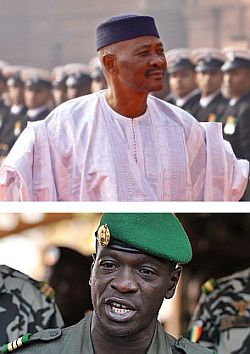
Former President Amadou Toumani Touré (top) and Captain Amadou Sanogo, the leader of the March 2012 coup.

Touré wasn’t a member of any political party, but most of Mali’s established parties joined a coalition in support of his policies. He was able to push sweeping legislation through the National Assembly with little or no debate. In 2009, after the Assembly passed a progressive bill to reform Mali’s 1962 laws governing women’s rights and families by 117 votes to 5, Islamic groups stirred up vociferous opposition, and parliamentarians had to distance themselves from a bill few of them had actually read. The law was never enacted. Touré’s ‘rule by consensus’ became a euphemism for the suppression of political debate and a trend towards absolutism. Checks and balances existed only on paper. Journalists were afraid to challenge the president’s agenda, especially after five of their colleagues were arrested in 2007 for writing about a teacher in Bamako who got his students to comment on a short story about a girl made pregnant thanks to the ‘carnal escapades’ of an African head of state. In Mali’s restive northern regions, ‘rule by consensus’ invited more problems. When a group of Tuareg rebels – seen in the south as gangsters involved in the region’s drug smuggling – rose up in 2006, Touré negotiated a controversial peace accord and withdrew the army from much of the north.

‘A fish rots from the head,’ Malians say. To keep the aid money flowing, Touré maintained a veneer of progress. His government at first boosted the number of children enrolled at school, which pleased donors, but never invested adequately in the country’s dilapidated education system. Only 12 per cent of students passed the high school leaving exams this year, the lowest rate ever recorded. Touré purchased a temporary peace in the north but never made good on promises to reduce the acute poverty there. He accepted millions of dollars of US military aid, which was supposed to be used to drive out al-Qaida in the Islamic Maghreb, but he never actually went after the group’s encampments. The military itself was racked by nepotism, and officers often skimmed off their soldiers’ ammunition and pay.

In 2010, the Global Fund to Fight Aids, Tuberculosis and Malaria suspended aid to Mali after it found that officials had pocketed millions of dollars of its grants. This fraud was noteworthy only because some of its perpetrators were held to account: Touré’s health minister is awaiting trial for embezzlement. The perception that corruption went unchecked at the highest levels of the state cost the president much of his legitimacy at home. At best, Malians felt he had turned a blind eye to the problem; at worst, they accused him and his wife of being directly involved.

As Touré’s second term approached its end, Malians had also lost faith in the rule of law. On the outskirts of Bamako, residents saw their property seized by members of the president’s inner circle, and were powerless to seek redress through the courts. Few Malians felt protected by the police, who were busy extorting bribes from motorists. Judges sold favourable verdicts to the highest bidders. There was the revival of a practice known as Article 320, first seen in the lawless days after Moussa Traoré’s fall: accused thieves were doused with petrol and set alight. (The name comes from the price of a litre of petrol and a box of matches, which in 1991 totalled 320 local francs.) At least seven such vigilante killings were reported in Bamako in the first two months of this year, and it seems likely that many more have taken place since.

The putschists capitalised on the popular disappointment with bogus democracy and weak government, using it to justify their actions. Hours after taking over, [Captain Amadou] Sanogo spoke of his men’s desire for reform: ‘not of the army, of the state’. The junta duly called itself the National Committee for Recovering Democracy and Restoring the State. Sanogo described Mali’s democratic edifice under Touré as a sagging wall that he and his men would knock down and rebuild. The coup had not derailed Mali’s democracy, he claimed, but had been necessary to save it. ‘When at a high level of state responsibility,’ he said in a televised interview in May, ‘you allow yourself to look a citizen in the eyes and lie to him, when you allow yourself to rig elections, to buy elections … is that what you call democracy?’

Whether Sanogo intended to save Mali’s democracy or confiscate it is an open question. But he and his men could never have hoped to overthrow Touré, and win support among Malians, had the country’s core institutions – the police, the courts and the electoral process – been sound. The soldiers who stormed the presidential palace on 21 March knew that Touré no longer had any legitimacy for the Malian people. So did Touré himself: hence his swift and silent departure. He resurfaced weeks later to sign a letter of resignation before the television cameras, then flew into exile in Senegal. [Continue reading…]

Facebooktwittermail

Mali music ban by Islamists ‘crushing culture to impose rule’

Robin Denselow writes: Nowhere does music have a greater social and political importance than in the vast desert state of Mali. It is shocking, therefore, that it has been banned across much of the two-thirds of Mali currently controlled by Islamic rebel groups.

As “Manny” Ansar, the director of the country’s celebrated Festival in the Desert, which has now been forced out of the country, explained: “Music is important as a daily event. It’s not just a business, for it’s through our music that we know history and our own identity. Our elders gave us lessons through music. It’s through music that we declare love and get married – and we criticise and make comments on the people around us.”

Malian musicians have become household names in the west. The list is remarkable, from the late Ali Farka Touré to the soulful Salif Keita, from Toumani Diabaté, the world’s finest exponent of the kora, to the bravely experimental Rokia Traoré. Then there’s the rousing desert blues of Tinariwen, who have performed alongside the Rolling Stones.

There is the passionate social commentary of Oumou Sangaré, and the rousing, commercially successful African pop fusion of Amadou & Mariam.

These musicians, with varied, distinctive styles, have educated western audiences about Africa and their country’s ancient civilisation, and the way in which traditional families of musicians, the griots, had acted as advisers to the rulers and guardians of the country’s history, and kept alive an oral tradition for generation after generation.

And yet the Islamic rebel groups are trying to wipe out this ancient culture – and in the process have forced Malian musicians to examine the role they should now play.

Ansar said he was “ashamed at what has happened has happened – and it was provoked by people who call themselves Muslims, like me”.

When I met him at a censorship conference in Oslo, he said the militias were stopping the music “to impose their authority, so there’s nothing to threaten them”. He added: “That’s why they are attacking the traditional chiefs and musicians. And they’re using concepts of Islam that are 14 centuries old and have never been applied. I find it strange that these ideas are being imposed now. It’s as if they took a computer and wiped the hard drive, and then imposed their ideas instead.”

The situation is particularly painful for musicians from the north of Mali, for bands such as Tinariwen from the nomadic Touareg or Kel Tamashek people, whose international popularity has been helped for the last 12 years by the Festival in the Desert. [Continue reading…]

Facebooktwittermail

Syria: Is it too late?

Frederic C. Hof writes: Syria is dying. Bashar al-Assad has made it clear that the price of his removal is the death of the nation. A growing extremist minority in the armed opposition has made it clear that a Syria of citizenship and civil society is, in its view, an abomination to be killed. And those in the middle long begging for Western security assistance are increasingly bemoaning that it is already too late. Between the cold, cynical sectarianism of Assad and the white-hot sectarian hatred of those extremists among his opponents Syria already is all but gone, a body politic as numbingly cold and colorless as the harsh wintry hell bringing misery and hopelessness to untold numbers of displaced Syrians.

It might in fact be too late to save Syria from the diabolical ministrations of Assad and his enabling Salafist enemies. Indeed, the single-minded, self-centered destructiveness of foes who once cooperated in the killing of Iraqis and who now collaborate in the murder of Syria may be sufficiently powerful to block any effort at national salvation regardless of its source. By facilitating Assad’s poison pill sectarian strategy Iran, Hezbollah, and Russia have facilitated the implantation of al-Qaeda (in the form of the Nusra Front) in Syria. By funneling arms and money to those calling for death to Alawites and the establishment of a Syrian emirate, donors in certain Gulf countries, Turkey, and elsewhere have advanced Assad’s survival strategy with a toxic blend of tactical skill and strategic stupidity. As in “Murder on the Orient Express,” many hands have plunged the knife into a victim perhaps too far gone to be saved.

Yet even if one accepted, analytically, the “it’s too late to save Syria” thesis, and the argument that saving Syria was never something the United States and its allies could do, can this be the basis of prudent policy? If Syria, as now appears likely, becomes a death star of failed statehood, will the effects of its ravaged carcass on the surrounding neighborhood be so benign as to present no challenges to US statecraft far more perilous than those presented by Syria now? Will the great sucking sounds of Lebanon, Jordan, Turkey and perhaps Iraq being pulled into the black hole of what was once Syria become the next normal; chapter two in the “it’s too late” saga? Will Americans at that point look back with regret at our reluctance to try to shape and influence when we may at least have had a chance to do so? [Continue reading…]

Facebooktwittermail

If you think we’re done with neoliberalism, think again

George Monbiot writes: How they must bleed for us. In 2012, the world’s 100 richest people became $241 billion richer. They are now worth $1.9 trillion: just a little less than the entire output of the United Kingdom.

This is not the result of chance. The rise in the fortunes of the super-rich is the direct result of policies. Here are a few: the reduction of tax rates and tax enforcement; governments’ refusal to recoup a decent share of revenues from minerals and land; the privatisation of public assets and the creation of a toll-booth economy; wage liberalisation and the destruction of collective bargaining.

The policies that made the global monarchs so rich are the policies squeezing everyone else. This is not what the theory predicted. Friedrich Hayek, Milton Friedman and their disciples – in a thousand business schools, the IMF, the World Bank, the OECD and just about every modern government – have argued that the less governments tax the rich, defend workers and redistribute wealth, the more prosperous everyone will be. Any attempt to reduce inequality would damage the efficiency of the market, impeding the rising tide that lifts all boats. The apostles have conducted a 30-year global experiment, and the results are now in. Total failure. [Continue reading…]

Facebooktwittermail

Is Washington’s chief drone warrior ready to wind up the CIA’s drone war?

Mark Perry writes: Lost amidst all the fuss over whether Obama nominee Chuck Hagel is – or isn’t – acceptable to the Israeli lobby (or whatever), is the crucial, but strangely low-profile, debate over the president’s nomination of controversial counterterrorism chief John Brennan to head up the CIA.

The 25-year agency veteran, who first tied himself to Obama when the then-Illinois Senator was launching his long-shot campaign for the Oval Office, makes Hagel look positively liberal. This early support for an Illinois back bencher paid off for Brennan, for when Obama took office he immediately turned to the CIA veteran for his expertise on the war on terrorism.

While Brennan’s official title during Obama’s first term was US Deputy National Security Advisor for Homeland Security and Counterterrorism, he was known to critics and supporters alike as “Mr Drone” – the official behind the administration’s more than 350 separate drone strikes in Pakistan, Yemen and Somalia that have killed more than 3400 people, including an estimated 891 civilians.

“No politically appointed official in US history has played such a prominent role in killing so many people outside of a war zone as John Brennan,” Foreign Policy‘s Micah Zenka writes, adding that Brennan is the “most lethal bureaucrat” in Washington.

That may well be, but while Brennan hasn’t exactly been given “a pass” by either Democrats or Republicans (and has been dubbed the administration’s “assassination czar” by American progresssives), his most predictable critics have been less than outspoken in opposing his nomination.

One of the reasons may well be that Brennan believes the CIA should be “demilitarised” (which has gained him the support of the agency’s powerful senior analysts), and its drone war turned over to the Pentagon – which is where it belongs.

Although doing so probably won’t end the programme (should it actually happen), senior military officers are known to be sceptical of its utility, and intelligence veterans support Brennan’s position on transforming the post-Patraeus CIA back into what it was intended to be – an agency that gathers intelligence instead of running push-button wars. [Continue reading…]

Facebooktwittermail

Mr Marlboro: the jihadist back from the ‘dead’ to launch Algerian gas field raid

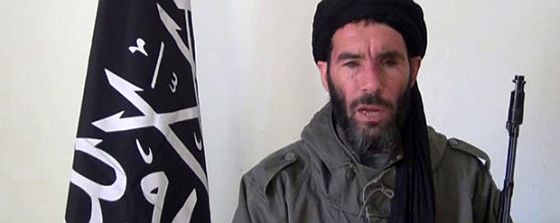
Mokhtar Belmokhtar

Peter Beumont writes: For a man whose death in combat in the Malian city of Gao was announced last June, Mokhtar Belmokhtar – the Islamist militant allegedly behind the raid on the Ansema gas field in Algeria – has been surprisingly busy.

Since that raid – which saw the deaths of several foreign oil workers, including a Briton, and the kidnapping of 41 more – Belmokhtar has been described in journalistic shorthand as “al-Qaida”.

On Thursday, as it was reported that some 25 of those captives had escaped, the real motives behind Belmokhtar’s raid – and his relationships with other Islamist groups in the Sahel – began to emerge as far more complex than first reported.

The standard version of Belmokhtar’s career as an Islamist leader is easy to summarise. The man dubbed the Uncatchable, as well as Mr Marlboro for his involvement in cigarette smuggling, was born in Ghardaia, Algeria, in 1972, starting his jihadist activities early.

By his own account – given in an interview at a time he was trying to shore up his leadership credentials – Belmokhtar, also known as Khalid Abu al-Abbas, travelled aged 19 to Afghanistan, where he claimed he gained training and combat experience before returning to his homeland in 1992.

This launched him into a two-decade career of Islamic militancy, first as a member of Algeria’s Islamic Armed Group (GIA) in the country’s civil war, then as a joint founder of the Salafist Group for Preaching and Combat (GSPC), which started extending its attacks against security forces into countries of the arid Sahel, which forms the southern fringe of the Sahara.

That group evolved into al-Qaida in the Islamic Maghreb (AQIM), a group as much interested in the financial benefits of kidnapping and smuggling as building an Islamic caliphate.

Despite the claims that Belmokhtar’s latest actions were carried out on behalf of AQIM in response to the French military action in Mali, his real agenda is likely to be more complicated and opaque. [Continue reading…]

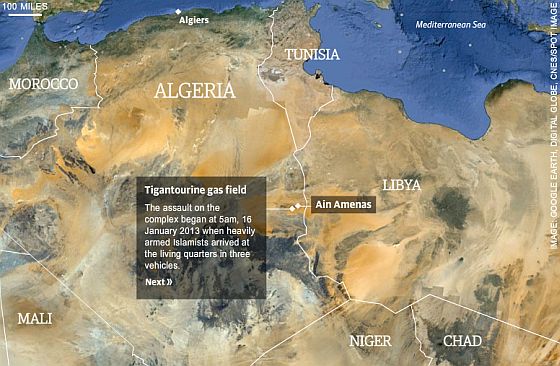
Click on the image below to view an interactive map of the Ain Amenas gas field attack:

Facebooktwittermail

The risks of the French intervention in Mali

Hannah Armstrong writes: Mamadou Doumbia was so thrilled that France intervened this weekend to beat back a jihadi offensive in Mali that on Monday he took me to buy a French flag to mount next to the Malian flag on the dashboard in his taxi.

“If you had given me a French flag nine months ago,” he said, “I would have burned it.”

Just last week, Mamadou was waiting in Bamako in terror as the Al Qaeda-linked trinity that controls northern Mali and has imposed a form of Shariah law there advanced southward on multiple fronts. With the militants closing in on the buffer zone between the rebel-held north and the government-held south, the capital erupted in a series of antigovernment protests and strikes.

There was no doubt that Mali, whose political class and military forces were decimated by the northern rebellion and a coup d’état last March, was not ready to meet its enemy in battle. In Bamako, we were receiving reports that Malian soldiers were already starting to shed their uniforms and flee. The jihadis seemed set on capturing Sévaré, a garrison town about 350 miles northeast of Bamako, with an airport of unparalleled strategic importance.

But Monday, on our way to the busy intersection where a dozen young boys were selling French flags, Mamadou broke into an enormous smile upon hearing a radio broadcast from Sévaré. French airstrikes had killed 60 jihadi rebels in the northern city of Gao, it reported, and the rest were said to be running away. “People have started to smoke cigarettes and wear long pants!” Mamadou translated for me. “They’re playing soccer in the streets!” he said.

The French, by all accounts here, saved Mali from an existential threat and the region from the nightmare of seeing a terrorist stronghold expand.

Yet the hasty, ad hoc French deployment brings dangers of its own. One consequence is that it legitimizes the putschist regime that toppled a twice-elected president last March. Other governments, in particular Washington, had been reluctant to intervene in Mali, largely because of objections to the continued hold on power of Capt. Aya Sanogo, the leader of last year’s coup. The French’s push forward not only validates his presence; it enhances his powers. [Continue reading…]

Facebooktwittermail

Iran’s reactionary revolutionaries

Robin Yassin-Kassab writes: In August 2012 Egyptian President Muhammad Morsi attended a meeting of the Non-Aligned Movement (NAM) in Tehran. His presence at the conference was something of a diplomatic victory for the Iranian leadership, whose relations with Egypt, the pivotal Arab state, had been at the lowest of ebbs since the 1979 revolution.

Egypt’s President Sadat laid on a state funeral for the exiled Iranian shah. A Tehran street was later named after Khalid Islambouli, one of Sadat’s assassins. Like every Arab country except Syria, Egypt backed Iraq against Iran in the First Gulf War. Later, Hosni Mubarak opposed Iranian influence in Iraq, Syria, Lebanon and Palestine, worked with the US and Saudi Arabia against Iran’s nuclear program, and was one of the Arab dictators (alongside the Abdullahs of Jordan and Saudi Arabia) to warn darkly of a rising “Shi’ite cresent”. Not surprisingly, Iran was so overjoyed by the 2011 revolution in Egypt that it portrayed it as a replay of its own Islamic Revolution.

Iran also rhetorically supported the revolutions in Tunisia and Libya, the uprising in Yemen, and, most fervently, the uprising in Shia-majority Bahrain.

In Syria, however, Iran supported the Assad tyranny against a popular revolution even as Assad escalated repression from gunfire and torture to aerial bombardment and missile strikes. Iran provided Assad with a propaganda smokescreen, injections of money to keep regime militias afloat, arms and ammunition, military training, and tactical advice, particularly on neutralising cyber opponents. Many Syrians believe Iranian officers are also fighting on the ground.

Iran’s backing for al-Assad is ironic because at a certain point the Syrian revolution was the one that most resembled 1979 in Iran – the violent repression of demonstrations leading to angry funerals leading to still more in a constantly expanding circle of anger and defiance; the people chanting allahu akbar from their balconies at night; women in hijabs joining women with bouffant hair to protest against regime brutality. [Continue reading…]

Facebooktwittermail

Algeria hostage crisis sparks fears of escalation across region

The Guardian reports: The attack on the Algerian gas field has raised fears of the conflict in Mali becoming an international battle bleeding across the porous borders of the Sahel and Sahara region.

It also presents a major challenge to the military-dominated regime in Algiers – still in the shadow of a decade of bloody civil war – which had been accused of having an ambiguous stance towards the Mali crisis.

Algeria will now firmly be dragged into resolving the Mali conflict, while also dealing with the return of major action by Islamist groups on its home turf.

The hostage-taking has spelled out the complexities of the unrest in the Sahel: a tangled mix of communal tensions, economic struggle, desertification, poverty, criminality, kidnapping and smuggling, which shifts seamlessly across borders.

With six days of French airstrikes failing to erode the Islamist gains in Mali, French special forces prepared to launch a land assault on Wednesday around Diabaly, 250 miles (450 km) from the capital.

France’s aim is to secure the vast desert area seized last year by an Islamist alliance, which combines al-Qaida in the Islamic Maghreb (AQIM) – the terrorist network’s north African wing – with Mali’s homegrown Movement for Oneness and Jihad in West Africa (Mojwa) and Ansar Dine rebel groups. But the Algerian hostage drama at the BP oilfield far away to the north at the Algerian-Libyan border marks a turning point and a widening of the game.

Attacks on oil-rich Algeria’s hydrocarbon facilities are very rare, despite the country’s decades of fighting an Islamist insurgency, mostly in the north.

Jon Marks, associate fellow at Chatham House, London’s leading foreign affairs thinktank, said: “The attack is remarkable for a number of reasons.

“If you look at Algeria’s conflict of the 1990s, out of which AQIM sprang, the major oil and gas fields of the deep south, a strategic interest to Europe, were not attacked. Even in Algeria’s bloody history, this is the first time there has been major attack on a hydrocarbon facility.

“It shows the degree to which the events in Mali are an international Sahel and Sahara-wide issue. These groups are international: including Malians, people who came from the Libya conflict, but also from Algeria and Mauritania.”

He said the attack showed how deep-rooted those groups were. “The groups we are now calling AQIM, that the French military are targeting, have roots going back decades in the region. They have been involved in cigarette smuggling, electronic goods smuggling, guns, drugs, a lot of criminality.”

He described it as a potent “interface” where criminality meets politics in an area that is “more and more desperate”. [Continue reading…]

Facebooktwittermail

Israel’s own behavior poses a threat to its survival

“[I]f Israel, a small state in an inhospitable region, becomes more of a pariah — one that alienates even the affections of the U.S., its last steadfast friend — it won’t survive. Iran poses a short-term threat to Israel’s survival; Israel’s own behavior poses a long-term one.”

That’s a paragraph from Jeffrey Goldberg’s latest column — a column credited with causing Likud to take a hit in the polls with the Israeli election coming up on Tuesday.

Jerusalem Post columnist Michael Freund writes:

According to Goldberg, in the period following the unilateral Palestinian move at the United Nations late last year, Obama said in private conversations that “Israel does not know what its own best interests are.”

He added that Obama believes that “Iran poses a short-term threat to Israel’s survival; Israel’s own behavior poses a long-term one.”

This crude condescension is breathtakingly offensive on so many levels.

Freund goes on to say:

It is essential that American Jewry speak out loudly and clearly against Obama’s insulting tone and aggressive rancor.

But read what Goldberg writes. It’s not unambiguous, but the assertion that Israel’s behavior poses a long-term threat to its survival, is not attributed to Obama. It seems to be coming just as much from Goldberg himself — arguably the most influential voice of American Jewry.

What Freund’s bluster is designed to conceal is a danger to Israel much greater than lack of love from one particular president; it is the opening of a rift much harder to repair as American Jews become resigned to the idea that Israel is sealing its own fate — that if Israel can’t save itself, it can’t be saved by its American friends.

Facebooktwittermail

Israel’s upcoming tribal census

Daniel Levy writes: Israelis will go to the polls on Jan. 22 to elect a new parliament and, by extension, government — an event that has so far attracted relatively little international attention. Understandably so: Benjamin Netanyahu just came closer than any Israeli prime minister in more than two decades to serving out a full parliamentary term, and nobody expects him to lose. His putative challengers from the center have been unable to find, coalesce around, or attract enough support for a credible alternative candidate.

If this election does have a headline, it is the coming of age of Israel’s new right, encapsulated by the candidacy of Naftali Bennett, 40, the new leader of Habayit Hayehudi, the “Jewish Home” Party, which is storming to third place in the polls, having shared the honor of being the smallest party in the outgoing Knesset. Bennett, a former advisor to Netanyahu, is an interesting character: A dot-com millionaire of American parentage, he served in the military’s elite Sayeret Matkal unit, wears a kippa, and is deeply rooted in the national religious movement. Bennett’s soft-spoken style often obscures his hard-line views: He is radically pro-settler and even annexationist in his position on the territories. Israel’s most popular political satire show, Eretz Nehederet (“A Wonderful Country”), has caricatured him as a new software app: the iBennett, a modern version of the old settler model — “no beard, no crazy-mystical gaze, smaller kippa” — but with occasional glitches (the spoof iBennett character recognizes there are other nations in God’s promised land, sounding reasonable, but then reverts to type by claiming “God will strike them with a plague of frogs”).

Alongside Bennett’s rapid rise, Jan. 22 is best understood as a “Tribes of Israel” election — taking identity politics to a new level. Floating votes may exist within the tribes of Israel, but movement between tribes, or political blocs, is almost unheard of. Israelis seem to relate their political choices almost exclusively to embedded social codes rather than contesting policies. [Continue reading…]

Facebooktwittermail

Opening the Gate of the Sun

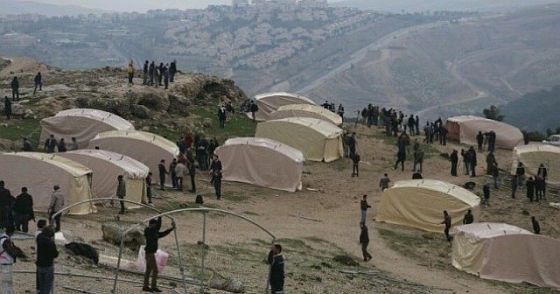
Adam Shatz writes: At 2.30 on Sunday morning, the Israeli army removed 250 Palestinians from Bab al-Shams, a village in the so-called E1 corridor: 13 square kilometres of undeveloped Palestinian land between East Jerusalem and Ma’ale Adumim, an Israeli settlement in the West Bank with a population of 40,000. Israel has had designs on E1 for more than a decade: colonising it would realise the vision of a ‘Greater Jerusalem’, and eliminate the possibility of a contiguous Palestinian state with East Jerusalem as its capital. After the UN vote to recognise Palestine as a non-member observer state, Binyamin Netanyahu declared that Israel would build 4000 new settler homes in E1. The high court issued a six-day injunction against his order to ‘evacuate’ Bab al-Shams, but Netanyahu was in no mood to wait. Once the Palestinians had been driven out, the land was declared a closed ‘military zone’.

It was another bleak day in the story of Palestinians trying to hold onto their land in the face of Israeli expansionism. But it was also something else. Bab al-Shams was no ordinary village, but a tent encampment set up by Palestinian activists, a number of them veterans of the Popular Resistance Committees who have been organising weekly demonstrations against the ‘separation fence’ in the villages of Bil’in and Nil’in. Several journalists noted that the residents of Bab al-Shams used the same tactics as Israeli settlers: pitching their tents, laying claim to the land, establishing ‘facts on the ground’. But the differences were more significant than the resemblances. The pioneers of Bab al-Shams were Palestinians, not foreigners. When settlers establish wildcat outposts, they know that the authorities may chastise them for it but will nonetheless soon supply them with electricity and water, and even build roads and access routes on their behalf. The people of Bab al-Shams knew that an IDF demolition crew would appear in due course: less than three days, as it turned out.

Bab al-Shams took its name from Elias Khoury’s epic novel, published in 1998. In the book, Bab al-Shams (‘the gate of the sun’) is a secret cave where a Palestinian fighter, Yunis, and his wife, Nahilah, meet to make love. They turn it into ‘a house, a village, a country’. Nahilah calls it the only liberated part of Palestine. Khoury gave his blessing to the village of Bab al-Shams. ‘What these guys did in three days,’ he told me, ‘was they opened the Gate of the Sun and liberated a small part of Palestine.’ [Continue reading…]

Facebooktwittermail

Wyden letter to CIA director-nominee Brennan seeks legal opinions on killing of Americans

Press release from the office of Senator Ron Wyden: With the confirmation process for Deputy National Security Advisor John Brennan to be Director of the Central Intelligence Agency set to be begin shortly, U.S. Senator Ron Wyden (D-Ore.), a member of the Senate Select Committee on Intelligence, is asking Brennan to provide Congress with the secret legal opinions outlining the government’s ability to target and kill Americans believed to be involved in terrorism.

In a letter to Brennan [PDF] sent today, Wyden reiterated his concerns that the intelligence community, Justice Department and the Administration have not been adequately forthcoming to Congress on their legal justifications for targeting and potentially killing U.S. citizens believed to be involved in terrorism activities. He said that it is important that the legal opinions guiding these activities be released so that Congress and the American people can “have full knowledge of how the executive branch understands the limits and boundaries of this authority…”

“For the executive branch to claim that intelligence agencies have the authority to knowingly kill American citizens but refuse to provide Congress with any and all legal opinions that explain the executive branch’s understanding of this authority represents an alarming and indefensible assertion of executive prerogative,” Wyden wrote in the letter.

For more than two years, Wyden has been seeking these legal opinions and others but has either received insufficient responses to his inquiries or no response at all. He has asked that prior to the start of Brennan’s confirmation hearing in the Intelligence committee that he and other committee members and their cleared staffs are given these opinions and that written assurance be given to the committee that future legal opinions related to this topic will also be provided.

“I have an obligation from my oath of office to review any classified legal opinions that lay out the federal government’s official views on this issue, and I will not be satisfied until I have received them,” Wyden continued in the letter.

Wyden also asked for a list of countries in which the intelligence community has used its lethal counterterrorism authorities. He also is seeking declassification of secret legal opinions made by the Justice Department’s Office of Legal Counsel one of which regards common commercial service agreements. He has asked for this legal opinion to be revoked.

Facebooktwittermail