The Washington Post reports: With President Obama readying an overhaul of the nation’s gun laws, a liberal think tank with singular influence throughout his administration is pushing for a sweeping agenda of strict new restrictions on and federal oversight of gun and ammunition sales.
The Center for American Progress is recommending 13 new gun policies to the White House — some of them executive actions that would not require the approval of Congress — in what amounts to the progressive community’s wish list.
CAP’s proposals — which include requiring universal background checks, banning military-grade assault weapons and high-capacity ammunition magazines, and modernizing data systems to track gun sales and enforce existing laws — are all but certain to face stiff opposition from the National Rifle Association and its many allies in Congress.
Obama — as well as Vice President Biden, who is leading the administration’s gun violence task force — has voiced support for many of these measures. Yet it is unclear which policies he ultimately will propose to Congress. Biden is planning to present his group’s recommendations to Obama on Tuesday.
CAP’s recommendations, presented Friday to White House officials and detailed in an 11-page report obtained by The Washington Post, establish a benchmark for what many in Obama’s liberal base are urging him to do after last month’s massacre at an elementary school in Newtown, Conn.
Britain to send aircraft to Mali to assist French fight against rebels
The Guardian reports: Britain announced on Saturday night that it was deploying aircraft to assist French military operations against Islamist rebels in Mali as an escalation in hostilities was claimed to have killed more than 120 people.
David Cameron’s offer to transport foreign troops and equipment involved Britain in a fresh conflict that could provoke terrorist reprisals against European targets. President François Hollande yesterday placed France on high alert as French planes bombarded targets in Mali.
Downing Street said two transport planes would be dispatched, but British troops would not join the French military mission to help recapture the north of Mali from al-Qaida-linked rebels acting against the country’s government.
“The prime minister spoke to President Hollande this evening to discuss the deteriorating situation in Mali and how the UK can support French military assistance provided to the Malian government to contain rebel and extremist groups in the north of the country,” a spokeswoman said. “Both leaders agreed that the situation in Mali poses a real threat to international security given terrorist activity there.”
Earlier, Hollande warned that two days of air strikes by French war planes were only the opening salvoes in a longer campaign. “We have already held back the progress of our adversaries and inflicted heavy losses on them. But our mission is not over yet,” he said.
Video: Latest developments in Syria following Assad’s speech
Iran and the fallacy of saber-rattling
Paul Pillar writes: Among several broadly held misconceptions about Iran is that to get Iranians to make concessions we want them to make at the negotiating table the United States must credibly threaten to inflict dire harm on them—specifically, with military force—if they do not make the concessions. Some in the United States (and some in Israel) who are especially keen on promoting this notion would welcome a war. If war preparations and brinksmanship used to communicate such a threat lead the two nations to stumble into an accidental war—and there is a real danger they might—so much the better from their point of view. But the belief in saber-rattling as an aid to gaining an agreement in the negotiations over Iran’s nuclear program extends to many who actually want an agreement and are not seeking a war. We have heard more about this lately in connection with Chuck Hagel’s nomination to be secretary of defense. People ask whether this nominee, who has evinced an appreciation of the huge downsides of a war with Iran, would be able to rattle the saber as convincingly as the same people think a secretary of defense ought to rattle it.
Even the usually thoughtful David Ignatius has adopted this line of thought. In his latest column he makes a comparison with nuclear deterrence in the time of Dwight Eisenhower. Under the doctrine of mutual assured destruction, a “bluff” of “frightening the Soviets with the danger of Armageddon” was used to dissuade them from overrunning Western Europe. “Obama,” says Ignatius, “has a similar challenge with Iran.”
No, he doesn’t. One situation was deterrence of what would have been one of the most epic acts of aggression in history. The other is an effort to compel a far lesser country to curtail or give up an avowedly peaceful program, and to do so by threatening what itself would be an act of aggression. [Continue reading…]
Video: Israel forces Palestinians from ‘tent city’
The bravest politician in Israel
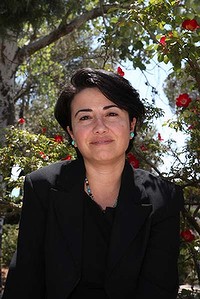
Larry Derfner writes: Sitting in a barren, slightly mildewy campaign office in this Arab village, I asked Haneen Zoabi, an Arab member of the Israeli Knesset, what it was like being the country’s most hated politician. “It doesn’t bother me at all,” she said.
It’s easy to believe. Zoabi’s style is to head for the eye of the Arab-Jewish political storm — the result being that while she is the Jewish majority’s most hated politician, she may well be the Arab minority’s most beloved.
Zoabi is running for reelection in Israel’s Jan. 22 parliamentary election, but it was a struggle to even reach this point. Right-wing Knesset members moved to have her disqualified, saying she had “undermined the state of Israel” and “openly incited” against the government. Only a decision by the Israeli Supreme Court in late December overturned the ban. A poll published in Haaretz indicated that her legal victory stood to gain her small, virtually all-Arab party an additional Knesset seat.
Zoabi, 43, petite and pretty in black jacket, slacks, and pointed heels — a modern, single woman in a conservative, patriarchal Arab subculture — had just exhorted some 50 local residents to “use all the democratic tools at our disposal to carry on the struggle.” She urged them not to be what she derided as “good Arabs,” those who “thank Israel every day for not expelling them in 1948, who think they are not equal to Jewish citizens.”
She had held the audience’s attention for nearly two hours. In the front row sat middle-aged Arab women in Islamic headscarves next to high school girls in jeans. Afterward, amid the stream of well-wishers, the girls came up and exchanged phone numbers with her. “She’s the only Arab woman who speaks for us, who gives us the courage to stand up to the racism,” said one. [Continue reading…]
A maid’s execution in Saudi Arabia

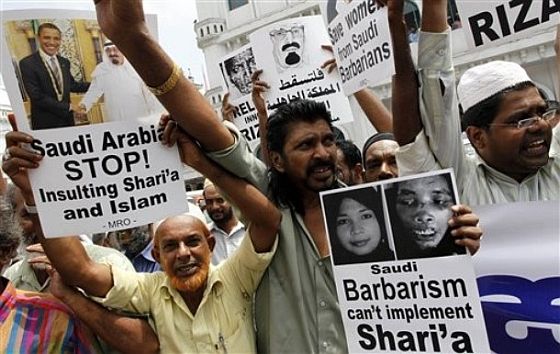
Protesters demanding a pardon for Sri Lankan maid Rizana Nafeek, July 2011.
Basharat Peer writes: On Wednesday, the Saudi Arabian government beheaded Rizana Nafeek, a Sri Lankan woman who had worked as a maid in the kingdom, holding her responsible for the death of the four-month-old baby of her employer.
Nafeek — the daughter of an impoverished wood-cutter from a village in Trincomalee, in northern Sri Lanka — was a seventeen-year-old in the second week of her job as a maid in the Saudi town of Dawadmi when the child died in her care on May 22, 2005. She said that she had been bottle-feeding him when he choked. Her employer, Naif Al-Otaibi, accused her of strangling the child after an argument with his wife and took her to a local police station, where she was arrested.
Nafeek was tried in the Dawadmi High Court without legal representation. The main evidence against Nafeek was a “confession” she had signed in the police station. On June 16, 2007, the Dawadmi High Court sentenced her to death. After the news of her conviction spread, Fernando Basil, a Sri Lankan expatriate who runs the Hong Kong-based human-rights group Asian Human Rights Commission, hired a Saudi lawyer named Kateb Al Shammari and appealed Nafeek’s conviction.
To lift up her family from desperate poverty, Nafeek had dropped out of high school in Mutter village near Trincomalee in Sri Lanka and moved to Saudi Arabia to work as a maid. Men from domestic-worker recruiting agencies based in the Sri Lankan capital, Colombo, tour the countryside selling Saudi and Gulf dreams of prosperity to impoverished families. It is a process that is replicated in India, Pakistan, Bangladesh, and the Philippines, among other places. Nafeek’s family was convinced, but they faced a technical problem: she was a minor, seventeen years old, born on February 4, 1988. For a fee, the agent made her passport with a falsified date of birth, which listed her as a twenty three year old, born on February 2, 1982. And with that Nafeek became one of the twenty-five million migrant domestic workers in the Middle East, mostly from Asia and Africa.
Although their remittances lift their societies from stark poverty, a foreign maid steps into a world of abuse, overwork, and suspicion. Migrant workers enter Saudi Arabia and most other oil-rich Middle Eastern countries through a system known as kafala, or sponsorship. Kafala has happier roots; it is the Bedouin tradition of granting a stranger temporary refuge and feeding him as long as he wishes. In the modern Arab world, kafala has become an oppressive, non-transferable visa regime, which ensures that a foreign worker can only work for the kafeel, the employer who sponsored his/her visa. On a worker’s arrival, the kafeel generally confiscates his or her passport, and the worker is left with little protection. [Continue reading…]
Video — Noam Chomsky: The responsibility of privilege
Video: Matt Taibbi and William Black on bailout secrets and how new foreclosure deal spares banks from justice
France continues Mali strikes, sends troops to Bamako
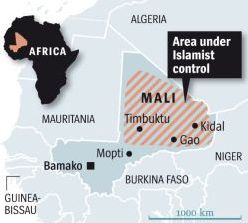
Reuters reports: French forces carried out a second day of air strikes against Islamist rebels in Mali on Saturday and sent troops to protect the capital Bamako in an operation involving several hundred soldiers, Defence Minister Jean-Yves Le Drian said.
A French pilot was killed on Friday when his helicopter was shot down during an air strike near the central town of Mopti as France began the operation to help the Malian government stem a push south by rebels who control much of the north, he said.
The operation targeted a column of rebels headed for Mopti, he said.
“In this intense fighting, sadly, one of our pilots … was fatally injured. He was evacuated to the nearest medical centre before dying of his wounds,” Le Drian told a news conference.
He said France had sent special forces into Mopti to prepare the ground and later sent “several hundred” troops into Bamako on Friday to safeguard the capital.
Nick Hopkins writes: [I]f the jihadists are not stopped in their tracks, the US and EU may yet get drawn into an emerging crisis in a country that some security analysts regard as a dangerous new frontier for Islamic extremism in the post-Afghanistan era.
The attack this week was certainly audacious. Konna is barely 25km from a military base at Sévaré, where the French military is understood to have been flying personnel and supplies this week.
At the moment, it is difficult to know exactly who is behind this new push, but it is likely the group of hardcore jihadists fighting under the broad banner of ‘al-Qaida in the Islamic Maghreb’ are principally involved.
They brought with them the tactics of terror – kidnappings of westerners and the imposition of harsh sharia law in the places over which they have control.
They have been supported by thousands of Tuareg tribesmen, many of whom have returned to Mali last year after being recruited by Muammar Gaddafi to support his regime. Paul Melly, who has written on Mali for Chatham House, said: “This is the first serious attempt by the jihadist groups to push towards the more densely settled south of Mali.
“If they were to break past Konna and seize Mopti, one of the most important towns in Mali, that would be a major blow to morale as well as a military setback.”
“Several jihadist groups are active in northern Mali. Ansar Dine, which is mainly composed of local Tuaregs, may be seeking to bolster its hand in negotiations with the government, which it recently began but then suspended.
“But the other jihadist factions, including al-Qaida in the Islamic Maghreb, are largely foreign-led and have not been engaged in talks. Following December’s UN vote to authorise a west African intervention force, the rebels may be trying to seize as much ground as they can before international troops arrive to help the government mount a push to restore its authority in the north.”
Alex Perry adds: There is still a lingering colonial attitude in Paris that France is primus inter pares among foreign players in the region: West Africa is part of la francophonie — the French-speaking world — and France demands and assumes the role of lead international player there. Second, and not unrelated, there is a (probably well-founded) fear in France that a radical Islamist Mali threatens France most of all, since most of the Islamists are French speakers and many have relatives in France. (Intelligence sources in Paris have told TIME that they’ve identified aspiring jihadis leaving France for northern Mali to train and fight.) Al-Qaeda in Islamic Maghreb (AQIM), one of the three groups that make up the Malian Islamist alliance and which provides much of the leadership, has also designated France — the representative of Western power in the region — as a prime target for attack.
But while everyone had agreed on the need for action, no one wanted to be the one to actually do it. The Islamists have made tens of millions of dollars from ransoming Western hostages and cocaine smuggling and spent much of it on acquiring large parts of Muammar Gaddafi’s arsenal, brought into Mali by Tuareg troops who fought for the former Libyan dictator.
Facing off against them is a Malian army that is demoralized, rarely paid, sometimes barely fed, and poorly armed. Backstopping it in any fight under long-discussed plans were also meant to be Mali’s West African neighbors, represented by the West African regional grouping, ECOWAS. But divided, dysfunctional and with mostly similarly ragged armies at its disposal, ECOWAS has so far produced little in the way of solid troop commitments.
These uncomfortable realities made an earlier U.N.-French plan — in which a West African force of 3,000 would fight the Islamists, while French and U.S. trainers would assist the Malian army in doing the same — “crap,” in the delicate leaked words of the U.S. ambassador to the U.N., Susan Rice. Indeed, the notion that an African intervention force had remained an idea rather than a reality was recognized in the U.N.’s initial resolution in favor of military action in Mali, passed on Dec. 20, which clarified that any force was unlikely to deploy until September. Hollande’s description of that earlier resolution as a game changer seemed emptier still when considered against the Islamists’ holding of at least seven French hostages — specifically, as one Islamist commander told TIME last year, to safeguard against any French action. And if war was a poor prospect, peace talks weren’t a great option either. The last round didn’t even include the Islamists, broke up in December without any resolution and was in any case hosted by Burkina Faso, whose security services have long been suspected of benefiting commercially from Islamist kidnappings.
Video: On being wrong
Music: Quantic — ‘Transatlantic’
Neurons gone wild

Daniel Dennett says: Each neuron is imprisoned in your brain. I now think of these as cells within cells, as cells within prison cells. Realize that every neuron in your brain, every human cell in your body (leaving aside all the symbionts [such as mitochondria]), is a direct descendent of eukaryotic cells that lived and fended for themselves for about a billion years as free-swimming, free-living little agents. They fended for themselves, and they survived.
They had to develop an awful lot of know-how, a lot of talent, a lot of self-protective talent to do that. When they joined forces into multi-cellular creatures, they gave up a lot of that. They became, in effect, domesticated. They became part of larger, more monolithic organizations. My hunch is that that’s true in general. We don’t have to worry about our muscle cells rebelling against us, or anything like that. When they do, we call it cancer, but in the brain I think that (and this is my wild idea) maybe only in one species, us, and maybe only in the obviously more volatile parts of the brain, the cortical areas, some little switch has been thrown in the genetics that, in effect, makes our neurons a little bit feral, a little bit like what happens when you let sheep or pigs go feral, and they recover their wild talents very fast.
Maybe a lot of the neurons in our brains are not just capable but, if you like, motivated to be more adventurous, more exploratory or risky in the way they comport themselves, in the way they live their lives. They’re struggling amongst themselves with each other for influence, just for staying alive, and there’s competition going on between individual neurons. As soon as that happens, you have room for cooperation to create alliances, and I suspect that a more free-wheeling, anarchic organization is the secret of our greater capacities of creativity, imagination, thinking outside the box and all that, and the price we pay for it is our susceptibility to obsessions, mental illnesses, delusions and smaller problems.
We got risky brains that are much riskier than the brains of other mammals even, even more risky than the brains of chimpanzees, and that this could be partly a matter of a few simple mutations in control genes that release some of the innate competitive talent that is still there in the genomes of the individual neurons. But I don’t think that genetics is the level to explain this. You need culture to explain it.
This, I speculate, is a response to our invention of culture; culture creates a whole new biosphere, in effect, a whole new cultural sphere of activity where there’s opportunities that don’t exist for any other brain tissues in any other creatures, and that this exploration of this space of cultural possibility is what we need to do to explain how the mind works. [Continue reading…]
France launches air strikes in Mali against Islamist rebels
Reuters reports: France carried out air strikes against Islamist rebels in Mali on Friday as it began a military intervention intended to halt a drive southward by the militants who control the country’s desert north.
Western governments, particularly former colonial power France, voiced alarm after the al Qaeda-linked rebel alliance captured the central Malian town of Konna on Thursday, a gateway towards the capital Bamako 600 km (375 miles) further south.
President Francois Hollande said France would not stand by to watch the rebels push southward. Paris, the leading advocate for foreign intervention in Mali, has repeatedly warned that Islamists’ seizure of the country’s north in April gave them a base to attack the West.
“We are faced with blatant aggression that is threatening Mali’s very existence. France cannot accept this,” Hollande said in a New Year speech to diplomats and journalists.
The president said resolutions by the United Nations Security Council, which in December sanctioned an African-led military intervention in Mali, mean France is acting in accordance with international law.
A military operation had not been expected until September due to the difficulties of training Malian troops, funding the African force and deploying during the mid-year rainy season. However, Mali’s government appealed for urgent military aid from France on Thursday after Islamist fighters took Konna.
The Washington Post adds: Konna lies about 45 miles north of Mopti, which is the northernmost headquarters for Malian government military operations. French officials expressed fear the Islamist forces, if they continue their advance, could capture Mopti and from there push all the way south to Bamako, the capital more than 300 miles to the southwest.
“Their objective obviously was the control of all Mali in order to turn it into a terrorist state,” said Foreign Minister Laurent Fabius.
Against that background, France on Friday ordered nonessential French citizens to leave the country and international aid organization in Bamako began evacuating their foreign employes.
The Malian army has been largely in disarray since a bungled coup d’etat in March led by Capt. Amadou Haya Sanogo. Following the coup, Tuareg guerrilla forces in the Azawad National Liberation Movement, led by Col. Mohamed Ag Najim, took control of the area with little opposition from the leaderless army. On April 6 they declared independence for “the Islamic State of Azawad,” the Tuareg name for the region.
Northern Mali’s Tuareg population, ethnically different from the black residents of Bamako and the south, have long sought independence or at least greater autonomy. A number of accords have been reached over the years, some brokered by neighboring Algeria, only to end up dead letter.
Najim’s forces were fresh from years of serving in Libya as an adjunct to Col. Muammar Gaddafi’s army. As a result, they were trained and well armed, according to some reports with surface-to-air missiles from Gaddafi’s arsenal.
In addition, Najim was aided by the Ansar al-Din al-Salafiya, a fundamentalist Islamist Tuareg group with close ties to al-Qaeda in the Islamic Maghreb and led by Iyad Ag Ghali. Before the summer was over, the three main branches of AQIM had filed into the region, along with other extremist groups, and pushed Najim’s mainly secular forces aside, setting up what amounted to an Islamist outland.
Drones are fool’s gold: they prolong wars we can’t win
Simon Jenkins writes: The greatest threat to world peace is not from nuclear weapons and their possible proliferation. It is from drones and their certain proliferation. Nuclear bombs are useless weapons, playthings for the powerful or those aspiring to power. Drones are now sweeping the global arms market. There are some 10,000 said to be in service, of which a thousand are armed and mostly American. Some reports say they have killed more non-combatant civilians than died in 9/11.
I have not read one independent study of the current drone wars in Afghanistan, Pakistan and the horn of Africa that suggests these weapons serve any strategic purpose. Their “success” is expressed solely in body count, the number of so-called “al-Qaida-linked commanders” killed. If body count were victory, the Germans would have won Stalingrad and the Americans Vietnam.
Neither the legality nor the ethics of drone attacks bear examination. Last year’s exhaustive report by lawyers from Stanford and New York universities concluded that they were in many cases illegal, killed civilians, and were militarily counter-productive. Among the deaths were an estimated 176 children. Such slaughter would have an infantry unit court-martialled. Air forces enjoy such prestige that civilian deaths are excused as a price worth paying for not jeopardising pilots’ lives.
This week President Obama appointed two drone “enthusiasts” as his new defence secretary, Chuck Hagel, and his new CIA chief, John Brennan. Drone war is now the flavour of the month and the military-industrial complex is licking its lips. If Obama, himself a lawyer, had any reservations about the legality of these weapons, he has clearly overcome them. [Continue reading…]
Death of a prisoner
Laura Poitras writes: When President Obama pledged to close the Guantánamo Bay prison on his first day in office as president in 2009, I believed the country had shifted direction. I was wrong. Four years later, President Obama has not only institutionalized Guantánamo and all the horrors it symbolizes, but he has initiated new extrajudicial programs, like the president’s secret kill list.
In September 2012 I read the news that another prisoner at Guantánamo had died, and I knew I had probably met his family. I traveled to Yemen in 2007 with the idea of making a film about a Guantánamo prisoner. I went there with the Guantánamo lawyer David Remes. He met with families and delivered the news of their sons, brothers, fathers and husbands. I had hoped to film the journey of someone being released from Guantánamo and returning home. Five years later, I find myself making that film, but under tragic circumstances.
Adnan Farhan Abdul Latif recently died in solitary confinement at Guantánamo at age 36, after nearly 11 years of imprisonment there, despite never having been charged with a crime. Last month his body was returned to his family in Yemen, but we are left with many unanswered questions about his imprisonment and death.
Mr. Latif’s death is under investigation by the United States military, which claims he committed suicide from an overdose of prescription medication complicated by acute pneumonia. But that’s hard to take at face value. Why was he placed in solitary confinement when he was suffering from acute pneumonia? How could he have overdosed on medication, given the strict protocols at Guantánamo? Why did it take three months for the body to be returned to Yemen? And finally, why are his autopsy and toxicology report classified and being withheld from his family?
These questions are not just about Adnan Latif. They also address the injustices that our government has instituted and normalized in the war on terror.
What John Brennan’s support for CIA torture meant for Sami al-Hajj
Amy Goodman writes: It takes courage to enter a warzone willingly, armed with a microphone and a camera as a journalist. That is what al-Jazeera cameraman Sami al-Hajj was doing in December 2001, as he was entering Afghanistan from Pakistan to cover the US military operations there.
While his colleague was allowed in, al-Hajj was arrested, in what was to be a harrowing, nightmarish odyssey that lasted close to seven years, most of it spent as prisoner 345, the only journalist imprisoned at Guantánamo Bay – without charge. Al-Hajj is out now, back at work at al-Jazeera and reunited with his family. His recollections of the horror of detention by the United States should be front and center in the forthcoming confirmation hearings for President Barack Obama’s choice to lead the CIA, John Brennan.
It has been 11 years since the Guantánamo prison was opened, and four years since President Obama promised to close it within a year.
“He speaks very eloquently [about] what many hundreds of other detainees suffered, who cannot tell their story,” Baher Azmy, legal director of the Center for Constitutional Rights, told me:
“The brutality he suffered in Afghanistan, the fact that he was turned over for political reasons or for a bounty, the arbitrariness of his detention in Guantanamo and the brutality of his treatment there.”
I sat down with Sami al-Hajj last month at al-Jazeera’s headquarters in Doha, Qatar. [Continue reading…]
Forming a Syrian opposition government: the time is now
Frederic C. Hof writes: The Syrian Opposition Council (SOC) formed in November 2012 faces no shortage of dire challenges as it tries to organize itself and give desperately needed political leadership to a heterogeneous hodgepodge of armed and unarmed opponents of the dying yet lethally venomous regime of Bashar al-Assad. How to uphold the primacy of citizenship in an increasingly sectarian struggle? How to maintain credibility with those who are fighting and dying? How to reach out to minorities and other fence sitters inside Syria? How to prepare for the practicalities of transition and governance? How to shape and influence international support for Syria’s revolution rather than being shaped and influenced by outsiders? How to eclipse internal rivalries and policy differences with selflessness and a unifying sense of mission encompassing a broadly acceptable vision of what the new Syria will be and how it will function?
In a just world, Syrians emerging from an induced political coma of some 50 years would not be faced with such daunting tasks. Starting with the 1958-1961 Egyptian-run United Arab Republic, Syrians have become accustomed to the heavy hand of intelligence services on political discourse. Over the years, frank political discussions even within families became guarded and circumscribed, a condition not significantly altered by the “Damascus Spring” experiment over a decade ago. Now it is all out there for discussion and decision. Syrians who, not long ago, could only choose among silence, torture, and departure are now being asked to practice teamwork, transparency, and compromise. There is nothing fair or just about this situation.
Yet fair or not, ready or not, Syria requires a government. For more than 40 years the Syrian Arab Republic Government (SARG) was the transmission belt for the desires of a narrow, family-based clique. That government is now neutered—the geographical scope of its assigned writ having shrunken dramatically over the past 21 months. Yet a functioning bureaucracy will be central to any transition plan due to the need for continuity of government. Ministries, departments, and agencies—including the security services—employ people and provide services, albeit often ineffectively and corruptly. The preservation of these organs, as imperfect as they are, can facilitate the rapid dispersal of international assistance post-Assad and reassure millions of Syrians who fear the chaos of revolutionary rule. Reform will come in time. It is important to distinguish government and its associated bureaucracy from the ruling clique, which has become a militia, willing and even eager to risk destroying Syria to try to save itself.
As I have written previously the old expression, you can’t beat something with nothing, applies in spades to Syria. No one—not even Bashar al-Assad himself—doubts the corruption, incompetence, and brutality of what remains of the old system. Yet millions of Syrians grudgingly adhere to “the Doctor.” They do so partly because they fear his jailers and torturers, but largely because they know not what comes next. This is the obstacle that a provisional government formed by the SOC can address and overcome. [Continue reading…]