1. What was the most difficult class you took in college? Good question. Gives them a chance to come off as pleasantly humble. If they say Organic Chemistry, we know they’re not lying. If they can’t recall even one class that gave them trouble, it’s not going to ruin them, but they’ll come off as inattentive or evasive.
2. What trait or talent does your opponent possess that you most admire or wish you possessed? Wouldn’t we all like to know this? Mitt might say he wished he could debate or play basketball as well as the President, and Obama might say he envied Mitt because, as a Mormon, he gets to wear magic underwear.
3. With the exception of your wife or mother, what woman has had the most profound effect on your life? Tough question, especially being sprung without warning. That’s why it would be fascinating to hear their answers.
4. Who are your favorite writers? They better have some, otherwise they’re going to sound uninformed, uninquisitive and uncultured….positively Palinesque.
5. Who are your favorite singers or musical groups? We’d all like to know this. Wouldn’t it be shocking if Obama said he liked the Carpenters and Eagles, and Romney admitted to being a fan of Lil’ Kim?
6. Do you believe that, even with its atrocious human rights record, we should continue to give financial aid to Ruwati? A trick question meant to test their honesty. There is no such country as Ruwati. Would these guys admit to having never heard of the place, or would they try to bullshit us? [Continue reading…]
George Monbiot writes: Over the gates of Auschwitz were the words “Work Makes You Free“. Over the gates of the Solovetsky camp in Lenin’s gulag: “Through Labour – Freedom!”. Over the gates of the Ngenya detention camp, run by the British in Kenya: “Labour and Freedom”. Dehumanisation appears to follow an almost inexorable course.
Many tens of thousands were detained and tortured in the camps. I won’t spare you the details: we have been sparing ourselves the details for far too long. Large numbers of men were castrated with pliers. Others were raped, sometimes with the use of knives, broken bottles, rifle barrels and scorpions. Women had similar instruments forced into their vaginas. The guards and officials sliced off ears and fingers, gouged out eyes, mutilated women’s breasts with pliers, poured paraffin over people and set them alight. Untold thousands died.
The government’s secret archive, revealed this April, shows that the attorney general, the colonial governor and the colonial secretary knew what was happening. The governor ensured that the perpetrators had legal immunity: including the British officers reported to him for roasting prisoners to death. In public the colonial secretary lied and kept lying. [Continue reading…]
Andrew Parasiliti writes: Turkish President Abdullah Gul said this week that Syria is becoming the “worst-case scenario that we’ve all been dreading.”
The shelling across the Turkish-Syrian border, now entering its seventh day, gives further testimony, as if any were needed, that Turkey’s Syria policies have failed and that the civil war in Syria is also a regional, sectarian war, with no end in sight.
Turkish intervention in Syria is unpopular and Ankara may be desperate to end it. A clear majority of Turkish citizens oppose intervention in Syria, according to a recent poll. Just two years ago, Turkey prospered under a “good neighbor” policy with Syria, Iran and Iraq. Now Turkey has problems along all three borders.
Any clear-eyed assessment of the battlefield does not foresee President Bashar al-Assad stepping down or being forced to step down anytime soon. Assad is committed to staying in place until constitutionally mandated elections in 2014, and he has not yet decided whether he will run in those elections. Russia and Iran have no interest in letting his regime fall. [Continue reading…]
CNN reports: For years, Abdullah al-Omar rubbed shoulders with some of the most powerful people in Syria.
In case there is any doubt, he is quick to show photos in his phone as proof.
Scores of photographs show the corpulent Syrian beaming and shaking hands with government ministers, foreign dignitaries, and even the Syrian president.
“He knew me by name,” al-Omar said, pointing to a photo of himself standing with Bashar al-Assad. “One day we were sitting at a table and he fed me with his own hand and said to me, ‘You love food since you are from Aleppo.’ Then he said to his escort, ‘Take special care of Abdullah al-Omar because he loves food and his stomach.'”
Al-Omar claims that for five years he worked in the press office of the presidential palace in Damascus, as part of a 15-person team under the direction of long-time government spokeswoman and presidential adviser Bouthaina Shabaan.
Al-Omar claims that for five years he worked in the press office of the presidential palace in Damascus, as part of a 15-person team under the direction of long-time government spokeswoman and presidential adviser Bouthaina Shabaan.
Until he defected and fled the Syrian capital last month, al-Omar said, the bulk of his work consisted of lying.
“Our job was to fabricate, make deceptions and cover up for Bashar al-Assad’s crimes,” he said.
The New York Times reports: The United States military has secretly sent a task force of more than 150 planners and other specialists to Jordan to help the armed forces there handle a flood of Syrian refugees, prepare for the possibility that Syria will lose control of its chemical weapons and be positioned should the turmoil in Syria expand into a wider conflict.
The task force, which has been led by a senior American officer, is based at a Jordanian military training center built into an old rock quarry north of Amman. It is now largely focused on helping Jordanians handle the estimated 180,000 Syrian refugees who have crossed the border and are severely straining the country’s resources.
American officials familiar with the operation said the mission also includes drawing up plans to try to insulate Jordan, an important American ally in the region, from the upheaval in Syria and to avoid the kind of clashes now occurring along the border of Syria and Turkey.
The officials said the idea of establishing a buffer zone between Syria and Jordan — which would be enforced by Jordanian forces on the Syrian side of the border and supported politically and perhaps logistically by the United States — had been discussed. But at this point the buffer is only a contingency.
The Obama administration has declined to intervene in the Syrian conflict beyond providing communications equipment and other nonlethal assistance to the rebels opposing the government of President Bashar al-Assad. But the outpost near Amman could play a broader role should American policy change. It is less than 35 miles from the Syrian border and is the closest American military presence to the conflict. [Continue reading…]
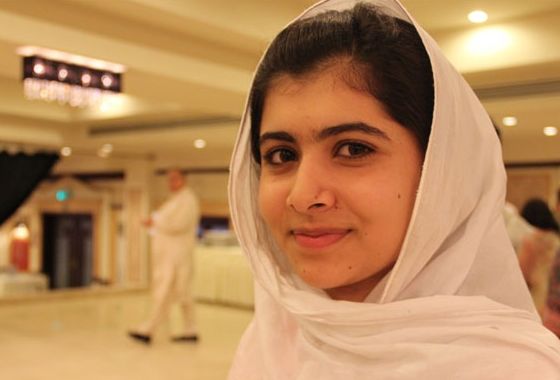
Rob Creely writes: Few in Pakistan dare to stand up to the home-grown thugs and gangsters of the Taliban. When they extended their reign of terror through the Swat Valley in 2007 and 2008 what did the government and military do? They signed a ceasefire allowing the extremist cleric Maulana Fazlullah a free hand to continue his campaign of beheadings and intimidation.
Malala Yousufzai was one of the few brave voices who spoke out. She did it anonymously – to do otherwise would have brought immediate death. But her blog for the BBC Urdu Service detailing the abuses meant no one could pretend an accommodation with the terrorists was anything other than a deal with the devil.
Now she lies in a hospital bed in a critical condition after being shot by the Pakistan Taliban. So serious are her injuries that a 737 remains on standby ready to fly her to Dubai once she is well enough to be moved.
Malala is not the first campaigner to be singled out for assassination by the Taliban thugs. Commanders of anti-Taliban militias, women’s rights campaigners, anyone who has suggested reform of the draconian blasphemy laws risks death. Pakistan is long hardened to vicious, senseless killings. Few raise more than a murmur, such is the wearying nature of Pakistan bloody list of the dead. (Unless America can be blamed, in which case there will be an orchestrated outcry.)
Declan Walsh reports: At the age of 11, Malala Yousafzai took on the Taliban by giving voice to her dreams. As turbaned fighters swept through her town in northwestern Pakistan in 2009, the tiny schoolgirl spoke out about her passion for education — she wanted to become a doctor, she said — and became a symbol of defiance against Taliban subjugation.
On Tuesday, masked Taliban gunmen answered Ms. Yousafzai’s courage with bullets, singling out the 14-year-old on a bus filled with terrified schoolchildren, then shooting her in the head. Two other girls were also wounded in the attack.
All three survived, but on Wednesday a neurologist said Ms. Yousafzai was in critical condition at a hospital in Peshawar, though doctors had been able to remove a bullet. A government official in Peshawar, speaking on condition of anonymity, said arrangements had been made to send Ms. Yousafzai abroad for treatment, but that doctors had said she should not be moved for now. The two other wounded girls were reported to be in stable condition.
A Taliban spokesman, Ehsanullah Ehsan, confirmed by phone Tuesday that Ms. Yousafzai had been the target, calling her crusade for education rights an “obscenity.” [Continue reading…]
The Telegraph reports: A 14-year-old Pakistani girl who campaigned to promote education and expose extremist brutality has been shot in the head by gunmen from the Pakistani Taliban in a retaliatory attack.
Malala Yousafzai was on her way home from school in the former militant stronghold of Swat when two men opened fire, shooting her in the forehead and injuring two other girls.
Witnesses said a bearded man had asked for the girl by name before opening fire.
Her work earned her international recognition and numerous peace awards after she was revealed as the brave seventh grader who wrote an anonymous blog for the BBC’s Urdu service when the Taliban controlled Swat in 2009.
But it also brought death threats.
On Tuesday, a spokesman for the Pakistan Taliban claimed responsibility for the attack, accusing her of promoting Western, secular values.
“This was a new chapter of obscenity, and we have to finish this chapter,” he said. “We have carried out this attack.”
Reuters adds: Taliban spokesman Ehsanullah Ehsan said his group was behind the shooting.
“She was pro-West, she was speaking against Taliban and she was calling President Obama her ideal leader,” Ehsan said by telephone from an undisclosed location.
“She was young but she was promoting Western culture in Pashtun areas,” he said, referring to the main ethnic group in northwest Pakistan and southern and eastern Afghanistan. Most members of the Taliban come from conservative Pashtun tribes.
The Express Tribune reports: The Tehreek-i-Taliban Pakistan (TTP) which attacked National Award Peace winner Malala Yousafzai on Tuesday have said that they will target her again if she survives because she was a “secular-minded lady”.
A TTP spokesperson told The Express Tribune that this was a warning for all youngsters who were involved in similar activites and added that they will be targeted if they do not stop.
Channel Four News aired this report:
Adam Ellick at the New York Times interviewed Malala extensively in a 2009 documentary that was rebroadcast on Al Jazeera:
Ellick writes: The Malala I know transformed with age, from an obedient, rather shy girl 11-year-old into a publicly fearless teenager consumed with taking her activism to new heights. Her father’s personal crusade to restore female education seemed contagious. He is a poet, a school owner and an unflinching educational activist. Ziauddin is truly one of most inspiring and loving people I’ve ever met, and my heart aches for him today. He adores his two sons, but he often referred to Malala as something entirely special. When he sent the boys to bed, Malala was permitted to sit with us as we talked about life and politics deep into the night.
After the film was seen, Malala became even more emboldened. She hosted foreign diplomats in Swat, held press conferences on peace and education, and as a result, she won a host of peace awards. Her best work, however, was that she kept going to school.
In the documentary, and on the surface, Malala comes across as a steady and calming force, undeterred by anxiety or risk. She is mature beyond her years. She never displayed a mood swing, and never complained about my laborious and redundant interviews.
Reuters reports: NATO said on Tuesday it had drawn up plans to defend Turkey if necessary against any further spillover of violence from Syria’s border areas where rebels and government forces are fighting for control.
Rebel suicide bombers struck at President Bashar al-Assad’s heartland, attacking an Air Force Intelligence compound on the edge of Damascus, insurgents said. Activists living nearby said the bombing caused at least 100 casualties among security personnel, based on the ambulances that rushed to the scene.
“Assad…is only able to stand up with crutches,” Turkish Prime Minister Tayyip Erdoğan, once a close ally of Assad, told a meeting of his ruling AK Party.
“He will be finished when the crutches fall away.”
Erdoğan, reacting to six consecutive days where shells fired from Syrian soil have landed on Turkish territory, has warned Ankara will not shrink from war if forced to act. But Ankara has also made clear it would be reluctant to mount any major operation on Syrian soil, and then only with international support.
Syrian forces and rebels have clashed at several sites close to the Turkish border in the last week. There has been no sign of any major breakthrough by either side, though activists said rebels killed at least 40 soldiers on Saturday in a 12-hour battle to take the village of Khirbet al-Joz.
It was not clear whether the shells landing on the Turkish side were aimed at Turkey or simply the result of government troops overshooting as they attacked rebels to their north. [Continue reading…]
The New York Times reports: The night before leaving his parents’ home in Wayne, Tex., to join the rebels trying to overthrow President Bashar al-Assad in Syria, Obaida Hitto left a bouquet of white roses for his mother, with a sterling silver locket and a note: “You’ve made me what I am. But now I need to go and do what I need to do.”
Mr. Hitto, 25, a former high school football player, deferred his plans for law school to sneak into Syria to assist the rebels by making videos and spreading information on the Internet to help their cause.
“I’m one of them,” Mr. Hitto said proudly during a recent telephone interview.
Since the early days of the uprising, Syrian rebel forces have filled their ranks with army defectors and civilians. But as the war has dragged on, and the government has made it much harder for soldiers to defect, two other groups have contributed to the opposition. There has been a rise in the number of foreign fighters, many of them Islamist extremists. But there has also been a small, though noticeable, number of men like Mr. Hitto, of Syrian descent and with Western passports, who have made the journey to join the Free Syrian Army. Experts estimate they number roughly a hundred and come from the United States, Britain, France and Canada.
Their presence is not enough to shift the tide of the battle, but they add another element of determination and complexity to a bloody landscape where loyalties and ambitions are often unclear.
“Even though he’s not fighting on the front lines, I would consider him a foreign fighter,” Aaron Y. Zelin, a fellow at the Washington Institute for Near East Policy, said of Mr. Hitto. Mr. Zelin keeps a rough tally of foreign fighters in Syria based on news reports and Islamist postings and said the two groups together number in the thousands.
Mr. Hitto, who has extended family in Damascus, has spent five months posting videos and photographs from Deir al-Zour, sometimes very near the fighting, many marked by billowing plumes of thick smoke, the clack of gunfire and narrations that shake with an activist’s conviction and anger, delivered in an American accent. “All around us there is shooting,” he said in an Aug. 1 clip of a burning building. “The world seems to not care.” [Continue reading…]
Jason Pack and Haley Cook write: Libya’s experiment in democracy has taken another unexpected turn. On the surface, the elections to the General National Congress (GNC) last July produced a surprising victory for the “liberal” National Forces Alliance (NFA) and a fairly resounding defeat for the Muslim Brotherhood’s Justice and Construction party.
But when those political parties were unable to forge a national unity government, that picture changed. It became inevitable that locally elected independents, who form the majority of the Congress, would come to the fore.
On 12 September, the NFA saw its prime ministerial candidate, Mahmoud Jibril, defeated by two votes in favour of Mustafa Abushagur, the outgoing deputy prime minister.
Abushagur seemed to be a compromise candidate. He enjoyed a reputation as a good manager with moderate Islamist leanings but without party affiliation. All elements of the “anyone but Jibril” camp rallied around him: Cyrenaicans and Tripolitanians, Muslim Brothers and Misratans with loyalties to their homegrown militias. It seemed then that Abushagur was just the man to cobble together a coalition of Libya’s many factions.
And yet, when he presented his first cabinet list, it featured unexpected members of the outgoing transitional government, lacked a single candidate from the NFA, contained unknown quantities for key posts including the oil ministry, … and furthermore, it was apparent that Abushagur’s allies were favoured.
Libya has so many cities that harbour intense local sentiment and it is manifestly impossible to appease them all simultaneously. Yet protesters from Zawiya were not placated by such hard truths; they stormed the Congress building.
When the list was read out in Congress, the NFA members simply walked out. As a result, the Libyan government and Abushagur were disgraced. The authorities revealed that they did not yet have sufficient military capacity to provide adequate security for their own parliamentary offices, let alone for the complex process of disarming and demobilising the hundreds of militias. For his part, Abushagur had clearly miscalculated how his cabinet list would be received – suggesting that he was not the right man for the moment after all. [Continue reading…]
Should it rely on the FBI, treating the assaults on the two U.S. compounds like a regular crime for prosecution in U.S. courts? Can it depend on the dysfunctional Libyan government to take action? Or should it embrace a military option by ordering a drone strike — or sending more prisoners to Guantanamo Bay?
President Obama has vowed to “bring to justice” the killers of Ambassador J. Christopher Stevens and three other Americans. But nearly one month later, the White House has not spelled out how it plans to do so, even if it is able to identify and capture any suspects.
Each of the options is fraught with practical obstacles and political baggage. An unproductive, slow-moving investigation is complicating matters, with the FBI taking three weeks to reach the unsecured crime scene. Meanwhile, the administration has given contradictory assessments, initially suggesting the attack was committed in the heat of the moment by a mob and more recently saying it was planned by terrorists affiliated with al-Qaeda.
On Tuesday, Obama’s chief counterterrorism adviser, John O. Brennan, is scheduled to visit Tripoli to meet with senior Libyan officials and give a high-level kick to the investigation.
The White House is not ruling out any option, an administration official said. The official, who spoke on the condition of anonymity to describe the evolving policy, said the involvement of the FBI at this stage should not be taken as evidence that the administration plans to prosecute any suspects in U.S. courts.
More broadly, it remains uncertain whether the White House will respond to the fatal assault on the Americans in Benghazi as a criminal act or an act of war, a critical legal distinction that has gone unresolved in Washington since the other Sept. 11 attacks, in 2001. [Continue reading…]
Chris Hedges gave this talk Sunday night in New York City at a protest denouncing the 11th anniversary of the war in Afghanistan. The event, at the Vietnam Veterans Memorial, was led by Veterans for Peace.
Many of us who are here carry within us death. The smell of decayed and bloated corpses. The cries of the wounded. The shrieks of children. The sound of gunfire. The deafening blasts. The fear. The stench of cordite. The humiliation that comes when you surrender to terror and beg for life. The loss of comrades and friends. And then the aftermath. The long alienation. The numbness. The nightmares. The lack of sleep. The inability to connect to all living things, even to those we love the most. The regret. The repugnant lies mouthed around us about honor and heroism and glory. The absurdity. The waste. The futility.
It is only the maimed that finally know war. And we are the maimed. We are the broken and the lame. We ask for forgiveness. We seek redemption. We carry on our backs this awful cross of death, for the essence of war is death, and the weight of it digs into our shoulders and eats away at our souls. We drag it through life, up hills and down hills, along the roads, into the most intimate recesses of our lives. It never leaves us. Those who know us best know that there is something unspeakable and evil many of us harbor within us. This evil is intimate. It is personal. We do not speak its name. It is the evil of things done and things left undone. It is the evil of war.
We do not speak of war. War is captured only in the long, vacant stares, in the silences, in the trembling fingers, in the memories most of us keep buried deep within us, in the tears.
It is impossible to portray war. Narratives, even anti-war narratives, make the irrational rational. They make the incomprehensible comprehensible. They make the illogical logical. They make the despicable beautiful. All words and images, all discussions, all films, all evocations of war, good or bad, are an obscenity. There is nothing to say. [Continue reading…]
The Washington Post reports: One-fifth of U.S. adults say they are not part of a traditional religious denomination, new data from the Pew Research Center show, evidence of an unprecedented reshuffling of Americans’ spiritual identities that is shaking up fields from charity to politics.
But despite their nickname, the “nones” are far from godless. Many pray, believe in God and have regular spiritual routines.
Their numbers have increased dramatically over the past two decades, according to the study released Tuesday. About 19.6 percent of Americans say they are “nothing in particular,” agnostic or atheist, up from about 8 percent in 1990. One-third of adults under 30 say the same. Pew offered people a list of more than a dozen possible affiliations, including “Protestant,” “Catholic,” “something else” and “nothing in particular.”
For the first time, Pew also reported that the number of Americans identifying themselves as Protestant dipped below half, at 48 percent. But the United States is still very traditional when it comes to religion, with 79 percent of Americans identifying with an established faith group.
Experts have been tracking unaffiliated Americans since their numbers began rising, but new studies are adding details to the portrait.
Members can be found in all educational and income groups, but they skew heavily in one direction politically: 68 percent lean toward the Democratic Party. That makes the “nones,” at 24 percent, the largest Democratic faith constituency, with black Protestants at 16 percent and white mainline Protestants at 14 percent. [Continue reading…]
The problem which any unaffiliated minority faces is that lack of affiliation means lack of representation. We, by definition, have no singular voice.
In God’s Law, Fuqua’s 2012 book, the candidate wrote that while parents love their children, a process could be set up to allow for the institution of the death penalty for “rebellious children,” according to the Arkansas Times. Fuqua, who is anti-abortion, points out that the course of action involved in sentencing a child to death is described in the Bible and would involve judicial approval. While it is unlikely that many parents would seek to have their children killed by the government, Fuqua wrote, such power would serve as a way to stop rebellious children.
Here’s the passage in Deuteronomy 21:18-21 that calls for child killing:
18 If a man have a stubborn and rebellious son, which will not obey the voice of his father, or the voice of his mother, and that, when they have chastened him, will not hearken unto them:
19 Then shall his father and his mother lay hold on him, and bring him out unto the elders of his city, and unto the gate of his place;
20 And they shall say unto the elders of his city, This our son is stubborn and rebellious, he will not obey our voice; he is a glutton, and a drunkard.
21 And all the men of his city shall stone him with stones, that he die: so shalt thou put evil away from among you; and all Israel shall hear, and fear.
Noam Chomsky writes: With the quadrennial presidential election extravaganza reaching its peak, it’s useful to ask how the political campaigns are dealing with the most crucial issues we face. The simple answer is: badly, or not at all. If so, some important questions arise: why, and what can we do about it?
There are two issues of overwhelming significance, because the fate of the species is at stake: environmental disaster, and nuclear war.
The former is regularly on the front pages. On Sept. 19, for example, Justin Gillis reported in The New York Times that the melting of Arctic sea ice had ended for the year, “but not before demolishing the previous record – and setting off new warnings about the rapid pace of change in the region.”
The melting is much faster than predicted by sophisticated computer models and the most recent U.N. report on global warming. New data indicate that summer ice might be gone by 2020, with severe consequences. Previous estimates had summer ice disappearing by 2050.
“But governments have not responded to the change with any greater urgency about limiting greenhouse emissions,” Gillis writes. “To the contrary, their main response has been to plan for exploitation of newly accessible minerals in the Arctic, including drilling for more oil” – that is, to accelerate the catastrophe.
This reaction demonstrates an extraordinary willingness to sacrifice the lives of our children and grandchildren for short-term gain. Or, perhaps, an equally remarkable willingness to shut our eyes so as not to see the impending peril.
That’s hardly all. A new study from the Climate Vulnerability Monitor has found that “climate change caused by global warming is slowing down world economic output by 1.6 percent a year and will lead to a doubling of costs in the next two decades.” The study was widely reported elsewhere but Americans have been spared the disturbing news.
The official Democratic and Republican platforms on climate matters are reviewed in Science magazine’s Sept. 14 issue. In a rare instance of bipartisanship, both parties demand that we make the problem worse. [Continue reading…]
Reuters reports: China’s leading telecom equipment makers accused in a U.S. congressional report of being a potential security risk may face fresh scrutiny in other markets, while American firms operating in China could be vulnerable to retaliation.
The U.S. House of Representatives’ Intelligence Committee on Monday warned that China could use equipment made by Huawei Technologies Co Ltd and ZTE Corp – the world’s second- and fifth-largest makers of routers and telecoms gear – for cyber-espionage through software embedded in Chinese-made network equipment.
In its 52-page report, the committee noted that “China’s military and intelligence services, recognizing the technological superiority of the U.S. military, are actively searching for asymmetrical advantages that could be exploited in any future conflict with the United States. … Malicious implants in the components of critical infrastructure, such as power grids or financial networks, would also be a tremendous weapon in China’s arsenal,” it stated.
China’s official People’s Daily newspaper accused the committee on Tuesday of acting on a “presumption of guilt” against Huawei and ZTE. “This foolhardy political step … will impede the healthy development of Sino-American trade cooperation,” said a commentary in the newspaper, which generally reflects government thinking.
It added that the committee had produced “not an iota” of evidence to back its accusation that Huawei and ZTE products were used for espionage in the United States. “This report, which spurns the facts and is suffused with prejudice, is a vicious expansion of trade protectionism,” it said.
Bloomberg columnist Paula Dwyer agrees: What the report lacks is evidence. It also smacks of protectionism, despite denials by the committee chairman, Michigan Republican Mike Rogers, that he is invoking national security to shield U.S. telecoms equipment companies from Chinese competition.
The House investigation found “credible” reports of illegal behavior by Huawei, including immigration violations, bribery and corruption. But the original allegations that triggered the investigation a year ago — that Huawei and ZTE were installing equipment with codes to relay sensitive information back to China — are far from proven.
60 Minutes ran a report on Huawei in which it contrasted the way Chinese companies are subservient to the government with the way U.S. companies supposedly operate without much government interference. That might apply to Wall Street, but when it comes to surveillance, the U.S. telecom corporations only concern about fulfilling government requests is that they receive adequate compensation.
In the CBS report, Huawei’s founder, Ren Zhengfei, is portrayed as a sinister character because of his ties with the Chinese military and Communist Party. Maybe Sprint’s CEO, Dan Hesse, should be viewed with equal suspicion. He does after all serve on President Obama’s National Security Telecommunications Advisory Committee. And maybe the $176,700 that the House intel committee chairman Mike Rogers received from the U.S. communications/electronics sector this year has some relevance here.
This website or its third-party tools use cookies, which are necessary to its functioning. By closing this banner, you agree to the use of cookies.