BBC speaks to Mohammed al-Jayoosi, Syria Arab News Agency correspondent in Jordan

In an interview with the BBC, a correspondent for Syria’s state-run SANA comes out with a series of bizarre claims such as these: that the protest movement that began in Syria in March 2011 had no political agenda; that the protests were induced by people standing at the back of the crowds releasing chemicals causing a sexual frenzy; that the Shabiha are not thugs, as they are commonly described, but are humanitarian workers and social media activists.

Facebooktwittermail

After this, Julian Assange has very few friends left in Sweden

Karin Olsson writes: Julian Assange’s circus has pulled off another breathtaking stunt: he has won political asylum in Ecuador. Assange’s flight from Sweden, a decent democracy with a largely excellent justice system, takes ever more absurd forms. After the decision of Ecuador’s foreign minister, Ricardo Patiño, the Swedish Twitterverse filled with mocking jokes.

Assange has few fans left here. On the contrary, his unholy alliance with Ecuador’s political leadership casts a shadow over what was, despite everything, his real achievement: to reveal shattering news through the revolutionary medium of WikiLeaks.

Patiño praised Assange as a fighter for free expression, and explained that they had to protect his human rights. But Ecuador is a country with a dreadful record when it comes to freedom of expression and of the press. Inconvenient journalists are put on trial. Private media companies may not operate freely.

President Rafael Correa is patently unable to tolerate any truths that he does not own. Reporters Without Borders has strongly and often criticised the way that media freedoms are limited in Ecuador. Assange is a plaything for the president’s megalomania. [Continue reading…]

Facebooktwittermail

Richard Silverstein exposed

In a post I published yesterday I described Richard Silverstein as a fool. It appears that I may have been treating him too kindly.

Richard Silverstein

Soon after Silverstein published a “document” which he described as “Bibi’s Secret War Plan” a number of Israeli readers were quick to note the glaring similarity between this “document” and a post on the Israeli social media site, Fresh.

Silverstein accounted for the similarities by saying this:

My original IDF source leaked the post to a Fresh member and me at the same time. That person published a small portion of the original memo at Fresh, embellishing it with much material that was meant to disguise what it was and where it came from. I can’t ascribe motives to whoever published it at Fresh, but much of it [is] fantasy and isn’t in the original document.

The operators of Fresh have now released the following statement which makes it clear that Silverstein’s “document” originated from the Fresh post itself. Whether it was Silverstein’s own plagiarism or someone else’s we don’t know, but his claim that this is an Israeli government document has now been shown to be false. Again, whether Silverstein was duped or was a knowing participant in this act of falsification, we don’t know.

I suggested yesterday that Silverstein has been given attention by the mainstream media that he doesn’t deserve, but I think the situation has now changed. The same reporters who were recently willing to turn to him for information about his latest dubious “scoop” should now be calling him to ask some tough questions.

Here’s the statement from Fresh:

Over the past two days, most of the people in Israel (ourselves included), have seen news reports all over the media, detailing the “Israeli Iran Attack Plan”, allegedly originating from one Richard Silverstein, an American Anti-Israeli blogger.

Silverstein, whose lack of integrity is shown by his claims to have never visited www.fresh.co.il though he has an active account, which he used to write 11 posts (the 12th was an attempt to publish classified information and resulted in deletion and a six month suspension of his account – suspension which was ended over a year ago), published yesterday a translation of what he claimed to have been a document obtained from “a high-level Israeli source who received it from an IDF officer”.

Since we can’t read minds, we can only guess whether Silverstein source actually exist, and whether the source was informed on this “attack plan”. What we don’t need to speculate about, is the fact the first publication of the said document (in a different version, which defined it as “an optimistic scenario for an attack in Iran” and clearly stated that it was based on foreign and non-classified sources and on the author’s own imagination) – was published four days before Silverstein’s publication, right here, on this website, in the Army and Security Forum, as a thread which was started by the forum’s moderator, Sirpad, on behalf of one of the forum’s most veteran and respected users, who was the original author of the document (yes, he and non-other).

Since we have no expectations that a man who dedicates his life to causing harm to the State of Israel and its citizens, will be honest enough to admit that his “scoop” is neither scoop nor his, we were hoping that at least the Israeli Media, which rushed to quote Silverstein, Will know to give Sirpad, the real author, and original place of publication, their due credit. Needless to say they we were disappointed. Since yesterday there were articles in NRG, YNET, Channel 2, Ma’ariv (whose printed version did point out that Silverstein wasn’t in fact the first publisher of the story, but failed to name Sirpad, The real author, or fresh.co.il and identified the true origin as “an Israeli Forum” ), Israel army radio and “Israel Hayom” – and none of them gave the credit which media outlets are supposed to give.

Worthy of a positive mention is Avri Gilad who named the true origin of the story both in his morning show in Channel 2 and in his radio show in the Army radio.

We understand there is great deal of embarrassment among the media, which had quoted a dubious and irresponsible blogger, but that shouldn’t, in our opinion, cause them to refrain from correcting their articles, now, when they know the truth. In fact the seriousness of a news publication can be measured in its willingness to admit its mistakes and to correct them.

We hope that media outlets, mentioned here, all of them among the most respected in Israel, will know to set things right, and clarify that the original publication was written by a veteran and well known member of the fresh.co.il community, and was published on his behalf by the Moderator of the Army and Security Forum, Sirpad. That is how a responsible media should act – and this how any news organization would expect other to treat him or its reporters were things different.

Sincerely,
Fresh.co.il team

Facebooktwittermail

Securing Syria chemical weapons may take tens of thousands of troops

Reuters reports: The United States and its allies are discussing a worst-case scenario that could require tens of thousands of ground troops to go into Syria to secure chemical and biological weapons sites following the fall of President Bashar al-Assad’s government, according to U.S. and diplomatic officials.

These secret discussions assume that all of Assad’s security forces disintegrate, leaving chemical and biological weapons sites in Syria vulnerable to pillaging. The scenario also assumes these sites could not be secured or destroyed solely through aerial bombings, given health and environmental risks.

A U.S. official, speaking on condition of anonymity to explain the sensitive discussions, said the United States still had no plans to put boots on the ground in Syria. President Barack Obama’s administration has, in fact, so far refused to provide lethal support to the rebels fighting to oust Assad’s regime and the Pentagon has played down the possibility of implementing a no-fly zone anytime soon.

“There is not a imminent plan to deploy ground forces. This is, in fact, a worst-case scenario,” the official said, adding U.S. forces would likely play a role in such a mission.

Two diplomatic sources, also speaking on condition of anonymity, said as many as 50,000 or 60,000 ground forces may be needed if officials’ worst fears are realized, plus additional support forces.

Even a force of 60,000 troops, however, would not be large enough for peacekeeping and would only be the amount required to secure the weapons sites – despite some of the appearances of a Iraq-style occupation force, the diplomatic sources cautioned.

It is unclear at this stage how such a military mission would be organized and which nations might participate. But some European allies have indicated they are unlikely to join, the sources said.

Facebooktwittermail

Pakistani nuclear weapons base attacked by militants

Declan Walsh reports: An attack early Thursday on a major Pakistani air force base where some of the country’s nuclear weapons are thought to be stored set off a heavy gun battle in which eight attackers and one security official were killed.

The authorities believe Islamic militants are responsible for the attack, on the Minhas air force base in Kamra, 25 miles northwest of the capital, Islamabad. The assault was a stark reminder of the militants’ determination to attack Pakistan’s most sensitive installations despite continuing military operations in their tribal hide-outs.

The sprawling air base, in the Attock district of Punjab, is believed by some Western experts to be one of the locations where elements of Pakistan’s nuclear stockpile, estimated to include at least 100 warheads, is stored. But Pakistani officials have denied that.

Over the past several years there have been several attacks on bases that are believed to be involved in the country’s nuclear program, but most evidence has suggested that the militants were targeting the country’s military capability in general.

Facebooktwittermail

What’s behind the ‘new’ intelligence on Iran’s nuclear program

Jeffrey Lewis writes: On Aug. 9, the Israeli newspaper Haaretz reported that U.S. President Barack Obama has received a new Special National Intelligence Estimate finding that “Iran has made surprising, significant progress toward military nuclear capability.” U.S. officials have refused to confirm that the new estimate exists — either on the record or anonymously — but the administration has asserted that its overall assessment remains unchanged since its last public statement this January, when James Clapper, the director of national intelligence, said, “Iran is keeping open the option to develop nuclear weapons … should it choose to do so. We do not know, however, if Iran will eventually decide to build nuclear weapons.” Defense Secretary Leon Panetta reiterated this view on Tuesday, Aug. 14. Unfortunately, the White House’s concerted campaign to criminalize national security discourse has prevented officials from discussing the estimate with journalists, allowing the most alarmist conjecture to dominate public debate.

The “new” intelligence is probably old news, but that’s hard to see, especially when reporters and officials continue to misstate the judgments of the now famous 2007 National Intelligence Estimate (NIE) on Iran’s nuclear capabilities and intentions. Unless you have carefully read that report, you are almost certainly misinformed about what it says. Much of the discourse, even among foreign-policy “elites,” includes wildly inaccurate assertions, which in turn makes the entire discourse about Iran much, much dumber.

This is not the time to dumb down the discussion of Iran’s nuclear programs. There is growing support for military action, and we are entering the homestretch of a U.S. presidential election, when sober policy analysis will take a back seat to rhetorical machismo and blatant pandering to any ill-informed prejudice that might swing a few votes. I don’t know if time is drawing short, but my friends and colleagues are clearly wondering about the possibility. Injecting a little realism into this discussions depends, first and foremost, on understanding what the intelligence estimates do, and do not, say.

There have been at least four NIEs on Iran’s weapon-of-mass-destruction programs: in 2001, 2005, 2007, and 2011. (The 2005 document was a “memo to holders,” but for our purposes we can refer to all of them as NIEs.) The defining text is the 2007 NIE. In the popular telling of the story, the 2007 NIE reversed the findings of previous NIEs, revealing that Iran had no nuclear weapons program. This is, depending on your political inclination, a courageous act of dissent by an intelligence community desperate to stop George W. Bush’s warmongering administration from invading yet another country, or a cowardly effort by unelected bureaucrats to subvert the will of the people by undermining Bush’s determination to prevent the most dangerous weapons from falling into the most dangerous hands. Neither of these caricatures is remotely accurate. [Continue reading…]

Facebooktwittermail

Who delivers the smart message?

This is the definition of ideological myopia: the ideologue can’t see beyond his or her own convictions and so is singularly lacking when it comes to the art of persuasion.

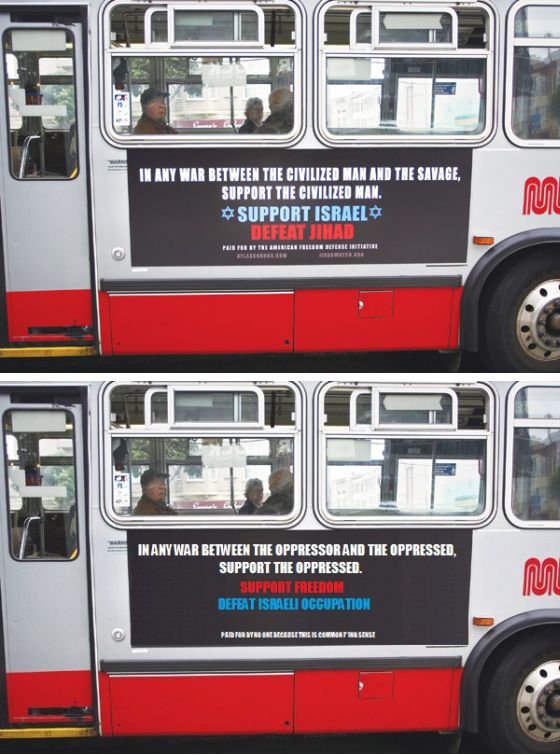
Pamela Geller thinks that a message plastered on the side of a bus is a good way of reaching a lot of people — especially in a city like San Francisco where there are lots of buses and lots of pedestrians. The problem for her is that the message she wants to spread is one that is likely to only appeal to Islamophobic bigots like her. It’s hateful tone simply won’t resonate with people who don’t already share her fears.

Yousef Munayyer has come up with a counter-message (which is thus far just a photoshop image) and since he doesn’t go for the jugular or push a slogan that merely appeals to pro-Palestinian activists, he’s crafted a message that does what every effective political message should do: attempt to engage people with open minds.

Facebooktwittermail

Assange is still stuck

The retired British ambassador, Oliver Miles, addresses some of the speculation on whether Julian Assange will be able to leave the Ecuadorian embassy in London now that he has been offered political asylum.

Jeremy Harding quotes someone talking of Assange being ‘set on a rapid path to Ecuadorian citizenship and finally awarded a minor consular position, which gets him from the steps of the embassy to a boarding gate at Heathrow under diplomatic immunity’. That won’t wash: you don’t get diplomatic immunity in Britain until your name has been notified by your government and accepted by the FCO [Foreign and Commonwealth Office], which can refuse without giving reasons.

When Assange went into the Ecuadorian Embassy I assumed that the FCO would ask the Ecuadorians either to hand him over or let the British police go in and get him. Not to do so would send a message to every crook in London: find an ambassador, pay him off, and you have free passage to the Costa del Crime.

If the Ecuadorians said no, the British government would be under no international diplomatic obligation to take the matter further, but if they did not do so they could not fulfil their obligation under British and European law to extradite Assange to Sweden. I would assume that they would assess their options, up to and including expelling the ambassador, considering ways to get the Ecuadorians to change their position, and taking into account other British interests that might be at risk. Timing is always important, and in this case it seems that the British government need be in no particular hurry.

Britain’s foreign secretary, William Hague, says:

We will not allow Mr Assange safe passage out of the United Kingdom, nor is there any legal basis for us to do so. The United Kingdom does not recognise the principle of diplomatic asylum.

It is far from a universally accepted concept: the United Kingdom is not a party to any legal instruments which require us to recognise the grant of diplomatic asylum by a foreign embassy in this country.

Moreover, it is well established that, even for those countries which do recognise diplomatic asylum, it should not be used for the purposes of escaping the regular processes of the courts. And in this case that is clearly what is happening.

Facebooktwittermail

Julian Assange asylum: Ecuador is right to stand up to the U.S.

Mark Weisbrot writes: Ecuador has now made its decision: to grant political asylum to Julian Assange. This comes in the wake of an incident that should dispel remaining doubts about the motives behind the UK/Swedish attempts to extradite WikiLeaks founder Julian Assange. On Wednesday, the UK government made an unprecedented threat to invade Ecuador’s embassy if Assange is not handed over. Such an assault would be so extreme in violating international law and diplomatic conventions that it is difficult to even find an example of a democratic government even making such a threat, let alone carrying it out.

When Ecuadorian foreign minister Ricardo Patiño, in an angry and defiant response, released the written threats to the public, the UK government tried to backtrack and say it wasn’t a threat to invade the embassy (which is another country’s sovereign territory). But what else can we possibly make of this wording from a letter delivered by a British official?

“You need to be aware that there is a legal base in the UK, the Diplomatic and Consular Premises Act 1987, that would allow us to take actions in order to arrest Mr Assange in the current premises of the embassy. We sincerely hope that we do not reach that point, but if you are not capable of resolving this matter of Mr Assange’s presence in your premises, this is an open option for us.”

Is there anyone in their right mind who believes that the UK government would make such an unprecedented threat if this were just about an ordinary foreign citizen wanted for questioning – not criminal charges or a trial – by a foreign government?

Ecuador’s decision to grant political asylum to Assange was both predictable and reasonable. But it is also a ground-breaking case that has considerable historic significance.

First, the merits of the case: Assange clearly has a well-founded fear of persecution if he were to be extradited to Sweden. It is pretty much acknowledged that he would be immediately thrown in jail. Since he is not charged with any crime, and the Swedish government has no legitimate reason to bring him to Sweden, this by itself is a form of persecution. [Continue reading…]

I would add this one speculative note: that the British government did not act on its own initiative in making its outrageous threat to storm the Ecuadorian embassy. It was surely acting under pressure from the U.S. — pressure that led the British, as they so often do, to surrender their better judgement if by doing so they might hope to please Washington. Why this obsequious relationship still endures, heaven only knows.

Facebooktwittermail

Richard Silverstein is a fool. Shame on the media for taking him seriously

There’s a form of laziness, opportunism, and cynicism that is far too common among mainstream journalists: the willingness to report on stories that news reporters themselves believe to be false.

Why would a journalist from the BBC or the New York Times or some other publication that purports to have a high regard for its own credibility treat as newsworthy something that even their own readers will quickly conclude deserves no attention?

For the simple reason that once something, however fanciful, enters the public domain thanks to the world of push-button publishing we now live in, it can be treated as a phenomenon in the news environment and thus traded as a piece of news. Its veracity can be treated as secondary to the fact that it has already become a subject of conversation. Most importantly, the journalist who chooses to breath life into such a worthless story can contrive a judicious distance from the story by attaching the necessary number of caveats that make it clear that he is doing nothing more than repeat someone else’s claims. Note that this kind of reporting will always repeatedly use the phrase “says” in order to underline that no factual claims are being made by the reporter. The reporter assumes a pretense of agnosticism.

In addition to employing fake naivety, the reporter will also fall back on the myth that journalists are mere observers — that they do not have an instrumental role in making news.

So, to turn to the specific case now at hand — Richard Silverstein’s latest episode of blogging buffoonery — the BBC‘s diplomatic correspondent Jonathan Marcus who interviewed Silverstein yesterday would no doubt explain his choice to do so by saying that the story — Silverstein’s promotion of a bogus war plan for an Israeli attack on Iran — is “out there.”

Marcus writes:

The leaked text may or may not be a precis of Israel’s battle plans.

But it is now an integral part of the increasingly feverish national debate and a debate that resonates well beyond Israel’s own borders.

But it’s only an integral part of that debate thanks to the BBC and others. Were it not for the attention that the press gives Silverstein, his blog would generally be ignored and he would not be flattered by being referred to as a journalist.

Silverstein’s latest antics began with a post titled “Bibi’s Secret War Plan“. The post includes a passage of text that Silverstein describes as a “document” and he claims that this is Benjamin Netanyahu’s “pitch for war” against Iran. He claims that this is an “Israeli government document” yet presents no evidence to back up this claim other than that his source’s source described it as such.

The one thing that seems clear about this “document” is that it was written by someone who knows Hebrew so I think one could strongly infer that means the author is in Israel. Having limited the number of possible authors to a few million Hebrew speakers, how are we going to radically narrow that range and determine this was written inside the Israeli government for consideration by its highest officials. That’s a tall claim and requires strong evidence.

Silverstein has no physical document and merely the claim from a purported former Israeli minister (not a rare species given the rapid turnover of Israeli governments and ministerial positions) that he received it from an IDF officer (and there are only a few tens of thousands of those).

Preempting reader doubts, Silverstein writes:

There will be those who will dispute the authenticity of this document. I’m convinced it is what my source claims, based on his prior track record and the level of specificity offered in the document. It references cities by name and the facilities they contain. It names new weapons systems including one Israel supposedly hasn’t even shared with the U.S.

Anyone who follows Silverstein’s “exclusives” should know that the credibility of his source(s) is highly debatable, but most importantly — and this is something Silverstein clearly does not understand — the authenticity of a document can rarely be established on the basis of its content. Content merely points to plausibility — or in this case implausibility. Referencing Iranian facilities and their locations can be accomplished by anyone with access to the internet. If these details carried any weight in authenticating the document they’d have to reveal vastly more — such as the naming of facilities whose existence is only known to Israeli intelligence. But even if that much was established it would still not take us that extra and all-important leap — to show that this is indeed a briefing document written for Netanyahu. Moreover, even if we were to cast an uncritical eye on the claim about the document’s authenticity, we are still left with the most problematic question: if this was being leaked from the prime minister’s office, why would it end up being passed on to a blogger, least of all one with such a dubious reputation?

Needless to say, none of this concerns Silverstein as he breathlessly declares:

This story is now a screaming headline in the Israeli media and at no point has anyone in the Israeli government maintained that this document is anything other than what I claim it to be. They know it is authentic. Anyone else who claims otherwise does so at the risk of their own credibility (if they have any).

Sorry, but the absence of a denial is not the proof of truth. And in this instance, when the Israeli prime minister and defense minister have already been working overtime raising to fever pitch the talk of war, Silverstein’s entry into the arena is no doubt welcomed as yet another element in the war-is-just-around-the-corner hysteria.

Beyond the implausibility of a war plan that makes grandiose claims about Israel’s ability to launch an attack on Iran that, as described, would militarily be more impressive than the U.S. invasion of Iraq, some observers were quick to note the Silverstein’s “secret document” was actually already in the public domain and had appeared as a post in a military and security forum on the Israeli social media site, Fresh.

Silverstein hit back:

Israelis are posting a claim that the document I published is identical to a post published by Fresh, an Israeli gossip/news portal, a few days ago. It is not. My original IDF source leaked the post to a Fresh member and me at the same time. That person published a small portion of the original memo at Fresh, embellishing it with much material that was meant to disguise what it was and where it came from. I can’t ascribe motives to whoever published it at Fresh, but much of it fantasy and isn’t in the original document.

And in a follow-up post he writes:

Contrary to claims made by many in the hasbarafia at sites like Harry’s Place and CIF Watch, anyone who actually reads the Fresh post and compares it to what I translated & published would see that there is very little overlap. Of the entire 500 word (in English translation) document, perhaps 100 words are in the Fresh post, which itself is quite long, probably over 1,000 words (I haven’t checked).

Let’s see how this assertion checks out by comparing the translation of the “document” Silverstein posted with a Google translation of the Hebrew post appearing at Fresh. (Bear with me. I don’t understand Hebrew and Google’s automated translation produces mangled English, but still, the correspondence between the two texts should be obvious.)

The Silverstein “document”:

The Israeli attack will open with a coordinated strike, including an unprecedented cyber-attack which will totally paralyze the Iranian regime and its ability to know what is happening within its borders. The internet, telephones, radio and television, communications satellites, and fiber optic cables leading to and from critical installations—including underground missile bases at Khorramabad and Isfahan—will be taken out of action. The electrical grid throughout Iran will be paralyzed and transformer stations will absorb severe damage from carbon fiber munitions which are finer than a human hair, causing electrical short circuits whose repair requires their complete removal. This would be a Sisyphean task in light of cluster munitions which would be dropped, some time-delayed and some remote-activated through the use of a satellite signal.

Fresh post:

Israel’s attack opens a combined action an unprecedented cyber attack, completely paralyzing the Iranian government ability to know what’s going on in his own country. Internet networks, telephone, radio and television, satellite communications and fiber optic and leading to important sites – including underground missile bases and Asfahn Bhorambad – find out of action. Years of careful planning, and intelligence assets landfill command day – worthwhile. Power grids across Iran are paralyzed, and hate sites (transformers of the power grid) suffer serious injuries of arms dissipating carbon fiber fish trough person – creating short in order to fix them requires removing the physical – a task Sisyphean light quenching area arming cluster shared a time delay and some remotely operated via satellite signal.

The Silverstein “document”:

A barrage of tens of ballistic missiles would be launched from Israel toward Iran. 300km ballistic missiles would be launched from Israeli submarines in the vicinity of the Persian Gulf. The missiles would not be armed with unconventional warheads [WMD], but rather with high-explosive ordnance equipped with reinforced tips designed specially to penetrate hardened targets.

Fresh post:

Barrage of dozens of ballistic missiles from Israel to Iran shot. Missiles are equipped with non-conventional warhead – but charged warheads and explosives specially ruggedized bow, designed to penetrate hardened targets deep in particular. […] Short Range Ballistic Missiles (300 km), shooting Israeli submarines.

The Silverstein “document”:

The missiles will strike their targets—some exploding above ground like those striking the nuclear reactor at Arak–which is intended to produce plutonium and tritium—and the nearby heavy water production facility; the nuclear fuel production facilities at Isfahan and facilities for enriching uranium-hexaflouride. Others would explode under-ground, as at the Fordo facility.

Fresh post:

Missiles hitting their target – some above ground, such as Arak nuclear reactor designed to produce plutonium and tritium, production facility next to the heavy water, the production facilities of nuclear fuel conversion facilities Baisfahn gas and uranium Hksaflurid.

The Silverstein “document”:

A barrage of hundreds of cruise missiles will pound command and control systems, research and development facilities, and the residences of senior personnel in the nuclear and missile development apparatus. Intelligence gathered over years will be utilized to completely decapitate Iran’s professional and command ranks in these fields.

Fresh post:

The hundreds of cruise missiles adequate command and control systems, facilities development and research institutes, and even in residential buildings and villas surrounded by lush greenery of senior officials in the nuclear and missile development of Iran. For years, collected intelligence manifested almost complete decapitation of professional ranks and command of Iran in these areas.

The Silverstein “document”:

After the first wave of attacks, which will be timed to the second, the “Blue and White” radar satellite, whose systems enable us to perform an evaluation of the level of damage done to the various targets, will pass over Iran. Only after rapidly decrypting the satellite’s data, will the information be transferred directly to war planes making their way covertly toward Iran. These IAF planes will be armed with electronic warfare gear previously unknown to the wider public, not even revealed to our U.S. ally. This equipment will render Israeli aircraft invisible. Those Israeli war planes which participate in the attack will damage a short-list of targets which require further assault.

Fresh post:

After the first assault wave, precise timing of seconds, flies over Iran satellite radar “Blue and White”. Its systems allow to evaluate the extent of damage caused purposes. Only after the fastest decryption of satellite data, data is transferred directly to the aircraft en route to the unknown paths towards Iran. these planes of the Israeli air force, equipped with electronic warfare suits that were brought to the attention of the general public, nor exposed to the Friends of Israel from the United States. Systems can then be puzzled by the weapons expert in the world – yes, they made the Israeli planes can be elusive. Air Force aircraft participating in the attack last – and affect only a small number of targets that require further injury – not detected at all by the discovery and tracking system of Iran. Air defense system will launch into the sky hundreds of anti-aircraft missiles – blindly – futile attempt to harm aircraft corps.

The Silverstein “document”:

Among the targets approved for attack—Shihab 3 and Sejil ballistic missile silos, storage tanks for chemical components of rocket fuel, industrial facilities for producing missile control systems, centrifuge production plants and more.

Fresh post:

Among the targets approved injury – storage sites such ballistic missile Shahab-3 and Sejil, reservoirs of chemicals used in rocket fuel materials, industrial facilities for the production control systems for missiles, the factories producing centrifuges, and more.

Let’s reconsider Silverstein’s claim: “anyone who actually reads the Fresh post and compares it to what I translated & published would see that there is very little overlap.”

OK. I think that most readers who have trudged through this tedious process this far will probably share my assessment. Richard Silverstein is a fool and it’s time the media stopped treating him like Julian Assange. He might share Assange’s hunger for media attention, but unlike Wikileaks which understands that the organization’s credibility will evaporate if it starts publishing bogus documents, for Silverstein getting his name in the newspaper appears to be the be all and end all of his operation.

Facebooktwittermail

Julian Assange’s fate in balance as UK ‘threatens to storm embassy’

The Guardian reports: The diplomatic and political minefield that is the fate of Julian Assange is expected to come a step closer to being traversed when Ecuador’s president, Rafael Correa, gives his decision on whether his country will grant the WikiLeaks’ founder asylum around lunchtime on Thursday.

The decision – if it comes – will mark the end of a turbulent process that on Wednesday night saw Ecuador’s foreign minister, Ricardo Patiño, raging against perceived threats from Britain to “storm” the embassy and warning that such a “dangerous precedent” would be met with “appropriate responses in accordance with international law”.

The dramatic development came two months after Assange suddenly walked into the embassy in a bid to avoid being extradited to Sweden, where he faces allegations of sexual assault.

At a press conference on Wednesday, Patiño released details of a letter he said was delivered through a British embassy official in Quito, the capital of the South American country.

The letter said: “You need to be aware that there is a legal base in the UK, the Diplomatic and Consular Premises Act 1987, that would allow us to take actions in order to arrest Mr Assange in the current premises of the embassy.”

It added: “We need to reiterate that we consider the continued use of the diplomatic premises in this way incompatible with the Vienna convention and unsustainable and we have made clear the serious implications that this has for our diplomatic relations.”

On Wednesday night appeals were tweeted for Assange supporters to occupy the embassy to prevent British police from arresting him, and while there was a police presence outside the embassy, Scotland Yard insisted that officers were simply there to “police the embassy like any other embassy”.

Patiño said he was “deeply shocked” by the diplomatic letter. Speaking to reporters later, he said: “The government of Ecuador is considering a request for asylum and has carried out diplomatic talks with the governments of the United Kingdom and Sweden. However, today we received from the United Kingdom a written threat that they could attack our embassy in London if Ecuador does not give up Julian Assange.

“Ecuador, as a state that respects rights and justice and is a democratic and peaceful nation state, rejects in the strongest possible terms the explicit threat of the British official communication.

“This is unbecoming of a democratic, civilised and law-abiding state. If this conduct persists, Ecuador will take appropriate responses in accordance with international law.

“If the measures announced in the British official communication materialise they will be interpreted by Ecuador as a hostile and intolerable act and also as an attack on our sovereignty, which would require us to respond with greater diplomatic force.

“Such actions would be a blatant disregard of the Vienna convention on diplomatic relations and of the rules of international law of the past four centuries.

“It would be a dangerous precedent because it would open the door to the violation of embassies as a declared sovereign space.” Under international law, diplomatic posts are considered the territory of the foreign nation. [Continue reading…]

Facebooktwittermail

Israel sees monthlong war after Iran strike

The Associated Press reports: An Israeli attack on Iran’s nuclear program could trigger a bloody monthlong war on multiple fronts, killing hundreds of Israelis or more, the Israeli Cabinet’s civil defense chief warned in an interview published Wednesday.

It was the most explicit assessment yet of how the government sees events unfolding in the aftermath of an Israeli attack.

Matan Vilnai, who is stepping down as the “home front” Cabinet minister to become Israel’s ambassador to China, described the scenarios to Israel’s Maariv daily at a time of heightened debate about the Iranian nuclear threat.

Vilnai, a retired general who was deputy military chief of staff, has spent the past five years overseeing upgrades of Israel’s civil defense systems, including air-raid sirens, bomb shelters and a public alert system.

In the Maariv interview, Vilnai said “the home front is ready as never before.” Nonetheless, he said the country must be braced for heavy casualties in the case of conflict with Iran.

Vilnai said the government has prepared for the possibility of hundreds of rockets and missiles falling on Israeli population centers each day, with the expectation of 500 deaths.

“It could be that there will be fewer fatalities, but it could be there will be more. That is the scenario that we are preparing for according to the best experts,” he said. “The assessments are for a war that will last 30 days on a number of fronts.”

Reuters adds: Martin van Creveld, a military historian who is critical of the Netanyahu government’s Iran posture, posited a deterioration in Israel’s fitness to confront an enemy state since it absorbed Iraqi missile salvoes in the 1991 Gulf war.

“More than 20 years of fighting the weak has bred in Israel a revolting blend of aggression and self-pity,” he said, referring to outgunned Lebanese and Palestinians.

Van Creveld questioned whether Israeli morale was prepared for the costs of an Iran war, such as downed pilots. But retired air force chief David Ivry, who masterminded Israel’s 1981 bombing of Iraq’s atomic reactor, dismissed such pessimism.

Even were Iran to take 10 pilots captive, he said, “we’ll free 10,000 prisoners to get them back. If the country decides that its national security is at stake, then the price is paid.”

Philip Handleman, U.S.-based co-author of “Air Combat Reader – Historic Feats and Aviation Legends”, said he believed Israel was willing to tackle Iran though bereft of the long-range bombers and refueling planes available to the Americans.

“I don’t think Israel would be ‘banking on’ subsequent U.S. military involvement, though that might very well happen. If Israel strikes, it would be out of a pureness of heart, a very primordial survivalist instinct,” Handleman said.

Israel’s resilience has been underestimated in the past.

Hezbollah leader Hassan Nasrallah used to compare it to a “spider’s web” – easily blown away. Then Hezbollah triggered the 2006 war with a cross-border raid which Nasrallah later rued, saying he would not have ordered it had he known Israel’s response would be that fierce.

There is ample indication Israel would similarly try to hit Iran and its allies hard and fast, hoping to curtail the fight.

“War is difficult and sad, and when it is unavoidable it should be embarked upon with all capabilities utilized so as not to become its victim,” Shimon Peres, Israel’s president and a Nobel Peace Prize laureate, wrote in a weekend newspaper essay.

Facebooktwittermail

Houla killings: UN blames Syria troops and militia

The Guardian reports: The UN has issued a damning 102-page report saying that Syrian government forces and Shabiha fighters have carried out numerous war crimes in the country including murder, torture and the massacre of 100 civilians, almost half of them children, near the town of Houla in May.

The UN’s independent international commission of inquiry said the violations were the result of “state policy”. It claimed president Bashar al-Assad’s “security forces and government” at the highest levels were involved in “gross violation of international human rights”.

The violations included “unlawful killing, indiscriminate attacks against civilian populations and acts of sexual violence,” it said. The report painted a bleak picture of events on the ground in Syria, noting the situation inside the country has “deteriorated significantly” since February.

The commission, led by investigator Paulo Pinheiro, also reported that Syria’s rebels were guilty of violations including murder, torture and extra-judicial killings. But it said abuses by anti-government groups were not “of the same gravity, frequency and scale” as those committed by Syrian regime forces and allied Shabiha militia.

The UN’s findings were published on another day of carnage inside Syria. Opposition activists said at least 30 people were killed and scores wounded when a Syrian jet bombed a hospital in the northern city of Azaz, close to a strategic Turkish border crossing, which was captured by rebels last month after a fierce battle.

Facebooktwittermail

U.S. special ops and intel launch attack on the White House

Reuters reports: A group of former U.S. intelligence and Special Forces operatives is set to launch a media campaign, including TV ads, that scolds President Barack Obama for taking credit for the killing of Osama bin Laden and argues that high-level leaks are endangering American lives.

Leaders of the group, the Special Operations OPSEC Education Fund Inc, say it is nonpartisan and unconnected to any political party or presidential campaign. It is registered as a so-called social welfare group, which means its primary purpose is to further the common good and its political activities should be secondary.

In the past, military exploits have been turned against presidential candidates by outside groups, most famously the Swift Boat ads in 2004 that questioned Democratic nominee John Kerry’s Vietnam War service.

The OPSEC group says it is not political and aims to save American lives. Its first public salvo is a 22-minute film that includes criticism of Obama and his administration. The film, to be released on Wednesday, was seen in advance by Reuters.


The OPSEC Team that created this video has on its website as a slogan part of the “Special Forces Creed” — “I serve quietly, not seeking recognition or accolades…”

It’s debatable whether launching a campaign like this during a presidential election campaign exemplifies the spirit of serving quietly. On the other hand, if it turns out that Obama fails to score as many political points as he hoped for being the Assassin-in-Chief, then maybe he can think a bit more deeply about what this country needs rather than imagining that his willingness to order people’s executions makes him look good.

Facebooktwittermail

Damascus ‘UN bombing’ narrative falls apart

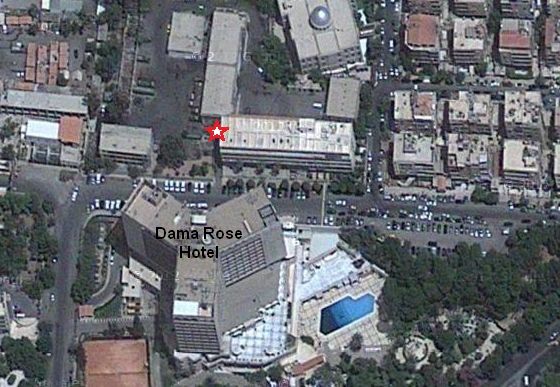
This is how state propaganda works. A bomb goes off in central Damascus, apparently targeting a meeting of top security officials, and the location of the attack is close to the Dama Rose Hotel which has been housing UN observers.

Another major breach of security threatens the Assad regime and so it attempts to obscure what has happened by claiming that rebels attacked the UN.

The slow-footed Western media with little else to rely on simply repeats the narrative pumped out by Syrian state media:

CBS/AP reports: A bomb attached to a fuel truck exploded Wednesday outside a Damascus hotel where U.N. observers are staying, wounding at least three people, Syria’s state TV reported.

The government controlled channel said the explosion took place near a parking lot used by the army command, which is about 300 yards away.

Syrian Deputy Foreign Minister Faisal Mekdad toured the area of the blast and said none of the U.N. staff was hurt. The explosion occurred as U.N. humanitarian chief Valerie Amos was in the Syrian capital but her team is believed to be staying at a different hotel.

CBS News’ George Baghdadi reports the area near the blast was quiet following the explosion. There had been reports of clashes after the blast, but Baghdadi saw no sign of violence.

Mekdad called the explosion a “terrorist act” meant to “destabilize” the country.

The lot where the explosion occurred is near the Dama Rose Hotel, popular with the U.N. observers in Syria.

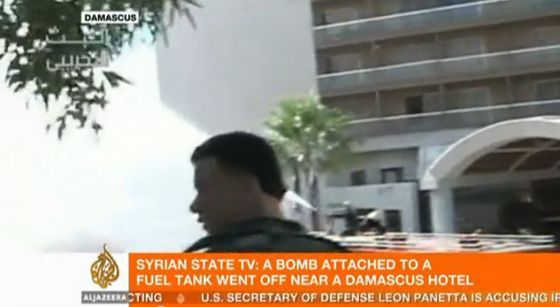
Here’s a screenshot that shows a firetruck outside the entrance to the hotel with a soldier in the foreground watching a firefighter on top of the truck directing a water cannon to the left. The scene of the explosion is off to the left, correct?

Dama Rose Hotel, Damascus

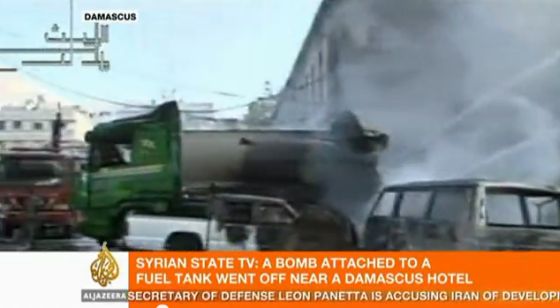
The camera pans to the left and we see the scene of the bombing:

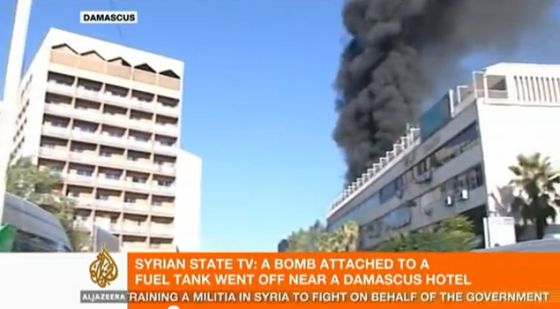
However, watch the video carefully and you will notice that the panning is actually the splicing together of two separate pieces of footage. In fact, the Syrian propaganda effort in its haste spin an implausible narrative (pause for a moment to consider: why would the FSA target the UN?) also included real evidence that the bomb did not target the Dama Rose Hotel but exploded several hundred meters away.

This screenshot from Syrian state TV images shows the Dama Rose Hotel to the left, and a thick plume of smoke rising beyond a building that separates the hotel from the site of the bombing:

Site of bombing some distance from Dama Rose Hotel

The actual location of the bombing is shown here:

Location of blast shown with a red star.

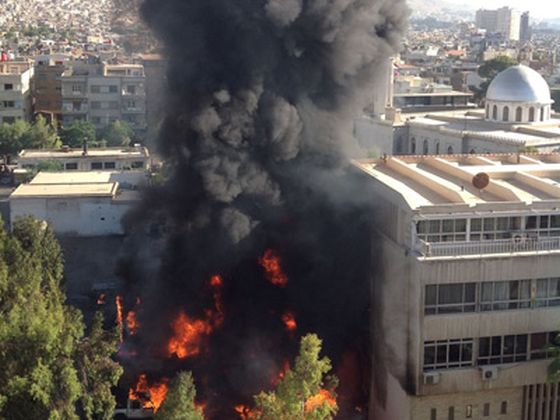
This is a photo of the bombing location in which the Al Hassan Mosque can be seen in the background.

Damascus bombing, August 15, 2012

Al Jazeera interviewed Abu Noor, a FSA spokesman who explains where the bomb was located and who it was targeting.

Facebooktwittermail

Some in Syrian opposition fear rebels miscalculated in Aleppo

The Los Angeles Times reports: In million-dollar apartments in a neighborhood of the city as yet unscathed, the battle for Aleppo plays out daily on flat-screen TVs. Amid imported sofas and abstract art, the revolution doesn’t seem so close.

But as the call for night prayers rang out from the minaret of the nearby mosque on a recent day, two loud explosions boomed.

“Do you hear that?” a father of seven asked, briefly looking away from the TV. “It’s like this every night.”

From the balcony, which on this night let in a little cool summer breeze, his family can occasionally see smoke rising above other Aleppo neighborhoods that are under attack by forces loyal to President Bashar Assad.

The father is solidly opposed to Assad, but he fears the prospect of rebels who have filtered in from the suburbs seizing his neighborhood as they try to take Syria’s largest city and commercial hub.

“What [the rebels] did was wrong, coming in and forcing all these civilians to flee and live in schools. You came to protect civilians, but now you’re hurting them?” said the father, one of the city’s merchants. “It’s wrong what they did.”

As the fighting intensifies in a city once regarded as immune to the violence racking much of Syria, some opposition activists are concerned that those who have taken up arms against Assad have made a serious miscalculation here. They fear that the offensive is creating a humanitarian crisis they are ill-equipped to handle and turning many of those affected against the rebels.

“The military campaign for Aleppo came too, too early,” said Marcell Shehwaro, a dentistry graduate and a prominent activist. “Because people here didn’t see the government violence that would make them believe the Free Syrian Army was needed.”

Even now, weeks into the battle for Aleppo, the traffic of everyday routines still snarls roundabouts in safer parts of the city. Syria’s national flag still flies freely here, and the walls are devoid of antigovernment graffiti that festoon rebel-held areas.

Pricey restaurants in nice neighborhoods open — expectantly — every night.

Abdulaziz “Abu Jumuah” Salameh, who heads a coalition of dozens of militias called the Al Tawheed Brigade, acknowledged that the city may not have wanted the rebel offensive to begin so soon. But that didn’t matter: The revolution has its own timing.

“Other provinces finished their revolution, and Aleppo hadn’t started yet,” he said, speaking from his headquarters in Tal Rifaat, a town north of the city. “You could wait 100 years, and Aleppo still won’t be ready.”

Even as rebels continue to stream into Aleppo, there is bitter disagreement over whether they can win over its residents. [Continue reading…]

Facebooktwittermail