The Los Angeles Times reports: A political coalition led by the former National Transitional Council’s de facto prime minister has claimed an early lead in Libya’s national election to replace the government of fallen longtime dictator Moammar Kadafi.
The National Forces Alliance, which appeals to secularists and moderate Islamist sensibilities, said that early exit polls showed it securing sizable majorities in the party vote for a national assembly. The coalition is headed by Mahmoud Jibril, an American-educated political scientist who once served as an economic advisor for Kadafi.
The NFA’s polling claims, made by Secretary General Faisal Krekshi, were backed up by the rival Muslim Brotherhood’s Justice and Construction Party.
“The National Forces Alliance achieved good results in some large cities except Misrata,” the Muslim Brotherhood’s Justice and Construction Party’s Mohammed Sawan told AFP. “They have a net lead in Tripoli and in Benghazi.”
High National Election Commission officials refused to confirm Krekshi’s claims.
“We are all waiting and we have nothing to suggest that one party is ahead of others,” the commission’s head Nouri al-Abar told journalists.
Official results are expected later this week.
Election officials said about 60% of eligible voters turned out on Saturday for a vote that was largely incident-free and hailed by foreign observers as free and fair.
Iran warns of regional ‘catastrophe’ if no political solution is found to Syria crisis
The Associated Press reports: An Iranian official has warned of a “catastrophe” in the Middle East if no political solution is found to the 16-month crisis in Syria.
Deputy Foreign Minister Hossein Amir Abdollahian also says Syria has a strong army and is able to defend itself from attack alone without Iran’s help.
Iran is Syria’s closest ally and has stood by President Bashar Assad’s regime through the uprising against his rule.
Abdollahian spoke at a press conference in Amman, Jordan, Sunday.
His comments follow an acknowledgement by special envoy Kofi Annan that the international community’s efforts to find a political solution to the escalating violence in Syria have failed.
Reuters reports: Syria’s navy fired live missiles from ships and helicopters over the weekend, state media said on Sunday, in an exercise aiming at showcasing its ability to “defend Syria’s shores against any possible aggression”.
Syrian television aired video of a variety of missiles being fired from launchers on land and from ships and showed the Syrian Defence Minister Dawud Abdallah Rahijia in attendance.
“Naval Forces conducted an operational live fire exercise on Saturday, using missiles launched from the sea and coast, helicopters and missile boats, simulating a scenario of repelling a sudden attack from the sea,” Syrian news agency SANA said, adding manoeuvres would continue for several days.
Opposition figures have been calling for a no-fly zone and NATO strikes against Syrian forces, similar to those carried out in Libya last year which enabled rebel ground forces to end the rule of Muammar Gaddafi.
But while President Bashar al-Assad has faced sanctions and international condemnation over his crackdown on dissent which has left thousands dead, major Western and Arab powers have shied away from the idea of direct military action.
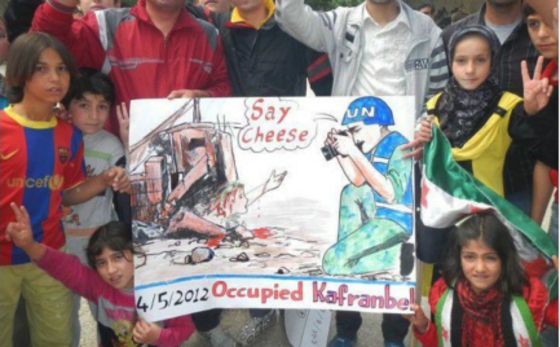
The banners from Kafranbel, a town in northwestern Syria

Foreign Policy: A town in northwestern Syria has become the creative center of the revolt against President Bashar al-Assad. Since the beginning of the uprising, the residents of Kafr Anbel have drawn signs that skewer the Assad regime and express outrage that the world has not done more to stop the killing in Syria.
The signs come in two basic varieties. Some are cartoons, often drawing their inspiration from Western movies or TV shows, which lampoon the Syrian government and its allies, notably Russian President Vladimir Putin. Others are straightforward, text-only banners that call for NATO intervention in Syria or arming the rebel Free Syrian Army (FSA). Many of the signs are written in English.
Raed Fares, an activist in Kafr Anbel, explained to FP that the town’s residents chose to draw in English, rather than Arabic, explicitly to reach an international audience. “It’s very important to send our message to all the world,” he said. “And English is the public language.”
Message to Presbyterians: ‘If you truly want to help the Palestinian people, I urge you to listen to what they are asking for’
Anna Baltzer gave the following testimony to the Presbyterian Church (USA) Middle East Peacemaking Committee on Monday, July 2, 2012: Friends, I am not up here as a Jew to tell that it’s okay for you to divest. Because you do not need my permission to do whatever you think is the righteous thing to do. You don’t need anybody’s permission.
I realize that divestment is controversial. That’s okay. Slavery was controversial. The Church was divided. Desegregation was controversial. Especially in the South, people were afraid of damaging relationships if they spoke out for desegregation. But the Presbyterian Church supported an end to segregation before it was common. I urge you to honor that legacy by acting today out of love and compassion rather than fear of what others will say.
You are being told that action against the occupation will estrange you from the Jewish people. But the occupation is fundamentally contrary to our shared values of equality and justice.
There is nothing Jewish about racial profiling with Hewlett Packard bioscanners.
There is nothing Jewish about protecting stolen land with Motorola technology.
There is nothing Jewish about demolishing Palestinian homes with Caterpillar bulldozers.And to claim that ending cooperation with these human rights violations means ending cooperation with Judaism, or Jews, draws a very dangerous parallel. There is a sea change happening. Jews are divided on this issue. You have to follow your own conscience.
Israel divestment campaigns gain momentum in U.S.
Mitchell Plitnick reports: A resolution at the General Assembly of the Presbyterian Church (USA) to divest from three corporations which provide equipment used to maintain Israel’s occupation of Palestinian lands failed by a mere two votes on Thursday.
Yet despite this apparent setback, the movement to divest from such corporations has gained tremendous momentum in recent weeks.
On Jun. 25, Morgan Stanley Capital Index (MSCI) announced that it had removed the Caterpillar corporation from its index of socially responsible companies, due in part to the use of its equipment to violate the human rights of Palestinians in the West Bank.
As a result, the leading retirement assets management firm for workers in the academic, research, medical and cultural fields, TIAA-CREF divested from Caterpillar. Activists in the Boycott, Divestment and Sanctions (BDS) movement against the Israeli occupation hailed this as a major victory, as TIAA-CREF had been the target of a divestment campaign for several years.
The TIAA-CREF decision raised hopes among pro-Palestinian activists that the Presbyterian Church (USA) would also choose to divest from three corporations – Caterpillar, Hewlett-Packard and Motorola Solution – which their Israel-Palestine Mission Network (IPMN) had identified as profiting from Israeli violations of Palestinian human rights.
If the Presbyterians passed a divestment resolution they would become the first mainstream Christian church body to do so.
But major Jewish institutions lobbied hard, as they have in previous years, to defeat the Presbyterian divestment initiative, and they succeeded, albeit by the narrowest of margins. The final vote was 333 against the resolution, 331 in favour and two abstentions.
The narrow margin of defeat, however, provided substantial encouragement to some BDS activists. [Continue reading…]
Egypt President Mohammed Mursi reverses parliament ban
BBC News reports: Egypt’s President Mohammed Mursi has ordered parliament to reconvene, a month after it was dissolved by court order amid a row over voting systems.
The Supreme Court had ruled parliament unconstitutional because two voting systems had been used in the election.
The military, which was then running the country, enforced the dissolution.
But Mr Mursi, whose Muslim Brotherhood won most parliamentary seats, said the chamber should reconvene until a new election could be held.
Libya election: Count under way after historic vote
BBC News reports: Vote-counting is under way after Libya held its first free national election for 60 years on Saturday.
The first results are expected on Monday, with some unofficial exit polls suggesting a liberal alliance was doing better than Islamist parties.
Sunday has been declared a holiday, amid celebrations after a largely peaceful election with a 60% turnout.
The 200-member assembly will choose the first elected government since Col Gaddafi came to power in 1969.
On voting day there were pockets of unrest in the east, where there are fears the region will be under-represented in the new temporary assembly being elected.
Reuters reports: Swept up in the euphoria of Libya’s first free national vote in six decades, voters in the eastern city of Benghazi braved anti-election protests on Saturday to pour into polling stations.
But the mood of celebration should not fool anyone: in the city that was the cradle of last year’s uprising against Muammar Gaddafi and remains the hub of Libya’s lucrative oil sector, the revolution is far from over yet.
Long a political hotbed that nurtured earlier attempts to unseat Gaddafi, Benghazi is now the focal point of a widespread sense among easterners that post-Gaddafi authorities are still neglecting their region economically and socially.
Many queuing to cast their ballots in Benghazi said they were using their votes simply to back candidates in a new interim assembly whose main policy drive will be to demand greater political representation for the region.
“We were able to get rid of the regime of Muammar Gaddafi with all his power and resources,” local women’s rights activist Salwa Homi said of the insurgency which, with the help of NATO bombs, ended 42 years of hardline Gaddafi rule.
“Don’t you think we can do the same to a few people we’ve elected ourselves?”
Nearly 18 months ago, the arrest of human rights activist Fethi Tarbel sparked a riot in Benghazi that triggered a civil war, the fall of Tripoli 1,000 km (630 miles) to the west and ultimately the capture and killing of Gaddafi himself.
The immediate bone of contention now is the fact that the east will get only 60 out of 200 seats in the new assembly being voted in on Saturday and which will appoint a new prime minister and prepare the ground for parliamentary elections in 2013.
But the bigger issue is what status Libya’s second-largest city will have in the new country taking shape and what stake it will have in national oil supplies currently running at 1.6 million barrels a day – the bulk of which are in the east.
“We contributed the most blood and the most sacrifice to the country and to the revolution,” Hamed al-Hassi, a former rebel who leads a military body originally charged with securing the east but which has since fallen out with the interim government.
“The country will be in a state of paralysis because no one in the government is listening to us,” said Hassi.
Fossil fuel industry has plan to save itself and put others at risk
Peter Montague and Steve Horn write: Most Americans are now convinced that climate change is real because dramatic evidence keep piling up – searing heat waves, multiyear droughts, record-setting wildfires, unprecedented tornadoes and Biblical floods.
Furthermore, there’s now widespread agreement among scientists that humans are causing these problems by burning fossil fuels (coal, oil, natural gas), thus emitting carbon dioxide (CO2) gas, which acts like a blanket, warming the planet.
One obvious solution: use fossil fuels far more efficiently (doing the same work with less energy), thus drastically reducing CO2 emissions. Wherever we use lights, heat or motors, we could greatly enhance efficiency.
Furthermore, efficiency could improve quickly – the National Academy of Sciences said recently we could cut the nation’s energy use 20 percent by 2020 and 30 percent by 2030 using technologies that are available and affordable today. David Goldstein has shown how we could cut national energy use more than 80 percent in ten to 20 years, creating many thousands of good jobs while saving trillions of dollars in reduced fuel costs – enough to fund a modern, renewable energy system.
One crucial caveat: the people who would benefit least from efficiency are the purveyors of fossil fuels – they’d sell less product, reducing their profits. For them, efficiency is a threat, not an opportunity.
In response, fossil fuel corporations have devised their own plan to mitigate global warming while burning more and more coal, oil and natural gas. Their plan is called “carbon capture and sequestration,” or CCS, for short.
In a nutshell, the plan would capture CO2 as a gas, pressurize it into a liquid, pipe it to a suitable location and then pump it a mile below ground, hoping it will stay there forever. You may not have heard of it, but the CCS plan is chugging along worldwide. [Continue reading…]
Higgs boson: A cause for celebration. But will it be our last great discovery?
When 30 years ago the Large Hadron Collider was first proposed, its construction was far from certain. Robin McKie writes: The US was then planning the Superconducting Super Collider (SSC), an underground tunnel – 54 miles in circumference – round which protons would be hurled at energies three times those generated by those in the LHC. Why construct an inferior device, critics asked?
But the SSC proved to be a debacle. Individual congressmen initially backed it because they hoped it would be built in their state. But after Texas was selected, those outside the state lost interest. Costs soared and the SSC, now friendless, was cancelled. So the US put its money into the international space station, a project of no scientific value but which upset no vested interests.
After its rival disappeared, the case for the LHC looked stronger. Yet it still took a decade of negotiations to get Cern’s member nations to agree to build it. Eventually a deal was signed – only for Britain, following its 1993 economic crisis, and Germany, reeling under the cost of reunification, to renege. In both cases, last-minute deals saved the project, although Llewellyn Smith says it had balanced, several times, on the edge of extinction. “It was touch and go on a number of occasions. It could so easily not have happened.”
And that point has clear implications for the LHC. If its giant detectors produce evidence of Higgs bosons and little else in its lifetime, particle physicists will struggle to persuade the world they need a bigger machine to probe even further into the structure of matter, a point stressed by the Nobel prize-winning physicist Steven Weinberg.
“My nightmare is that the LHC’s only important discovery will be the Higgs,” says Weinberg. “Its discovery was important. It confirms existing theory but it does not give us any new ideas. We need to find new things that cry out for further investigation if we are to get money for a next generation collider.”
Candidate discoveries would include particles that could explain the presence of dark matter in the universe. Astronomers know that the quarks, electrons and other forms of normal matter found on Earth can only explain about a sixth of the mass of the universe. There is something else out there. Scientists call it dark matter but cannot agree about its nature. A particle, as yet undetected, that permeates the cosmos, might be responsible.
As Weinberg says: “What could be more exciting than finding a particle that makes up most of the universe’s mass?” Certainly, finding hints of dark matter would help scientists get the billions they will need for a next generation collider. But if they find no exotic fare like this, they will flounder.
This point is backed by [Sir Christopher] Llewellyn Smith [Cern’s director general in the 1990s]. “The only real case for a next generation device would be the discovery of a phenomenon that the LHC could only just detect but could not study properly. We will have to wait and see if something like that happens. Certainly, it will give scientists plenty to do at the LHC for the next few years.”
As to the nature of that next generation device, by far the most likely candidate would be a linear – as opposed to a circular – accelerator which would fire electrons in straight lines for miles before smashing them together. A world consortium of experts, including Lyn Evans, has already been set up to create plans. But until the LHC produces results, its design will remain uncertain. “It is quite conceivable that we have reached the end of the line,” adds Llewellyn Smith. “Certainly, unless someone comes up with an unexpected breakthrough, it is hard not to conclude we have come about as far as we can with accelerator technology.” After 50 years of whizzing sub-atomic particles along tunnels before battering them together, we appear to be approaching the limits of this technology.
And even if the technical hurdles can be overcome, the political issues may be insurmountable. Battles over local interests will inevitably strike again. Scientists will then have to use other methods to study the fabric of the cosmos: powerful, space-based telescopes that could peer back into the early universe. On their own, these are unlikely to produce major breakthroughs. As a result, when LHC has completed its work next decade, we may face a long pause in our progress in unravelling the universe’s structure.

Music: Shankar Tucker with Rohini Ravada — ‘Sapnon se Bhare Naina’
Syria fighting widespread, spills into Lebanon
Reuters reports: Syria’s conflict spilled further into Lebanon on Saturday when mortar fire from government forces crashed into villages in the north, killing two women and a man after rebels crossed the border for refuge, residents said.
In contrast with Turkey, which openly harbors rebels fighting to topple Syrian President Bashar al-Assad, Lebanon was not expected to respond militarily and has played down the effect of regular clashes along the frontier.
But rebels have used north Lebanon as a base and Assad’s forces have at times bombed villages and even crossed the border in pursuit of militants, threatening to inflame tensions in Lebanon given a long history of Syrian domination there.
Residents of Lebanon’s Wadi Khaled region said several mortar bombs hit farm buildings five to 20 km (3 to 12 miles) from the border at around 2 a.m. At midday villagers reported more explosions and said they heard gunfire close to the border.
In the village of al-Mahatta, a house was destroyed, killing a 16-year-old girl and wounding a two-year old and a four-year old, family members told Reuters. A 25-year-old woman and a man were killed in nearby villages, residents said.
The Lebanese army issued a brief statement about the incident. There was no immediate response from the prime minister or the foreign ministry, both of whom have expressed fears that Lebanon could be dragged into the conflict.
Video: Palestinians from Syria flee to Jordan
Syria: How important is the Tlass defection?
Joshua Landis answers this question: Absolutely important – The Tlass family has been at the heart of the regime from the beginning. They are the keystone of the Sunni-Alawi alliance that has cemented the regime for 4 decades.
Abdul Halim Khaddam and the Tlass family were the two leading Sunni families in the state from the beginning, when Hafiz al-Assad, the architect of the regime, built the structures that have endured since. Bashar preserved the blueprint drawn up by his father.
Vice President Khaddam defected in 2005. His departure sent a shudder through the regime, but this time is different. The Tlas defection sends the sign that the regime is done for. No longer is this uprising merely about angry young men in the countryside. It has reached to the very top. The elite Sunnis are looking for the exit door – but it will be hard to replicate this defection. Manaf got the golden parachute into Paris. His family is all out – his father, brother, wife and children. He planned this carefully. He has the power and the means.
Other generals have no bodyguards, no visas, no money…. It will be a long and painful process for most to defect.
What is more the Alawite officers have their backs to the wall.
The regime will not just collapse. This is not “The Tipping Point” but it is very significant for morale. It sends a message: the game is up.
A statement by General Manaf Tlass: As issued by international press and media, I have just left Syria.
With the will to remain faithful to my military principles and loving feelings towards Syria, I have always tried to fulfill my duty with rightness, in order to preserve unity for Syria and its people.
I did not joined the armed forces to see this army harm its own people, without giving systematically a chance to political solutions.
Thus, because I was in complete opposition with the unjustified violence and crimes committed by Assad’s regime in the past months, I was progressively dismissed from my place of duty in the armed forces.
Today, I call for all my comrades in armed forces, whatever their rank in the hierarchy, who are dragged into this fight against their Syrian fellows and against their own ideals, to end supporting this regime.
I recognize the legitimacy of the fight of the opposition members to the regime, particularly the ones on the ground. In this respect, let me be grateful to those who made it possible for me to leave the Syrian territory where my own person and family were threatened.
In the coming days, I will make a statement on my motives and the possibilities that the future offers me.
Long life to Syria!
General Manaf Tlas
WikiLeaks: PR firm tried to buff Syria’s image after crackdown
The Los Angeles Times reports: A New York-based public relations firm tried to help the Syrian government “brand” its reforms last year as media reported its crackdown on protesters, according to an email released Friday by WikiLeaks.
The firm, Brown Lloyd James, had earlier helped arrange a rosy profile of Syrian first lady Asma Assad in Vogue magazine that praised her as “the freshest and most magnetic of first ladies.” It had been paid $5,000 a month for that work, according to a Foreign Agents Registration Act document.
Months later, in a memo last May to one of her aides, the firm advised Syria that it needed to buff up its image abroad as decidedly unflattering stories of mass arrests and alleged killings spread in the press.
“Mass arrests of activists, protesters and in some cases males older than 15 have skyrocketed, with thousands held in detention centers where human rights activists say they have been subjected to physical and mental abuse,” the Los Angeles Times reported eight days before the firm sent its memo. A later article said dissidents claimed a mass grave filled with slain protesters had been found in the south.
The public relations firm said Syria suffered from “an imbalance in its communications approach” that had failed to reassure the Syrian people and outsiders that it was genuinely pursuing reform.
“Syria seems to be communicating with two hands. One is offering reform and the other, rule of law. Rule of law is a fist. Reform is an open hand. Right now the fist appears to the outside world, and probably to many Syrians, as though it is ten times bigger than the outstretched palm,” the firm wrote in its email, which WikiLeaks dated to May 19, 2011. “They must be brought into better balance.”
Brown Lloyd James added that the Obama administration had not demanded regime change and clearly wanted the leadership in Syria to survive, saying “criticism has been relatively muted.” It warned, however, that the U.S. tone had grown harsher in recent weeks and could be nearing a tipping point.
Video: Covering Libya’s first post-Gaddafi elections
Protests and tears of joy as Libyans rush to vote
Reuters reports: Crowds of joyful Libyans, some with tears in their eyes, parted with the legacy of Muammar Gaddafi on Saturday as they voted in the first free national election in 60 years.
But in the eastern city of Benghazi, cradle of last year’s uprising and now seeking more autonomy from the interim government, protesters stormed polling stations and burned hundreds of ballot papers.
Libyans are choosing a 200-member assembly which will elect a prime minister and cabinet before laying the ground for full parliamentary elections next year under a new constitution.
Candidates with Islamic agendas dominate the field of more than 3,700 hopefuls, suggesting Libya will be the next Arab Spring country – after Egypt and Tunisia – to see religious parties secure a grip on power.
In Benghazi, witnesses said protesters stormed a polling station just after voting started and publicly burnt hundreds of ballot slips in a bid to undermine the election’s credibility.
One local election commission worker said two other polling stations in Benghazi had also had their ballots boxes looted.
At one polling station hit by the protests, a man was shot in the arm, local election official Ismail Al-Mjbali told Reuters. Blood from the attack stained the floor and the man had been taken to hospital, Mjbali said.
In the capital Tripoli, voting was smooth. A loud cry of “Allahu akbar” (“God is greatest”) went up inside a polling station there as the first woman cast her vote in a converted school building abuzz with the chatter of queueing locals.
“I can’t describe the feeling. We paid the price, I have two martyrs in my family. I am certain the future will be good, Libya will be successful,” Zainab Masri, a 50-year-old teacher, said of her first experience of voting.
“I am a Libyan citizen in free Libya,” said Mahmud Mohammed Al-Bizamti. “I came today to be able to vote in a democratic way. Today is like a wedding for us.”
Majdah al-Fallah flashes a broad smile and pumps the hands of shoppers in downtown Tripoli as she works potential voters on the campaign trail ahead of Libya’s landmark national assembly elections on Saturday.
A doctor by trade who lived in Ireland for years, Fallah is running for the Justice and Construction Party, the political arm of the Muslim Brotherhood which is tipped to do well. But her small team of election helpers often find the going tough.
“Sometimes when I give out the flyer some people reject it or take it and then rip it up in front of me because there are women on it,” said Huthaifa al-Harram, a 20-year-old male backer of Fallah and another female candidate on the same ticket.
“People say, ‘I don’t think women should play a role in the government – they don’t know what to do’,” Harram added.