Hurriyet Daily News reports: It would not be right for a country to go to war over a pilot, the father of missing pilot Capt. Gökhan Ertan said in regards to the crisis over Syria’s downing of a Turkish jet.
Ertan’s father Ali Erton (Ertan changed his surname from Erton) spoke to broadcaster Samanyolu at his residence in the southeastern province of Malatya yesterday.
Turkey is not a country that would go to war because another country killed one of their pilots, according to Erton. “It is not appropriate for a country to go to war over a pilot, an airplane or 50 airplanes,” Erton said. The missing pilot’s father said he was aware of the possibility that his son could have been killed when the plane he was in was shot down by Syria.
“What matters is that my son serves his country,” Erton said. “I am a man of faith and do not believe martyrs ever die.”
Osman Aksoy, the father of the second missing pilot Lt. Hüseyin Aksoy, said he talked to his son on June 19, three days before the incident. “We are following the developments on television, and [Hüseyin Aksoy’s] brother is keeping us informed from Malatya. We are holding our hopes high,” Aksoy told reporters at his home in Istanbul’s Bağcılar district.
“Such reconnaissance flights were done before too, [and now] our state has given that duty to my son,” Aksoy said
All options for action against Syria were on the table, including the right to military retaliation, the Turkish government said yesterday. The government has vowed to keep its rights stemming from international law reserved.
Syrian violence escalates as UN prepares for conference
The Guardian reports: Evidence gathered by UN investigators in Syria shows human rights violations, including executions “on an alarming scale”, according to a new report on a conflict that is spiralling into “deeper and more destructive violence” and in which sectarian motives now predominate.
Against a background of escalating bloodshed and global concern, with gunmen killing seven on Wednesday at a pro-regime TV station near Damascus, the foreign ministers of the world’s leading powers have been invited to meet in Geneva on Saturday in a desperate attempt to agree a political exit from the impasse.
On Tuesday, president Bashar al-Assad ratcheted up his own language by describing the crisis as “a real war” and pledged to do everything necessary to prevail. Assad had previously always blamed the uprising on “armed terrorist gangs” backed by the west and Arab countries.
Underlining the gravity of the situation, the Syrian Observatory for Human Rights described the last week as the bloodiest yet in the 16-month uprising. Observatory director Rami Abdul-Rahman said 916 people had been killed from 20 to 26 June. On Tuesday alone the reported death toll was 113, though these figures cannot be independently verified. Tank fire was reported from al-Qusair near Homs. Other attacks by government forces were reported on Wednesday in Deraa and Zamalka.
Leading experts call on Obama to focus on aid instead of drone attacks on Yemen
Atlantic Council: Twenty-seven leading foreign policy experts have sent a letter to President Obama, calling for a broader approach on US policy towards Yemen that “expands beyond the narrow lens of counterterrorism.” As US intelligence agencies point to the rise of Al Qaeda in the Arabian Peninsula (AQAP) activity making Yemen the next front in counterterrorism, the letter, signed by diplomats, security specialists, scholars, and US policy experts, argues that current US policy is short-sighted. It strongly urges for better policy that still serves America’s national interests by decreasing extremism and combating security threats in the region, but through a comprehensive, long-term approach that addresses Yemen’s social, economic, and political challenges.
The five-page letter, signed by, among others, former US Ambassador to Yemen Barbara Bodine, argues that current US counterterrorism policy toward Yemen “does not address the underlying causes that have propelled such [militant] forces to find fertile ground in Yemen” and that US public diplomacy only reinforces such perceptions: “Although the Department of State, USAID, and others have invested millions in development and governance projects, the perception both in the US and in Yemen is that we are singularly focused on AQAP. Yemenis need to know that their country is more than a proxy battleground and that our long-term commitment to the stability, development, and legitimacy of the country matches our more immediate and urgent commitment to the defeat of AQAP.”
The sharp, sudden decline of America’s middle class
Jeff Tietz writes: Every night around nine, Janis Adkins falls asleep in the back of her Toyota Sienna van in a church parking lot at the edge of Santa Barbara, California. On the van’s roof is a black Yakima SpaceBooster, full of previous-life belongings like a snorkel and fins and camping gear. Adkins, who is 56 years old, parks the van at the lot’s remotest corner, aligning its side with a row of dense, shading avocado trees. The trees provide privacy, but they are also useful because she can pick their fallen fruit, and she doesn’t always have enough to eat. Despite a continuous, two-year job search, she remains without dependable work. She says she doesn’t need to eat much – if she gets a decent hot meal in the morning, she can get by for the rest of the day on a piece of fruit or bulk-purchased almonds – but food stamps supply only a fraction of her nutritional needs, so foraging opportunities are welcome.
Prior to the Great Recession, Adkins owned and ran a successful plant nursery in Moab, Utah. At its peak, it was grossing $300,000 a year. She had never before been unemployed – she’d worked for 40 years, through three major recessions. During her first year of unemployment, in 2010, she wrote three or four cover letters a day, five days a week. Now, to keep her mind occupied when she’s not looking for work or doing odd jobs, she volunteers at an animal shelter called the Santa Barbara Wildlife Care Network. (“I always ask for the most physically hard jobs just to get out my frustration,” she says.) She has permission to pick fruit directly from the branches of the shelter’s orange and avocado trees. Another benefit is that when she scrambles eggs to hand-feed wounded seabirds, she can surreptitiously make a dish for herself.
By the time Adkins goes to bed – early, because she has to get up soon after sunrise, before parishioners or church employees arrive – the four other people who overnight in the lot have usually settled in: a single mother who lives in a van with her two teenage children and keeps assiduously to herself, and a wrathful, mentally unstable woman in an old Mercedes sedan whom Adkins avoids. By mutual unspoken agreement, the three women park in the same spots every night, keeping a minimum distance from each other. When you live in your car in a parking lot, you value any reliable area of enclosing stillness. “You get very territorial,” Adkins says.
Each evening, 150 people in 113 vehicles spend the night in 23 parking lots in Santa Barbara. The lots are part of Safe Parking, a program that offers overnight permits to people living in their vehicles. The nonprofit that runs the program, New Beginnings Counseling Center, requires participants to have a valid driver’s license and current registration and insurance. The number of vehicles per lot ranges from one to 15, and lot hours are generally from 7 p.m. to 7 a.m. Fraternization among those who sleep in the lots is implicitly discouraged – the fainter the program’s presence, the less likely it will provoke complaints from neighboring homes and churches and businesses.
The Safe Parking program is not the product of a benevolent government. Santa Barbara’s mild climate and sheltered beachfront have long attracted the homeless, and the city has sometimes responded with punitive measures. (An appeals court compared one city ordinance forbidding overnight RV parking to anti-Okie laws in the 1930s.) To aid Santa Barbara’s large homeless population, local activists launched the Safe Parking program in 2003. But since the Great Recession began, the number of lots and participants in the program has doubled. By 2009, formerly middle-class people like Janis Adkins had begun turning up – teachers and computer repairmen and yoga instructors seeking refuge in the city’s parking lots. Safe-parking programs in other cities have experienced a similar influx of middle-class exiles, and their numbers are not expected to decrease anytime soon. It can take years for unemployed workers from the middle class to burn through their resources – savings, credit, salable belongings, home equity, loans from family and friends. Some 5.4 million Americans have been without work for at least six months, and an estimated 750,000 of them are completely broke or heading inexorably toward destitution. In California, where unemployment remains at 11 percent, middle-class refugees like Janis Adkins are only the earliest arrivals. “She’s the tip of the iceberg,” says Nancy Kapp, the coordinator of the Safe Parking program. “There are many people out there who haven’t hit bottom yet, but they’re on their way – they’re on their way.” [Continue reading…]

Is there no choice but voting for Obama?
M.J. Rosenberg writes: Back in 2007-8, I was an outspoken promoter of Barack Obama’s nomination and election. I believed he had both the skills and the progressive views that would make him another FDR. Additionally, as the first black president, his election would be a hugely significant milestone in the history of a country cursed by racism from the very beginning.
I was right only on that last point: race. Obama’s presidency changes America forever. No matter how successful or unsuccessful his presidency is judged to be, or whether he wins a second term, the very idea that the United States elected Barack Hussein Obama shows that a clear majority of the country accepts the revolutionary (for Americans) fact of racial equality. Yes, America is still cursed with racism but Obama’s face among the 44 presidents depicted in every child’s history book or on the post office wall, changes America in a profound way.
Unfortunately, I do not believe he has been a particularly good president. Former Chief Justice Oliver Wendell Holmes famously said of FDR that he was a born leader because, although he had a “second class intellect,” he had “a first class temperament. ” In my opinion, Obama is the opposite.
He is a brilliant man but he does not have the temperament for the presidency. He is reclusive, avoiding the glad handing of Congress that is necessary to get individual members of the House and Senate to feel personally close or loyal to him. He is not a fighter, always seeking to conciliate the opposition rather than defeat it. He refuses to use the presidency as a “bully pulpit” (in Theodore Roosevelt’s phrase), reaching over Congress and the media to rally the people behind him.
Worst of all, his critical policy decisions have been informed by timidity.
His two most significant efforts — reviving the economy and health care reform — were both hobbled by a lack of boldness and propensity for preemptive compromising. His stronger actions, as on gay equality and on immigration, were only undertaken after he had lost the strong mandate he was elected with and needed to solidify his base in advance of re-election
Obama’s foreign policy record is even worse. Between intensifying drone attacks, staying the course in Afghanistan, keeping Guantanamo open, and aligning our Middle East policies with Israel, Obama’s foreign policy is pretty much a continuation of George W. Bush’s.
In short, for progressives like me, Obama is a big disappointment. Nonetheless, it is absolutely critical that he be re-elected.
If M.J. wanted win this argument among the rest of us who have been particularly disappointed by Obama’s foreign policy record, he would need to show why with Obama as president there is less chance that the U.S. will go to war with Iran. That’s a difficult argument to make and thus it’s not surprising M.J. makes no mention of Iran.
A lot of the support Obama got in 2008 derived simply from antipathy for everything George Bush represented, but then we discovered that the opponent of torture preferred summary executions and that far from being the opposite of Bush, Obama turned out to be more like Bush 2.0.
Does he now deserve a second term just because he’s not a Republican?
The only thing that seems reasonable to predict about the 2012 election is that there will be a miserably low turnout. And the one person who will bear the primary responsibility for that will be the man who took a cynical ride on the hope of millions of Americans.
Gunmen attack Syrian TV station Assad talks of war
The New York Times reports: A day after President Bashar al-Assad said Syria was living in a “state of war,” rebels operating with increasing audacity around the capital were reported by the country’s official media on Wednesday to have stormed into a pro-government television station, killed several employees and planted explosives that destroyed studios.
But the rebels denied carrying out the attack, saying a unit of the elite Syrian Republican Guard assigned to guard the station defected and attacked other government soldiers who had remained loyal. The conflicting versions offered graphic testimony to the difficulties facing outsiders in ascertaining the true course of events in a war from which independent reporters as well as international relief and monitoring officials are effectively barred.
On Wednesday, for instance, the United Nations Human Right Council in Geneva, which is investigating human rights violations in Syria, said it was unable to determine conclusively who was responsible for the May 25 massacre of 108 civilians in the western region of Houla, but it “considers that forces loyal to the government may have been responsible for many of the deaths.”
While the panel accused government forces of committing violations on “an alarming scale” in recent months, it also found that both sides had carried out summary executions.
“Gross human rights violations are occurring regularly in the context of increasingly militarized fighting,” Paulo Pinheiro, the Brazilian chairman of the panel, said.
The attack on the al-Ikhbaria satellite broadcaster began before dawn on Wednesday when assailants “planted explosive devices in the headquarters of al-Ikhbaria following their ransacking and destroying of the satellite channel studios, including the newsroom studio which was entirely destroyed,” the official Syrian news agency SANA reported.
The news agency referred to the assailants as terrorists — the usual official language to denote armed opponents Mr. Assad’s government. While initial reports from SANA said three employees were killed, a subsequent official estimate put the death toll at seven.
Extradition of Gaddafi deputy plunges Tunisia into political crisis
Time.com reports: With political upheaval in Egypt and Libya and calamitous violence in Syria, the one stable point of the Arab Spring seemed to be Tunisia, where the wave of revolutions began 19 months ago. Now even that looks in doubt. Before dawn last Sunday, Tunisian officials dragged the country’s highest-value detainee — Muammar Gaddafi’s last Prime Minister, Al-Baghdadi Ali al-Mahmoudi — from his prison bed, then handed him to Libyan officials, who flew him to a Libyan jail an hour away. Why the cloak-and-dagger extradition? The operation occurred under the nose of Tunisia’s own President, who at the time was sound asleep in his sprawling seaside palace, just a few kilometers away.
The political furor in Tunisia has since laid bare deep rifts between the country’s secular liberals and Islamists, two factions wrestling for the country’s future in wake of the dictatorship’s collapse in January 2011. In some ways, the conflict mirrors the political struggles playing out in Libya and Egypt too, as all three countries try to rebuild after decades of one-man rule. In Tunisia, a three-way coalition has ruled the country since the first democratic elections last October, with the popular Islamic party Ennahda — long outlawed under the dictatorship — controlling the government under a Prime Minister, and the two major secular parties in control each of the presidency and the constitution-writing assembly.
But the clamor over al-Mahmoudi’s fate now threatens to torpedo the arrangement, placing the Islamists in firm control over the most secular country in North Africa.
For months, Tunisian President Moncef Marzouki fiercely opposed Libyan requests to send al-Mahmoudi back. As the argument dragged on, it became a litmus test not only for what kind of justice system the new Tunisia might have, but also for what kind of President there will be once the new constitution is approved some time next year: one with big powers, like the American President, or a figurehead — as some suspect the newly elected Egyptian President Mohamed Morsy might ultimately be. [Continue reading…]
The vindictive prosecution of CIA whistleblower John Kiriakou
Kevin Gosztola writes: The government is pursuing a “selective” and “vindictive” prosecution against former CIA agent John Kiriakou, according to a defense motion to dismiss charges recently cleared for public release and posted by Secrecy News. Kiriakou was indicted in April for allegedly releasing classified information to journalists that included the identities of a “covert CIA officer” and details on the role of “another CIA employee in classified activities.” The Justice Department charged him with one count of violating the Intelligence Identities Protection Act and three counts of violating the Espionage Act, along with a count for “allegedly lying to the Publications Review Board of the CIA” so he could include classified information in his book.
The motion argues Kiriakou is not being prosecuted for the “acts alleged” in the indictment. Rather, he is being prosecuted because, on December 10, 2007, he “gave an interview to ABC News in which he stated that the United States had engaged in torture of detainees captured in the war on terror. In 2009, Kiriakou further challenged the government policy in favor of torturing terror suspects when he stated that he did not think torture was effective.”
It declares this is why “the government has seized upon the current allegations of improper disclosures to prosecute him, even though numerous other individuals that have communicated the same or similar information have not faced prosecution.” Furthermore:
Prosecutorial decisions are given great deference. Nonetheless, when the government chooses among similarly-situated people and charges only those who have publicly spoken out against the government’s position, the government engages in selective prosecution. When the government chooses to punish an individual based on animus, the government engages in vindictive prosecution. When either of those scenarios occurs, the government has exercised its prosecutorial powers impermissibly and unconstitutionally, and the indictment should be dismissed.
To back up the argument that Kiriakou is being selectively prosecuted, the defense outlines multiple instances where individuals leaked names of covert operatives to the press and connected “particular individuals to allegedly classified programs.” In August 2011, the New Yorker “published an article [“Getting Bin Laden”] about the raid that killed Osama bin Laden.” Writer Nicholas Schmidle “stated that he knew the identities of the Seal Team which executed the operation.” On March 24, 2012, Greg Miller of the Washington Post “published an article profiling the director of the CIA’s Counterterrorist Center [“At CIA, a convert to Islam leads the terrorism hunt”]. The CTC director’s name is not “public knowledge.” Miller could not publish the director’s real name because he works “undercover.” Numerous CIA and Federal Bureau of Invetigation (FBI) sources discussed the CIA, the director (“Roger”) and how he is the “principle architect of the CIA’s drone program.”
On May 3, 2012, CNN’s terrorism correspondent Peter Bergen appeared on “The Daily Show” with Jon Stewart to promote his book, Manhunt: The 10 Year Search for Bin Laden – from 9/11 to Abbottabad. He mentioned high-level sources in the CIA, Defense Department and White House he had interviewed. In the same month, CIA officials leaked details on a CIA underwear bomb plot sting operation in Yemen to the Associated Press while the operation was still technically in progress. And, finally, on June 1, 2012, the New York Times published an article on cyber warfare against Iran by David Sanger [“Obama Order Sped Up Wave of Cyberattacks Against Iran”]. Sources from the White House Situation Room were quoted. While the Justice Department has appointed two attorneys to investigate the leaks from officials on the bomb plot sting op and the cyber warfare against Iran, there are no known investigations into the other instances where sources in the government spoke to reporters and no sources for news reports have been slapped with criminal charges. [Continue reading…]
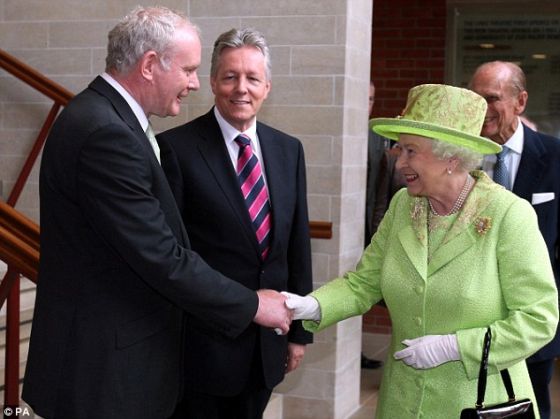
Historic handshake in Belfast

Martin McGuiness, Northern Ireland's deputy first minister, shakes hands with Queen Elizabeth II. The former IRA commander said when he shook the hand of the Queen he would be symbolically shaking the hand of every unionist in Northern Ireland.
The Guardian reports: Anglo-Irish relations took a momentous step forward on Wednesday when the Queen shook hands with Sinn Féin’s Martin McGuinness.
The historic encounter between the former IRA commander – now Northern Ireland’s deputy first minister – and the Queen was unthinkable a little over 10 years ago.
But the success of the peace process and the Queen’s acclaimed visit to the Republic of Ireland last year, when her conciliatory words and gestures won over many critics of the monarchy, paved the way for their meeting.
The much-anticipated first handshake took place away from the media spotlight behind closed doors.
They later shook hands in public. McGuinness held the monarch’s hands for a few moments and spoke to her in Irish. He told her the words meant: “Goodbye and God’s speed.”
McGuinness was a senior member of the IRA when it killed the Queen’s cousin Lord Mountbatten in a bomb blast in 1979.
The Queen is the head of Britain’s armed forces, seen in the past by Republicans as occupying troops in Northern Ireland.
Fear grows of consequences of euro collapse
Der Spiegel reports: It wasn’t long ago that Mario Draghi was spreading confidence and good cheer. “The worst is over,” the head of the European Central Bank (ECB) told Germany’s Bild newspaper only a few weeks ago. The situation in the euro zone had “stabilized,” Draghi said, and “investor confidence was returning.” And because everything seemed to be on track, Draghi even accepted a Prussian spiked helmet from the reporters. Hurrah.
Last week, however, Europe’s chief monetary watchdog wasn’t looking nearly as happy in photos taken in front of a circle of blue-and-yellow stars inside the Euro Tower, the ECB’s Frankfurt headquarters, where he was congratulating the winners of an international student contest. He smiled, shook hands and handed out certificates. But what he had to tell his listeners no longer sounded optimistic. Instead, Draghi sounded deeply concerned and even displayed a touch of resignation. “You are the first generation that has grown up with the euro and is no longer familiar with the old currencies,” he said. “I hope we won’t experience them again.”
The fact that Europe’s top central banker is no longer willing to rule out a return to the old national currencies shows how serious the situation is. Until recently, it was seen as a sign of political correctness to not even consider the possibility of a euro collapse. But now that the currency dispute has escalated in Europe, the inconceivable is becoming conceivable, at all levels of politics and the economy.
Investment experts at Deutsche Bank now feel that a collapse of the common currency is “a very likely scenario.” German companies are preparing themselves for the possibility that their business contacts in Madrid and Barcelona could soon be paying with pesetas again. And in Italy, former Prime Minister Silvio Berlusconi is thinking of running a new election campaign, possibly this year, on a return-to-the-lira platform.
Nothing seems impossible anymore, not even a scenario in which all members of the currency zone dust off their old coins and bills — bidding farewell to the euro, and instead welcoming back the guilder, deutsche mark and drachma.
It would be a dream for nationalist politicians, and a nightmare for the economy. Everything that has grown together in two decades of euro history would have to be painstakingly torn apart. Millions of contracts, business relationships and partnerships would have to be reassessed, while thousands of companies would need protection from bankruptcy. All of Europe would plunge into a deep recession. Governments, which would be forced to borrow additional billions to meet their needs, would face the choice between two unattractive options: either to drastically increase taxes or to impose significant financial burdens on their citizens in the form of higher inflation.
A horrific scenario would become a reality, a prospect so frightening that it ought to convince every European leader to seek a consensus as quickly as possible. But there can be no talk of consensus today. On the contrary, as the economic crisis worsens in southern Europe, the fronts between governments are only becoming more rigid.
The Italians and Spaniards want Germany to issue stronger guarantees for their debts. But the Germans are only willing to do so if all euro countries transfer more power to Brussels — steps the southern member states, for their part, don’t want to take.
The discussion has been going in circles for months, which is why the continent’s debtor countries continue to squander confidence, among both the international financial markets and their citizens. No matter what medicine European politicians prescribe, the patient isn’t getting any better. In fact, it’s only getting worse. [Continue reading…]
U.S. intelligence sees few cracks in Assad’s inner circle
Reuters reports: Despite some military defections, Syrian President Bashar al-Assad’s inner circle remains cohesive and the 16-month conflict with rebels is likely to be a drawn-out struggle, senior U.S. intelligence officials said on Tuesday.
That assessment appears to dash any U.S. hopes that Assad, whose ouster Washington has called for, will fall soon of his own accord. The Obama administration has declined to intervene militarily in Syria, citing the lack of international backing and the country’s sectarian divisions.
White House spokesman Jay Carney said on Tuesday that Assad “has been slowly, too slowly, losing his grip over his country. The process, because of his refusal to step aside, has been horrific and has exacted a terrible toll on the Syrian people.”
But U.S. intelligence agencies, watching closely for cracks in Assad’s inner circle, do not see them so far.
“The regime inner circle and those at the next level still seem to be holding fairly firm in support of the regime and Assad,” one intelligence official said on condition of anonymity.
Assad said on Tuesday that Syria was in a “state of war” and snubbed those calling for him to step aside, saying the West “takes and never gives and this has been proven at every stage.
Despite the deterioration in Syria, so far there has been no sign of an appetite for Western intervention like that by NATO against Libya’s Muammar Gaddafi last year. On Tuesday, the Western alliance called the shooting-down of a Turkish warplane by Syrian forces last week “unacceptable” but stopped short of threatening retaliation.
The Independent reports: Some of the fiercest fighting seen since the start of the conflict in Syria raged on the outskirts of Damascus yesterday as better trained and equipped rebels attacked elite forces loyal to the regime.
The increase in violence came as Turkey’s Prime Minister, Recep Tayyip Erdogan, warned that he would order his troops to attack Syrian army units if they dared to approach the countries’ 550-mile shared border.
“Turkey is not a kind of country whose borders and hostility can be tested,” Mr Erdogan told his parliament in Ankara. The threat came after Syria admitted shooting down a Turkish F-4 Phantom jet last Friday, which Turkey claimed was in international airspace after briefly violating Syrian territory.
Describing the Syrian regime as presenting a “clear and present” threat to Turkish security, Mr Erdogan announced a change in the rules of engagement for the country’s military.
Any Syrian military offensive that approached the country’s borders would be considered a legitimate target. Claiming that Syrian helicopters had recently violated Turkish airspace, he said that any future infringement would be met with military action.
Syrian forces fire at second Turkish plane
Reuters reports: Turkey said on Monday Syrian forces had fired towards a Turkish military transport plane involved in a search for an F-4 reconnaissance jet shot down by Syria last week, but the second aircraft was not brought down.
Damascus described its shooting down of the F-4 jet on Friday as an act of self-defence and warned Ankara and its NATO allies against any retaliation. Turkey said the incident would “not go unpunished” but it did not intend to go to war over it.
The disclosure of the second incident came on the eve of a NATO crisis meeting that Turkey summoned to address the shooting down of its F-4 jet, which Ankara has described as an unprovoked attack in international airspace.
Mohamed Morsi to pick woman and Christian as Egypt’s vice-presidents
The Guardian reports: Mohamed Morsi’s first appointments as president-elect of Egypt will be a woman and a Coptic Christian, his spokesman has told the Guardian, as he moves to allay fears of the Muslim Brotherhood.
Sameh el-Essawy said that although the names of the two choices had not been finalised, they would be Morsi’s two vice-presidents.
When the appointments go through, they will constitute the first time in Egypt’s history that either a woman or a Coptic Christian has occupied such an elevated position in the executive branch.
The Muslim Brotherhood is at pains to calm fears of what an Islamist president might mean for Egypt and the region at large. Appointing both a woman and a Coptic Christian is an attempt at a show of unity, and a rule by consensus.
Meanwhile, defeated presidential candidate Ahmed Shafik – Mubarak’s last prime minister and Morsi’s rival in the runoff election – flew to Abu Dhabi on Tuesday morning with his two daughters. His camp denied that he had fled as investigations begin into allegations of corruption against him while minister of civil aviation. He was in Abu Dhabi for “tourism” purposes, they said. [Continue reading…]
Stuxnet will come back to haunt us
Misha Glenny writes: The decision by the United States and Israel to develop and then deploy the Stuxnet computer worm against an Iranian nuclear facility late in George W. Bush’s presidency marked a significant and dangerous turning point in the gradual militarization of the Internet. Washington has begun to cross the Rubicon. If it continues, contemporary warfare will change fundamentally as we move into hazardous and uncharted territory.
It is one thing to write viruses and lock them away safely for future use should circumstances dictate it. It is quite another to deploy them in peacetime. Stuxnet has effectively fired the starting gun in a new arms race that is very likely to lead to the spread of similar and still more powerful offensive cyberweaponry across the Internet. Unlike nuclear or chemical weapons, however, countries are developing cyberweapons outside any regulatory framework.
There is no international treaty or agreement restricting the use of cyberweapons, which can do anything from controlling an individual laptop to disrupting an entire country’s critical telecommunications or banking infrastructure. It is in the United States’ interest to push for one before the monster it has unleashed comes home to roost.
Stuxnet was originally deployed with the specific aim of infecting the Natanz uranium enrichment facility in Iran. This required sneaking a memory stick into the plant to introduce the virus to its private and secure “offline” network. But despite Natanz’s isolation, Stuxnet somehow escaped into the cyberwild, eventually affecting hundreds of thousands of systems worldwide.
This is one of the frightening dangers of an uncontrolled arms race in cyberspace; once released, virus developers generally lose control of their inventions, which will inevitably seek out and attack the networks of innocent parties. Moreover, all countries that possess an offensive cyber capability will be tempted to use it now that the first shot has been fired. [Continue reading…]
The optimism of accepting the inevitability of death
German court outlaws genital mutilation of newborn boys
AFP reports: Circumcising young boys on religious grounds causes grievous bodily harm, a German court ruled Tuesday in a landmark decision that the Jewish community said trampled on parents’ religious rights.
The regional court in Cologne, western Germany, ruled that the “fundamental right of the child to bodily integrity outweighed the fundamental rights of the parents”, a judgement that is expected to set a legal precedent.
“The religious freedom of the parents and their right to educate their child would not be unacceptably compromised, if they were obliged to wait until the child could himself decide to be circumcised,” the court added.
The case was brought against a doctor in Cologne who had circumcised a four-year-old Muslim boy on his parents’ wishes.
A few days after the operation, his parents took him to hospital as he was bleeding heavily. Prosecutors then charged the doctor with grievous bodily harm.
The doctor was acquitted by a lower court that judged he had acted within the law as the parents had given their consent.
On appeal, the regional court also acquitted the doctor but for different reasons.
The regional court upheld the original charge of grievous bodily harm but also ruled that the doctor was innocent as there was too much confusion on the legal situation around circumcision.
The court came down firmly against parents’ right to have the ritual performed on young children.
“The body of the child is irreparably and permanently changed by a circumcision,” the court said. “This change contravenes the interests of the child to decide later on his religious beliefs.”
The decision caused outrage in Germany’s Jewish community.
Israeli author: Israel is the most racist state in the ‘developed’ world
Haaretz reports: Israeli culture is no less toxic than fanatic Islam, and the country’s discriminatory attitude toward Mizrahi Jews and Arabs qualifies it for the title of “most racist state,” prominent Israeli author Sami Michael said on Monday.
“Israel can claim the title of most racist state in the developed world,” Michael, who heads the Association for Civil Rights in Israel, said at the opening of an international conference of the Association for Israel Studies at Haifa University.
“More than 60 years after the establishment of the Israeli state, the rift between European and Mizrahi Jewry has not mended. It is reflected in racism and social gaps,” the author said.
“To this day people from Arab states are underrepresented in the state’s central institutions, especially academic and cultural ones,” he said.
The racism is encouraged by cabinet members and MKs, and fueled by increasing religious extremism in the country, he said.
Michael also criticized the social inequalities in Israel and what he characterized as the failure of the left to adequately contend with these issues.
“Israel is in danger unless its leadership understands it isn’t located in Europe’s tranquil north but in the Middle East’s seething center,” said Michael. “We may lose everything. Israel could be a transient construct, like the First and Second Temples.”
Michael said Israeli children are trained to hate the other.
“Israeli culture is no less poisoned than the fanatic Islamic factions,” he said.
“From kindergarten to old age we feed our children hatred, suspicion and disgust toward the stranger and the other, and especially toward the Arabs,” he said.
He called the occupation “disaster incarnate” for Israel.
The more Germans know about the Mideast, the more they root for the Palestinians
Akiva Eldar writes: Official Jerusalem hasn’t been caught saying a bad word about the Muslim Brotherhood victory in the Egyptian elections and probably won’t have any slips of the tongue regarding the president-elect, Mohammed Morsi. All these years we’ve been saying that a secure peace is made with democratic regimes. And a democratic regime is what Egyptian democracy has managed to produce as a result of the protests in Tahrir Square.
The problems will start when people from the lunatic right decide the time has come to take over a few more houses in Silwan in East Jerusalem, or to refurbish some gate on the Temple Mount, Haram al-Sharif to the Arabs. Then we will hear that the worsening of relations with Egypt has nothing to do with the flourishing of the settlements or the withering of the peace process. That is when they will explain to us that it all starts from the anti-Semitism, rooted deep in the religion of Islam. Just like the European criticism of the government stems from Christian anti-Semitism.
Last year I wrote here about the book “Muslim Attitudes to Jews and Israel,” edited by Prof. Moshe Ma’oz (“How can Israel change Muslim extremists’ attitude toward Israel?” March 29, 2011 ). The book questions the common perception that Islam is anti-Semitic and anti-Israel. According to the Middle East scholar from Jerusalem, most researchers of Islam agree that along with periods of oppression and persecution, the Jewish communities in the Islamic countries enjoyed long eras of coexistence and tolerance. Ma’oz stresses that most of the regimes in the Arab and Muslim world, and most leading Muslim clerics, have adapted pragmatic attitudes toward Israel and the Jews. He pointed out the close connection between the occupation in the territories, the dispute regarding the Jerusalem sites that are sacred to Islam and the strengthening of the anti-Semitic and anti-Israel tendencies in the Muslim world.
A new study conducted recently in Germany also knocks the ground out from under the assertion that most of Israel’s critics in Europe are anti-Semitic. In presenting the findings of his research at a conference held last month in Istanbul, political psychologist Wilhelm Kempf related that both Muslim and Jewish colleagues initially voiced the suspicion that he was aiming to label criticism of Israel in the context of the conflict with the Palestinians as anti-Semitism. The findings were far more complex; 45 percent of the Germans who participated in the study interpreted the conflict in terms of the value of peace. One-third of them showed pro-Palestinian tendencies and 12 percent expressed pro-Israeli opinions. [Continue reading…]