Why South Africa’s decision to rebrand some Israeli imports packs a punch

Karl Vick writes: The international effort to boycott products made in Israeli settlements got a boost recently from a formidable quarter. South Africa announced it would label imports from the West Bank not “Made in Israel” but perhaps “Made in Occupied Palestine.” It seems a small thing. The new regulation stops well short of calling for a boycott on Ahava beauty products and other exports manufactured or grown by Israeli companies on Palestinian land occupied by the Israeli military since 1967.

But the labeling regulation makes such a boycott more feasible, which is one reason Israel is making a big deal of it. Another reason, of course, is that on the question of moral heft, South Africa ranks as a heavyweight. From the 1960s to the end of the 80s, an international boycott and disinvestment campaign against the Pretoria regime was one of the factors that led to abandoning the apartheid system that long let the white minority rule the black majority.

“It hurts, yes,” says Itzhak Galnoor, a political scientist at Hebrew University in Jerusalem. “It does send a message to the Israeli people and the Israeli government that the stalemate between Israel and the Palestinians is not acceptable. And I think that countries have the right to send the message.”

Galnoor is among the minority of Israelis who have long boycotted settlement products – making a point at the supermarket of not purchasing goods produced by Israeli companies on the Palestinian territory. Mostly that’s fruits and vegetables – Israeli plantation agriculture has turned the occupied Jordan River Valley into one big truck farm – but also fine wines and other temptations. To avoid “normalizing” the occupation, some Israelis also refuse to drive on Hwy. 443, a freeway cut into the West Bank for the convenience of Israelis commuting to Jerusalem from the coastal plain. (This can be a real sacrifice: The 443 is the only alternative to the steeper, almost alpine and frequently backed up Hwy 1, which except for a short span on “no-man’s land” lies entirely within Israel’s 1948 sovereign borders). The settlement product boycott is also being debated among American Jews at the urging of author Peter Beinart whose book The Crisis of Zionism argues that the occupation is endangering Israeli democracy.

But being judged by South Africa carries a special weight. The country went from pariah state to paragon overnight when the white President F.W. DeKlerk freed Nelson Mandela and agreed to give the black majority the vote. Galnoor himself worked as an advisor to the African National Congress, helping organize voter education seminars and bearing witness to the moving April 1994 election that brought the presidency to Mandela, followed by forgiveness to former oppressors, the dismantling of South Africa’s nuclear arsenal and a new constitution regarded as a modern model of a liberal democracy.

Facebooktwittermail

The elevation of Jeffrey Feltman

Vijay Prashad writes: A blog visited mainly by UN insiders announces that US Assistant Secretary of State for Near Eastern Affairs Jeffrey Feltman is up for a very important UN job. Former UN Assistant Secretary General for Public Information Samir Sanbar’s blog, UN Forum, notes that UN Secretary General Ban Ki-moon is set to replace B. Lynn Pascoe with Feltman in the post of UN Under-Secretary General for Political Affairs. The office was created in 1992 to help identify and resolve political conflicts around the world. Pascoe ran at least a dozen missions in Africa, Asia and the Middle East, notably in Burundi, Somalia, Iraq, Lebanon and Libya. The longest running mission is in Somalia (since 1995) and the most recent is in Libya (since September 2011). With a budget of $250 million and funds for special political missions that amount, this year, to $1 billion, the post allows its leader to intervene in political crises around the world.

When Secretary General Ban began his second term in January, he promised to reshuffle some of his senior staff. Pascoe’s replacement is part of this process.

Of the proposed new appointment Sanbar writes, “Designating someone with varied field experience, though controversial, and from a substantially senior post, may mean that more issues could be referred to the Security Council.” The UN Security Council’s Secretariat is handled by the Department of Political Affairs, which would be able to have some sway on its agenda. The post is central to the UN bureaucracy.

News of Feltman’s resignation from the State Department next week simply confirmed all the rumors. Another rumor suggests that the UN will announce the appointment on Monday, May 28.

Is Jeffrey Feltman the best person to run such an influential office in the UN? Why did Sanbar believe that this appointment is “controversial.”

Shibley Telhami, the Anwar Sadat Chair for Peace and Development at the University of Maryland and a Senior Fellow at the Brookings Institution, told me that Feltman is “an accomplished and respected American diplomat.” He has been involved in the Arab-Israeli conflict, Iran, Lebanon and Syria, and other hot spots. These bring up “inevitably controversial issues,” Telhami continued. “Feltman would have his share of detractors, including in the Middle East,” he said.

But why would Feltman have these “detractors” and how did he come off on the “controversial issues”?

On one issue Feltman is remarkably consistent. When it comes to the Middle East, Feltman has been outspoken about the threats posed by Iran in the region. Whether in Beirut or Manama, he has publically denounced Iranian “interference” outside its own boundaries. At the same time, Feltman has generously offered US assistance to these same regimes. In other words, US interference is quite acceptable, but Iranian interference is utterly unacceptable. This might be adequate behavior for the diplomat of a country, but it is hardly the temperament for a senior UN official. It raises doubts about Feltman’s ability to be even-handed in his deliberations as a steward of the world’s political dilemmas.

Feltman’s intemperate logic was not of the distant past. It was on display in March 2012 at a Lebanese American Organization’s meeting at the Cannon Office Building in Washington, DC (as Franklin Lamb reported on this site this week). At this meeting, the former US Ambassador to Lebanon, instructed the Lebanese people as to what they must do in their next election, “The Lebanese people must join together to tell Hezbollah and its allies that the Lebanese state will no longer be hijacked for an Iranian-Syrian agenda.” The people must “use the 2013 parliamentary elections to defeat the remnants of the Syrian occupation, the pillar of which is Hezbollah.” [Continue reading…]

Facebooktwittermail

Memorial for America’s conscience

Bill Moyers and Michael Winship write: Facing the truth is hard to do, especially the truth about ourselves. So Americans have been sorely pressed to come to terms with the fact that after 9/11 our government began to torture people, and did so in defiance of domestic and international law. Most of us haven’t come to terms with what that meant, or means today, but we must reckon with torture, the torture done in our name, allegedly for our safety.

It’s no secret such cruelty occurred; it’s just the truth we’d rather not think about. But Memorial Day is a good time to make the effort. Because if we really want to honor the Americans in uniform who gave their lives fighting for their country, we’ll redouble our efforts to make sure we’re worthy of their sacrifice; we’ll renew our commitment to the rule of law, for the rule of law is essential to any civilization worth dying for.

After 9/11, our government turned to torture, seeking information about the terrorists who committed the atrocity and others who might follow after them. Senior officials ordered the torture of men at military bases and detention facilities in Afghanistan and Iraq, in secret CIA prisons set up across the globe, and in other countries – including Libya and Egypt — where abusive regimes were asked to do Washington’s dirty work.

The best known of all the prisons remains Guantanamo on the southeast coast of Cuba. For years, the United States naval base there seemed like an isolated vestige of the Cold War – defying the occasional threat from Fidel Castro to shut it down. But since 9/11, Guantanamo – Gitmo – has been a detention center, an extraterritorial island jail considered outside the jurisdiction of US civilian courts and rules of evidence. Like the notorious Room 101 of George Orwell’s “1984,” the chamber that contains the thing each victim fears the most to make them confess, Guantanamo’s name has become synonymous with torture. Nearly 800 people have been held there. George W. Bush eventually released 500 of them, sometimes after years of confinement and cruelty. Barack Obama has freed 67, but 169 remain, even though the president pledged to close the Guantanamo prison within a year of his inauguration. Now, forty-six are so dangerous, our government says, they will be held indefinitely, without trial.

Yes indeed, on Memorial Day Americans should face the truth about the legacy of the last decade — that in the name of security this country abandoned so many of the principles of the rule of law.

But why talk about torture and ignore presidentially authorized murder?

There is in this commentary no mention of drones and remote warfare, yet when President Obama committed his administration to shun the use of torture he failed to explain the alternative he would put in its place: that in order to avoid the legal quagmire of detaining and interrogating so-called enemy combatants he would implement a de facto take-no-prisoners policy.

This policy might not have been enshrined in documents, speeches, or slogans, but it is clear that from Obama’s perspective, the best way to treat someone suspected of terrorism is simply to kill them. Indeed, Obama is so pleased that he could claim the most popular trophy of all — Osama bin Laden’s corpse — that his finest kill is now central to his re-election campaign.

Facebooktwittermail

Mohammed Morsi doesn’t rely on charisma

Ian Black writes: Mohammed Morsi, presidential candidate for the Muslim Brotherhood’s Freedom and Justice party, is an uninspiring figure but he is backed by the best-organised political force in the country, now honing its strategy to secure what would be a historic victory in a second round of voting in June.

Morsi, 60, is an engineer who has taught in the US as well as at Egyptian universities. An expert on precision metal surfaces, he worked at Nasa on the development of space shuttle engines in the early 1980s.

Making a virtue out of his modesty, Brotherhood officials say he was reluctant to run but was persuaded to do so when the more charismatic businessman Khairat al-Shater was disqualified.

Inside the Brotherhood, Morsi has long been a backroom operator who dealt with security – often liaising discreetly with the Mubarak regime – and internal discipline.

Little-known to the wider public, Morsi is a famously boring speaker who reduces Egyptian journalists to teeth-gnashing frustration as he rarely says anything remotely quotable.

Facebooktwittermail

Egyptian presidential election down to a choice between the Brotherhood and the military

The New York Times reports: The Islamist candidate of the Muslim Brotherhood appeared set to face former President Hosni Mubarak’s last prime minister in a runoff to become Egypt’s first freely elected president, several independent vote counts concluded Friday morning.

A small portion of the ballots remained to be counted. But out of a broad field of more than a dozen candidates, the runoff appears almost certain to pit the two most polarizing figures against each other in a reversion to the decades-old power struggle between Egypt’s secular-minded military elite and its longstanding Islamist opposition.

It was clear as early as Thursday night that a plurality of votes went to Mohamed Morsi, the American-educated engineer nominated by the Brotherhood, the secretive 84-year-old revival group that became the wellspring of political Islam around the world and already dominates the Parliament.

But only Friday morning did it appear that second place would go to Ahmed Shafik, a former Air Force general who briefly served as Mr. Mubarak’s last prime minister. A late entry into the race, he was a dark horse campaigning on promises to use a firm hand against the protests and lawlessness that have prevailed since Mr. Mubarak’s ouster. He presented himself as a strong check on the rise of the Islamists. Of all the candidates in the race, Mr. Shafik came closest to promising a restoration of the old order and aroused both vocal support and threats of a “second revolution” if he should win.

Mr. Shafik’s law and order message resonated with voters, helping him to overtake the two candidates previously considered, along with Mr. Mursi, to be the front-runners. One was Amr Moussa, a former foreign minister under Mr. Mubarak and former head of the Arab League, who had offered a softer but similar message. In the final weeks of the race, Mr. Moussa’s support appears to have all but collapsed in favor of Mr. Shafik.

Ahmad Sarhan, a spokesman for Mr. Shafik, said voters had rallied to the candidate because he promised to “save Egypt from the dark forces,” referring to the Muslim Brotherhood and more militant Islamists.

Mr. Shafik would bring back security, Mr. Sarhan said. “The revolution has ended,” he said. “It is one and a half years.” The other former front-runner who fell behind Mr. Shafik was Abdel Moneim Aboul Fotouh, a dissident former Brotherhood leader campaigning as both an Islamist and a liberal. He explicitly challenged the Brotherhood’s authority to speak as the voice of political Islam. His iconoclastic campaign promised to upend the old culture-war dichotomies of Egyptian and Arab politics, and it caught fire among an unlikely alliance of Brotherhood youth, ultraconservative Islamists known as salafis, and more secular minded leftists and liberals.

Facebooktwittermail

‘I prefer Sudanese refugees to proud Jews. I feel safer with them’

Yossi Gurvitz writes: I went to a demonstration led by MK Michael Ben-Ari two days ago (Tuesday), and was joined by my girlfriend, Galina. Ben-Ari, a Kahanist, was inciting the crowd against the African refugees in a distinctly anti-Semitic manner, peppering his talk with incessant references to excrement and urine. At some point, Galina couldn’t take it any longer, and shouted something back.

Within minutes we were surrounded by an angry mob of about 20 people, composed mostly of women, who hurled curses at her. Someone pulled out a tear gas canister and waved it at her face.

Racist and sexual slurs filled the air repeatedly. Time and time again, people expressed the wish she would be raped by Sudanese, and asked her if she was bedding them. A boy, between 10 and 11 years old, screamed at her point blank that what she needs is a “nigger’s cock.” David Sheen videotaped much of it.

For my part, I was busy trying to pull her out of there, and pushing away the hands in her way – there were plenty of them. There was also spitting. At a certain stage, when Ben-Ari and his travelling circus went on their way, a cop wended his way to Galina, and whispered to her that the police were pulling away, and she should, too.

We tried to get out of the market. The mob was screaming with glee that she was being arrested. More spitting and curses. A woman aimed a kick at Galina’s head from behind her, I blocked the kick with a snarl. She was smiling. On the way to the train station we were attacked, physically, by a hoodlum, and as I was trying to get in between him and Galina after he hit me in the back, I decided that if he attacks me again, I’d take the metal part of the camera and smash it into his jaw, and take my chances with the police later.

Luckily he pulled away, and we continued on fast towards the train station, with people swearing at Galina every few meters. A gang of teenagers waited for us near the train station. Plenty of sexual affront. One of them tried to knock David’s camera away. We fled to the security of the station.

So that’s what a proud Jewish mob looks like. Galina thought she could reason with them, and made a decent effort, but you can’t debate with 20 people screaming at you incessantly. When the demonstration began, there was a nutjub who, whenever she saw a refugee, would scream, “Here they are, here they are, why do you let them go?”

This was my first angry mob since the elections of 1988, and then I was young, stupid and unafraid. It is frightening, very much so. Argument is pointless with minds seeping with racism. With one exception, no one came to our aid. We were in the Hatikva Market, a public place, and no one came to our aid. I would like to think they wanted to but couldn’t overcome their fear.

Later, I thought we were lucky none of us stumbled. This may have served as a signal for an assault, and I’m not sure we would have been able to get up on our own. Let’s put it this way: after Tuesday, I prefer Sudanese refugees to proud Jews. I feel safer with them.

Facebooktwittermail

Racist mob violence in Tel Aviv

Ilan Lior, a reporter for Haaretz, describes how he found himself a target of mob violence incited by members of the Knesset in Tel Aviv last night. The hatred of the mob was primarily directed at African refugees, but MK Michael Ben Ari and others also pointed the finger at left-wingers. (The venom directed at anyone willing to stand up for the refugees can be seen in the video below Lior’s account.)

Just moments after Ben Ari’s speech, I found myself in a surreal situation. “You’re a left-winger that throws rocks at soldiers at checkpoints,” one protester called at me. “You’re a traitor, we’ll finish you,” threatened another. I tried to explain that I was a journalist, and not a left-wing activist, that I’ve never protested at checkpoints, nor thrown a rock at anyone. I told them that I came to give a voice to the residents’ calls, to their struggles, and to pass the message on to those who make decisions. No one listened.

The situation started to deteriorate very quickly. The threats became more intense, hands were thrown in the air, one of the protesters pushed me, another snatched my notepad and threw it in the air. “You’re making a mistake,” I said, desperately trying to stop the carnage. Border Patrol officers saved me, escorting me off to the side. “I recognize you. I’m a bus driver. I saw you throw rocks at soldiers at a checkpoint last week,” said one woman, running amok. “You’re mistaken, they’re deceiving you,” I answered. “I’ll get you,” she threatened, in front of the uniformed officers.

A short time after, she was joined by another protester, then another, then another. The officers decided they needed to get me out of there, and fast. They began to push me down Hahagana street. “Faster, they’ll murder you,” the frightened officers told me. I looked behind me. Hundreds of people had begun to chase me. It was clear to me that the small police presence would not be able to deal with the masses. Some of them caught up. One grabbed my shirt, and ripped it, while threatening to murder me. For the first time, I saw true hatred in the eyes of another person.

The officers pushed me into a patrol car, in an attempt to protect me. The patrol car became the center of the chaos. The masses surrounded it, protesters banged on the doors and windows, rocked the car from side to side. “Traitor,” they yelled.

The hardship of south Tel Aviv residents is real. No one denies that. These are weak neighborhoods, forced to take on a population with nothing, engaged in a daily struggle for survival. But that’s only part of the story. On Wednesday, everyone with black skin was labeled an enemy. These Knesset members are largely responsible for turning the words into acts. They cannot shake off that responsibility. The harsh violence against passersby that happened to have black skin is a direct result of their wild incitements. The incitements on Wednesday are the start of a slippery slope. It is best to stop it as early as possible. If the public leaders and neighborhood officials won’t take responsibility, someone could pay with their life. The writing is on the wall, in black and white.

In another report, a neighborhood resident told Haaretz: “In my opinion, what happened here [Wednesday night] was still minor. I hear what kind of mood people are in. It won’t end with this; it will get worse.”

Facebooktwittermail

Fear and loathing of all non-Jews

Israeli political lobby group “Fence For Life” chairman Ilan Tsion, speaking at the Ramle Conference on April 15, 2012. To Tsion’s right sits MK Michael Ben-Ari who helped incite mob violence attacking African refugees in Tel Aviv last night.

Facebooktwittermail

Did Iran kill one of its own nuclear scientists?

ABC News reports: Iranian dissidents have long suspected that the country’s Islamist regime has used the cover of its not-so-covert war with Israel to crack down on internal opponents, and that a leading Iranian nuclear scientist whose death was blamed on Mossad might really have been killed by his own government.

Now a prominent opposition blogger based in London says that discrepancies in the recent trial and execution of the “Israeli spy” officially charged with killing scientist Masoud Ali Mohammadi are yet more evidence that Iranian intelligence agents may have been the real assassins.

Mohammadi, a nuclear physicist, died in January 2010 when a motorcycle parked outside his house was detonated by remote control when he walked past.

A half dozen scientists and officials linked to the nation’s nuclear and long-range missile programs have died under suspicious circumstances since 2010, deaths the Iranian regime usually blames on Israel, the U.S., and the U.K. When Mohammadi died, the regime immediately blamed his murder on a “triangle of wickedness,” meaning the U.S., Israel and their “hired agents.”

“Zionists did it,” said President Mahmoud Ahmadinejad. “They hate us and they don’t want us to progress.” Ali Larjani, chairman of the Iranian parliament, said the government had “clear information that the intelligence regime of the Zionist regime and the CIA wanted to implement terrorist acts.”

But Western intelligence agencies had conflicting information about whether Mohammadi, a particle physicist, was really contributing to the nuclear program. Iranian dissidents, meanwhile, said Mohammadi had been killed by the regime because he was a supporter of reformist candidate Mir Hossein Mousavi, whom many believe actually won the 2009 Iranian presidential election before vote-tampering handed the victory to Ahmadinejad. A German-based opposition group released a photo of an alleged Arab hitman who had supposedly carried out Mohammadi’s assassination on regime orders.

At Mohammadi’s funeral, hundreds of regime loyalists waving anti-Israel banners packed the procession, where they clashed with supporters of Mousavi’s Green Movement.

More than two years later, on May 15, 2012, the Iranian government executed 24-year-old Majid Jamali Fashi, who had been convicted of assassinating Mohammadi.

Iranian authorities claimed that Fashi, 24, was recruited and trained by Mossad and was paid $120,000 to kill Mohammadi. In January 2011, Iranian media had broadcast Fashi’s confession, in which he said he “received different training including chasing, running, counter-chasing and techniques for planting bombs in a car” while in Tel Aviv. Fashi also confessed to receiving forged travel documents in Azerbaijan to travel to Israel, Iran’s Press TV reported.

A report which refers to Iran’s “not-so-covert war with Israel” stumbles at the gate. Can the reporter possibly not know that he got that back to front? It could just be standard mainstream sloppy journalism. Really, most of the content of this article is recycled news — the one new element comes not from ABC’s own reporting but from the London-based Iranian dissident Potkin Azarmehr in this post.

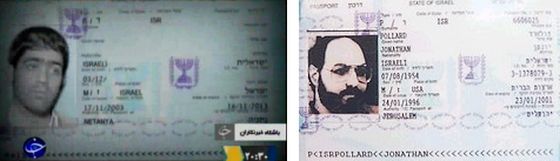
Azarmehr points to two rather glaring discrepancies in the fake Israeli passport that the Iranian hitman, Jamali Fashi, was supposedly provided by Mossad. The photo of Jamali would have been taken before the passport was issued in 2003 at which time Jamali would only have been 15, but he appears older. Also, he is not posing in the standard face-forward position used universally for passport photos. But then commenters on Azarmehr’s blog noticed an even more glaring problem: the passport contains exactly the same information as can be found on an image of an Israeli passport appearing on Wikipedia.

What others have not noted is perhaps the most basic problem with Jamali’s Israeli passport: it shows no name nor birth year!

Whatever Mossad is or is not capable of doing, I have no doubt that they could provide an agent with a flawless passport. (As for why they would be handing out such passports is a question I’ll come back to in a moment.)

So, whoever made Jamali’s Israeli passport it seems they were more likely serving the Iranian rather than the Israeli government and their objective was not to construct a physical document that could be shown to an immigration official but instead a document that could appear on TV. For that purpose, Wikipedia might have appeared to provide enough information.

Even so, the passport-maker seems to have been singularly lacking in imagination. Where Wikipedia redacted personally identifying information from an image of what is obviously a real Israeli passport, in the fake passport, instead of filling in the gaps the passport-maker just left these spaces blank — hence no surname or given name.

However, there was one blank he had to fill: the photo — and here’s where he seems to have been inspired by a creative impulse. How should Jamali pose? Just like another Israeli spy, Jonathan Pollard. Perhaps Israel has a special format it reserves for passports issued to spies, the counterfeiter thought.
OK. Enough of this blogger’s attention to detail.

There is a more basic question: why in heaven’s name would Mossad give an Iranian agent an Israeli passport? An Israeli passport is like the kiss of death and thus Mossad goes to great lengths to disguise the Israeli identity of its own operatives. So while the Israelis move around under assumed non-Israeli identity, they give their Iranian assassin an Israeli passport as though they wanted to pin a target on his back?

There is of course the much more obvious explanation: the Jamali-Mossad story was a dumb Iranian plot designed to cover up their own assassination of one of their own nuclear scientists.

But why is this story emerging now? Jamali’s confession was used by Iranian authorities to demonstrate that the dissident People’s Mujahedin of Iran or MEK have been collaborating with Israel in conducting assassinations inside Iran. The MEK, designated a terrorist organization by the U.S. government, is attempting to get this label removed. For that purpose there’s little doubt that the Jamali story, as it is now being retold, could serve as a useful element in the MEK’s PR campaign.

There is also another question: does this story have some relevance to the current negotiations between Iran and the P5 Plus One? Perhaps.

Can a government that’s willing to assassinate its own nuclear scientists operate a viable nuclear program whether that be for peaceful or military purpose?

As Jacques E.C. Hymans has noted, authoritarian governance and the challenges of scientific development do not work well together. Fear shackles creativity. That Iran’s nuclear program has advanced at a snail’s pace might not simply be a reflection of caution among Iran’s leaders but rather that the scientific community upon whose efforts progress depends has become so risk-averse that they are incapable of moving any faster. For those who fear the creation of an Iranian bomb, probably the smartest thing to do would be to do nothing.

Facebooktwittermail

Warrantless spying fight

Glenn Greenwald writes: In 2006, The New York Times‘ James Risen and Eric Lichtblau won the Pulitzer Prize for their December, 2005 article revealing that the Bush administration was eavesdropping on the electronic communications of Americans without the warrants required by the FISA law (headline: “Officials Say U.S. Wiretaps Exceeded Law”). Even though multiple federal judges eventually ruled the program illegal, that scandal generated no accountability of any kind for two reasons: (1) federal courts ultimately accepted the arguments of the Bush and Obama DOJs that the legality of Bush’s domestic spying program should not be judicially reviewed; and (2) the Democratic-led Congress, in 2008, enacted the Bush-designed FISA Amendments Act, which not only retroactively immunized the nation’s telecom giants for their illegal participation in that spying program and thus terminated pending lawsuits, but worse, also legalized the vast bulk of the Bush spying program by vesting vast new powers in the U.S. Government to eavesdrop without warrants (in his memoir, President Bush gleefully recounted that the 2008 eavesdropping bill supported by the Democrats gave him more than he ever expected).

It was then-Sen. Obama’s vote in favor of the FISA Amendments Act that caused the first serious Election Year rift between him and his own supporters. Obama’s vote in favor of the bill was so controversial for two independent reasons: (1) when he was seeking the Democratic nomination only a few months earlier and needed the support of the progressive base, Obama unequivocally vowed to filibuster “any bill that includes retroactive immunity for telecommunications companies,” only to turn around once he had secured the nomination and not only vote against a filibuster of that bill but then vote in favor of the bill itself; and (2) the bill itself legalized vast new powers of warrantless eavesdropping: powers which the Democratic Party (and Obama) had spent years denouncing (as Yale Law Professor Jack Balkin put it at the time: “Through the FISA Amendments Act of 2008, Congress has legitimated many of the same things people are now complaining about”). When Obama announced his reversal, his defenders insisted he was only doing it so that he could win the election and then use his power as President to stop warrantless eavesdropping abuses, while Obama himself claimed he voted for the FISA bill “with the firm intention — once I’m sworn in as President — to have my Attorney General conduct a comprehensive review of all our surveillance programs, and to make further recommendations on any steps needed to preserve civil liberties and to prevent executive branch abuse in the future.”

The only positive aspect of the FISA Amendments Act of 2008 was that Congress imposed a four-year sunset provision on the new warrantless eavesdropping powers it authorized. That sunset provision is set to expire and — surprise, surprise — the Obama administration, just like it did for the Patriot Act, is demanding its full-scale renewal without a single change or reform: [Continue reading…]

Facebooktwittermail

Breakdown or breakthrough? Iran nuclear talks hit a snag

Tony Karon writes: Nobody was expecting a breakthrough at Wednesday’s nuclear talks in Baghdad, but most weren’t expecting a breakdown, either. Indeed, predictions were that Iran and the P5+1 (the U.S., Britain, France, Germany, Russia and China) would engage on more detailed proposals for concrete, reciprocal confidence building measures, and then adjourn by day’s end having scheduled a new round of talks in a few weeks. But in what may be an exercise in brinkmanship, or a sign of an impending crisis, Iranian officials balked at the offer from the Western powers. ”The points of agreement are not yet sufficient for another round,” an anonymous Iranian official at the talks told AFP.

Iran’s state media, whose upbeat spin on the talks in recent weeks had many analysts concluding that Tehran was preparing its public for a deal, slammed what it called the “outdated” and “unbalanced” proposals by the Western powers in Baghdad. At Iranian insistence, Thursday will see a second day of talks in Baghdad, and the parties remained locked in negotiations until midnight. That looked like a tactic to create a mini crisis on the key sticking point in the talks: the question of whether Iran will be granted any relief from escalating Western sanctions if it agrees to the immediate confidence-building steps demanded by the P5+1. [Continue reading…]

Facebooktwittermail

Not all Israeli citizens are equal

Yousef Munayyer writes: I’m a Palestinian who was born in the Israeli town of Lod, and thus I am an Israeli citizen. My wife is not; she is a Palestinian from Nablus in the Israeli-occupied West Bank. Despite our towns being just 30 miles apart, we met almost 6,000 miles away in Massachusetts, where we attended neighboring colleges.

A series of walls, checkpoints, settlements and soldiers fill the 30-mile gap between our hometowns, making it more likely for us to have met on the other side of the planet than in our own backyard.

Never is this reality more profound than on our trips home from our current residence outside Washington.

Tel Aviv’s Ben-Gurion International Airport is on the outskirts of Lod (Lydda in Arabic), but because my wife has a Palestinian ID, she cannot fly there; she is relegated to flying to Amman, Jordan. If we plan a trip together — an enjoyable task for most couples — we must prepare for a logistical nightmare that reminds us of our profound inequality before the law at every turn.

Even if we fly together to Amman, we are forced to take different bridges, two hours apart, and endure often humiliating waiting and questioning just to cross into Israel and the West Bank. The laws conspire to separate us.

If we lived in the region, I would have to forgo my residency, since Israeli law prevents my wife from living with me in Israel. This is to prevent what Prime Minister Benjamin Netanyahu once referred to as “demographic spillover.” Additional Palestinian babies in Israel are considered “demographic threats” by a state constantly battling to keep a Jewish majority. (Of course, Israelis who marry Americans or any non-Palestinian foreigners are not subjected to this treatment.)

Last week marked Israel’s 64th year of independence; it is also when Palestinians commemorate the Nakba, or “catastrophe,” during which many of Palestine’s native inhabitants were turned into refugees.

In 1948, the Israeli brigade commander Yitzhak Rabin helped expel Lydda’s Palestinian population. Some 19,000 of the town’s 20,000 native Palestinian inhabitants were forced out. My grandparents were among the 1,000 to remain.

They were fortunate to become only internally displaced and not refugees. Years later my grandfather was able to buy back his own home — a cruel absurdity, but a better fate than that imposed on most of his neighbors, who were never permitted to re-establish their lives in their hometowns.

Three decades later, in October 1979, this newspaper reported that Israel barred Rabin from detailing in his memoir what he conceded was the “expulsion” of the “civilian population of Lod and Ramle, numbering some 50,000.” Rabin, who by then had served as prime minister, sought to describe how “it was essential to drive the inhabitants out.”

Two generations after the Nakba, the effect of discriminatory Israeli policies still reverberates. Israel still seeks to safeguard its image by claiming to be a bastion of democracy that treats its Palestinian citizens well, all the while continuing illiberal policies that target this very population. There is a long history of such discrimination.

It’s worth reading in full the 1979 report by David Shipler that Munayyer cites. The fact that Rabin’s account of Jews driving Palestinians from their homes at gun point was censored could be assumed to indicate that it was an account of unusual candor. But even if was such an account it was also an example of what is called in Hebrew yorim u’vochimwe shoot and we cry.

Rabin writes: “Great suffering was inflicted upon the men taking part in the eviction action. Soldiers of the Yiftach Brigade included youth-movement graduates, who had been inculcated with values such as international brotherhood and humaneness. The eviction went beyond the concepts they were used to.

“There were some fellows who refused to take part in the expulsion action. Prolonged propaganda activities were required after the action, to remove the bitterness of these youth-movement groups, and explain why we were obliged to undertake such a harsh and cruel action.”

At a time when Israeli leaders and Israel’s supporters frequently bemoan the fact that Israel is subject to harsh criticism, we are told that Israel is unfairly being singled out in a world where injustice is pervasive. Even so, there truly is something unique about the sentiment that Rabin and others describe.

Their message to the Palestinians is this: when you hurt, we empathize with your suffering so much that it hurts us too. We are not guilty of unfeeling brutality. Our brutality is garnished with sensitivity. Indeed, we are so sensitive that it hurts us deeply when onlookers who don’t carry the same moral burden that we do, judge us harshly. That is perhaps the greatest injustice.

Contrast this with the brutality of those who shoot and don’t cry. Ostensibly that is a worse brutality because it is bereft of empathy. Sometimes so, but, I would argue, this unfeeling brutality is unfeeling for a reason: callousness is a way of protecting those who inflict pain from the power of their own conscience. They know that if they were to allow themselves to empathize with their victims they would cry and stop shooting.

What those who shoot and cry are expressing is a narcissistic form of brutality. Empathy, instead of serving as an antidote to cruelty makes cruelty easier. And this empathy is in truth no such thing; it is a form of vanity — a conviction of those who refuse to doubt their own virtue.

Facebooktwittermail

Pentagon revealed secrets to Hollywood on bin Laden raid

The name of a SEAL Team 6 operator and commander “who was involved from the beginning as a planner” of the raid to kill Osama bin Laden was revealed to a Hollywood director and a screenwriter to assist them in making a feature film about the assassination, but this name cannot now be revealed to the press or public.

Transcripts of conversations between administration officials and the filmmakers, released because of a Freedom of Information Act lawsuit, contain redactions even though there’s no reason to believe the filmmakers had security clearances.

Politico reports: Just weeks after Pentagon and Central Intelligence Agency officials warned publicly of the dangers posed by leaks about the raid that killed Osama bin Laden, top officials at both agencies and at the White House granted Hollywood filmmakers unusual access to those involved in planning the raid and some of the methods they used to do it, newly released government records show.

At a briefing in July 2011, Undersecretary of Defense for Intelligence Mike Vickers told filmmakers Michael Boal and Katherine Bigelow that the leaders of the the Special Operations Command couldn’t speak to them for appearances’ sake. However, Vickers said that the Pentagon would make available a Navy SEAL who was involved in planning the raid from its earliest stages.

“On the operators side, Adm. McRaven and Adm. Olson do not want to talk directly, because it’s just a bad, their [sic] just concerned as commanders of the force and they’re telling them all the time—don’t you dare talk to anybody, that it’s just a bad example if it gets out—even with all sorts of restrictions and everything,” Vickers said, according to a transcript of the meeting released Friday to Judicial Watch. The conservative watchdog group filed a Freedom of Information Act lawsuit demanding the documents (posted here).

“The basic idea is they’ll make a guy available who was involved from the beginning as a planner, a SEAL Team 6 Operator and Commander,” McRaven said.

“That’s dynamite,” Boal replied, according to the transcript.

Bigelow, best known for “The Hurt Locker,” also chimed in. “That’s incredible,” she said, gratefully.

“He’ll speak for operators and he’ll speak for senior military commanders,” Vickers continued, adding that the designated SEAL would essentially be a mouthpiece for McRaven and Olson. “The only thing we ask is that you not reveal his name in any way as a consultant because again it’s the same thing, he shouldn’t be talking out of school, this at least gives him one step removed and he knows what he can and can’t say,” Vickers added, vouching that the SEAL cleared to meet with the filmmakers would be able to provide “lots of color.”

The Pentagon is now withholding from the public and the press the same name DoD gave the filmmakers. The response sent to Judicial Watch explains the deletion by citing privacy concerns as well as a statute allowing the Secretary of Defense to protect the names of members of “routinely deployable” and “sensitive” units. It is unclear whether the court will uphold such a withholding given that the name was already disclosed to a member of the public by a senior official, apparently with some forethought.

Facebooktwittermail

Israeli politicians incite mob violence targeting African refugees in Tel Aviv

Noam Sheizaf reports: More than 1,000 Israelis protested this evening (Wednesday) against the African refugees and asylum seekers who have settled in South Tel Aviv in recent years. According to eyewitnesses reports, the crowd grew angry and ultimately violent, following speeches from Knesset Members, including members of the government coalition.

It was one of the most violent protests Tel Aviv has known in recent years. Confrontations were continuing between police and Jewish citizens at around 10:30 p.m. local time.

Dozens of protesters tried to move from the Hatikva neighborhood, where the rally was held, towards Tel Aviv’s Shapira neighborhood, where most African refugees live. They were stopped by police. Protesters attacked a car passing by carrying African immigrants, smashing its windows. Shops associated with the African community were vandalized. [UPDATE: As of midnight, activists in Hatikva are still reporting looting and occasional attacks on Africans.]

In light of increasing violence and harassment in recent days, activists walked refugee children in Tel Aviv home from school on Wednesday in order to prevent them from potential attacks.

According to Maariv’s website, the mob chased a man from Eritrea, who took shelter in a storefront and was rescued by police. At least two journalists were attacked. One fled the area and the other, whose notepad was snatched by protesters, was sheltered by the cops.

Earlier, Knesset members spoke at the event. Some blamed government inaction for the “infiltration problem,” while others heaped attacks on human rights organizations helping the refugees. Knesset Member Miri Regev called the refugees “a cancer.” Regev, a member of Netanyahu’s Likud party, said that “leftists” are preventing the state from deporting the refugees back to Africa. Knesset Member Danny Danon (Likud), who also spoke at the event, wrote in a Facebook status tonight that “Israel is at war. An enemy state of infiltrators was established in Israel, and its capital is south Tel Aviv.”

Earlier this week, Haaretz reported: Prime Minister Benjamin Netanyahu said on Sunday that the “phenomenon of illegal infiltrators from Africa is extremely serious and threatens Israel’s social fabric and national security. He made the comments at a cabinet meeting, adding that “if we don’t stop the problem, 60,000 infiltrators are liable to become 600,000, and cause the negation of the State of Israel as a Jewish and democratic state.”

Netanyahu also praised the border fence that is being built in the south as a means of preventing infiltrations, but added that it is also important “to physically remove the infiltrators. We must crack down and mete out tougher punishments.”

Five groups that aid African migrants sent a letter to Netanyahu on Sunday, asking that he “immediately order the granting of work permits to asylum-seekers in Israel.” The letter stated that the current situation is forcing migrants to seek shelter in poorer neighborhoods, exacerbating the problems there. “The situation has become intolerable,” they wrote.

Interior Minister Eli Yishai echoed the sentiment expressed by the prime minister, and reiterated his own message last week, when he said that most African migrants are criminals and that all, “without exception,” should be arrested and deported.

On Sunday, Yishai said he is not responsible for asylum-seekers from war-torn countries whose lives might be at risk if deported back to those countries, because “as it is, there are millions more who might be murdered.

Facebooktwittermail
