



In The Independent, Freya Berry writes: What does a country do with a remorseless, apparently sane, mass-murderer? Unusually, Anders Breivik, perpetrator of the Utoya massacre, was left alive – something even he finds surprising. Now, safely in custody, famously liberal Norway is struggling to know how to deal with him.
The maximum prison sentence Norway offers is 21 years: roughly a third of a year for every person he killed. An insanity plea would render him liable for locking up indefinitely in a psychiatric unit – but Breivik insists he is sound in mind.
Norway has so far preserved its political ethics, balancing Breivik’s democratic rights with human decency and caution. Yet what is most notable is not the actions of the judiciary, but the response from the people. A poll by Dagbladet newspaper showed 68 per cent of the population remain opposed to the death penalty. The same newspaper has also introduced a “No Breivik” button, which removes him from its news feed. And of the 139 public tickets for Breivik’s hearing, just 50 have been taken up. This behaviour shows a dignified refusal to let his actions and beliefs affect their lives.
This is a country whose Prime Minister, Jens Stoltenberg, regularly cycles to work without security, without a chauffeured car following behind (David Cameron, I’m looking at you). At the memorial service to Breivik’s victims, he said “we will never give up our values. Our response is more democracy, more openness, and more humanity.”
Meanwhile, since the 7/7 bombings, the UK has sustained wars against two countries; tried to impose 42-day detentions without trial; and is now threatening to introduce secret courts.
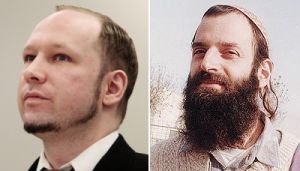 Anders Behring Breivik, the Norwegian mass murderer who killed 77 fellow Norwegians last July, wants to portray himself as both sane and the champion of a righteous cause. In his testimony before a court in Oslo he has said that he and other militant nationalists in the West are “selling dreams” to inspire others.
Can a man who has displayed such ruthlessness become a source of inspiration? The answer is clearly yes and one of the most obvious parallels to Breivik would be Baruch Goldstein.
After the American-born Jewish Israeli physician killed 29 Palestinians and wounded another 125 at the Cave of the Patriarchs massacre in Hebron in 1994, thousands of people visited Goldstein’s grave to pay their respects.
A few days after the massacre, the New York Times reported:
Dr. Goldstein, who was finally overcome and beaten to death by the worshipers, was buried today in Qiryat Arba after a funeral service in which some mourners praised him as a hero and a righteous man. His grave was said to be temporary, and there are plans to move him to the Jewish cemetery in Hebron when tensions ease.
“One million Arabs are not worth a Jewish fingernail,” Rabbi Yaacov Perrin said in a eulogy. At the service in Jerusalem, attended by 300 people, one man shouted, “We are all Goldstein,” an opinion echoed across Qiryat Arba by neighbors who said variously that they approved of his attack on the Arabs or at the least could not judge him.
Goldstein was a follower of Rabbi Meir Kahane and belonged to Kahane’s Jewish Defense League.
After Breivik’s bombing and shooting rampage, those in Europe and the United States who share his views about an “Islamic threat” have largely wanted to distance themselves from his actions even while defending his outlook.
There are however a few exceptions.
“Anders Breivik, The Kangaroo Court and The Lies of The Left,” a post at the Jewish Defence League UK website says (excerpt posted here without corrections):
At the beginning of the trial, Officials and Court members shook Breivik’s hand as if to give a Façade that they were not corrupt in the trial of this man. Anders Breivik spoke out and refused to recognize the court as The court room was being held by Leftists who were connected to the Marxist government of Norway. Quite rightly, because it was a classic Kangaroo court. the judges and prosecution were constantly staring at Breivik wide eyed, they were like a bunch of children trying an adult, they looked completely unprofessional and out of their league. A man like Breivik in a case such as this surely deserves a better trial than that?
[…]
[W]hat happened on Utoya was regrettable, but those to blame are those who held the rally, the Labour Youth and the Norwegian government. Breivik killed nobody under the age of 14 in the shootings, they were young adults. The rally at Utoya was certainly no “kids day out” it was an Far Left indoctrination weekend, set on a picturesque island, only the day before those attending were holding “Boycott Israel” banners to show the cameras. You tell me what “child” attends political meetings? You tell me what “child” is classed as an up and coming Politician? They were not children, they were young adults. I hold the same amount of sympathy for the those on Utoya as I would if somebody committed this act on a Hitler Youth camp in the 1940’s, or were they just “children” as well?
“There are thousands and thousands of people desperate like [Breivik]” says co-founder, spokesman and leader of the English Defense League, “Tommy Robinson” (Stephen Yaxley-Lennon).
Breivik’s prosecutors will no doubt work hard to portray the accused as delusional in the hope that the “dreams” he wants to sell will find no buyers. But though his view of the world is no doubt twisted, it is shared far too widely to be dismissed. And were Breivik not a rightwing extremist and white, he would without question have been branded a terrorist and those who share his views be seen as terrorist sympathizers.
The label “terrorist” has little value if it serves as nothing more than as an expression of antipathy, but the ranks of Breivik’s fellow travelers are all too easy to identify.
Robert Spencer and Pamella Geller’s Stop Islamization of America Facebook page has 7,668 likes: Stop Islamization of Norway (Stopp islamiseringen av Norge), 10, 348 members; Stop Islamization of the World, 8,466 likes; Anti-Islam Alliance, 6,312 likes; United States Defense League, 2,321 likes; English Defence League, 13, 679 likes; Stop Islamization of Denmark (Stop Islamiseringen Af Danmark), 2,321 members; and Stop Islamization of Europe – Bulgaria (ДА СПРЕМ ислямизацията!/SIOE Bulgaria), 4,077 members.
Even if the Knights Templar network to which Breivik claims he was recruited doesn’t actually exist, such a group with the aims he has outlined could certainly be created.
The idea that Breivik’s trial and conviction should serve as a warning to those who might contemplate following his lead reflects the slanted view of justice which puts all the emphasis on punishment. Indeed, punishment — whatever form it takes — will for Breivik be turned into some kind of ideological reward.
The most valuable function his trial can serve is as a demonstration that the actions of an individual or handful of individuals should not be used as a justification for abandoning the legal and democratic principles upon which a free society is based.
Erik Dale writes:
Much has been said about how Norway reacted as a nation in the immediate aftermath of the attacks, but in 10 weeks we will know what this nation is really made of.
The first challenge is to accept that no punishment can ever fit the crime. Some have called for changes in the legal system to allow for longer prison sentences or even death, but even if those had been real possibilities no punishment in the world is ever going to feel enough. Others have reacted strongly to pictures of the terrorist smiling and giving extremist salutes in the courtroom, pointing out that he is getting exactly the kind of attention he wants.
We should be outraged by the ideas that motivate him, but if we deny him the chance of explaining himself in an open court, we let the essence of those ideas, oppression and intolerance, dominate us. Although my heart is filled with anger, fear and sorrow, I am glad the Norwegian legal system treats everyone the same and is not subject to popular opinion. Its objective rules are there to deliver justice when emotions get the better of us. If Norwegians can hold on to that, they have already won a great victory.
The second challenge is to remain true to the values of Norwegian society. It is easy to be sympathetic to demands for stronger censorship, policy controls and online surveillance. Many will suggest that Breivik could have been stopped if only we had adopted some measure or other. But such doubts must not be allowed to change Norway. Even more important than the terrorist’s right to speak in court is that the right of opinion and right of organisation keep forming the core of our free society. Right of opinion, the heart of freedom of speech, also includes right of privacy and anonymity.
Extremism of any creed is not fuelled by those who speak in public, but by those who feel that no one speaks for them at all. There must be room for even the dark sides of human nature if Norway is to remain Norway. Only then can Norwegians emerge on the other side of this challenge as a greater and stronger people than they were before.

The incomparable percussionist, Trilok Gurtu, playing cajón, alongside Nils Petter Molvaer on trumpet, Lars Danielsson: cello, Mike Lindup: piano, and Nicolas Fiszman: bass.
Al Jazeera reports: “The fishermen have never seen anything like this,” Dr Jim Cowan told Al Jazeera. “And in my 20 years working on red snapper, looking at somewhere between 20 and 30,000 fish, I’ve never seen anything like this either.”
Dr Cowan, with Louisiana State University’s Department of Oceanography and Coastal Sciences started hearing about fish with sores and lesions from fishermen in November 2010.
Cowan’s findings replicate those of others living along vast areas of the Gulf Coast that have been impacted by BP’s oil and dispersants.
Gulf of Mexico fishermen, scientists and seafood processors have told Al Jazeera they are finding disturbing numbers of mutated shrimp, crab and fish that they believe are deformed by chemicals released during BP’s 2010 oil disaster.
Along with collapsing fisheries, signs of malignant impact on the regional ecosystem are ominous: horribly mutated shrimp, fish with oozing sores, underdeveloped blue crabs lacking claws, eyeless crabs and shrimp – and interviewees’ fingers point towards BP’s oil pollution disaster as being the cause.
Jodi Dean writes: The movement opened up by Occupy Wall Street is the most exciting event on the US political left since 1968—it’s like, my god, finally we can breathe, finally there is an opening, a possibility of organized mass political action. As in 1968, the current movement extends globally, encompasses multiple grievances, and is being met by violent police responses. From Egypt to New York, Spain to Oakland, hundreds of thousands of people have responded to capitalist dispossession by taking space, occupying sites that, ostensibly open and public, the process of occupation reveals to be closed to the many and belonging to the few. Also as in 1968, an economic wrong, the wrong of capitalism, is at the core of the political rupture. Recall that in May ‘68, a general strike shut down the French economy. Students occupied the Sorbonne and workers occupied factories. In September 2011, protesters in New York occupied Wall Street. They were inspired by revolutions in Tunisia and Egypt, the February occupation of the Wisconsin State Capitol, and the 15 May movement of the squares in Spain (as well as by the occupation movements that in recent years have accompanied protests over cutbacks in education and increases in university tuition in California, New York, and the UK).
That Wall Street was actually the nearby privately owned Zuccotti Park didn’t really matter. What mattered, and what opened up a new space of political possibility in the US, was that people were finally waking up to the ultimate incompatibility between capitalism and the people—after forty years of neoliberalism’s assault on the working and middle class and after a decade of rapacious class warfare in which the top one percent saw an income increase of 275% (their share of the national income more than doubling) while most of the rest of the country saw an income increase of roughly 1% a year. Instead of continuing in the fantasy that “what’s good for Wall Street, is good for Main Street,” the occupation claimed the division between Wall Street and Main Street and named this division as a fundamental wrong, the wrong of inequality, exploitation, and theft.
Occupy Wall Street’s staging of the incompatibility between capitalism and the people was visible, material, and practical. Visibly, urban camping brought to the heart of New York’s financial district the reality of dispossession. It forced Wall Street to look homelessness in the face, both the homelessness of the New Yorkers that the city had been trying to repress, hide, and disperse and that of those across the country who had been evicted in the foreclosure crisis and left to dwell in make shift tent cities reminiscent of shanty towns and Hoovervilles of the Depression. Materially, the presence of people crowded into places where capitalism has determined they don’t belong was manifest in the array of physical needs impressing and expressing themselves in Zuccotti park—the absence of public toilets and showers, the impermissibility of gas-run generators, open flames for cooking, and the illegality of tents resulted in a series of issues encapsulated in the media under the headings public health, filth, and disease. Practically, Occupy Wall Street—and the police reaction to it—led to the proliferation of police barriers all over downtown Manhattan. Even more important, the daily activities of occupiers strove to bring into being new practices of sociality, new ways of living together, ways no longer coordinated by the capital but by discussion, mutuality, and consensus. Not surprisingly, in the course of these practical engagements, new incompatibilities emerged and were only beginning to be addressed when Zuccotti Park was evicted.
The movement’s early slogan, “We are the 99 Percent,” quickly went viral. It spread in part because of the Tumblr collection of images and testimonials to the hardships of debt, foreclosure, and unemployment, a “coming out” of the closet imposed by the conceit that everyone is middle class, everyone is successful. Conservative politicians bristled with indignation at what they depicted as the unfairness of the many who were now refusing to accept the one percent’s seizure of an outrageously unfair portion of the common product. Presidential candidate Mitt Romney scolded what he called the “politics of envy.” These privileged carriers of the 99 versus the 1 percent meme couldn’t quite grasp the change in the situation, the shift in the status quo whereby people no longer believed the myths that “greed is good” and “inequality benefits everyone.” They attempted to turn the issue around, making themselves into victims of exclusion and invective, as if the 99% were the criminals, as if our primary condition had been mutually compatible until some malcontents started to cause trouble, as if class war were a new rather than constitutive incompatibility between those who need to work to live and those who have enough capital not to. A fortunate effect of this tactic was the continued accentuation of class division—as a recent poll from the Pew Foundation found, 66% of Americans think that divisions between rich and poor are strong or very strong, an increase of 19% since 2009. Not only is this view held in every demographic category but more people think that class division is the principle social division than they do any other division.
The slogan “We are the 99%” highlights the division between the wealth of the top 1% and the rest of us. Mobilizing the gap between the 1% with nearly half the country’s wealth and the other 99% with the rest of it, the slogan asserts a collectivity. It does not unify this collectivity under a substantial identity—race, ethnicity, religion, nationality. Nor does it proceed as if there were some kind of generic and unified public. It rejects the fantasy of a unified, non-antagonistic public to assert the “we” of a divided people, the people divided between expropriators and expropriated. In the setting of an occupied Wall Street, this “we” is a class, one of two opposed and hostile classes, those who have and control wealth, and those who do not.
The assertion of a numerical difference as a political difference, that is to say, the politicization of a statistic, expresses capitalism’s reliance on fundamental inequality—“we” can never all be counted as the top 1%. Thus, the announcement that “We are the 99%” names an appropriation, a wrong. In so doing, it voices as well a collective desire for equality and justice, for a change in the conditions through which one percent seizes the bulk of collective wealth for themselves, leaving 99% with the remainder.0
“We are the 99%” also effaces the multiplicity of individuated, partial, and divided interests that fragment and weaken the people as the rest of us. The count dis-individualizes interest and desire, reconfiguring both into a common form. Against capital’s constant attempts to pulverize and decompose the collective people, the claim of the 99% responds with the force of a belonging that not only cannot be erased but that capital’s own methods of accounting produce: as capital demolishes all previous social ties, the counting on which it depends provides a new figure of belonging. Capital has to measure itself, count its profits, its rate of profit, its share of profit, its capacity to leverage its profit, its confidence or anxiety in its capacity for future profit. Capital counts and analyzes who has what, representing to itself the measures of its success. These very numbers can be, and in the slogan “We are the 99%” they are, put to use. They aren’t resignified—they are claimed as the subjectivation of the gap separating the top one percent from the rest of us. With this claim, the gap becomes a vehicle for the expression of communist desire, that is, for a politics that asserts the people as a divisive force in the interest of over-turning present society and making a new one anchored in collectivity and the common.0
Admittedly, the occupiers of Wall Street, and the thousand other cities around the world with occupations of their own, have not reached a consensus around communism (as if communism could even name a consensus). The movement brings together a variety of groups and tendencies—not all of them compatible. Many in the movement see that as Occupy’s strength. They see Occupy as an umbrella movement capable of including a multiplicity of interests and tendencies. For them, “occupy” serves as a kind of political or even post-political open source brand that anyone can use. Because occupation is a tactic that galvanizes enthusiasm, they suggest, it can affectively connect a range of incompatible political positions, basically working around fundamental gaps, divisions, and differences. The mistake here is not only in the effort to ignore multiple incompatibilities; it is also, and more importantly in the evasion of the real antagonism that matters, the one that connects the movement to its setting—class struggle. “Tactics as brand” neglects the way occupation is a form that organizes the incompatibility of capitalism with the people and emphasizes instead a flexibility and adaptability already fully compatible with capitalism. [Continue reading…]
Tony Karon writes: Staying within the “clock is ticking” metaphor favored by the Obama Administration when discussing diplomacy with Iran, Saturday’s talks in Istanbul could be said to have hit the snooze button. The doomsday alarm could yet sound, but not for a while yet. Iran and Western powers agreed Saturday to hold another round of talks—in Baghdad, of all places, at Iran’s request—on May 23. That means a proverbial “diplomatic window” (another rhetorical favorite of Administration officials) will remain open at least for the next five weeks.
And there are indications from Istanbul that the parties are working towards a formula for keeping the window open a lot longer. “We have agreed that the Non-Proliferation Treaty [NPT] forms a key basis for what must be serious engagement, to ensure all the obligations under the NPT are met by Iran while fully respecting Iran’s right to the peaceful use of nuclear energy,” said the West’s chief negotiator, EU foreign policy chief Dame Catherine Ashton, at the conclusion of Saturday’s talks. “We want now to move to a sustained process of serious dialogue, where we can take urgent practical steps to build confidence and lead on to compliance by Iran with all its international obligations. In our efforts to do so, we will be guided by the principle of the step-by-step approach and reciprocity.”
Despite no breakthroughs or even substantial discussion in Istanbul over specific proposals, there’s more to Ashton’s comments than pablum. Successful negotiations require a common framework in which each side is able to see its core concerns addressed, even if their understandings of that common framework are different.
Vincent Warren writes: It is a bedrock principle of democratic government that the state cannot be judge, jury and executioner all at once. Yet the CIA and Pentagon maintain lists of suspected terrorists to be targeted for killing and have these “kill lists” approved only by an internal executive process. They then hand them over to drone operators who sit thousands of miles away from their targets and execute the strikes via a video monitor that makes it hard to remember that “targeted killing” is a real government program and not the name of a cool new Xbox game. In this depersonalized, dehumanized setting, drone victims are referred to as “bug splats,” as Michael Hastings reported in Rolling Stone this week, because on the video monitors “viewing the body… gives the sense of an insect being crushed.”
Among the thousands of bodies crushed in this way are the bodies of hundreds of civilians, including 168 children since 2004, according to the U.K.-based Bureau of Investigative Journalism. Also crushed is any accountability for the decisions on who is marked to die and who is actually killed, whether the intended targets or bystanders who solely by accident of birth live, and die, in a country that the U.S. is not at war with but has decided it needs to kill in.
The case of the December 17, 2009, attack in Yemen demonstrates everything that is horribly wrong with the targeted killing program, and serves as a call to action to all those concerned about the rule of law and respect for human life. On that day, U.S. cruise missiles loaded with cluster bombs struck a remote mountain community in the al-Majalah region, killing 41 people, including 21 children and 14 women. Initially, the Yemeni government claimed responsibility for the killings, but reports that the U.S. had actually executed the strike began leaking out almost immediately. The publication of a January 2010 diplomatic cable obtained by WikiLeaks confirmed these reports as well as an orchestrated U.S.-Yemeni effort to cover up the truth. “We’ll continue saying the bombs are ours, not yours,” the cable quotes Yemeni President Ali Abdullah Saleh telling U.S. General David Petraeus.
Yet to date, no one in the U.S. has had to answer for the al-Majalah attack, the carnage it caused, or the attempted cover-up of the U.S.’s role in it. No one has had to explain the government’s legal basis in U.S. or international law for this strike in a country that the U.S. is not at war with, or to account for the decision of the target and what knowledge officials had of the civilians present.
Today — with the filing of a Freedom of Information Act request for documents in this case by the Center for Constitutional Rights and the American Civil Liberties Union — answers and accountability are being demanded. The ACLU and CCR are part of a growing chorus of critics pressing for answers in this case.
Michael Hastings writes: One day in late November, an unmanned aerial vehicle lifted off from Shindand Air Base in western Afghanistan, heading 75 miles toward the border with Iran. The drone’s mission: to spy on Tehran’s nuclear program, as well as any insurgent activities the Iranians might be supporting in Afghanistan. With an estimated price tag of $6 million, the drone was the product of more than 15 years of research and development, starting with a shadowy project called DarkStar overseen by Lockheed Martin. The first test flight for DarkStar took place in 1996, but after a crash and other mishaps, Lockheed announced that the program had been canceled. According to military experts, that was just a convenient excuse for “going dark,” meaning that DarkStar’s further development would take place under a veil of secrecy.
The drone that was headed toward Iran, the RQ-170 Sentinel, looks like a miniature version of the famous stealth fighter, the F-117 Nighthawk: sleek and sand-colored and vaguely ominous, with a single domed eye in place of a cockpit. With a wingspan of 65 feet, it has the ability to fly undetected by radar. Rather than blurting out its location with a constant stream of radio signals – the electronic equivalent of a trail of jet exhaust – it communicates intermittently with its home base, making it virtually impossible to detect. Once it reached its destination, 140 miles into Iranian airspace, it could hover silently in a wide radius for hours, at an altitude of up to 50,000 feet, providing an uninterrupted flow of detailed reconnaissance photos – a feat that no human pilot would be capable of pulling off.
Not long after takeoff – a maneuver handled by human drone operators in Afghanistan – the RQ-170 switched into a semiautonomous mode, following a preprogrammed route under the guidance of drone pilots sitting at computer screens some 7,500 miles away, at Creech Air Force Base in Nevada. But before the mission could be completed, something went wrong. One of the drone’s three data streams failed, and began sending inaccurate information back to the base. Then the signal vanished, and Creech lost all contact with the drone.
Today, even after a 10-week investigation by U.S. officials, it’s unclear exactly what happened. Had the Iranians, as they would later claim, hacked the drone and taken it down? Did the Chinese help them? If so, had they pulled off a sophisticated attack – breaking open the drone’s encrypted brain and remotely piloting it to the ground – or a cruder assault that jammed the drone’s signal, causing it to crash? Or did the drone operators back at Creech simply make a mistake, sparking a glitch that triggered the aircraft to land? “After a technical fuck-up, people panic and start trying to fix it, doing things they shouldn’t have done,” says Ty Rogoway, a drone expert who runs an industry website called Aviation Intel. “It was fishy from Day One.”
What we do know is that the government lied about who was responsible for the drone. Shortly after the crash on November 29th, the U.S.-led military command in Kabul put out a press release saying it had lost an “unarmed reconnaissance aircraft that had been flying a mission over western Afghanistan.” But the drone wasn’t under the command of the military – it was operated by the CIA, as the spy agency itself was later forced to admit.
Ten days after the crash, the missing drone turned up in a large gymnasium in Tehran. The Iranian military displayed the captured aircraft as a trophy; an American flag hung beneath the drone, its stars replaced with skulls. The drone looked nearly unscathed, as if it had landed on a runway. The Iranians declared that such surveillance flights represented an “act of war,” and threatened to retaliate by attacking U.S. military bases. President Obama demanded that Iran return the drone, but the damage was done. “It was like when someone from Apple left a prototype of the next iPhone at a bar,” says Peter Singer, a defense specialist at the Brookings Institute and the author of Wired for War: The Robotics Revolution and Conflict in the 21st Century. “It was a propaganda win for Iran.”
The incident also underscored the increasingly central role that drones now play in American foreign policy. During the invasion of Iraq in 2003, the military conducted only a handful of drone missions. Today, the Pentagon deploys a fleet of 19,000 drones, relying on them for classified missions that once belonged exclusively to Special Forces units or covert operatives on the ground. American drones have been sent to spy on or kill targets in Iran, Iraq, Afghanistan, Pakistan, Yemen, Syria, Somalia and Libya. Drones routinely patrol the Mexican border, and they provided aerial surveillance over Osama bin Laden’s compound in Abbottabad, Pakistan. In his first three years, Obama has unleashed 268 covert drone strikes, five times the total George W. Bush ordered during his eight years in office. All told, drones have been used to kill more than 3,000 people designated as terrorists, including at least four U.S. citizens. In the process, according to human rights groups, they have also claimed the lives of more than 800 civilians. Obama’s drone program, in fact, amounts to the largest unmanned aerial offensive ever conducted in military history; never have so few killed so many by remote control. [Continue reading…]
The New York Times reports: Western military and intelligence officials acknowledged on Monday that they were surprised by the scale and sophistication of the synchronized attacks in Afghanistan on Sunday, seeing it as a troubling step in the evolution of the Haqqani Taliban network from a crime mob to a leading militant force.
Even as the Western officials praised the Afghan security forces’ response and sought to play down the attacks’ strategic impact, they privately agreed with the criticism by President Hamid Karzai on Monday. He said the assaults — involving dozens of attackers who crossed hundreds of miles to strike at seven different secured targets, all around 1:45 p.m. on Sunday — represented an “intelligence failure for us, and especially NATO.”
The officials said the episode raised two pivotal questions: whether the militants now had the ability to mount such audacious assaults repeatedly, rather than just once every several months, and whether the Afghan government would be able to blunt such plots after 2014, the deadline for Western troop withdrawal, when its access to allied intelligence assistance would be limited.
“It certainly seems there’s some kind of gap in intelligence collection or in sifting through the volume of what’s collected,” said John K. Wood, an associate professor at the National Defense University who was senior director for Afghanistan on the National Security Council in the Bush and Obama administrations, and who just visited Kabul.
For the Haqqani network, a family of border criminals and smugglers that has gained an astonishing notoriety in recent years as a leading killer of allied troops in Afghanistan, the attacks on Sunday represented more than just the ability to paralyze the mostly tightly secured districts of Kabul for hours. They were proof that the Taliban offshoot could create the vast network of logistical support and planning needed to mount terrorist attacks without anything leaking to the intelligence groups so tightly focused on it.
Human Rights Watch: The farmers of the West Bank village of Beit Surik used to make their living selling oil from their olive trees. Now, says Abu Rami, the head of the village farmers’ association, they cannot produce enough olive oil for their own families. The problem is the system Israel has set up for getting access to their land in the West Bank is on the other side of Israel’s separation barrier. In effect, Israel treats all Palestinians living in or seeking to reach their own lands on the Israeli side of the barrier as though they were security threats.
Israel began building its separation barrier – in some places a fence, in others an eight metre-high concrete wall with guard towers – in 2002, for the stated purpose of preventing Palestinian suicide bombers from attacking Israeli civilians. The International Court of Justice ruled, in 2004, that the barrier route violates international law where it veers into the occupied Palestinian territories. Today, 85 per cent of the barrier’s route lies inside the West Bank, cutting tens of thousands of Palestinians off from lands they own or previously farmed without restriction.
Israel argues that it has opened gates in the barrier to allow West Bank Palestinians to reach their lands. But the daily reality belies this claim. By preventing these Palestinian farmers from reaching their land for most of the year, Israel is reducing many of them to poverty. To pass through the gates, Palestinians must “coordinate” – the Israeli term for getting advance permission from the military. The Palestinians must also obtain special military permits to reach the more than 18,400 hectares on the other side that Israel has designated “seam zones”: areas that are closed military zones to Palestinians, though not to Israelis.
In a confidential report from July 2011, which was later leaked; European Union heads of mission dealing with Palestinian issues recommended that the EU should “encourage Israel to open the gates to the seam zone on a more regular basis without prior coordination”. One affected area is known as the Biddu enclave. It consists of eight villages with 30,000 residents surrounded by the barrier on three sides. The barrier has cut off a group of Palestinian farmers there from 50 per cent of their farmlands and 70 per cent of their grazing lands.
In response to petitions to Israel’s High Court of Justice, the military built five gates for Palestinian farmers in the barrier around the enclave. All five gates require advance “coordination”. And one is also a seam zone gate, meaning Palestinians need special permits to use it. The result has been that farmers from the enclave were unable to reach their farmlands for 268 days in 2009, 282 days in 2010, 328 days in 2011 and 84 days in 2012 – as of April 3, according to UN monitors. On the limited days that Israel grants access, it does so without adequately considering the seasonal variations in farming and harvesting. A farmer from the village of Biddu, Faruq Radad, says that he owns two hectares of grape vines beyond the barrier – but that for the past two years, the days that Israel allowed access did not correspond to the grape harvest season. His grapes rotted on the vine.
Israel’s High Court has rejected arguments that security needs could be met with a less restrictive system, such as soldiers checking farmers for weapons before allowing them to cross the barrier. But Israel imposes a much less restrictive system on Palestinians working in Israeli settlements. For example, about 150 Palestinians from one of the villages in the Biddu enclave work in the settlement of Har Adar – according to the Beit Iksa village council. Their settler employers collect their identification documents and give them to the Israeli military for security checks. The Palestinians receive permits that are typically valid for three months, generally renewed, and they can cross through a gate in the separation barrier six days a week. It appears that Israel is willing to adopt a more discerning security system when the issue is the convenience of settlers, but not when it concerns Palestinian farmers trying to make a living on their own land.
The Israeli military now allows only 15 farmers from Beit Iksa to pass through the same gate, and has only opened that gate to them on 10 days so far in 2012 – according to United Nations monitors. In November 2010, the military granted permits to 70 farmers – which were valid for three weeks. Months later, in March 2011, the military renewed only 15 of the 70 – for bureaucratic rather than specific security reasons. It has been 10 years since Israel began constructing its separation barrier. Without meaningful pressure on Israel to change its barrier policies, Palestinian farmers are likely to suffer continued rights violations. The EU could best help Biddu’s farmers avoid being forced into poverty by vigorously advocating for Israel to allow them to work their land.
Ali Abunimah writes: Air France demanded to know the religion of a passenger on a flight from Nice to Tel Aviv and removed her because she is not a Jew.
The 15 April incident, confirmed by an Air France official, may violate international and European law by subjecting prospective passengers to illegal religious discrimination.
Over the past few days, Israeli authorities have reacted to an effort by hundreds of European travelers to visit the occupied West Bank at the invitation of Palestinians, by stationing hundreds of armed police and soldiers at the main international airport at Lydd, detaining and expelling travelers, and ordering European airlines to prevent boarding of travelers that Israel has placed on a political blacklist.
Several European airlines meekly complied with these Israeli orders, canceling tickets of those arbitrarily blacklisted by Israel.
The revelation that passengers are being subjected to religious tests takes this complicity with Israel’s apartheid policies to shocking new levels. [Continue reading…]
A soldier is on the battlefield, face-to-face with the enemy — but he’s run out of ammunition. How’s he going to engage in what could be the final fight for his life?
If he’s an Israeli soldier he’ll most likely employ the no-holds-barred Krav Maga, one of the world’s deadliest hand-to-hand combat styles. This technique derived from street-fighting skills developed by Imi Lichtenfeld, who made use of his training as a boxer and wrestler, as a means of defending Bratislava’s Jewish quarter against attacks by fascist groups in the 1930s.
This is what Lt. Col. Shalom Eisner, deputy commander of the IDF’s Jordan Valley brigade, resorted to when faced with the “threat” posed by a bunch of kids on bicycles on Saturday afternoon.
Eisner might have appeared to have lost control but his was what might be called measured brutality — restrained enough not to kill or to fracture a peaceful protester’s skull.
The following video shows Israelis training in the technique the lieutenant colonel employed.
Amir Mizroch is the editor of the English Newsletter Edition of Israel Hayom, Israel’s most widely-read Hebrew daily newspaper. He says the blow that Eisner delivered to Andreas Ias, an ISM activist participating in the Jordan Valley cycle tour, is a Krav Maga blow that IDF recruits are taught in their first week of basic training.
Eisner’s blow is just one of a sequence of Krav Maga blows that recruits learn. The blow that Eisner delivered, textbook style, could have been followed by at least 4 others in the sequence, which are designed to completely demobilize an enemy, perhaps even kill him. The fact that Eisner lost his cool and ‘reverted to type’ and his training, is an indication that the soldier was not mentally prepared for his mission against the ISM. He shouldn’t have been there in the first place. Eisner is a man the IDF wants in the field to face his opposite numbers in the Syrian army, the Iranian army, or Hezbollah. He is a soldier, a killer if he needs to be. The IDF does not want Eisner in a lose-lose situation where the battle is against peaceful protestors armed with cameras.
Until the army learns this lesson, no amount of sensitivity training, media awareness training, or damage control, is going to fix the problem.
The issue that Mizroch fails to address is the nature of military occupation.
The only reason policing works in a free society is through the support and consent of the wider population. Military occupation like martial law is rule without consent — it is imposed against the will of the people.
Eisner didn’t just lose his cool — he illustrated the very nature of Israel’s rule over the Palestinians: rule by force in which violence is not exceptional; it is the method of government.