Israel: Lt. Col. Shalom Eisner and his supporters

Lt. Col. Shalom Eisner

Israel’s President Shimon Peres, Prime Minister Benjamin Netanyahu, and IDF Chief of Staff Benny Gantz, all understand the world well enough to be in no doubt that the behavior of Lt. Col. Shalom Eisner as he slammed his M-16 rifle into the face of a Danish activist, Andreas Ias, was bad for Israel.

“Such behavior does not characterize IDF soldiers and officers and has no place in the Israel Defense Forces and in the State of Israel,” Netanyahu said.

Indeed. But the problem for Israel is that not only was Eisner’s behavior not an aberration — it has been widely praised.

In less than 24 hours a Facebook page, “We Support Lt Colonel Shalom Eisner,” has received several hundred “likes.” (The French-speaking creator of the page also happens to like the extremist Jewish Defense League and the English Defense League.)

Former Chief IDF Rabbi Avihai Ronski criticized the swift decision to suspend Eisner, who he described as “a highly ethical individual.”

“How can you say this was ‘a serious event’ after only a few seconds of footage? These kinds of incidents are why today’s commanders feel they have no backing.”

Danny Dayan, the chairman of the Yesha Council for Jewish settlers in the West Bank on Monday condemned the “overwhelming hysteria” in Israel over Eisner’s attack. He said there was no reason for the prime minister, the defense minister, and other high-ranking political authorities to be involved.

Michael Ben Ari, a National Union member of the Knesset responded by congratulating Eisner.

“Well done to the IDF officer who did what Bibi [Netanyahu] and [Yitzhak] Aharonovich [minister of internal security] have no brain or courage to do,” Ben Ari said. “Radical leftists must be handled with a heavy hand. There was a tangible threat to the lives of the soldiers and the officer had no other choice.”

Along with politicians, fellow soldiers have now voiced their support for Eisner. Ynet reports:

Eighty-three reservist officers and soldiers who served under the lieutenant colonel who was videotaped striking a Danish pro-Palestinian activist with an M-16 rifle, sent a letter addressed to IDF Chief of Staff Lt.-Gen. Benny Gantz and Defense Minister Ehud Barak in which they expressed “support and appreciation” for their “moral and ethical commander.”

Amidst so much sympathy for the lieutenant colonel, Ziv Lenchner, a Ynet columnist, expresses a deeper concern: that Eisner’s behavior accurately reflects Israel’s moral decline.

He writes:

The easiest thing we can do is jump to conclusions and make accusations before clarifying the circumstances of the incident where Lt. Colonel Shalom Eisner struck a leftist activist. Yet on second thought, this is not the easiest thing we can do.

The truly easiest thing is to hide behind the details that may emerge or the arguments that may be presented – a pacifist provocation, a difficult day in the area, warm weather that inflamed the spirits – in order to justify the epitome of brutality.

One regrettable fact will not be going anywhere: A thug wearing a lieutenant colonel uniform forcefully striking the jaw of a protestor using an IDF rifle. This is a moral nadir that a moral society cannot tolerate and certainly should not accept. It must not.

With one gesture, Lieutenant Colonel Eisner provided a new and appalling interpretation to the term “purity of arms.” The disturbing thought that won’t let go wonders how many such cases take place in our country and in the territories, right under our noses and not in front of our cameras.

Many sneers must accompany the above words, and this is no coincidence. An interesting historical study to be undertaken one of these days will aim to figure out when exactly did morality turn into “self-righteousness” and “being a bleeding heart” in Israel.

Most public responses to Eisner’s act, as expressed in the talkbacks among other things, are sympathetic to his actions. The reactions range from “the Danish scumbag deserved it” to “Eisner is a real man.” The prevalent argument among the handful of objectors has to do with the PR angle: How foolish it was for the senior officer to act this way in front of the cameras, thereby undermining Israel’s image (which is otherwise superior, as we know.)

There is no doubt that the images from the Jericho area will cause Israel PR damage, and rightfully so. Yet the fact this is the main issue that concerns Israel’s decent citizens is odd, not to mention twisted – not the fact that an IDF lieutenant colonel behaves like a Syrian thug in Homs, but rather, the fear that the world will see it on television and think bad things about us.

This is actually an excellent opportunity for us to think about ourselves. How did we reach a state where a protestor on a bicycle, even if he’s naïve, eccentric and annoying, is received by the Israel Defense Force with a bone-shattering gesture, and only a few of us view it as a crime?

This may be a natural development in a country that is so scared that it undertakes a mass deportation of foreign protestors instead of allowing them to demonstrate as much as they wish in the West Bank. After all, said the man at the top, we are the only democracy in the Middle East. Aren’t we?

The blow delivered by Lieutenant Colonel Eisner is particularly painful because it was delivered by a senior officer, rather than a young, inexperienced soldier who lost his head. It’s even more difficult and painful because of the target of the blow, and it wasn’t only the Danish protestor’s face. It was the face of all of us. Look in the mirror for a second and see what our face looks like this morning.


Facebooktwittermail

First they come for the Muslims

Chris Hedges writes: Tarek Mehanna, a U.S. citizen, was sentenced Thursday in Worcester, Mass., to 17½ years in prison. It was another of the tawdry show trials held against Muslim activists since 9/11 as a result of the government’s criminalization of what people say and believe. These trials, where secrecy rules permit federal lawyers to prosecute people on “evidence” the defendants are not allowed to examine, are the harbinger of a corporate totalitarian state in which any form of dissent can be declared illegal. What the government did to Mehanna, and what it has done to hundreds of other innocent Muslims in this country over the last decade, it will eventually do to the rest of us.

Mehanna, a teacher at Alhuda Academy in Worcester, was convicted after an eight-week jury trial of conspiring to kill U.S. soldiers in Iraq and providing material support to al-Qaida, as well as making false statements to officials investigating terrorism. His real “crime,” however, seems to be viewing and translating jihadi videos online, speaking out against U.S. foreign policy in the Middle East and refusing to become a government informant.

Stephen F. Downs, a lawyer in Albany, N.Y., a founder of Project Salam and the author of “Victims of America’s Dirty War,” a booklet posted on the website, has defended Muslim activists since 2006. He has methodically documented the mendacious charges used to incarcerate many Muslim activists as terrorists. Because of “terrorism enhancement” provisions, any sentence can be quadrupled—even minor charges can leave prisoners incarcerated for years.

“People who have committed no crime are taken into custody, isolated without adequate recourse to legal advice, railroaded with fake or contrived charges, and ‘disappeared’ into prisons designed to isolate them,” Downs told me when we met last week at Brown University in Providence, R.I.

Downs calls the process of condemning people before they have committed a crime “pre-emptive prosecution.” The concept of pre-emptive prosecution mocks domestic law as egregiously as pre-emptive war mocks the foundations of international law. [Continue reading…]

Facebooktwittermail

Does the 2012 Presidential Election matter?

Matt Stoller writes: If you picked up a newspaper in DC this week, it would have been hard to avoid noticing that a bizarre and irrelevant spat is consuming much of the insider political media and top political officials. Earlier this week, a corporate lobbyist named Hilary Rosen tweeted a vague insult at GOP Presidential nominee wife Ann Romney. Rosen said that Romney had never worked a day in her life, and so could not credibly speak to the economic concerns of women. The Republicans demanded an apology. Rosen refused. Obama advisors like David Axelrod and Jim Messina then weighed in on Romney’s side. Eventually, Rosen caved to the pressure and apologized. This is why.

By the end of Thursday, the most prominent voices in Washington had weighed in, including Vice President Joseph R. Biden Jr., the first lady, Michelle Obama, and the president himself, who said that there is “no tougher job than being a mom” and that anyone who thinks otherwise “needs to rethink their statement.”

Just what is going on? How did one mildly annoying tweet from a corporate lobbyist who isn’t working on a political campaign come to dominate the electoral coverage for days for the office of the most powerful political position in the world?

Political scientist Tom Ferguson has noted that there are always two elections at work concurrently in America, a public election that voters see, and a hidden election where funders operate in shifting coalitions to pull the levers of power. In this case, it’s the very triviality that is on display that speaks to what is going. Rosen, a corporate lobbyist who represents or has represented copyright interests, for-profit colleges, and BP, is fighting with David Axelrod, who has made money from the nuclear industry, and Anna Romney, who rides expensive horses bought by her husband’s private equity millions. This is staged kabuki between powerful millionaires, none of whom can credibly speak from recent experience on economic struggles.

The 2012 election, in other words, is at this point a completely empty enterprise, bereft of substance, or integrity. This is new to our era, reminiscent of the late 19th century electoral landscape which was dominated by policy consensus around corruption and plutocracy while electoral contests were organized around “bloody shirt” smear campaigns. Populism intruded briefly, but there’s a reason that time period was known as the time of the robber barons. It’s increasingly analogous to our time.

Facebooktwittermail

Inside the mind of Anders Breivik

The Independent reports: They met for the first time on 19 February: Terje Torrisen, the Norwegian psychiatrist given the task of assessing the sanity of a mass murderer, and Anders Behring Breivik, the man who today goes on trial for one of the most shocking crimes in European post-war history.

Breivik was well-mannered and co-operative, according to Mr Torrisen: “My first impression was that he was a polite man. He was answering all of our questions and did whatever he could to make the process as smooth as possible.”

Throughout the 24-hour-a-day observation Mr Torrisen and the rest of his team were able to watch and analyse how the self-confessed mass murderer eats, sleeps and interacts with others. When Breivik sleeps alone in his cell – or spends time weight-training, or reading world history – the team has always been around him, scrutinising his behaviour for more than 200 hours, building up the most complete profile of Norway’s worst-ever serial killer.

“He’s not like a normal person,” Mr Torrisen told The Independent, seemingly stating the obvious by adding that Breivik has an extreme personality. “During conversations, he is friendly,” Mr Torrisen explained. He said Breivik spends a lot of time, as he has done during his handful of public appearances, talking about his own thoughts and political opinions. He “smiles every time he discovers himself in newspapers or on television,” Mr Torrisen said.

Breivik has told the psychiatrists and doctors that he is “incredibly proud” of what he has done, and that “the operation was a major ego boost, in a way I am probably a little attention-whore”.

Last week, Mr Torrisen and Agnar Aspas, the other analyst to assess Breivik’s mental state, delivered a report about his mental health to the court in Oslo. The report was commissioned after an earlier assessment declared him insane. According to newspapers in Norway, the new report – still confidential – concludes that Breivik has a narcissistic and antisocial personality disorder – a diagnosis that has certain similarities with other psychopaths. It concludes, however, that he is mentally fit enough to face trial.

Facebooktwittermail

Prominent rabbis rally to aid of Lt. Col. Shalom Eisner

Ynet reports: Several prominent rabbis expressed their support for Lieutenant-Colonel Shalom Eisner, who was suspended after assaulting a Danish pro-Palestinian activist with an M-16 rifle, saying that the military’s decision to suspend him was impetuous.

Eisner expressed remorse over his action, saying that while he should not have flung his weapon at the activist, the video footage released depicted only “60 seconds out of a two-hour event.”

Rabbi Haim Drukman, who was Eisner’s mentor, described his former pupil as “a fine man, an idealist. He didn’t choose a military career because he needed a job – he is there to give his life for the security of Israel,” he told Ynet Monday.

“Seeing such images is naturally disturbing, he continued, “But that’s just a few seconds that do not depict the entire incident. This is not someone who likes violence. He found himself in an unusual situation and this is what happened.”

Rabbi Drukman further said that he was sure the IDF inquiry into the incident will “get to the bottom of things.”

Former Chief IDF Rabbi Avihai Ronski slammed the decision to suspend Eisner, who he described as “a highly ethical individual.”

The reaction, he said, “most likely stemmed from the fact that the activist had just assaulted him and broke his hand. It was instinctual.”

Ronski also questioned what he called the rash decision to suspend the officer: “What’s the rush? Conduct your inquiry first and impose discipline only if the result warrants it.

“How can you say this was ‘a serious event’ after only a few seconds of footage? These kinds of incidents are why today’s commanders feel they have no backing.”

Military Judge Advocate General Brigadier-General Avi Mandelblit ordered a criminal investigation against Eisner.

IDF Chief of Staff Lt.-Gen Benny Gantz condemned the incident, and Prime Minister Benjamin Netanyahu said that “Such conduct does not represent the IDF, its officers and soldiers and is utterly unacceptable.”

The Jerusalem Post reports: Chairman of the Yesha Council Danny Dayan on Monday condemned the “overwhelming hysteria” in Israel over an IDF officer’s attack on a pro-Palestinian activist Sunday.

Speaking to Israel Radio, Dayan said that the officer who struck the activist should not have been judged by a 7-second video from an incident that lasted two hours. Moreover, the fact that the IDF had already condemned the officer just hours after the incident displays a loss of control on the part of the IDF and an irresponsible course of action taken by Israeli political institutions.

Dayan called the pro-Palestinian activist an enemy of Israel and implied that the Jewish State is more concerned with its image abroad than protecting its soldiers.

Dayan also condemned the Israeli political and military establishment for its “hysteria” over the incident, saying there was no reason for the prime minister, the defense minister, and other high-ranking political authorities to be involved.

Facebooktwittermail

Nature as an ally: An interview with Wendell Berry

Sarah Leonard writes: Each generational wave of environmental concern seems to lap at Wendell Berry’s doorstep. He gave up teaching and writing in New York in the sixties to return to Kentucky, establishing a small farm at Lanes Landing near Port Royal, and dedicating himself to writing about the roots of the life he leads there. Readers have sought his inspiration to overcome the incessant churning of environmental destruction and industrial food production. Berry embodies a certain sort of alternative. When I arrived at Lanes Landing, I knew that many seekers had come before me to put a face to the writing, and to see this life for themselves.

Berry is best known for his attention to place—an insistence on community and an intimate knowledge of home, from the soil to the weather patterns to the human history. I initially came to his work through the Southern Agrarians, a group of twelve Southerners who in 1930 published I’ll Take My Stand, a manifesto against Northern industrialism and the loss of a romanticized, rooted, agrarian life. Berry’s resistance to capitalist definitions of progress rhymes with a long intellectual tradition of skepticism of American urbanization, mechanization, and hypermobility. His 1973 “Manifesto: The Mad Farmer Liberation Front” begins with the image of the uprooted, commercially oriented modern:
Love the quick profit, the annual raise,
vacation with pay. Want more
of everything ready-made. Be afraid
to know your neighbors and to die.
And you will have a window in your head.
Not even your future will be a mystery
any more. Your mind will be punched in a card
and shut away in a little drawer.
When they want you to buy something
they will call you. When they want you
to die for profit they will let you know.

Even as he subjects market society to a scathing critique, he seeks out the tensions that remained deeply unresolved in the writings of the Agrarians: how people might become more free—free from patriarchy, racism, and so on—without becoming deracinated. In The Hidden Wound, Berry explored race through his experience growing up on a Kentucky farm, and in essays like “Feminism, the Body, and the Machine,” he set freedom in relation to the productive household economy; feminism for him, and male freedom too, is full and free employment within an independent household, minimally reliant on commodities.

Berry’s influences can be traced beyond the Agrarians to ecological and religious conceptions of nature. He asks how we can develop our understanding of our environment so that we can respect its limits as we arrange our human lives. He therefore opposes the national-parks model of conservation: purity on this side, despoliation on the other. “Agriculture using nature,” he has written, “…would approach the world in the manner of a conversationalist….On all farms, farmers would undertake to know responsibly where they are and to ‘consult the genius of the place.’”

All of this raises serious questions about a sort of agrarian epistemology. If we can’t count on technocratic solutions, how can we determine our limits? How do we consult the genius of place? Berry approaches this question through discussions of the farming life, but through religion and poetry as well. His most recent book, The Poetry of William Carlos Williams of Rutherford, is a tribute to the poet whose work explored Paterson, New Jersey, with all the sensitivity and accompanying understanding that Berry brings to poetic explorations of his own place.

Lest this all sound too abstract, the first thing Berry placed in my hands, after a glass of water, was the 50-Year Farm Bill, a long-term proposal largely devised by his friend Wes Jackson of the Land Institute “for gradual systemic change in agriculture.” The proposal focuses on redeveloping the natural biodiversity of land, and Berry has been to Washington to lobby on its behalf. Berry has been active as well in opposition to the coal industry in Kentucky, and recently withdrew his papers from the University of Kentucky after it accepted coal money to build a dormitory for the basketball team.

Berry, now seventy-seven, has received many accolades for his work. This year he was chosen to give the Jefferson Lecture in the Humanities, the federal government’s top honor in the humanities. The Michael Pollans of the world pay him tribute openly and often. But the state of ecological affairs in America and the world is now more dire than when he started writing.

Berry’s farmhouse sits on a steep hillside overlooking the Kentucky River and land about which he has long written, “a place I don’t remember not knowing.” It is heartening to see Berry honored and his works quoted, but Berry asks us to be concerned with the whole agricultural process, from the land to the workers, all the overlapping realms of economy discussed by the authors in this special section. This is not an easy thing to do in the face of impending environmental catastrophe, a situation that would seem to demand quick fixes. We began with Berry’s lamentation that food alone should so dominate public discussion. [Continue reading…]

Facebooktwittermail

Sharing is human

Maria Konnikova writes: Last week, Facebook made its largest ever acquisition: Instagram, the popular photo-sharing service that lets you snap, filter and send with the click of a button. While the fit seems to make sense – a major reason to use Facebook is to share photos; the more photos you share the more time you spend on the site; the more time you spend, the happier the advertisers – the $1bn price tag raised many an eyebrow.

But should the price come as a surprise or is the purchase perhaps a visionary move? In making its offer for Instagram, Facebook had, I think, recognised the ever-growing importance of one little impulse that is awfully hard to resist: the urge to share.

That irresistible impulse to post, to tweet, to “like” has evolutionary roots that far precede the advent of social media. Consider something that’s known as the “communal sharing” norm. In an environment of scarce resources (ie, the one that prevailed for most of our history), every existing resource has to be shared with others. In this environment, what I find out isn’t my exclusive prerogative – it’s actually common property, in case it can be beneficial to someone else. There’s a bear in that cave; these berries may kill you; I found a stream of water in that direction. All important information to pass on and the quicker the better. After all, the bear may wake up or the berries may end up in someone’s mouth before we’ve had a chance to share our wisdom.

The facts may have changed, but the immediacy seems just as real now. It’s hard to shake off the feeling that people are somehow missing out or worse off if we don’t communicate what we’ve seen – and communicate it at once. Is it really so far from: “There’s a bear in the cave” to: “Look at that adorable bear playing with the berries in that YouTube video”? We don’t just passively take in information. We want actively to pass it on to others. We share emotions; we share thoughts; we share opinions; we share objects. We share because we’re happy, angry, perplexed, upset. Or experiencing any strong emotion.

Facebooktwittermail

ICG conflict risk alert: Bahrain

International Crisis Group: Beneath a façade of normalisation, Bahrain is sliding toward another dangerous eruption of violence. The government acts as if partial implementation of recommendations from the November 2011 Independent Commission of Inquiry (the Bassiouni Report) will suffice to restore tranquillity, but there is every reason to believe it is wrong. Political talks – without which the crisis cannot be resolved – have ground to a halt, and sectarian tensions are mounting. A genuine dialogue between the regime and the opposition and a decision to fully carry out the Bassiouni Report – not half-hearted measures and not a policy of denial – are needed to halt this deterioration.

Clashes between young protesters and security forces occur nightly, marked by the former’s use of Molotov cocktails and the latter’s resort to tear gas. Several have died, in most cases reportedly due to tear gas inhalation. The 9 April explosion of a handmade bomb in al-Akar, a Shiite village in the east of the Kingdom, which injured seven policemen, crossed a significant threshold and could be followed by worse. Already, even before authorities could investigate, pro-government Sunni vigilante groups retaliated, vandalising two cars and a supermarket owned by a Shiite firm accused of supporting the February 2011 protests.

Amid these and other violent events – including the death of a young protester apparently shot from a civilian car – there are two potential time bombs. The first concerns Bahrain’s scheduled hosting of a Formula 1 race on 22 April. On 8 April, the Coalition of the Youth of the February 14 Revolution, an umbrella for an array of opposition groups that commands the loyalty of Shiite neighbourhoods, warned that it would consider participants, sponsors and spectators as regime allies and declared that it would not accept blame for “any violent reaction” during the event. The Bahrain Centre for Human Rights has pledged to use the expected presence of foreign tourists and journalists to highlight human rights violations; the government’s 15 April arrest of human rights activists shows that it will try hard to prevent this.

Facebooktwittermail

Video — Michael Provence: Understanding Syria

Michael Provence is the director of the Middle East Studies Programs at the University of California, San Diego. His research focuses on the colonial and post-colonial Arab world, particularly popular insurgency and nationalism, and he has travelled and lived in many countries in the region including Lebanon and Syria. In this two-part interview, Ed Sweed of Alternate Focus asks Michael about the current situation in Syria and its implications for the wider region.

Facebooktwittermail

As shells fall, U.N. few say can save Syria truce

Reuters reports: A handful of soldiers in blue caps put a tentative United Nations presence on the ground in Syria on Monday, predicting success for their mission to stabilize a shaky four-day-old ceasefire even as shells continued to fall.

Charged with overseeing an end to 13 months of violence, the unarmed multinational squad of six professed their optimism.

“We are going to organize ourselves in order to be ready to do our task as soon as possible,” the leader of the advance guard, Colonel Ahmed Himmiche of Morocco, told reporters at a Damascus hotel before meeting Syrian officials in the capital.

“All peacekeepers are optimistic,” he added when asked if he was hopeful an observer mission that will be expanded to 250 could cement a truce that has been marked by persistent, sporadic violence.

Activists trying to topple President Bashar al-Assad said his army was still shelling targets in the battered city of Homs and rounding up opponents, despite its promise to U.N. peace envoy Kofi Annan to withdraw from cities.

Security forces in armored vehicles stormed the village of Khattab in Hama province and carried out raids, the activist Syrian Observatory for Human Rights reported, and dozens of people were detained.

Activists said the army on Monday once again shelled the Bayada and Khalidiya districts in Homs with heavy mortars. A video posted by them on YouTube showed explosions followed by clouds of smoke and dust.

Facebooktwittermail

Taliban free 384 inmates in Pakistan

The New York Times reports: In what is being called the biggest jailbreak in Pakistani history, Taliban fighters stormed a prison in the northwestern town of Bannu early Sunday, freeing almost 400 prisoners, including a militant commander who tried in 2003 to assassinate the president, Gen. Pervez Musharraf.

The assault started at 1:30 a.m. when at least 100 militants driving pickup trucks and armed with grenades and small arms attacked the main gate of the prison, which housed 900 inmates, provincial government officials said.

After blasting their way into the prison, the attackers broke open cell doors and freed 384 inmates, including several who had been condemned to death, said Mohammad Azam Khan, the home minister of Khyber Pakhtunkhwa Province.

A senior security official, speaking on the condition of anonymity, said prison guards had offered little resistance to the Taliban, who were in “total control” of the facility for over two hours. “The militants asked them to get aside and leave,” he said.

The fierce, disciplined raid represented an operational boost and a propaganda coup for the Pakistani Taliban, which wasted little time in claiming responsibility.

“We have released our men without losing a single man,” said Ihsanullah Ihsan, a spokesman for the group, speaking from an undisclosed location. “We had been planning this blessed operation for months.”

Facebooktwittermail

Complex attack by Taliban sends message to the West

The New York Times reports: Taliban suicide bombers and gunmen barraged the diplomatic quarter and the Parliament in the Afghan capital for hours on Sunday and struck three eastern provinces as well, in a complex attack clearly designed to undermine confidence in NATO and Afghan military gains.

Though the overall confirmed death toll was low, with six victims initially reported across four provinces, they were among the most audacious coordinated terrorist attacks here in recent years. The multiple sieges ended in Kabul on Monday morning after nearly 18 hours, and silence fell on the city with roads in the bullet-strafed areas beginning to reopen. The last of the attacks to be resolved was the one on the Parliament, which ended at 7:30 a.m., according to a statement by the Afghan Interior Ministry. “The situation is normal,” the ministry said.

The attacks came near the peak of the American military troop “surge” in Afghanistan, some of it designed around ensuring the security of the capital. And they were an early test for the Afghan National Security Forces, who responded with only minimal help from NATO, Western military officials said.

Facebooktwittermail

Iran demands U.S., Europe hold off attack as long as nuclear talks continue, sources say

Haaretz reports: The round of nuclear talks between the six major world powers and Iran ended on Saturday in Istanbul without a significant breakthrough but with an agreement to reconvene next month. Sources close to the talks told Haaretz that the Iranians are demanding an American and European commitment not to carry out a military attack on their country as long as the talks continue.

Western and Turkish diplomats said Saturday’s meeting, which involved the five permanent members of the United Nations Security Council – the United States, Russia, Britain, France and China – in addition to Germany and the Iranians, was held in a positive atmosphere.

“They met in a constructive atmosphere,” said Michael Mann, a spokesman for European Union foreign policy chief Catherine Ashton, after the morning session of talks Saturday. “We had a positive feeling that they did want to engage.”

Iran’s ISNA news agency reported that an American envoy had asked for a meeting with Iran’s chief nuclear negotiator, Saeed Jalili and that Jalili had accepted, but another news agency, Fars, later denied that.

The Istanbul talks were the first such meeting for 15 months. A second round is scheduled to take place in the Iraqi capital Baghdad on May 23.

Expectations for the talks in Istanbul had been low at the outset. The United States termed them a last chance at a diplomatic solution to the crisis over the Iranian nuclear program. The U.S. and Israel have not ruled out military action to destroy Iran’s nuclear sites.

The major drama at the talks in Turkey was simply the fact that they took place, this time without prior conditions. In January last year, the Iranians refused to enter into discussions without a commitment to lift international sanctions against their country. For its part, the U.S. had refused at the time to discuss removing sanctions without a halt by the Iranians of their nuclear fuel enrichment operations.

This time around, among the details leaked from the conference hall was an indication that the world powers would agree to continued Iranian nuclear enrichment activities at the relatively low level of 3.5 percent, and would not require that the Fordo underground facility near the Iranian city of Qom be dismantled. The world powers would require continuous monitoring of nuclear fuel production sites, according to the leaks.

Western officials have made clear their immediate priority is to persuade Tehran to cease the higher-grade uranium enrichment it began in 2010. It has since expanded that work, shortening the time it would need for the relatively rapid development of nuclear weapons. Iran has signaled some flexibility over limiting its uranium enrichment to a fissile purity of 20 percent, compared with the 5 percent level required for nuclear power plants, but also suggests it is not ready to do so yet.

A Turkish government source told Haaretz that following a series of contacts by Turkish Prime Minister Recep Tayyip Erdogan with the Iranian leadership, there was a sense that Iran was ready to forgo uranium enrichment at a level of 20 percent for a short period, but would demand the immediate lifting of some of the international sanctions in return and the gradual scrapping of others.

Also to be considered in the next round of discussions is a Russian proposal for a blueprint for the talks including a time line, in an effort to build a sense of trust between Iran and the Western powers. The plan would call for Iran to gradually halt uranium enrichment while the West would at the same time remove sanctions. Iranian President Mahmoud Ahmadinejad has vowed that his country would not cede its right to enrichment activities, claiming that they are designed for peaceful purposes.

Facebooktwittermail

Lt. Col. Shalom Eisner represents the Israel Defense Forces

Haaretz reports: Prime Minister Benjamin Netanyahu on Sunday condemned the beating of a pro-Palestinian activist by a senior IDF officer, which was seen in a film posted on YouTube earlier Sunday.

“Such behavior does not characterize IDF soldiers and officers and has no place in the Israel Defense Forces and in the State of Israel,” Netanyahu said.

IDF Chief of Staff Benny Gantz also commented on the incident in which a senior officer was filmed hitting a leftist activist in the face with an M-16 rifle, saying he sees the incident as very grave.

“The incident does not reflect IDF principles and will be thoroughly investigated,” Gantz said.

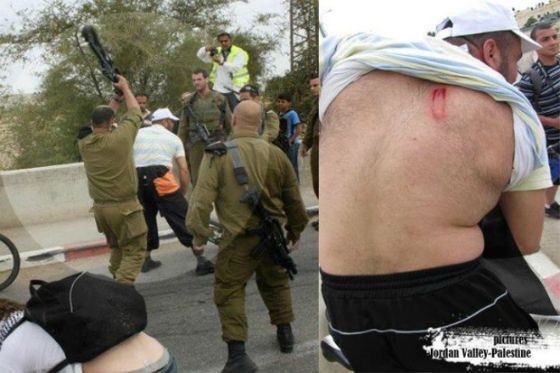
On Saturday, a group of some 250 activists, mostly Palestinian youths from the West Bank, went on a bike ride in the Jordan Valley in a silent protest. At a certain point, several dozens of IDF soldiers stopped the activists, and events quickly escalated into a confrontation. IDF soldiers hit the activists and threw their bikes over a tunnel across the road.

In the video, which was posted by the International Solidarity Movement on YouTube on Sunday, Lt.-Col. Shalom Eisner is seen beating youths who took part in a pro-Palestinian bike ride in the Jordan Valley.

One of the volunteers who organized the bike ride said that the soldiers were waiting for the activists and began clashing with them.

Lt.-Col. Eisner was filmed hitting one of the activists in the face with his M-16.

“We did not expect any harassment on the part of the Israeli soldiers, we just came for fun,” one of activists told Haaretz. “I tried to talk to them, to say that we only want to enjoy the beautiful road and the Jordan Valley in the springtime, but we were unsuccessful. The activists were beaten badly, and the officers just told us we couldn’t be in that area.”

Four activists who sustained wounds on their faces and backs were evacuated to a hospital in Jericho, while three more youths who were beaten refused to receive medical care.

Eisner recounted his version of events, and said that the youth that he beat had hit him beforehand, and even broke two of his fingers. He said that the incident lasted two hours, and that the activists were trying to block a road in the Jordan Valley.

Eisner claimed that he carried out his job after two hours of trying to stop lawbreakers.

Palestinian media reported on Saturday on the events that took place during the bike ride. After the video was posted Sunday and showed testimony of what transpired, GOC Central Command Nitzan Alon ordered the IDF to investigate the matter.

As Israel’s top officials try to portray Eisner’s assault as an aberration, it’s worth noting how the incident was treated on Nablus TV which first aired the footage on Saturday.

The attack was only shown midway through their report. For the Palestinian reporters this was just one more example of Israeli brutality that is far from exceptional.

As painful as it must have been for the young Danish activist to have an M-16 slammed in his face, this particular incident is unfortunately relatively minor in the history of the institutionalized violence which provides the foundation for Israel’s occupation of Palestinian land.

Facebooktwittermail

Unwelcome to Israel — operation barred foreigners for no reason

In the grip of hysteria and a desperate effort to prevent peaceful protesters setting foot in Israel, a no-fly list that was designed to thwart the Welcome to Palestine campaign included a French diplomat and his wife who were coming to find an apartment in Jerusalem, an Italian government official who had been scheduled to meet her Israeli counterparts, and a member of the board of directors of German pharmaceutical giant Merck which is making a significant investment in an Israeli research institute. Several Israelis were also blacklisted.

Haaretz reports: Forty percent of the non-Israeli citizens who were blacklisted and not permitted entry into Israel on Sunday were kept out even though the Shin Bet security service had no concrete information showing they were connected with so-called fly-in protest. This information comes from a high-ranking Israeli source with knowledge of the blacklist, who added that the Shin Bet also had no solid grounds for believing that 470 of the 1,200 people whom Israel labeled as “pro-Palestinian activists” intended to do anything illegal.

“We put people on the list who are as far removed from anti-Israel political activity as east is from west,” one Foreign Ministry official said. “We have insulted hundreds of foreign citizens because of suspicions, and have given the other side a victory on a silver platter.”

“Direct damage has been done to tourism and to Israel’s good name,” the official said.

Organizers said on Sunday that their “Welcome to Palestine” protest, in which hundreds of pro-Palestinian activists were planning to participate in demonstrations in the West Bank, was a success that still advanced the Palestinian narrative even though many of the protesters were forced to stay home.

“It doesn’t matter if eight people came or 800,” said Lubna Masarwa, one of the organizers of the event. “What’s clear is that there is a popular struggle that is gaining momentum and has the international support of thousands of activists. The Palestinians are not alone in their struggle.”

A 23-year-old French woman who made it into Israel to take part in the protest said about half her group of 50 was detained.

“The security forces in France and Israel treated us like criminals,” she said. “It’s very frustrating and surprising that the authorities cooperated with the Israeli claims and propaganda.”

The list of banned passengers was inflated over the weekend in what one Foreign Ministry official called “overexertion.”

“The net was spread too wide, bringing down innocent people,” he said.

That net did not spare holders of diplomatic passports, like a French diplomat and his wife who are due to begin working at the French consulate in Jerusalem this summer. They were planning to look for an apartment in Jerusalem, but the night before their flight they received an e-mail from their airline, Lufthansa, saying their tickets were canceled because they had been banned from entering Israel.

“The Population Registry people told us their flight route was suspicious because they were coming in on a connecting flight from Munich, not direct from Paris,” said a European diplomat who was trying to help the couple get into the country. “Only after we explained that the ticket from Munich was bought because it was cheaper did they take them off the list.”

Lufthansa was one of about 20 airlines, mostly European, that Israel threatened with sanctions if they did not cancel the tickets of the passengers who appeared on the lists Israel sent them. Other airlines that canceled tickets included Air France, Alitalia, Easyjet and Turkish Airlines.

Other passengers who appeared on the blacklist despite having no connection to the protest include an employee of Italy’s Communications Ministry who was supposed to meet with her Israeli counterparts here, and a Dutch member of the board of directors of German pharmaceutical giant Merck, who was part of a company delegation taking part in the dedication of a biotechnology hothouse at the Weizmann Institute of Science, in which Merck is investing 10 million euros.

Both were eventually allowed into the country.

It wasn’t only foreign citizens who were banned from entering Israel, though: An Israeli woman from Kfar Vradim was informed the night before her flight home that she wouldn’t be allowed to board the plane. There were other instances of Israelis being put on the blacklist.

The Shin Bet, which compiled the list along with the intelligence division of the Israel Police, did not respond to a request for comment. For its part, the Population Registry was also involved in keeping out certain passengers, but said it was following the Shin Bet’s orders.

The 730 people on the initial blacklist were all foreign citizens who were banned either because they were determined by Israeli intelligence to be flying in for the express purpose of taking part in the protest, or because they had arrived here for that purpose during a previous fly-in in July.

The 270 people who took part in the previous protest have been banned from entering the country for 10 years.

Police sources said many of the passengers on the list had been arrested for protests in the West Bank, or their names appeared online in connection with pro-Palestinian groups.

Facebooktwittermail

Lt. Col. Shalom Eisner and Israel’s image problem

As Israeli authorities detained the few pro-Palestinian activists on the ‘flytilla’ who got as far as Ben-Gurion International Airport, perhaps they should have claimed they were being prevented from visiting the West Bank for their own safety. Had they been allowed to complete their journey they would have been at risk of encountering thugs like Lt. Col. Shalom Eisner, the deputy commander of the Jordan Valley brigade, seen here slamming his American-made rifle into the face of a young Danish activist on Saturday.

Another image appears to show Eisner striking another activist with his rifle.

Ami Kaufman reports that praise for Eisner is flooding the Israeli social media and that this senior officer is in line for a promotion.

A source who approached me and wishes to remain anonymous at this point has informed me that Lt. Col. Eisner is set to be the next deputy commander of Bahad 1 – the IDF’s training base for all of its officers. This piece of info could not be confirmed.

The IDF spokesperson in response: “We do not discuss IDF appointments in the media until they are signed and sealed. When appointments are confirmed, the media is notified.”

Leading Bahad 1 is considered to be one of the most prestigious jobs in the IDF. Some of its former commanders were Shaul Mofaz, Giora Eyland, Matan Vilnai, Elazar Stern and others who later became high-ranking generals or Chiefs of Staff.

Haaretz reported:

National Union MK Michael Ben Ari issued a response to the incident and congratulated the IDF officer who hit the leftist activists.
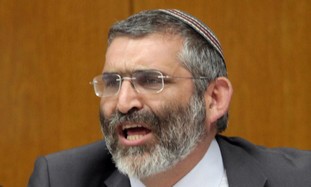
“Well done to the IDF officer who did what Bibi [Benjamin Netanyahu] and [Yitzhak] Aharonovich [minister of internal security] have no brain or courage to do,” Ben Ari said. “Radical leftists must be handled with a heavy hand. There was a tangible threat to the lives of the soldiers and the officer had no other choice.”

Facebooktwittermail

Israel’s Orwellian message on human rights

It would appear that Israel’s borders now extend as far as most of Europe.

This weekend hundreds of people participating in the Welcome to Palestine campaign have been barred from “entering” Israel by being prevented from leaving their own country.

Article 13 of The Universal Declaration of Human Rights says:

Everyone has the right to leave any country, including his own, and to return to his country.

Israel provided airlines with a list of individuals whose right of entry it denies, ordered these airlines to prevent them from boarding their flights and threatened the airlines with sanctions if they failed to comply. So much for the human right of freedom of movement.

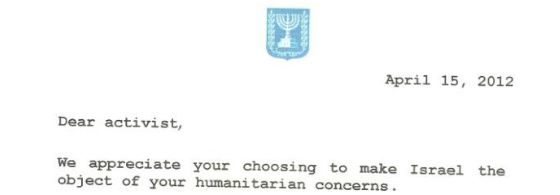
Anticipating that Israeli intelligence might not have been able to identify everyone they are afraid of, the Israeli Prime Minister’s Office prepared a letter to be handed to activists who manage to reach Ben-Gurion International Airport.

The letter looks like it could have been hammered out by Benjamin Netanyahu himself on a manual typewriter as he struggles to protect Israel from its latest existential threat. It’s ironic that a state that craves respect and recognition as a democratic state, expresses itself in the sarcastic language one might expect from a paranoid autocratic ruler.

Unwelcome to Israel letter

The unsigned letter (without corrections) states:

Dear activist,

We appreciate your choosing to make Israel the
object of your humanitarian concerns.

We know there are manyother worthy choices.

You could have chosen to protest theSyrian
regime’s daily savagery against its own people,
which has claimed thousands of lives.

You could have chosen to protest the Iranian
regime’s brutal crackdown on dissent and support
of terrorism throughout the world.

You could have chosen to protest Hamas rule in
Gaza, where terror organizations commit a double
war crime by firing rockets at civilians and
hiding behind civilians.

But instead you chose to protest against Israel,
the Middle East’s sole democracy, where women are
equal, the press criticizes the government, human
rights organizations can operate freely,
religious freedom is protected for all and
minorities do not live in fear.

We therefore suggest that you first solve the
real problems of the region, and then come back
and share with us your experience.

Have a nice flight.

In 2008, Israel’s Ambassador to the UN, Gabriela Shalev, commemorated the 60th anniversary of the Universal Declaration of Human Rights, saying:

Let us reaffirm that each and every state –– regardless of circumstances –– must fulfill its primary responsibility to respect and protect the rights of all individuals, without distinction of any kind. Let us continue to promote the work of non-governmental organizations and human rights defenders who have played a critical role in assessing violations and protection gaps. Let us work towards supporting international mechanisms, such as human rights treaty bodies, international and regional tribunals and courts and the ICC – all of which seek to provide effective tools to ensure adequate redress and respect for human rights.

In an era when we are increasingly interconnected –– in a time when information rapidly flows across oceans and continents –– we must shine the light of the Universal Declaration to the four corners of the globe. We must commit our resources, as well as our collective resolve and determination, to secure human life, dignity and basic rights for all.

For in the end, human rights are not merely legal instruments. They are expressions of our common humanity, our common vision for a better, more just world.

Nice words. It’s a shame they have such little meaning in a state that repeatedly trumpets its claim to be the region’s “sole democracy” yet denies the human rights of almost four million Palestinians living under Israel military rule or control.

Meanwhile, this is how Israelis treat foreign human rights activists if they manage to reach the West Bank:

Just as disturbing as this soldier’s unprovoked use of violence are the comments below the video.

Facebooktwittermail