Max Blumenthal demolishes talking-points about Israel’s ‘liberal democracy’

Joshua Holland writes: Terror wars tend to lead to blow-back on domestic populations. Not only do they come with almost inevitable restrictions of civil liberties, but hard-right political factions also capitalize on the specter of terrorism to gain legitimacy and win power. Israel is no exception – the country’s far-right has gained an enormous amount of influence in recent years, and has used it to enact a series of laws that many on the left call a dire threat to Israeli democracy.

This week, Max Blumenthal – author of Republican Gomorrah: Inside The Movement That Shattered The Party — appeared on the AlterNet Radio Hour to explain what is happening to “the only democracy in the Middle East.” Below is a transcript that has been lightly edited for clarity (you can also listen to the show here).

Joshua Holland: Max, I don’t want to talk about Iran today. I don’t want to talk about the Israeli lobby in the United States, and I don’t want to talk about the Occupation. I want to talk about something I don’t think gets enough attention in this country, which is the sharp rightward turn of the Israeli government.

One of the great non-sequiturs of our political discourse is that Israel is the only democracy in the Middle East. And I say it’s a great non-sequitur because it’s usually used as a response to, for example, criticism of the Occupation. You say this Occupation is terrible, and people say it’s the only democracy in the Middle East.

Anyway, Tzipi Livni, the leader of the opposition Kadima Party, accused Benjamin Netanyahu recently of, “an attempt to transform Israel into a type of dictatorship.” Kadima lawmakers said that recent legislation passed by the Knesset represented, “the gravest challenge to democracy since the establishment of the state in 1948.” Tell me about the sharp rightward lurch. When did this happen, because I remember when I was a kid Israel was almost a socialist country.

Max Blumenthal: Well, by not wanting to talk about Iran you’re an anti-Semite and I condemn that.

JH: Max, I’m a self-loathing Jew — please get this straight.

MB: Part of Netanyahu’s goal in focusing on Iran is taking the Palestinian question off the table, and so it’s good that you’re talking about this. Israel has never been a democracy in the sense that we think about a democracy. It’s a settler, colonial state that privileges the Jewish majority, which it created through violent methods of demographic manipulation over the indigenous Palestinian outclass.

That’s true even inside Israel. So when you hear people like Tzipi Livni — who is for now the head of the Kadima Party but soon to be ousted, and actually came out of the Likud Party and was aide to Arial Sharon – when you hear liberal Zionists, people on the Zionist left, warning that Israel is turning into a fascist state what they’re talking is the occupation laws creeping back over the green line, and that these right-wing elements are actually starting to crack down on the democratic rights that have been afforded to the Jewish master class inside Israel. So Jews who are left-wingers, who are dissidents and speak out against state policy are actually beginning to feel a slight scintilla of the kind of oppression that Palestinians have felt since the foundation of the state of Israel. That’s where this criticism is coming from.

I think we really need to get beyond the discourse of occupation and the discourse of fascism, and instead to talk about institutional discrimination and apartheid, which is what has been present since the foundation of the state of Israel. [Continue reading…]


Facebooktwittermail

The West must get out of Afghanistan this year

Rory Stewart writes: Afghanistan is a tragedy: but it is not one the West can end. For a decade Nato has tried to fix a failed state and defeat the Taliban. This strategy required three things: preventing the Taliban from finding safe haven and supplies in Pakistan, creating an effective Afghan government, and winning the support of the Afghan people.

None of this has worked. The house-to-house shooting of women and children by a US soldier yesterday feels like a terrible, final symbol. But it follows many dramatic public examples of failure. There was the anger after the burning of the Korans two weeks ago. There was the discovery, last year, that Bin Laden had been living next to a Pakistan military academy. There was President Karzai’s statement last week supporting conservative social codes, targeted at women — on International Women’s Day.

Did our mission go wrong because Nato had too few troops; or because it sent too many? Could a different strategy have fixed the situation; or was it always impossible? The reason no longer matters. Whatever the explanation, things will not improve: Nato will not “solve the relationship with Pakistan”; it will never create “an effective, credible, legitimate Afghan government”; and in most parts of the country it has already lost “the hearts and minds” of the Afghan people.

The New York Times reports: Displaced by the war, Abdul Samad finally moved his large family back home to this volatile district of southern Afghanistan last year. He feared the Taliban, but his new house was nestled near an American military base, where he considered himself safe.

But when Mr. Samad, 60, walked into his mud-walled dwelling here on Sunday morning and found 11 of his relatives sprawled in all directions, shot in the head, stabbed and burned, he learned the culprit was not a Taliban insurgent. The shooting suspect was a 38-year-old United States staff sergeant who had slipped out of the base to kill.

The American soldier is accused of killing 16 people in all in a bloody rampage that has further tarnished Afghan-American relations and devastated Mr. Samad, a respected village elder whose tired eyes poured forth tears one minute and glared ahead in anger the next.

Once a believer in the offensive against the Taliban, he is now insistent that the Americans get out. “I don’t know why they killed them,” said Mr. Samad, a short, feeble man with a white beard and white turban, as he struggled in an interview to come to terms with the loss of his wife, four daughters between the ages of 2 and 6, four sons between 8 and 12, and two other relatives.

“Our government told us to come back to the village, and then they let the Americans kill us,” Mr. Samad said outside the military base, known as Camp Belambay, with outraged villagers who came to support him.

The New York Times also reports: The Obama administration is discussing whether to reduce American forces in Afghanistan by at least an additional 20,000 troops by 2013, reflecting a growing belief within the White House that the mission there has now reached the point of diminishing returns.

Accelerating the withdrawal of United States forces has been under consideration for weeks by senior White House officials, but those discussions are now taking place in the context of two major setbacks to American efforts in Afghanistan — the killings on Sunday of Afghan civilians attributed to a United States Army staff sergeant and the violence touched off by burning of Korans last month by American troops.

Administration officials cautioned on Monday that no decisions on additional troop cuts have been made, and in a radio interview President Obama reaffirmed his commitment to the Afghan mission in spite of the recent setbacks, warning against “a rush for the exits” amid questions about the American war strategy. “It’s important for us to make sure that we get out in a responsible way, so that we don’t end up having to go back in,” Mr. Obama said in an interview with KDKA in Pittsburgh.

Any accelerated withdrawal would face stiff opposition from military commanders, who want to keep the bulk of the remaining American troops in Afghanistan until the end of 2014, when the NATO mission in Afghanistan is supposed to end. Their resistance puts Mr. Obama in a quandary, as he balances how to hasten what is increasingly becoming a messy withdrawal while still painting a portrait of success for NATO allies and the American people.

Facebooktwittermail

A better understanding of Iran might save us from catastrophe

In a debate which has been dominated by Israel’s security concerns, Peter Beaumont poses a question that too few analysts ask: What does Iran really want?

Writing in 2009, Kayhan Barzegar, an expert on Iran who has taught both in Tehran and in the US, described what he called the “paradox of Iran’s nuclear consensus“. He was attempting to lay bare the complex and competing historical, political and strategic considerations behind the theocratic regime’s nuclear decision-making processes.

Referencing two centuries of internal criticism of Iran’s failure “to acquire substantial power, influence and wealth”, Barzegar cites more recent history that has persuaded many Iranians, not least in the country’s elites, that the west, and Britain and America in particular, have long conspired to throw obstacles in the way of Iran’s development both economically and as a major regional player.

From an Iranian point of view, there is ample evidence of this: from the overthrow of Mohammed Mossadegh’s government in a CIA and MI6-led coup in 1953, after he nationalised the Anglo-Iranian Oil Company, to western resistance to the shah’s Esfahan steel manufacturing project to President Clinton’s killing off a $1bn deal for the US energy company Conoco to develop offshore oil fields. It is a suspicion that has been amplified by the country’s post-Islamic revolution politics.

Indeed, one of the bleakest of historical ironies is that the early revolution under Ayatollah Khomeini actually halted the western-supported civil nuclear programme in place under the shah and it was only persuaded that it needed to acquire nuclear weapons technology because of Iran’s massive losses in the war with Iraq, then supported by the US, which saw Iran targeted with chemical weapons.

Facebooktwittermail

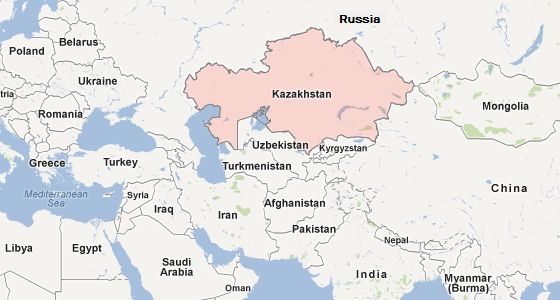
The Kazakhstan massacre: Killing hope to benefit U.S. geopolitical interests

Steve Horn and Allen Ruff report: December 16, 2011, should have been, at minimum, a fairly bright day for the people of Kazakhstan marking the country's Independence Day and 20th birthday.

But rather than being a moment of celebration, it became a day of brutal repression and death, a bloody scene in the regional center of Zhanaozen paralleling those that occurred at the hands of US-supported dictatorial regimes during the uprisings now commonly referred to as the Arab Spring.

The victims of the state's crackdown were striking oil workers protesting subsistence wages and poor working conditions in the city of 51,000 citizens 75 miles east of the Caspian Sea.

Kazakhstan's state media reported police shot and killed ten workers, wounding more than 80 strikers. Independent journalist Mark Ames translated an account of a Russian reporter who estimated approximately 70 dead, with 500 to 800 wounded. Scores more were jailed, likely the victims of beatings and torture.

Following the shootings and arrests, Zhanaozen, home to the state-owned oil company, KazMunaiGas (KMG), was placed under a state of emergency. Authorities cut off Internet and communications access nationwide and the city was inundated with additional thousands of police. KMG has ongoing business ownership partnerships with the US-based multinational energy giants Chevron and ExxonMobil, which hold significant concessions in the country.

EurasiaNet's Joshua Kucera reported the attacks on the strikers were carried out by police armed with US-supplied weaponry. Some of the 114 Humvees given to Kazkahstan since 2002 as part of the US-funded  Kazakhstan Peacekeeping Brigade (KAZBRIG) were filmed on the streets during the height of the repression.

That same cold, dark December day at Aktau, 75 miles to the west, police cracked down on rallies held in solidarity with the Zhanaozen workers. Human Rights Watch documented that, "police detained about 100 protesters and took them to a temporary detention center … Workers in Aktau reported heavy police surveillance at the protest, which was held in front of the regional mayor's office."

Human Rights Watch responded to the abuse of civil liberties by calling for an investigation into the use of state violence and called for the restoration of telecommunications services.

The repression was conducted by a police apparatus built up under the dictatorial reign of President Nursultan Nazarbayev, the country's leader and "winner" of fixed election after election since the Central Asian Republic became independent following the break-up of the Soviet Union in 1991.

Later, parliamentary elections took place on January 15, with Nazarbayev initially barring those living in Zhanaozen from participating. He later revoked that decision, but that didn't matter, since the elections are consistently rigged to begin with under what is essentially a one-party state.

The December repression of oil workers, and the political situation at large in Kazakhstan, call for a deeper examination into the geopolitical situation of a country located at the heart of what has long been referred to as the historic Silk Road trade route and what investigative journalist Pepe Escobar refers to as Pipelineistan.

Four times the size of Texas and larger than western Europe, a massive country of over 16 million at the heart of Central Asia, resource-rich Kazakhstan has increasingly become a vital centerpiece of US strategic interest, "soft power" and "hard power" regional influence.

The country has become case study for US deployment of the so-called "three D's": diplomacy, development and defense – as part of the broader ongoing long-war effort delineated in the Pentagon's April 2011 National Strategic Narrative and elsewhere. [Continue reading…]

Facebooktwittermail

Washington’s high-powered terrorist supporters

Glenn Greenwald writes: We now have an extraordinary situation that reveals the impunity with which political elites commit the most egregious crimes, as well as the special privileges to which they explicitly believe they — and they alone — are entitled. That a large bipartisan cast of Washington officials got caught being paid substantial sums of money by an Iranian dissident group that is legally designated by the U.S. Government as a Terrorist organization, and then meeting with and advocating on behalf of that Terrorist group, is very significant for several reasons. New developments over the last week make it all the more telling. Just behold the truly amazing set of facts that have arisen:

In June, 2010, the U.S. Supreme Court issued its 6-3 ruling in the case of Holder v. Humanitarian Law. In that case, the Court upheld the Obama DOJ’s very broad interpretation of the statute that criminalizes the providing of “material support” to groups formally designated by the State Department as Terrorist organizations. The five-judge conservative bloc (along with Justice Stevens) held that pure political speech could be permissibly criminalized as “material support for Terrorism” consistent with the First Amendment if the “advocacy [is] performed in coordination with, or at the direction of, a foreign terrorist organization” (emphasis added). In other words, pure political advocacy in support of a designated Terrorist group could be prosecuted as a felony — punishable with 15 years in prison — if the advocacy is coordinated with that group.

This ruling was one of the most severe erosions of free speech rights in decades because, as Justice Breyer (joined by Ginsberg and Sotomayor) pointed out in dissent, “all the activities” at issue, which the DOJ’s interpretation would criminalize, “involve the communication and advocacy of political ideas and lawful means of achieving political ends.” The dissent added that the DOJ’s broad interpretation of the statute “gravely and without adequate justification injure[s] interests of the kind the First Amendment protects.” As Georgetown Law Professor David Cole, who represented the plaintiffs, explained, this was literally “the first time ever” that “the Supreme Court has ruled that the First Amendment permits the criminalization of pure speech advocating lawful, nonviolent activity.” Thus, “the court rule[d] that speech advocating only lawful, nonviolent activity can be made a crime, and that any coordination with a blacklisted group can land a citizen in prison for 15 years.” Then-Solicitor-General Elena Kagan argued the winning Obama DOJ position before the Court.

Whatever one’s views are on this ruling, it is now binding law. To advocate on behalf of a designated Terrorist group constitutes the felony of “providing material support” if that advocacy is coordinated with the group. [Continue reading…]

Facebooktwittermail

Syria: 47 women and children dead in massacre, opposition claim

The Telegraph reports: Syria’s opposition has accused security forces of killing 47 women and children in Homs and urged the UN Security Council to hold an emergency meeting to discuss the killings.

Hadi Abdallah, a Syrian activist in the besieged central city, said the bodies of 26 children and 21 women, some with their throats slit and others bearing stab wounds, were found in the Karm el-Zaytoun and Al-Adawiyeh neighbourhoods.

“Some of the children had been hit with blunt objects on their head, one little girl was mutilated and some women were raped before being killed,” he said.

The main opposition group, the Syrian National Council (SNC), called for an emergency UN Security Council meeting to discuss the “massacre”, which it said took place on Sunday.

“The Syrian National Council is making the necessary contacts with all organisations and countries that are friends with the Syrian people for the UN Security Council to hold an emergency meeting,” the SNC said in a statement.

And in a clear reference to Russia and China, the SNC said that allies of Syria’s President Bashar al-Assad shared responsibility for the “crimes” committed by his regime.

State television blamed “armed terrorist gangs” for the killings, saying they had kidnapped residents of Homs, killed them and then made video footage of the bodies in an attempt to discredit Syrian forces.

News of the killings came after UN-Arab League peace envoy Kofi Annan left Damascus on Sunday without managing to secure an accord to end bloodletting monitors say has claimed more than 8,500 lives since March last year.

Annan departed at the end of a two-day mission during which he said he presented Assad with “concrete proposals” to halt the unrest that has rocked Syria since pro-democracy protesters rose up against his regime on March 15, 2011.

On the ground, more than 150 people – 61 of them civilians caught in the crossfire – were killed weekend clashes between armed rebels and regular soldiers in various flashpoint areas, according to figures of rights monitors.

Facebooktwittermail

A major defection from Syria?

AFP reports: Syrian regime stalwart and former defence minister Mustafa Tlass has arrived in Paris with one of his sons but they are not defecting, opposition representatives told AFP on Monday.

Tlass arrived in France from Syria with his businessman son Firas, the Paris-based opponents said. His other son Manaf, an officer in the Syrian regime’s military, is believed still to be in Damascus.

Mohamad al-Rashdan, member of the National Committee for Support of the Syrian Revolution, told AFP: “He has been in France for five days after having an argument with Assef Shawkat, President Bashar al-Assad’s brother-in-law.”

Shawkat is the current deputy defence minister and husband of President Assad’s sister Bushra.

A source close to the Syrian community in exile told AFP: “Tlass and his son Firas arrived in Paris yesterday (Sunday). I don’t think this is a defection. He will be here awhile, but it is with the regime’s authorisation.”

Other Syrian regime opponents confirmed Tlass’s presence in France but denied reports that he was about to announce his defection or that he was meeting with opposition members.

A Sunni Muslim, Tlass was Syrian defence minister from 1972 to 2004, having befriended Bashar’s father and predecessor as Syrian president, Hafez, at military academy.

Joshua Landis quotes an anonymous source saying:

Word in Lebanon is that Mustafa Tlass was trying to recruit people here to overthrow Bashar, and the regime found out about it. They let him and his one son leave, to France, but the other son is in the Army and they are basically keeping him as a hostage to prevent Tlass from joining the rebels.

Landis also posts a letter from one of his readers who recently visited Latakia, Syria’s principal port city.

I am a christian Syrian living abroad. Last month I went back to Syria and spent a week with my parents in Lattakia. Here are some observations.

The son of my 2nd grade teacher is in prison. He was caught distributing pro opposition fliers. A few days ago, his flat burned down and his 3 kids died in the fire. His wife is in a critical condition.

A relative of my family lawyer, a university student was arrested couple weeks ago in Damascus. She was released the day I arrived.

Another guy from our neighborhood, though known to be pro regime, was picked up by the secret police at the university as he was leaving his mid term exam room. He disappeared for 2 weeks. He was just released…. Some name miss match they explained.

I was stopped at the airport. Was called to Damascus for questioning by an officer in one of the security branches. Without my father’s connections I am sure I would ve not been able to get the travel permission and to leave on time. I still don’t know what they wanted from me.

We hear stories about kidnappings taking place in the eastern part of the country near Deir Ezzor, in Homs and on the outskirts of Damascus in exchange of ransom.

Lattakia is one of the cities the least affected by the events. It’s kept under tight control by a strong pro regime presence. The government is doing all it can to show that it’s business as usual. They do amazing cleaning job after each Friday clashes. As I hang out with some friends at a coffee shop in the afternoon, life seems to go on as usual in the busy streets… but something weird is felt in the air… a thick layer of pessimism and anxiety is hanging over the city… everybody feels that it is boiling and it might explode at any moment. You can’t miss the signs:

My high school has become an army base. The main city square, less than 1000 yards from my parents flat and a center of protests in the early days, is now filled with soldiers and sand bags. “Al Assad soldiers” they proudly painted on the walls.

My friends drove me by the Ramel neighborhood. One of the hot areas in town. Army check points with sand bags control all streets entering the neighborhood. “POLICE” is painted on them. We all know it is the army who controls them and not the police.

Gunmen in civilian clothing are present at all hospital entrances. They are there to arrest wounded protesters seeking treatment.

4×4 trucks with armed men and mounted machine guns pass by every now and then.

Electricity is cut off 6 hours a day, 3 in the morning and 3 in the afternoon. It is setting the rhythm for business hours. – Today Electricity is off 12 hours a day. it’s on and off every 3 hours.

The price for heating fuel has sky rocketed. The price for cooking gas has doubled. It s cold in my parents and my friends flats. It’s been one of the coldest and rainiest winters in Syria. People wear many layers indoors and sleep with thick wool covers- these are still the privileged neighborhoods. I can’t imagine the living conditions in rebelled areas.

I have just come back from a week stay in Syria. I left as the bombing of Homs was about to begin.

Facebooktwittermail

A deal with the Taliban is the only way out

Ahmed Rashid writes: The Afghan people are exhausted by a war that has gone on in one form or other since 1979, when most US soldiers now in Afghanistan were not even born. Increasing numbers of Afghans would agree with what the Taliban have been arguing for almost a decade: that the western presence in Afghanistan is prolonging the war, causing misery and bloodshed. The hundreds of civilians killed already this year across the country are almost forgotten now in the aftermath of the killing of children by a farengi, or foreigner.

Moreover, faced with an increasingly corrupt and incompetent government, Afghans are seeing fewer improvements on the ground. So-called “nation building” has ground to a halt, simple justice and rule of law is unobtainable and a third of the population is suffering from malnutrition. The people blame not just the Americans but equally Hamid Karzai and his inner circle, which gives him conflicting and contradictory advice, leading him to flip and flop on policy issues.

The Afghan president’s desire to seek a strategic partnership agreement with the US is becoming more and more unacceptable to the Afghan people. At the same time he also wants to make peace with the Taliban, but they have no desire for a pact with Washington. His dilemma, which he still refuses to understand, is that he can either ask for a long-term US presence or peace with the Taliban, but not both.

Facebooktwittermail

Report says soldier conducted massacre during two trips out of base

According to an Afghan guard at the base who spoke to the BBC, the soldier who conducted a massacre outside Kandahar last night, left his base twice, returning for an hour and a half after the first stage in his killing spree only to head out again for another two hours.

An official told ABC News that the soldier has suffered a mild traumatic brain injury (TBI) in the past, either from hitting his head on the hatch of a vehicle or in a car accident. He went through the advanced TBI treatment at Fort Lewis and was deemed to be fine.

He also underwent mental health screening necessary to become a sniper and passed in 2008. He had routine behavioral health screening after that and was cleared, the official said.

When the soldier returned from his last deployment in Iraq he had difficulty reintegrating, including marital problems, the source told ABC News. But officials concluded that he had worked through those issues before deploying to Afghanistan.

The shooting occurred at 3 a.m. in three houses in two villages in the Panjway district of southern Kandahar province, an area that was once a Taliban safe haven but has recently become more safe after a surge of troops in 2009.

The soldier left the base in the middle of the night and wore night-vision goggles during the alleged rampage, according to a source.

The first village was more than a mile south of the base. While there, he allegedly killed four people in the first house. In the second house, he allegedly killed 11 family members — four girls, four boys and three adults.

He then walked back to another village past his base where he allegedly killed one more person, according to a member of the Afghan investigation team and ABC News’ interviews with villagers.

BBC News reports: Initial reports said that the soldier simply walked to the villages, which were located about 500 (546 yds) from the military base in Panjwai district.

But local journalists say that the villages of Najeeban and Alkozai are about 5-7km (3-4 miles) apart. This immediately raises questions about accounts which said he completed his deadly circuit on foot.

An Afghan guard at the Nato base told the BBC that the soldier left the base twice. He returned at 00:30 local time (20:00 GMT) after the first trip out and was out between 02:00 and 04:00 for the second trip.

Facebooktwittermail

Kandahar massacre may be turning point in Afghan war

David Axe reports: At 3:00 in the morning on Sunday a 38-year-old U.S. Army staff sergeant reportedly sneaked out of a coalition outpost in the Panjwai district of Afghanistan’s Kandahar province, walked at least 500 yards to a cluster of home compounds known as khalats and began forcing open doors. Moving from khalat to khalat, the sergeant allegedly shot and killed at least 16 Afghan civilians, including nine children.

He covered some of the bodies with rugs, lit them on fire then strolled back towards the outpost. An American patrol, alerted by Afghan troops that had witnessed the alleged killer’s departure, intercepted the shooter and took him into custody. But the fallout from the Sunday killings could be greatest in the villages that are most vital to NATO’s endgame strategy.

The alleged killer, reportedly a veteran of three Iraq tours who deployed to Afghanistan for the first time in December, is now in military custody. His brutal crime, as yet unexplained, has stoked the political firestorm sparked when a U.S. officer accidentally sent several Muslim holy texts to a burn pit outside a U.S.-run prison two weeks ago. Rioting and shootings in the aftermath of the Koran burnings claimed the lives of scores of Afghans and six U.S. troops.

On Sunday, The New York Times reported hundreds of angry Afghans Afghan gathering outside the Panjwai outpost as Afghan President Hamid Karzai called the killings “inhuman” and “unforgivable.” More riots are likely as news of the murders spreads. “They really want justice,” Prince Ali Seraj, head of the National Coalition for Dialogue with the Tribes of Afghanistan, said of Afghans. The Taliban has vowed revenge.

The Army, the Pentagon, the NATO International Security Assistance Force and U.S. President Barack Obama all denounced Sunday’s killings and vowing to investigate. But the official apologies may be too late to save the decade-long NATO-Afghanistan alliance, already damaged by the Koran burnings, the 2010 “sport hunting” of Afghan civilians by rogue U.S. troops (reportedly from the same base as the alleged Panjwai killer), errant NATO air strikes that have killed thousands of innocent Afghans over the years plus countless minor acts of cultural cluelessness that have slowly poisoned relations between Afghans and their supposed foreign allies.

Disturbingly, it seems the alleged killer, though apparently not a Special Forces soldier himself, was working alongside U.S. commandos as they worked to establish ties with Panjwai’s elders. Special Forces are selected in part for their language skills and cultural sensitivity. During our February visit to a Special Forces “A Team” in Laghman province, east of Kabul, the commandos described many of the ways coalition troops purposefully or accidentally offend their Afghan counterparts.

AFP reports on a statement issued by the Taliban: “A large number from amongst the victims are innocent children, women and the elderly, martyred by the American barbarians who mercilessly robbed them of their precious lives and drenched their hands with their innocent blood,” the Taliban said.

“The American ‘terrorists’ want to come up with an excuse for the perpetrator of this inhumane crime by claiming that this immoral culprit was mentally ill.

“If the perpetrators of this massacre were in fact mentally ill then this testifies to yet another moral transgression by the American military because they are arming lunatics in Afghanistan who turn their weapons against the defenceless Afghans without giving a second thought.”

Facebooktwittermail

Video: Former Mossad chief Meir Dagan on Iran’s threat

Before this interview aired, the snippets that were being used to promote it focused on two points: that Dagan was attempting to slow down Netanyahu’s rush to war and that he recognizes the Iranians as rational actors.

It turns out he has a much more mixed message. Dagan’s is like Gingrich’s “anti-war” message: there’s not much point bombing nuclear facilities when the real goal should be regime change.

As for Iranians being rational actors, Dagan says “maybe not exactly rational based on what I call Western thinking,” and that “they invented what I call the bazaar culture of negotiations.”

In response to the question, why can’t Israel and the world live with a nuclear Iran if they are rational, Dagan’s answer is because Iran is bent on Israel’s destruction. Predictably, Lesley Stahl fails to ask the utterly obvious follow-up question: how could a nuclear-armed Iran risk its own destruction by attacking a much more heavily armed Israel?

Worst of all, Dagan alludes — with a grin — to Israeli support for Iran’s pro-democracy movement. This is plain stupid. What better way is there to undermine the movement than to hint that it’s getting Israeli support.

On balance, I’d say it might have been better if Dagan had maintained Mossad’s code of silence.

Facebooktwittermail

10 myths about Iran — and why they’re dead wrong

Jasmin Ramsey writes: As media reports continue to imply that a military confrontation with Iran is closer than ever, rhetoric demonizing the Iranian government is rampant, particularly among Israeli leaders and most Republican presidential candidates — so much so that former Israeli Mossad director Efraim Halevy recently complained that Mitt Romney is “making the [Iran] situation worse” with his statements.

So it should come as no surprise that according to a 2012 Gallup poll, Iran is Americans’ “least favored nation” and has consistently ranked unfavorably since 1989. Gallup is not specific about why an overwhelming majority of respondents have such a low “overall opinion” of the Islamic Republic, but they suggest that “heavy scrutiny and criticism from the West over its nuclear programs” sheds light on American reasoning. Alarmist notions about Iran’s foreign and nuclear policy that spread through the media perpetuate a negative image that is oftentimes inaccurate–and help pave the path to war, which experts say would have disastrous consequences for Israel, the broader Middle East and the U.S.

AlterNet decided to look at 10 myths about Iran, many of them created by these alarmist notions—and explain why they’re dead wrong.

1. Iran does not have a nuclear weapon.

According to the Iranian government, the International Atomic Energy Agency and American intelligence assessments, the common assumption that Iran already has a nuclear bomb is wrong. Even Israeli intelligence agrees.

Yet 71 percent of Americans said “Yes” to the question, “Do you think Iran currently has nuclear weapons, or not?” in the last poll to ask that question. The question was asked a little over two years ago and public opinion could have become more accurately informed. Then again, when widely read newspapers like the Wall Street Journal publish weekly pieces suggesting that “evil” Iran is “building a nuclear bomb” (while justifying terrorism against Iranian citizens), and when Republican presidential contenders like Mitt Romney write that Iranian “Islamic fanatics” are “racing to build a nuclear bomb,” the truth can understandably become muddied for the average person. [Continue reading…]

Facebooktwittermail

Escalation is good for Israel

Zvi Bar’el writes: Advocates of a strike on Iran couldn’t have hoped for a more convincing performance than the current exchange of fire between Israel and Gaza. “A million Israelis under fire” is only a taste of what is expected when Iran’s nuclear project is completed. When that happens, seven million Israelis will be under the threat of fire and nuclear fallout.

This is what happens when “only” the Islamic Jihad fires Grad rockets, when Hamas stays out of the fight, and when the “miraculous system” that prevents missiles from falling on kindergartens still works. Under the threat of a nuclear Iran, miracles won’t help, and people in Tel Aviv will also be forced to hide in bomb shelters or escape to Eilat.

Here’s the proof: There is no alternative to striking Iran and there is no better time than the present, when the weather permits and world diplomacy is preoccupied with Syria. For Israelis, there is no better proof that no harm will come to them as a result of an attack on Iran than the performance of the Iron Dome anti-rocket system, which has demonstrated a 95% rate of effectiveness. The escalation in Gaza is good for Israel – that is, for that part of Israel that wants to strike Iran.

It is hard to understand what basis there is for the assertion that Israel is not striving to escalate the situation. One could assume that an armed response by the Popular Resistance Committees or Islamic Jihad to Israel’s targeted assassination was taken into account. But did anyone weigh the possibility that the violent reaction could lead to a greater number of Israeli casualties than any terrorist attack that Zuhair al-Qaisi, the secretary-general of the Popular Resistance Committees, could have carried out?

In the absence of a clear answer to that question, one may assume that those who decided to assassinate al-Qaisi once again relied on the “measured response” strategy, in which an Israeli strike draws a reaction, which draws an Israeli counter-reaction. Everything is proportionate, and Israel controls the height of the flames, while proclaiming that “Israel does not seek to escalate the situation.”

Is that so?

And what IDF Chief of Staff Benny Gantz’s statement a few weeks ago that there will be no alternative to a large-scale operation in Gaza? And what if the Islamic Jihad does not adopt the Israeli strategy and stop firing? Will Gantz’s threat finally materialize, catapulting Israel into a “Cast Lead Two” scenario?

Unlike Israel, Hamas has an understandable interest in putting an end to the escalation, which caught it off guard. The organization is mired in an internal political struggle. After fleeing Syria, its leadership is looking for a new home. The dialogue with Fatah has yet to produce an agreement on a unity government, and its ideological side must deal with the willingness of the Muslim Brotherhood, its ideological umbrella organization, to carry on a dialogue with the U.S. and respect the peace agreement between Egypt and Israel.

Hamas, while it does not fully control the activities of all of the organizations in Gaza, has managed to secure important agreements with most of them, including the Islamic Jihad, which has joined the effort to reconcile with Fatah. Hamas is also dependant on Egypt regarding the passage of civilians through the Rafah Crossing and merchandise through the network of tunnels between the two territories, as well as for the fuel that enables it to provide Gazans with electricity. Even if its leadership was still located in Damascus, Hamas cannot disconnect itself from Egypt and remains shackled to its foreign policy toward Israel.

This dependence on Egypt has managed in the past to produce extended ceasefires which have proven themselves in recent months, especially after the signing of the reconciliation agreement with Fatah, which produced Khaled Meshal’s declarations that Hamas would restrict itself to nonviolent forms of struggle against Israel.

However, it seems that the change in Hamas not only hasn’t convinced Israel, but even stands in the way of its “no partner” policy and could sabotage its efforts to head off the creation of a Palestinian unity government, which would lead to renewed efforts at the UN to secure an independent Palestinian state.

Thus, Hamas must be dragged toward military activity against Israel, and nothing is easier, at least in Israel’s estimation, than to launch a “unilateral” attack against a wanted non-Hamas man, to wait for the response to come, and hope that Hamas joins in.

So far, it hasn’t happened. Hamas still prefers the diplomatic channel and has carried on intensive diplomatic contacts over the past two days with Egypt’s Supreme Military Council. Israel apparently needs to wait for another opportunity. Meanwhile, however, it has already managed to turn the attention of Arab diplomacy away from Syria and toward the Israeli-Palestinian issue.

Assad must be pleased.

Facebooktwittermail

What if the “broken windows” theory were applied to Wall Street?

Bill Black writes: James Q. Wilson, who died recently, was a political scientist who often studied the government response to blue collar crime. The public knows him best for his theory called “broken windows.” The metaphor explains what happens to a vacant building when broken windows are not promptly repaired. Soon, most of the windows in the abandoned building are broken. The criminals feel little compunction against petty destruction because the building’s owners evince no concern for the integrity of their building. Wilson took social norms, community, and ethics seriously. He argued that as community broke down, fewer honest citizens were active in monitoring and policing behavior. The breakdown in community led to widespread serious blue collar crime. Wilson urged us to take even minor blue collar crimes and breaches of civility seriously and to demand that they be contained through social pressure and policing.

New York City’s police strategy embraced “broken windows,” making it a priority to respond to even minor offenses that upset the community – like “squeegee men,” graffiti, and street prostitution. Reported blue collar crime fell. It also fell sharply in most other cities, which did not implement “broken windows” programs, but Wilson and the NYPD got the credit and popular fame. Wilson became one of the most famous blue collar criminologists in the world.

Wilson’s broken window theory remains controversial among many blue collar criminologists. As a celebration of his life and research, I offer this discussion of applying “broken windows” theory and policies to elite white-collar crime.

Wilson was strongly conservative, and his research focus in criminology was almost exclusively blue collar crime. That was a shame, because “broken windows” theory is most compelling in the context of elite white-collar crime. Such an application, however, would have been outside Wilson’s comfort zone. Wilson tended to use the word “crime” to refer exclusively to blue collar crime and his emphasis was on very low status criminals. In Thinking About Crime, Wilson argued that criminology should focus overwhelmingly on low-status blue collar criminals.

“This book [does not deal] with “white collar crimes”…. Partly this reflects the limits of my own knowledge, but it also reflects my conviction, which I believe is the conviction of most citizens, that predatory street crime is a far more serious matter than consumer fraud [or] antitrust violations … because predatory crime … makes difficult or impossible maintenance of meaningful human communities (1975: xx).

I am rather tolerant of some forms of civic corruption (if a good mayor can stay in office and govern effectively only by making a few deals with highway contractors and insurance agents, I do not get overly alarmed)….” (1975: xix)”

Notice that Wilson’s explanation is antithetical to his “broken windows” reasoning. There are, of course, relatively minor white-collar crimes. Wilson emphasized that it was the willingness of society to tolerate relatively minor blue collar crimes that led to social disintegration and epidemics of severe blue collar crimes, but he engaged in the same willingness to tolerate and excuse less severe white collar crimes. He predicted in his work on “broken windows” that tolerating widespread smaller crimes would lead to epidemic levels of larger crimes because it undermined community and social restraints. The epidemics of elite white collar crime that have driven our recurrent, intensifying financial crises have proven this point. Similarly, corruption that is excused and tolerated by elites is unlikely to remain at the level of “a few deals.” Corruption is likely to spread in incidence and severity precisely because it undermines community and the rule of law. It is likely to grow more pervasive and harmful the more we tolerate it.

“Broken windows” theory, in the white collar crime context, would lead us to make the prevention and deterrence of consumer frauds and anti-trust violations through prosecutions a high priority because of their tendency to produce a “Gresham’s” dynamic in which businesses or CEOs that cheat gain a competitive advantage and bad ethics drives good ethics out of the markets. These offenses degrade ethics and erode peer restraints on misconduct. [Continue reading…]

Facebooktwittermail

Why attack Gaza now?

Israel’s latest assault on Gaza began with a missile strike killing the secretary general of the Popular Resistance Committees, Zuhair Qaisi. His assassination was justified on the grounds that it “foiled a major terror attack,” the Jerusalem Post claimed. [My emphasis]

Yet the same report went on to say: “The IDF decided on Friday to close Route 12 – which runs along the border with Egypt – due to fears that the planned attack might still take place.” [My emphasis.]

The Post also reported:

Assessments ahead of the decision to bomb the car carrying Zuhair Qaisi predicted that around 100 rockets could be fired into Israel during each day of the round of violence expected to erupt. This was a price the government felt it was capable of paying.

Setting aside the question of whether the price of the attack is being paid by the Israeli government, the residents of Southern Israel or those in Gaza, 100 rockets a day might have been less of a price and more of a reward.

How so?

Even while ratcheting up the threat of war on Iran, the Israeli government has been cutting spending on domestic defense. It doesn’t want to spend more on Iron Dome anti-missile batteries which would be its primary defense from missiles being fired by Hezbollah from Southern Lebanon in the event that they launched attacks in response to an Israeli strike on Iran’s nuclear facilities.

During the 2006 Lebanon war, about 900 rockets hit urban areas in Northern Israel. That averaged about 27 a day.

The Post reports on the current round of rocket attacks:

The three Iron Dome batteries deployed in Ashdod, Ashkelon and Beersheba succeeded in interpreting [sic] 27 rockets fired from Gaza out of 30 that they tried to shoot down, marking a record-high interception rate of 90 percent.

So was this the point of the exercise? Assassinate a militant leader in order to trigger a significant reprisal with rocket attacks in order to then test the Iron Dome batteries in battlefield conditions?

Hamas is committed to a political track that makes them very reluctant to get dragged into another war and they have also ruled out offering military support for Iran in any war with Israel. Israel probably calculated that the risks of escalation beyond a few days of rocket attacks were fairly low.

So as for who actually pays the price for Israel’s Iron Dome test exercise, more than anyone else it ends up being the residents of Gaza — the people that Israel treats as its laboratory animals for testing its war machine.

Facebooktwittermail